
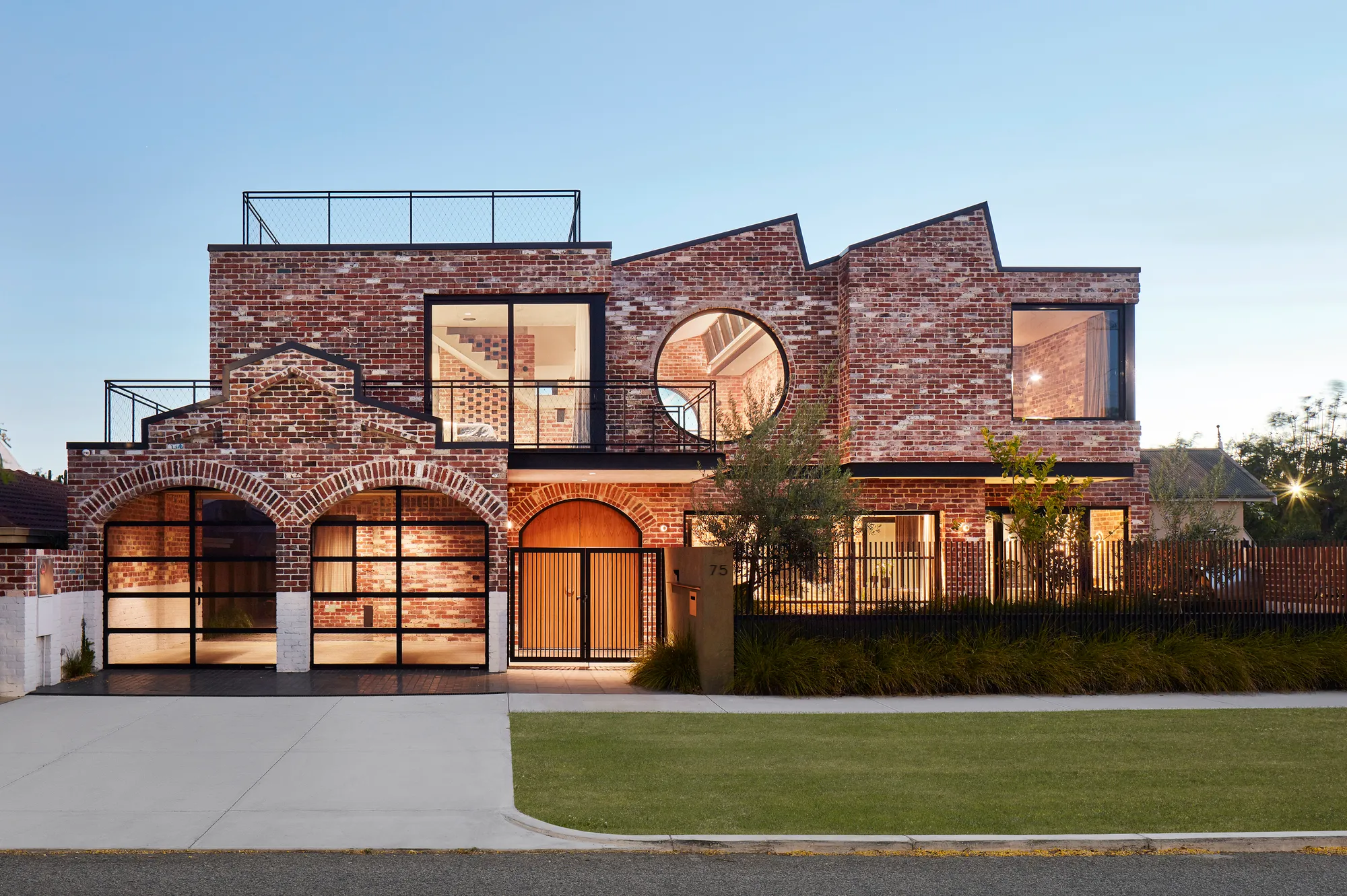
State of Kin Builds a House from Its Neighbors' Demolished Bricks in Mount Lawley
A compact inner-city home in Perth reclaims local red brick to channel the suburb's industrial past through exaggerated arches and saw-tooth roofs.


Mount Lawley is a leafy inner suburb of Perth defined by Federation-era homes and a red-brick streetscape that has been slowly thinning as older character houses are demolished to make way for infill. State of Kin saw that process not as loss but as raw material. For Brick House, the studio sourced reclaimed red bricks from demolished local homes, some still bearing layers of beige, blue, and green paint from their previous lives, and reassembled them into a 323 square meter residence that reads as both tribute and provocation.
What makes the project genuinely compelling is the refusal to treat salvaged material as a sentimental gesture. State of Kin pushes the bricks through a full catalogue of techniques: herringbone vaulting, jali-style hit-and-miss screens, exaggerated arches scaled well beyond domestic convention, and load-bearing walls that do real structural work. Paired with saw-tooth roof profiles borrowed from the area's old factory buildings, the house is less a nostalgic homage than a contemporary argument about what local identity actually means when the neighborhood is in flux.
A Facade That Belongs and Doesn't


From the street, Brick House registers immediately as part of Mount Lawley's red-brick vernacular, then quickly unsettles that reading. The arched openings are oversized, almost ceremonial, framing garage doors and a large circular window that glows warmly at dusk. The proportions borrow from the language of the suburb's 20th century character homes but exaggerate them past the point of comfortable replication. It is the architectural equivalent of speaking the local dialect with a deliberate accent.
The effect at night is particularly strong. The circular window becomes a lantern, and the deep arches cast shadows that give the facade a sculptural weight unusual for a residential frontage. State of Kin clearly wanted the house to hold its own against the vibrant high street that runs through the area, and the facade succeeds in that regard without competing with its quieter neighbors.
Arches as Spatial Frames

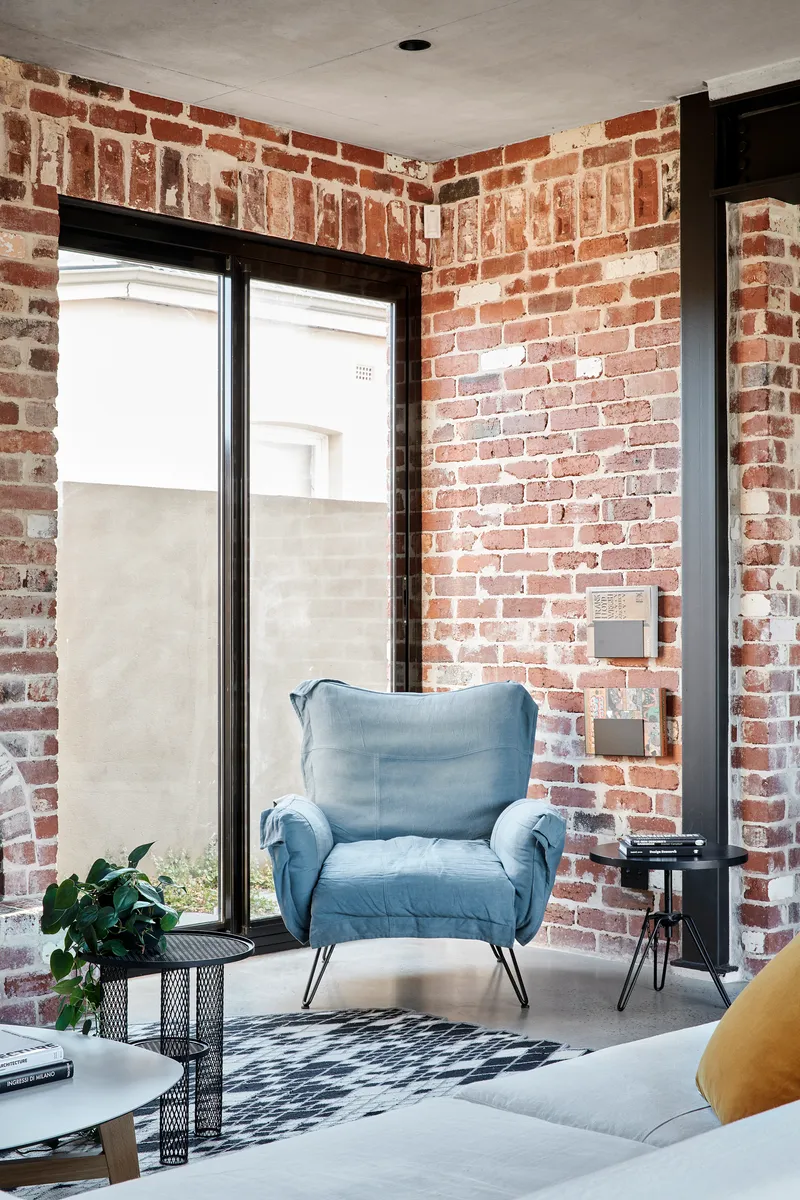
Step inside and the arches shift from decorative gesture to spatial device. The transition from the street through the brick arches into the open-plan dining area frames the interior like a series of prosceniums, each threshold compressing and then releasing the space. Exposed steel beams and polished concrete floors announce a different material register from the brickwork, but the pairing feels calibrated rather than jarring. The dining area beyond the arches is bathed in north-facing light, a deliberate orientation choice that serves passive solar goals.
A corner seating area uses black-framed glazing to open toward a courtyard, creating a secondary reading point where the heavy masonry meets thin lines of steel and glass. The contrast keeps the brick from becoming oppressive. Every time the walls threaten to close in, a void or a glazed edge pulls the eye outward.
The Staircase and Its Perforated Screen


The black steel staircase is the primary circulation spine, ascending through multiple levels beneath the structural beams. It is a deliberately industrial element, unapologetic about its material reality, and it gains most of its character from what flanks it: a jali-style hit-and-miss brick screen that wraps the adjacent lift shaft. The perforated pattern turns a structural necessity into a light-filtering membrane, dappling the corridors with shifting patterns as the sun moves.
State of Kin treats the lift shaft not as a service element to be hidden but as an opportunity to demonstrate another bricklaying technique. The house accumulates these moments of craft. Each surface seems to have been considered as an independent exercise in what reclaimed brick can do, yet the whole never feels like a sampler. The steel staircase provides a consistent, neutral thread that ties the masonry experiments together.
The Herringbone Vault Below


Below grade, Brick House hides its most arresting space. The underground cellar features a herringbone brick vault ceiling that hovers above board-formed concrete walls, a combination that feels almost ecclesiastical. A single figure standing in the room gives a sense of scale: the vault is generous, not cramped, and the herringbone pattern catches raking light in a way that makes the ceiling feel woven rather than built.
Back above, a large circular window punched through a brick wall offers one of the house's defining images. A mesh platform suspended in the double void creates a moment of vertiginous transparency, framing occupants against the circle of light. The window itself is double-glazed for thermal performance, but its real job is theatrical: it turns the simple act of sitting in a house into something worth looking at.
Courtyard and Living Spaces
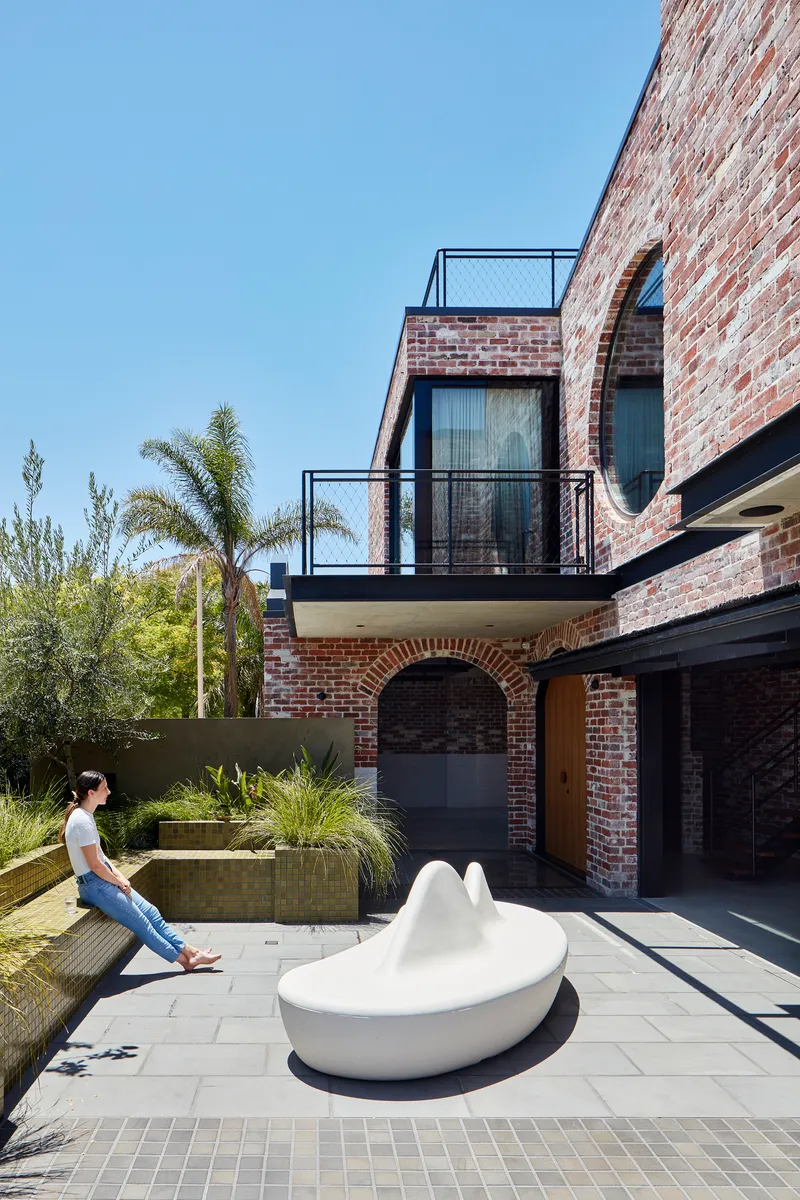
On a compact inner-city site, the courtyard does the critical work of pulling daylight and ventilation into the center of the plan. White sculptural seating and a concrete planter edge give it a slightly gallery-like quality, offset by the warmth of the surrounding brick. The courtyard mediates between the public face of the house and its private interior, functioning as both outdoor room and light well.
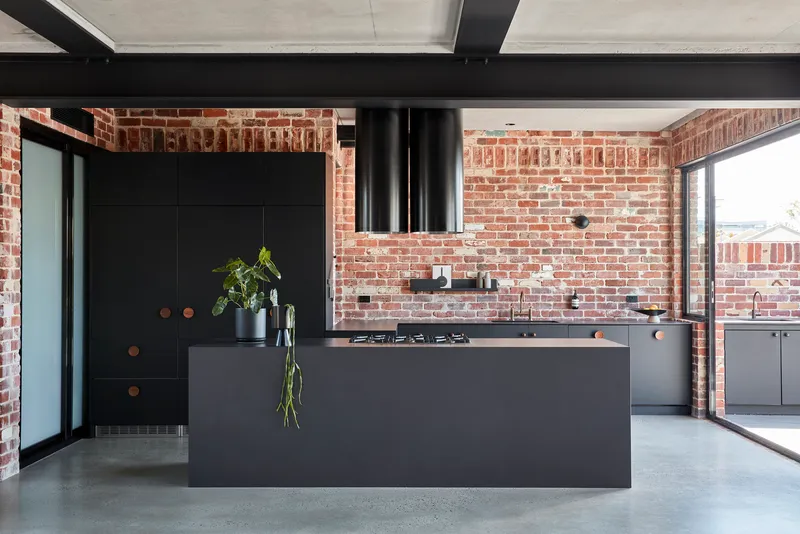
Inside, the kitchen anchors the ground floor with a matte black island beneath the exposed brick walls and a cylindrical range hood that reads as a minimal counterpoint to the arched masonry. The open plan flows from kitchen to dining to living without partition walls, relying on floor level changes and the central double voids to differentiate zones. Clerestory windows within the saw-tooth roof angles push hot air out through operable louvres, keeping mechanical cooling loads low.
Private Rooms and Material Detailing


The upper levels step down in intensity. Bedrooms use black built-in cabinetry against exposed brick walls, maintaining the palette without the spatial drama of the ground floor. Doorway openings are generous enough to keep sight lines running between rooms, preserving the sense of a connected interior even in the most private quarters.
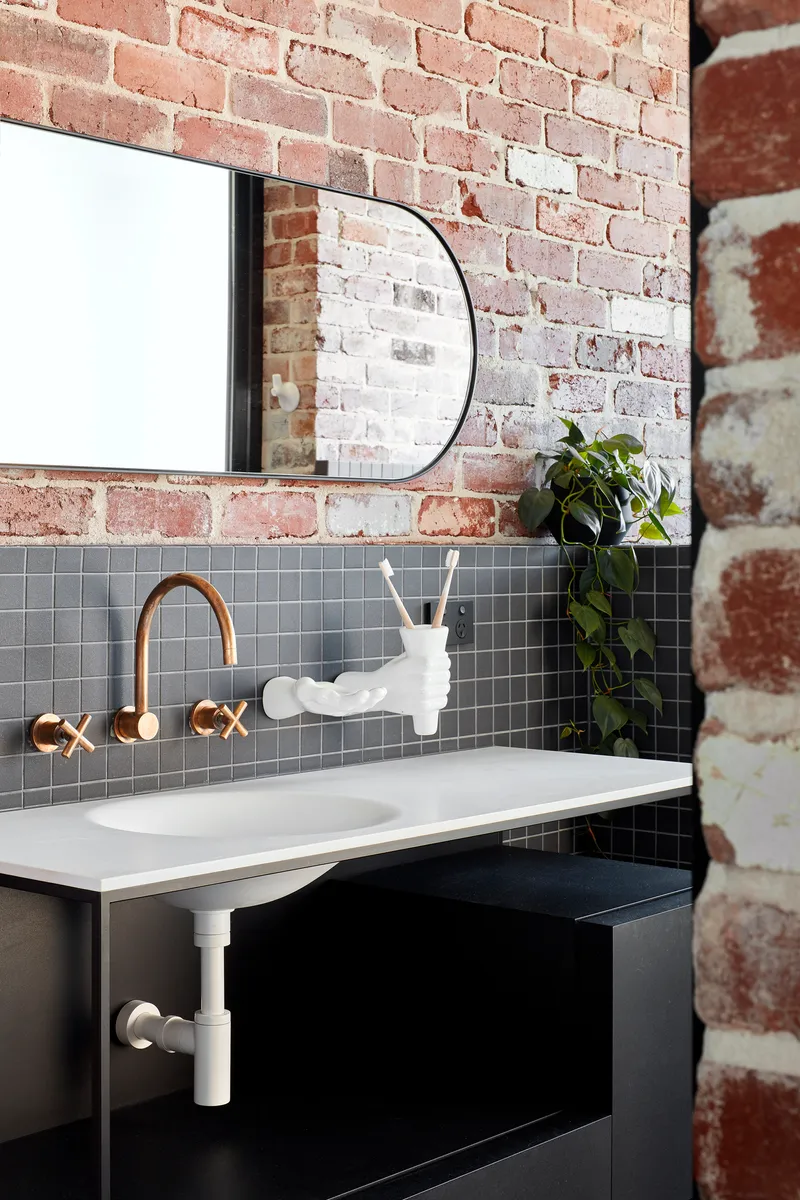
Bathrooms introduce a change in texture: grey mosaic tile and black mosaic tile enclosures sit beneath skylights that wash the brick in direct overhead light. Wall-mounted brass fixtures add a deliberate warmth against the cooler tones. The shower in particular, enclosed in dark tile between two brick walls with a skylight directly above, feels like a compressed version of the house's larger strategy: raw masonry, precise openings, controlled light.
Plans and Drawings


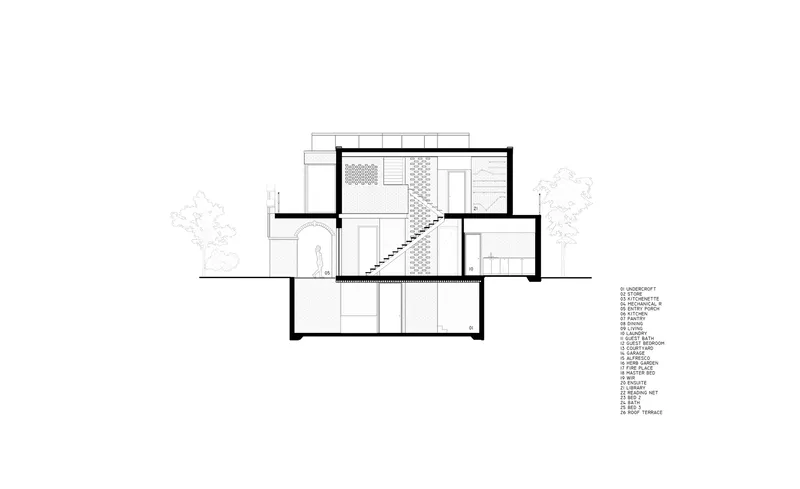
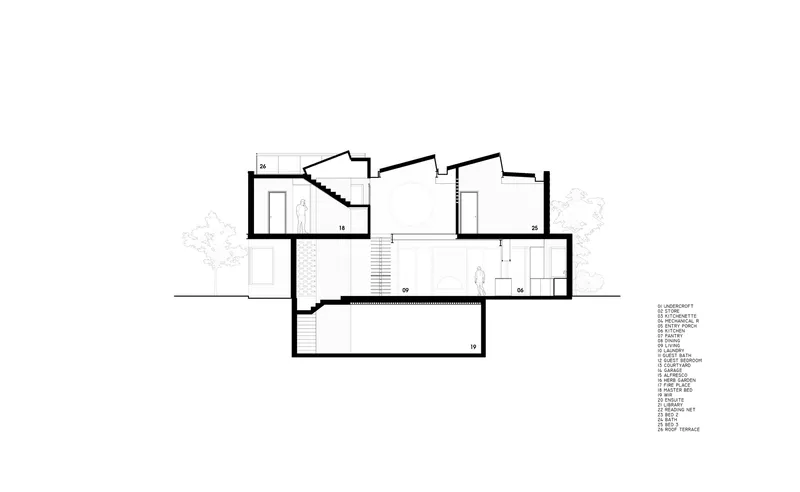
The floor plans reveal how tightly the house is organized around its central stair and void. The ground floor dedicates nearly all its area to open living, dining, and kitchen spaces that spill toward the courtyard. The first floor redistributes that openness into bedrooms arranged around the central void, while the second floor is a single large room with the service core pushed to the perimeter. The roof plan shows the saw-tooth profile that defines the house's silhouette and its passive ventilation strategy.
The two section drawings cut through the staircase and expose the split-level organization that is hard to read from the exterior. The cellar sits below the main volume, the double voids punch vertically through the floors, and flanking trees are drawn in outline to show the relationship between the house and its planted boundary. Human figures placed throughout the sections give a clear sense of the generous ceiling heights, particularly in the vaulted cellar and the saw-tooth lit upper room.
Why This Project Matters
Brick House matters because it takes a position on material reuse that goes well beyond token sustainability. Reclaiming bricks from the demolished houses of your own neighborhood and building them into a new structure that explicitly references the area's industrial and domestic past is a pointed act. It says that the material culture of a place has value even when the market has decided to tear it down. State of Kin backs that claim up with craft: the variety of bricklaying techniques on display here is genuinely impressive, and none of it feels gratuitous.
The project also offers a useful model for compact urban sites. At 323 square meters across multiple levels including a cellar, the house feels substantially larger than its footprint. Double voids, courtyards, clerestory windows, and saw-tooth roofs work together as a passive environmental system that reduces the need for mechanical intervention. In a city like Perth, where summers are punishing, that is not a design luxury but a practical necessity. Brick House proves that a dense, materially rich home can sit on a tight lot and still breathe.
Brick House by State of Kin, Mount Lawley, Australia. 323 m², completed 2018. Photography by Jack Lovel.
About the Studio
Share Your Own Work on uni.xyz
If projects like this are the kind of work you want to make, uni.xyz is a place to publish your own, find collaborators, and enter design competitions.



Popular Articles
Popular articles from the community


Conexión: Biophilic Design Reimagines High-Rise Living in Hong Kong
Conexión reimagines high-rise living in Hong Kong through biophilic design, green facades, shared spaces, daylight, water and nature within.

Co-Life: Senior Housing Design That Reconnects Older Adults With the City
Co-Life reimagines senior housing design through healing gardens, shared streets, workshops, and a sustainable community across generations.

AL-JANNAH: Sustainable Architecture and Permaculture for Afghan Widows
AL-JANNAH uses sustainable architecture and permaculture to create resilient oasis of housing, learning, work and renewal for Afghan widows.

The Ocean Hive: Sustainable Architecture for a Self-Sufficient Civilization at Sea
The Ocean Hive imagines sustainable architecture at sea, where modular habitats, algae, wave power and ocean waste sustain a growing colony.

Similar Reads
You might also enjoy these articles

Bao Huynh Watercolor Atelier: A Serene Art Retreat in Hội An
Bao Huynh Watercolor Atelier in Hội An blends multifunctional art spaces, sustainable design, local materials, and family-friendly living in a serene environment.

Atelier Macri Concept Store Interior Design by CASE-REAL
Atelier Macri store features a "ko" counter, walnut wood details, cork displays, blending retail, gallery, and seamless customer experiences.

Manuel Vargas Izquierdo Stadium and High-Performance Sports Center: Architectural Excellence in Jalpa de Méndez
The Manuel Vargas Izquierdo Stadium blends sustainable design, inclusive sports facilities, and cultural-inspired architecture, revitalizing Jalpa de Méndez’s public spaces.

KAKR Buluh Awar Hall: Revitalizing Community and Ecology Through Bamboo Architecture
Community built bamboo hall revitalizes Buluh Awar village, empowering youth, restoring ecology, celebrating vernacular craftsmanship through sustainable architecture and culture.




Comments (0)
Please login or sign up to add comments
No comments yet. Be the first to comment!