
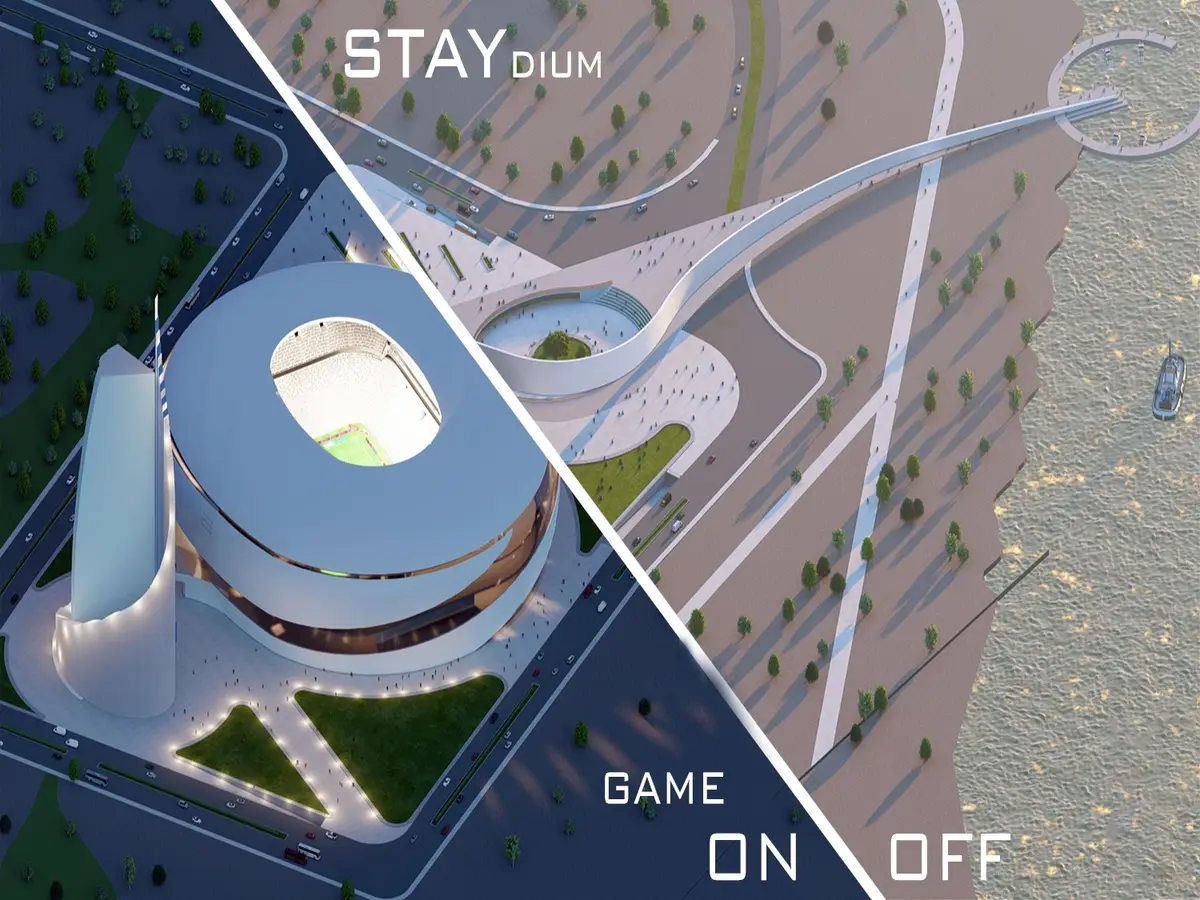
STAYdıum
KEEP THE STADİUM ALİVE

Every city has dynamics that include historical, geographical, human characteristics and multi-layered sub-contexts that combine them, and these dynamics also create their own potentials. In coastal cities, "being on the coast" and "contact with water", which are the focal points of these layers, play a decisive role in the formation and development of the city. If this potential is used correctly, a "living city" integrated with its coast will be possible.
Coastal and Public
Public spaces are very important in the development of the socio-cultural life of societies. The meanings attributed to public spaces that directly affect the people living in the city are one of the most important factors that determine the communication/interaction between society and individuals. The interaction of the environment and society also prepares the ground for encounters. These encounters strengthen the sense of togetherness, trust and community – belonging/belonging. In this sense, public spaces have an important place in the formation of a city's identity. “Public spaces on the coast” are indispensable for the coastal city to share the city. The primary aim is to use the coasts for public benefit. By determining the vital identity of a city, the coast shapes the way of life of its inhabitants. The strongest bonds that will ensure the coexistence of a coastal city with its inhabitants are established “on the shore”. Every action is associated with the shore. The beach belongs to the citizen and the right to fair use should be ensured by everyone. In this sense, the proposed coastal design; pedestrian-oriented, sustainable, responsive to the diverse needs of people of all ages and cultures, where people can come into contact with water in a continuous and public flow. By considering the coastal design integrated with the city, it is aimed to use the coast effectively in urban life. It will be a tool for social interaction and togetherness and will increase awareness of folk culture. The beach belongs to the citizen and the right to fair use should be ensured by everyone. In this sense, the proposed coastal design; pedestrian-oriented, sustainable, responsive to the diverse needs of people of all ages and cultures, where people can come into contact with water in a continuous and public flow. By considering the coastal design integrated with the city, it is aimed to use the coast effectively in urban life. It will be a tool for social interaction and togetherness and will increase awareness of folk culture. The beach belongs to the citizen and the right to fair use should be ensured by everyone. In this sense, the proposed coastal design; pedestrian-oriented, sustainable, responsive to the diverse needs of people of all ages and cultures, where people can come into contact with water in a continuous and public flow. By considering the coastal design integrated with the city, it is aimed to use the coast effectively in urban life. It will be a tool for social interaction and togetherness and will increase awareness of folk culture. By considering the coastal design integrated with the city, it is aimed to use the coast effectively in urban life. It will be a tool for social interaction and togetherness and will increase awareness of folk culture. By considering the coastal design integrated with the city, it is aimed to use the coast effectively in urban life. It will be a tool for social interaction and togetherness and will increase awareness of folk culture.
A "public-oriented", "living coast" design was adopted, which would strengthen the city, join the coast to the city, and the city to the coast, enabling the formation of collective social life and all kinds of activities.
The main idea behind the visual concept is that the Mississippi river looks like a big tree when viewed on a large scale and splits into different branches.
When you look at the map, Mississippi looks like a large tree with all its tributaries. Mississippi's largest right tributaries are the Red River, Missouri, Arkansas. Among the left arms, Ohio can be distinguished. Missouri and Mississippi, St. Louis, but the dirtier tributary of the great river doesn't mix with the clear blue waters of the Mississippi for a while.
From this point of view, the stadium is likened to the main body of the tree, the shopping areas and the hotel placed around it represent the curved branches of the tree, while the clarity and pollution level of the water is abstracted by spaces reserved for different functions in the area.
Stadiums are structures that lose their importance after the event is over. In order to prevent this, it is aimed to keep the stadium alive after the event along with the public spaces. In addition to being a stimulating and entertaining place for football spectators, it is designed as a highly accessible public space for all, serving the thriving community around the stadium, even on non-match days. Within the broad spectrum of design, the complex also connects to the commercial area, which includes accommodation, entertainment and shopping; an inclusive public space that meets nature It provides physical infrastructure for the integration of human, sport and urban identity.
When the pier that takes people from the river rises from the ground and reaches the stadium, it first transforms into a structure that forms the facade of the stadium and then into a rising structure that surrounds the hotel. It is aimed not to interrupt the view with the lower square built on the part facing the river. There are eating and drinking areas in the parts of the stadium facing the river, and the facade has been made transparent in the parts corresponding to this area in order not to spoil the view.


Popular Articles
Popular articles from the community


longwave studio Reorganizes a 112 m² Tainan Apartment Around the Daily Routines of a Family and Two Cats
In Tainan, Taiwan, birch plywood, rust-red furniture and a freestanding plaster wall link arrival, storage, work and family life in one apartment.

Architekt Andreas Gruber Scatters 23 Dark Timber Chalets Across a South Tyrolean Forest Edge
In Molini di Tures, Amonti Chalets breaks a resort into a hamlet of gabled timber houses, with parking, storage and services pushed into the slope.

GROUP A Strips a 1969 Rotterdam Harbor Headquarters to Its Frame and Wraps It in Timber Louvers
In Rotterdam's M4H harbor district, Ferro Offices reuses a 1969 frame, adds one timber storey and reaches BREEAM-NL Outstanding.

David Ortega Stacks a Two-Story Mexico City Penthouse Around a Steel Stair and a Pergola-Shaded Roof Terrace
In Colonia Roma, a 300 m² penthouse uses oak joinery, a planted steel stair and a slatted roof pergola to make a new-build apartment feel like a house.

Similar Reads
You might also enjoy these articles
The Rhythm of Seasons
A Farmers' Market Connecting Nature and the City

More Than a Building-Designing a Living System
More Than a Building-Designing a Living System
Base Beyond
DESERT COMPOUND ARID: TOURISM OF ABSENCE AND ABUNDANCE

Explore İshak Şimşek Arhitecture Competitions
Discover active competitions in this discipline


Challenge to reimagine the Iron Throne

Photograph architecture without architects

Illustrate the lost glory of Angkor Wat - Render Challenge

Design challenge to reuse E-waste
Comments (2)
Please login or sign up to add comments
Visually very attractive architectural design
Felicitations!