

MSR Architecture Stitches a French Farmstead Back Together with Granite, Corten, and a Village Square Pool
At Château du Latz in Brittany, reclaimed stone and weathered steel transform two neo-Breton houses into a coherent family hamlet.


Somewhere on the grounds of Château du Latz, a historic estate in Brittany scattered with stone farmhouses, a chicken coop, an orchard, and crumbling walls, two neo-Breton houses were dropped onto the landscape in the 1970s and 1990s. They did what spec houses do: they ignored everything around them. MSR Architecture, led by Marie-Sophie Rollet, was brought in not to demolish and start over but to perform a more difficult operation. The brief was to stitch the existing buildings into the site's older logic of stone, pine, and river, turning a collection of mismatched structures into something that reads as a hamlet.
The result, completed in 2024 across 335 square meters, is a project that treats reclaimed granite as both material and argument. Stone is the common thread connecting facade, floor, landscape wall, and terrace. Corten steel frames the moments where the architecture opens up to the surrounding pines, its oxidized surface aging in step with the masonry rather than fighting it. The central outdoor space, organized around a swimming pool and conceived as a village square, gives the project its social core. It is a generous idea: a family compound that encourages gathering without forcing togetherness.
A Hamlet, Not a House
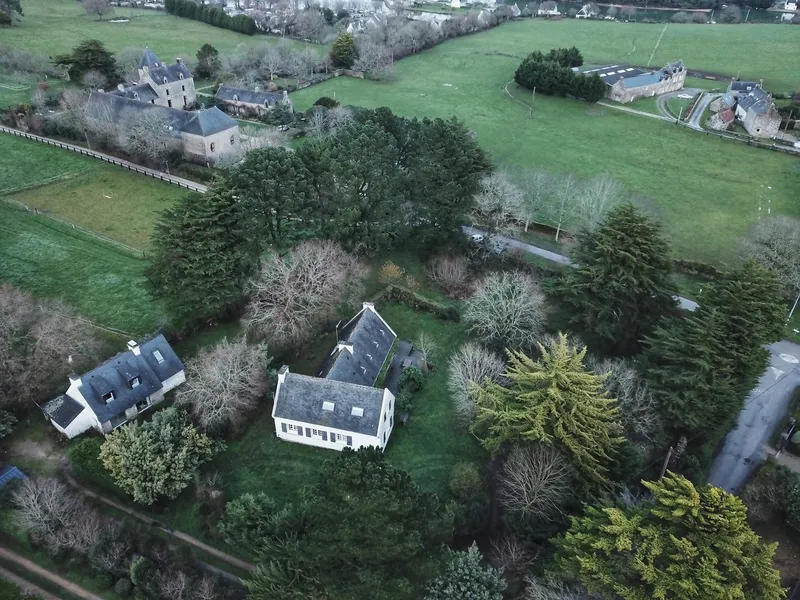
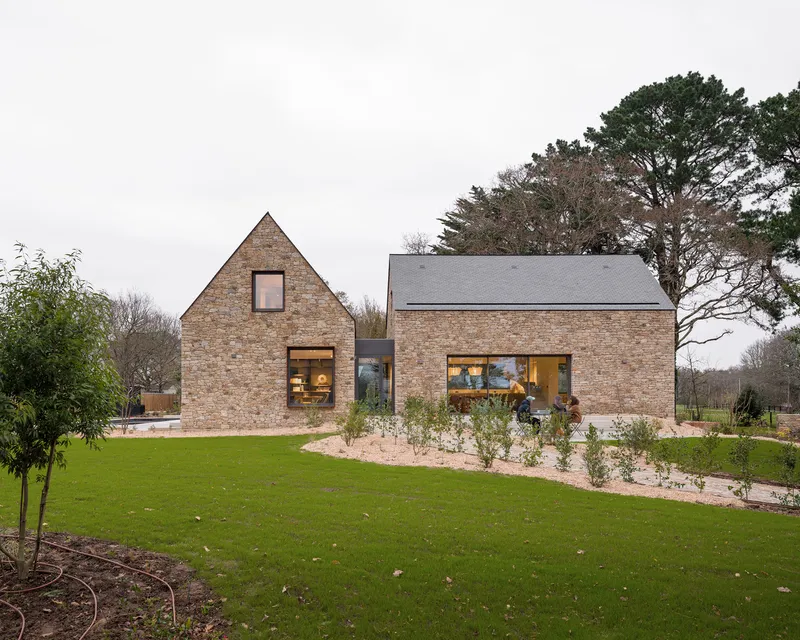
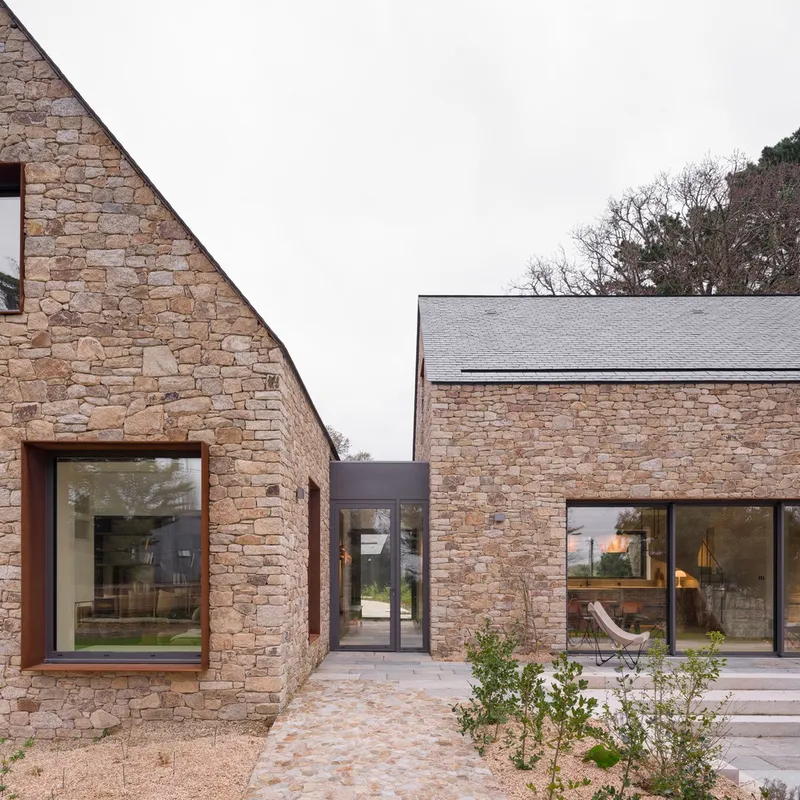
From the air, the strategy is legible. The primary T-shaped house commands the plot with its gabled volumes, while the smaller secondary building recedes into the background, partially screened by mature trees. The aerial view reveals a deliberate choreography: buildings, paths, and planting are not random accumulations but a composed sequence. The glazed link passage connecting two stone gable volumes across a gravel courtyard is the project's hinge, a transparent joint that makes the connection between old masses explicit rather than hidden.
MSR Architecture describes this as a "stitching" approach, and the metaphor holds. The firm did not erase the neo-Breton DNA of the existing houses; it reframed them. Slate roofs remain. Gabled forms persist. But the proportions have been tightened, the details stripped of pastiche, and the gaps between buildings turned into programmed outdoor rooms rather than leftover voids.
Stone as Argument
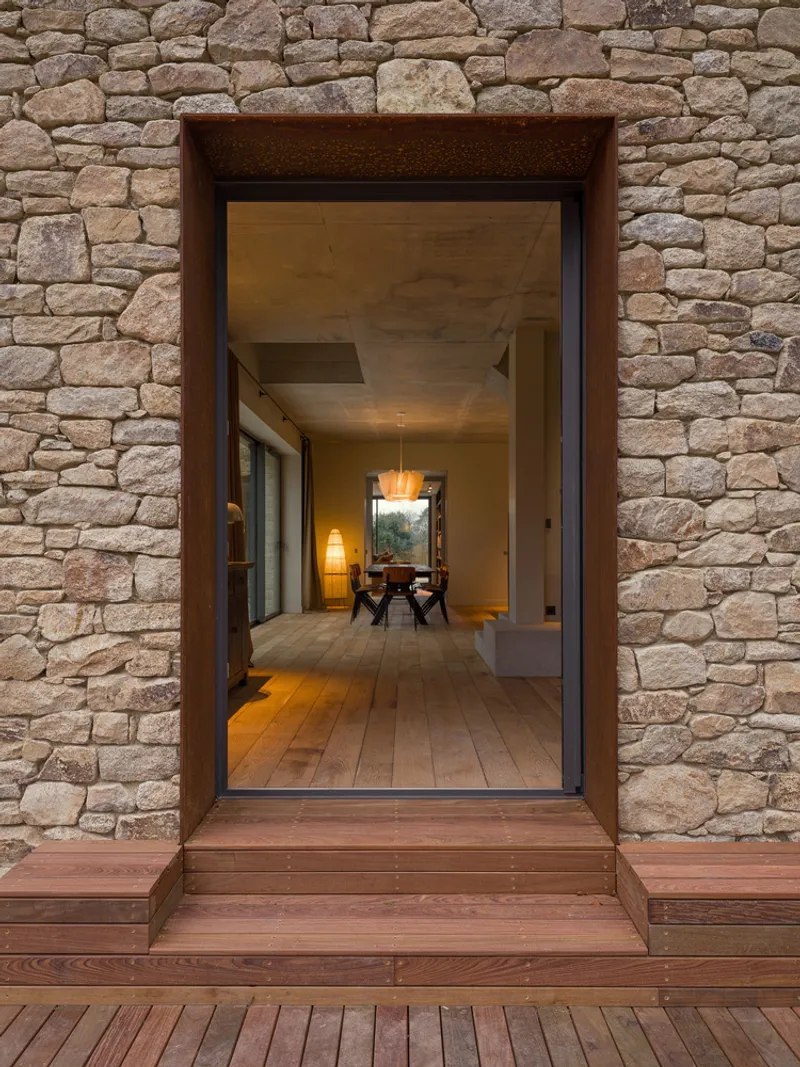
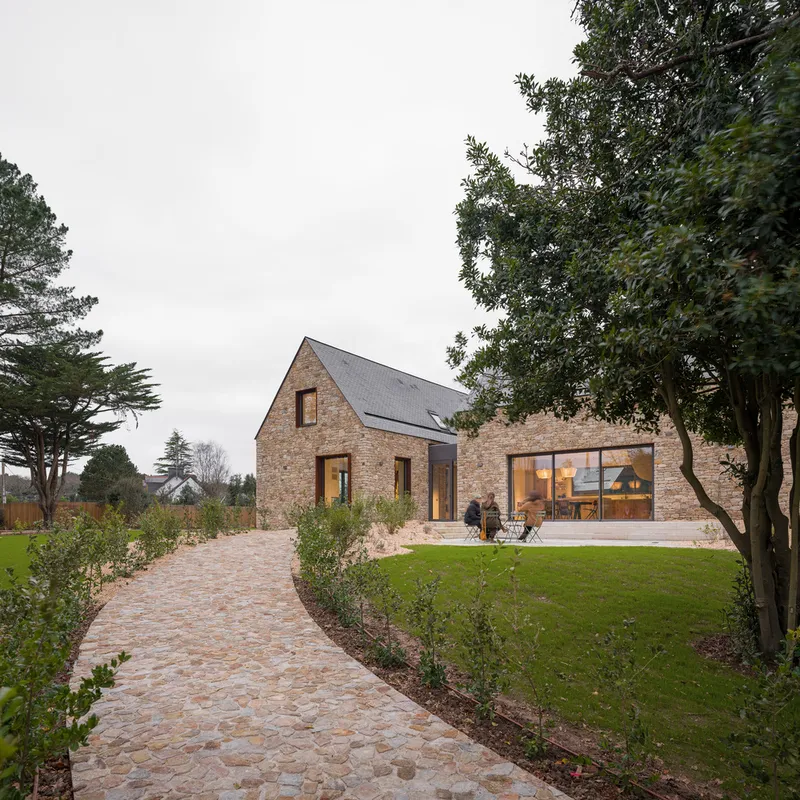
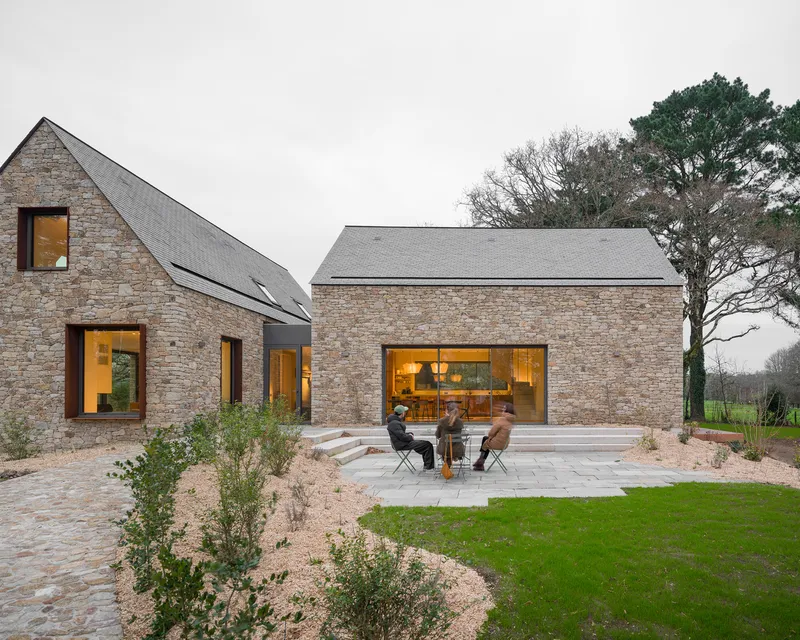
The facades are clad in semi-dry granite rubble, much of it reclaimed from surrounding construction sites and already weathered by decades of exposure. This is not decorative veneer. The coursed stone walls have the heft and imprecision of regional masonry, and the recessed timber-framed entry punched through them feels like walking into something that has been here longer than it actually has. It is an honest sleight of hand: a contemporary renovation wearing a patina that was earned elsewhere.
On the ground plane, large slabs of Luserna stone extend from interior floors out onto terraces, deliberately blurring the threshold between inside and outside. The cobbled pathways leading to the glazed elevations reinforce this continuity. Stone is everywhere, but it is never monotonous because it appears in different formats: rubble on the walls, sawn slabs on the floor, dry-stacked in the landscape walls. One material, multiple grammars.
Corten Steel and the Framing of Views
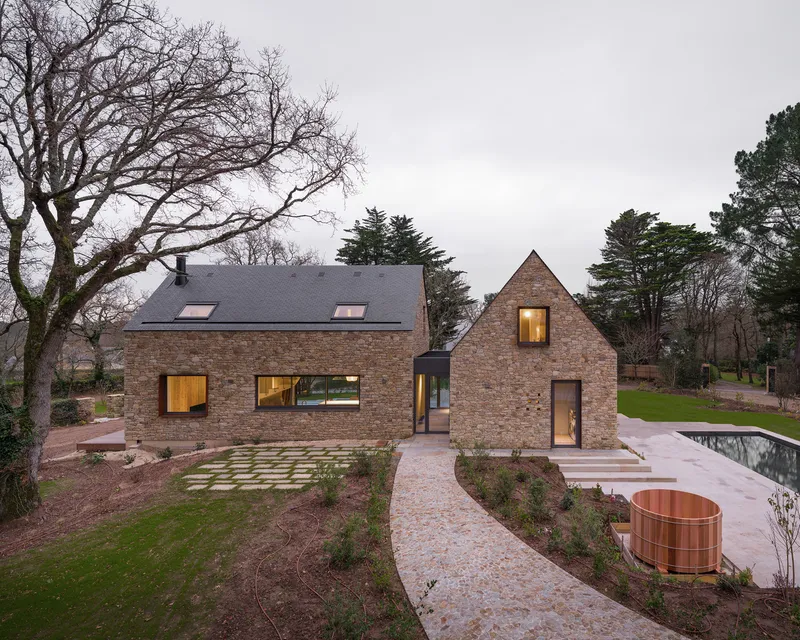
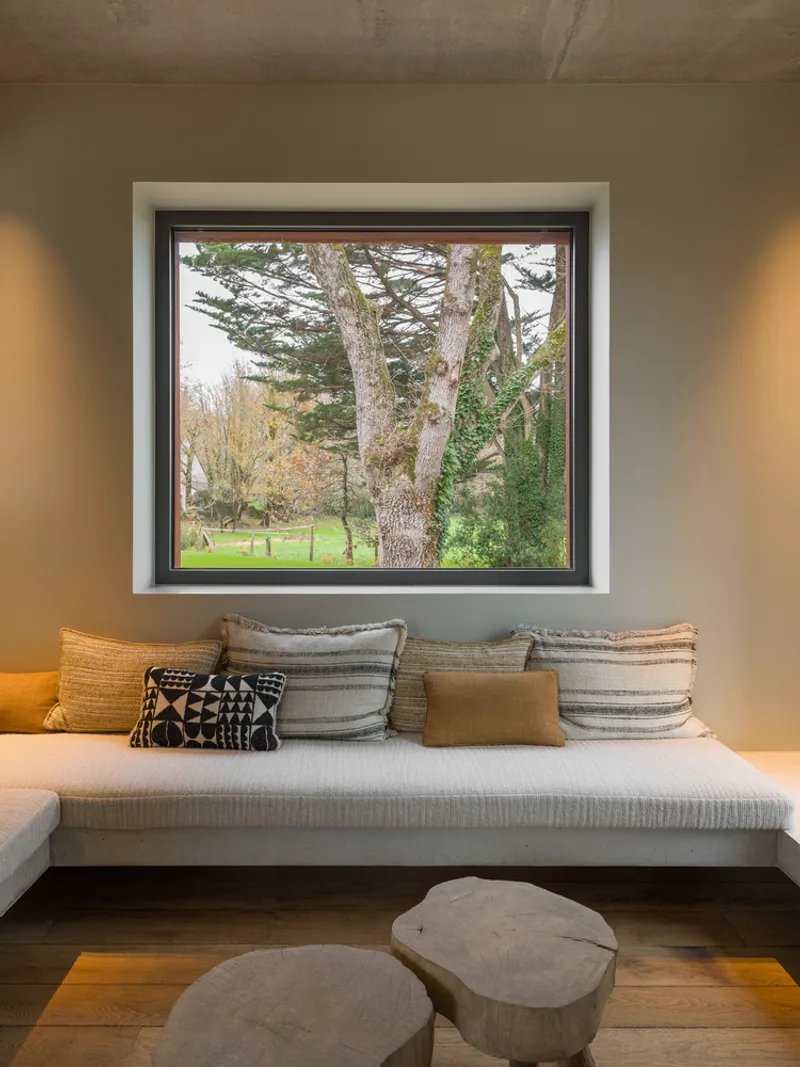
Where the stone is ancient and regional, the Corten steel is contemporary and industrial, but both share the same principle: they age. The oxidized steel appears at window surrounds and key thresholds, framing views of the surrounding pines and landscape with a material that will darken and shift over the years. It is a smart pairing. The Corten highlights the generous glazed openings without resorting to aluminum or painted metal, which would have read as foreign against the granite.
The deep window seat with cushions, framing a solitary tree in the landscape beyond, is the kind of detail that earns a project its emotional resonance. It is not the big move. It is what happens when the big move (material coherence, landscape integration) is executed well enough that a single moment of stillness can land.
Concrete, Timber, and the Interior Palette
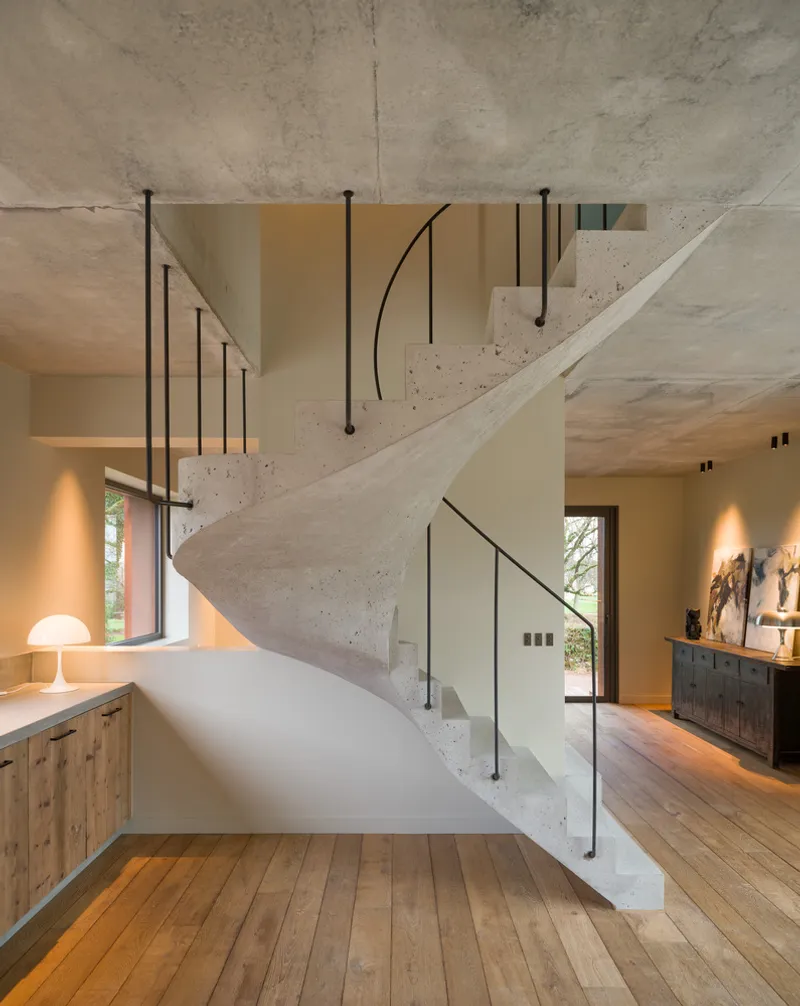
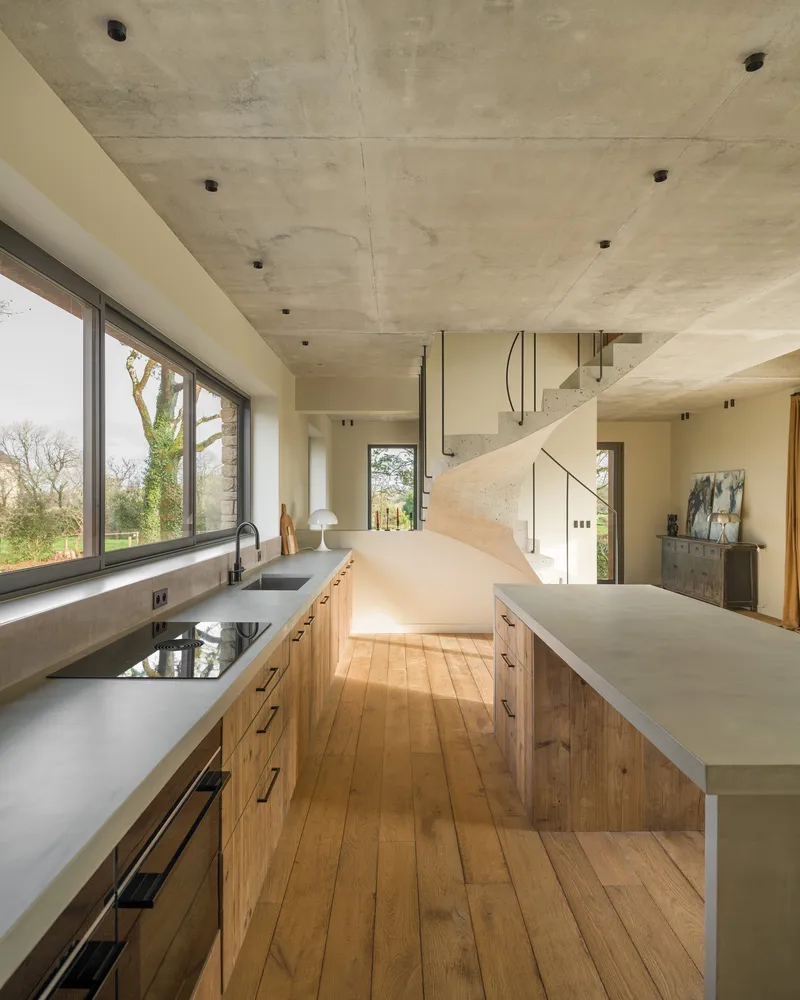
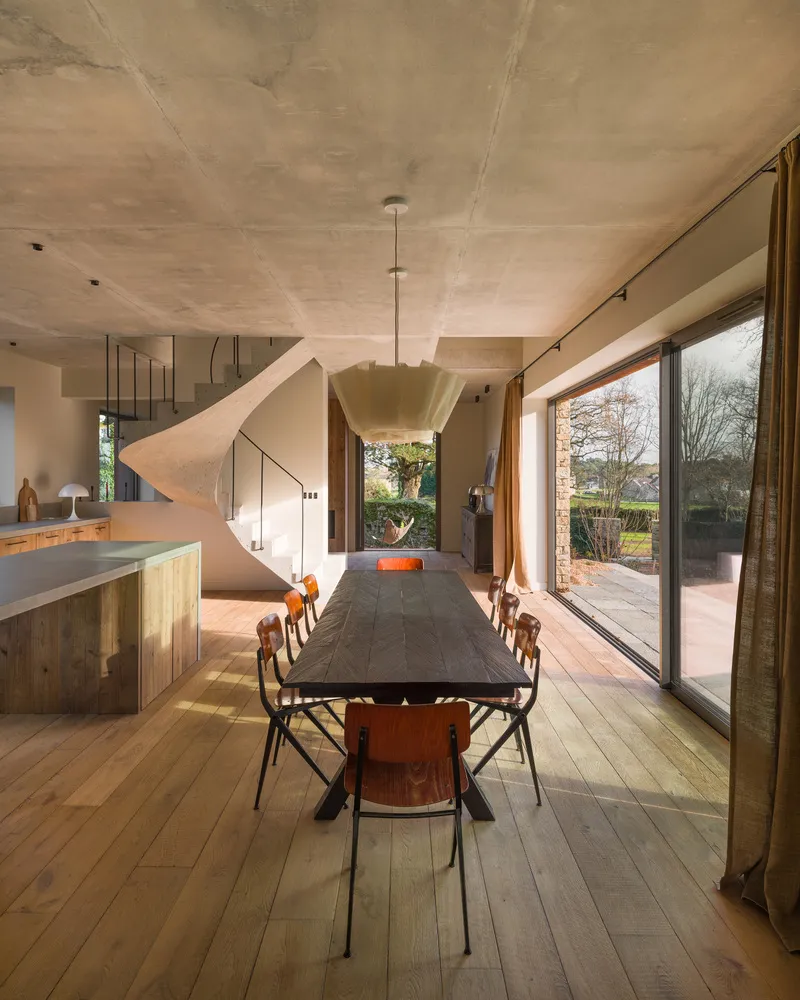
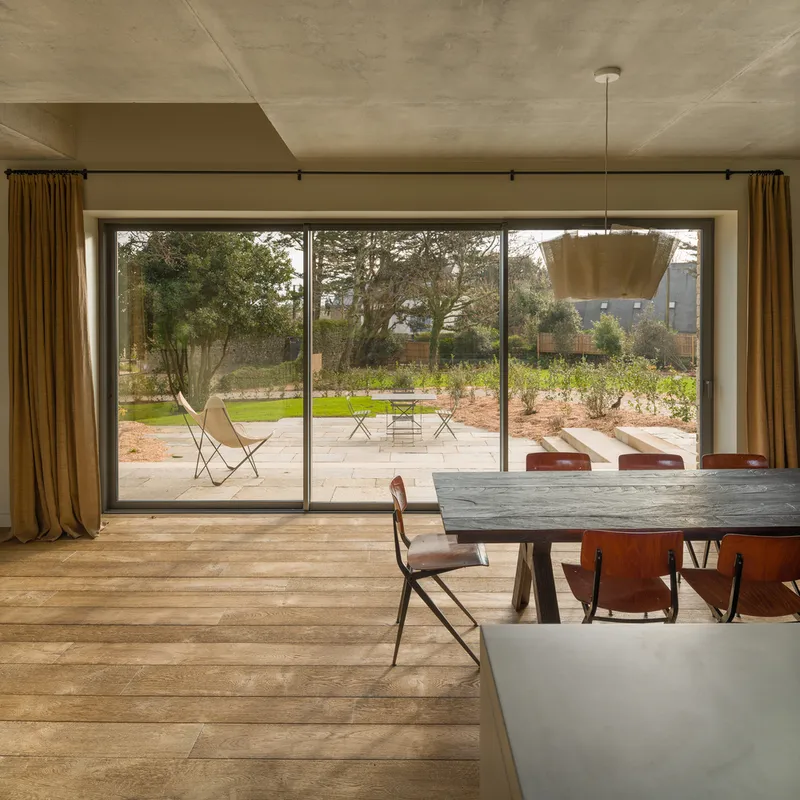
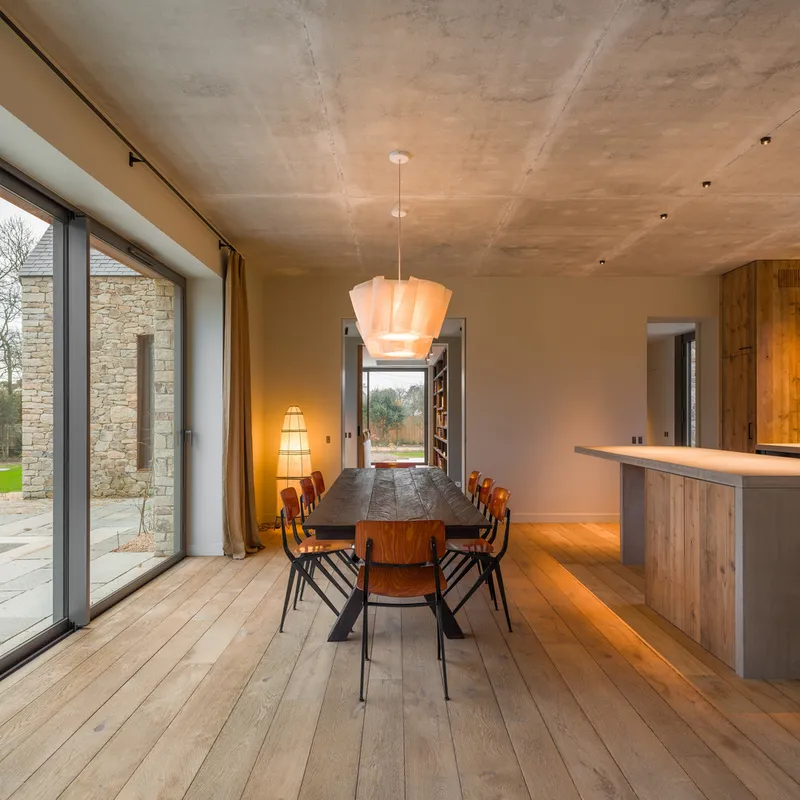
Inside, the material logic shifts but does not break. Exposed concrete ceilings run across the dining and kitchen spaces, their raw surfaces offset by reclaimed solid wood parquet floors that bring warmth underfoot. The cast concrete staircase with its black steel handrails and glass balustrade is the interior's most sculptural element, rising through a double-height void with a precision that contrasts deliberately with the rough-hewn granite outside.
Concrete also shows up as furniture: the kitchen island, the bench seating, the staircase itself. These are not afterthoughts but integral parts of the architecture, poured in place and left exposed. The kitchen, with its timber cabinetry and the curved plaster volume of the stair, manages to feel open without being loft-like. It is domestic in scale and generous in light, with the concrete ceiling acting as a unifying datum across the open plan.
Living Rooms with Memory
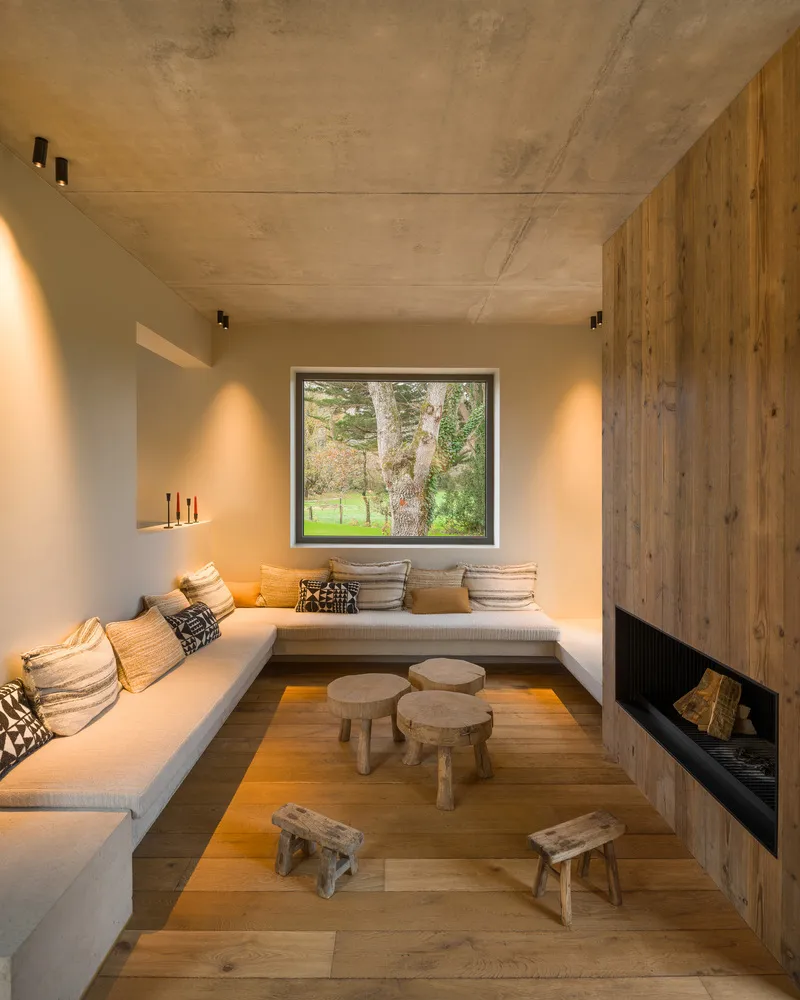
The sunken seating nook with its built-in benches, timber fireplace wall, and window framing a single tree is the project's most intimate space. It operates on a different register from the open kitchen and dining areas, pulling the ceiling down and the floor slightly lower to create a sense of enclosure. The fireplace is not ornamental; it is the room's gravitational center, the reason you would choose this seat over the terrace on a winter evening.
At dusk, the dining room with its full-height glazing becomes a lantern in the landscape, the pendant light hovering above the timber table while the garden terrace, outdoor chairs, and lawn stretch out beyond the glass. Interior design by Atelier la Tricoterie layers in cane-paneled closet walls, vessel sinks, and handcrafted iron details without cluttering the architectural armature. Every finish decision supports the core idea: warmth and restraint are not opposites.
Upper Rooms and the Vaulted Hallway
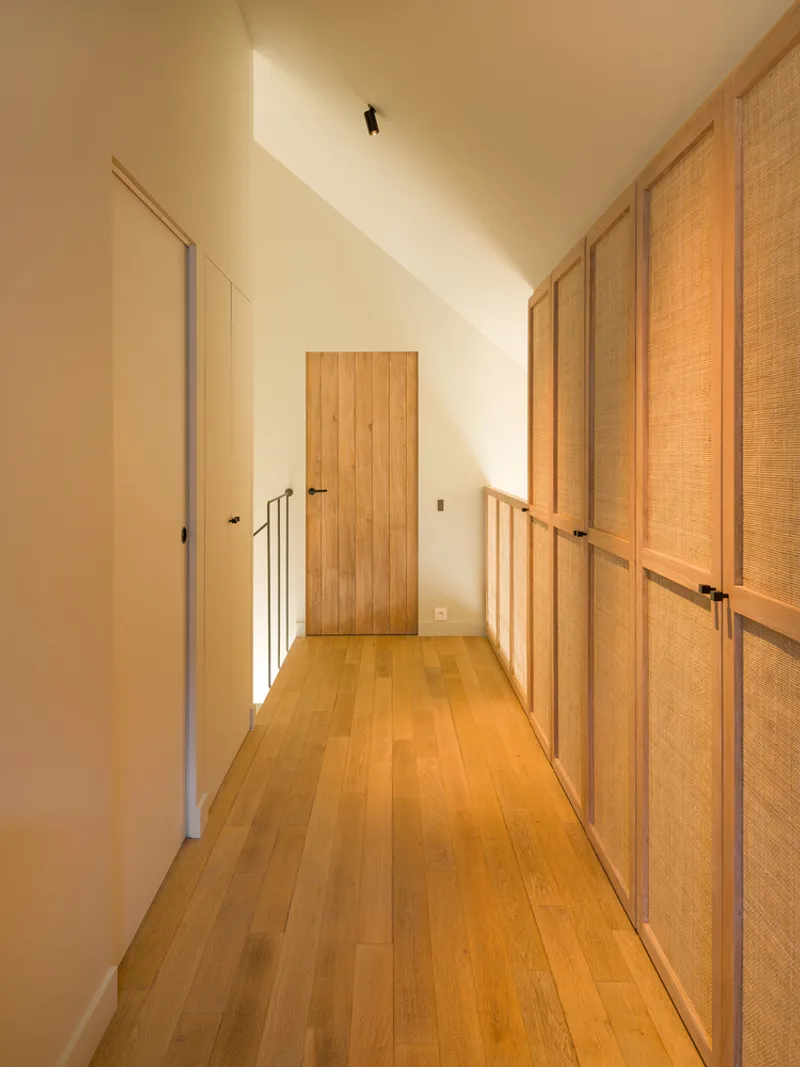
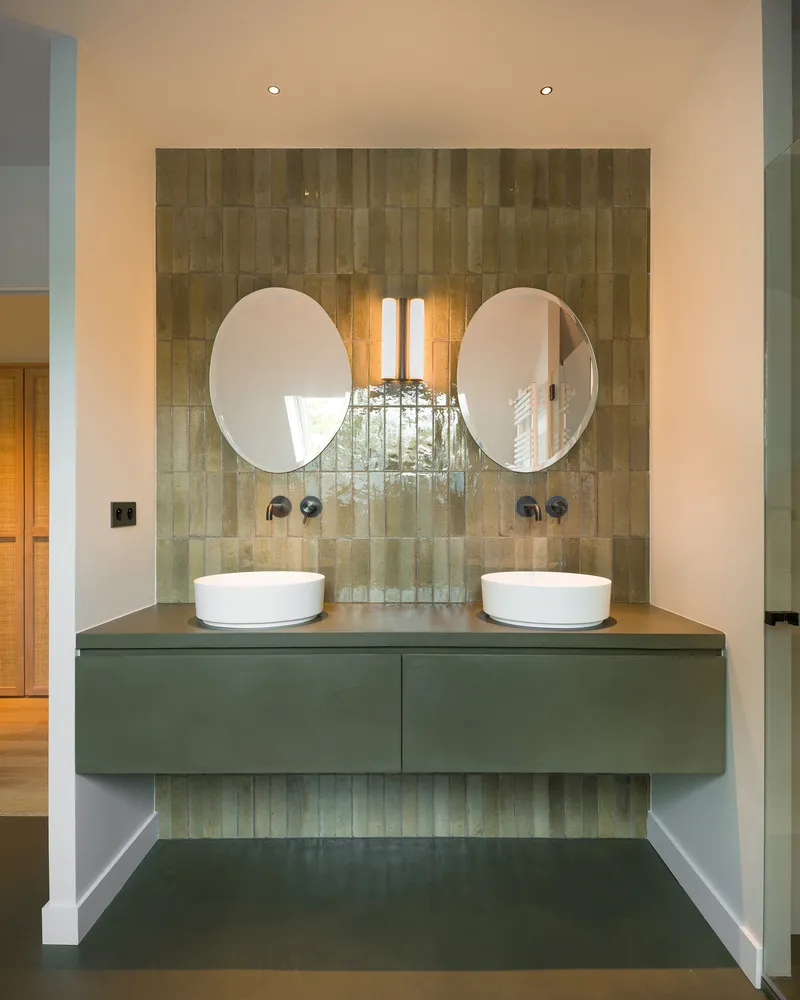
Upstairs, the vaulted ceiling in the hallway catches warm afternoon light and channels it past timber-clad doors and cane-paneled walls. The proportions are deliberately tight here, almost ecclesiastical in their verticality, creating a clear contrast with the open-plan living spaces below. The bathroom, with its twin vessel sinks, circular mirrors, and vertical glazed tile wall, is restrained but not austere. These are rooms that feel finished, which is rarer than it sounds in renovation projects that often leave the upper floors as afterthoughts.
The Central Pool as Village Square
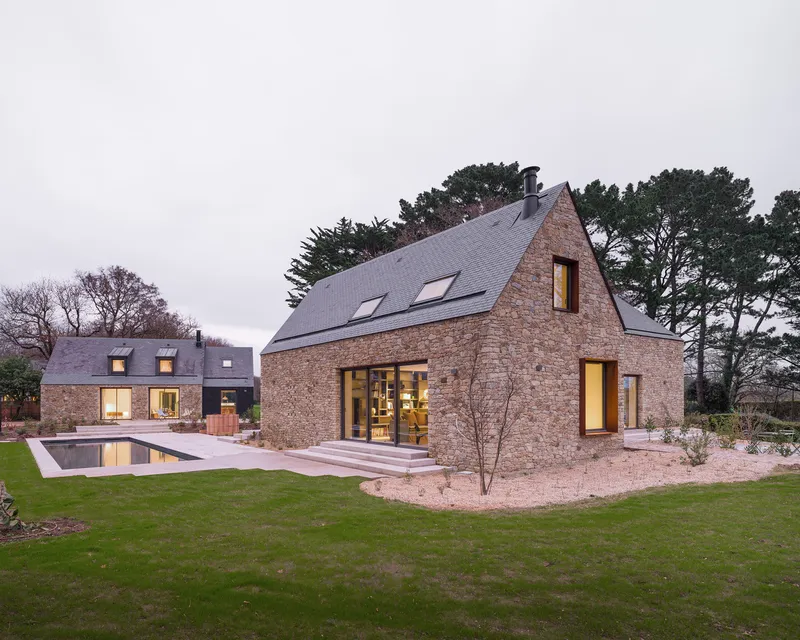
The swimming pool is not tucked away on a back lawn. It occupies the center of the hamlet, positioned between the two stone volumes and treated as the social heart of the compound. Landscape architect Atelier Callarec completely redesigned the grounds, planting pine trees and threading stone walls through the site to create continuity between the existing mature trees and the new plantings. The result is a courtyard that functions as an outdoor living room, with the pool as its defining feature rather than an amenity.
At twilight, the interplay between the lit interiors and the stone facades reflected in the pool water gives the hamlet its most photogenic moment. But the real achievement is spatial, not visual. The pool draws family members out of their private rooms and into shared space without requiring a door, a hallway, or a threshold. It is the hamlet's front porch, its town square, and its reason for being.
Plans and Drawings
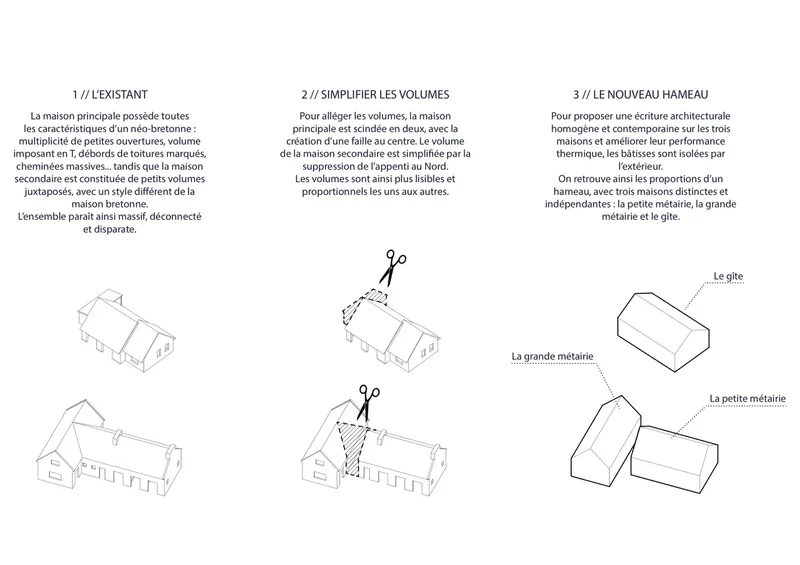
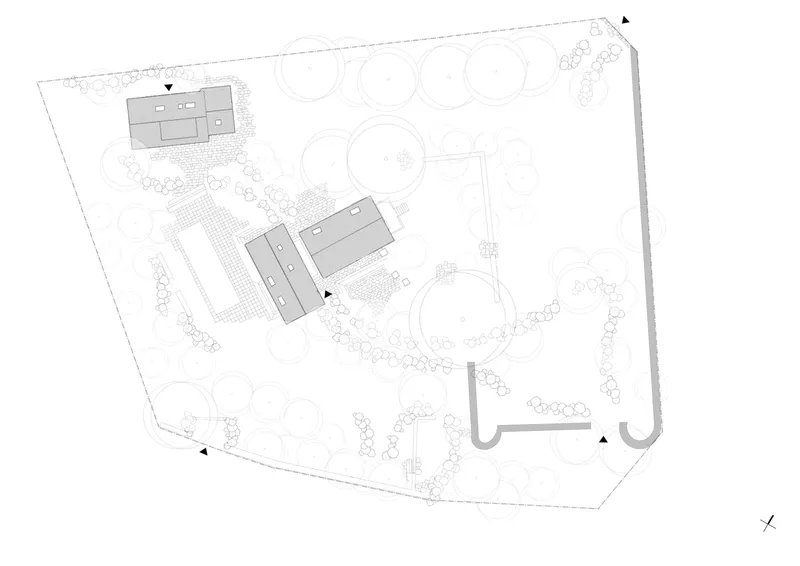
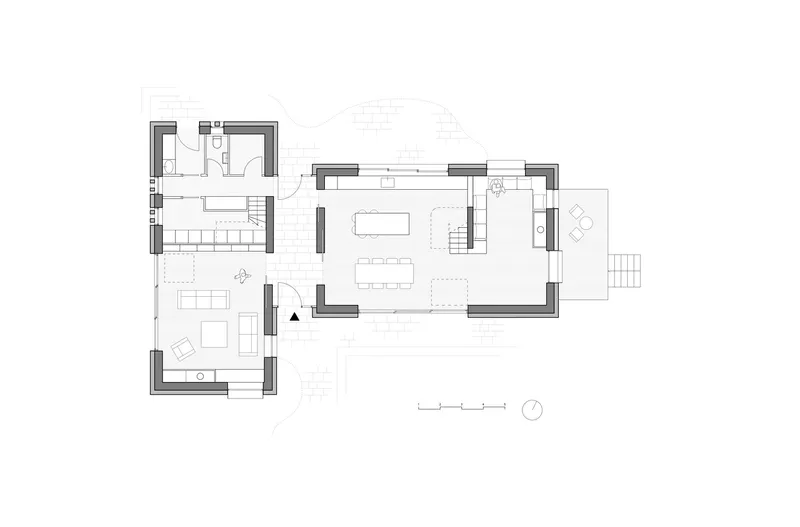
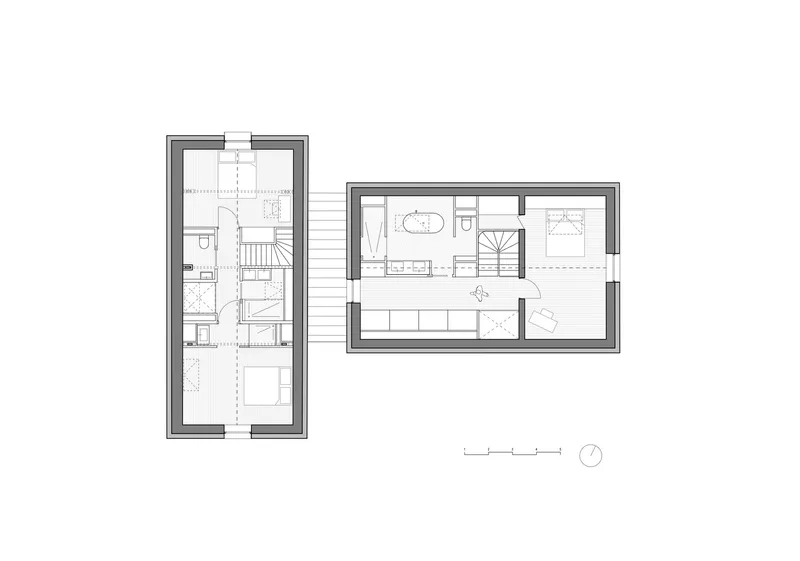
The axonometric diagrams reveal the design evolution most clearly: the original massing is split into three distinct barn volumes, each with its own gabled roof, then linked by transparent connectors. It is a strategy that lets the project read as a cluster rather than a single house, reinforcing the hamlet idea at the level of form. The site plan shows how the two buildings are positioned among circular tree canopies and meandering paths, with the pool centered between them. On the ground floor, open living and dining areas flow into one another through a central staircase, while the upper floor plan shows two volumes linked by an exterior walkway, each containing bedroom suites that offer privacy within the collective.
Why This Project Matters
The Hameau du Latz Houses matter because they take on a problem that is everywhere and rarely solved well: what to do with mediocre late-twentieth-century houses on extraordinary sites. The temptation is always to tear down and start fresh, or to wrap the old building in a new skin and pretend it never existed. MSR Architecture chose a third path, accepting the existing structures as starting points and using reclaimed stone, weathered steel, and a redesigned landscape to fold them back into the site's older story. The result is neither a restoration nor a new build. It is a repair.
More broadly, the project is a case study in how a single material idea, stone as the unifying thread, can organize everything from facade to floor to landscape wall without becoming repetitive. The consistency is earned through variation: rubble, slab, and dry-stack each play different roles while speaking the same language. In a moment when rural renovation often defaults to either nostalgic pastiche or aggressive contrast, the Hameau du Latz finds a middle ground that is neither timid nor showy. It is simply convincing.
Hameau du Latz Houses by MSR Architecture (Lead Architect: Marie-Sophie Rollet), with interior design by Atelier la Tricoterie and landscape architecture by Atelier Callarec. Located in France. 335 m². Completed 2024. Photography by François Dantart.
About the Studio
MSR Architecture
Share Your Own Work on uni.xyz
If projects like this are the kind of work you want to make, uni.xyz is a place to publish your own, find collaborators, and enter design competitions.


Popular Articles
Popular articles from the community


Architekt Andreas Gruber Scatters 23 Dark Timber Chalets Across a South Tyrolean Forest Edge
In Molini di Tures, Amonti Chalets breaks a resort into a hamlet of gabled timber houses, with parking, storage and services pushed into the slope.

LT2A and OPEN Architectes Thread a Brick and Glass High School Through a Wooded Belgian Campus
In Braine-l'Alleud, a 3,000 m² wing for Collège Cardinal Mercier pairs pale brick with a glazed colonnade, deferring to a small chapel and a dense wood.

David Ortega Stacks a Two-Story Mexico City Penthouse Around a Steel Stair and a Pergola-Shaded Roof Terrace
In Colonia Roma, a 300 m² penthouse uses oak joinery, a planted steel stair and a slatted roof pergola to make a new-build apartment feel like a house.

Cube Design Draws an Ecological Corridor Between Two Shenzhen Hills with the Nankai Building
Beside Shenzhen's container docks, the Nankai Building pairs stacked balconies with a climbing green screen to connect two hillsides across its height.

Similar Reads
You might also enjoy these articles

Bamboo Housing Challenge 2026: Design Affordable, Sustainable Homes Using Bamboo
An international design competition by Bamboo U and IBUKU inviting architects and designers to reimagine affordable housing using bamboo — with the winning design built full-scale in Bali.

Computational Design & Education: Beegraphy Design Awards Introduces 7th Category (Featuring Jiyun's Innovative Approach)
Dive into Beegraphy’s 7th Design Awards category, where computational design meets education to create immersive, interactive learning tools, inspired by Jiyun’s work.

From Parametric Lighting to Urban Furniture: Join the 2nd Workshop in Beegraphy’s Computational Design Series
Dive into Cutting-Edge Design Techniques and Practical Applications with Industry Experts

Last Call: Unleash Your Architectural Genius in SHAK's Kindergarten Design Competition
Urgent call for architects to join SHAK's kindergarten design competition before the looming deadline

Explore Architecture Competitions
Discover active competitions in this discipline

Challenge to reimagine the Iron Throne

Photograph architecture without architects

Illustrate the lost glory of Angkor Wat - Render Challenge

Design challenge to reuse E-waste
Comments (0)
Please login or sign up to add comments
No comments yet. Be the first to comment!