
Strombro Building Workshop Sculpts a Trio of Barrel Vaults for an Artist's House on a Swedish Hillside
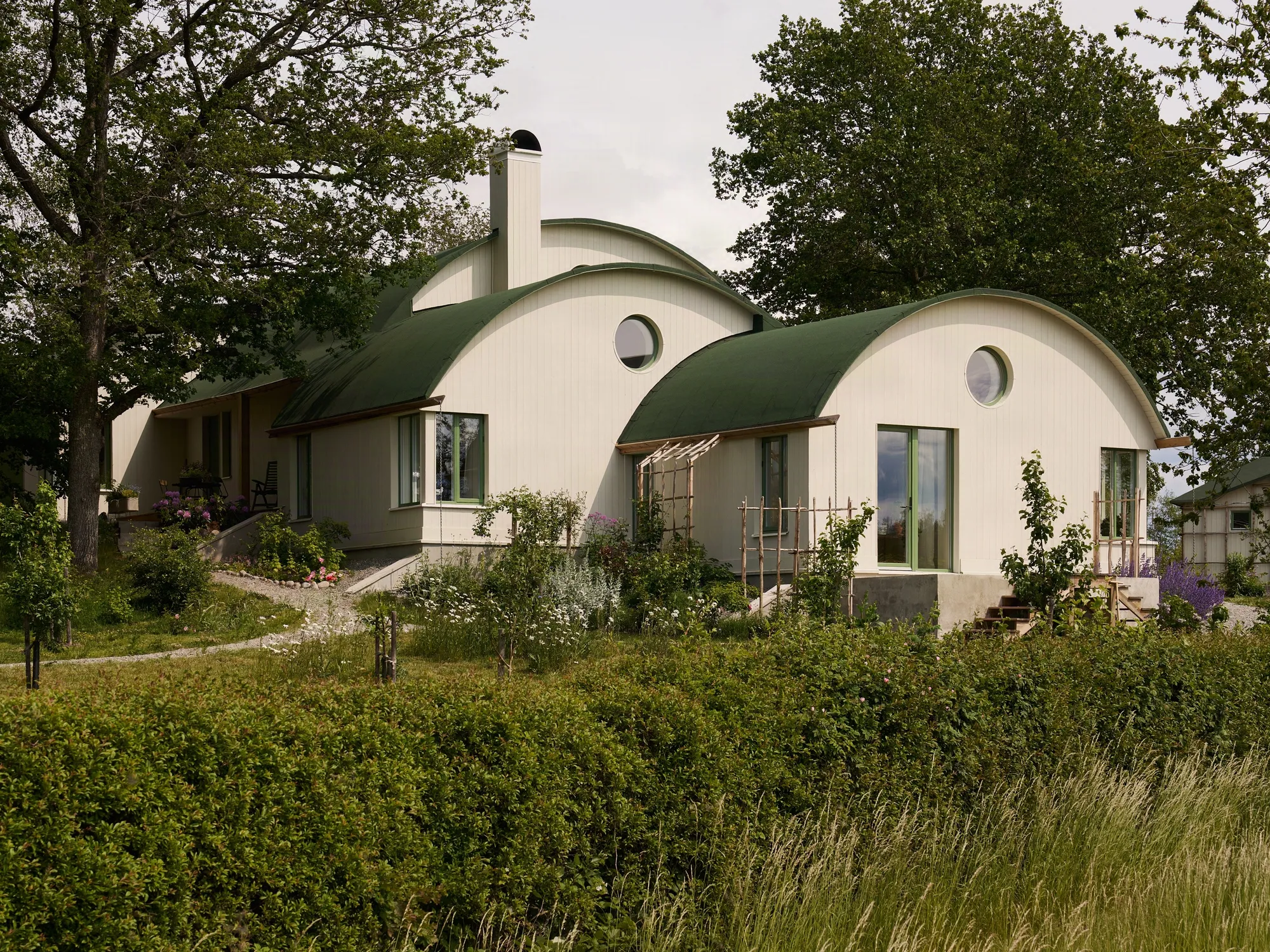
Villa Färingsö clusters three CLT vaulted volumes among oaks and pastures on a gentle westward slope near a Swedish lake.


Most architect-designed houses aspire to blend into their landscape. Villa Färingsö, by Strombro Building Workshop, does something rarer: it introduces a formal language so distinct from its pastoral surroundings that the two enter a genuine conversation. Three barrel-vaulted volumes, clad in white vertical paneling and capped with green standing-seam roofs, sit on a gentle 1/10 slope among oaks and fruit trees in the Swedish countryside. From a distance, the cluster reads as a miniature village of chapels or granaries, its proportions domestic but its silhouette unmistakably deliberate.
What keeps this 210 square meter house from veering into whimsy is a seriousness about construction and material. Strombro, a studio that doubles as a CLT fabricator, built the structural shells from cross-laminated timber panels finished on the interior with exposed slatted vaulting. The result is an envelope where structure and ornament are the same thing. Circular windows, timber pergolas, and a greenhouse corner connect the domestic program to the landscape without dissolving the boundary between inside and out. The house is for an artist, and it behaves like one: confident in its eccentricities, disciplined in its craft.
A Village of Vaults
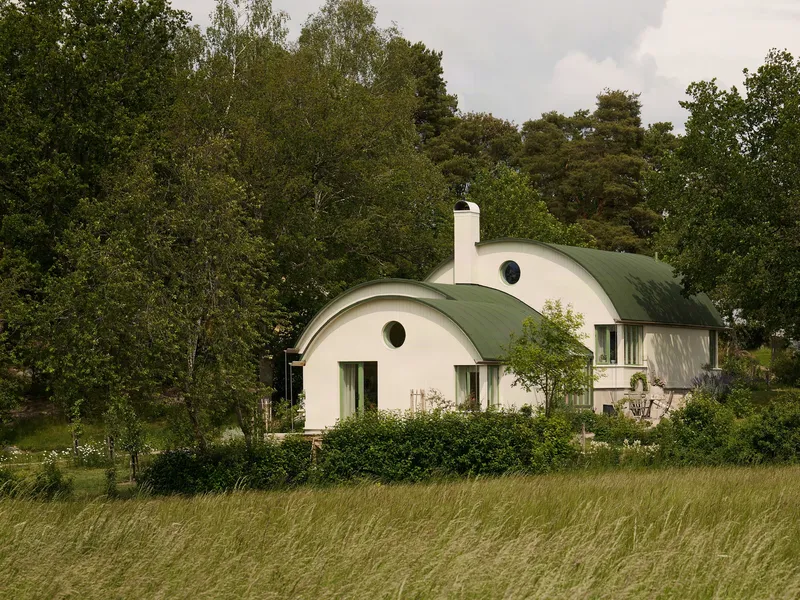
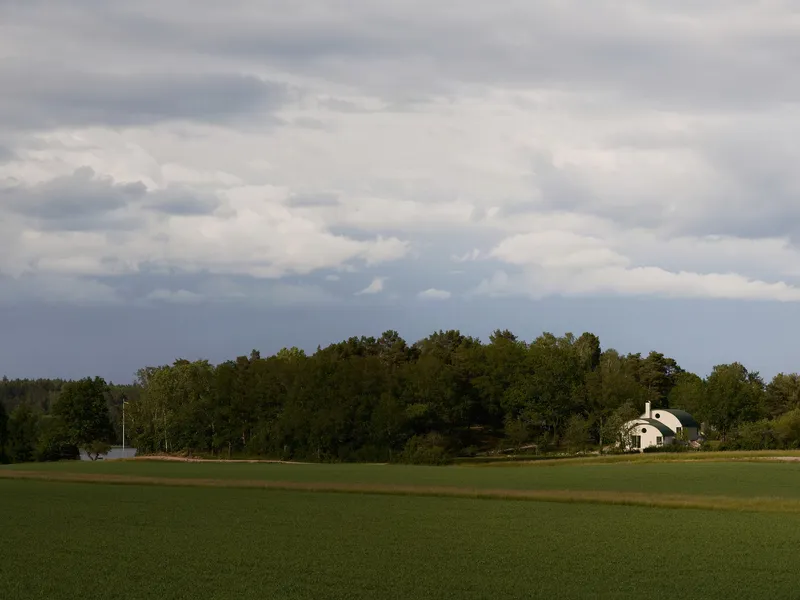
The decision to break a modest program into three separate vaulted volumes instead of a single bar or rectangle is the project's defining gesture. Seen from the meadow, the white arched forms appear almost found, like structures that have always occupied this pasture. The green roofing softens the profiles against the surrounding canopy, while the circular porthole windows give each volume a face, a quality somewhere between a ship's cabin and a Scandinavian summer cottage.
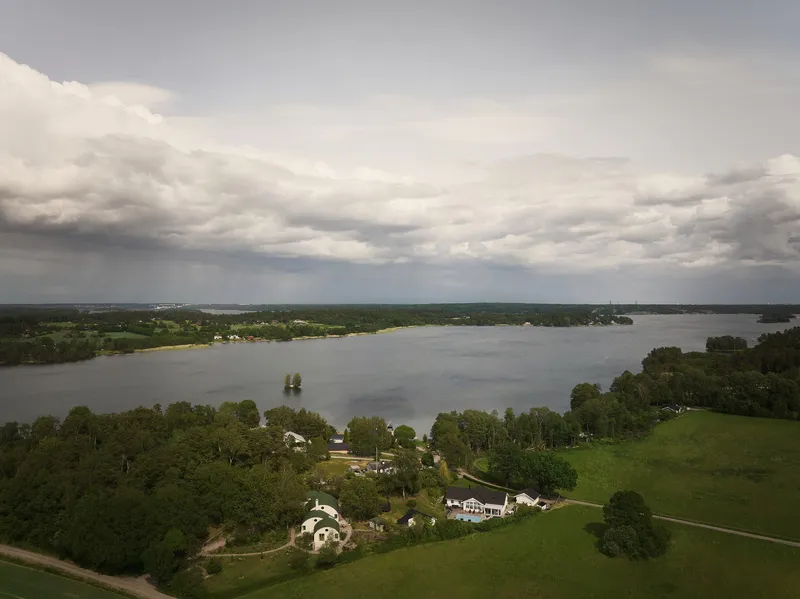
An aerial view reveals the clustering logic more clearly. The three volumes are offset from each other, creating sheltered pockets of garden between them. The site slopes gently toward a lake, and the staggered plan allows each vault to address the water view without blocking its neighbor. It is an additive composition rather than a subtractive one, and it lends the house a sense of informality that a unified massing would not achieve.
The Green Crown


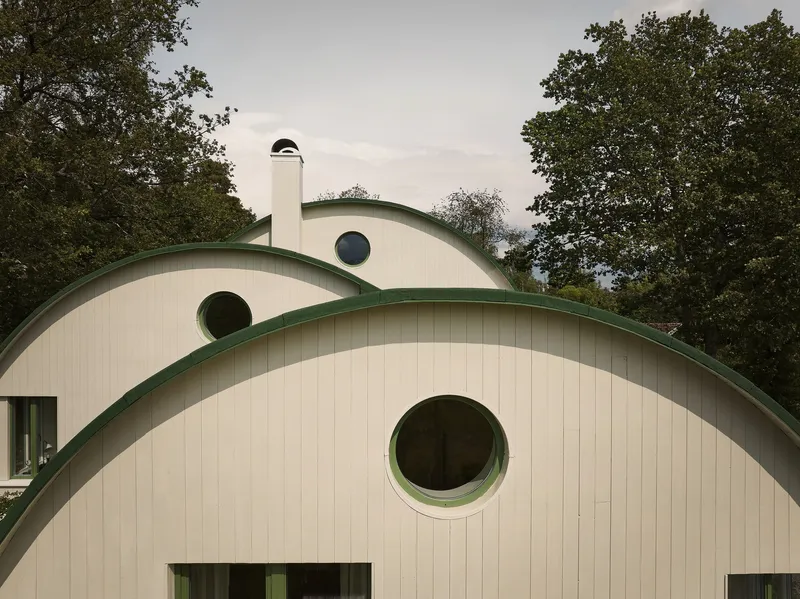
The barrel roofs are the most photogenic element, but their real interest is tectonic. The green metal cladding wraps tightly over the curved CLT structure, meeting the white wall panels at a clean trim line that doubles as a gutter detail. Round windows are punched directly into the curve, turning each roof end into an oculus wall that draws light deep into the interior vaults. The formal vocabulary is premodern: think Romanesque apses or Quonset huts, but the execution is precise and contemporary.
At ground level, the tall trees frame the curving profiles and make the house appear smaller than it is. The planted beds along the base soften the transition from cladding to earth, and afternoon light catches the green metal just enough to distinguish it from the foliage above. It is a calibrated ambiguity: the roofs belong neither fully to the architecture nor fully to the garden.
Timber Slats and Circular Light


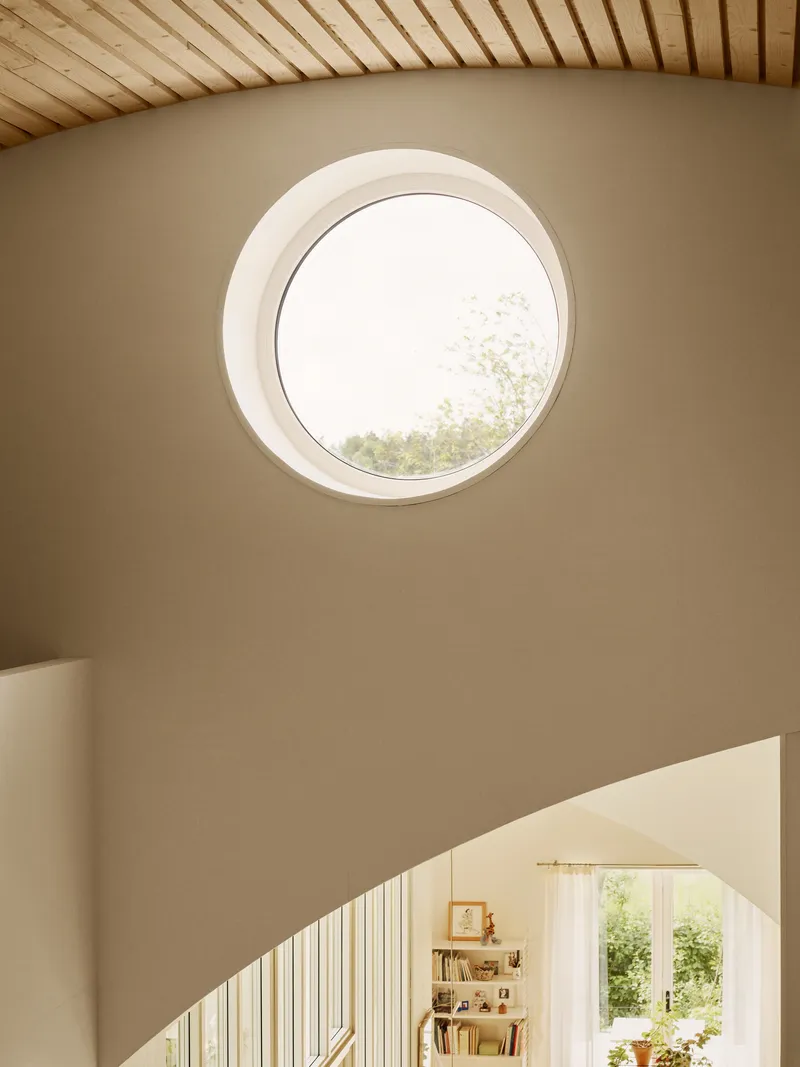
Inside, the barrel vault is expressed in exposed timber slats that run the full length of each volume. The slats are narrow and closely spaced, giving the curved ceiling a textile quality, almost like the inside of a woven basket. Light enters through the circular skylights and porthole windows, casting round pools onto the pale pine flooring. The circular motif, repeated across facade, roof, and ceiling, becomes the house's unifying ornamental system.
The living space is where this language works hardest. A pair of circular skylights sit at the vault's crown, flanked by tall glazed openings that bring the oak canopy into the room. A floral tapestry on the far wall introduces color and pattern without competing with the ceiling geometry. The overall effect is warm, luminous, and slightly theatrical, exactly the kind of interior an artist might want to live and work in.
Threshold and Transition


The connections between the three vaulted volumes generate some of the house's best moments. A hallway with timber slat vaulting leads to a staircase that rises between white walls, its treads in light pine, its handrail minimal. Arched doorways frame views through successive rooms, compressing and releasing space in a sequence that rewards movement.
A split-level section accommodates the site's slope, with a fireplace set into the step between floors. The curved slatted ceiling overhead unifies the two levels visually while the stairs create a gentle promenade through the house. It is a compact plan that feels generous, largely because every transition is shaped rather than merely functional.
Working and Resting Under the Vaults
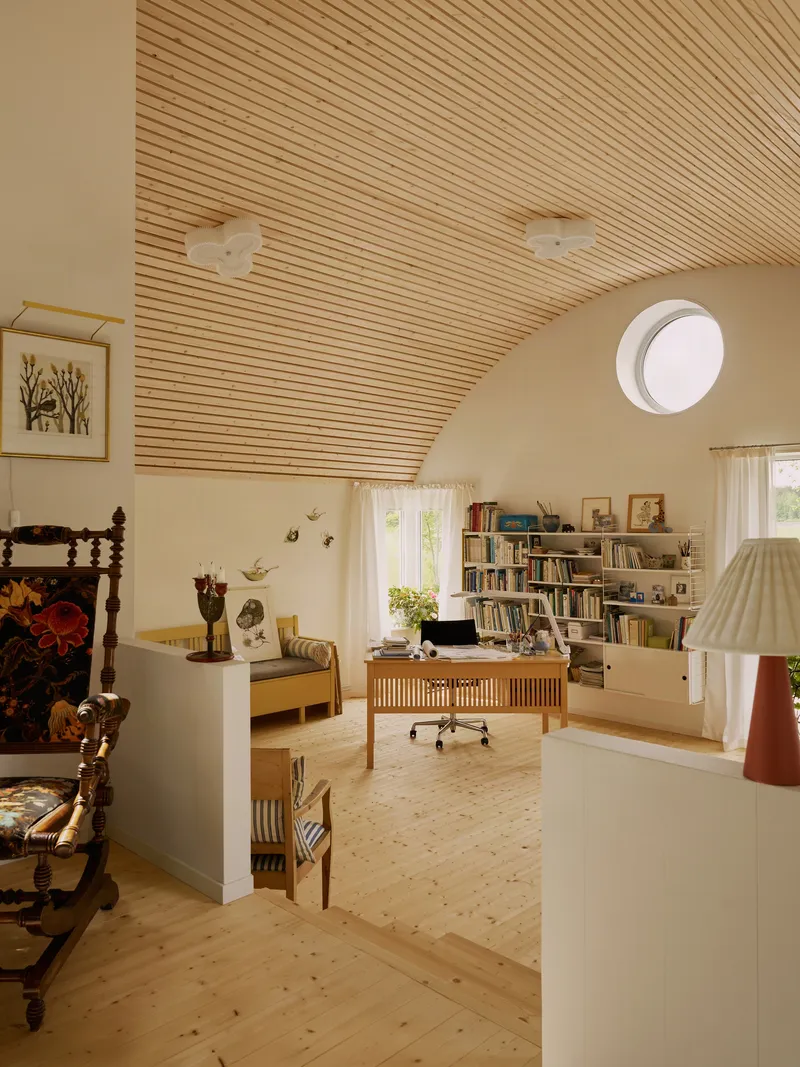
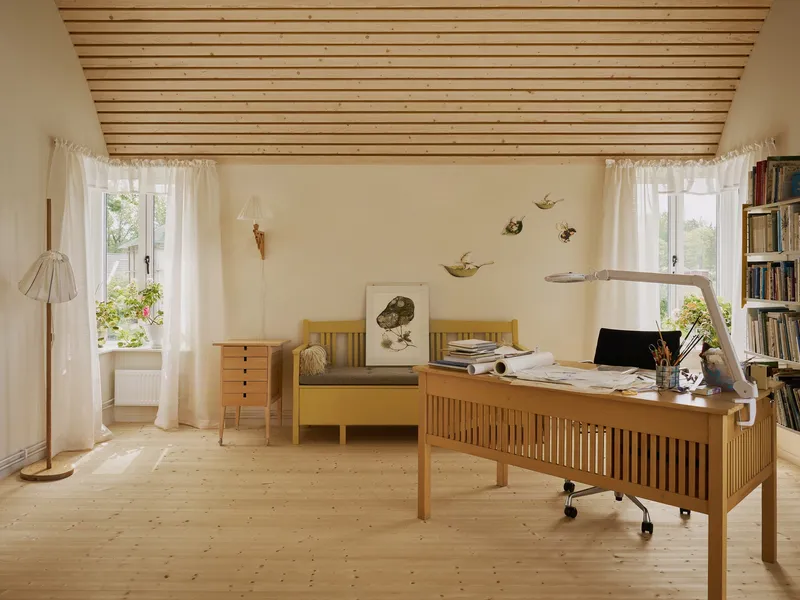

The house accommodates studio and domestic life without rigidly separating them. A study occupies one end of a vault, with a circular skylight directly overhead and low bookshelves lining the curved wall. A home office nearby tucks a wooden desk beneath a slatted ceiling panel and two curtained windows. These are modest rooms, not grand ateliers, but the quality of light and enclosure makes them feel purposeful.
The kitchen and dining area stretch along the central vault, a patterned runner on the pine floor softening the acoustics and adding a layer of domestic warmth. The vaulted ceiling here feels protective rather than monumental; it is scaled to the act of sitting at a table rather than gazing upward. Strombro understands that a vault can be intimate.
Gardens and Greenhouses


The relationship between interior and garden is handled with care. A corner terrace slides beneath the overhanging green roof and into the shade of an oak tree, its glazed walls offering shelter without enclosure. Elsewhere, a greenhouse corner with full-height white-framed doors fills with potted plants and filtered sunlight, operating as a liminal space between living room and meadow.
The garden elevation, seen in afternoon light, reveals a timber pergola connecting the vaulted volumes and creating a sheltered outdoor room. Planted beds with low perennials anchor the white walls to the ground plane. The landscape strategy is deliberately modest: no infinity pools, no cantilevered decks. The house is content to sit within its garden, not above it.
Details and Atmosphere
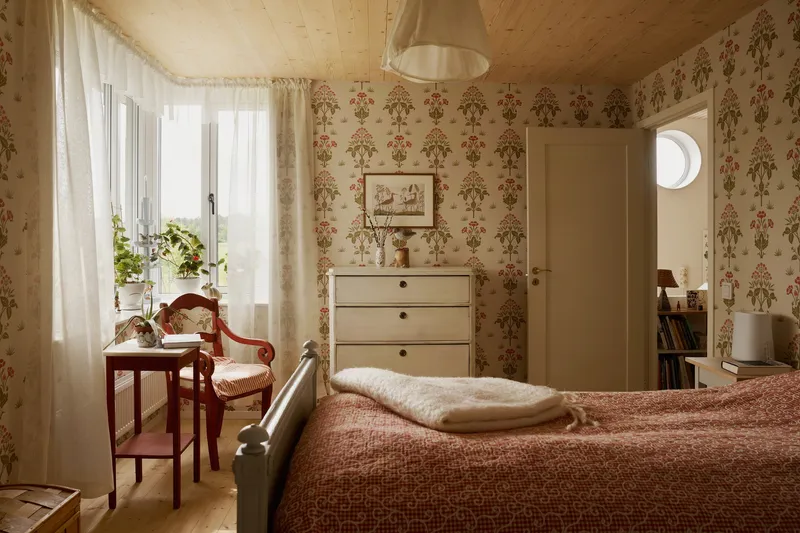
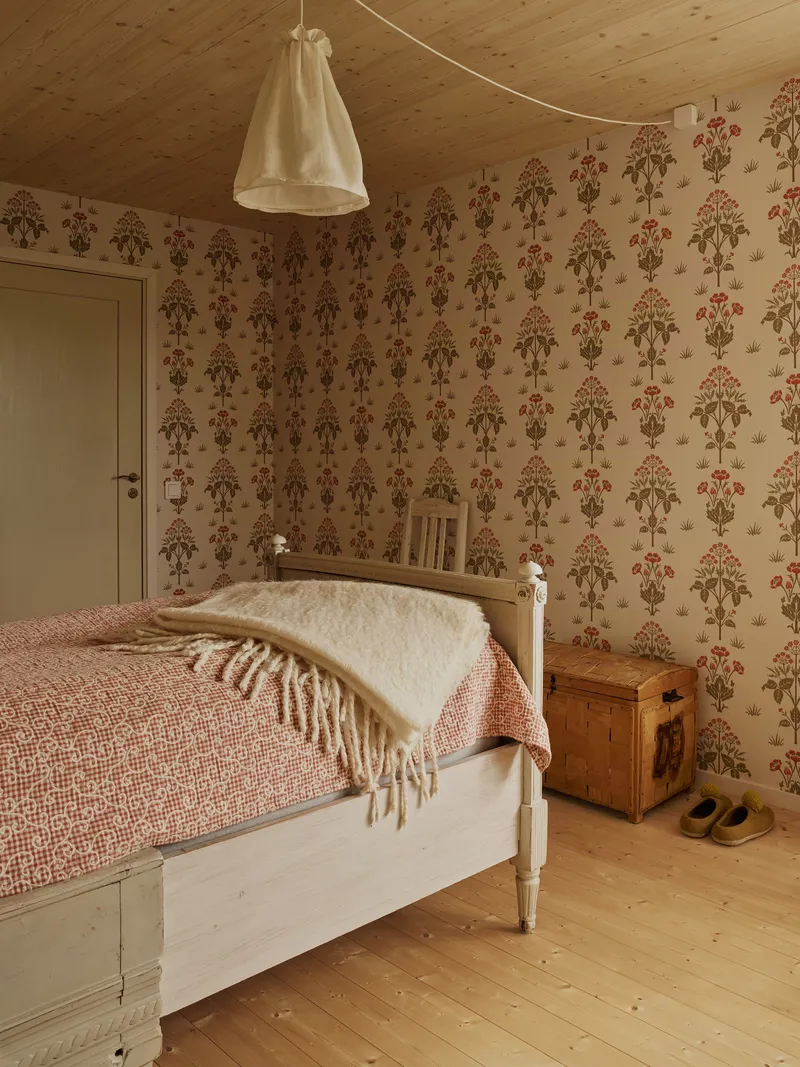

The bedrooms reveal a different register. Botanical wallpaper in soft florals lines the walls, meeting exposed timber ceiling planks without a cornice or trim. Sheer curtains filter the northern light, and a fabric pendant lamp hangs low. These rooms are unabashedly decorative, and the combination of patterned paper with raw timber structure avoids the sterility that afflicts so many contemporary Scandinavian interiors.
A stairwell with a triangular skylight, a white petal pendant lamp, and a gridded tile floor pattern captures the house's tonal range in a single frame. Strombro is not afraid of ornament, but every decorative choice serves a spatial purpose: the tile anchors the foot of the stair, the skylight draws the eye up, the pendant provides a human-scale focal point in a tall void. Decoration here is not applied but composed.
Vertical Moments
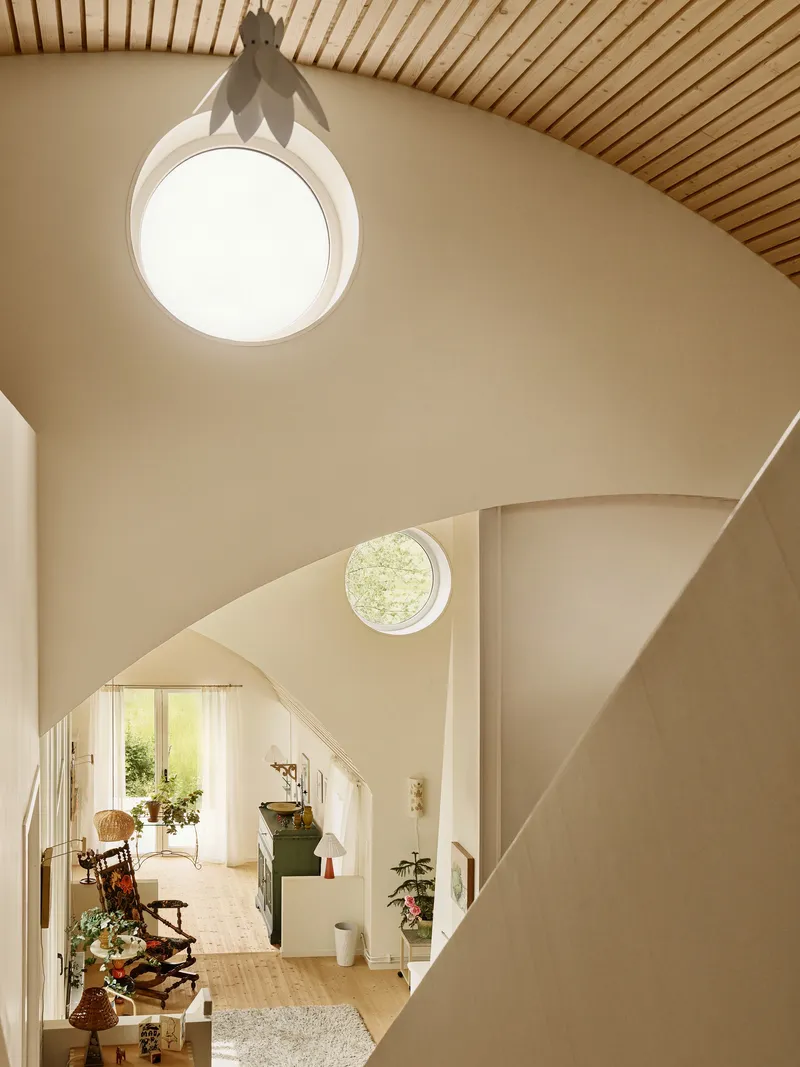
A view down through the double-height space, with circular windows stacked on the end wall and a pendant lamp suspended in the void, captures the sectional ambition hidden inside the modest plan. The barrel vaults create height where a conventional pitched roof would not, and Strombro exploits that height to introduce mezzanine-level openings and cross-views between rooms. In a 210 square meter house, these vertical connections make the difference between feeling compact and feeling cramped.
Why This Project Matters
Villa Färingsö is a reminder that small residential projects remain one of architecture's most potent laboratories. With a clear structural idea (CLT barrel vaults), a consistent material palette (timber slats, white cladding, green metal), and a willingness to embrace ornament, Strombro Building Workshop has produced a house that feels neither generic nor eccentric. It belongs to its Swedish landscape without mimicking vernacular forms, and it serves its artist client without performing the cliché of the creative's retreat.
The project also demonstrates the quiet potential of CLT beyond the mid-rise apartment blocks where it typically appears. By fabricating their own panels and shaping them into vaults, Strombro collapses the distance between design and making. The result is a house where every surface carries the evidence of its construction, and where the pleasure of inhabitation is inseparable from the pleasure of craft. That synthesis is increasingly rare, and worth paying attention to.
Villa Färingsö, Artist's House by Strombro Building Workshop. Located in Sweden. 210 m². Completed in 2024. Photography by Andrea Singer.
About the Studio
Share Your Own Work on uni.xyz
If projects like this are the kind of work you want to make, uni.xyz is a place to publish your own, find collaborators, and enter design competitions.




Popular Articles
Popular articles from the community


The Earth Pod: 3D Printed Homes for Resilient Refugee Communities
The Earth Pod reimagines refugee housing through 3D printed homes made from clay, combining resilience, self-sufficiency, and rapid shelter.

The Musturak Paradise: Senior Living Architecture for a Connected Future in Temara, Morocco
The Musturak Paradise reimagines senior living architecture in Temara via private homes, social spaces, culture, community, and shared care.

Co-life: Sustainable Architecture for Age-Friendly Community Living
Co-life reimagines sustainable architecture for seniors through courtyards, rammed earth, shared gardens, and spaces designed for belonging.

Riyadh For All: Intergenerational Urban Design for Active Aging in Rabat
Riyadh For All reimagines urban design in Rabat with intergenerational co-living, adaptive courtyards, and Moroccan cultural exchange today.


Similar Reads
You might also enjoy these articles

Bao Huynh Watercolor Atelier: A Serene Art Retreat in Hội An
Bao Huynh Watercolor Atelier in Hội An blends multifunctional art spaces, sustainable design, local materials, and family-friendly living in a serene environment.

Atelier Macri Concept Store Interior Design by CASE-REAL
Atelier Macri store features a "ko" counter, walnut wood details, cork displays, blending retail, gallery, and seamless customer experiences.

Manuel Vargas Izquierdo Stadium and High-Performance Sports Center: Architectural Excellence in Jalpa de Méndez
The Manuel Vargas Izquierdo Stadium blends sustainable design, inclusive sports facilities, and cultural-inspired architecture, revitalizing Jalpa de Méndez’s public spaces.
KAKR Buluh Awar Hall: Revitalizing Community and Ecology Through Bamboo Architecture
Community built bamboo hall revitalizes Buluh Awar village, empowering youth, restoring ecology, celebrating vernacular craftsmanship through sustainable architecture and culture.




Comments (0)
Please login or sign up to add comments
No comments yet. Be the first to comment!