

Studio APL and Likou Architecture Float a Metal Lotus Garden Over a Taitung Reservoir
A cycling rest station at Dapo Pond layers gabion stone, rippling canopies, and rice-field views into a roadside sanctuary on Taiwan's east coast.


Taiwan's east coast cycling corridor runs for hundreds of kilometers through some of the island's most dramatic terrain: volcanic peaks, deep gorges, and wide alluvial plains planted with rice. Infrastructure along the route tends to be utilitarian, so the appearance of a genuinely considered piece of architecture at Dapo Pond in Taitung County is worth paying attention to. Designed by Studio APL and Likou Architecture, the Tie-Ma Cycling Station is a public rest stop that refuses to behave like one.
What is actually interesting here is the negotiation between lightness and weight. The project sits at the edge of a reservoir bordered by rice paddies, and the architects have answered that horizontal landscape with an undulating metal canopy that reads, from the air, like lotus leaves settled on the surface of the water. Beneath those roofs, gabion stone walls and sunken concrete basins pull the eye downward, grounding the structure in the geology of the site. The result is a building that hovers and sinks simultaneously, never quite resolving into a single posture.
The Canopy as Landscape
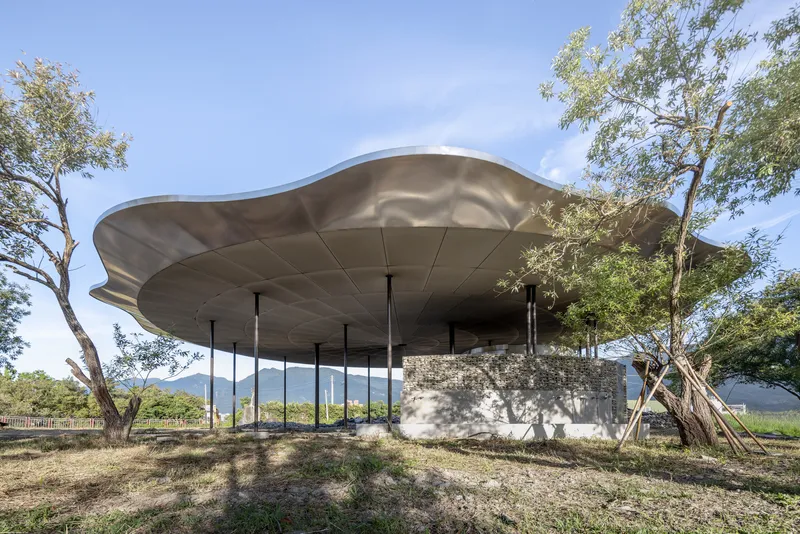
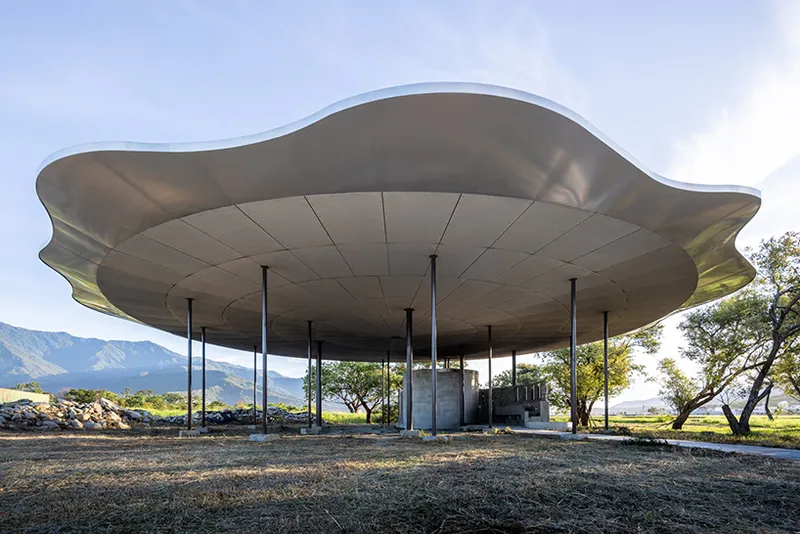
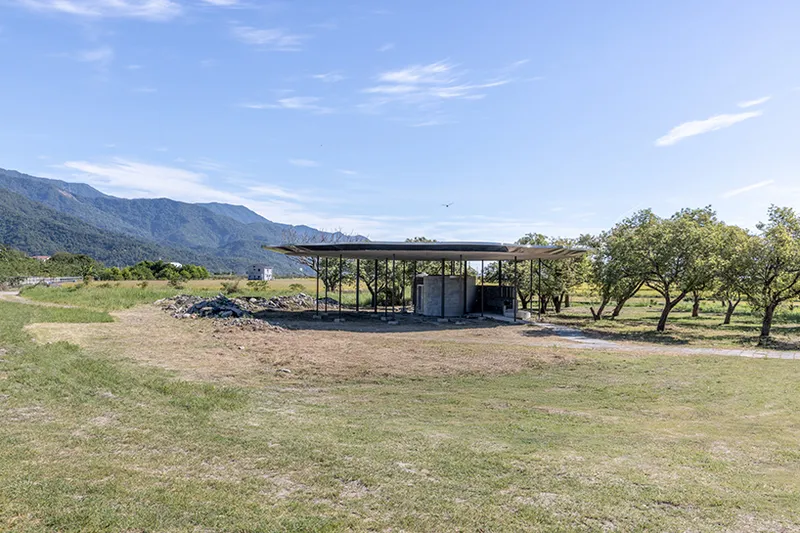
The most immediate gesture is the roof. Slender black columns, barely thicker than the surrounding tree trunks, carry panels of metal that ripple and fold like a fabric caught mid-billow. Seen from ground level, the canopy appears to float: its edges lift and dip in a rhythm that mirrors the distant mountain ridgeline. The architects clearly understood that in a landscape this open, any roofline would become a horizon line. Rather than fighting the panorama, the canopy echoes it.
From across the rice fields, the station registers as little more than a thin, shimmering datum among the trees. That restraint is deliberate. The building does not announce itself as a destination. It announces itself as a pause, a momentary thickening of the landscape where cyclists can stop, fill a water bottle, and sit in shade.
Gabion Walls and Grounded Materiality
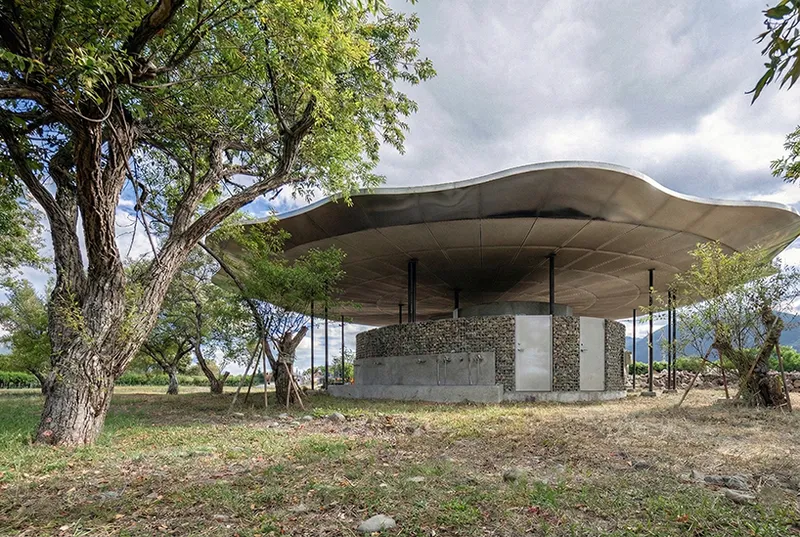
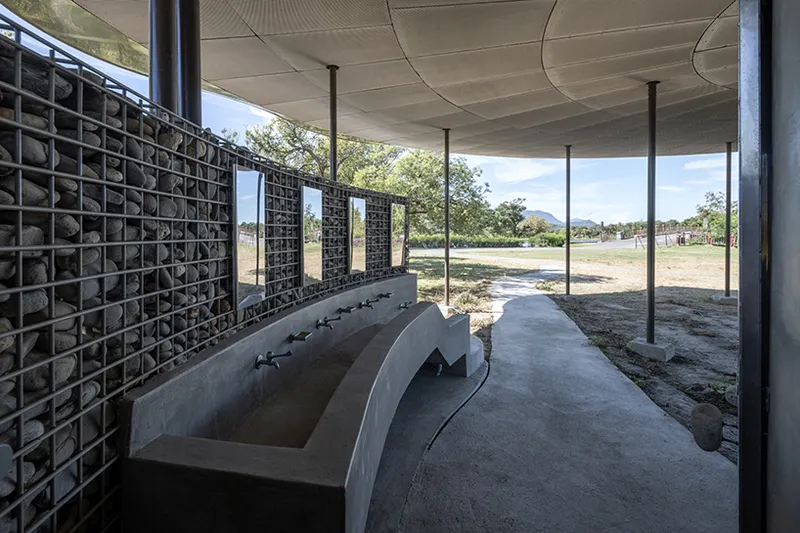
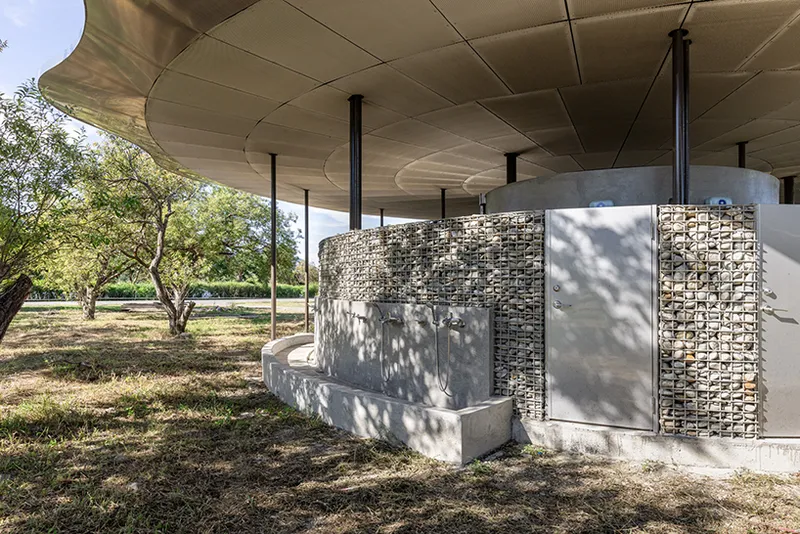
If the canopy is all air and curve, the ground plane is all mass and texture. Gabion baskets filled with local stone form walls, screens, and enclosures that anchor each pavilion to the earth. The contrast is productive: polished metal against rough aggregate, slick panels against the irregular silhouettes of trapped rock. These are not decorative gabions. They serve as thermal mass in a subtropical climate, as privacy screens for service cores, and as structural buttressing for the concrete elements behind them.
The stone-clad walls absorb and scatter dappled light through the trees, giving the interiors a mottled, cave-like quality that feels cool even before you step out of the sun. Studio APL and Likou Architecture appear to have treated material selection as a climate strategy rather than an aesthetic afterthought.
Water as Program
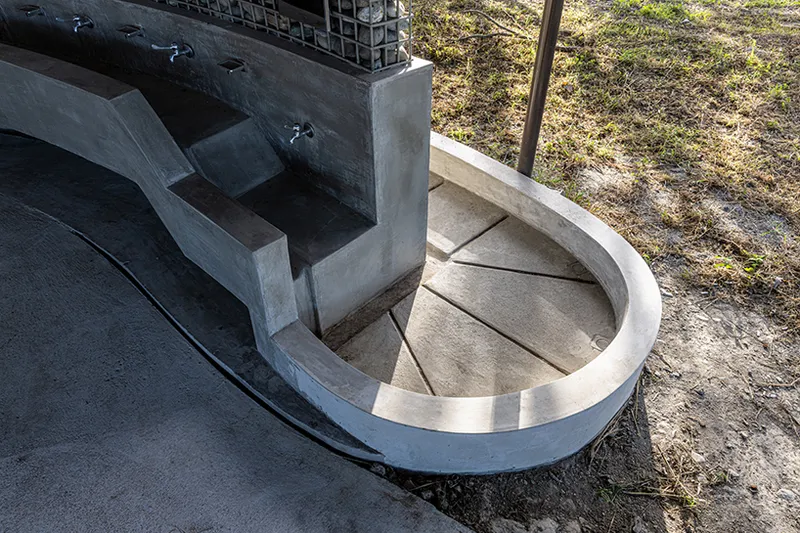
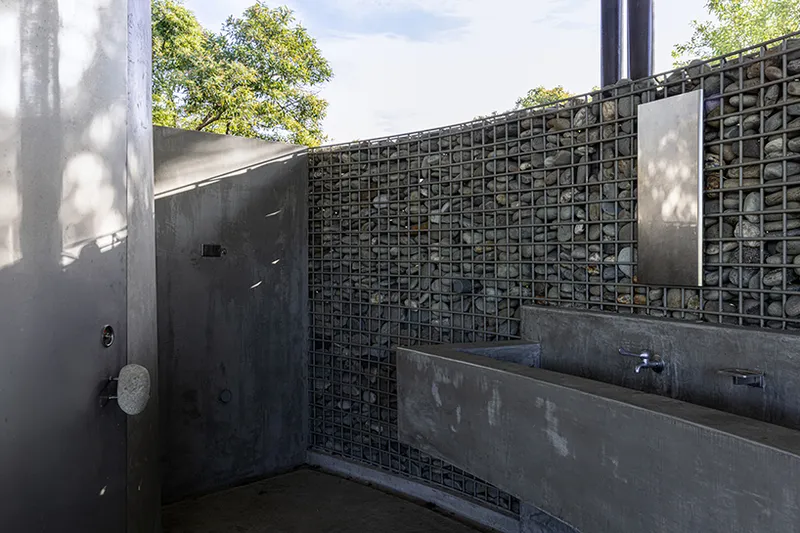
Water is everywhere in this project, and not only as scenery. A sunken concrete basin with a stepped trough collects and channels rainwater beneath the canopy, turning drainage into a sculptural feature. An outdoor shower enclosure, walled in concrete with a gabion screen, lets cyclists rinse off in the open air while leaf shadows pattern the floor. These are modest amenities, but they are executed with the kind of spatial care usually reserved for gallery interiors.
The proximity of Dapo Pond itself makes the water program feel coherent rather than forced. Irrigation canals feed the surrounding rice paddies; the station taps into that same hydrological logic, treating water as something to be seen, heard, and used rather than hidden in pipes.
Aerial Scale and the Rice-Field Context
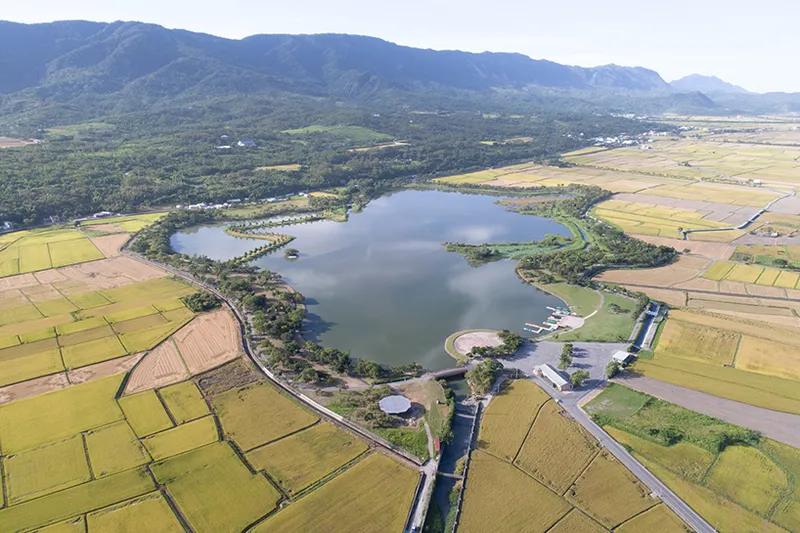
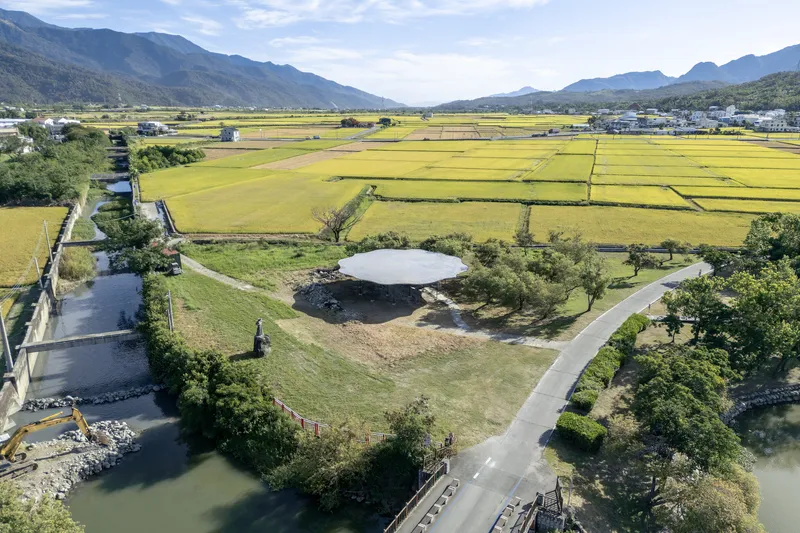
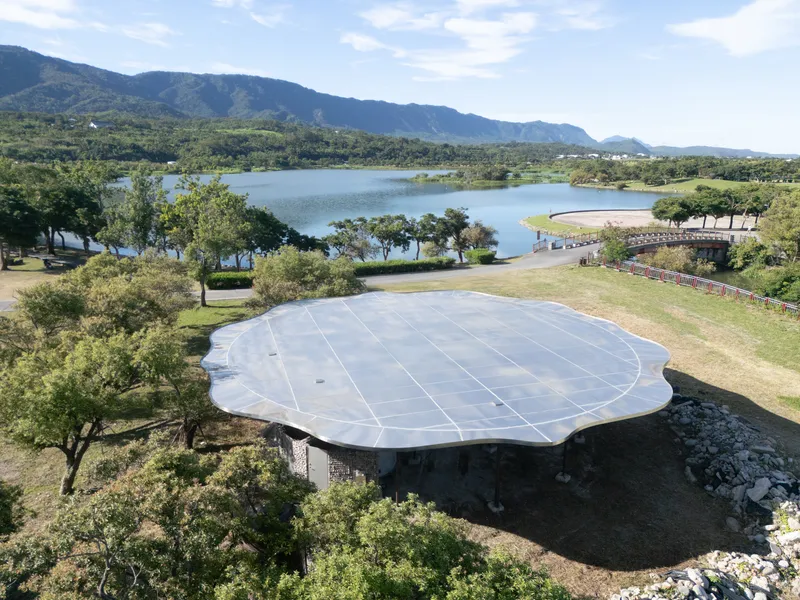
Seen from above, the station's circular pavilions sit like coins dropped into a quilt of golden and green paddies. The geometry is deliberate: round forms reduce the visual footprint within the orthogonal grid of the fields, and their radial symmetry means they present no dominant facade. No matter which direction a cyclist approaches from, the station offers the same profile. The triangular site, bounded by paths and canals, is treated as a garden plot, with trees, grass, and water features threaded between the built elements.
The mountain backdrop, visible in nearly every direction, turns the station into a kind of viewing platform. The architects kept the canopy low enough to frame rather than block those views, a calibration that only becomes clear when you see the project at the scale of the valley.
Structural Soffit and the View from Below
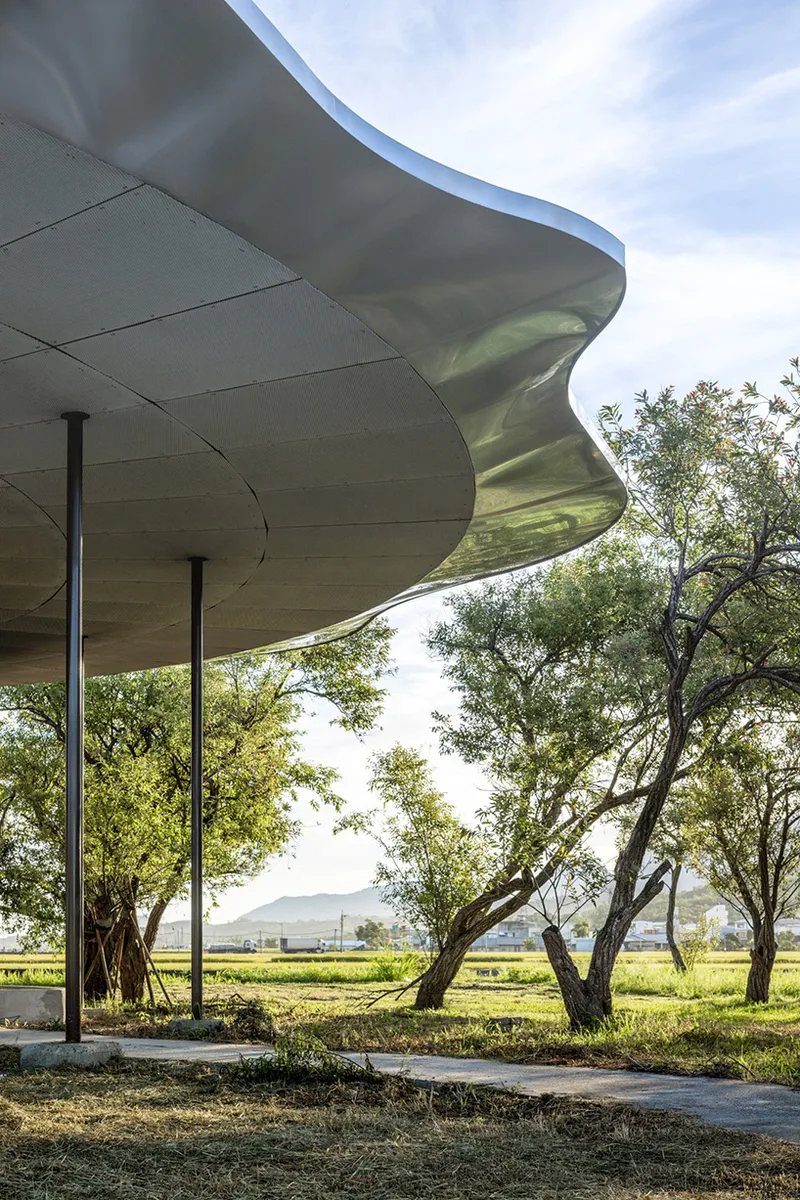
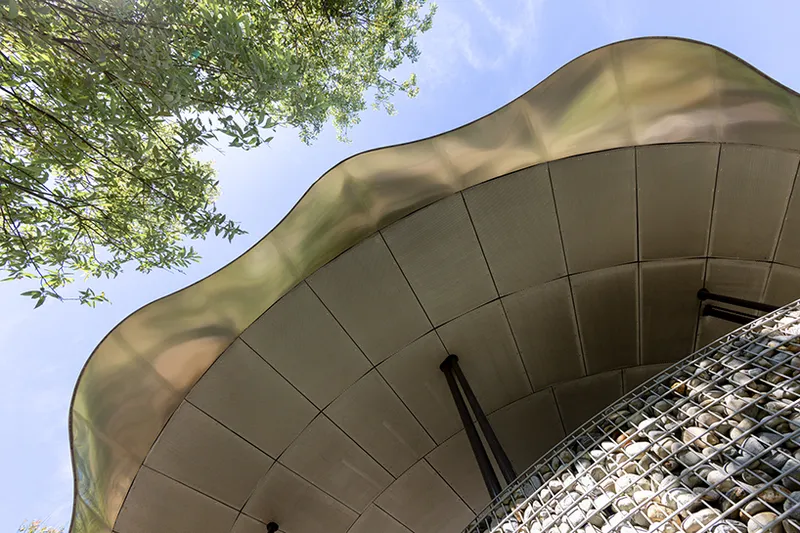
The underside of the canopy is where the building does its most nuanced work. Paneled ribs radiate outward from the column heads, creating a soffit pattern that shifts as you walk beneath it. At dusk, the warm light of the lowering sun catches the ridges and throws the valleys into shadow, producing a texture that changes by the minute. Overhanging branches from mature trees break through the roof's edge, reinforcing the sense that the structure grew around the existing landscape rather than displacing it.
For a cyclist arriving tired and sun-beaten, this is the first thing overhead: a patterned ceiling in filtered green light, with gabion walls on one side and open grassland on the other. It is a generous threshold between effort and rest.
The Field Boundary
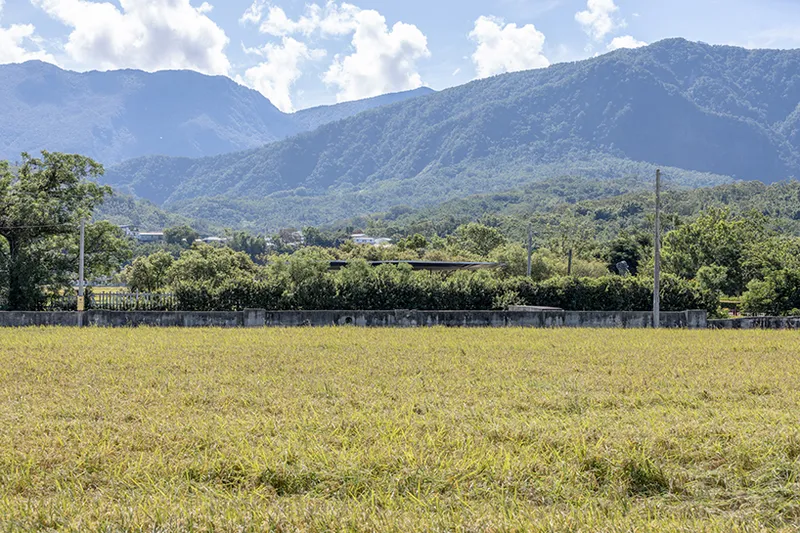
A low concrete wall traces the boundary between the station's grounds and the adjacent rice fields, establishing a clean line where architecture ends and agriculture begins. The wall is barely waist-high, enough to define territory without impeding the view. On one side, golden stalks bend under their own weight. On the other, mown grass and scattered trees lead to the pavilions. The transition is handled with the kind of understated care that separates a landscape project from a building that happens to be outside.
Plans and Drawings
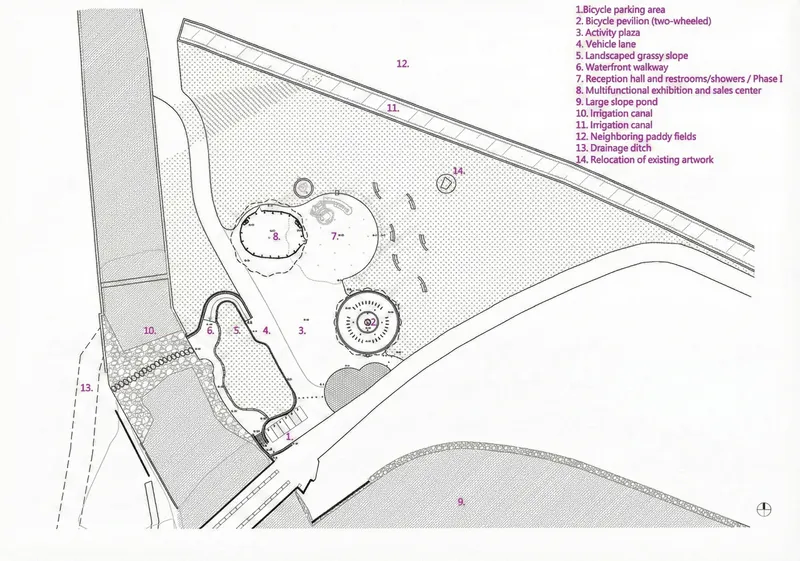
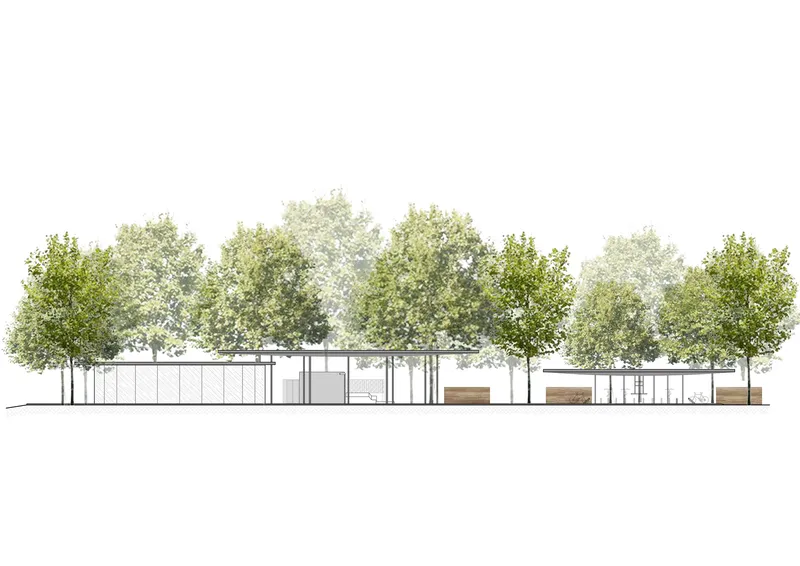
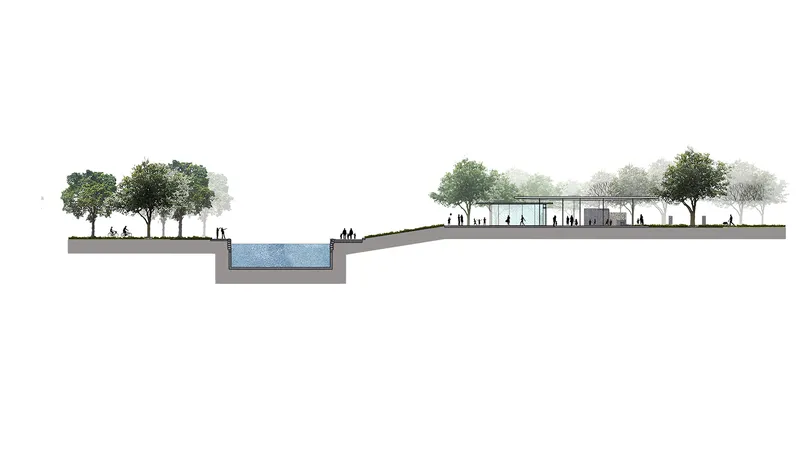
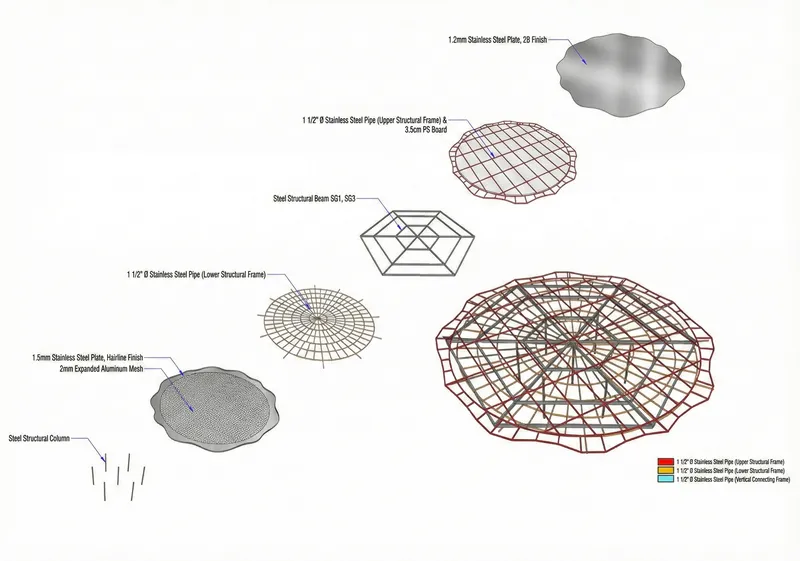
The site plan reveals how carefully the circular pavilions are positioned relative to the existing pond, irrigation canals, and pathways. Each structure occupies its own clearing within a belt of trees, connected by meandering routes rather than axial paths. The section drawing confirms the relationship between the canopy, the sunken water feature, and the surrounding grade, showing how the floor level drops just enough to create intimacy beneath the floating roof. The axonometric exploded view breaks the structure into its component layers: steel frame, mesh screen, roof finish, and gabion infill, exposing a construction logic that is additive and legible.
Why This Project Matters
Cycling infrastructure is, almost everywhere, an afterthought: a bench, a tap, a signpost. The Tie-Ma Cycling Station argues that a rest stop can be a work of architecture without being pretentious or overbuilt. Studio APL and Likou Architecture invested real spatial intelligence in a program that most firms would resolve in a single sketch. The result is a place that rewards attention, from the scale of the valley down to the shadow cast by a single gabion basket.
More broadly, the project demonstrates what happens when landscape architecture and building architecture are pursued as a single discipline rather than handed off between consultants. The canopy, the water features, the planting, and the field boundaries all participate in the same spatial idea: a thin layer of human intervention floating above a deep, productive ground. For a profession that increasingly talks about working with landscape, this is a concrete example of what that can look like.
Tie-Ma Cycling Station at Dapo Pond, designed by Studio APL and Likou Architecture. Taitung County, Taiwan. Completed 2024. Photography by YuChen Chao Photography.
About the Studio
Share Your Own Work on uni.xyz
If projects like this are the kind of work you want to make, uni.xyz is a place to publish your own, find collaborators, and enter design competitions.


Popular Articles
Popular articles from the community

Opera on the Sea: Driftwood Logic Shapes a Timber Opera House on Estonia's Coast
Trevor Orgill's opera house translates the entangled drift of floating timber into a civic building where wood, water, and music converge.
Cloaked Colonization: A Mobile Underwater Habitat That Moves Like a Fish
Micah Abaya's shortlisted EHC Pacific entry reimagines ocean settlement as a dispersed network of self-sustaining architectural organisms.
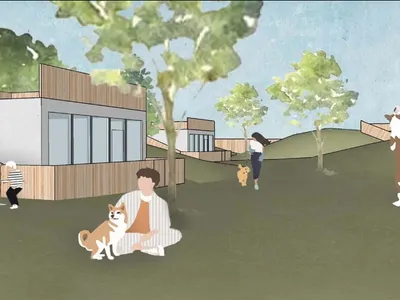
Temporary Home for Dogs: A Reversed Zoo Rethinks Animal Shelter Architecture
In Bucharest, a sinuous corridor and freed landscape flip the logic of containment, designing a shelter that works to make itself unnecessary.

Singing Woman: Contemporary Architecture Inspired by Estonia’s Voice and the Sea
Singing Woman turns Estonia’s song culture into flowing opera house architecture, blending public life, landscape, sea, and national memory.

Similar Reads
You might also enjoy these articles

Bao Huynh Watercolor Atelier: A Serene Art Retreat in Hội An
Bao Huynh Watercolor Atelier in Hội An blends multifunctional art spaces, sustainable design, local materials, and family-friendly living in a serene environment.

Atelier Macri Concept Store Interior Design by CASE-REAL
Atelier Macri store features a "ko" counter, walnut wood details, cork displays, blending retail, gallery, and seamless customer experiences.

Manuel Vargas Izquierdo Stadium and High-Performance Sports Center: Architectural Excellence in Jalpa de Méndez
The Manuel Vargas Izquierdo Stadium blends sustainable design, inclusive sports facilities, and cultural-inspired architecture, revitalizing Jalpa de Méndez’s public spaces.

KAKR Buluh Awar Hall: Revitalizing Community and Ecology Through Bamboo Architecture
Community built bamboo hall revitalizes Buluh Awar village, empowering youth, restoring ecology, celebrating vernacular craftsmanship through sustainable architecture and culture.

Comments (0)
Please login or sign up to add comments
No comments yet. Be the first to comment!