
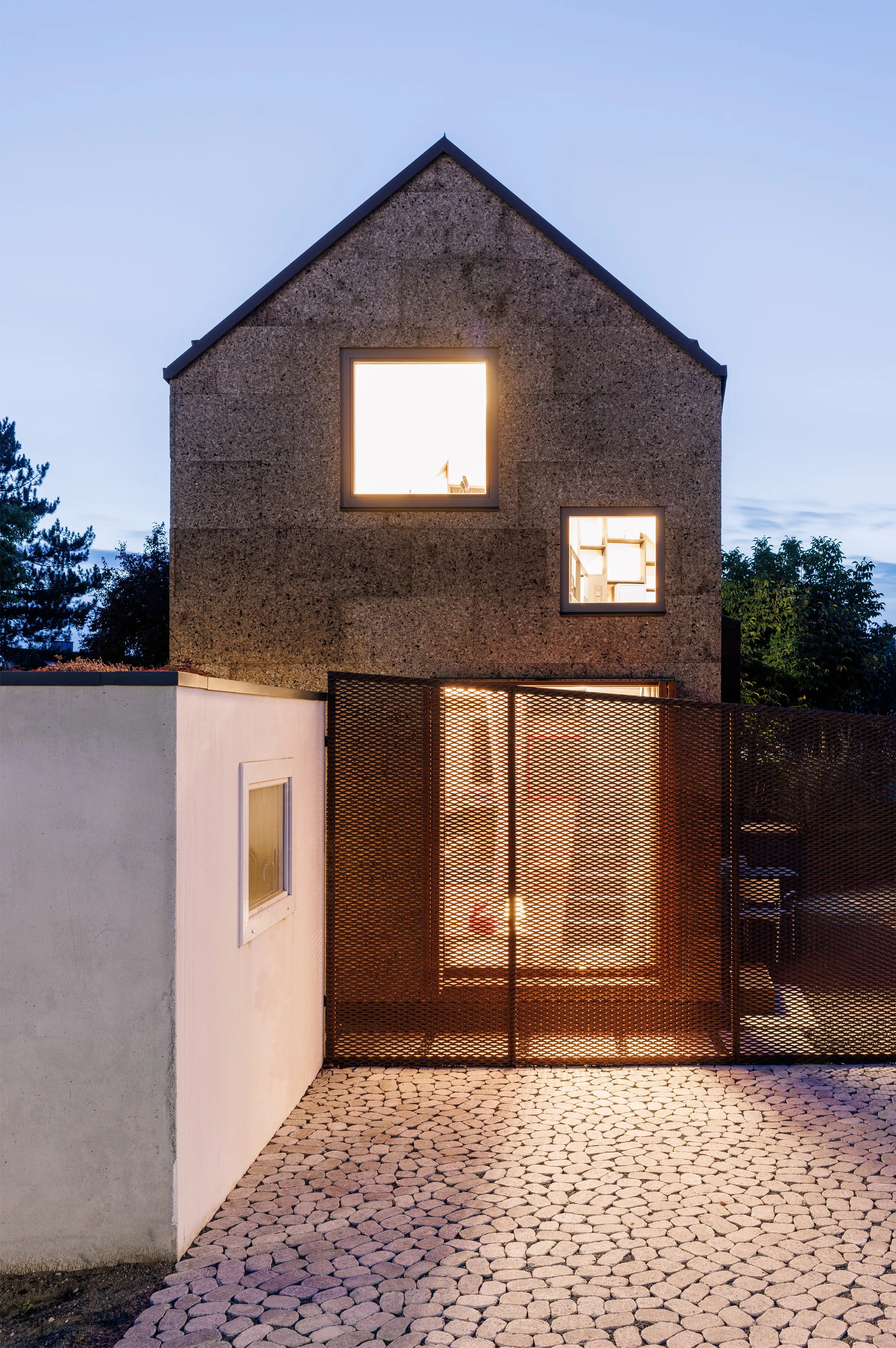
Studio Bauform Extends a Corten House in Homburg with a Cork-Clad Volume and Folded Roof
A 35-square-meter addition in southwestern Germany reinterprets the host building through cork aggregate, black steel, and a restrained gable form.

Extensions to single-family houses rarely get the editorial attention they deserve. They sit in the mundane gap between full commissions and interior renovations, constrained by budget, planning codes, and the gravitational pull of whatever already stands on site. The Cork House by studio bauform in Homburg, Germany, is only 35 square meters, but it punches well above that footprint in terms of material ambition and spatial clarity. Completed in 2025, the project adds living space to an existing corten-clad residence without mimicking or competing with the host structure. Instead, it proposes a sibling: similar in posture, distinct in skin.
Lead architect Jürgen Lehmeier, working with designers Sebastian Freyer and Diana Dinkel, chose cork aggregate as the primary facade material, a decision that gives the addition its name and its character. Where the original house is dark and weathered, the new volume is warm, porous, and textured in a way that reads as geological rather than industrial. A perforated copper screen, black steel staircase, and exposed timber ceiling structure complete a material palette that is both precise and deliberately tactile. The result is a small building that feels neither precious nor provisional.
Cork Against Corten: A Material Conversation
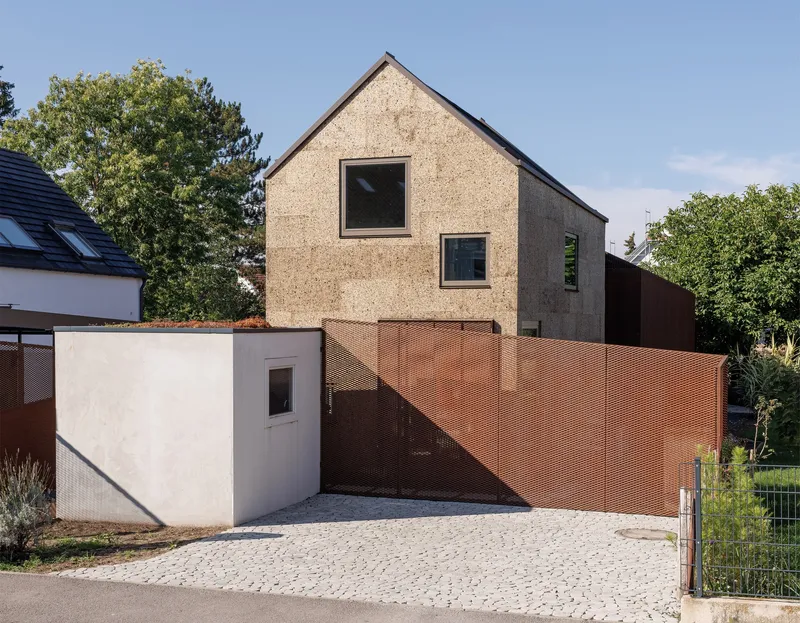
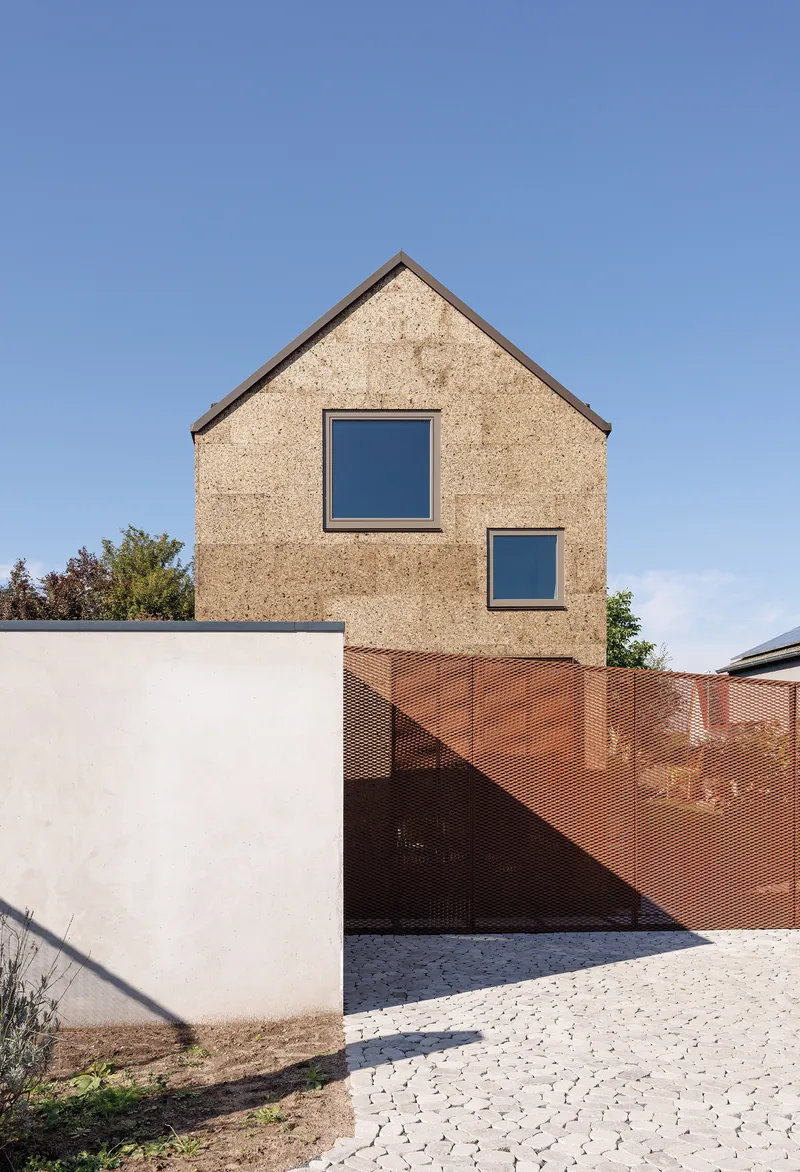
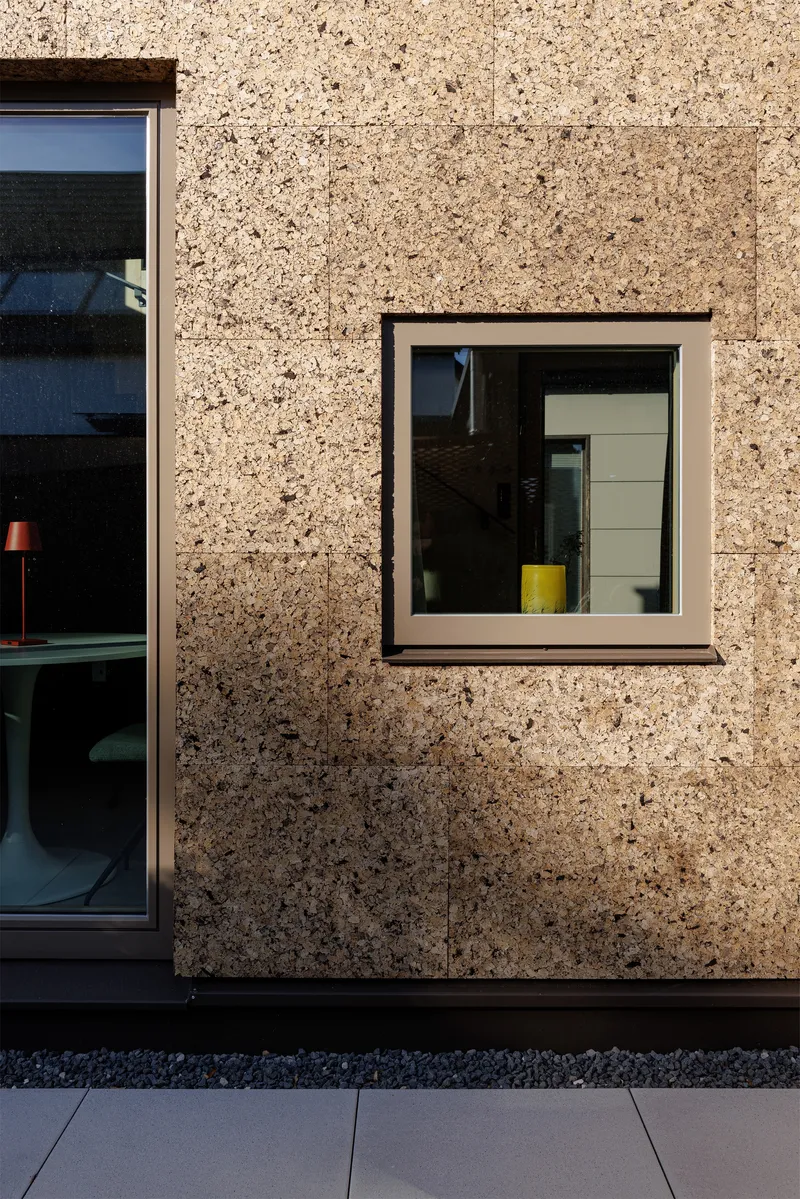
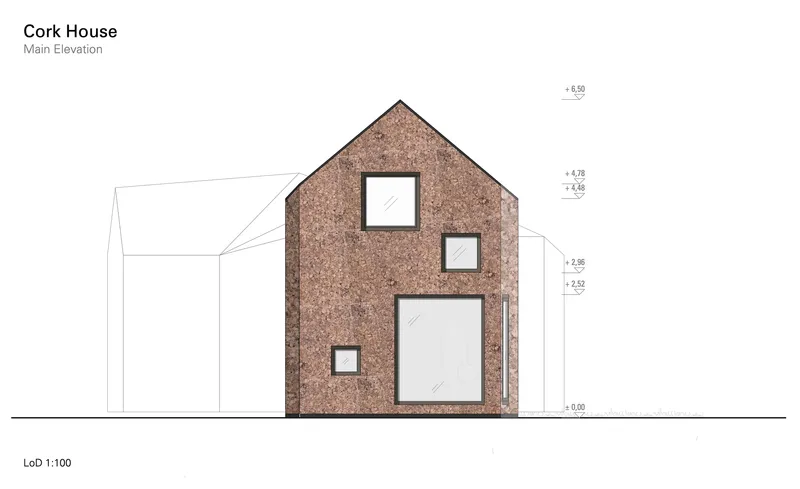
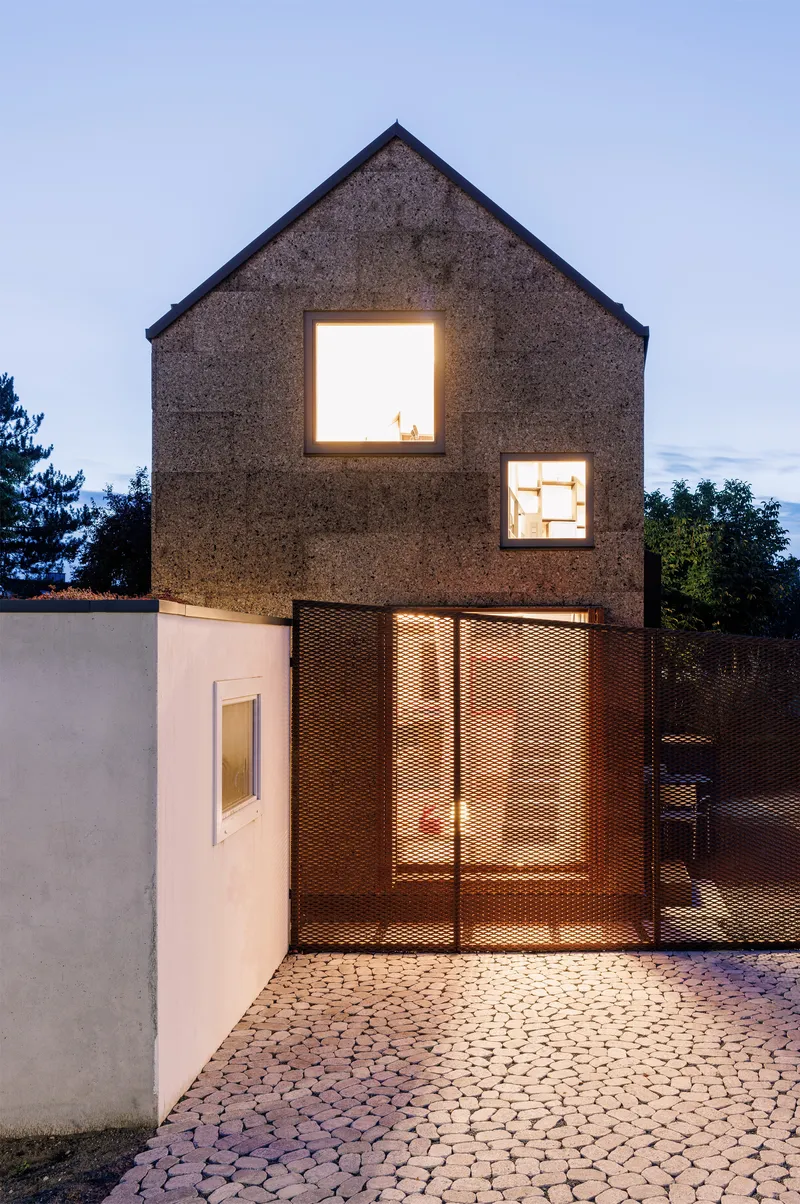
The street-facing gable facade is the building's most assertive gesture. Cork aggregate wraps the entire volume in a rough, granular surface that catches light differently at every hour. Two aluminum-framed windows are punched asymmetrically into this surface, their clean edges amplifying the raw quality of the surrounding material. Below, a white stucco base grounds the volume and marks the entry threshold, a crisp horizontal datum that prevents the cork from reading as too monolithic.
The contrast with the existing corten house is intentional and calibrated. Both materials patinate over time, both are earth-toned, but their textures and densities are opposites. Corten is flat, sealed, and reflective in rain. Cork is porous, absorptive, and slightly irregular up close. Studio bauform treats this difference as the entire point: the addition is legible as new without announcing itself as foreign.
The Perforated Copper Screen
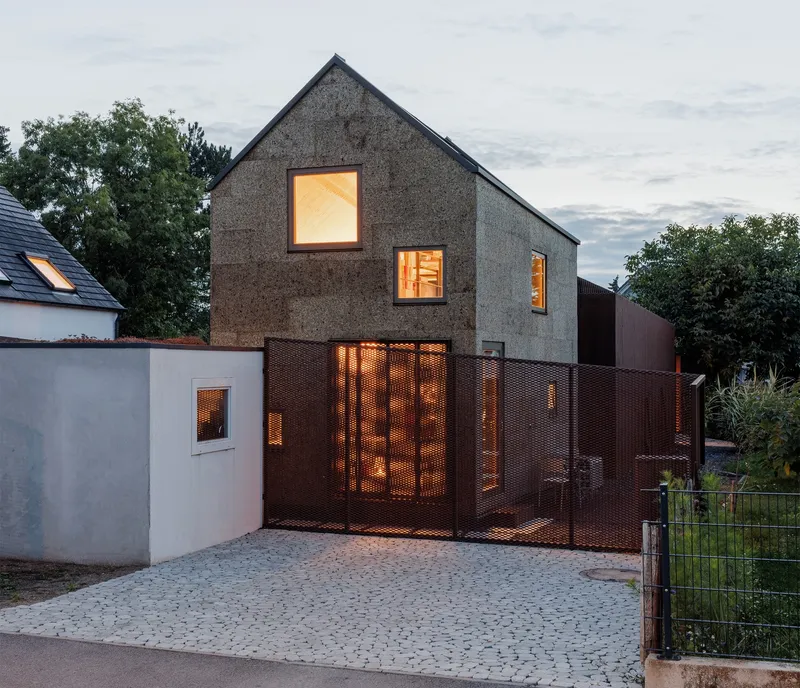
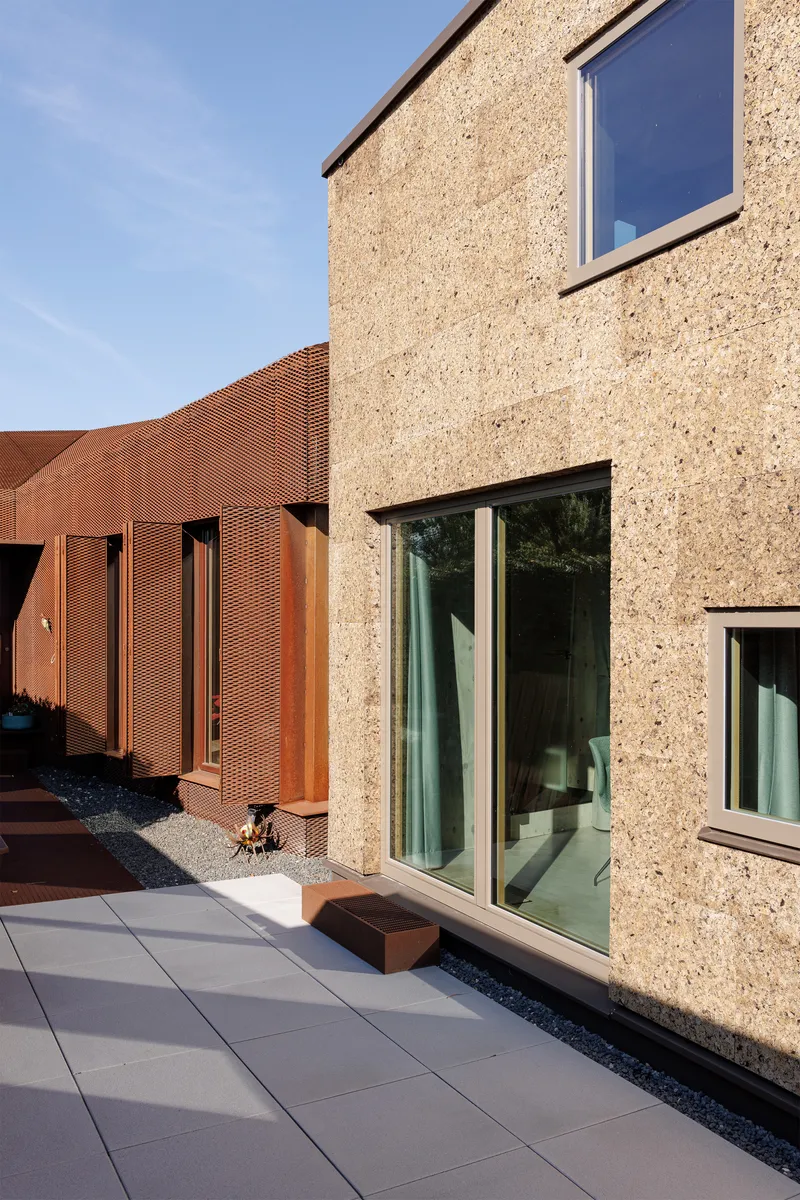
A perforated copper screen wraps the courtyard side of the property, doubling as fence, gate, and privacy filter. At dusk, it transforms entirely. Light from the interior passes through the perforations in a controlled glow, turning the boundary into a lantern. During the day, the screen admits filtered light to the courtyard terrace while blocking direct sightlines from the street.
The courtyard itself is modestly scaled, paved in grey stone that meets the cork facade without a plinth or transition strip. A curved section of the copper screen softens the corner, hinting at a spatial generosity that the tight site does not literally afford. It is a detail that rewards attention: the curvature is slight enough to feel structural rather than decorative.
Interior: Timber, Black Steel, and Vertical Space
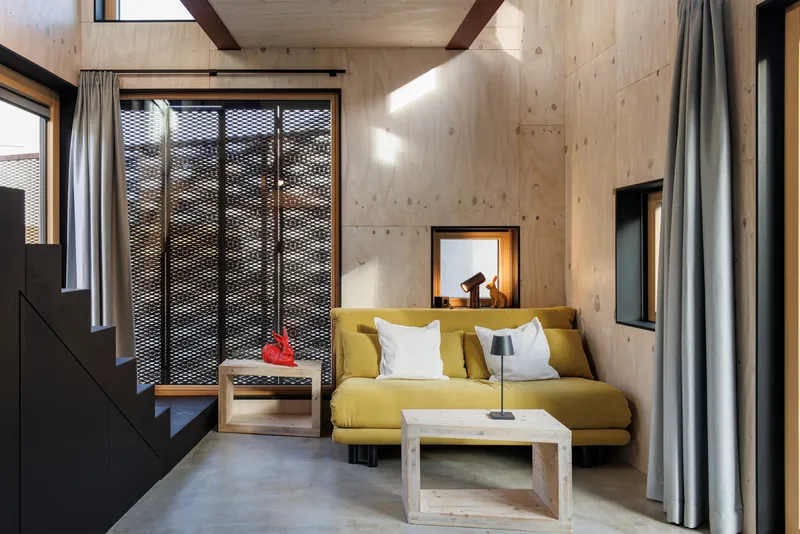
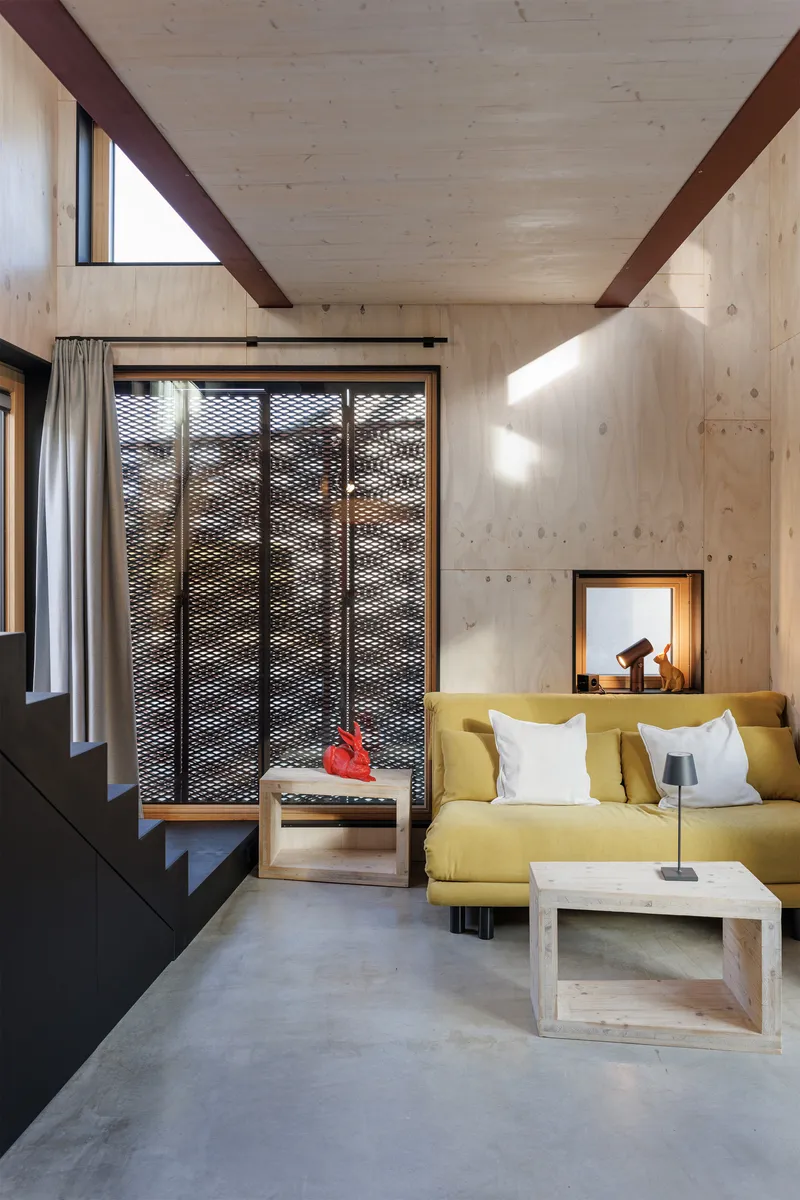
Inside, the 35 square meters are organized across two levels connected by an open-riser black steel staircase. The ground floor living room is the main social space, characterized by exposed timber ceiling beams running the full width and perforated metal sliding doors that echo the copper screen outside. A yellow sofa provides the only saturated color in an otherwise neutral palette of pale plywood, white walls, and black steel.
The timber ceiling structure is left exposed and unfinished, which is a smart move in a volume this compact. Concealing it behind drywall would have cost centimeters of headroom and erased the structural legibility that makes the room feel larger than its plan suggests. Natural daylight enters from both the gable windows and the sliding doors, creating a cross-ventilated volume that avoids the introverted feeling common to small extensions.
The Stair as Object
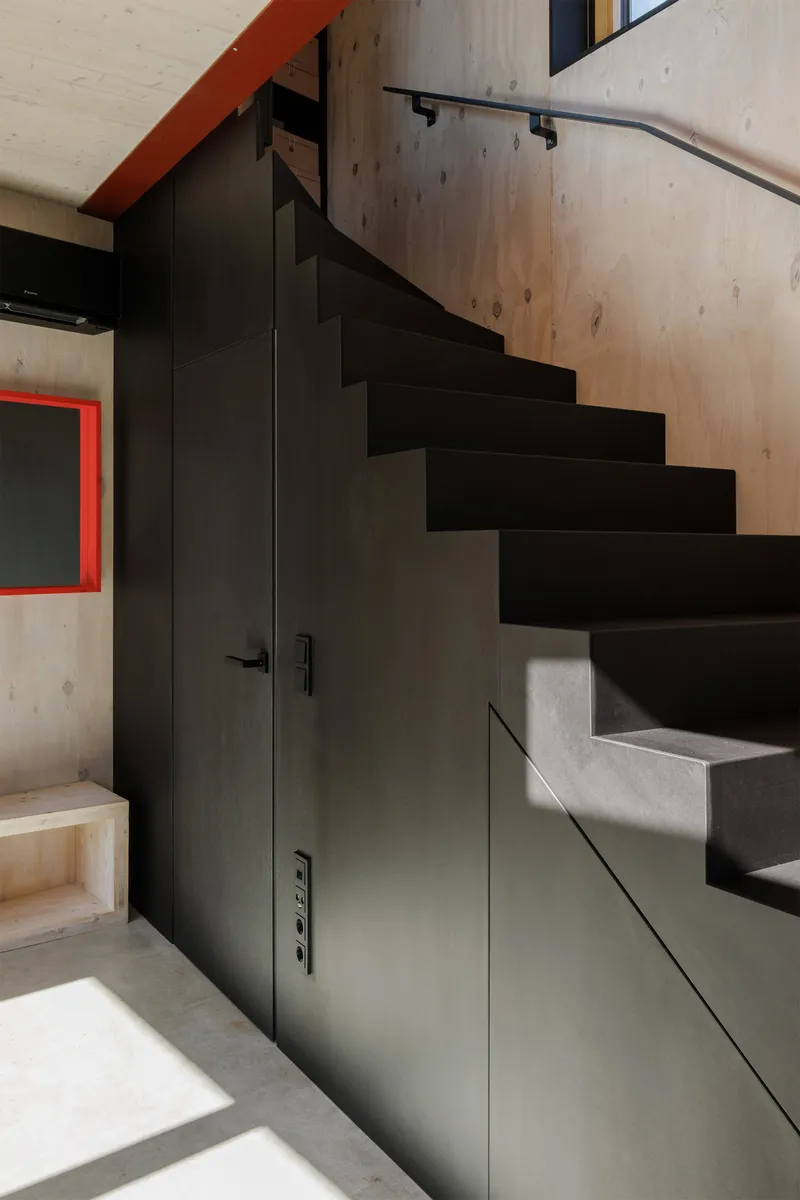
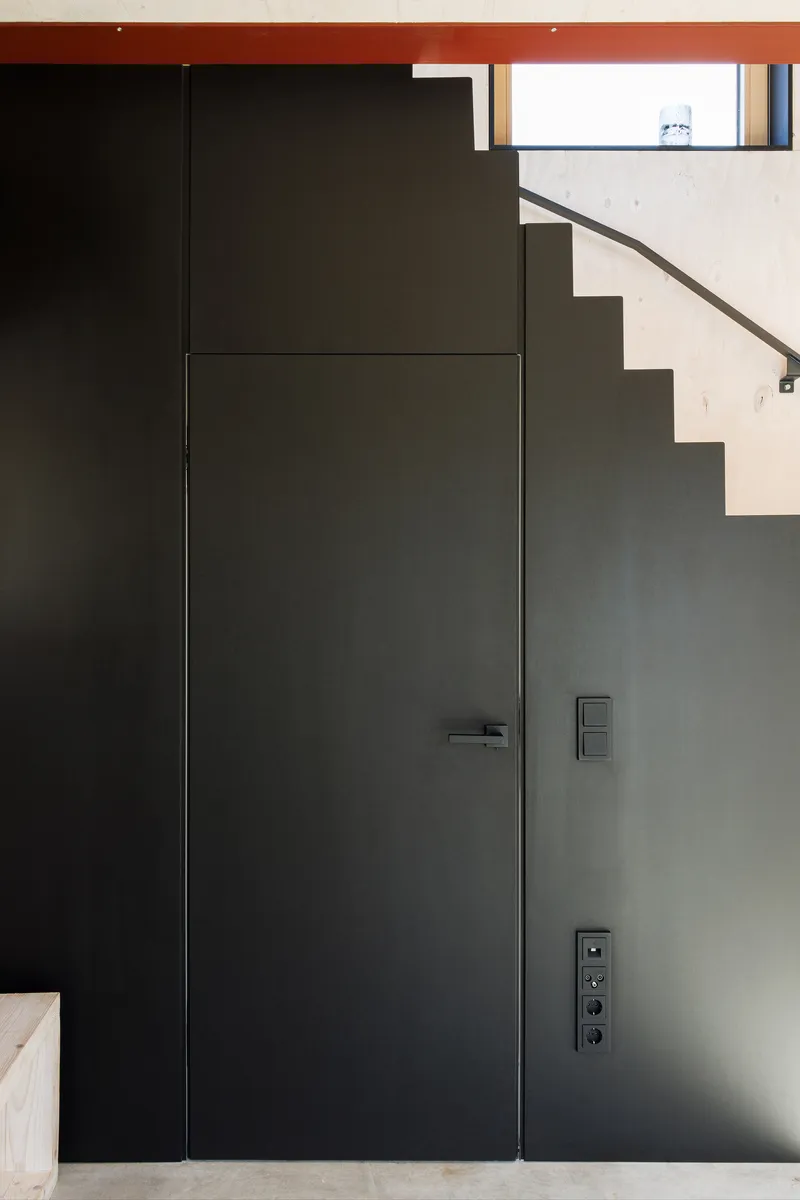
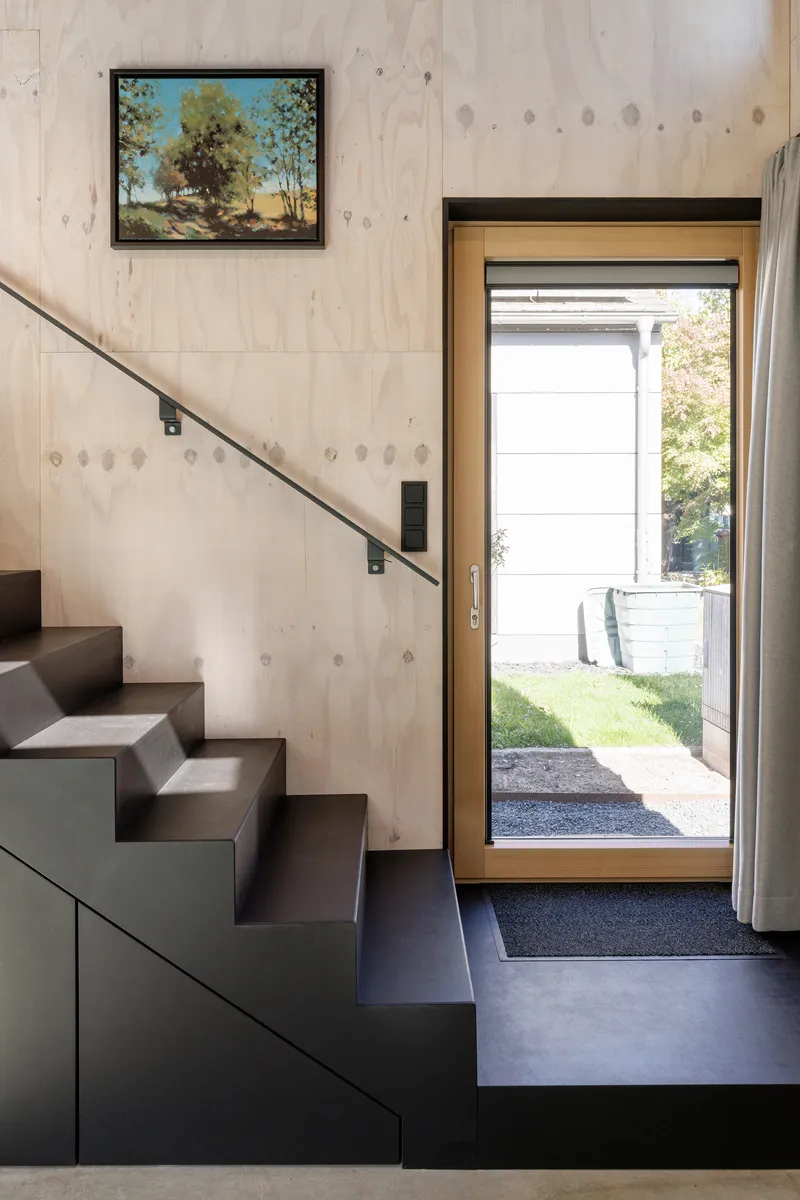
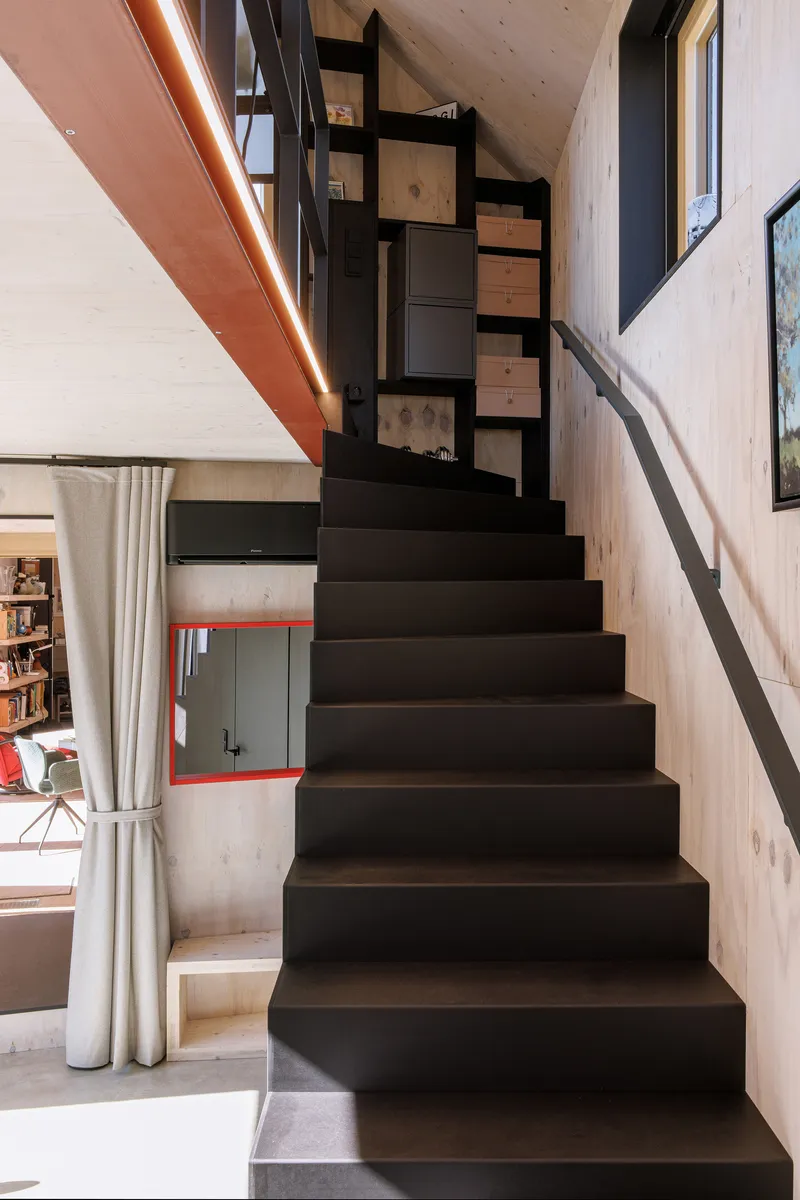
In a 35-square-meter building, the staircase cannot be treated as mere circulation. Studio bauform designs it as the spatial engine of the section. The black steel stair ascends through a double-height volume lined in light timber, its open risers keeping sight lines continuous from ground to roof. Beneath the treads, integrated storage cabinets reclaim every available cubic centimeter, their flush doors set into the pale timber wall so cleanly that they nearly disappear.
A flush black metal door beneath the stair offers access to what appears to be a service zone, its dark surface punctuated by a single red ceiling beam that introduces a moment of color without ceremony. At the base of the stair, an open timber-framed door reveals a garden view, anchoring the vertical circulation to the ground plane and the landscape beyond.
The Mezzanine Gallery
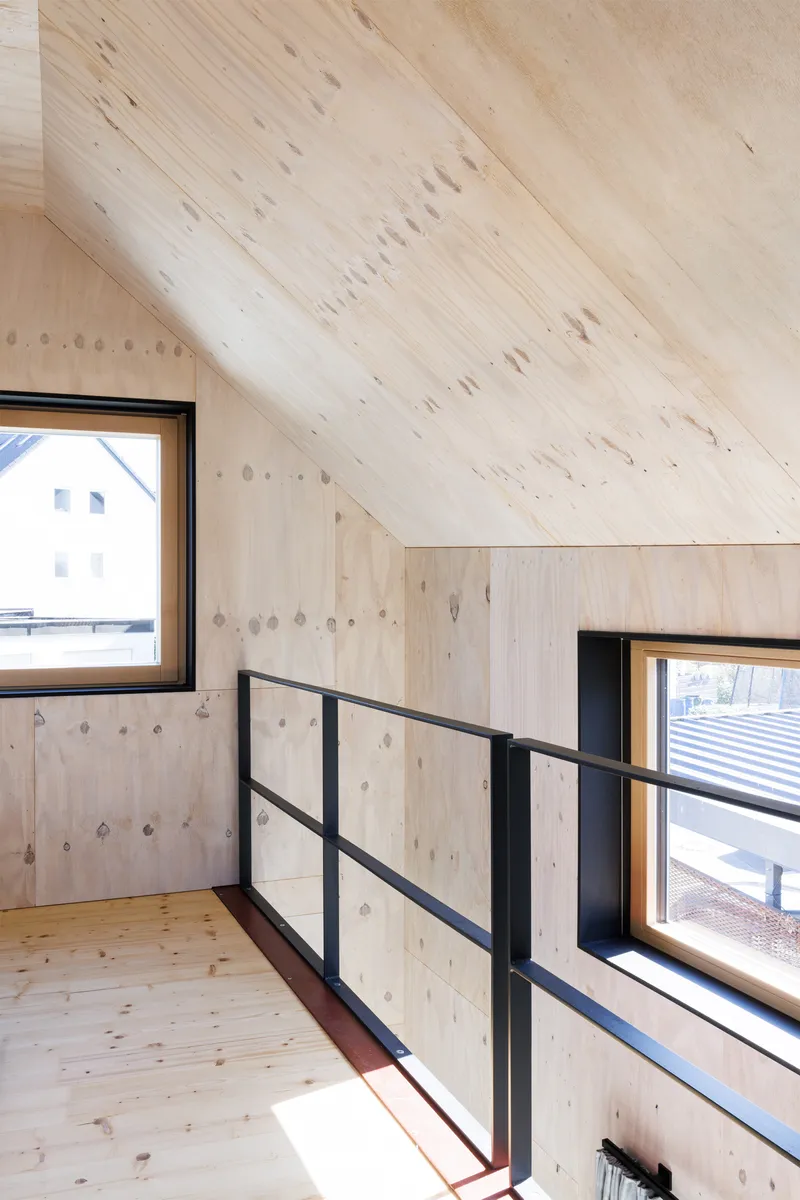
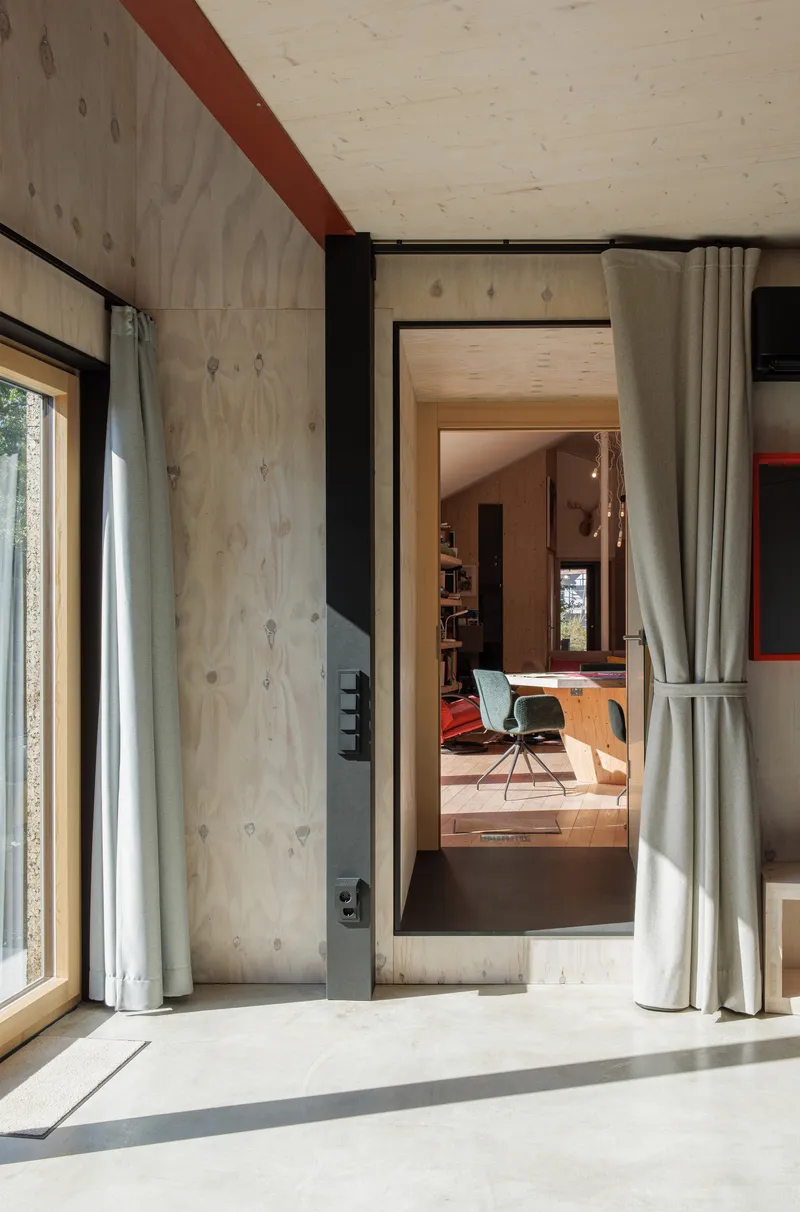
The upper level is a mezzanine gallery tucked under the pitched roof, its sloped timber ceiling compressing the space just enough to create a sense of shelter without claustrophobia. A black metal railing marks the edge where the mezzanine overlooks the double-height living room below, maintaining the visual connection between levels that keeps the small building feeling unified. Framed windows at this level bring in high-angle sunlight that washes down the timber surfaces.
A doorway framed in black steel leads through a white curtain into a workspace beyond, suggesting a layered sequence of privacy zones within the compact plan. The curtain is a low-tech move that works precisely because the architecture around it is so deliberate. Against the hard edges of steel and timber, the fabric reads as a considered choice rather than a compromise.
Plans and Drawings
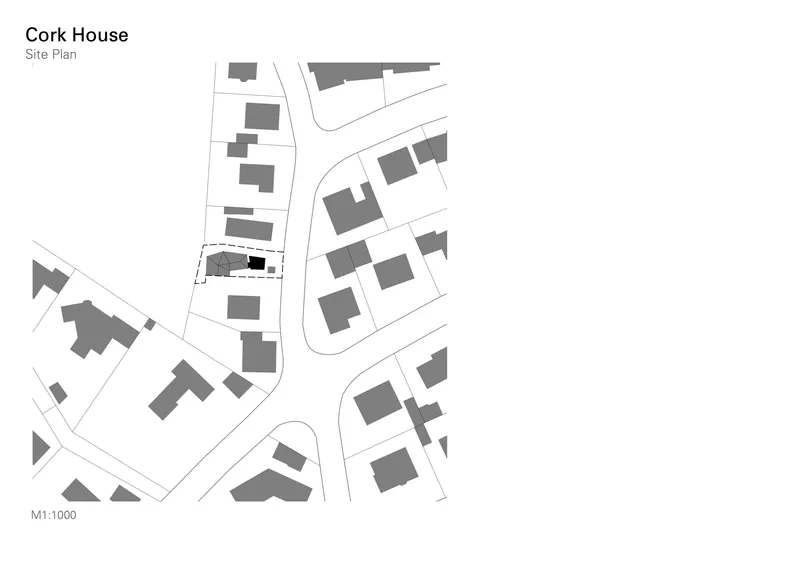
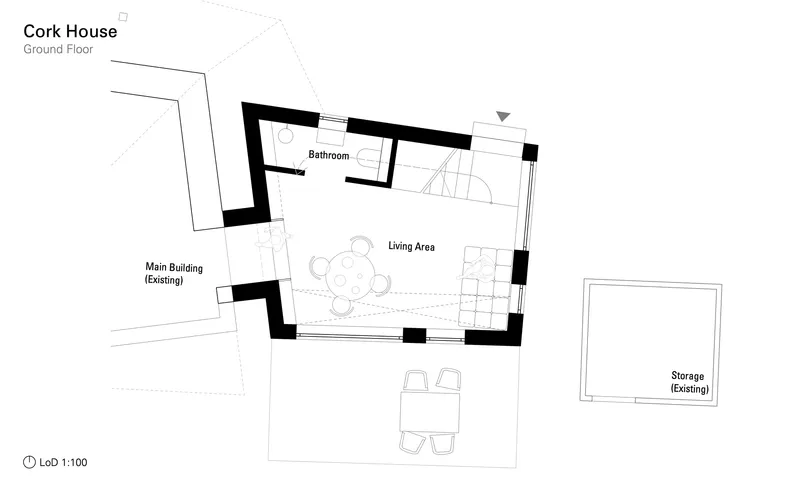
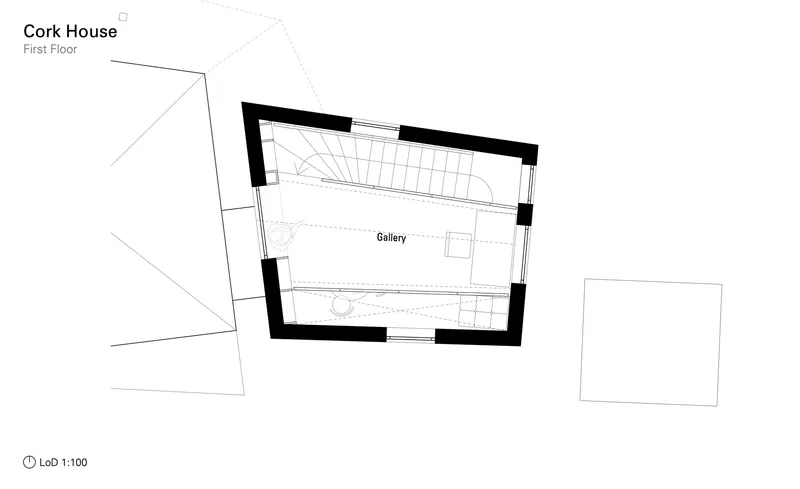
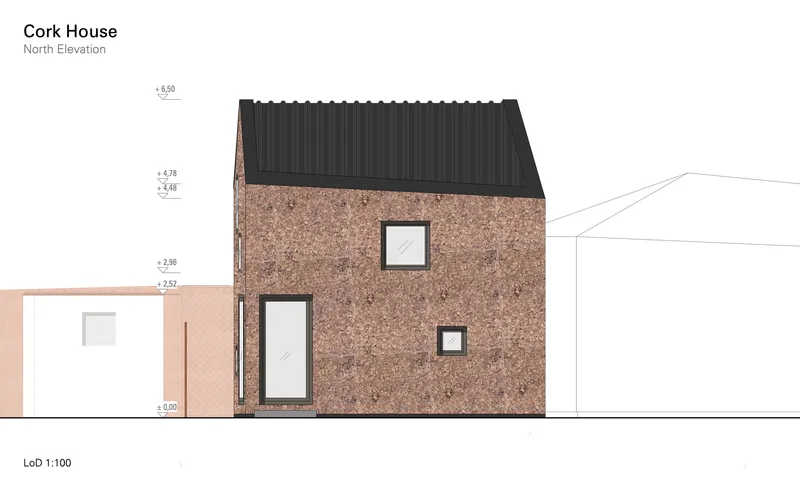
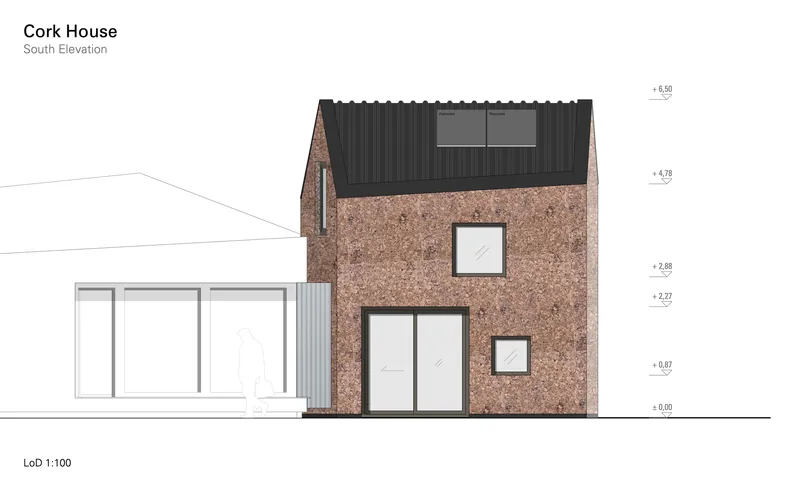
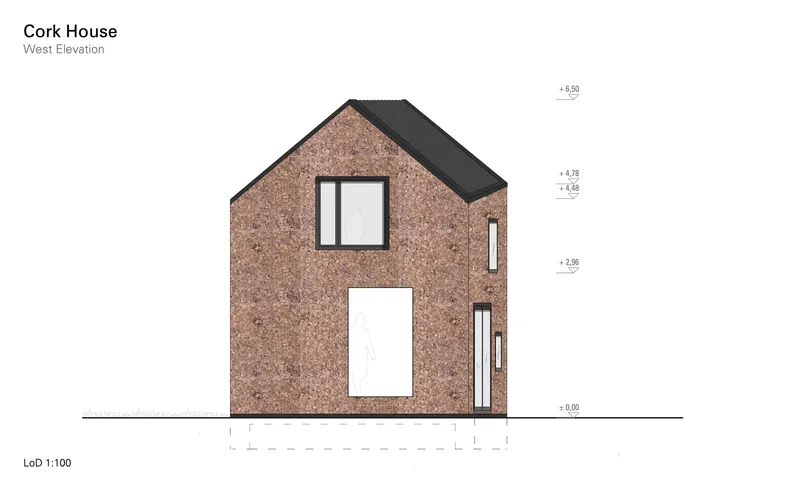
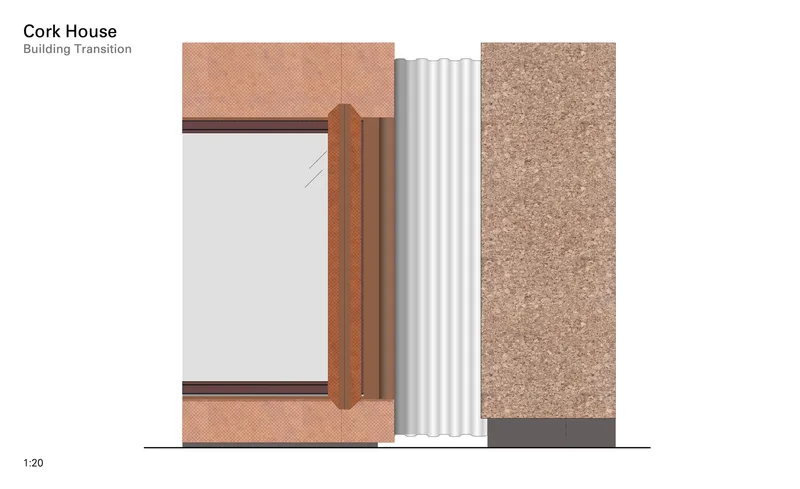
The site plan at 1:1000 reveals the addition's position within a dense residential block, slotted into an existing garden plot alongside the corten house. The ground floor plan shows a compact living area with bathroom and a direct connection back to the original building, confirming that the addition functions as a linked extension rather than a standalone pavilion. Upstairs, the gallery space opens to the double-height volume with the stair as its hinge.
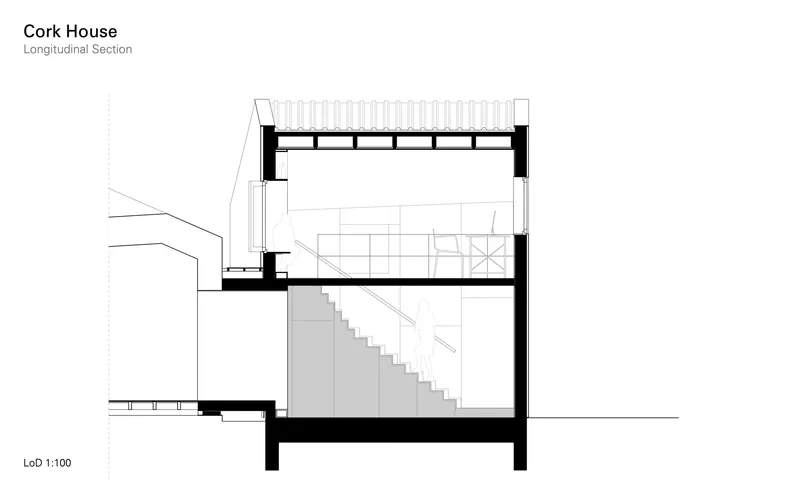
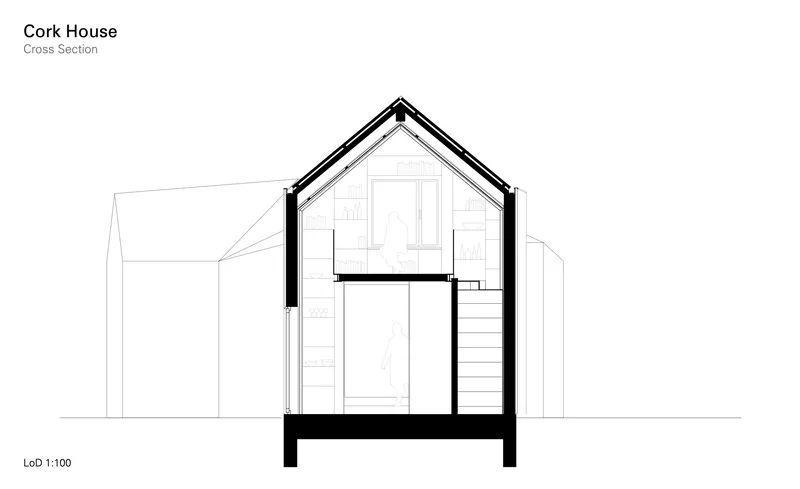
The longitudinal section is the most revealing drawing. It shows the full two-story interior, the exposed roof structure bearing down on the mezzanine, and the staircase threading between levels. The cross section confirms the pitched roof's steep geometry, which creates enough height at the ridge to accommodate the upper level without feeling like an afterthought. Elevation drawings make explicit the contrast between the cork aggregate walls and the black corrugated metal roof, while a construction detail at the transition between existing brick wall and new cork cladding documents the care taken to manage the junction between old and new.
Why This Project Matters
The architecture of small residential extensions is often invisible in professional discourse, dismissed as bread-and-butter work unworthy of sustained attention. Studio bauform's Cork House argues otherwise. At 35 square meters, the project demonstrates that material intelligence, sectional ambition, and considered detailing are not luxuries reserved for larger commissions. The cork aggregate facade alone represents a genuine position on how additions should address existing buildings: not through imitation, not through deliberate contrast for its own sake, but through a material kinship that acknowledges time and change.
There is also a useful lesson here about economy of means. The material palette is tight: cork, black steel, pale timber, perforated copper. No material appears arbitrarily, and each one does more than one job. The copper screen is fence and light filter. The stair is circulation and storage. The exposed ceiling structure is finish and spatial amplifier. In a profession that routinely overthinks large buildings and underthinks small ones, the Cork House is a corrective worth studying.
Cork House, Homburg, Germany. Architect: studio bauform. Lead Architect: Jürgen Lehmeier. Design Team: Sebastian Freyer, Diana Dinkel. Area: 35 m². Year: 2025. Photography: Markus Vogt.
About the Studio
studio bauform
Official website of studio bauform, one of the studios behind this project.
bauform.netShare Your Own Work on uni.xyz
If projects like this are the kind of work you want to make, uni.xyz is a place to publish your own, find collaborators, and enter design competitions.



Popular Articles
Popular articles from the community


The Memory of World: Skyscraper Architecture as a Vertical Exhibition of Human Civilization
A vertical museum in Hong Kong transforms skyscraper architecture into a journey through six eras of humanity, nature, memory, and progress.

UNA Barbara e Valentim Plants Four CLT Bungalows in a Fragile Ceará Landscape
Prefabricated eucalyptus timber cabins touch down lightly on the sandy, biodiverse coast of Barroquinha, Brazil.
Wiyoga Nurdiansyah Composes Three Volumes into a Quiet Family Compound in South Jakarta
RJH House splits domestic life across a cube, a cylinder, and a service block, laced together by courtyards and raw concrete.
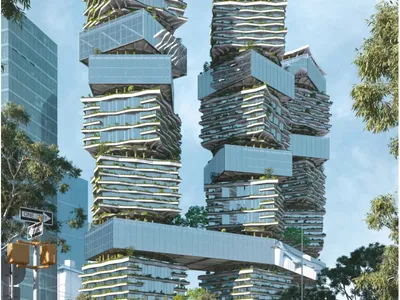
Hierarchy Towers: Sustainable Architecture for Vertical Co-Living in Singapore
Hierarchy Towers reimagines sustainable architecture through co-living, shared workplaces, green terraces, and new public life in Singapore.

Similar Reads
You might also enjoy these articles
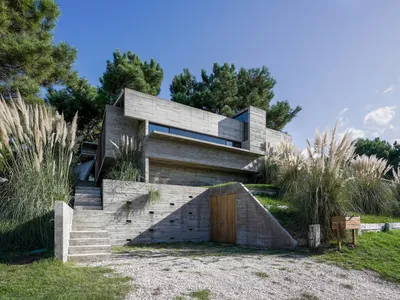
Loma House by Besonias Almeida Arquitectos: Modern Coastal Living in Costa Esmeralda
Loma House by Besonias Almeida Arquitectos is a modern coastal home in Costa Esmeralda, blending exposed concrete, wood, and natural dunes.
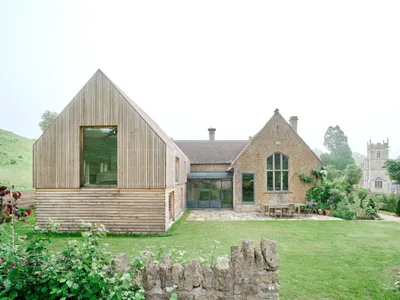
“Pitcombe’s Old School House Renovation by Bindloss Dawes: Blending Heritage and Contemporary Design”
Bindloss Dawes transformed Pitcombe’s 19th-century Somerset schoolhouse with a sustainable timber extension, blending historic charm, contemporary design, and panoramic countryside views.
F3 Residence by Belluzzo Martinhão Arquitetos: Contemporary Luxury in São Paulo’s Countryside
F3 Residence in São Paulo blends contemporary design, natural materials, multigenerational living, hillside integration, expansive glass, infinity pool, and seamless indoor-outdoor flow.
Private Villa in Ubud by BAMM ARCHITECTS: Contemporary Design Amidst Bali’s Jungle
Private Villa in Ubud blends contemporary design with tropical landscape, featuring open-air pavilion, stone and wood materials, suspended master bedroom, and jungle pool views.

Explore Residential Building Competitions
Discover active competitions in this discipline




The Global Benchmark for Architecture Dissertation Awards


Challenge to design mud housing for contemporary communities
Comments (0)
Please login or sign up to add comments
No comments yet. Be the first to comment!