
Studio Entitas Wraps a Medan Family Home Around Courtyards That Keep Six People Connected
On a narrow 15-by-60 meter site in Medan's Ring Road district, angular concrete volumes fold around private green rooms.


A 900-square-meter plot in Medan's Ring Road district is not a difficult piece of land by any measure, but studio entitas treats its proportions (15 meters wide, 60 meters deep) as a generator rather than a constraint. W House is organized so that every bedroom opens onto a single large living room, a spatial premise requested by the six-member family who live here. The result is a house whose plan reads less like a corridor-and-room diagram and more like a sequence of outdoor rooms threaded between angular concrete walls.
What makes the project worth studying is how it reconciles two opposing ambitions: total visual connection among family members inside, and near-total privacy from the street. The answer is a constellation of courtyards that pull light, air, and landscape deep into the footprint while the perimeter stays largely opaque. From the road you see sloped grass, raw concrete, and black cladding. Step inside and the house dissolves into timber decks, planted patches, and glass walls that pivot open.
A Street Face That Gives Nothing Away
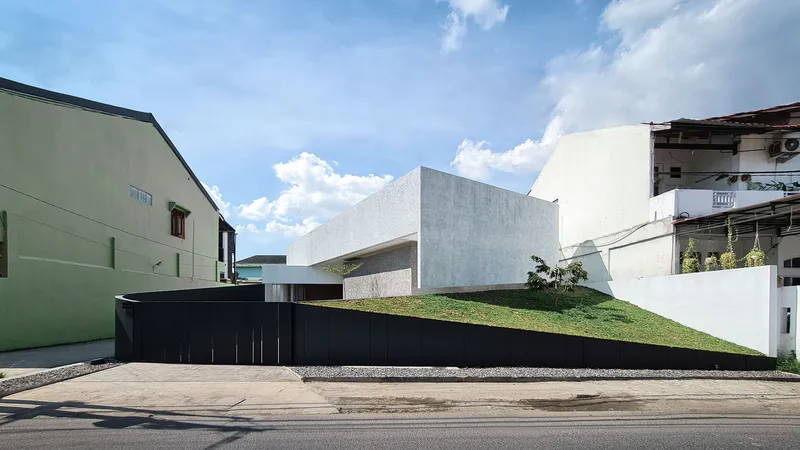
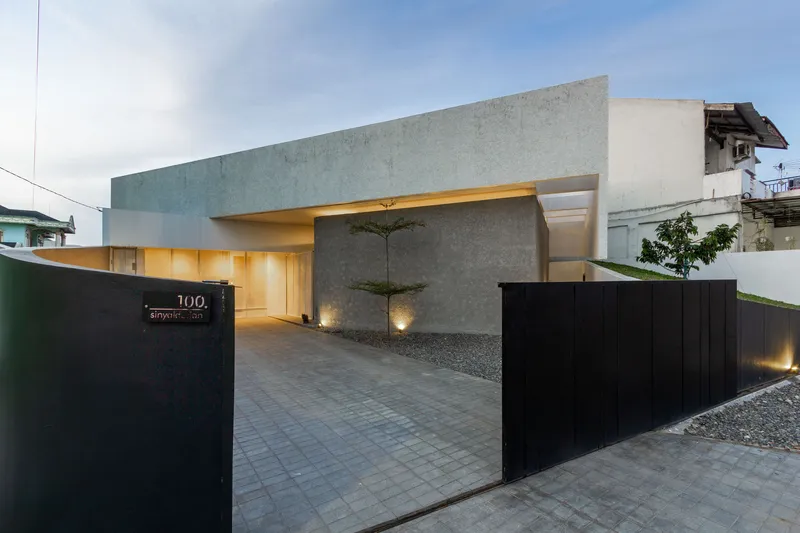
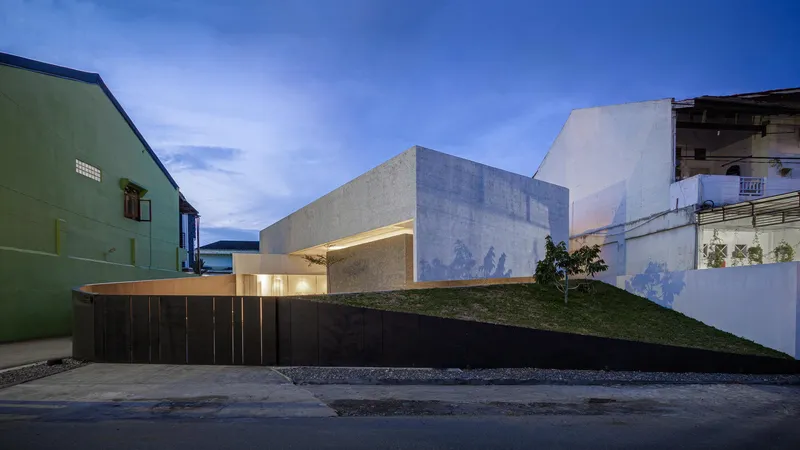
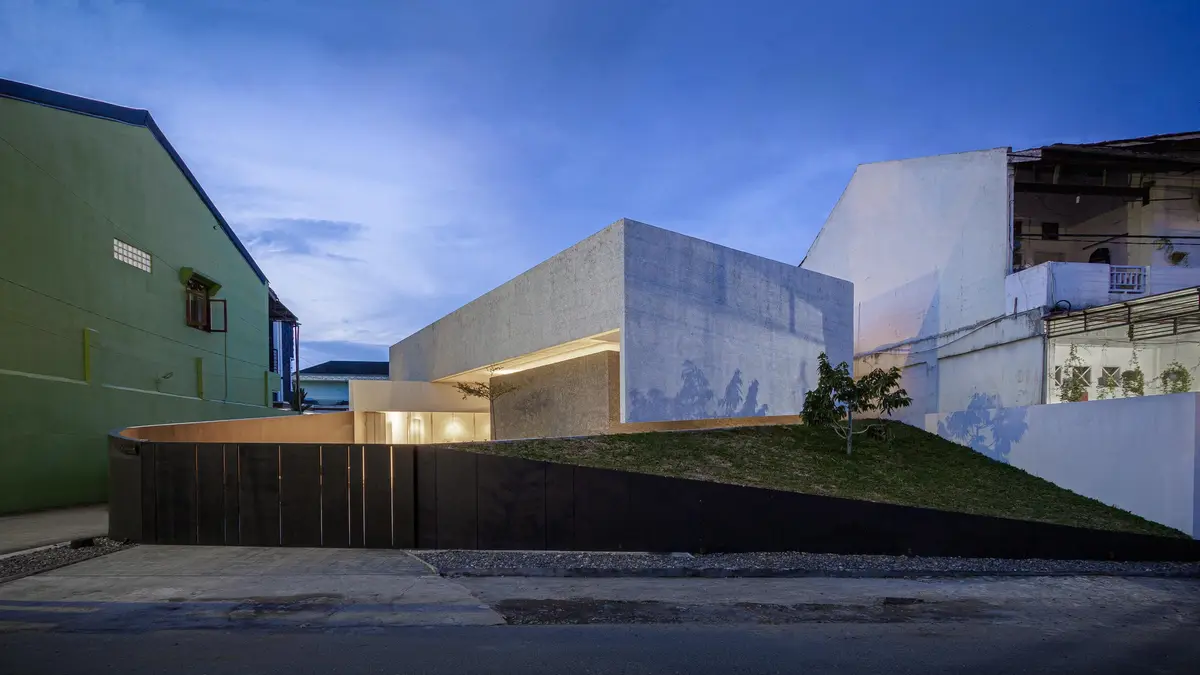
The public elevation is deliberately reticent. A sloped grass lawn rises above a dark base wall, concealing the domestic life behind it. At dusk the house reveals itself only through the glow of a recessed carport and a narrow entrance cut into textured concrete. The angled volumes, clad in black timber and topped with planted ramps, read almost as landforms rather than architecture. It is a posture that makes sense in a dense urban district: give the neighbors nothing to look at, keep the spectacle for the inhabitants.
The grass-covered slope is the project's most provocative gesture. It lifts the garden to the roof, turning what would normally be dead weight into a second ground plane visible from the upper interior spaces. Against the blue evening sky the triangular silhouette is striking, but the move is functional too: the planted surface insulates the concrete below and manages rainwater in Medan's tropical downpours.
Arriving Through Layers
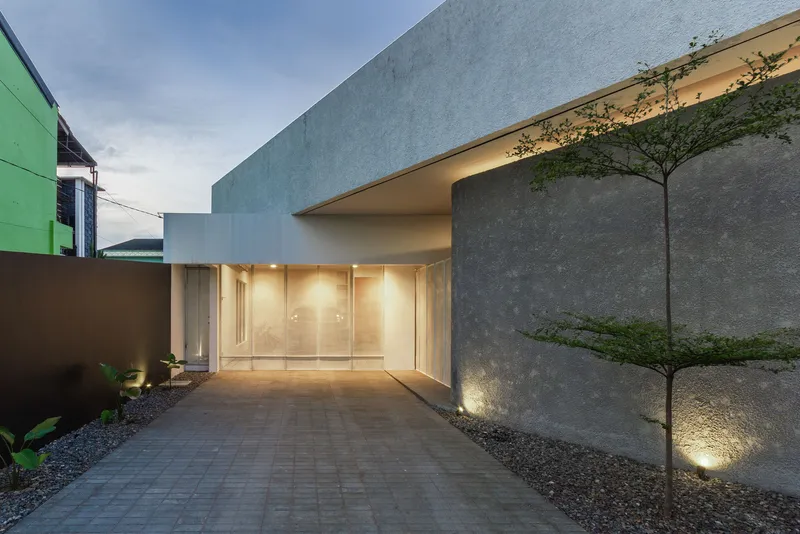
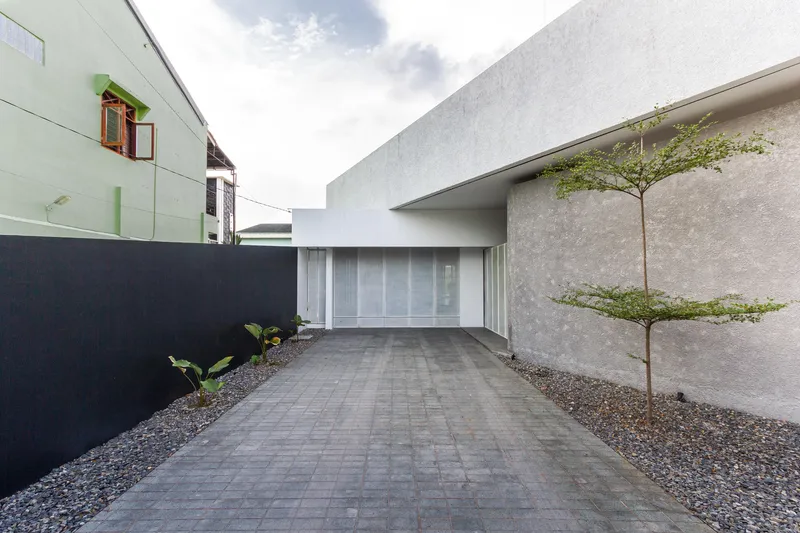
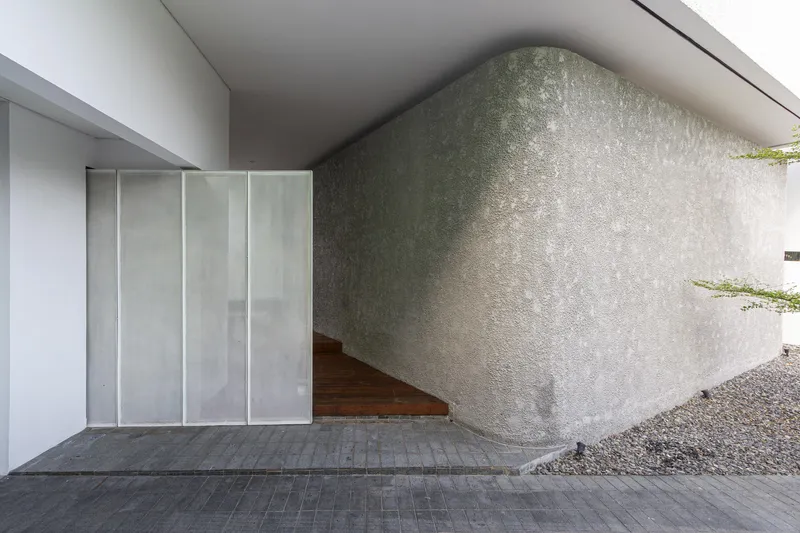
Entry into W House is not immediate. A paved drive passes a young tree set in a gravel planting bed, then turns toward a porch framed by translucent sliding panels and a rough concrete wall. The threshold is compressed and indirect, a deliberate deceleration that separates the noise of the Ring Road from the calm of the interior courts. Timber decking underfoot signals the transition from car to home.
The translucent panels at the porch corner deserve a closer look. They soften daylight without sacrificing privacy, and their lightweight frame contrasts with the mass of the concrete beside them. It is a small detail, but it establishes the material vocabulary that runs through the rest of the house: heavy versus light, opaque versus filtered, permanent versus movable.
Courtyards as the Heart of the Plan
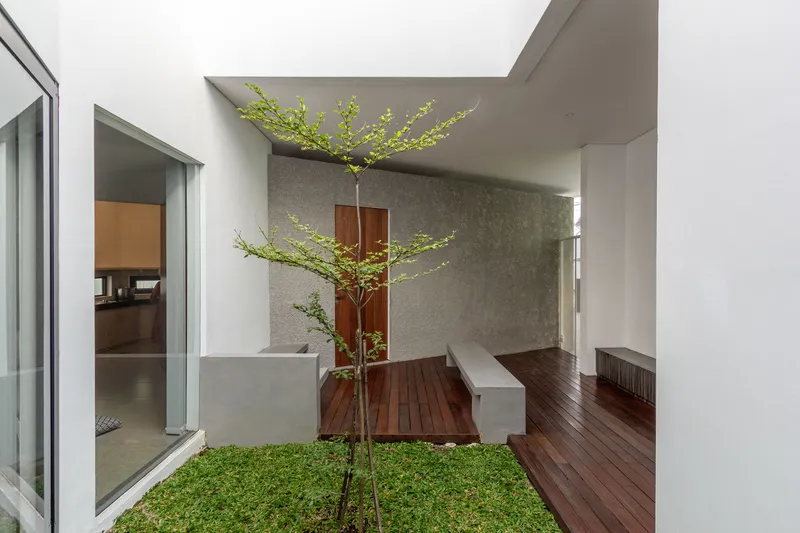
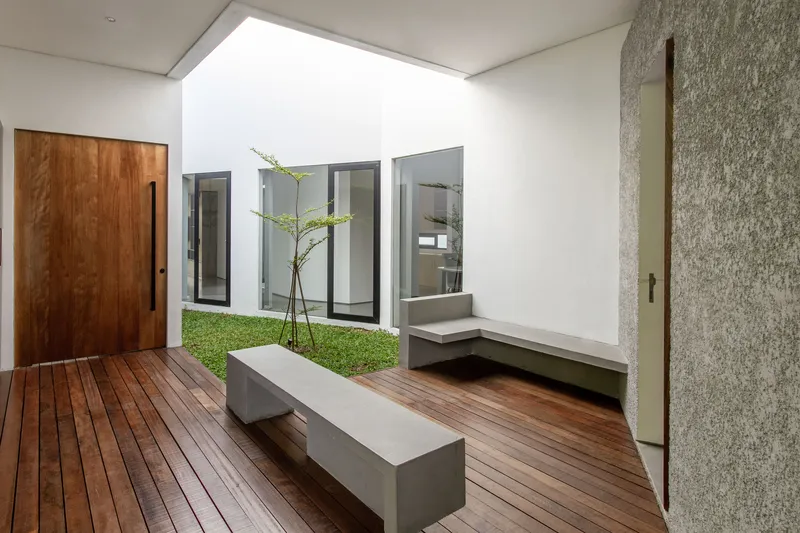
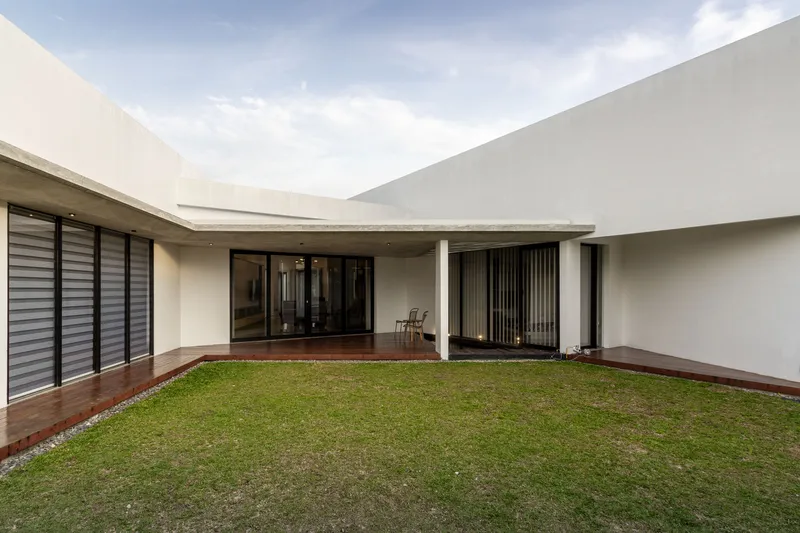
At least three distinct courtyards punctuate the long plan. Each one is slightly different in character: one is a grassed patch with a single tree ringed by timber decking and a concrete bench; another is a more private enclosure bordered by white rendered walls; a third serves as a light well visible through clerestory windows. Together they ensure that no room in the house is more than a few steps from open sky.
For a family that wanted togetherness, the courtyards work as shared visual anchors. You see the same tree, the same patch of sky, from the living room and from the bedrooms. The effect is communal without being claustrophobic: you are always aware of others, but you still have a wall to close behind you.
Interior Circulation and Transparency
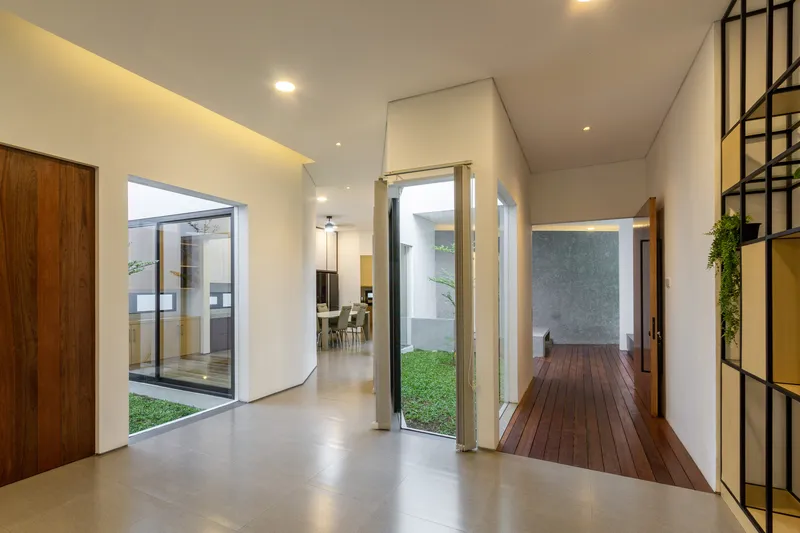
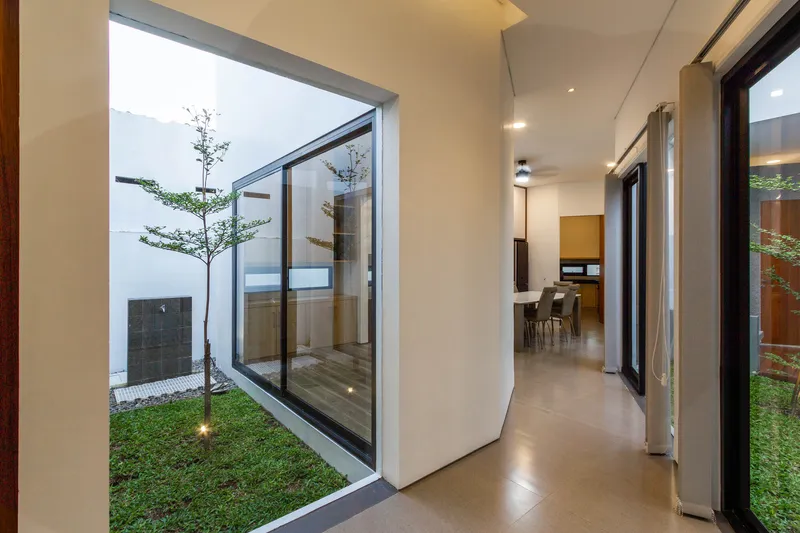
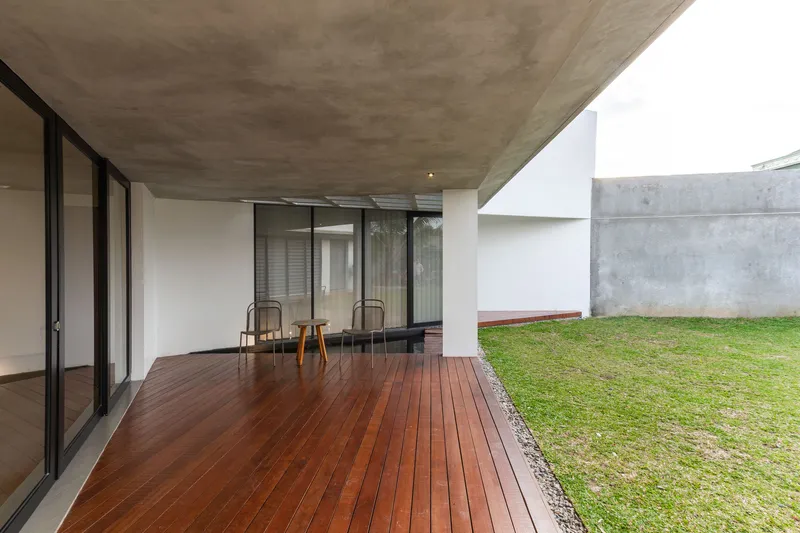
The corridors in W House are not neutral connectors. They are lined with glass walls that look onto planted courtyards, turning every walk between rooms into a moment of contact with landscape. A spiral stair punctuates one corridor, and pivoting glass panels allow the hallway to merge entirely with the courtyard when the weather permits. Polished concrete floors reflect the greenery, doubling the sense of depth in what is actually a fairly compact section.
A covered terrace with two chairs overlooking the grassed court acts as the family's informal gathering point. It is sheltered enough to use during rain but open enough to feel like an extension of the garden. In Medan's humid climate, these semi-outdoor zones are arguably the most lived-in spaces of the house.
Plans and Drawings
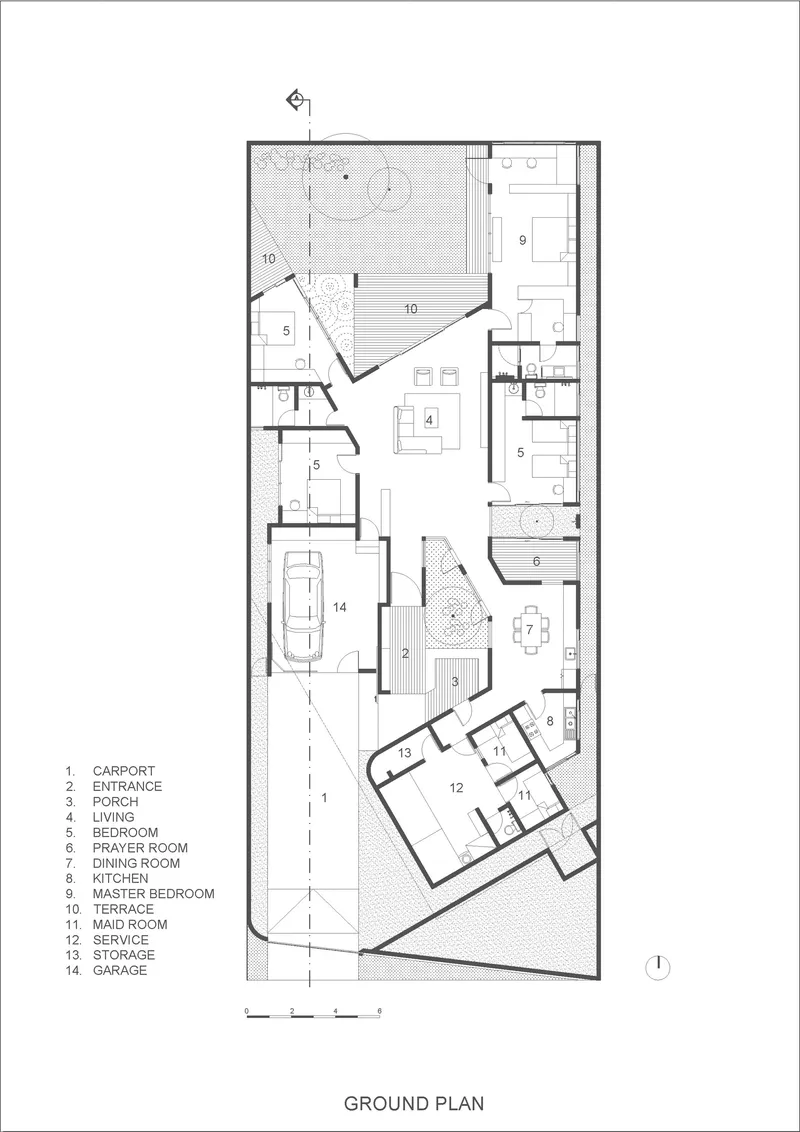
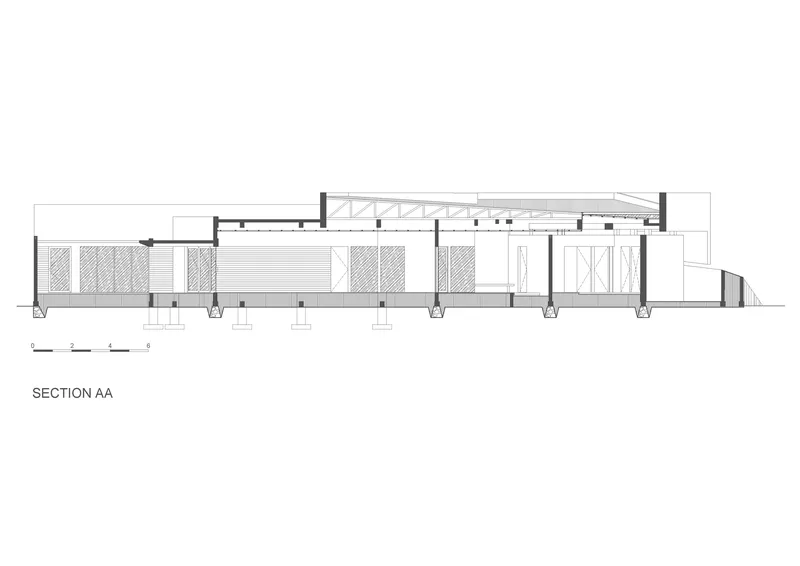
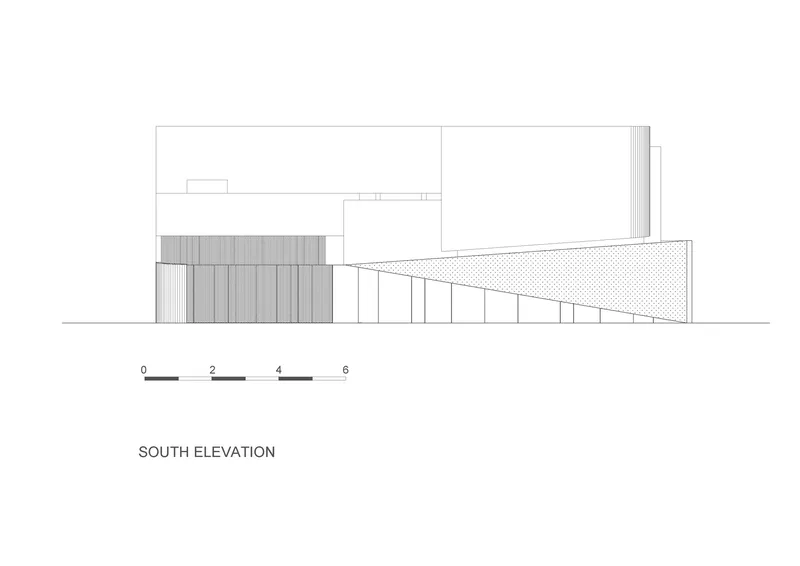
The ground floor plan confirms what the photographs suggest: the house is organized as a series of angular wings that pinch and widen around courtyards. A carport and service zone occupy the street end; living areas sit in the middle; bedrooms extend toward the rear. The section reveals a largely single-story structure with exposed roof trusses, keeping the interior volume generous despite the low profile. The south elevation shows vertical timber cladding and a triangular screened outdoor zone that echoes the sloped grass roof visible from the street.
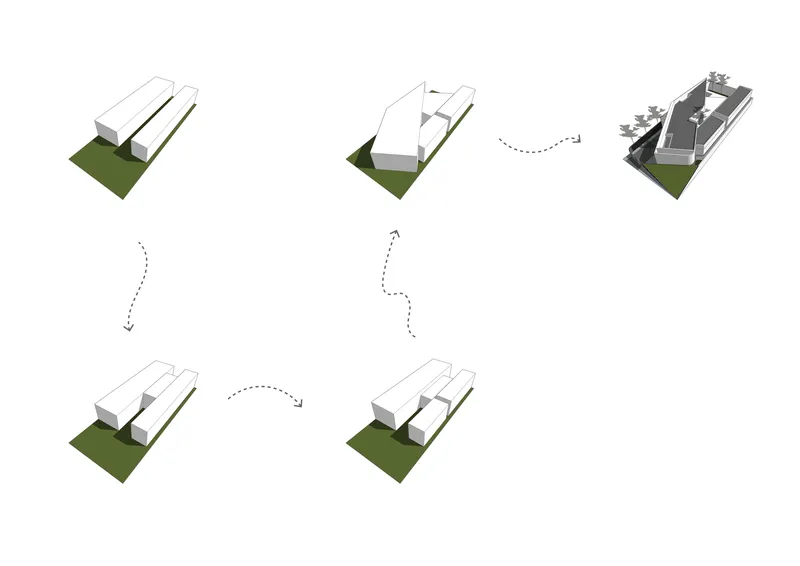
The six-step axonometric sequence is the most revealing drawing. It diagrams how the massing was carved and rotated from a simple rectangular volume into the faceted form that sits on site today. Each move introduces a courtyard or adjusts a sightline, confirming that the geometry is not arbitrary but driven by the desire to connect interior rooms visually while maintaining enclosure from the perimeter.
Why This Project Matters
W House is a clear demonstration that privacy and togetherness are not contradictory goals. By turning its back to the street and opening its insides to a network of courtyards, the house gives a family of six a shared spatial center without forcing anyone into a fishbowl. The courtyards do triple duty as light sources, ventilation channels, and social anchors, a compact strategy that more tropical houses should borrow.
Studio entitas also shows restraint in a market that rarely rewards it. The material palette is limited to concrete, timber, glass, and grass. The forms are angular but disciplined, each facet justified by the axonometric logic laid out in the drawings. In Medan's rapidly developing Ring Road district, where land is carved into long, narrow parcels and neighbors press close, this kind of inward-looking architecture is not just an aesthetic choice. It is a practical one, and it works.
W House by studio entitas, Medan, Indonesia. Site area: 900 m². Completed 2021. Photography by Andhika Nugraha Siregar.
About the Studio
Share Your Own Work on uni.xyz
If projects like this are the kind of work you want to make, uni.xyz is a place to publish your own, find collaborators, and enter design competitions.


Popular Articles
Popular articles from the community


David Ortega Stacks a Two-Story Mexico City Penthouse Around a Steel Stair and a Pergola-Shaded Roof Terrace
In Colonia Roma, a 300 m² penthouse uses oak joinery, a planted steel stair and a slatted roof pergola to make a new-build apartment feel like a house.

ETEH Reworks the Shared Spaces of São Domingos School in Brazil Around Timber, Color and Hanging Plants
At São Domingos School in Brazil, 436 m² of hall, refectory and library are recast with timber joinery, a yellow and blue code and trailing greenery.

FCC Arquitectura Expands a Portuguese Granite House with a Board-Marked Concrete Wing
In Portugal, JV House pairs a cleaned-up whitewashed and granite dwelling with a timber-shuttered concrete extension, courtyards and a garden pool.


Opera on the Sea: Driftwood Logic Shapes a Timber Opera House on Estonia's Coast
Trevor Orgill's opera house translates the entangled drift of floating timber into a civic building where wood, water, and music converge.

Similar Reads
You might also enjoy these articles

LAVA Architecten Gives Vocational Education a Sawtooth-Roofed Face on a Mechelen School Campus
In Mechelen, Belgium, a 2,053 m² STEM school on a 6×6 m grid turns workshops and classrooms into rooms that can be rearranged as teaching changes.

KEMA Studio Turns a Derelict Marvila Attic into a 60 m² Lighthouse Apartment Above Lisbon
In Lisbon's Marvila district, a rebuilt roof, four skylights and two plywood volumes turn an unlivable attic into a bright home facing the Tagus.

Pixel Gardens: One Repeated Module Stacked Into a Terraced Social Housing Tower for Famagusta
Salem Bader's shortlisted housing tower builds a vertical neighbourhood from one repeated module, offsetting units to carve terraces, light and air.

Bao Huynh Watercolor Atelier: A Serene Art Retreat in Hội An
Bao Huynh Watercolor Atelier in Hội An blends multifunctional art spaces, sustainable design, local materials, and family-friendly living in a serene environment.

Explore Plug-In House Competitions
Discover active competitions in this discipline

Comments (0)
Please login or sign up to add comments
No comments yet. Be the first to comment!