
Studio Gypsandconcrete Turns a Georgian Rose Plantation into a Glass Reception Pavilion
Lopota Reception dissolves the threshold between lobby and landscape in the heart of Georgia's Kakheti wine region.


There is a particular challenge in designing a building whose sole purpose is arrival. A reception space must accomplish something paradoxical: it must be architecturally assertive enough to orient visitors while simultaneously erasing itself so the landscape can speak. At Lopota Lake Resort & Spa, a 60-hectare family-owned estate in Georgia's Kakheti wine region, Studio Gypsandconcrete has answered that challenge with a 291-square-meter glass pavilion that reads less like a building and more like a greenhouse that wandered into the vineyards and decided to stay.
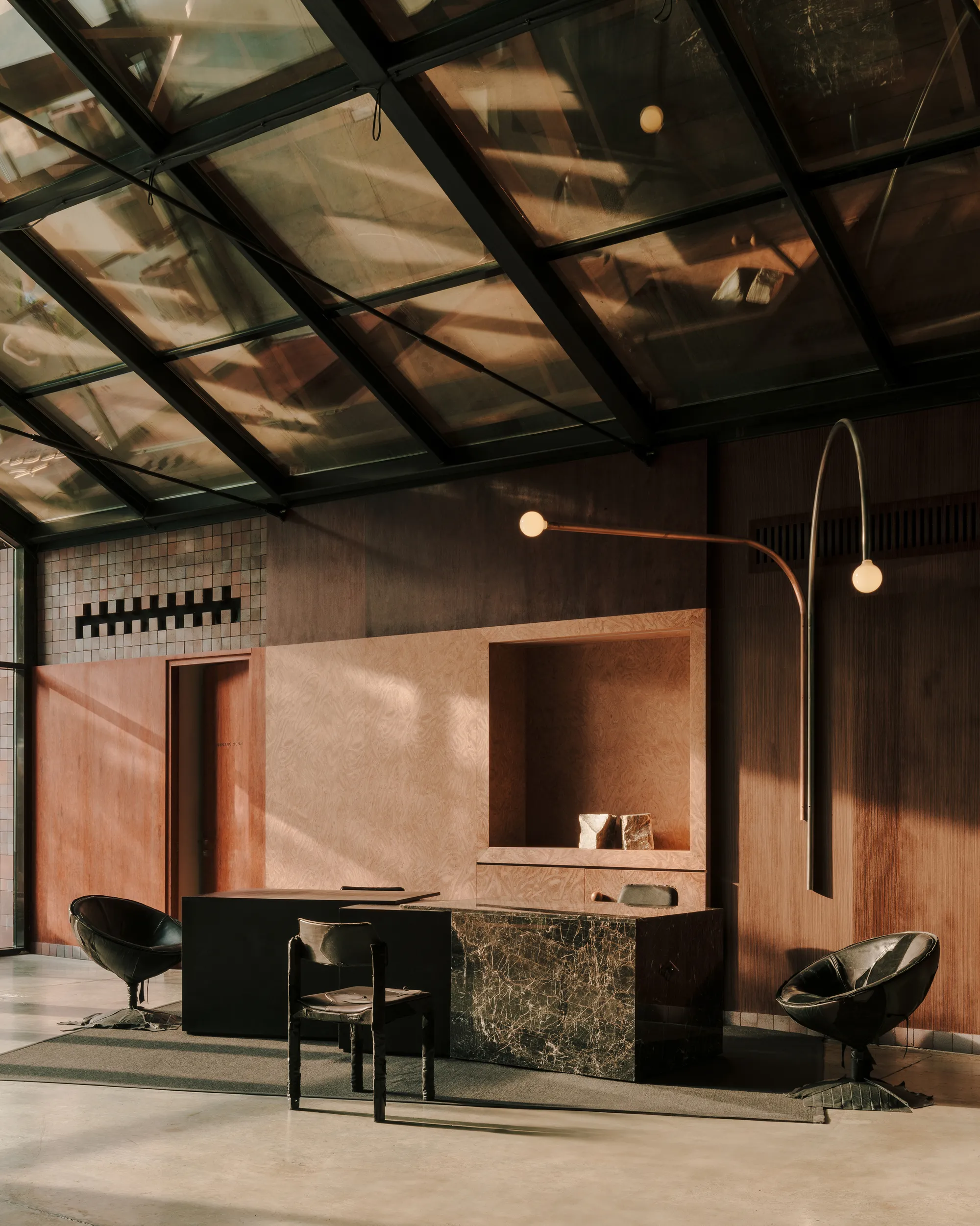
What makes this project worth close attention is the rigor with which lead architect Lado Lomitashvili has calibrated its material language against its site history. The land beneath the pavilion was once a rose plantation, and that botanical past echoes in every surface: rose-toned copper cladding, rosewood veneer walls, warm leather seating, and monolithic blocks of locally quarried Lopota marble. None of it is decorative in the superficial sense. Each material carries the region's geology and agricultural memory into the act of checking in.
A Greenhouse for Hospitality
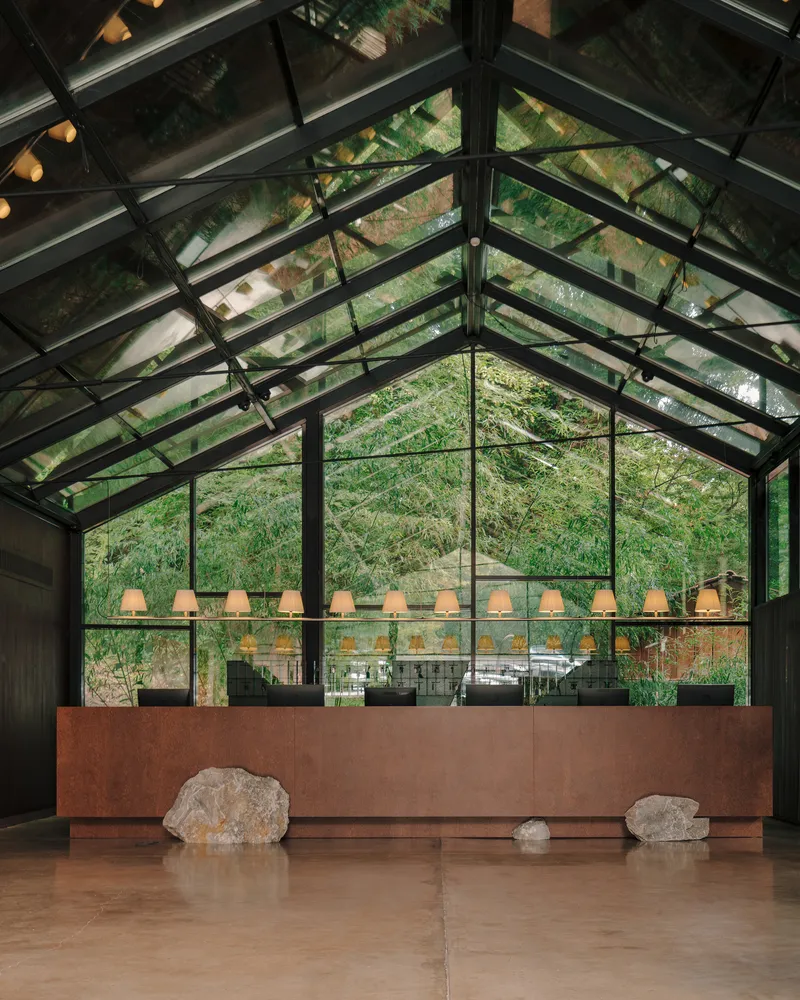
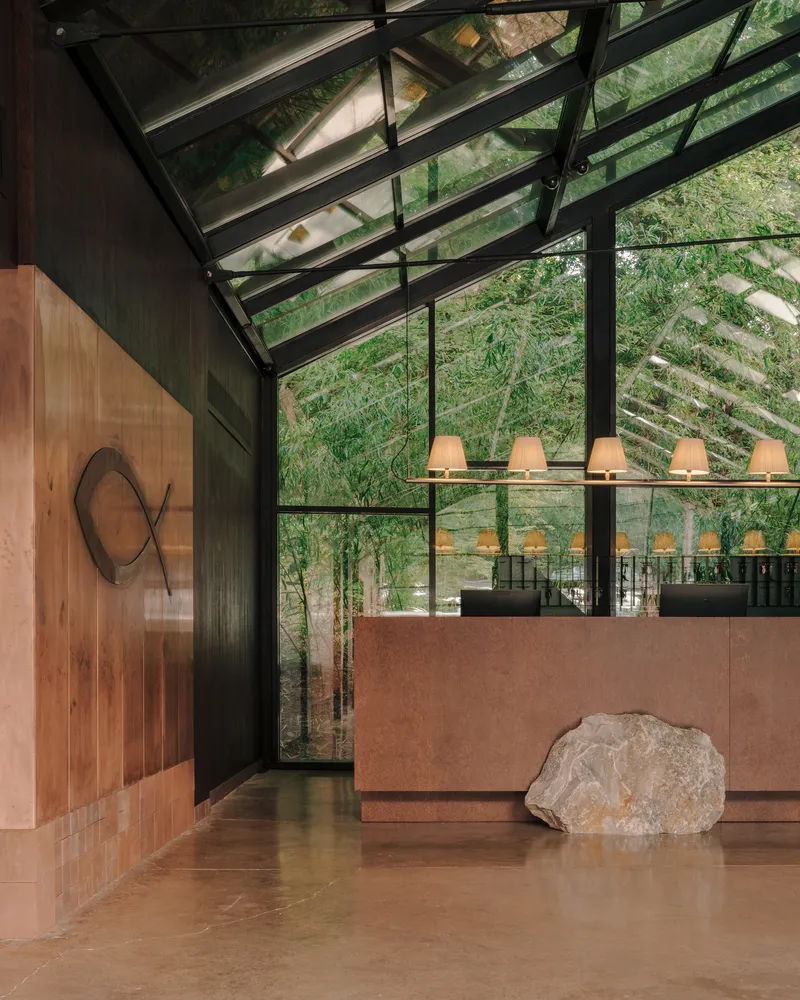
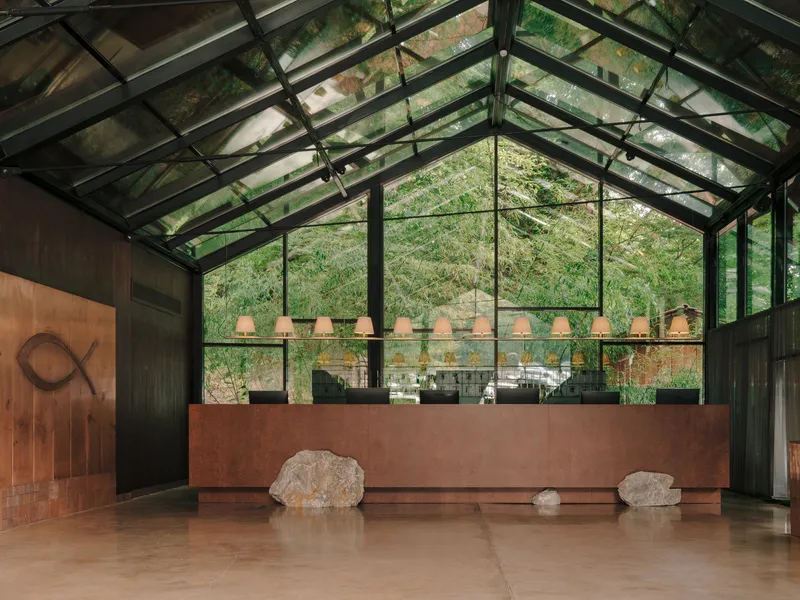
The pavilion's most immediate gesture is structural: a gabled glass roof supported by black steel framing that reads as a refined agricultural typology. Under that pitched canopy, the interior opens to the surrounding forest and bamboo groves on nearly all sides, turning the reception desk into something closer to a garden folly than a hotel lobby. The steel framework is deliberately legible, its repetitive bays establishing a rhythm that draws the eye toward the vanishing point of the landscape beyond.
This greenhouse logic is not merely aesthetic. The stained-glass walls allow light to migrate freely through the space over the course of a day, shifting the color temperature of the interior from cool morning blues to warm amber afternoons. The architecture does not fight the weather; it collaborates with it.
Marble, Copper, and the Memory of Roses
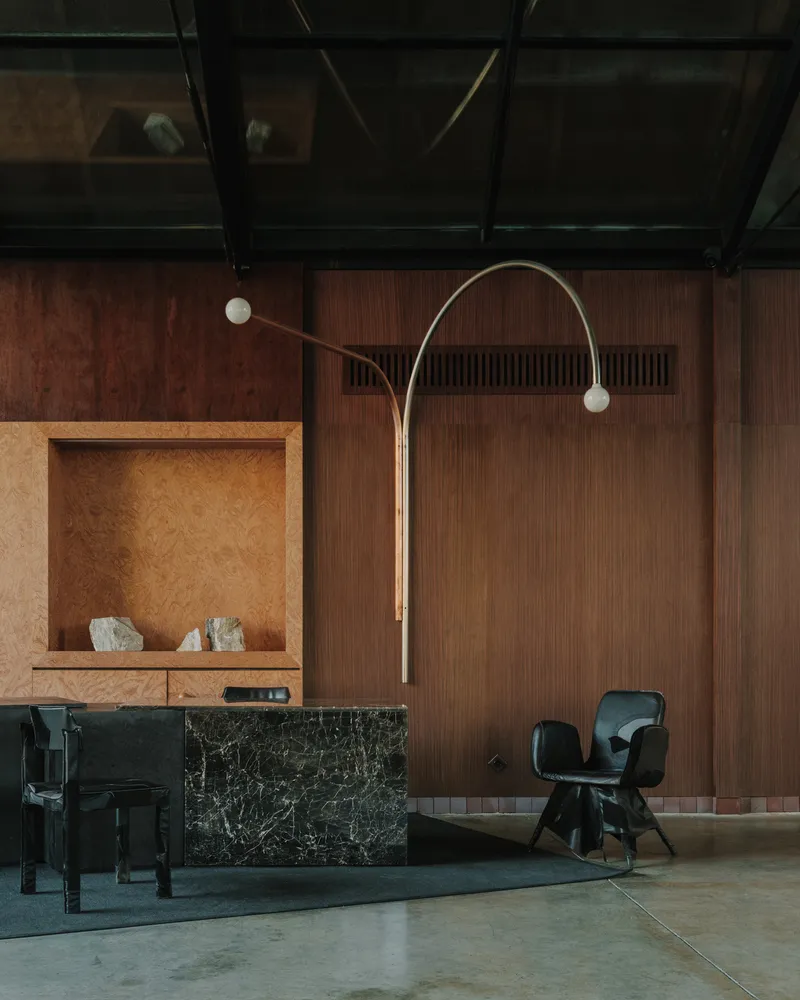
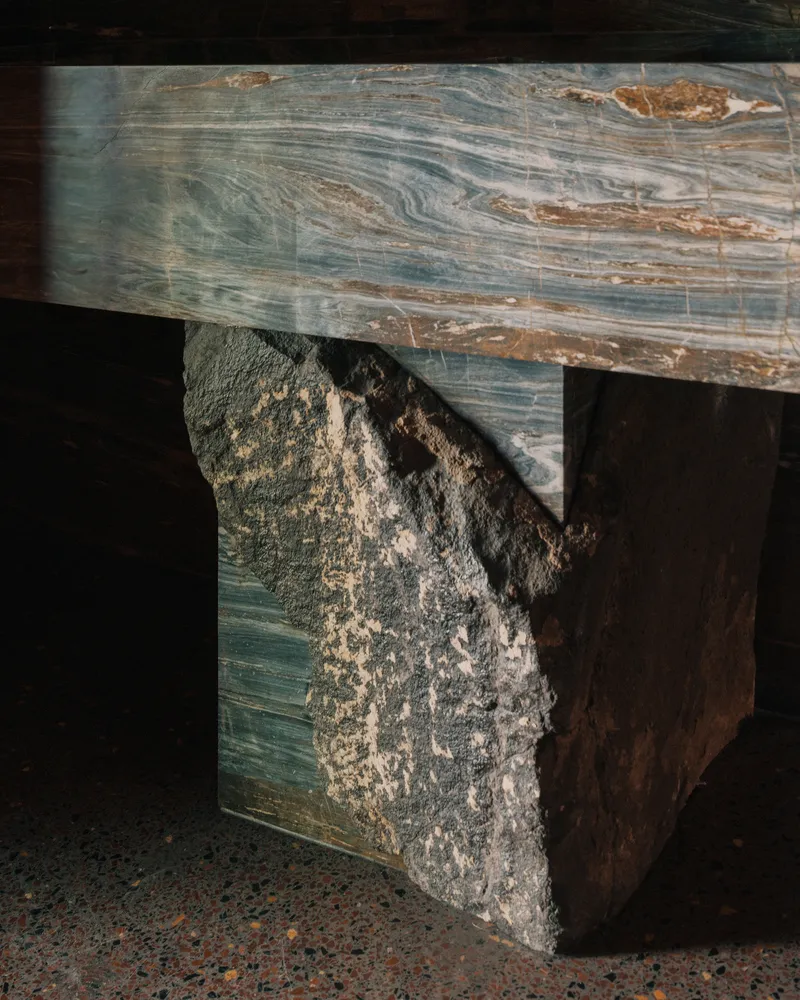

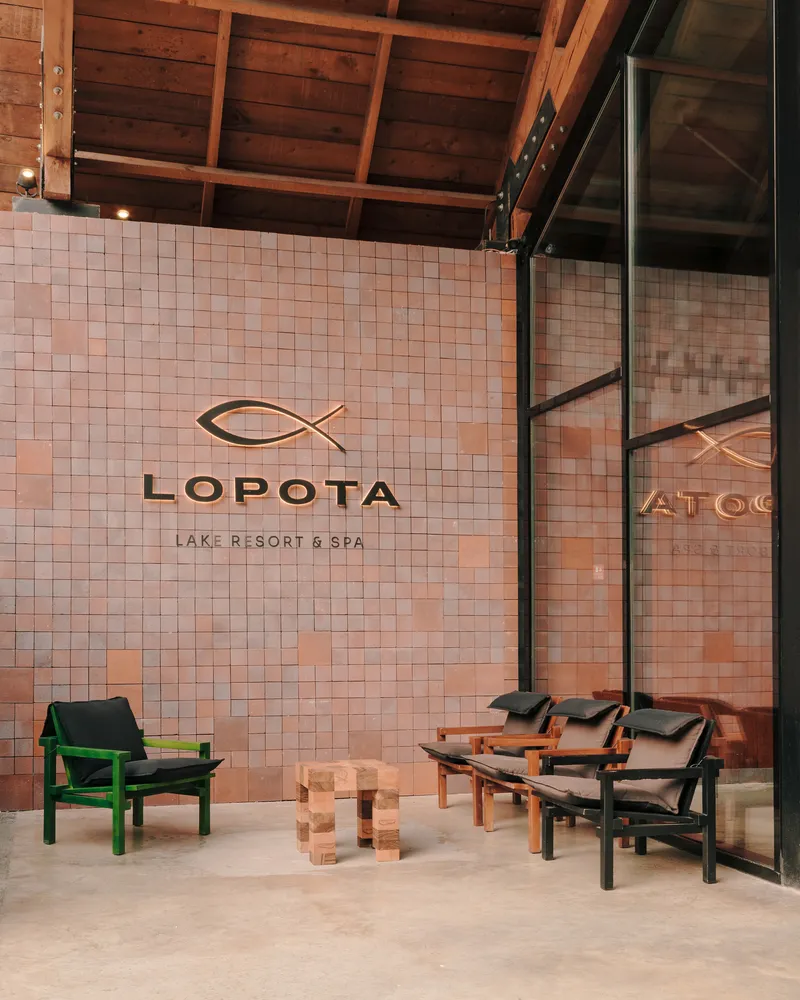
Studio Gypsandconcrete's material palette is small but precisely deployed. Lopota marble, quarried from the surrounding terrain, appears in monolithic blocks at the reception desk and in polished slabs that catch and scatter light across the floor. It is left rough in places, with raw quarried edges exposed at bench bases to remind visitors that this stone came from right here, not from a catalogue.
Rose-toned copper surfaces wrap walls and light fixtures, forming a chromatic bridge between the rosewood veneer panels and the warm leather of the lounge furniture. The Lopota resort emblem has been subtly reinterpreted as an architectural ornament pressed into one of the copper wall panels. It is the kind of detail that rewards a second glance without demanding the first.
Curtains, Carpets, and Controlled Softness
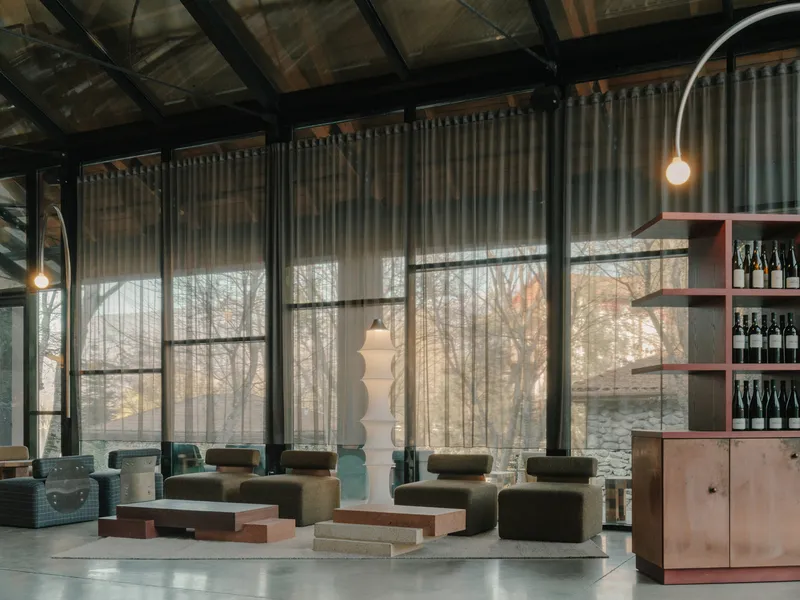
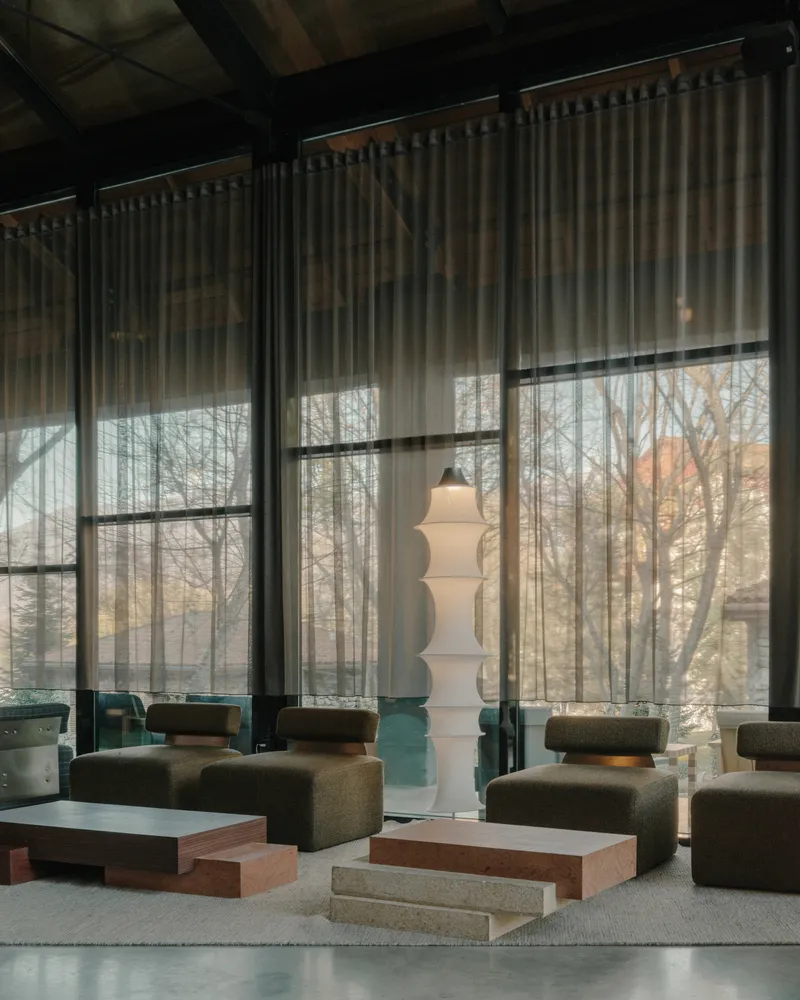

Against all that glass and steel, the interior risks feeling brittle. The architects counter this with two textile strategies. Sheer curtains, inspired by the movement of water, billow through the space and soften the geometry of the steel-framed walls. They filter daylight without blocking it, creating a haze that is calming rather than obscuring. Meanwhile, carpets are placed in unexpected compositions across the floor, subtly guiding circulation without the heaviness of walls or the banality of floor markings.
The effect is a space that feels lived in from the moment you enter. The leather lounge seating, sourced from leftover materials and paired with stainless steel frames, reinforces a material ethic of reuse without making sustainability the headline. It is embedded in the furniture rather than announced by it.
Wine, Light, and the Ritual of Arrival

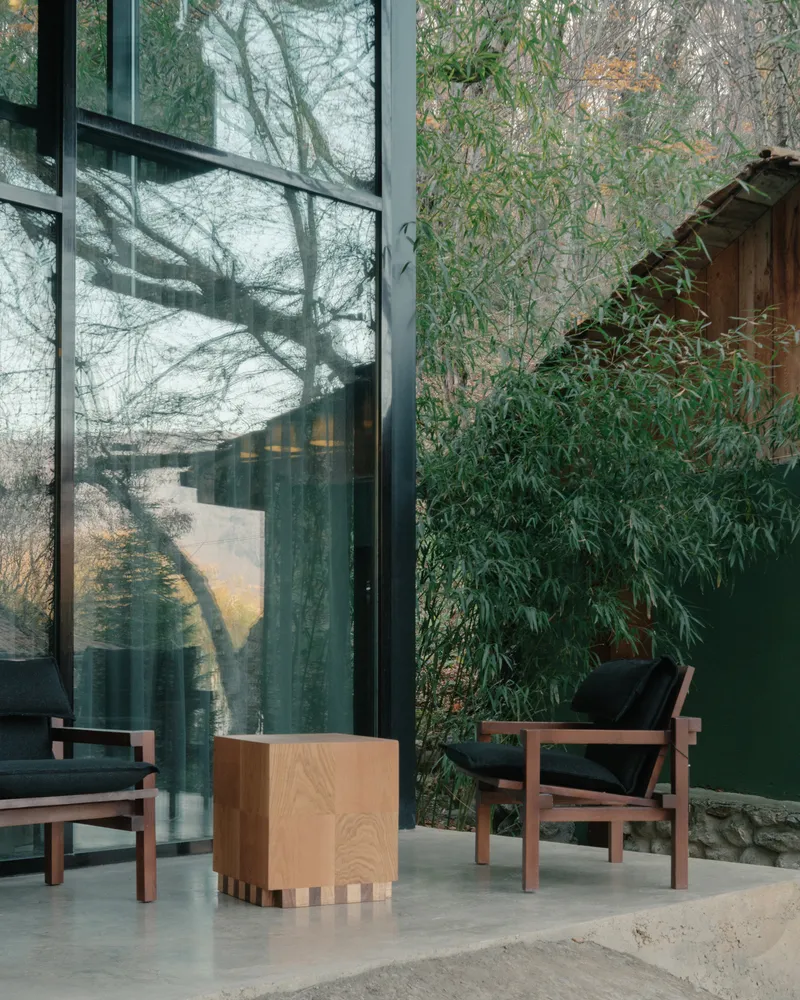

Kakheti is the heart of Georgia's celebrated wine culture, and Studio Gypsandconcrete acknowledges this with a drinks station and local wine shelf flanking both sides of the entrance vitrage. The shelving unit, finished in pink-stained plywood and paired with an arcing brass floor lamp, transforms a functional amenity into a spatial event. Arriving guests encounter wine before they encounter the check-in desk, which inverts the typical hotel sequence and foregrounds Georgian hospitality over procedural efficiency.
Select lighting pieces, including fixtures by Santa & Cole and a sculptural floor lamp by Bruno Munari for Artemide, are integrated alongside custom-designed pieces by the studio. The mix avoids the monotony of a fully bespoke interior while maintaining a coherent warmth. Through the floor-to-ceiling glazing, bamboo and bare winter trees become part of the composition: not backdrop, but active participants.
The Gift Shop as Satellite
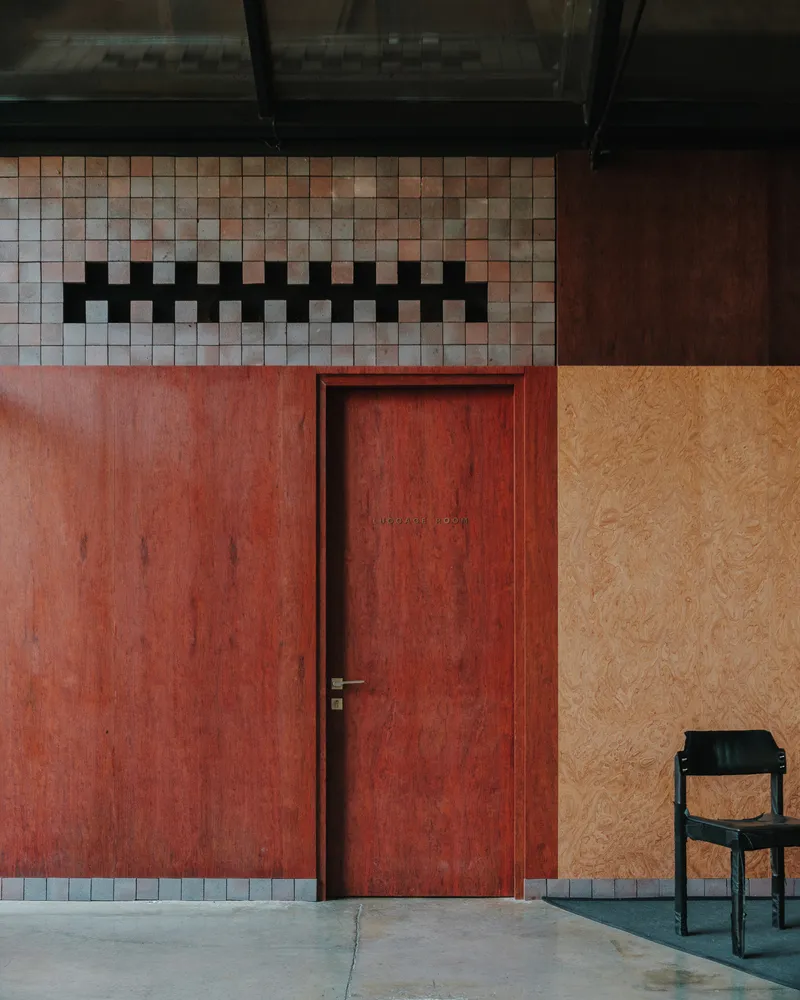
A related 48-square-meter gift shop within the resort extends the reception's material logic into a tighter, more playful enclosure. Mirrored green glass serves as the primary surface material, while walls finished with small greenish-grey stone gravel sit alongside exposed sections of original local stone structure. The lighting operates in two layers: linear architectural fixtures float below the ceiling, and wall sconces referencing fishing floats add a vernacular wit.
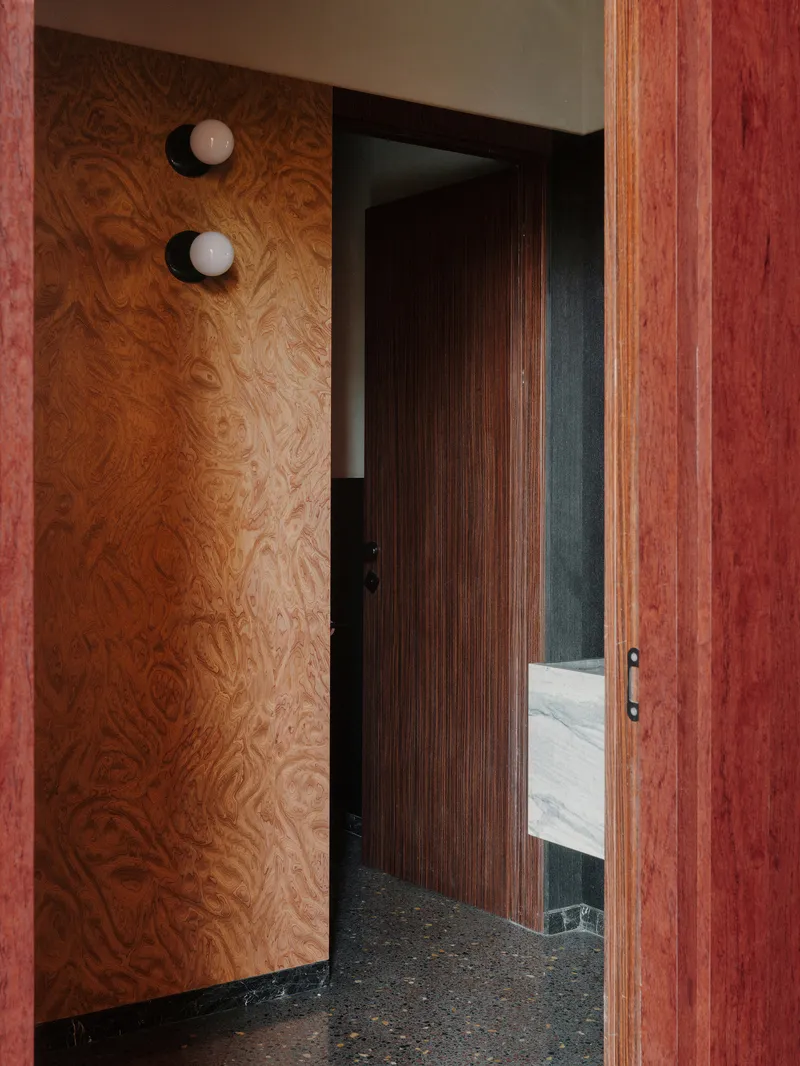
Red-stained plywood doors, mosaic tile clerestory bands, and terrazzo flooring connect this smaller space to the reception's broader material family without replicating it. The shop demonstrates the studio's ability to calibrate intensity: where the reception is transparent and expansive, the gift shop is dense and saturated.
Copper and Stone in the Bathrooms
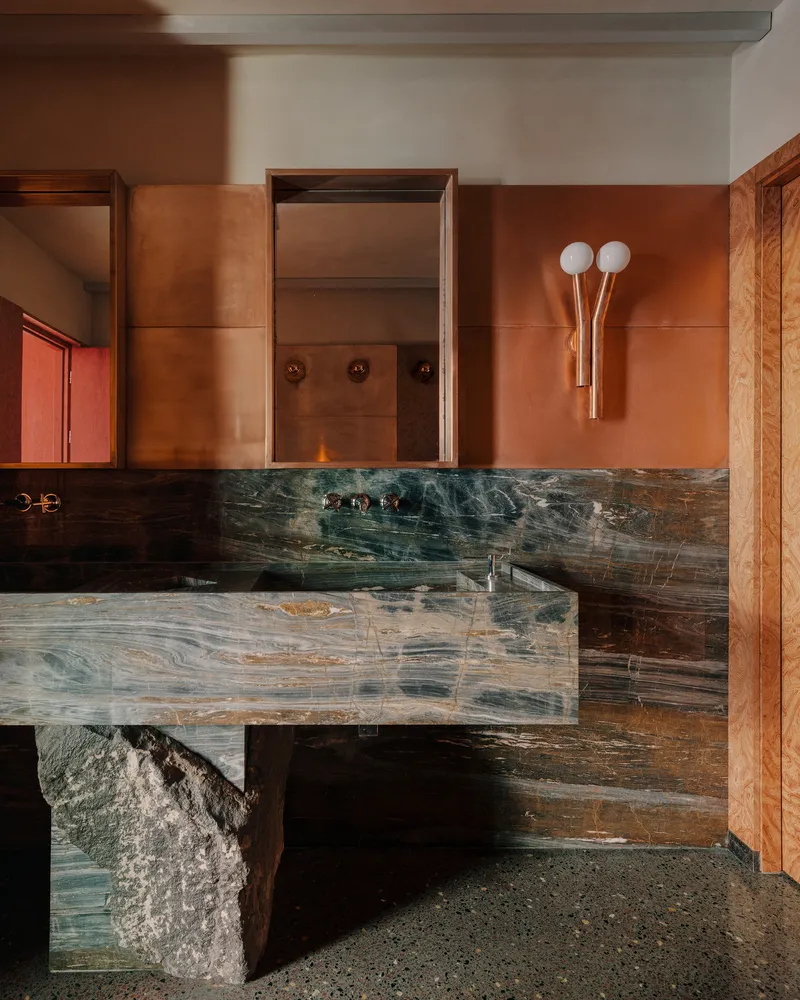

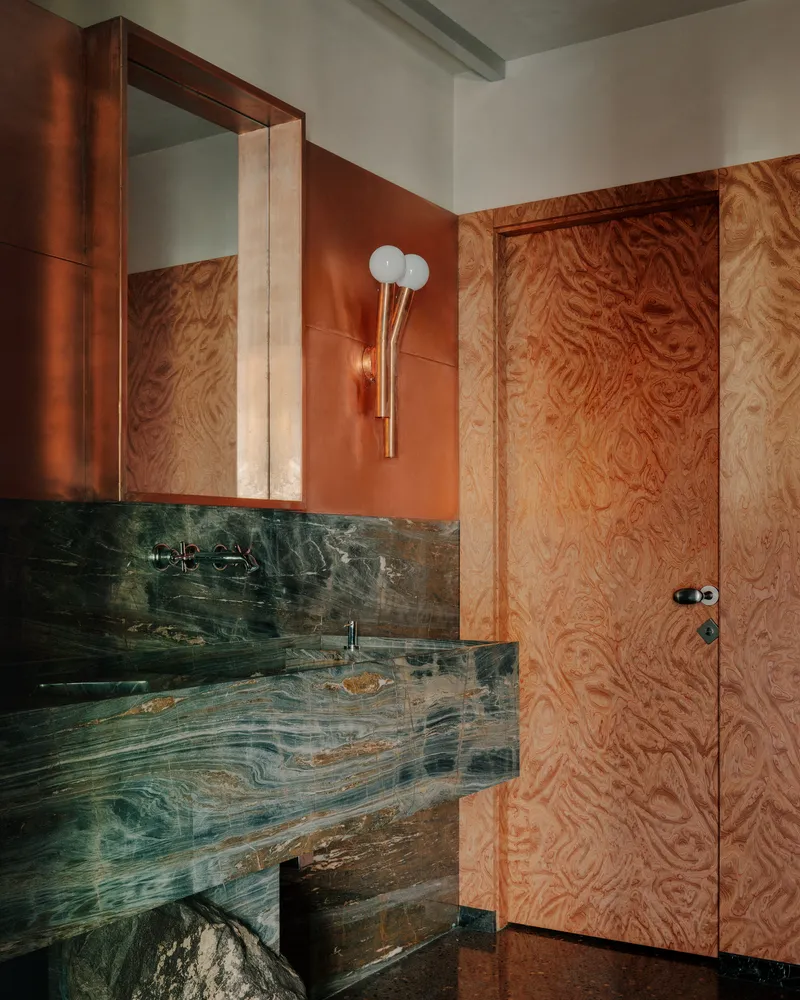
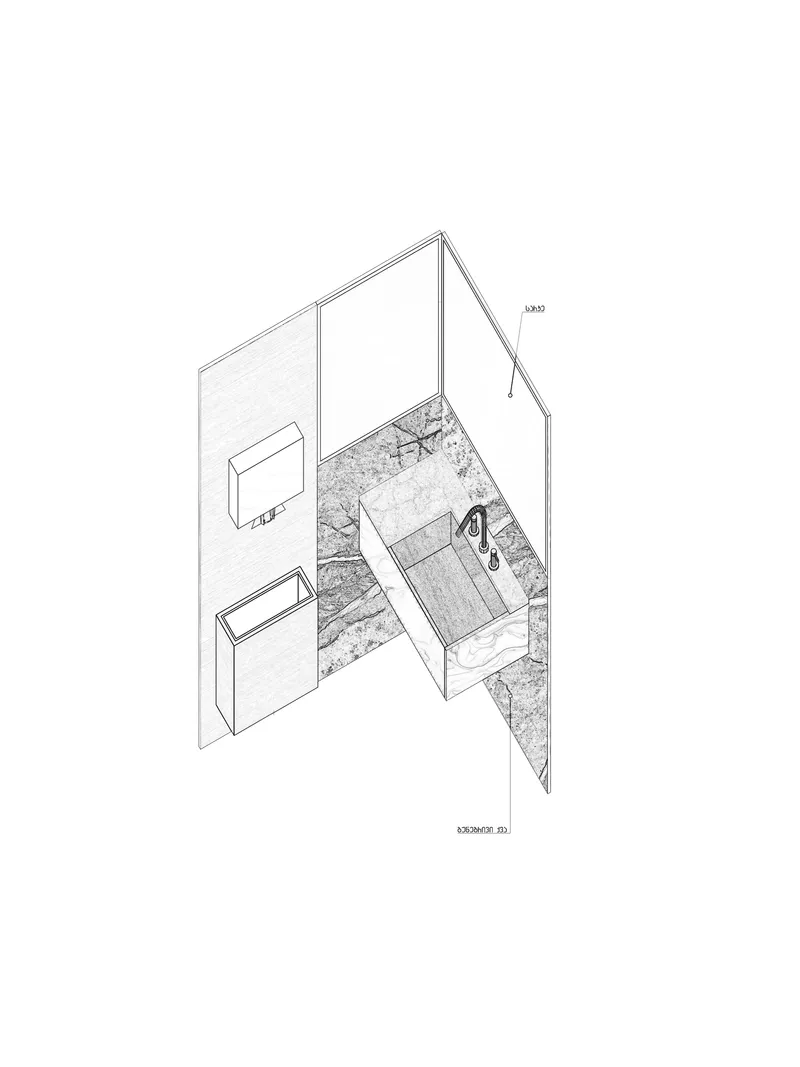
Even the bathrooms carry the project's material discipline. Floating vanities in dark veined stone sit against copper tile backsplashes, with wall-mounted faucets and sconces maintaining a clean, pared-back profile. Plywood cabinetry and terrazzo floors tie these smaller rooms back to the reception's palette. Nothing is an afterthought.
The green veined marble backsplashes in some units introduce a cooler note that keeps the copper warmth from becoming cloying. It is a subtle recalibration, the kind of tonal control that distinguishes an interior conceived as a whole from one assembled from separate mood boards.
Plans and Drawings
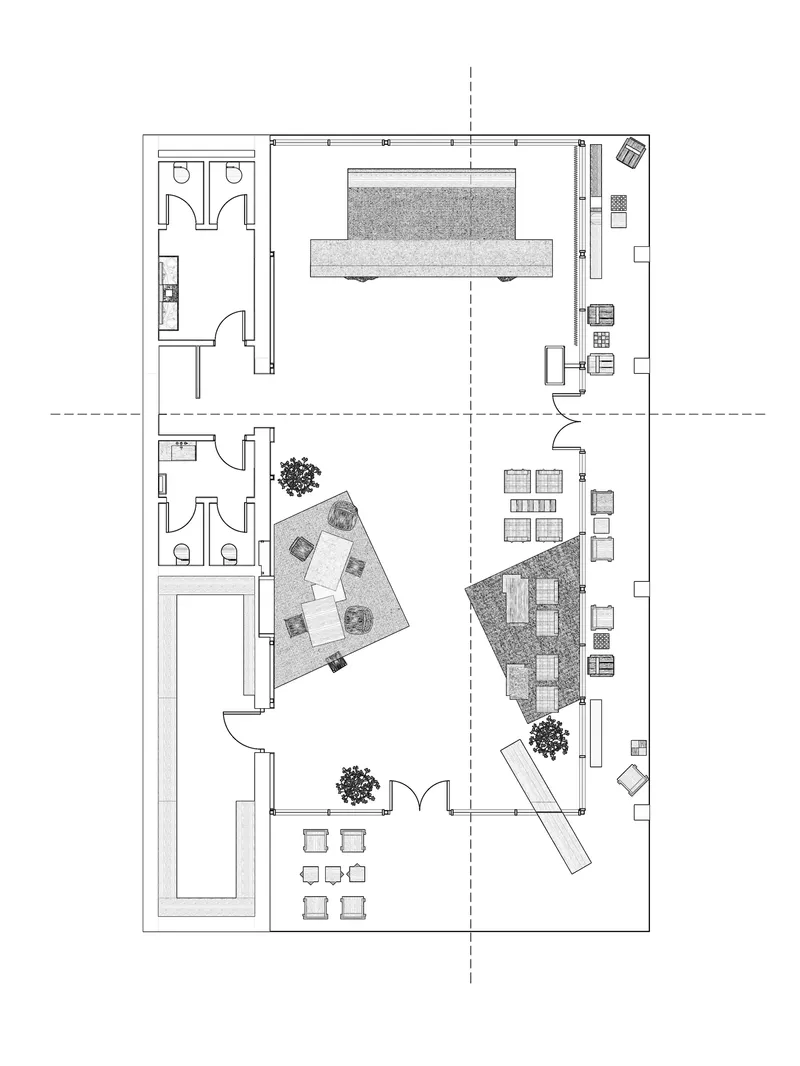

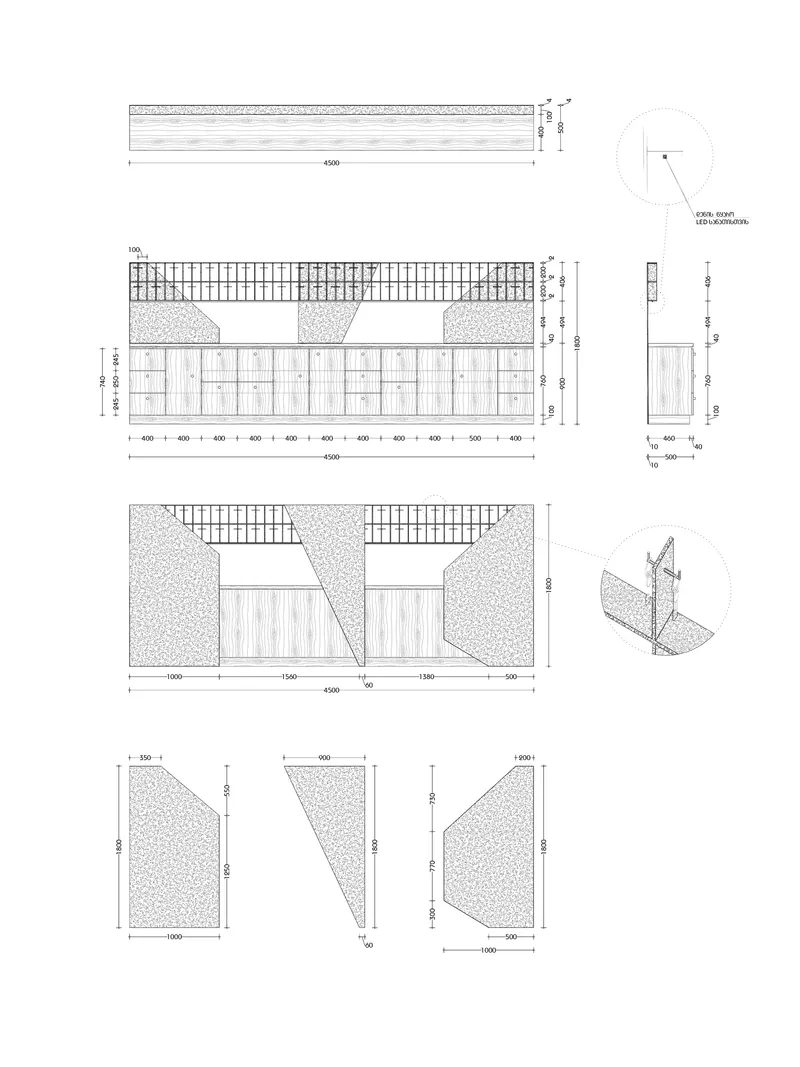
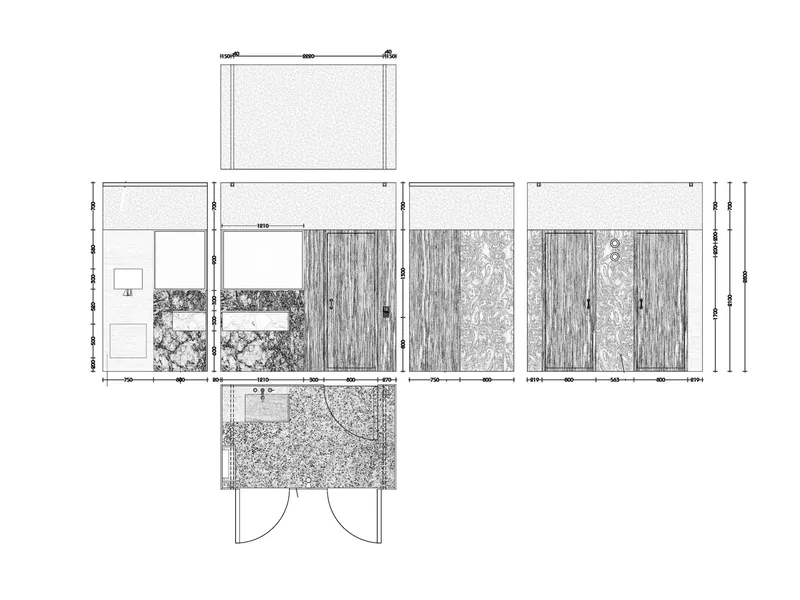
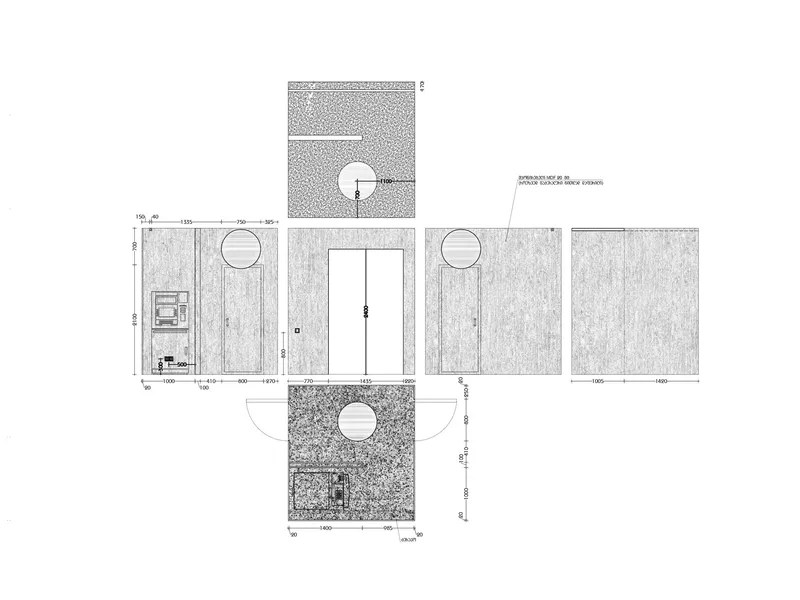
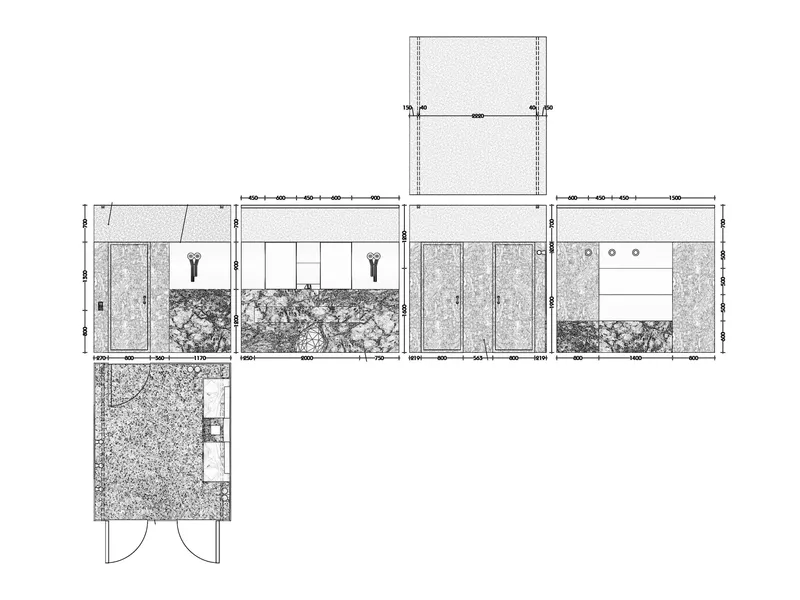
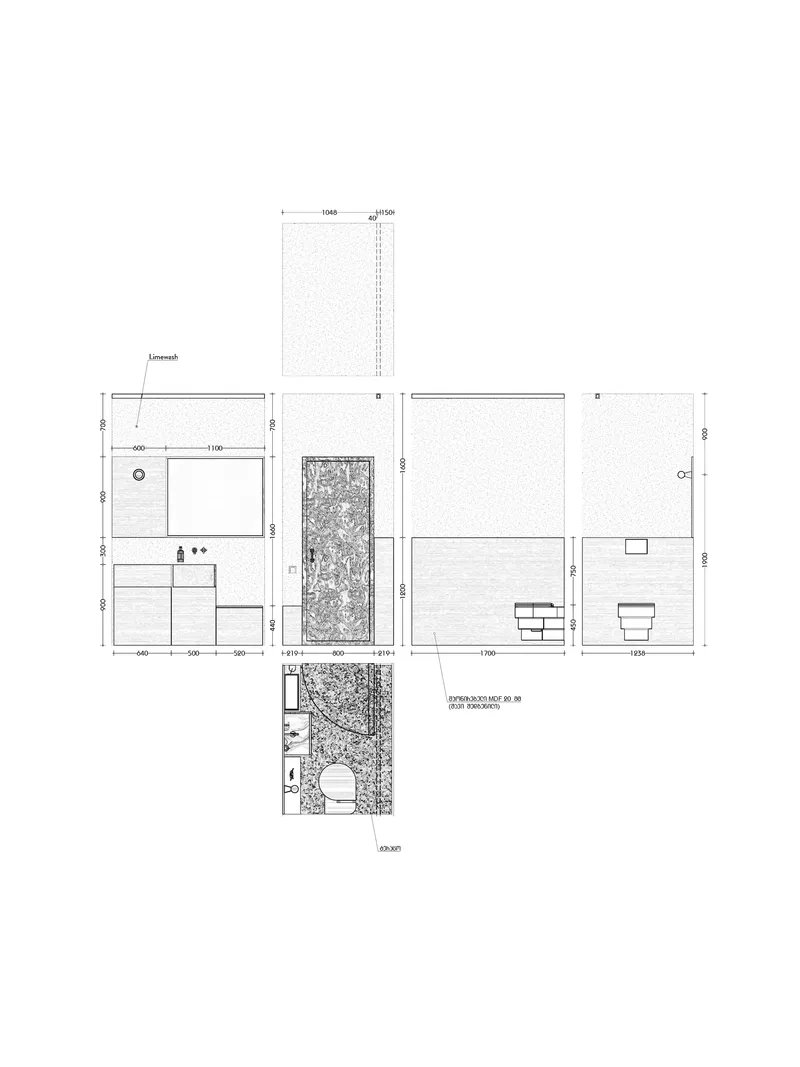
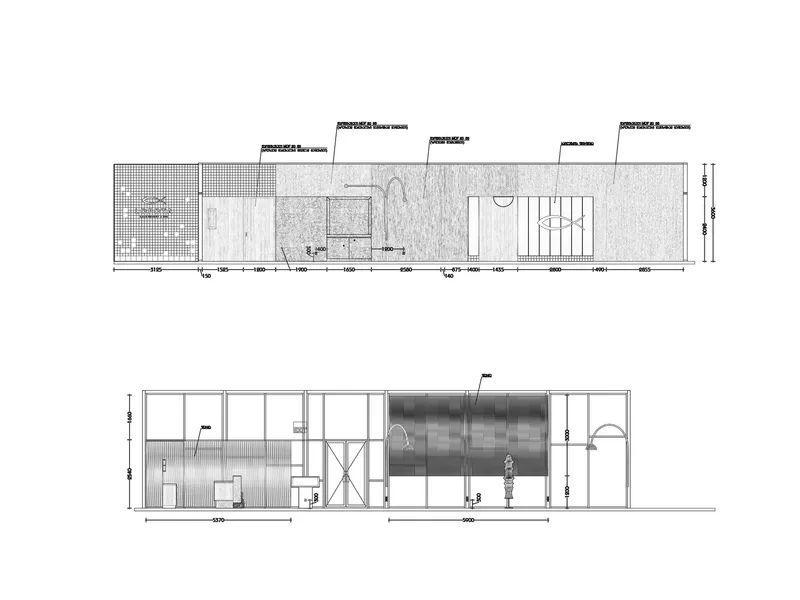

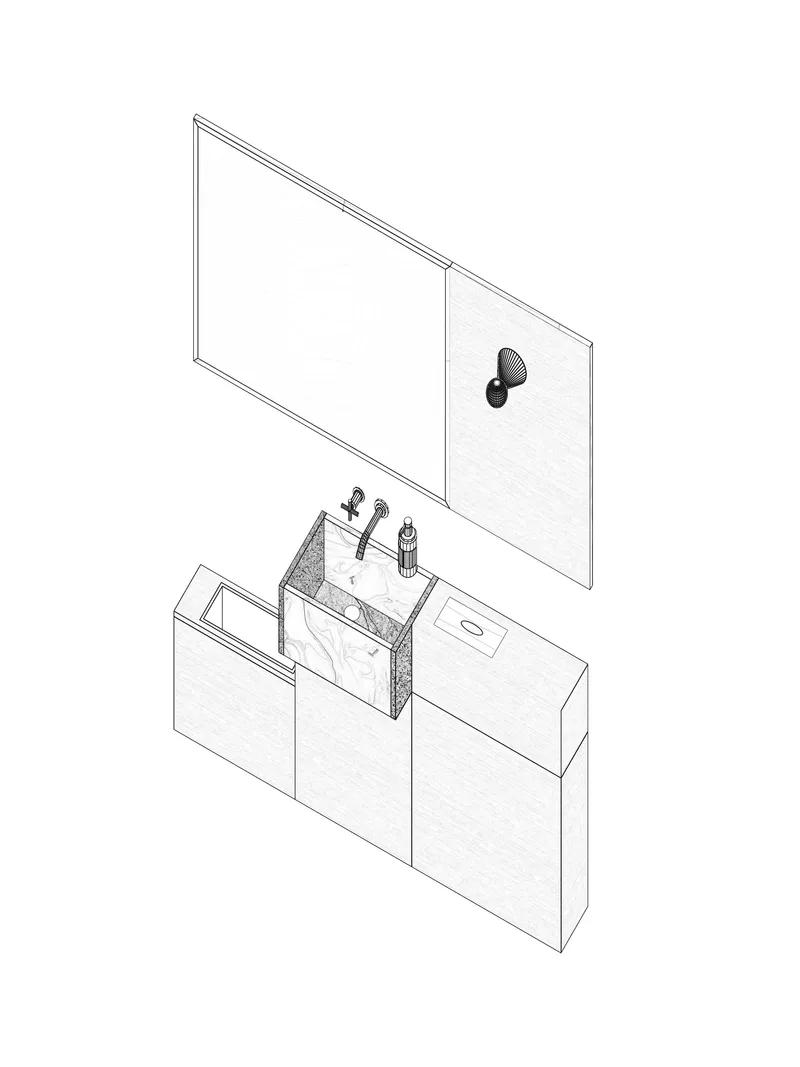
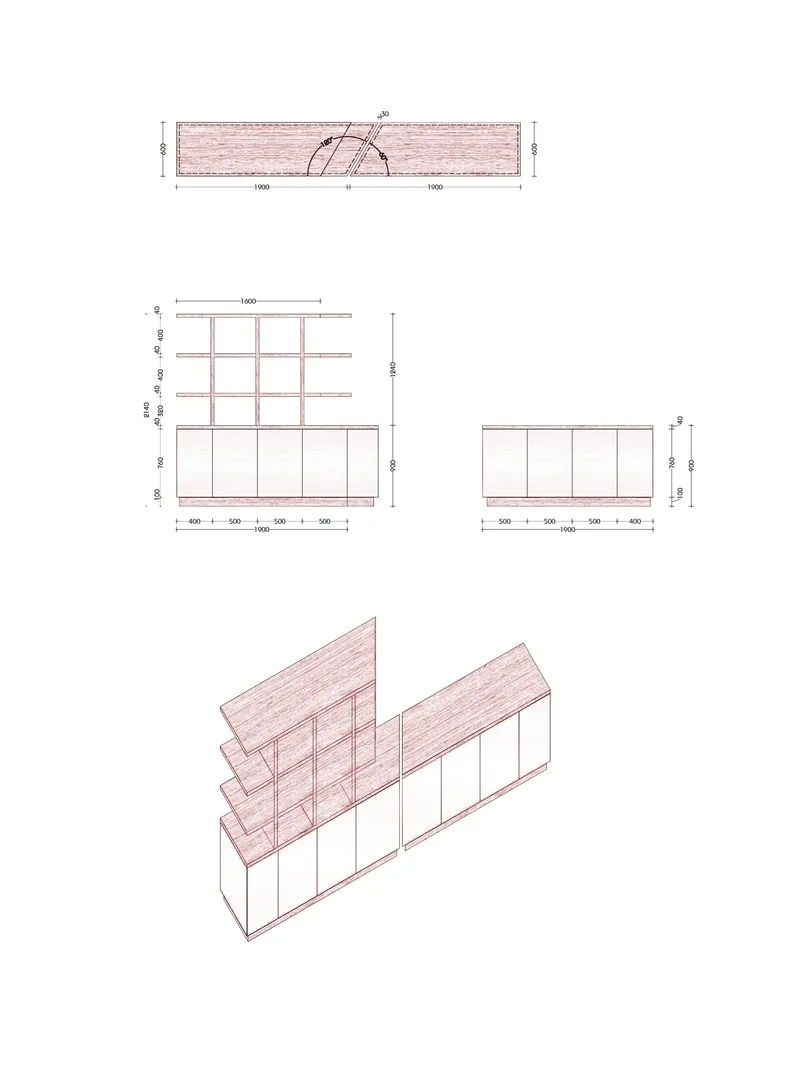
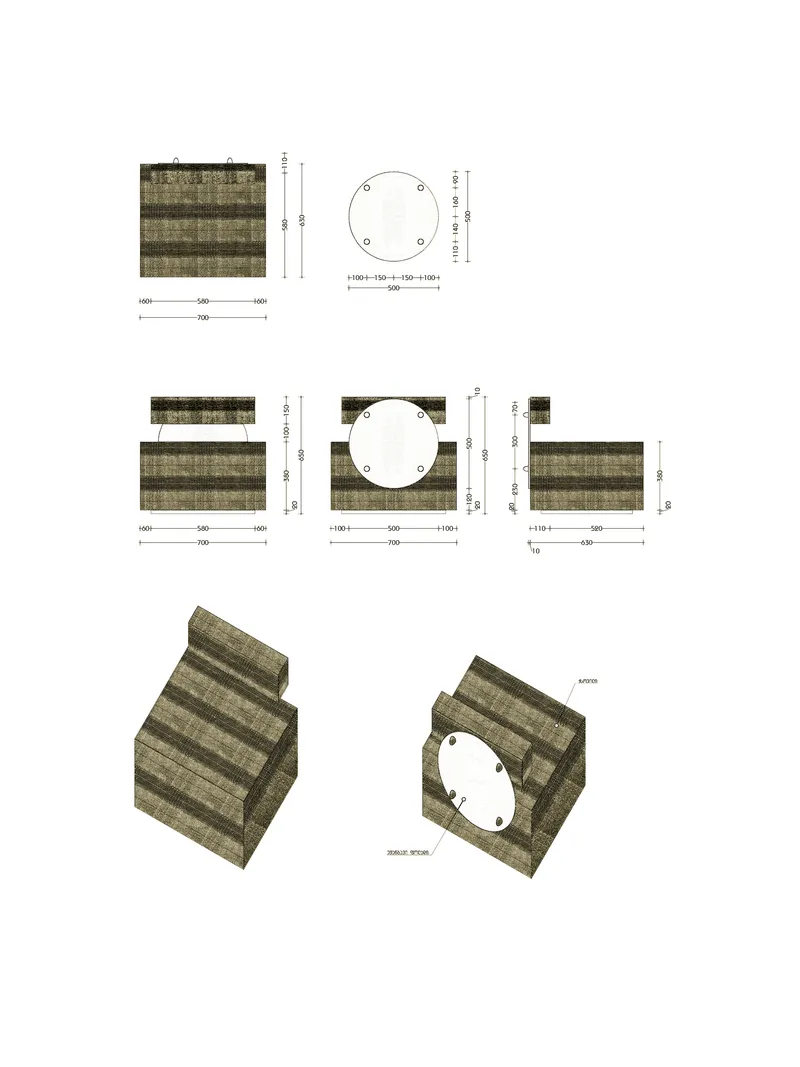


The floor plan reveals a rectangular layout threaded with angled interior volumes that break the predictability of the greenhouse envelope. Planted courtyards punctuate the plan, pulling landscape into the building at multiple points. The section drawings expose the gabled timber truss structure and its relationship to a lower service wing, clarifying how the tall reception volume and the more intimate support spaces negotiate their different ceiling heights.
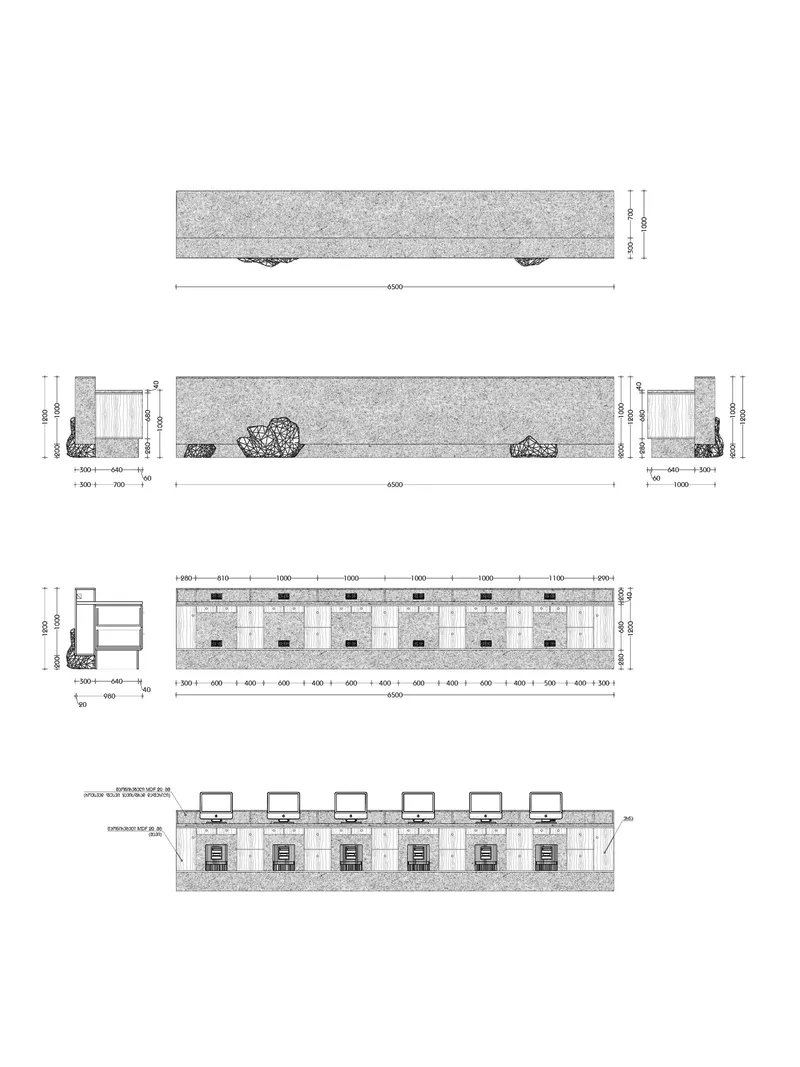
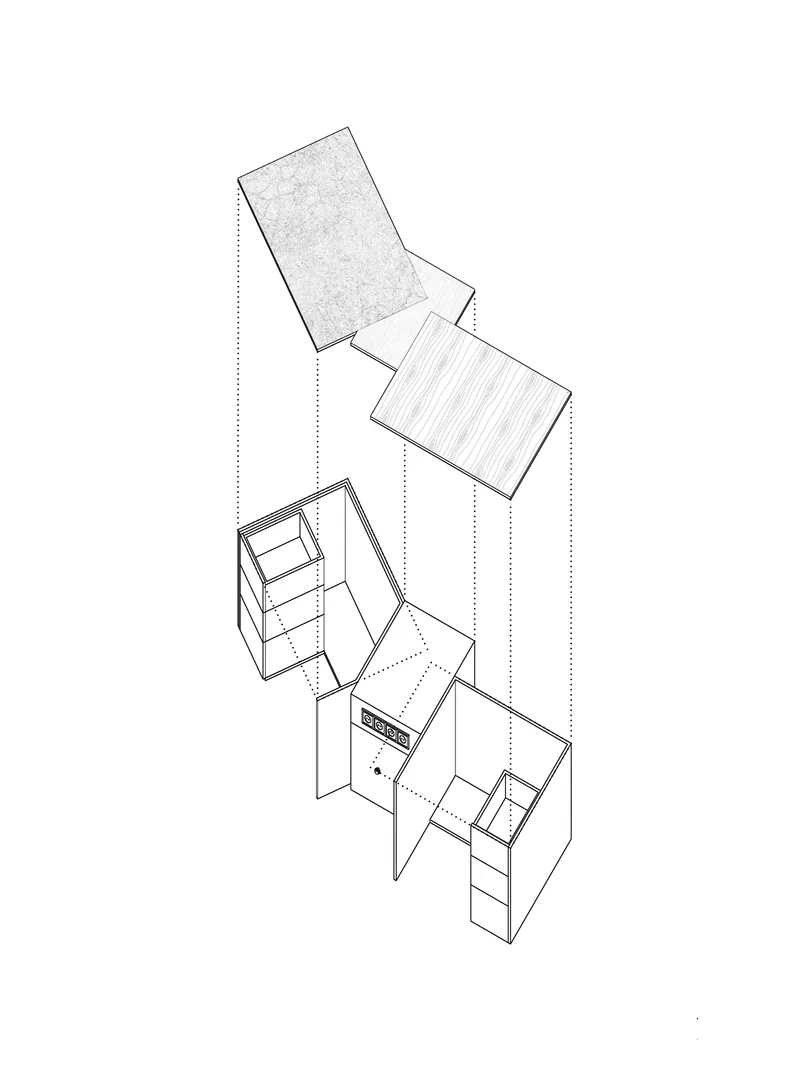
The exploded axonometric drawings are particularly revealing: they show how stacked volumes, courtyard insertions, and interior partitions create spatial variety within what could easily have been a monotonous glass box. Detailed furniture drawings for the vanity units and shelving demonstrate the studio's commitment to designing at every scale, from structural bay to sink basin.
Why This Project Matters
Hotel reception design is routinely treated as a branding exercise: a logo wall, a statement chandelier, a marble slab, done. Studio Gypsandconcrete's work at Lopota pushes back against that formula by grounding every decision in the specificity of place. The marble is from this hillside. The copper references the roses that once grew on this land. The wine shelf speaks to the region's 8,000-year viticultural history. None of these moves are arbitrary, and together they produce an interior that could not exist anywhere else.
The deeper lesson here is about transparency as an ethical position, not just a stylistic one. By building the reception as a glass pavilion, the architects refuse to compete with the Kakheti landscape. Instead, they frame it, filter it, and invite it in. The building succeeds precisely because it knows when to get out of the way. For a 291-square-meter space whose primary function is to say welcome, that is exactly right.
Lopota Reception by Studio Gypsandconcrete, lead architect Lado Lomitashvili. Located at Lopota Lake Resort & Spa, Telavi, Georgia. 291 m². Completed 2025. Photography by Grigory Sokolinsky.
About the Studio
Share Your Own Work on uni.xyz
If projects like this are the kind of work you want to make, uni.xyz is a place to publish your own, find collaborators, and enter design competitions.




Popular Articles
Popular articles from the community

AL-JANNAH: Sustainable Architecture and Permaculture for Afghan Widows
AL-JANNAH uses sustainable architecture and permaculture to create resilient oasis of housing, learning, work and renewal for Afghan widows.
EW PARK: Sustainable Architecture Reimagines the Future of Urban Parking
EW PARK reimagines city parking as a modular wooden tower combining automation, solar energy, electric mobility, and adaptable urban design.

The Ocean Hive: Sustainable Architecture for a Self-Sufficient Civilization at Sea
The Ocean Hive imagines sustainable architecture at sea, where modular habitats, algae, wave power and ocean waste sustain a growing colony.

The Musturak Paradise: Senior Living Architecture for a Connected Future in Temara, Morocco
The Musturak Paradise reimagines senior living architecture in Temara via private homes, social spaces, culture, community, and shared care.


Similar Reads
You might also enjoy these articles

Bao Huynh Watercolor Atelier: A Serene Art Retreat in Hội An
Bao Huynh Watercolor Atelier in Hội An blends multifunctional art spaces, sustainable design, local materials, and family-friendly living in a serene environment.

Atelier Macri Concept Store Interior Design by CASE-REAL
Atelier Macri store features a "ko" counter, walnut wood details, cork displays, blending retail, gallery, and seamless customer experiences.

Manuel Vargas Izquierdo Stadium and High-Performance Sports Center: Architectural Excellence in Jalpa de Méndez
The Manuel Vargas Izquierdo Stadium blends sustainable design, inclusive sports facilities, and cultural-inspired architecture, revitalizing Jalpa de Méndez’s public spaces.

KAKR Buluh Awar Hall: Revitalizing Community and Ecology Through Bamboo Architecture
Community built bamboo hall revitalizes Buluh Awar village, empowering youth, restoring ecology, celebrating vernacular craftsmanship through sustainable architecture and culture.


Comments (0)
Please login or sign up to add comments
No comments yet. Be the first to comment!