

Studio MM Architect Distills Rural Life to 1,290 Square Feet on a Catskills Hilltop
A retired couple's radically pared-back residence in North Branch, New York, trades square footage for deep connection to six acres of farmland.


Downsizing is easy to romanticize and hard to execute. Strip a house to 1,290 square feet for two people, one bedroom, and an art studio, and every decision carries weight: where light enters, what wall finishes touch skin, how the plan moves you from private sleep to shared cooking. Bully Hill House, completed in 2019 by Studio MM Architect on a six-acre hilltop meadow in Western Sullivan County, is a case study in what happens when clients and architect commit fully to less. The couple spent a year studying the site before a single line was drawn, watching sun angles and wind patterns across a sloping hayfield that backs up to forested ridges. That patience shows.
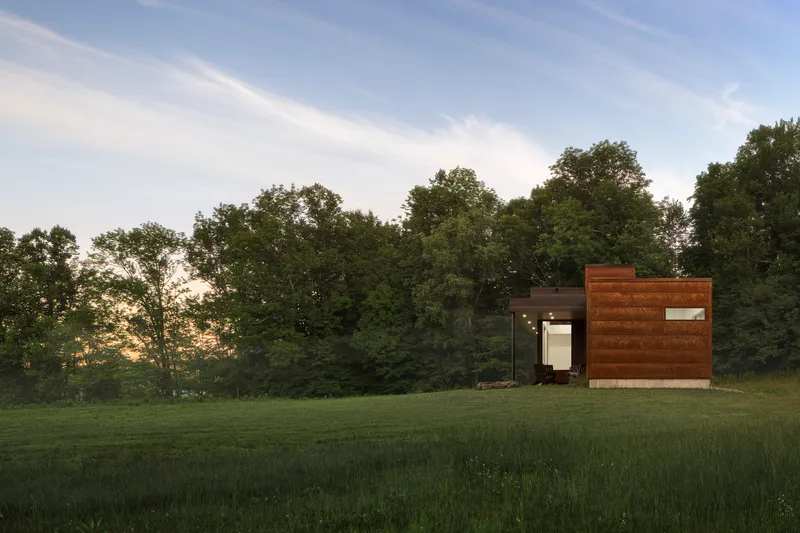
What makes the project genuinely interesting is not its smallness but the precision with which that smallness is deployed. The house reads as a low, dark bar notched into the crest of a hill, visible only once you clear a meandering driveway through woods. Its flat roof, black-stained pine siding, and Corten steel panels give it the mute authority of an agricultural outbuilding, one that happens to frame views of Bully Hill and distant mountains through carefully calibrated glass. No air conditioning. Radiant floor heating through a concrete slab that doubles as thermal mass. South-facing orientation calculated with sun studies so overhangs shade the interior in summer and admit low winter light. The building is a passive instrument tuned to its climate, not a sculptural object dropped on a pretty field.
Reading the Land
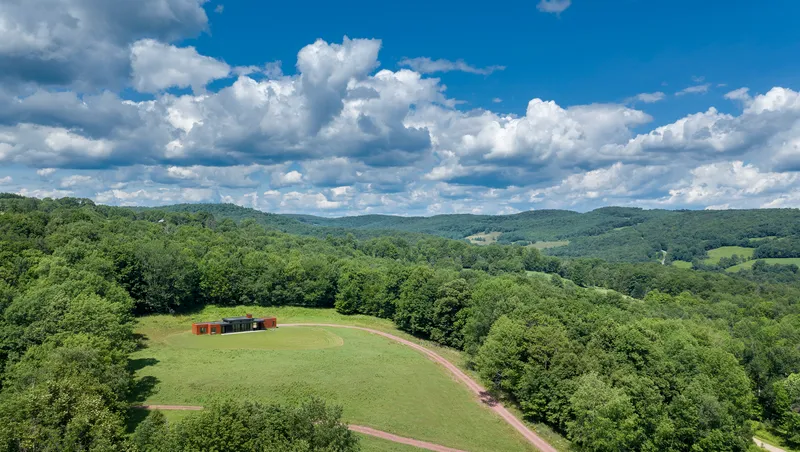
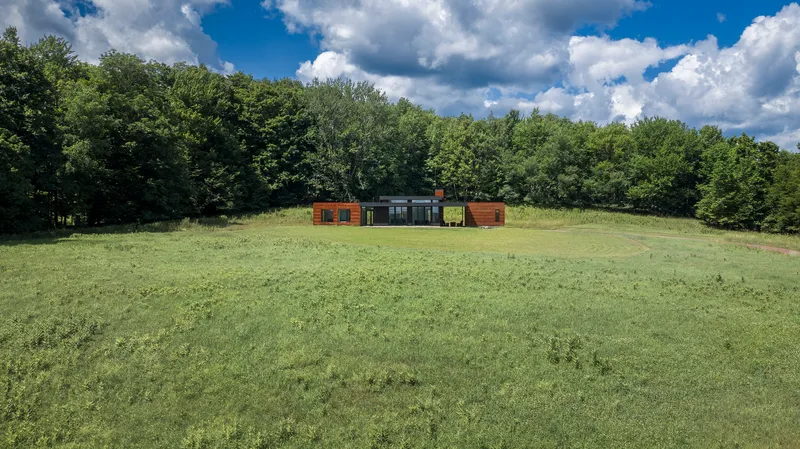
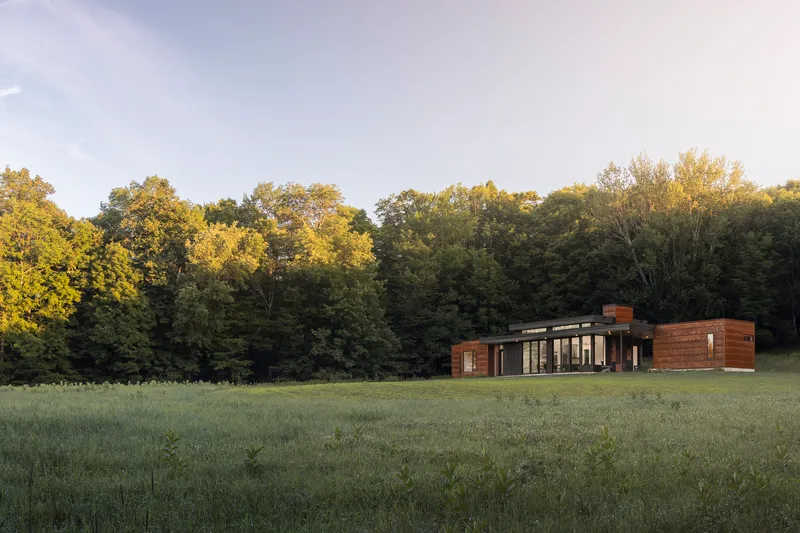
Seen from the air or from the meadow below, the house barely registers against its backdrop of tree line and sky. The site levels off at the hilltop crest, creating a natural building platform that the surrounding terrain hides from the road. It is a deliberate disappearance: the residence serves the landscape rather than commanding it. An active hayfield still operates on the property for a local farmer, preserving the agrarian character that drew the clients in the first place.
The linear massing runs roughly east-west, presenting a narrow profile to the prevailing weather and a generous south face to the sun. That orientation is not decorative. Cross ventilation pulls through south-side sliding doors and exits via operable windows on the north wall, eliminating the need for mechanical cooling entirely. The concrete slab floor holds the earth's temperature below, moderating interior swings season to season.
A Dark Bar in a Bright Field
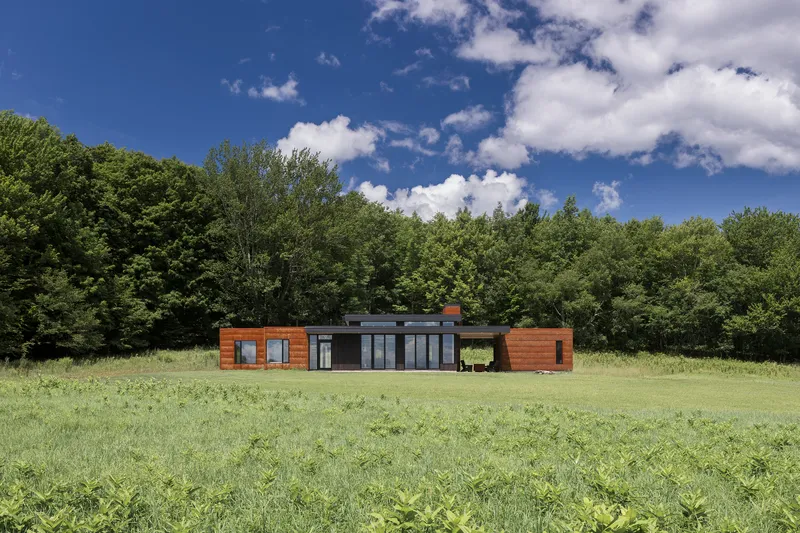
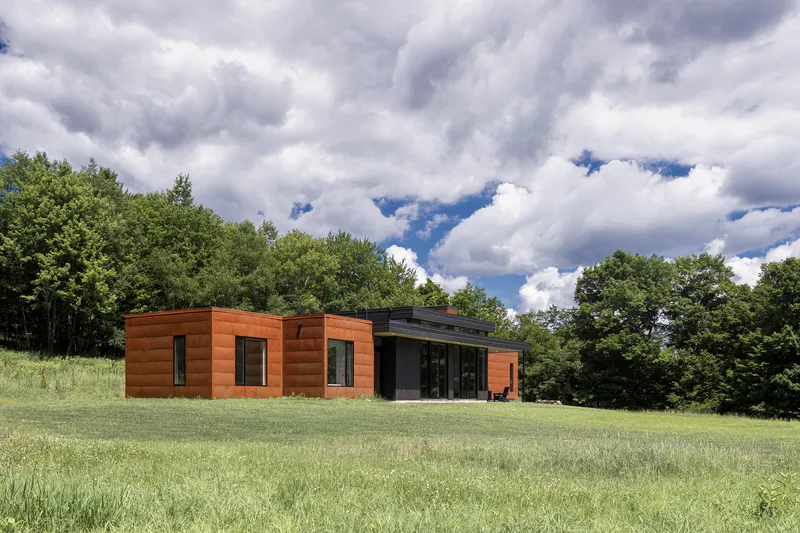
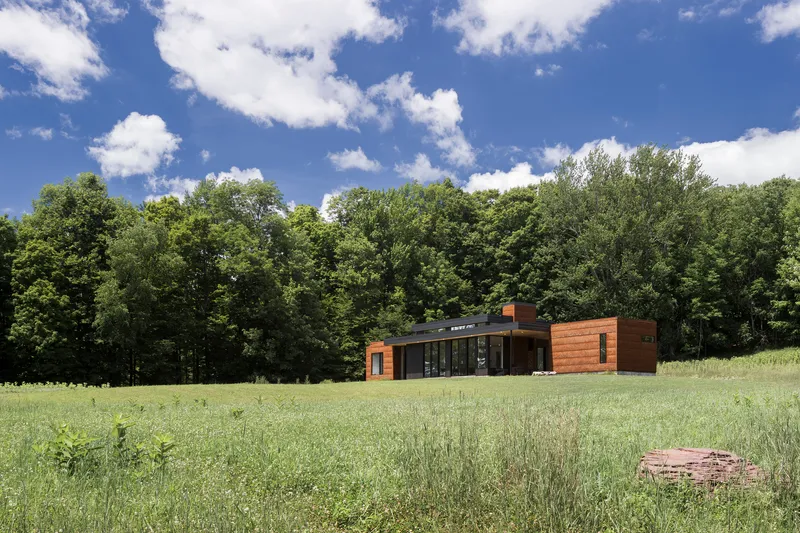
The exterior material palette is deliberately restrained: black-stained pine siding, 18-inch Corten steel panels, dark metal flashing, black window frames. Everything recedes. The Corten panels were dimensioned to align with the home's perimeter and horizontal window edges, avoiding cuts through the metal and producing a seam pattern that reinforces the house's horizontality. Over time the steel oxidizes deeper, pulling the facade closer to the ochre and umber tones of the surrounding soil and dried grass.
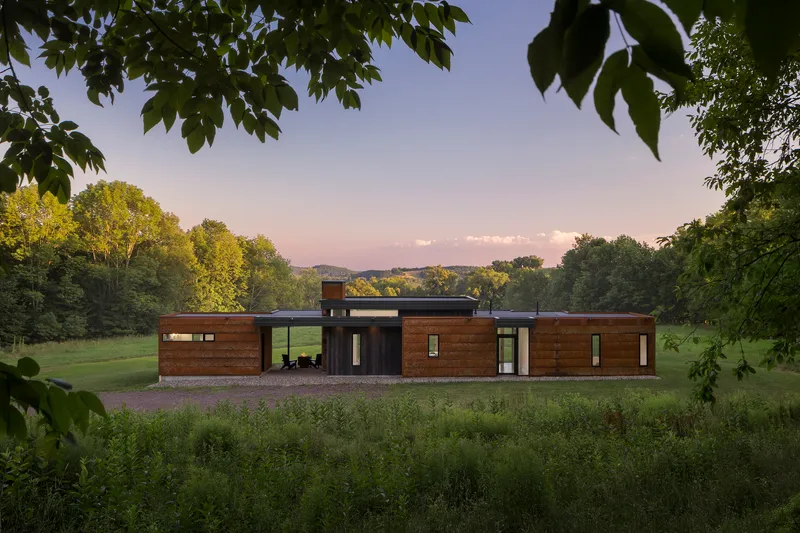
Two cedar-clad wings flank a central glazed pavilion that rises slightly above the roofline. At dusk, when interior lights catch the glass, the composition splits into three legible parts: solid, transparent, solid. It is a simple diagram, but the proportions are right, and the way the house catches the last pink light of a Catskills sunset justifies every careful alignment.
Material Honesty at the Joint
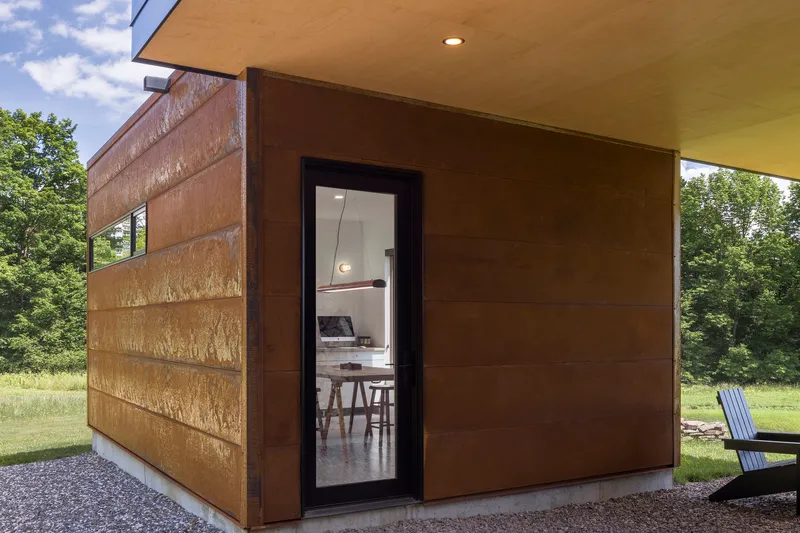
The corner detail where weathered Corten meets horizontal pine beneath a deep roof overhang is the kind of moment that separates competent residential design from thoughtful architecture. The overhang protects the wood from direct rain while allowing the steel to weather naturally. Neither material pretends to be the other. The dark metal flashing bridges them cleanly, functioning as a visual datum line that wraps the entire building.
Both materials were chosen for longevity and low maintenance, a practical consideration for clients designing a home to age in place. Corten is recyclable. Pine siding, stained dark, ages gracefully in the humid Northeast climate. These are not luxury finishes; they are durable ones, chosen to keep the building from demanding the constant attention its owners came here to escape.
Living in the Light Volume
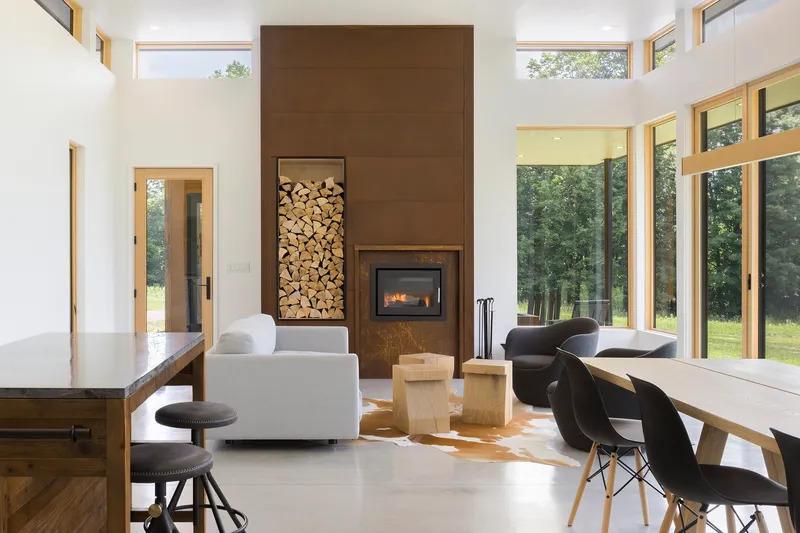
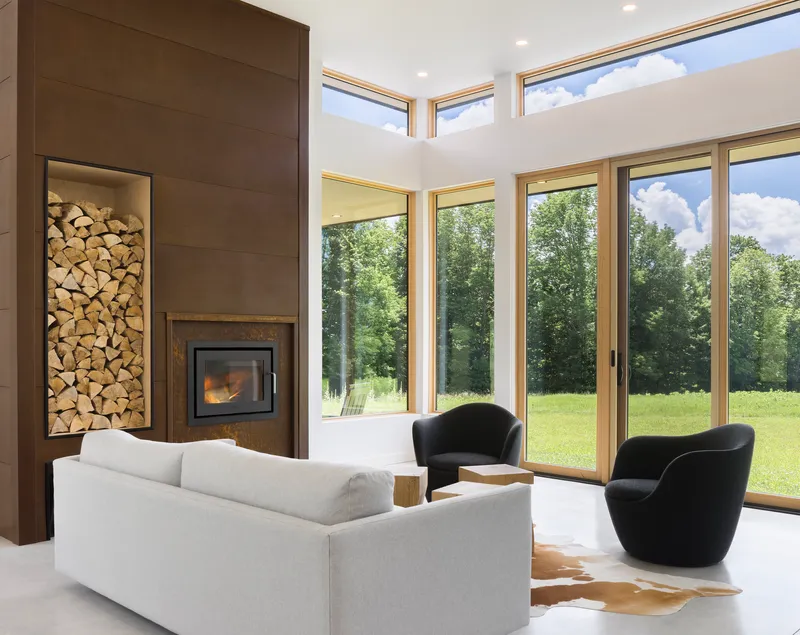
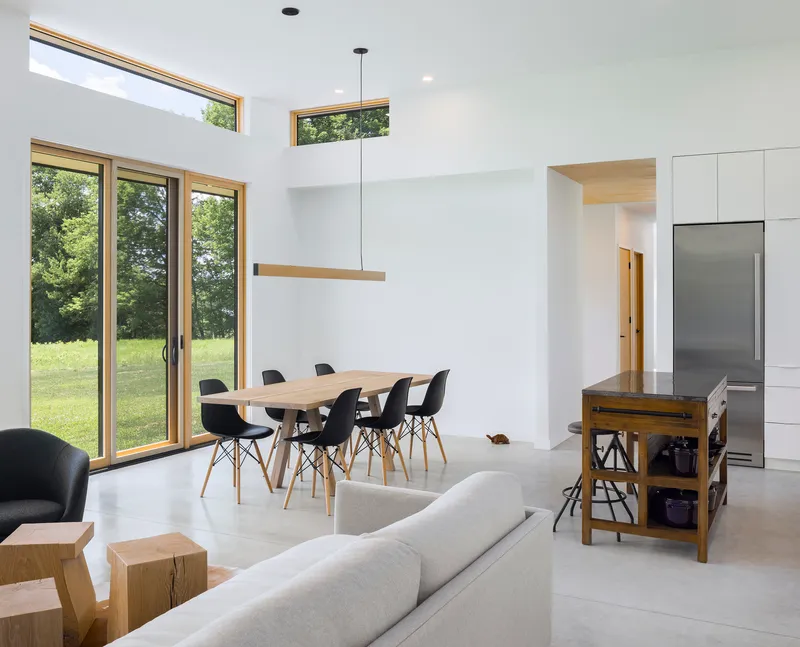
The central living volume is the heart of the house, and it earns that cliché. Double-height glazing on the south wall floods the open kitchen, dining, and living area with light. Clerestory windows above the fireplace wall pull daylight from the north, balancing the illumination and reducing glare. The fireplace itself is clad in Corten steel panels treated with vinegar, salt, and hydrogen peroxide to accelerate the rust patina indoors, a deliberate echo of the exterior cladding brought inside.
A stacked firewood niche beside the hearth is both practical storage and visual texture, turning a utilitarian need into a compositional element. The polished concrete floor extends continuously from entry to kitchen to living room, anchoring the open plan with a single uninterrupted surface that absorbs heat during the day and radiates it back at night.
Pared-Back Program
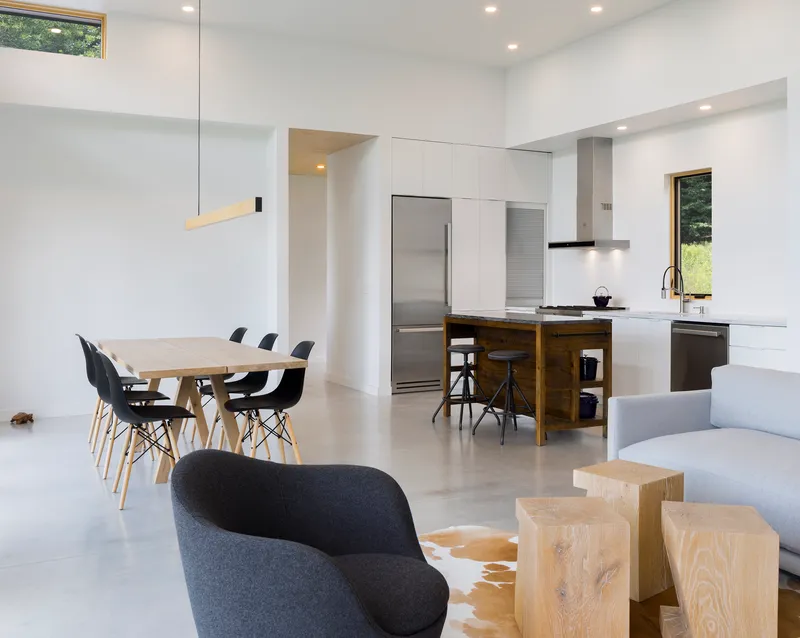
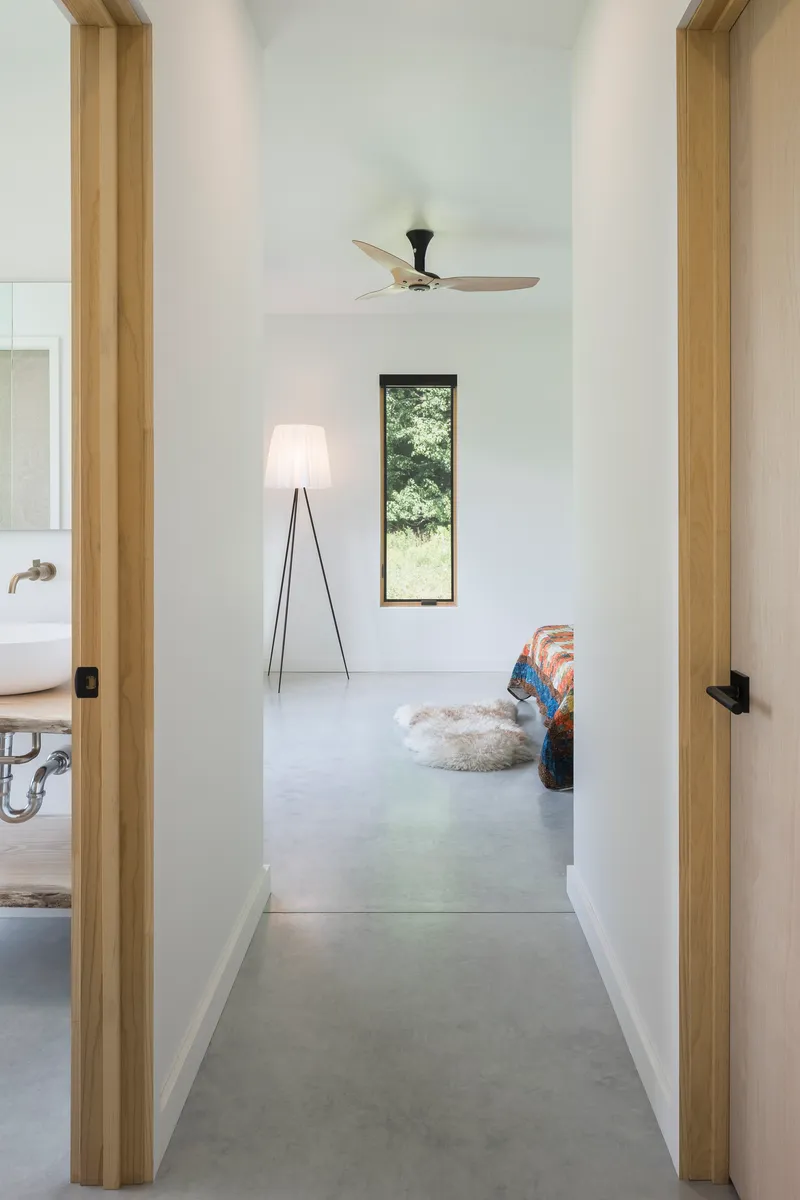
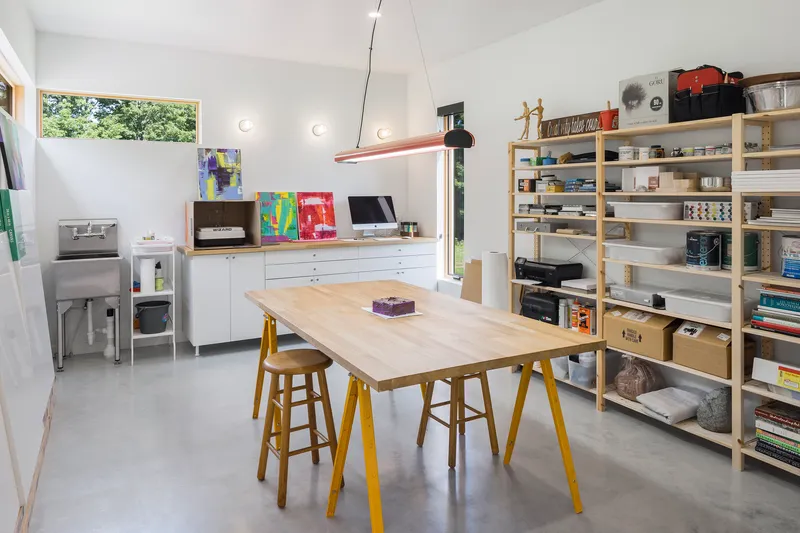
The plan is an enfilade: you enter through a sequence of rooms that unfolds laterally along the east-west axis. A single bedroom suite occupies the east end. The open kitchen and dining area sit in the central glazed volume. An art studio, connected by a breezeway, occupies its own wing to the west. Every room has a purpose; none exist as buffer or display.
The studio space, with its open shelving and work table on yellow trestle legs, reads as the most personal room in the house. It is unpretentious, functional, and well-lit. The hallway linking bedroom to living areas features light wood door frames and a vertical window that draws a stripe of outdoor green into the circulation spine. Even the transitions are designed.
Bathing with a View
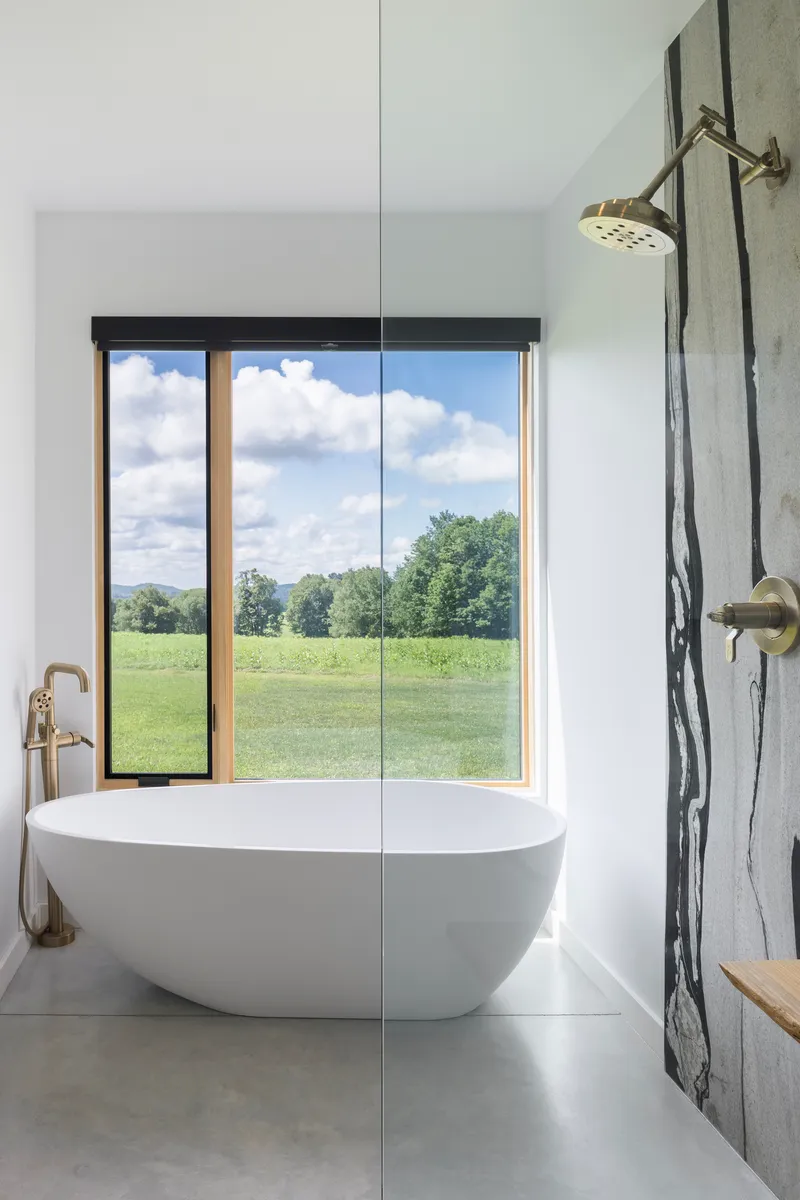
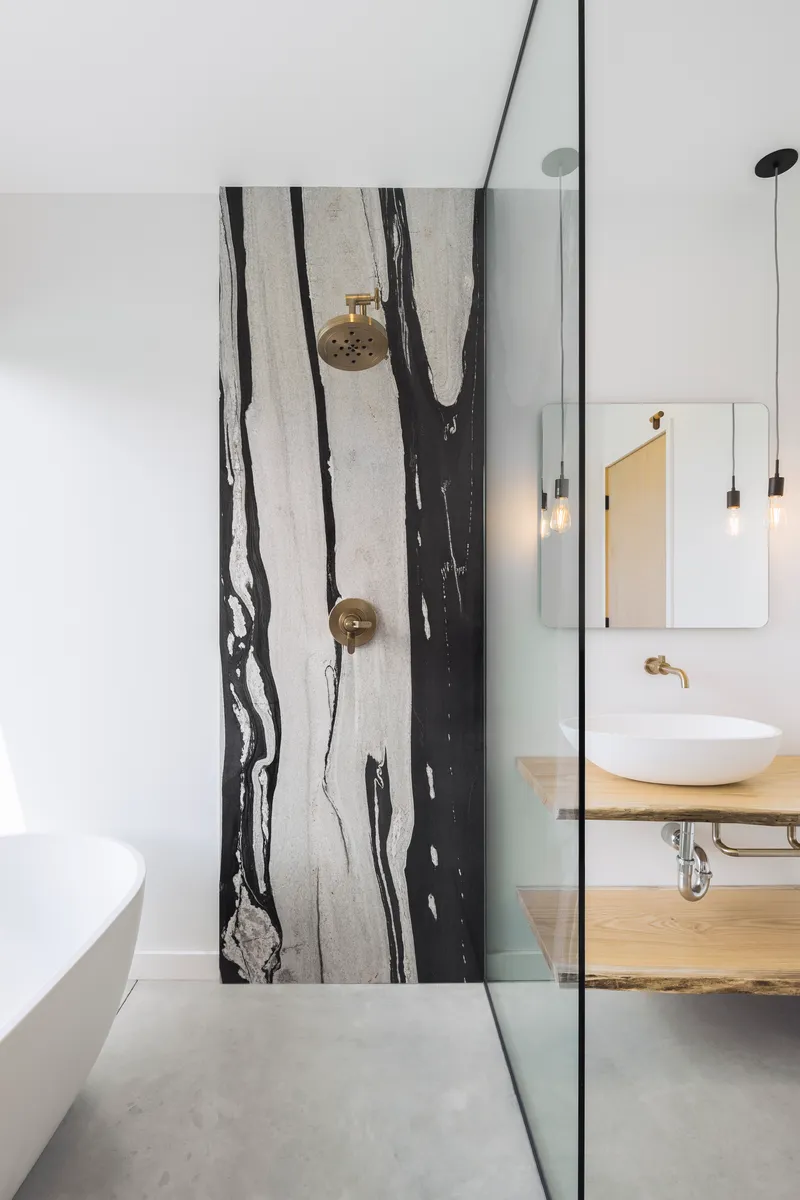
A freestanding white bathtub sits before a tall window framing a pastoral view of meadow and clouds. It is the kind of image that circulates on social media as pure aspiration, but in context it makes spatial sense: the bathroom occupies a private corner of the bedroom suite, oriented north toward the tree line where no neighbors exist. The marble shower wall, with black veining and brass fixtures, is the most overtly luxurious surface in the house, a controlled indulgence in a project otherwise committed to restraint.
Outdoor Room
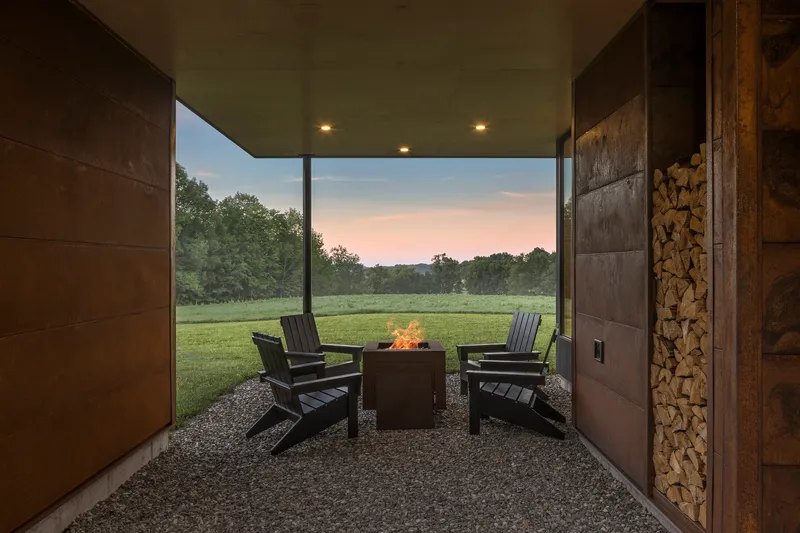
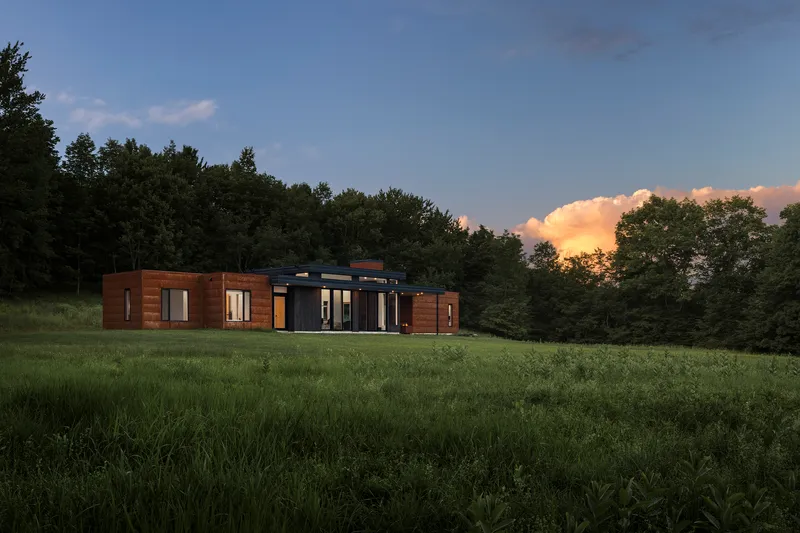
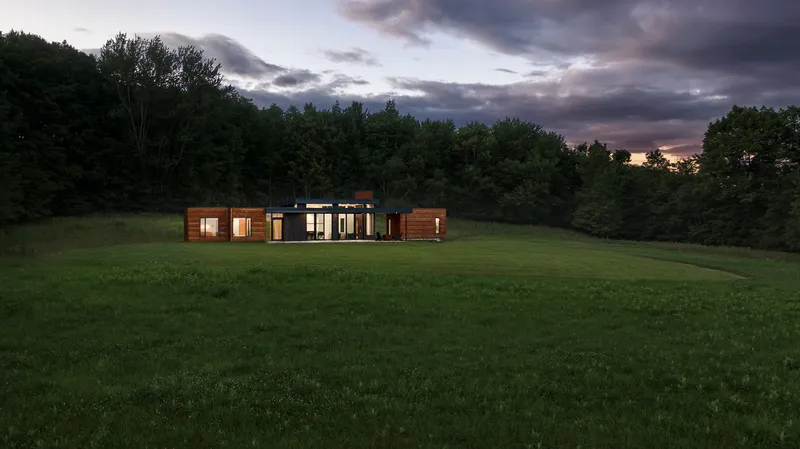
A covered terrace with a fire pit on gravel extends the living area outdoors, facing the open field. The deep overhang shelters the seating from rain while keeping the boundary between inside and out ambiguous. At twilight, the house glows from within while the terrace holds the last warmth of the day's embers. The relationship between the two spaces is not symbolic; it is thermal and social, an extension of the passive design strategy into habitable outdoor territory.
Plans and Drawings
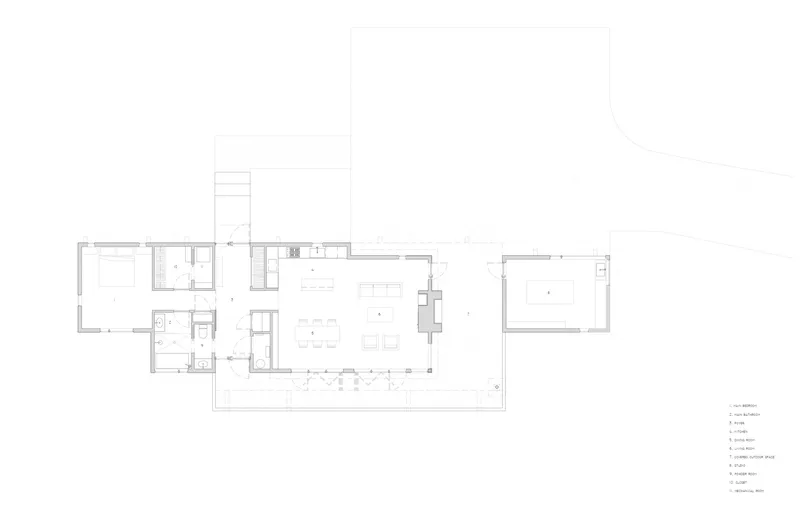
The floor plan confirms what the photographs suggest: a linear arrangement of rooms running east to west, with a detached garage set apart from the main volume. The breezeway between art studio and living quarters reads clearly as a deliberate separation of work and domestic life, connected but not merged. The plan's narrow width maximizes cross ventilation and ensures every room has access to natural light on at least two sides.
Why This Project Matters
Bully Hill House is a quiet argument against the prevailing logic of American residential construction, where more square footage signals more success. At 1,290 square feet on a budget under $500,000, this is not a vanity project dressed in modesty. It is a genuinely small house that performs at a high level because its architect and clients agreed on what to eliminate. No guest rooms. No garage attached to the main volume. No air conditioning. Every subtraction sharpens what remains.
The project also demonstrates that passive design does not require technological spectacle or LEED checklists. South-facing glass, calibrated overhangs, a concrete slab on grade, operable windows: these are old strategies executed with contemporary precision. Studio MM Architect has produced a house that will age well, both materially and conceptually, on a hilltop where nobody asked for architecture to announce itself.
Bully Hill House by Studio MM Architect (lead architect: Marica McKeel). North Branch, New York, United States. 1,290 sq ft (120 sq m). Completed 2019. Photography by Brad Feinknopf.
About the Studio
Share Your Own Work on uni.xyz
If projects like this are the kind of work you want to make, uni.xyz is a place to publish your own, find collaborators, and enter design competitions.


Popular Articles
Popular articles from the community


Singing Woman: An Opera House That Performs Before the Curtain Rises
Ovidiu Cristian Pavel's conceptual opera house translates Estonia's choral identity into a sculpted waterfront landmark facing the Baltic Sea.
Faces of the Soviet Avant-Garde: Turning Moscow's Street Names into an Open-Air Museum
A network of sculptural installations across a Moscow residential district transforms forgotten architect names into spatial encounters with cultural memor

The Amber Palace Opera: A Geological Fiction Surfaces on Tallinn's Baltic Waterfront
Pierre Brillard reimagines a Baltic legend as a public landscape, opera house, and waterfront promenade rooted in Tallinn's coastal identity.

Temporary Home for Dogs: A Reversed Zoo Rethinks Animal Shelter Architecture
In Bucharest, a sinuous corridor and freed landscape flip the logic of containment, designing a shelter that works to make itself unnecessary.

Similar Reads
You might also enjoy these articles

Pixel Gardens: One Repeated Module Stacked Into a Terraced Social Housing Tower for Famagusta
Salem Bader's shortlisted housing tower builds a vertical neighbourhood from one repeated module, offsetting units to carve terraces, light and air.

Bao Huynh Watercolor Atelier: A Serene Art Retreat in Hội An
Bao Huynh Watercolor Atelier in Hội An blends multifunctional art spaces, sustainable design, local materials, and family-friendly living in a serene environment.

Atelier Macri Concept Store Interior Design by CASE-REAL
Atelier Macri store features a "ko" counter, walnut wood details, cork displays, blending retail, gallery, and seamless customer experiences.

Manuel Vargas Izquierdo Stadium and High-Performance Sports Center: Architectural Excellence in Jalpa de Méndez
The Manuel Vargas Izquierdo Stadium blends sustainable design, inclusive sports facilities, and cultural-inspired architecture, revitalizing Jalpa de Méndez’s public spaces.

Comments (0)
Please login or sign up to add comments
No comments yet. Be the first to comment!