

STUDIO MOTLEY Folds a Bengaluru Home Around a Garden Court Beneath Layered Concrete Canopies
On a linear site in a quiet Bengaluru neighborhood, three wings and a crafted concrete roof orchestrate shade, air, and gathering.


The instinct in a warm city like Bengaluru is to pull back from the sun. STUDIO MOTLEY takes that instinct and turns it into the organizing idea for an entire house. House of Canopies, completed in 2022, is a residence for a couple and their sons on a linear plot within a quiet residential community. Its three wings fold around a generous garden court, and overhead, a series of concrete and steel canopy planes step outward to shade the west-facing facade. The result is a house that reads less as a single object and more as a system of sheltering surfaces held apart by light, air, and vegetation.
What makes the project worth studying is the precision with which the roof does architectural work beyond keeping rain out. A large concrete canopy cantilevers three meters over the garden, a Vierendeel truss supports it on one side, and slender steel double columns hold the opposite edge. A secondary canopy, built from a mild steel structure concealed within cement sheets that mimic the shuttering pattern of the concrete above, layers underneath. Continuous horizontal slits between roof and wall let hot air escape and draw diffused light into the rooms below. The palette of exposed concrete, polished kota stone, teak wood, and steel is deliberately restrained so that the quality of light and the experience of the garden remain the protagonists.
Canopy as Architecture
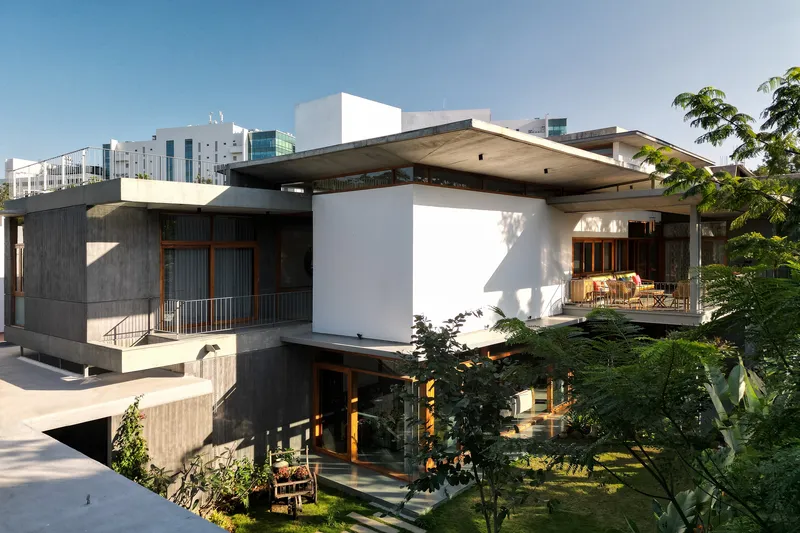
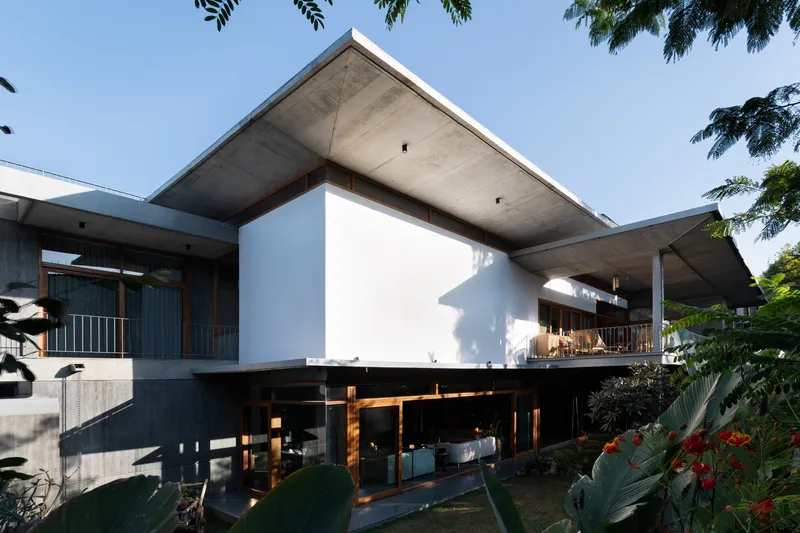
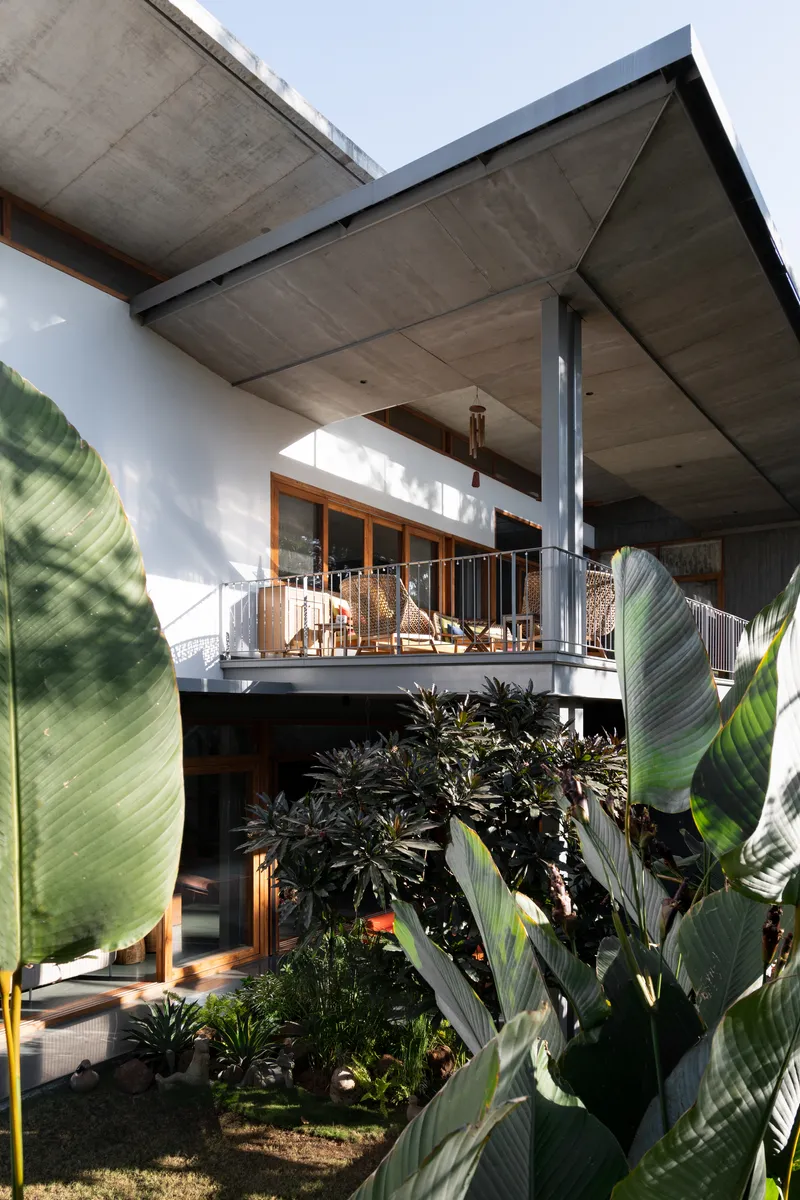
The defining gesture is visible from the street: broad concrete planes float above white stucco volumes, casting deep shadows that shift through the day. The canopy is not decorative. It is the climate strategy. By stepping outward over the west-facing facade, the roof eliminates direct solar gain on the largest glass surfaces of the house while still allowing the interiors to open generously toward the garden. Timber columns at the lower level and steel columns above resolve the load path with apparent lightness.
The secondary canopy below, clad in cement sheets whose seam layout echoes the formwork joints of the concrete above, adds another layer of modulated shade. Between the two planes, horizontal slits act as thermal chimneys, pulling warm air up and out. It is a straightforward passive strategy, but the detailing elevates it: the two canopies read as a single composed roof system rather than a primary structure with an afterthought bolted underneath.
The Garden Court as Center
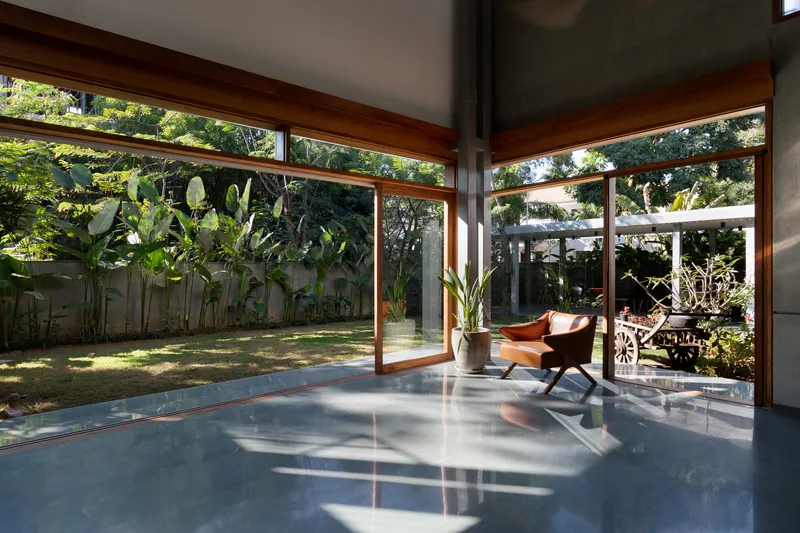
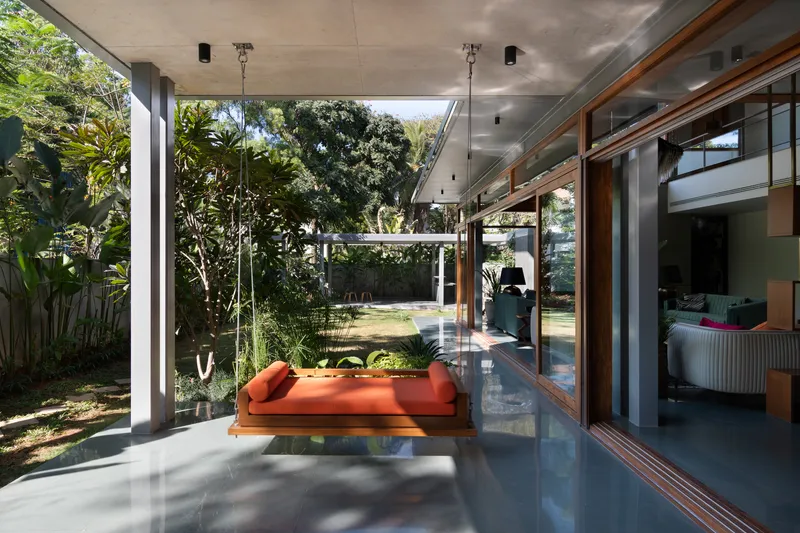
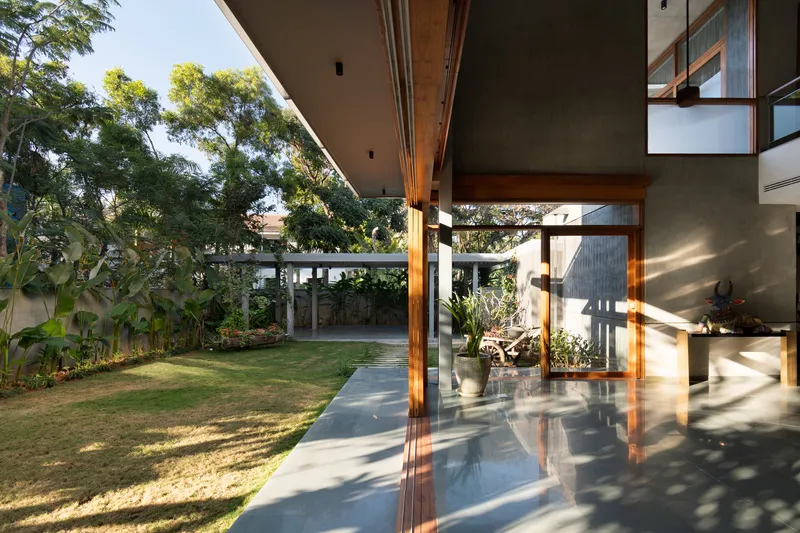
The three wings of the house wrap around a central garden court planted with banana trees and tropical species. Timber sliding doors, spanning nearly fifty feet, dissolve the boundary between inside and out. When fully retracted, the living and dining spaces become part of the courtyard, and the house transforms into a series of covered outdoor rooms. The brief asked for a home that could host large gatherings while offering a constant experience of the outdoors from within, and this layout delivers on both counts without resorting to oversized formal entertaining spaces.
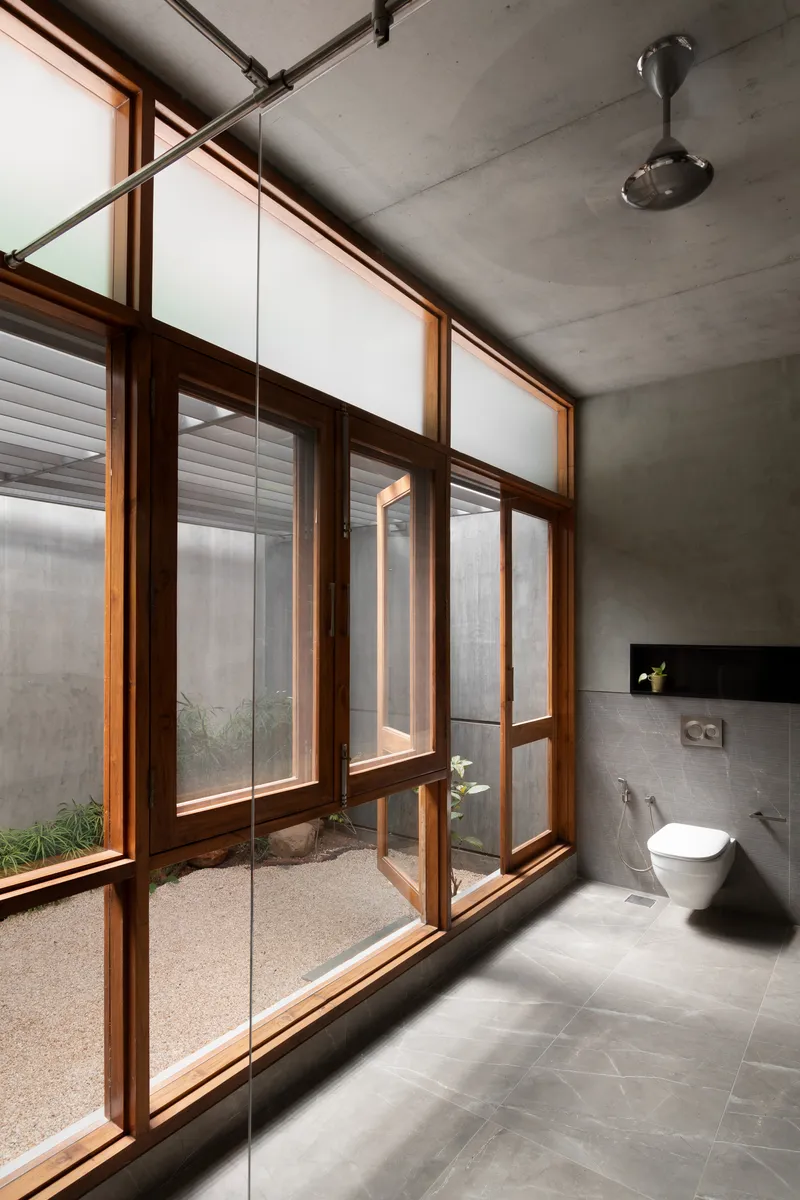
The courtyard is not merely a void left over from the building footprint. It is the spatial anchor from which every other room takes its orientation. The first-floor study floats above the dining area and looks across a generous sit-out directly into the canopy of trees. Even the bathrooms are oriented toward small gravel courts, ensuring that no room in the house feels sealed off from daylight and greenery.
Three Wings, Three Characters
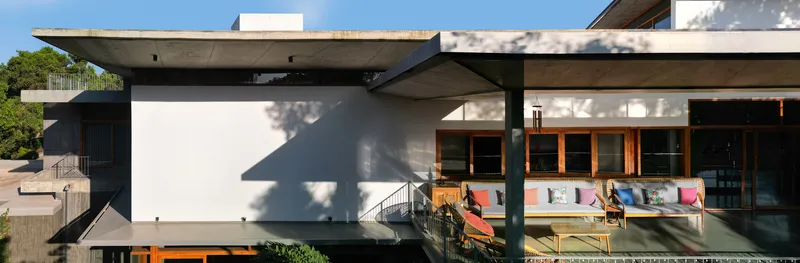
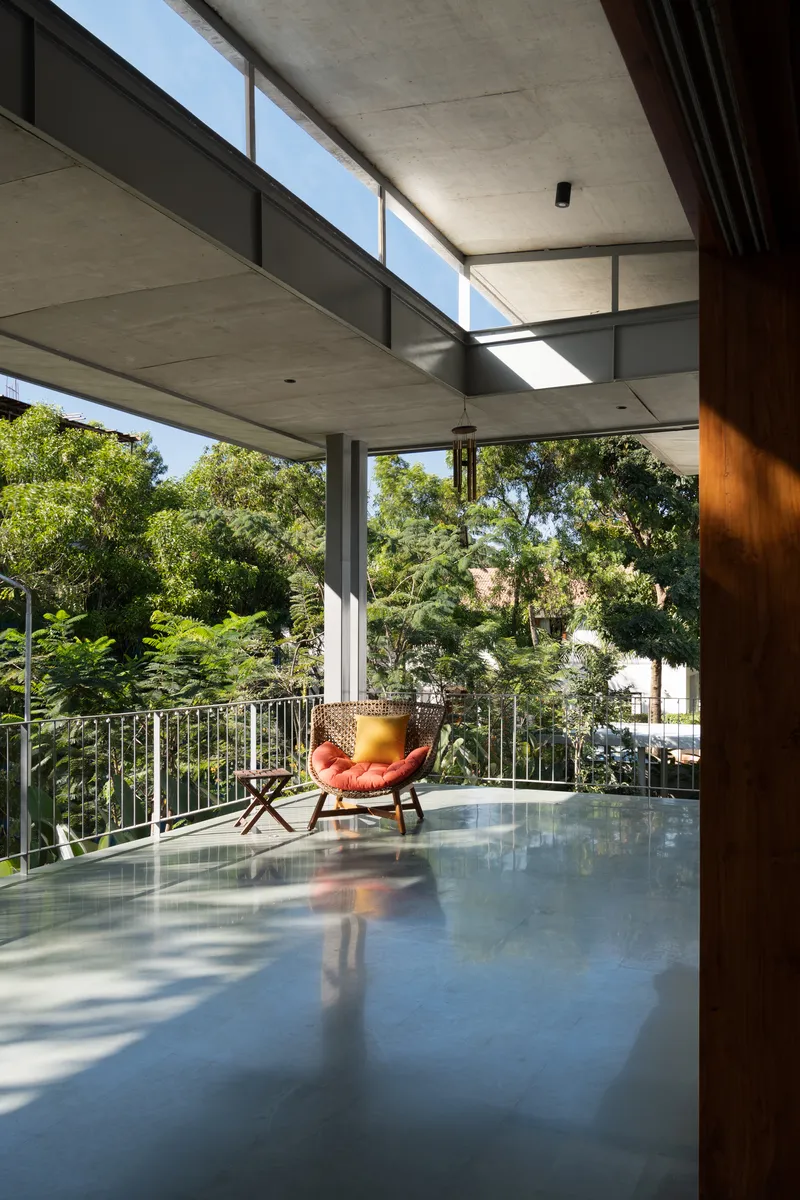
The programmatic split is clean. The front wing contains a semi-covered party area suited to Bengaluru's hospitable climate, a space that blurs the line between porch and pavilion. The central wing houses the living room, dining area, and main staircase, forming the social heart of the house within a double-height volume. The rear wing is reserved for private bedrooms. Each wing has a different relationship to the roof system: the party area sits under the deepest overhang, the central wing opens through the double-height void to clerestory light above, and the bedroom wing is lower, more enclosed, more introverted.
Upper-level balconies and terraces extend the social space vertically. An elevated terrace with colorful lounge chairs captures breezes above the garden canopy, and a covered balcony with a polished concrete floor offers a quieter retreat framed by dense tree crowns. These outdoor rooms at multiple levels mean the house rarely forces a choice between comfort and fresh air.
Vertical Circulation as Spatial Event
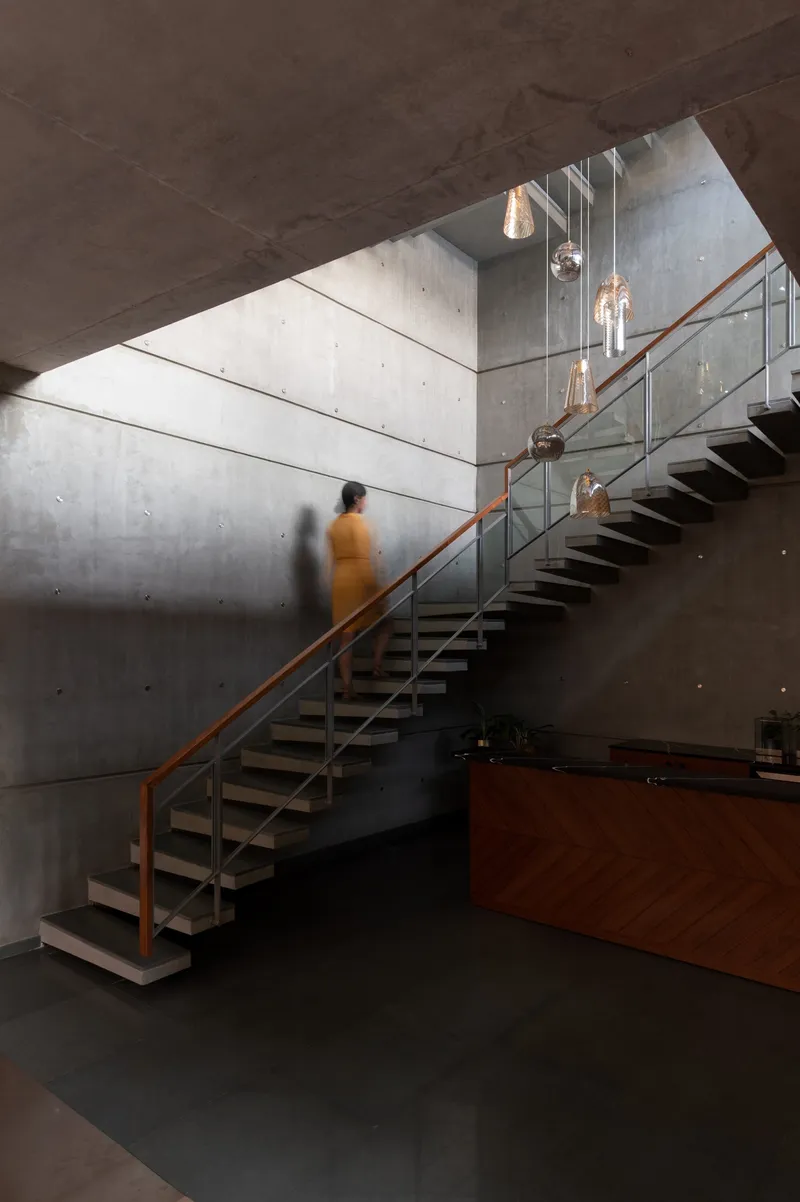
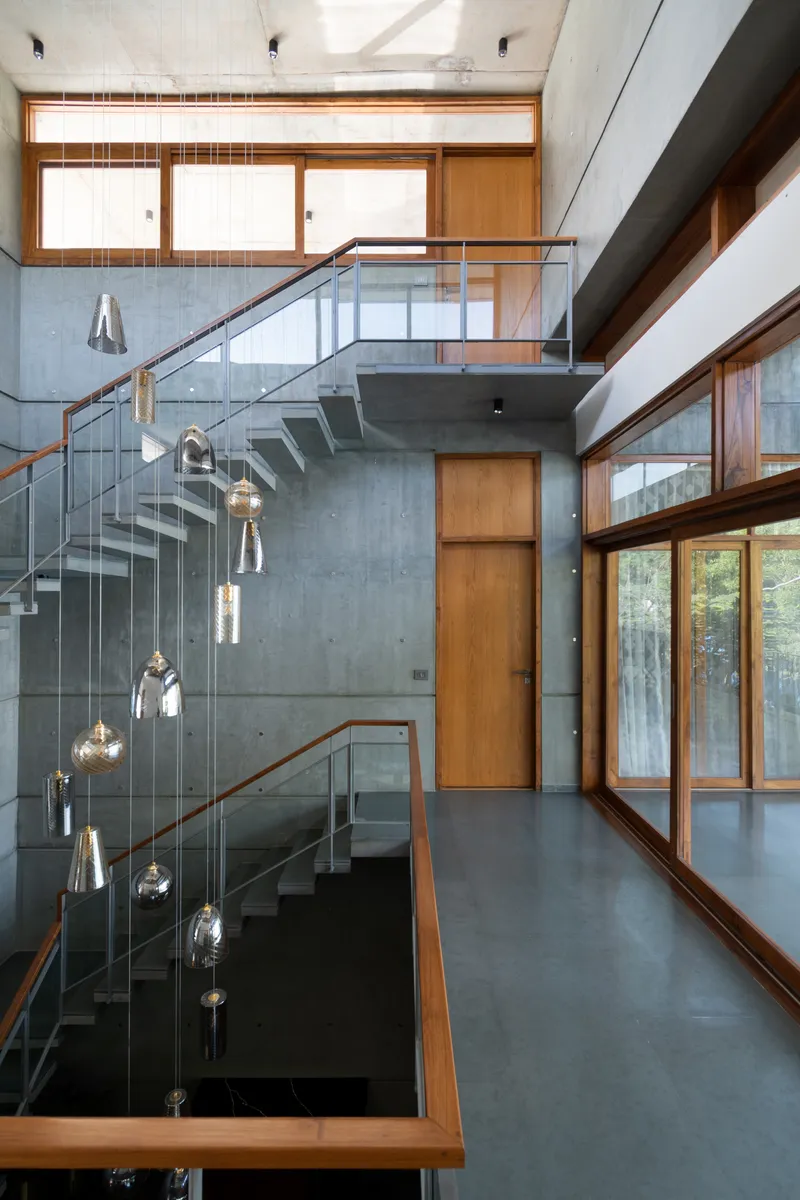
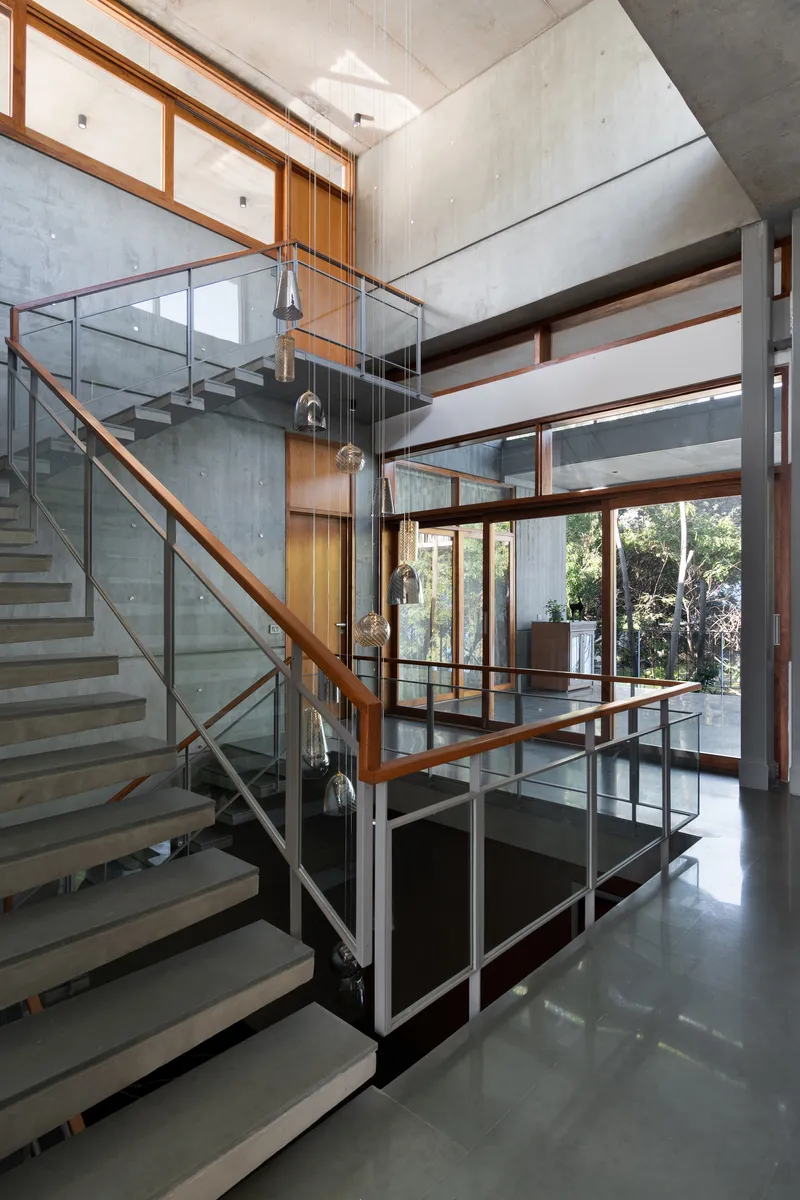
The central staircase is more than connective tissue. A steel and timber structure with a glass balustrade rises through a concrete-walled stairwell toward a skylight, and pendant lights descend through the resulting void to dramatize the vertical dimension. The split-level organization of the house means the stair negotiates multiple half-levels rather than a single floor-to-floor jump, and each landing offers a new framed view: back into the double-height living space, out toward the garden, or up into the clerestory slot.
Glass balustrades at the upper-level corridors maintain visual continuity across the void, so the double-height volume is always perceptible even from the most private parts of the house. The effect is a sense of spatial generosity that exceeds what the plan dimensions alone would suggest.
Materials and Light
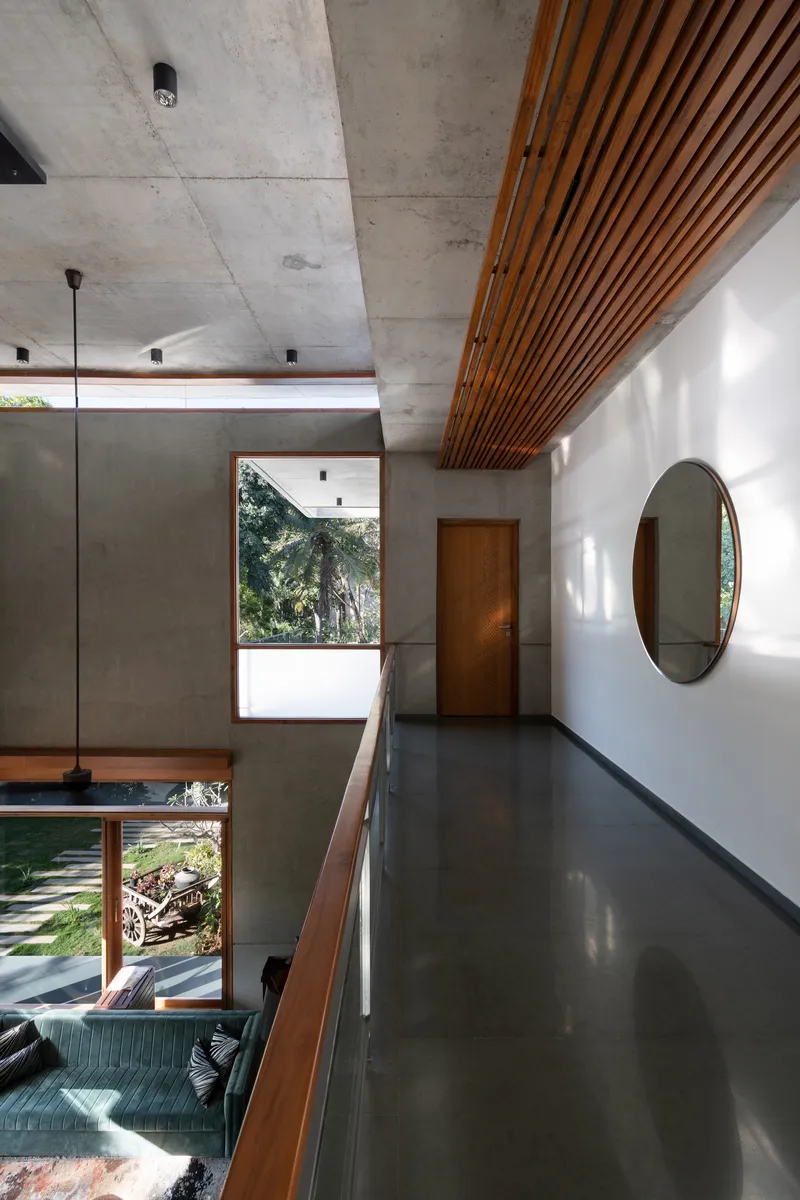
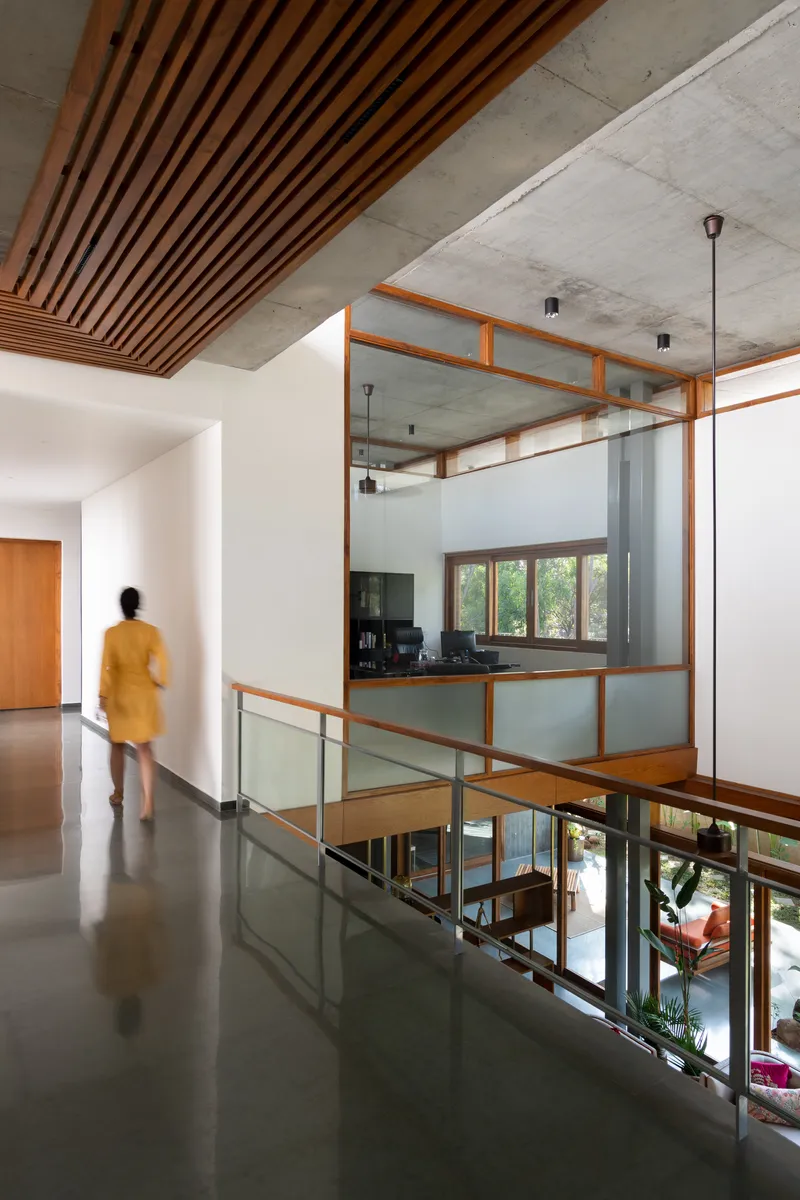
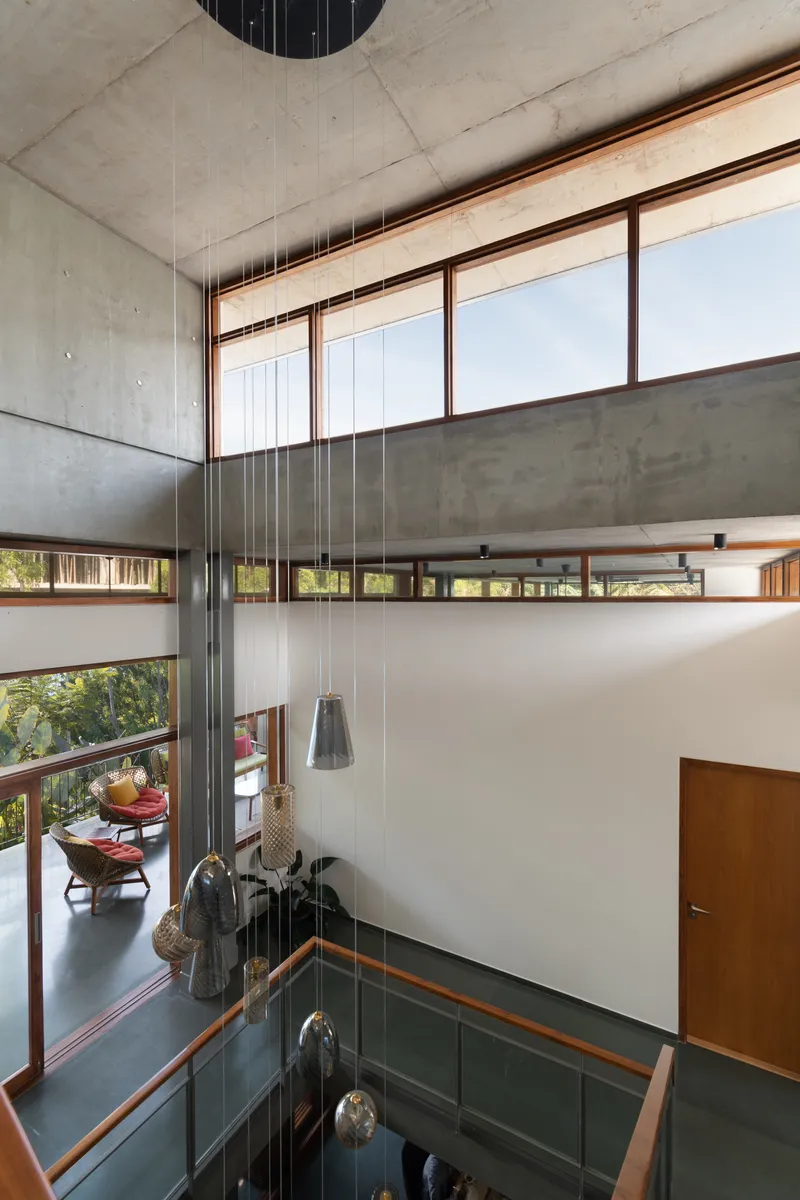
The material palette is concise: exposed concrete ceilings, polished kota stone floors, teak framing, and steel structure. STUDIO MOTLEY uses this restraint strategically. With surfaces kept neutral, the changing quality of light, diffused through clerestory slits in the morning, sharp and golden on the west facade at dusk, becomes the primary source of visual richness. Timber-slatted ceiling panels in the upper corridors filter overhead light into warm striations that contrast with the cool grey of the concrete soffits.
The continuous horizontal gaps below the roof planes deserve special attention. They serve a thermal function, letting hot air escape, but they also wrap the upper edge of every room in a band of diffused daylight. The perceptual effect is that the roof appears to hover, separated from the walls by a luminous seam. It is a simple detail, repeated consistently, that unifies very different spaces under a single atmospheric identity.
Plans and Drawings
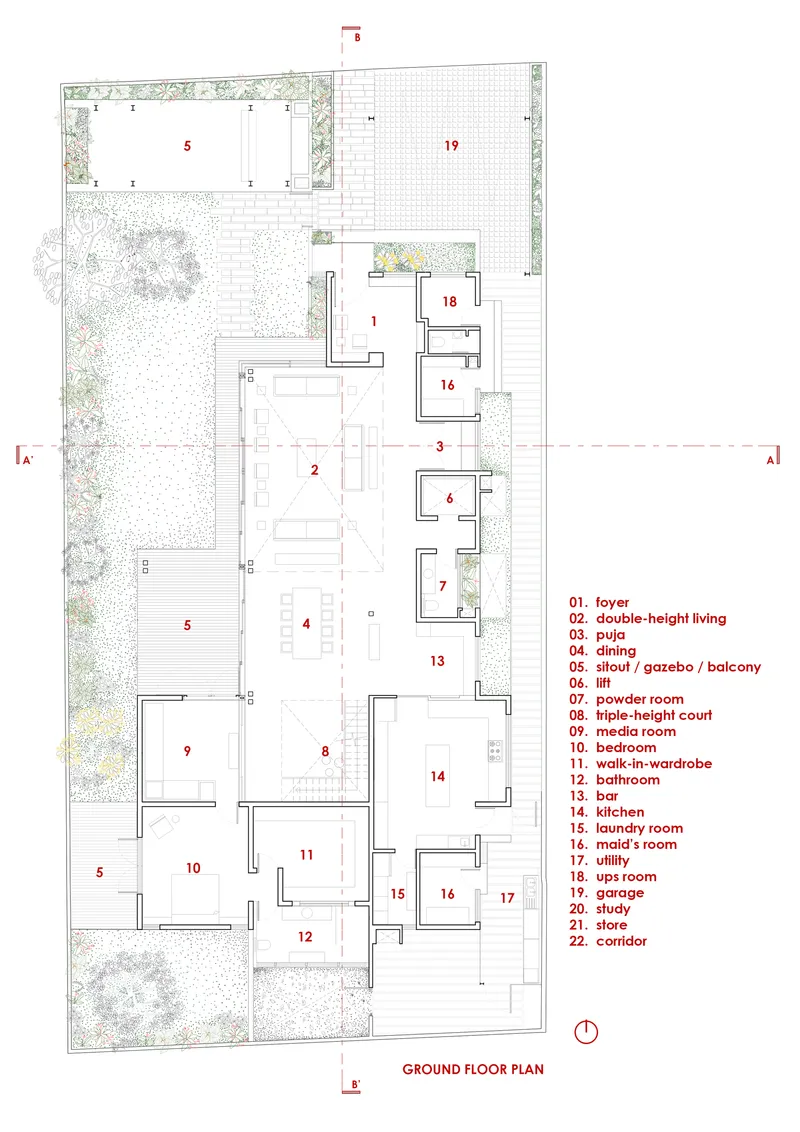
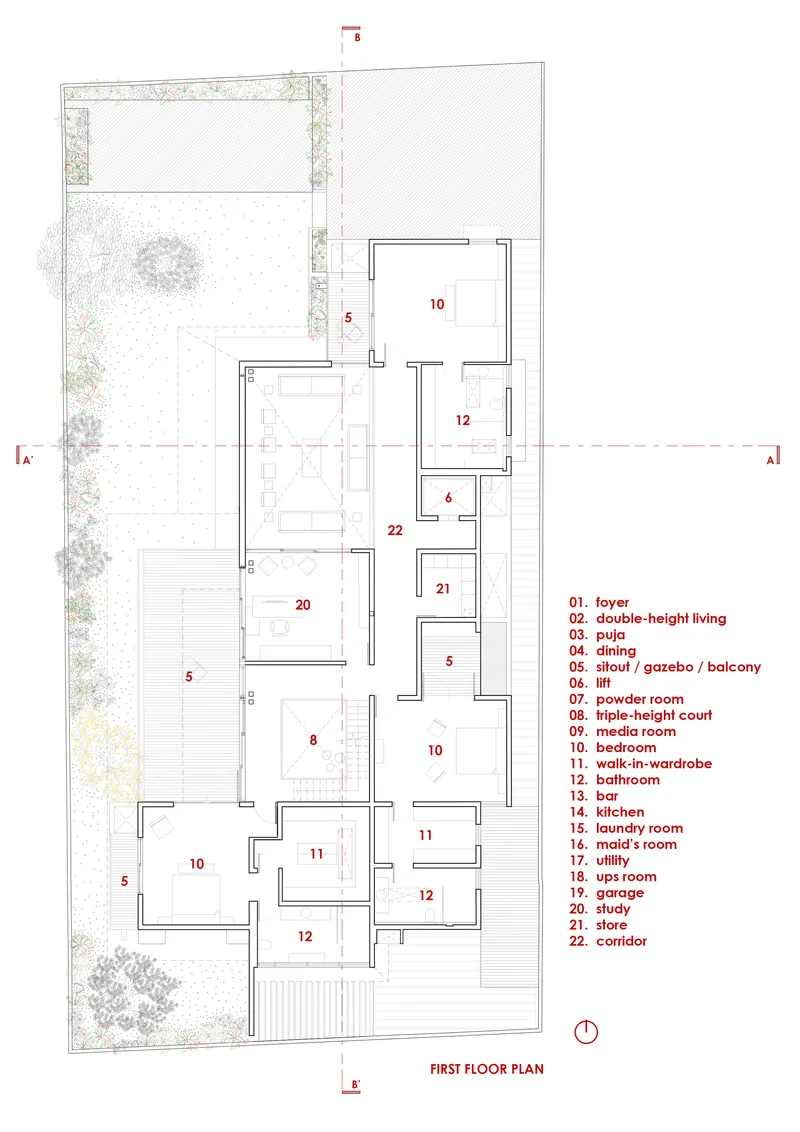
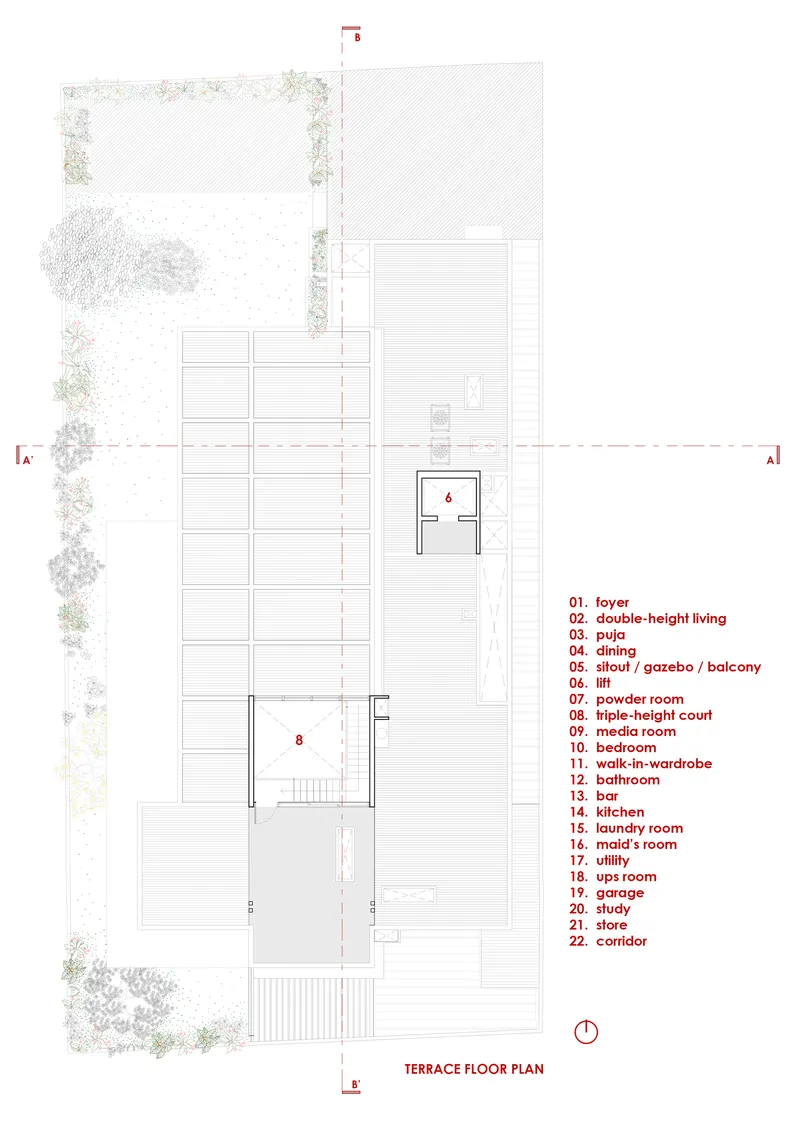
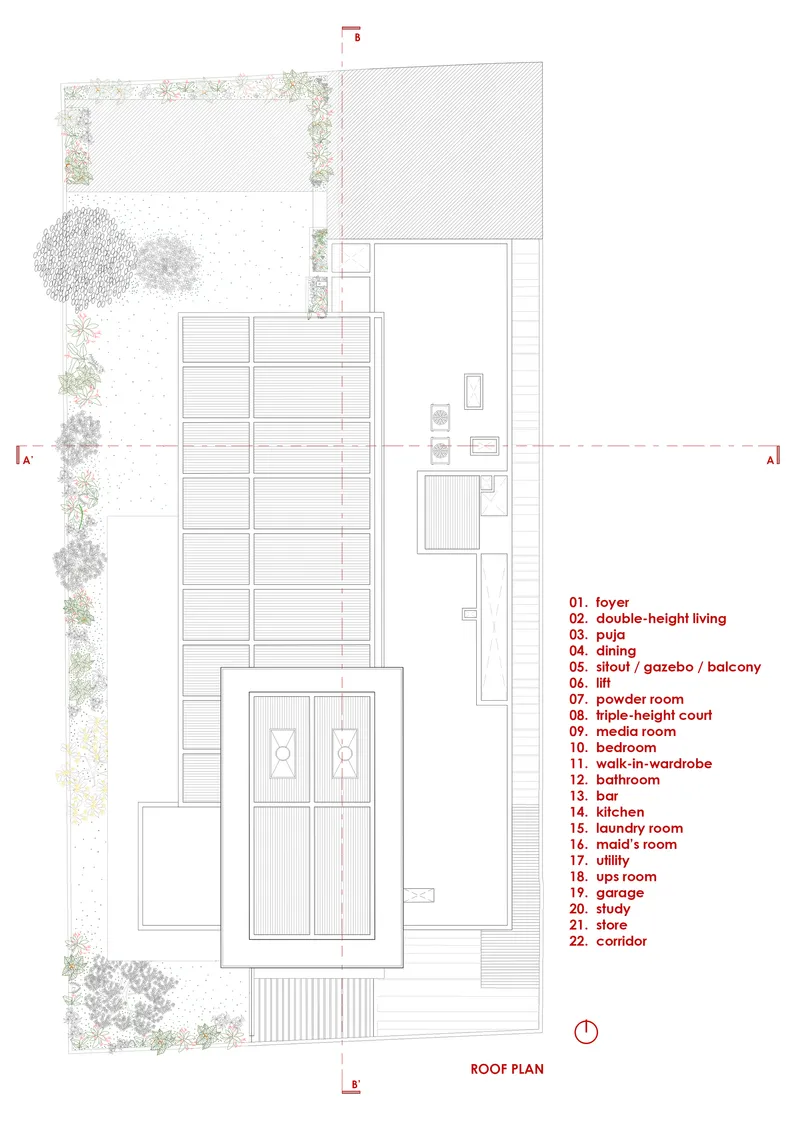
The ground floor plan confirms the three-wing logic: public life faces the street, the central living and dining spine connects to the courtyard through the long run of sliding doors, and the private bedrooms sit at the rear. On the first floor, bedrooms gain balconies that overlook the garden, and the study occupies a mezzanine position floating above the dining area. The roof plan reveals how the concrete canopy extends well beyond the building envelope, creating covered outdoor zones that register as neither fully inside nor fully outside.
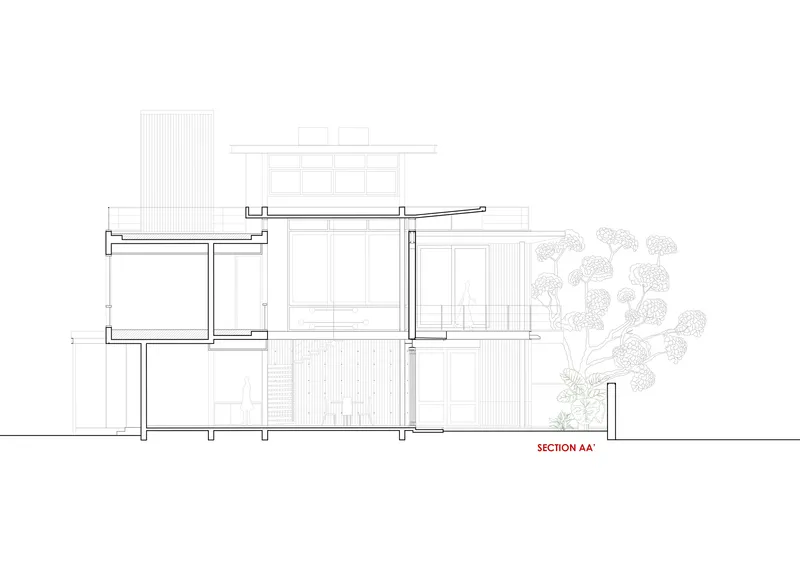
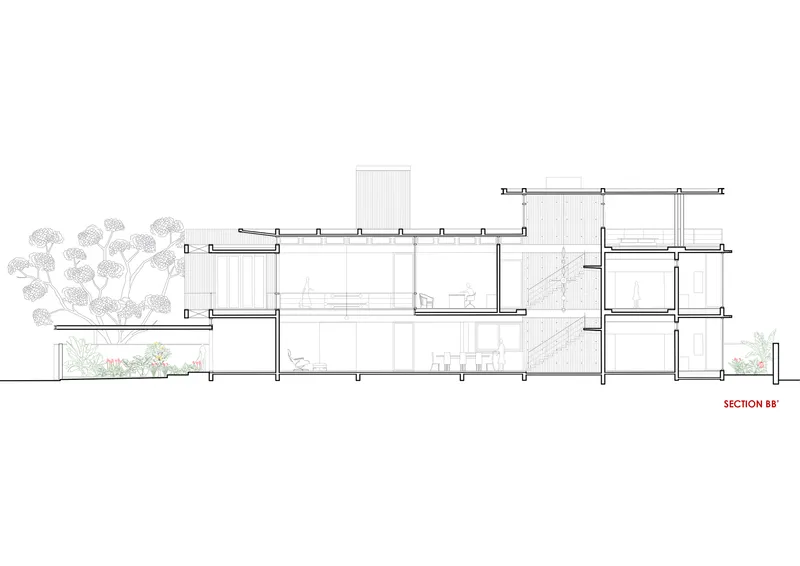
The two section drawings are the most revealing. They show the split-level organization, the double-height void at the center, and the way the canopy planes step outward to shade the garden edge. The sections also make legible the thermal strategy: the horizontal slits between roof and wall, the skylit stair volume acting as a stack-effect chimney, and the deep overhangs that protect glass surfaces from direct western sun. Flanking vegetation drawn at scale underscores how integral the landscape is to the environmental performance of the building.
Why This Project Matters
House of Canopies matters because it treats climate response not as an engineering overlay but as the primary generator of architectural form. The canopy is the roof, the shading device, the spatial organizer, and the visual identity of the house, all at once. Too often in residential design, passive strategies are treated as problems to be solved after the plan is fixed. Here, the need for shade on a west-facing site in a warm climate produced the parti, and every subsequent decision, from the Vierendeel truss to the cement-sheet cladding to the fifty-foot timber door run, serves that central idea.
The project also demonstrates that a restrained material palette does not have to mean austerity. By limiting finishes to concrete, kota stone, teak, and steel, STUDIO MOTLEY lets light, vegetation, and spatial volume carry the sensory weight. The garden court is not a luxury add-on; it is the core of the house, the thing every room turns toward. For architects working in similar climates and on similarly constrained linear sites, House of Canopies offers a legible, replicable lesson: let the roof do the work, and let the garden do the rest.
House of Canopies by STUDIO MOTLEY, Bengaluru, India. Completed 2022. Photography by Neelanjana Chitrabanu.
About the Studio
Share Your Own Work on uni.xyz
If projects like this are the kind of work you want to make, uni.xyz is a place to publish your own, find collaborators, and enter design competitions.


Popular Articles
Popular articles from the community


ETEH Reworks the Shared Spaces of São Domingos School in Brazil Around Timber, Color and Hanging Plants
At São Domingos School in Brazil, 436 m² of hall, refectory and library are recast with timber joinery, a yellow and blue code and trailing greenery.


Singing Woman: An Opera House That Performs Before the Curtain Rises
Ovidiu Cristian Pavel's conceptual opera house translates Estonia's choral identity into a sculpted waterfront landmark facing the Baltic Sea.

Cube Design Draws an Ecological Corridor Between Two Shenzhen Hills with the Nankai Building
Beside Shenzhen's container docks, the Nankai Building pairs stacked balconies with a climbing green screen to connect two hillsides across its height.

David Ortega Stacks a Two-Story Mexico City Penthouse Around a Steel Stair and a Pergola-Shaded Roof Terrace
In Colonia Roma, a 300 m² penthouse uses oak joinery, a planted steel stair and a slatted roof pergola to make a new-build apartment feel like a house.

Similar Reads
You might also enjoy these articles

LAVA Architecten Gives Vocational Education a Sawtooth-Roofed Face on a Mechelen School Campus
In Mechelen, Belgium, a 2,053 m² STEM school on a 6×6 m grid turns workshops and classrooms into rooms that can be rearranged as teaching changes.

KEMA Studio Turns a Derelict Marvila Attic into a 60 m² Lighthouse Apartment Above Lisbon
In Lisbon's Marvila district, a rebuilt roof, four skylights and two plywood volumes turn an unlivable attic into a bright home facing the Tagus.

Pixel Gardens: One Repeated Module Stacked Into a Terraced Social Housing Tower for Famagusta
Salem Bader's shortlisted housing tower builds a vertical neighbourhood from one repeated module, offsetting units to carve terraces, light and air.

Bao Huynh Watercolor Atelier: A Serene Art Retreat in Hội An
Bao Huynh Watercolor Atelier in Hội An blends multifunctional art spaces, sustainable design, local materials, and family-friendly living in a serene environment.


Comments (0)
Please login or sign up to add comments
No comments yet. Be the first to comment!