

Studio Okami Architects Wraps a Forest House in Reflective Aluminum That Slowly Learns to Disappear
In the wooded green belt outside Antwerp, a resto-mod villa uses concrete walls and mirrored cladding to vanish among the trees.


In the 1960s, the green belt on the outskirts of Antwerp became a proving ground for residential experimentation. Architects built bold villas among the conifers and beeches of Kalmthout, testing what a house could be when surrounded by deep woodland. One of those villas stood on this very site until it didn't. Decades of neglect left the original structure in decay, swallowed by overgrown greenery, and Belgian tax regulations ultimately demanded full demolition rather than renovation. What Studio Okami Architects, led by Hans Vanassche and Bram Van Cauter, built in its place is not a replica. It is something more interesting: a resto-mod.
The term, borrowed from automotive culture, describes a strategy of honoring an original design's spirit while rebuilding it with contemporary performance and sensibility. The Beli House takes the defining element of the 1960s predecessor, its concrete walls, and amplifies them. They grow taller, multiply across the garden, and take on every structural and programmatic role imaginable. Meanwhile, the upper floor wraps itself in reflective aluminum panels that mirror the surrounding forest, attempting to dissolve the house's mass into the canopy. Over time, condensation streaks the panels and dulls their reflectivity, a slow weathering process that also prevents bird collisions. The house, in other words, is designed to become less visible with age.
Concrete Walls That Do Everything
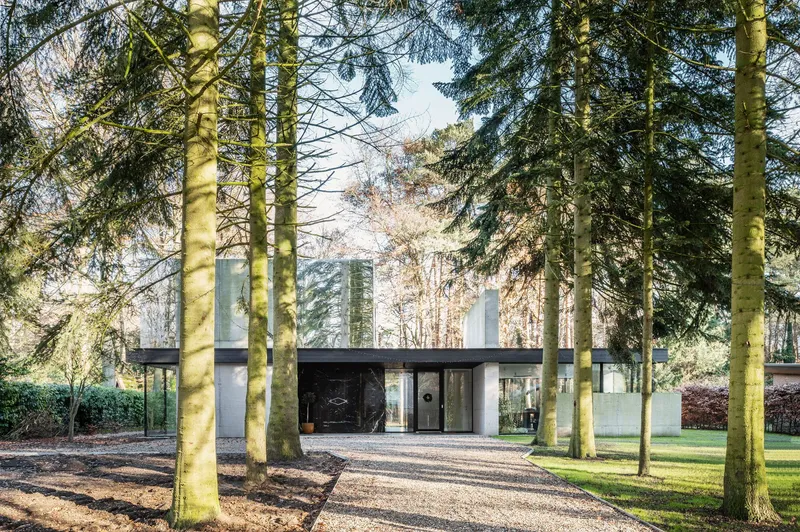
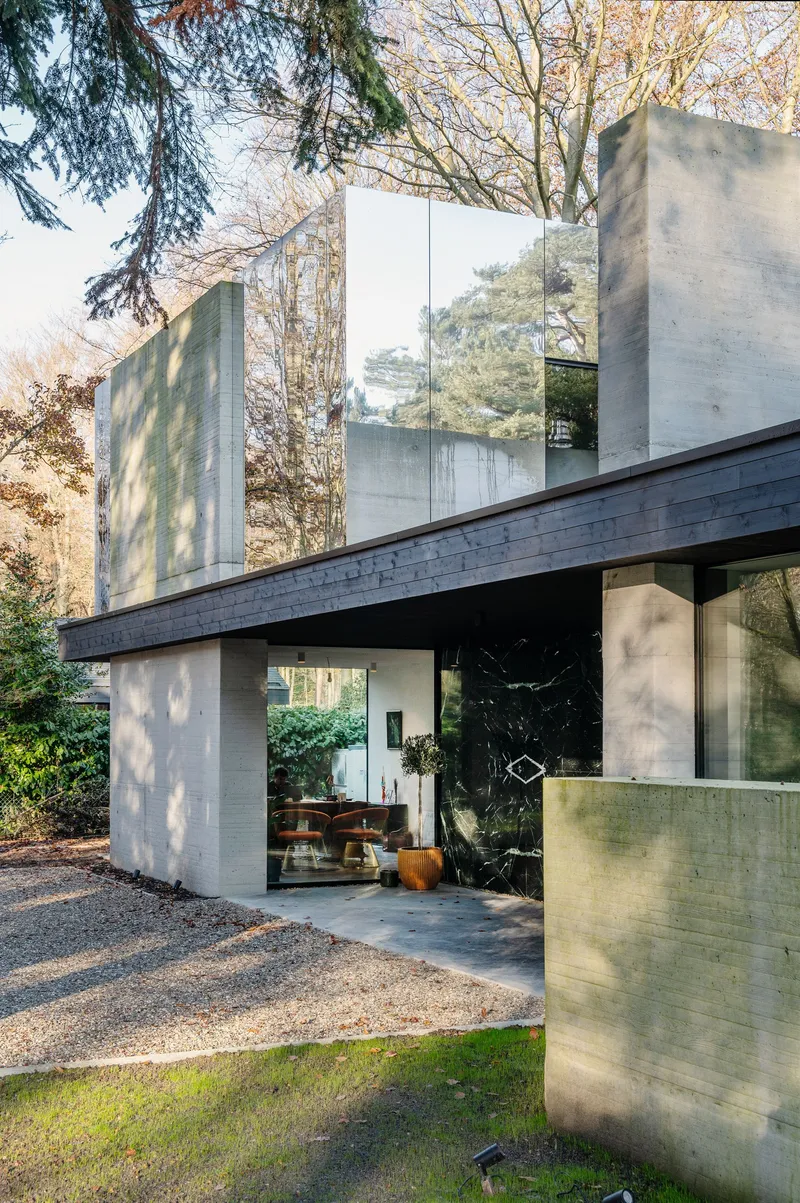
Concrete is not merely the structural backbone of the Beli House. It is the organizational logic. The bearing walls carry loads, obviously, but they also partition space, channel views, block sun, enclose a chimney, provide privacy screens, and define garden boundaries. Positioned at varying heights and angles across the 270 square meter plan, they create a loft-like ground floor where kitchen, dining, and living areas are visually separated without being sealed off from each other. The effect is closer to an inhabited landscape than a conventional floor plan.
Outside, additional concrete walls extend into the garden at increased heights, blurring the threshold between interior and exterior. Concrete floors run uninterrupted from the living spaces onto terraces, reinforcing the idea that the house and its site are continuous. The walls themselves become screens for the forest, catching dappled shadows from the surrounding pines and birches throughout the day.
A Mirrored Volume in the Canopy
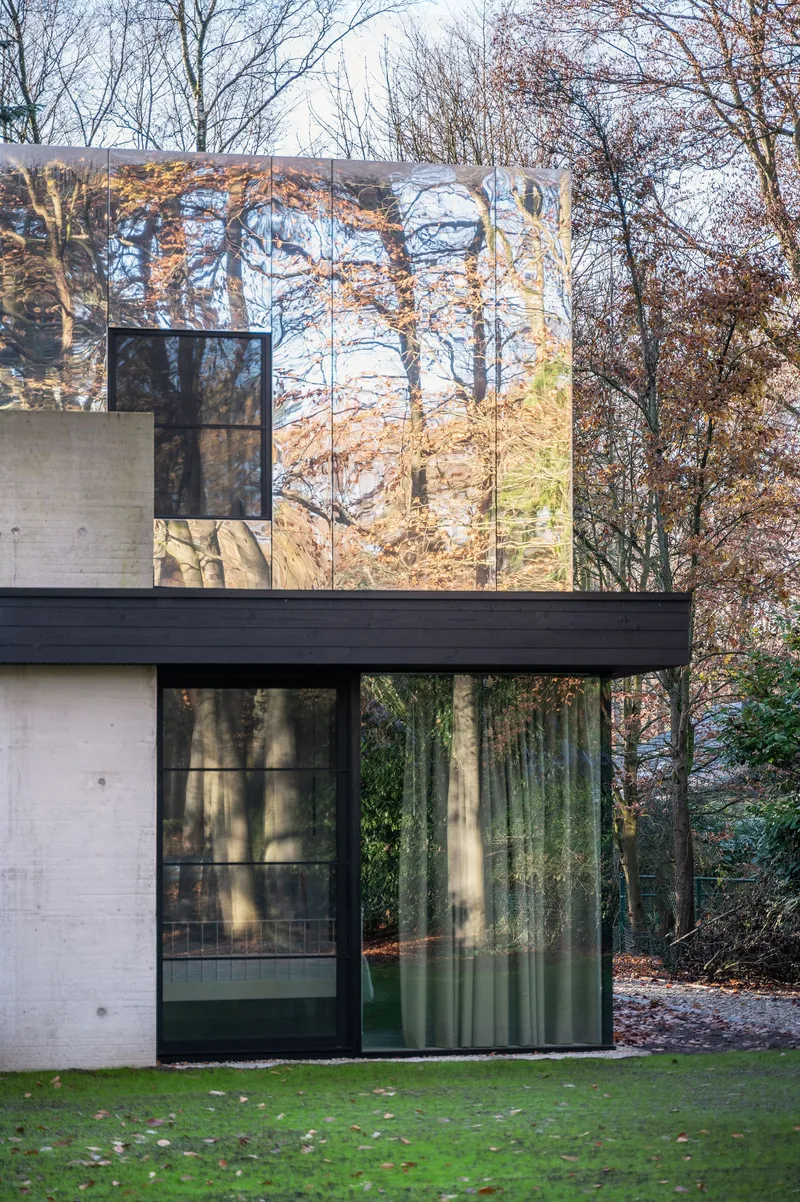
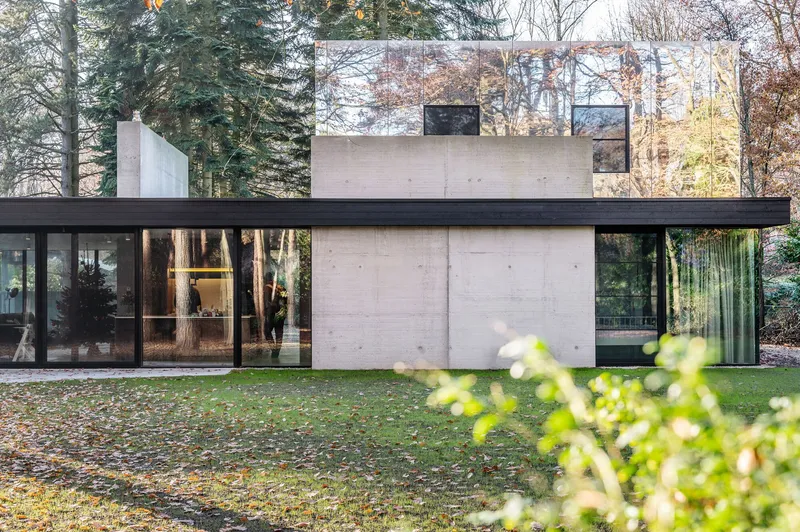
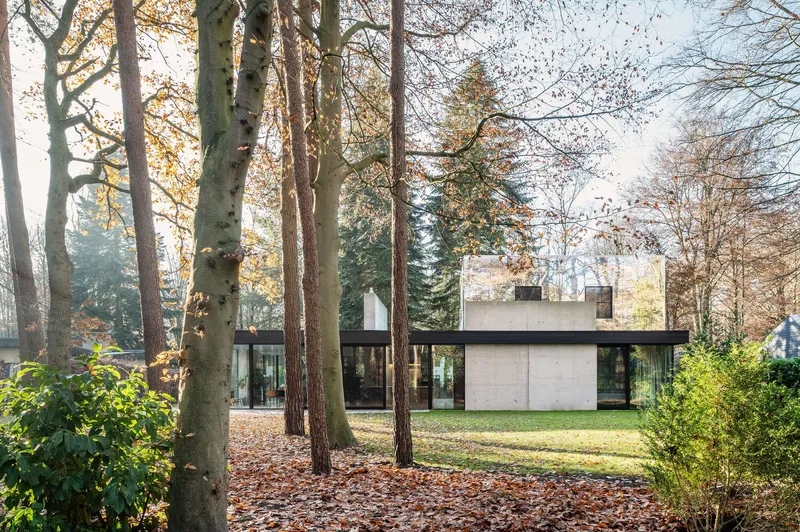
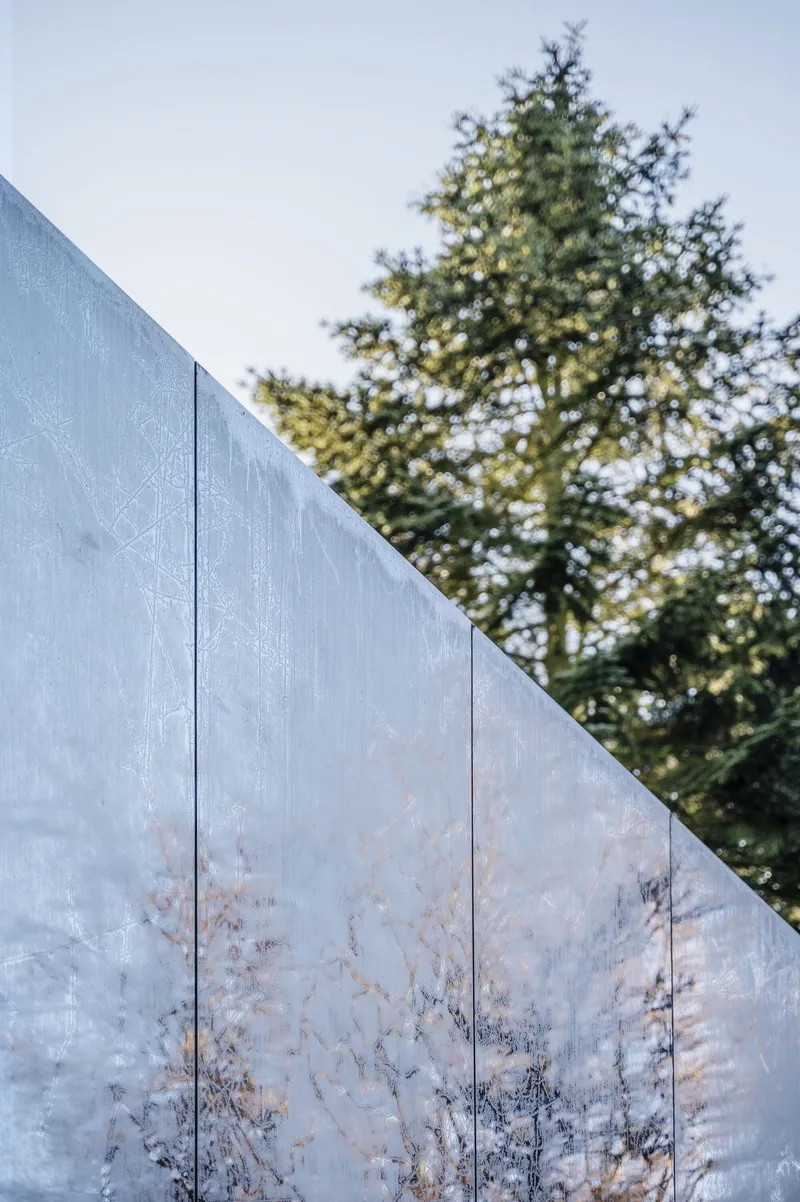
The upper floor, containing two children's bedrooms, a playroom, and two bathrooms, is clad in reflective aluminum panels sourced from Alucobond. These panels form a ventilated facade that sits independent of the building's insulated core, creating both a thermal buffer and a visual trick. On clear days the upper volume picks up the surrounding trees and sky, making it difficult to read the actual mass of the house. From certain angles, only the dark horizontal banding of the ground floor registers as built form.
What makes this strategy more than a gimmick is the deliberate acceptance of imperfection. The architects anticipated that frequent condensation would produce vertical streaks on the aluminum, gradually reducing its mirror quality. Rather than treating this as a maintenance problem, they folded it into the design intent. The house ages alongside its forest. It starts as a sharp reflection and settles, over years, into something softer and more textured.
The Ground Floor as Open Landscape
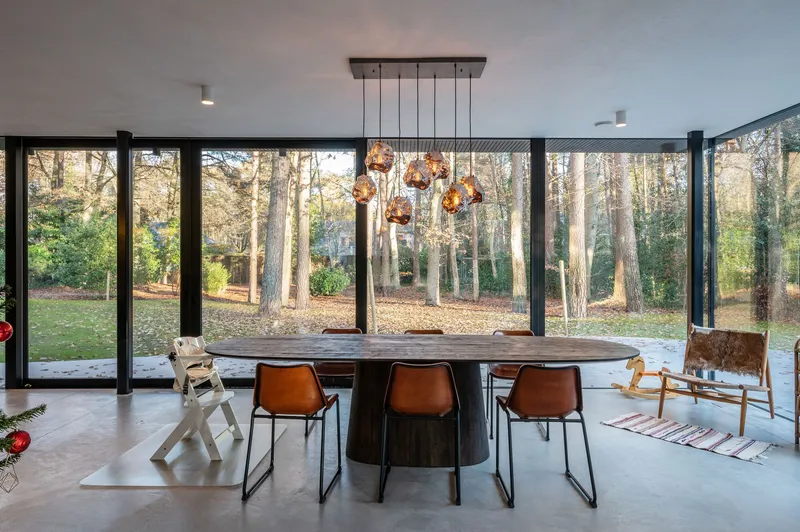
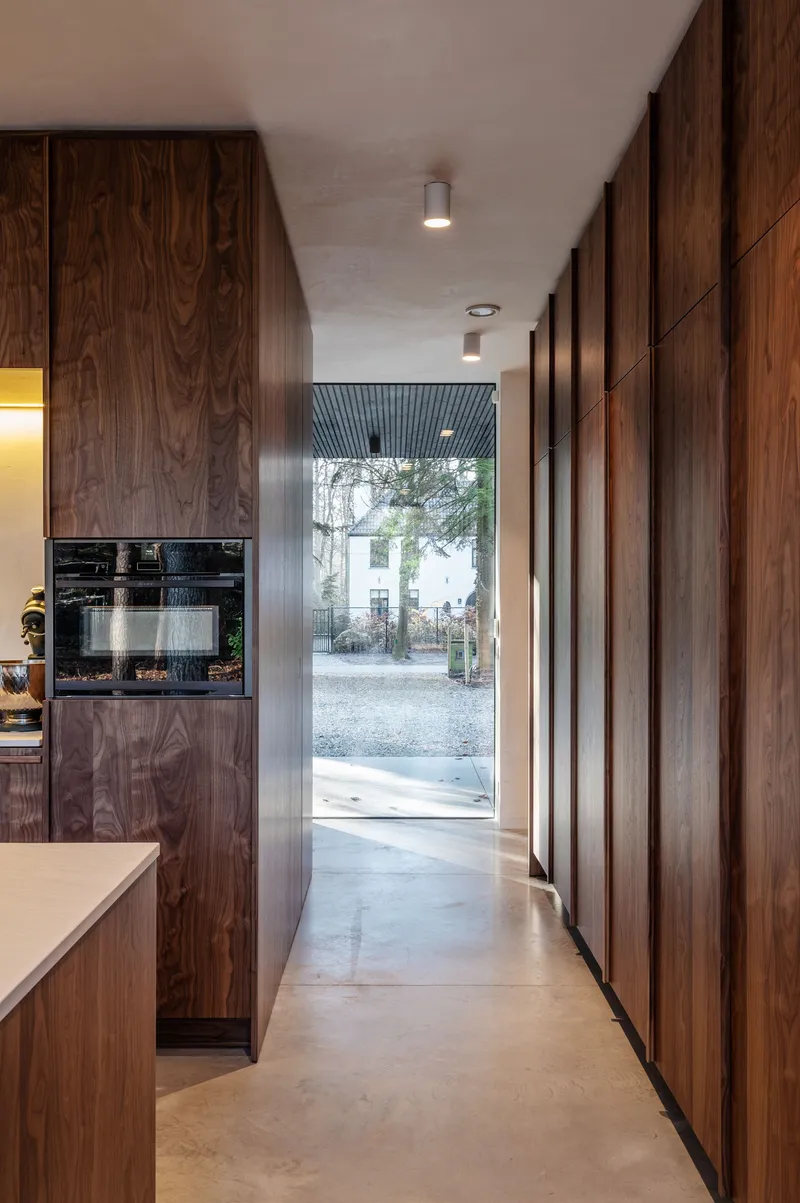
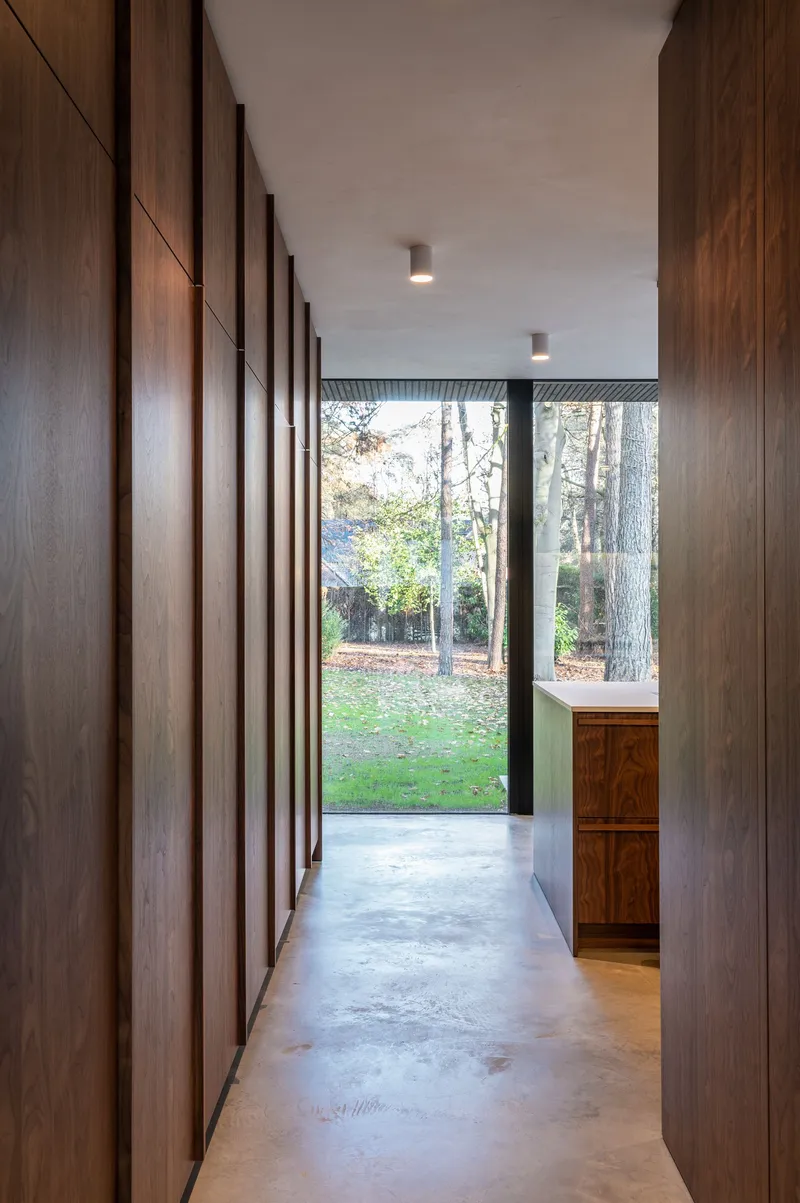
Step inside and the ground floor reads as a single continuous space punctuated by concrete planes and walnut-clad volumes. Floor-to-ceiling glazing wraps the perimeter beneath a cantilevered roof, pulling the woodland into every sightline. The dining area sits against a wall of glass overlooking the trees, while a corridor lined in walnut millwork and polished concrete connects the more private zones, including a home office and the main bedroom at one end of the plan.
The material palette is restrained to three registers: concrete for structure and ground, walnut for warmth and storage, and glass for dissolution. A marble wall at the entrance provides a single moment of deliberate contrast, marking the transition from the gravel courtyard into the interior. Reynaers Aluminium sliding systems allow the glazed walls to open fully, converting the living areas into covered terraces when weather permits.
Entering Through Concrete
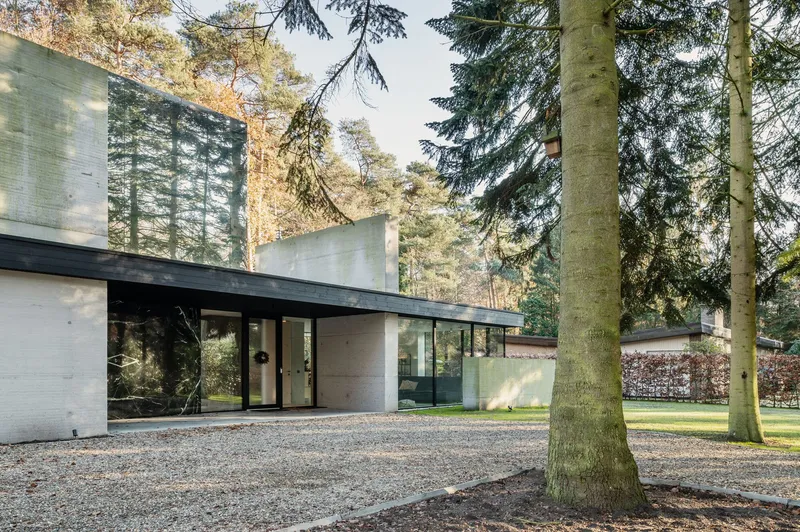
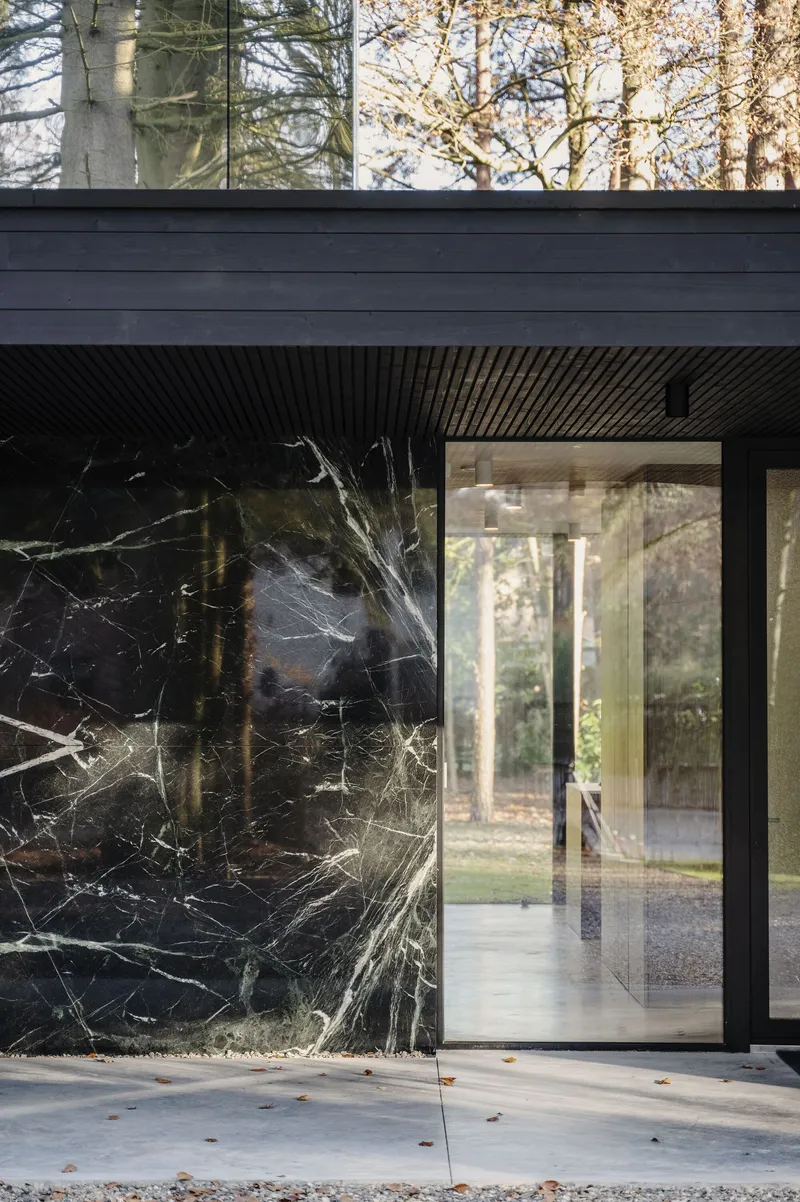
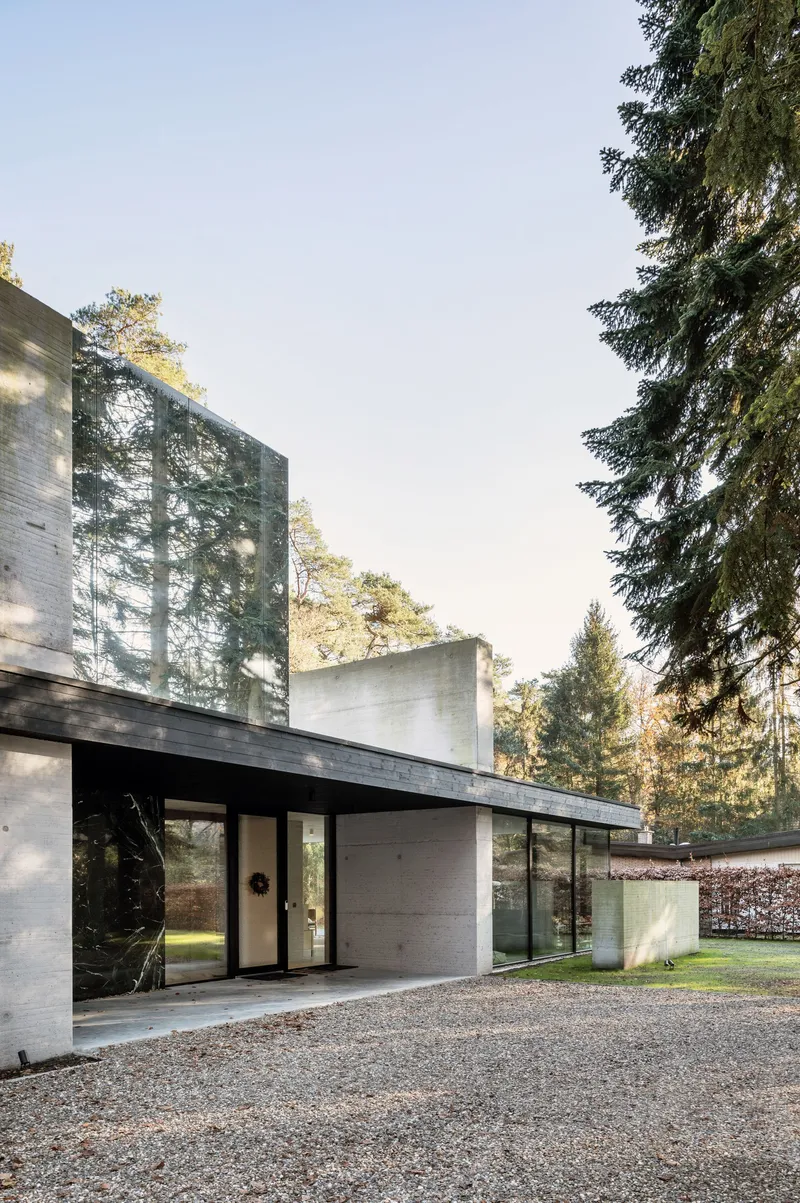
The approach sequence is carefully choreographed. A gravel courtyard framed by concrete volumes and tall conifers funnels visitors toward the entrance, where black marble panels and a deep cantilevered soffit compress the scale before the interior opens up. The contrast between the controlled entry and the expansive living spaces beyond is one of the house's strongest spatial moves, giving the open plan its sense of release.
Shadow plays a significant role here. The concrete canopy and surrounding trees cast constantly shifting patterns across the facade, animating surfaces that might otherwise read as static. The architects clearly understood that in a dense forest setting, the building would rarely be seen in uniform light, and they designed its surfaces to reward that variability.
Forest Interface
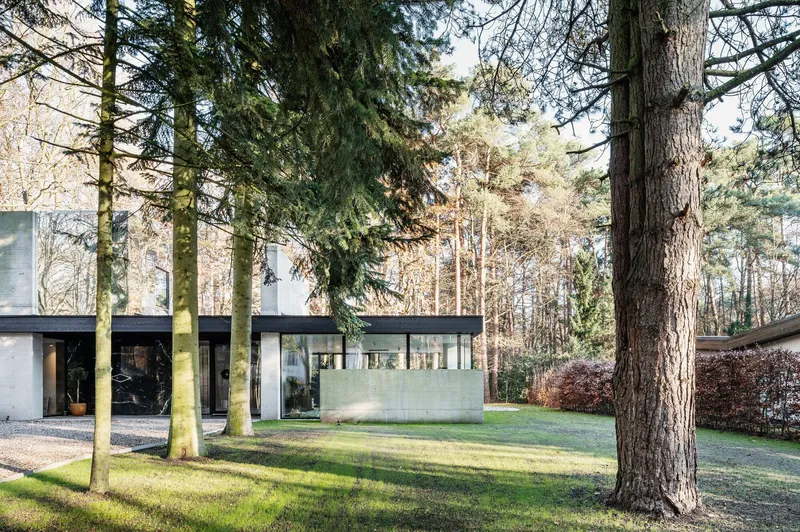
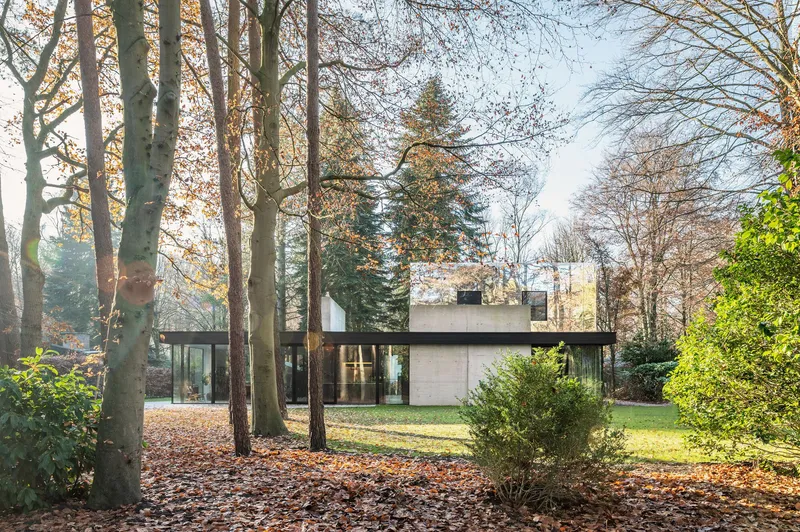
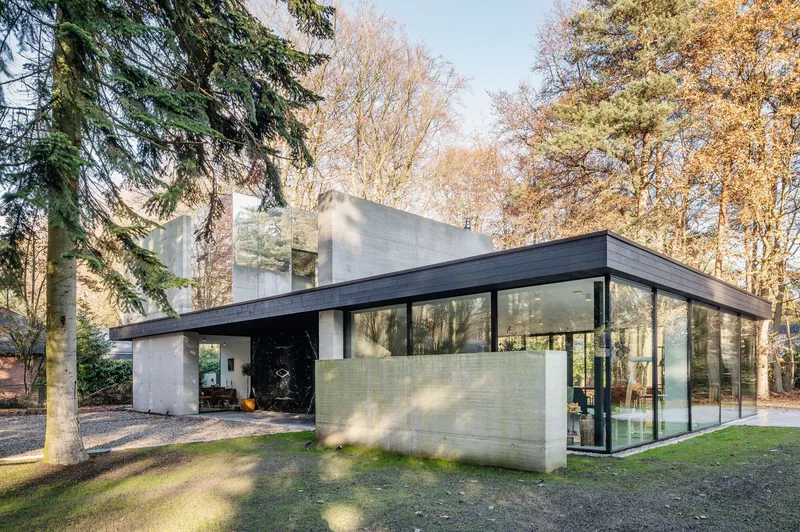
The house sits low in its site, a deliberate strategy to reduce its profile among the mature trees. The flat roof and horizontal massing echo the layered canopy above, while moss-covered trunks press close to the glazing on several sides. Viewed through bare deciduous branches in autumn, the residence appears as a series of horizontal bands: concrete, glass, dark timber fascia, mirrored aluminum. Each layer responds to the forest at a different register.
The perimeter walls extend beyond the building envelope to engage the garden as outdoor rooms. Continuous glazing bands set behind these walls create a layered reading of depth, so that from the interior you look through glass, past concrete, and into trees. It is a sequence that prevents the house from ever feeling like a sealed box, even as it provides the privacy and shelter its woodland setting demands.
Facade Details and Materiality
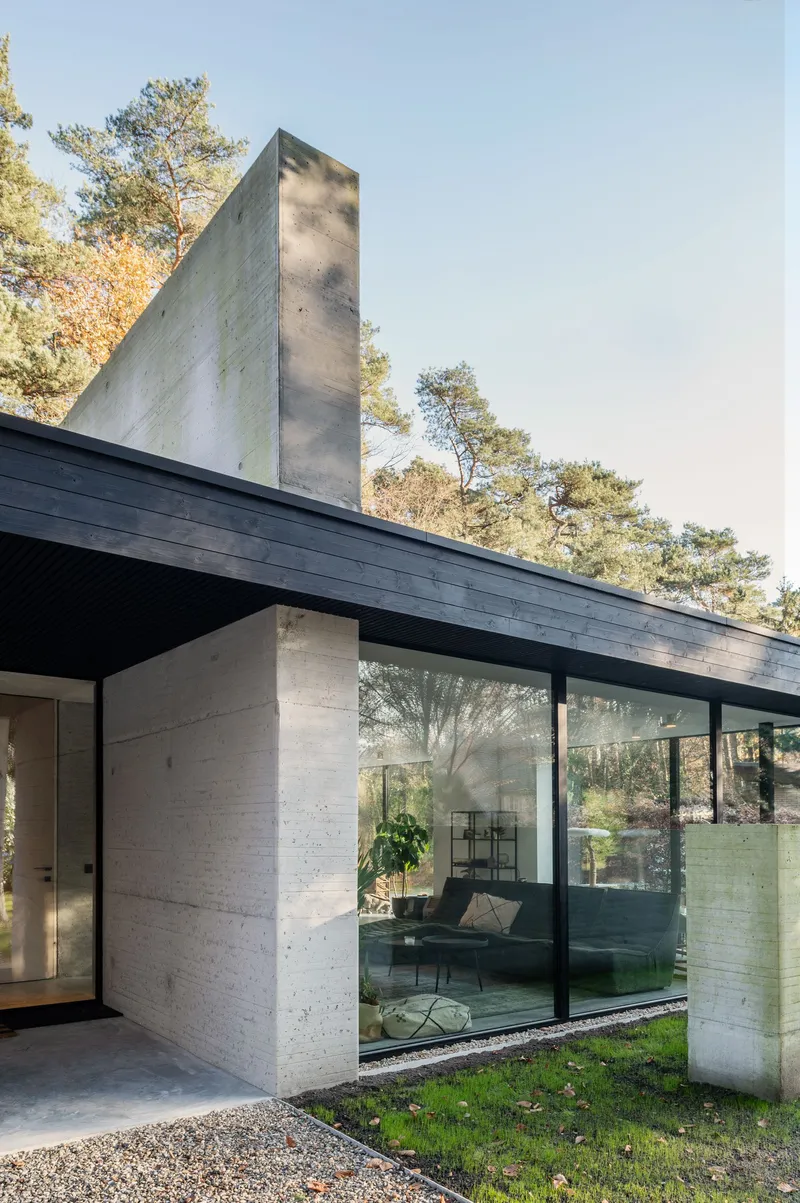
Up close, the building rewards scrutiny. The concrete chimney rises above the dark timber fascia as a sculptural element, its raw surface contrasting with the precision of the glazed walls below. The blackened timber overhang at the roofline reads as a unifying datum, tying together the various cladding materials into a coherent horizontal composition. Even the gravel ground plane is part of the palette, its exposed aggregate echoing the texture of the concrete.
Plans and Drawings
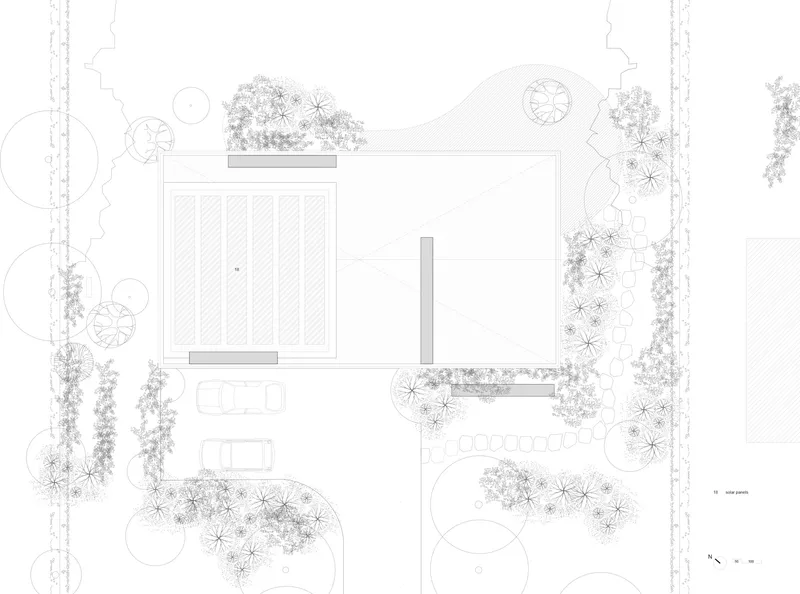
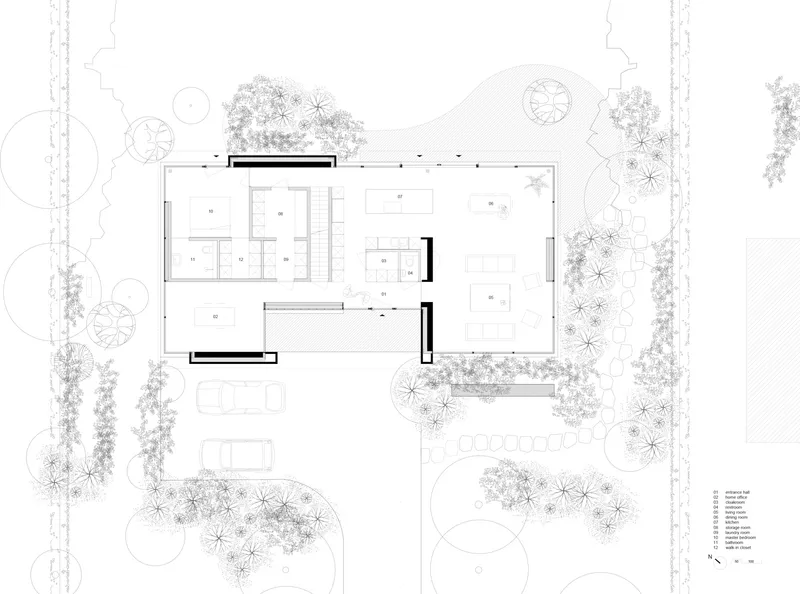
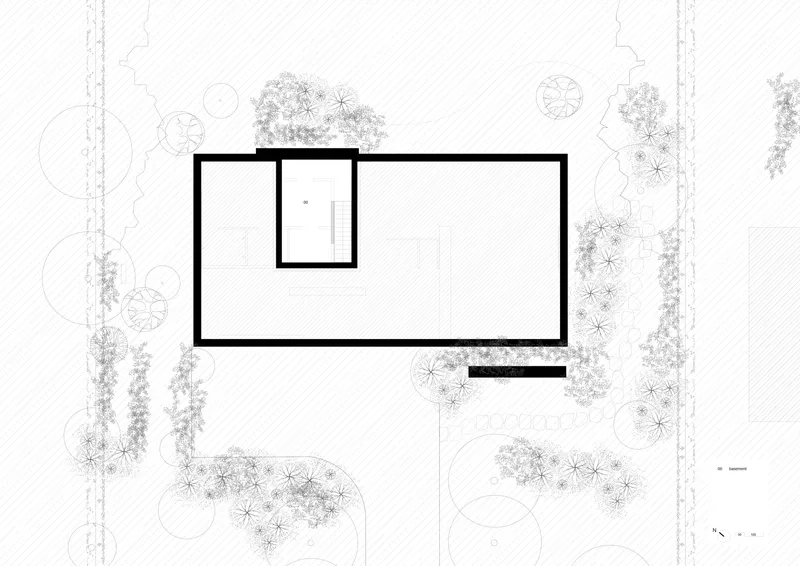
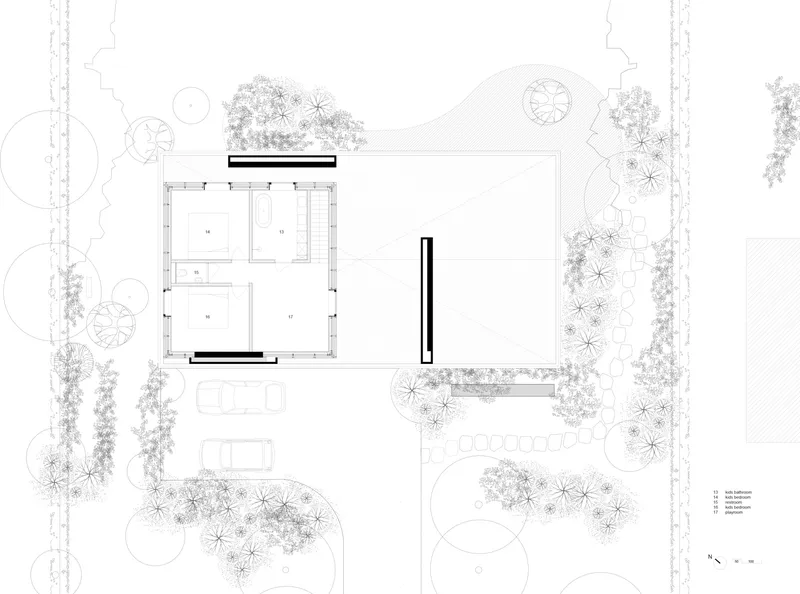
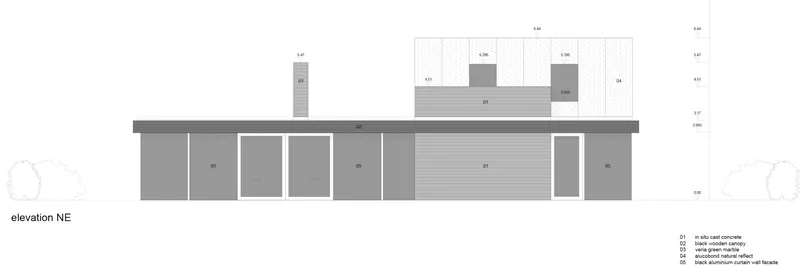
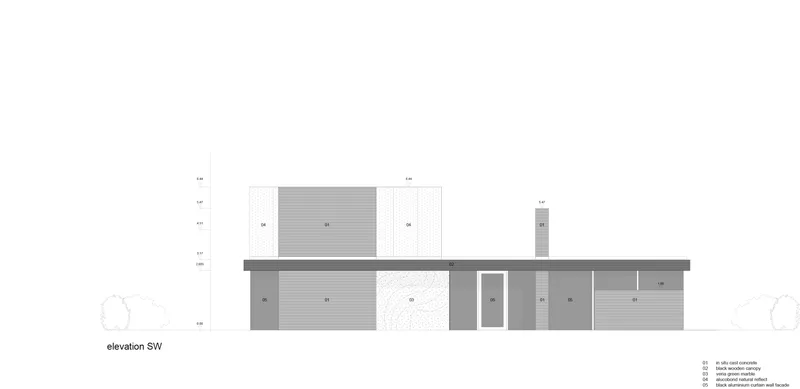
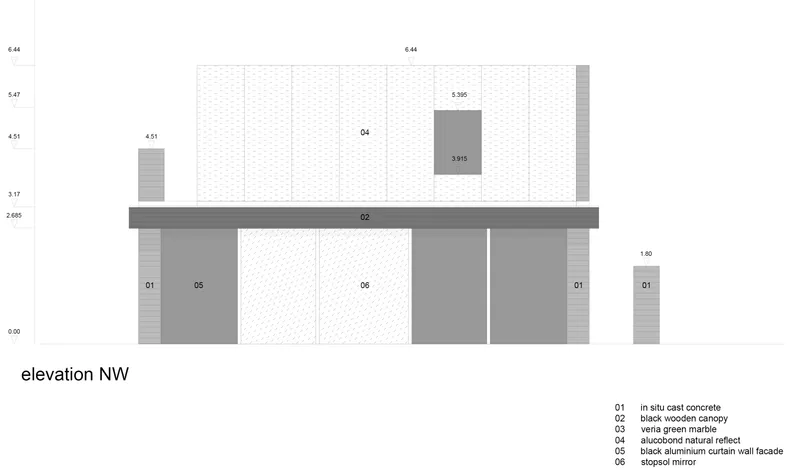
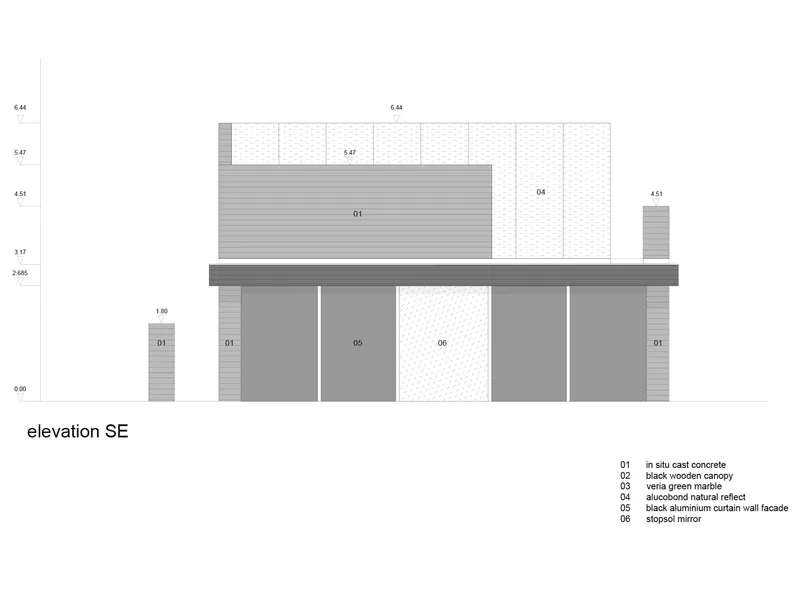
The drawings reveal the full scope of the concrete wall strategy. In plan, the walls fan out at varying angles, creating pockets of space that feel distinct even within a largely open layout. The ground floor plan shows how living, dining, and kitchen functions flow continuously while the home office and main bedroom occupy a quieter wing. The upper floor is more compact, with bedrooms organized around a central stair core. The site plan confirms the house's deep embedding in its landscape, with garden beds and mature trees pressing tight against the footprint. Elevations label the material zones precisely: concrete, aluminum, dark timber, and glazing, each assigned to specific registers of the facade.
Why This Project Matters
The Beli House proposes a specific answer to a common question: what do you do when an interesting old building can't be saved? Rather than mourning the original or pretending it never existed, Studio Okami Architects treated it as source material. The concrete walls are enlarged and multiplied, the relationship to the forest deepened, and the house rebuilt with the energy performance its predecessor could never have achieved. The resto-mod metaphor is more than branding; it describes a genuine design methodology that takes inheritance seriously without being trapped by it.
The reflective aluminum cladding is the move that will get the most attention, and it deserves it. But what makes the Beli House genuinely compelling is the integration of that gesture with everything else: the multifunctional concrete walls, the seamless interior-exterior ground plane, the calibrated entry sequence. This is a house where every material carries multiple responsibilities and where the passage of time is treated not as a threat but as a collaborator. In a discipline that often fetishizes the image of a building at the moment of completion, that patience is worth noting.
Beli House by Studio Okami Architects (Hans Vanassche and Bram Van Cauter). Kalmthout, Belgium. 270 m². Completed 2022. Photography by Nick Claeskens.
About the Studio
Share Your Own Work on uni.xyz
If projects like this are the kind of work you want to make, uni.xyz is a place to publish your own, find collaborators, and enter design competitions.


Popular Articles
Popular articles from the community


Manzana Morphosis: Stretching Barcelona's Grid into a Living Landscape for 2050
A radical reworking of the Eixample manzana turns density into a tool for generous public space, vertical ecology, and environmental performance.

Aquadapt: An Underwater Habitat That Rewrites Its Rooms by the Hour
Curved modules ring the seabed while one shell shifts from breakfast room to cinema, farm and football pitch as residents' needs change.


David Ortega Stacks a Two-Story Mexico City Penthouse Around a Steel Stair and a Pergola-Shaded Roof Terrace
In Colonia Roma, a 300 m² penthouse uses oak joinery, a planted steel stair and a slatted roof pergola to make a new-build apartment feel like a house.

FCC Arquitectura Expands a Portuguese Granite House with a Board-Marked Concrete Wing
In Portugal, JV House pairs a cleaned-up whitewashed and granite dwelling with a timber-shuttered concrete extension, courtyards and a garden pool.

Similar Reads
You might also enjoy these articles

LAVA Architecten Gives Vocational Education a Sawtooth-Roofed Face on a Mechelen School Campus
In Mechelen, Belgium, a 2,053 m² STEM school on a 6×6 m grid turns workshops and classrooms into rooms that can be rearranged as teaching changes.

KEMA Studio Turns a Derelict Marvila Attic into a 60 m² Lighthouse Apartment Above Lisbon
In Lisbon's Marvila district, a rebuilt roof, four skylights and two plywood volumes turn an unlivable attic into a bright home facing the Tagus.

Pixel Gardens: One Repeated Module Stacked Into a Terraced Social Housing Tower for Famagusta
Salem Bader's shortlisted housing tower builds a vertical neighbourhood from one repeated module, offsetting units to carve terraces, light and air.

Bao Huynh Watercolor Atelier: A Serene Art Retreat in Hội An
Bao Huynh Watercolor Atelier in Hội An blends multifunctional art spaces, sustainable design, local materials, and family-friendly living in a serene environment.

Explore Residential Building Competitions
Discover active competitions in this discipline

Challenge to design a portable theatre

Challenge to design a portable music platform

Challenge to design an open learning module for the elderly

Challenge to design mud housing for contemporary communities
Comments (0)
Please login or sign up to add comments
No comments yet. Be the first to comment!