
Studio Pheasant Turns a Dubai Warehouse into a Skateable Cultural Hub
Gooder merges an indoor skatepark with retail, dining, and co-working inside a 1,500 square meter Alserkal Avenue warehouse.


Retail spaces in the Gulf tend to fall into two categories: hermetically sealed luxury or generic mall fit-out. Gooder, designed by studio pheasant under the direction of lead architect Talar Bardakjian, does something far more interesting. It occupies Warehouse 08 on Dubai's Alserkal Avenue and turns 1,500 square meters into a single continuous landscape where you can kick-flip a ramp, buy a board, eat a slice of pizza, and sit down with a laptop, all without passing through a single branded threshold.
What makes the project genuinely notable is how it transplants the spatial logic of Middle Eastern courtyard architecture into a program borrowed from Southern California skate culture. A sculptural fountain, inspired by traditional Damascus courtyards and the founder's memories of Dubai's Deira Fountain in the late 1990s, sits at the center of the plan as a social anchor. Around it, modular fixtures on casters, perforated pegboard walls, and plywood partitions create zones that can be rearranged for exhibitions, events, or an entirely different merchandise layout. The building is not precious. It is built to be scratched.
A Ramp as Architecture
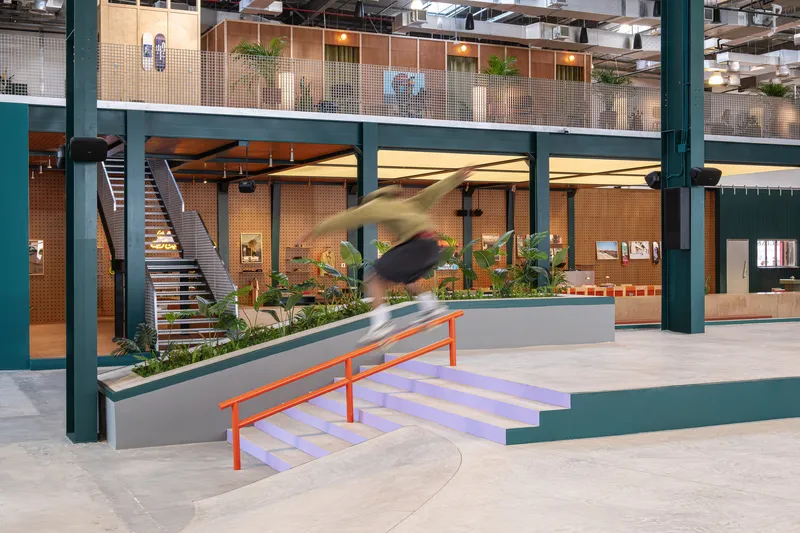
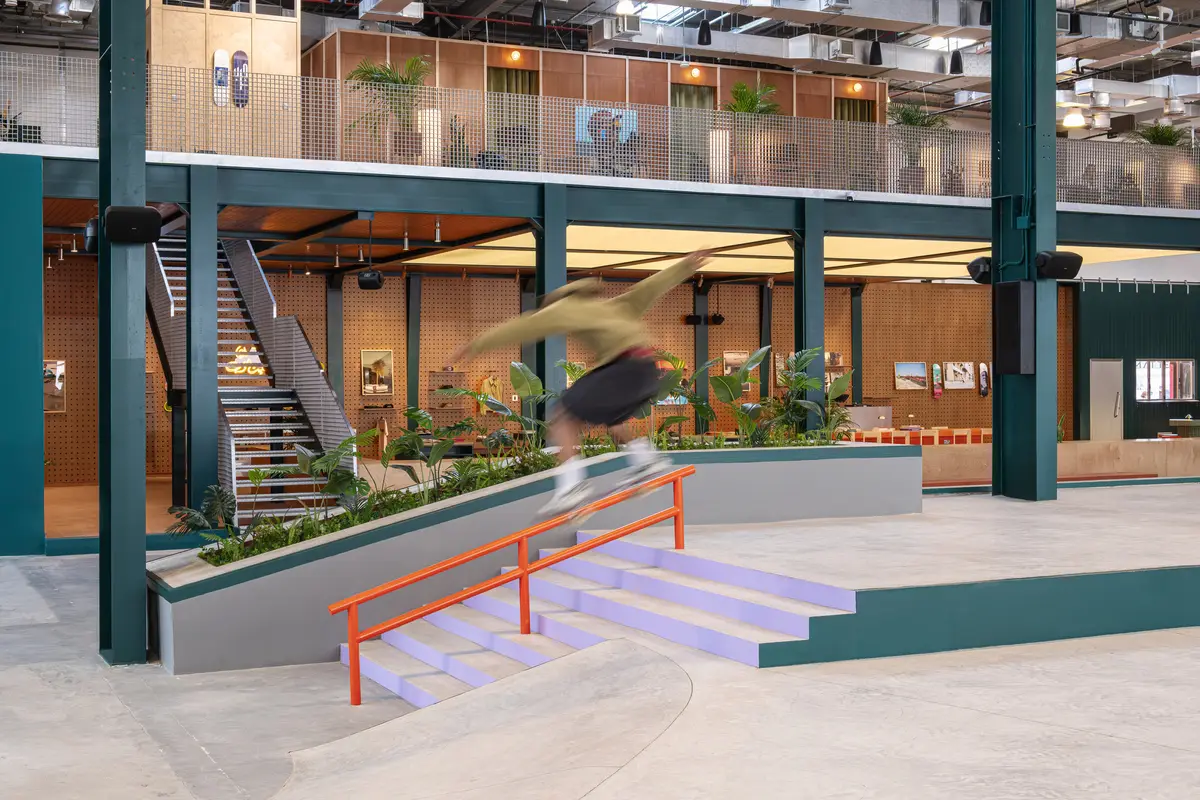
The indoor skatepark, constructed by Latvian specialists Mind Work, is not tucked into a back room. It occupies the double-height volume of the warehouse and announces itself the moment you walk in. Green steel columns rise through the space while concrete ramps curl along the ground plane. A blurred skateboarder in motion confirms the obvious: this surface is not decorative, it is infrastructure.
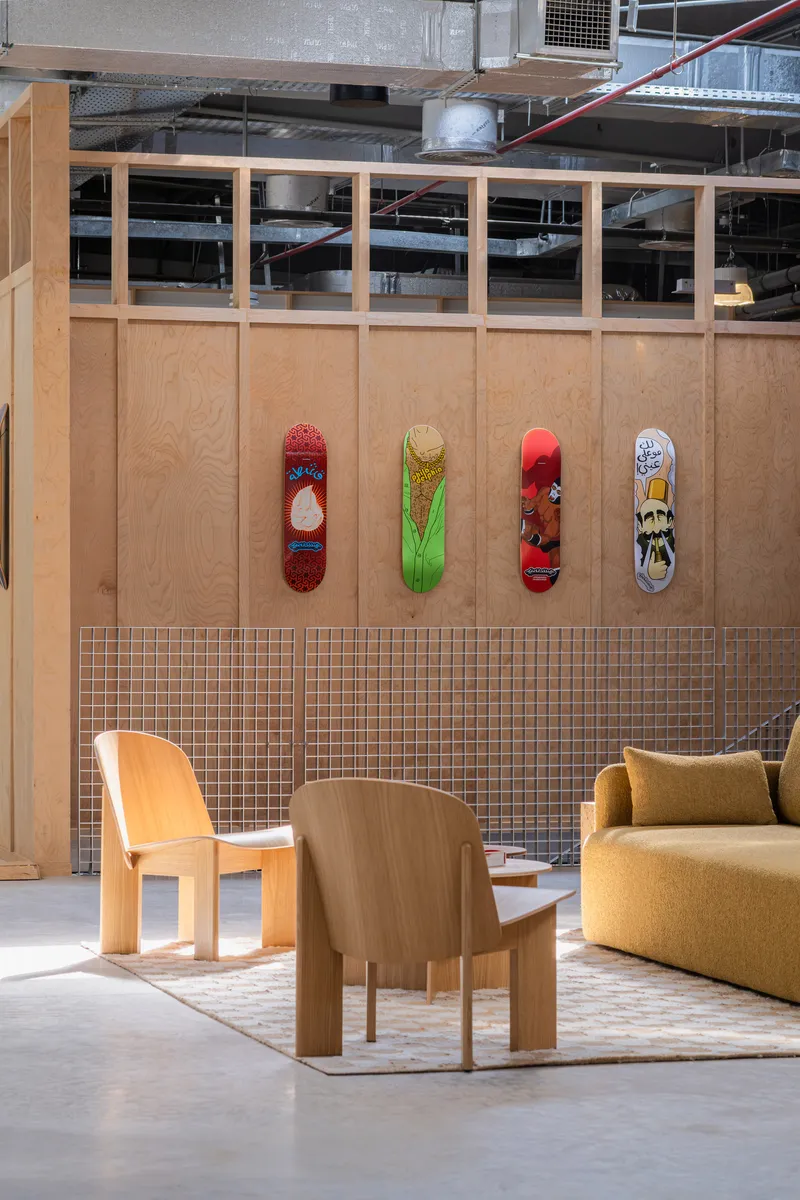
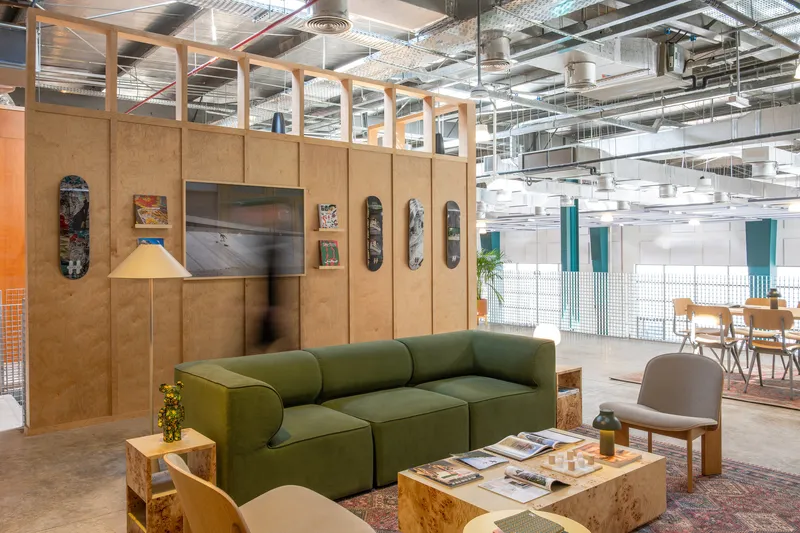
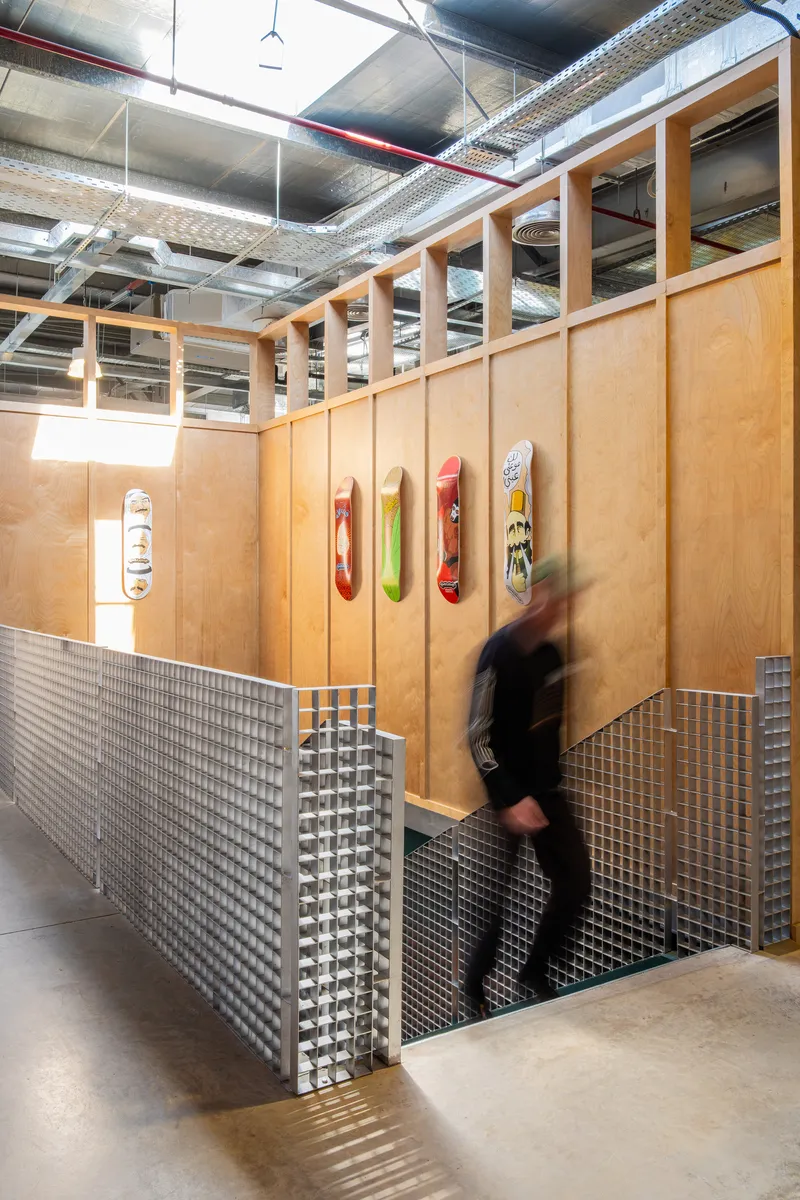
Skateboards mounted on plywood partitions serve as both decoration and inventory. The line between gallery display and retail merchandise dissolves, which is precisely the point. Skate culture has always operated in the gap between art and sport, and the architecture here refuses to resolve that ambiguity.
Material Palette: Earthy, Raw, Built to Age
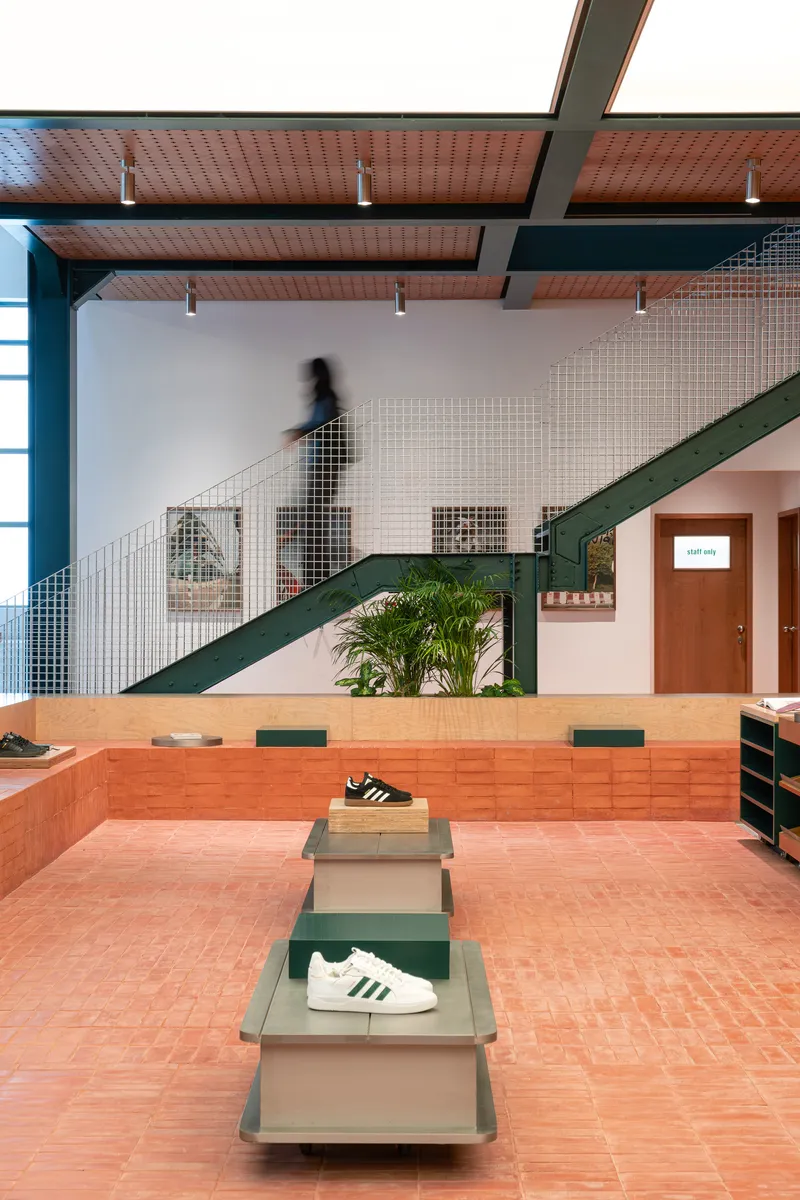
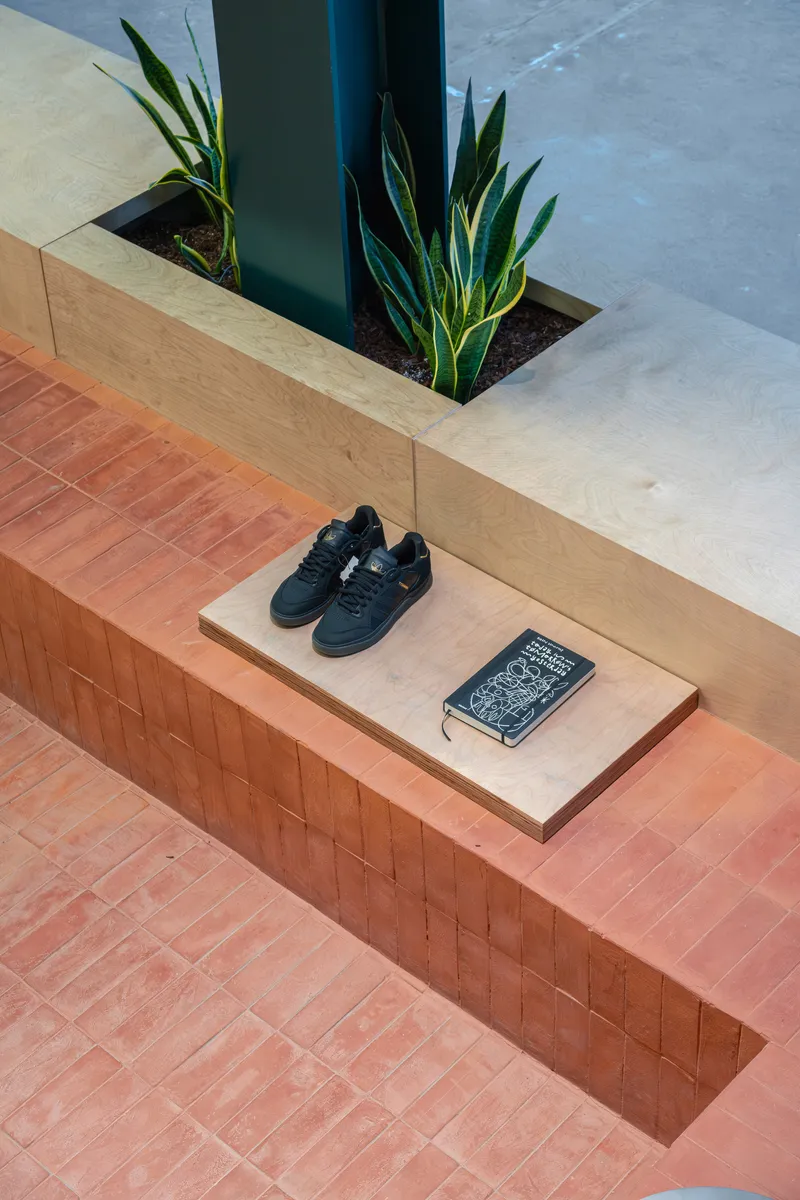
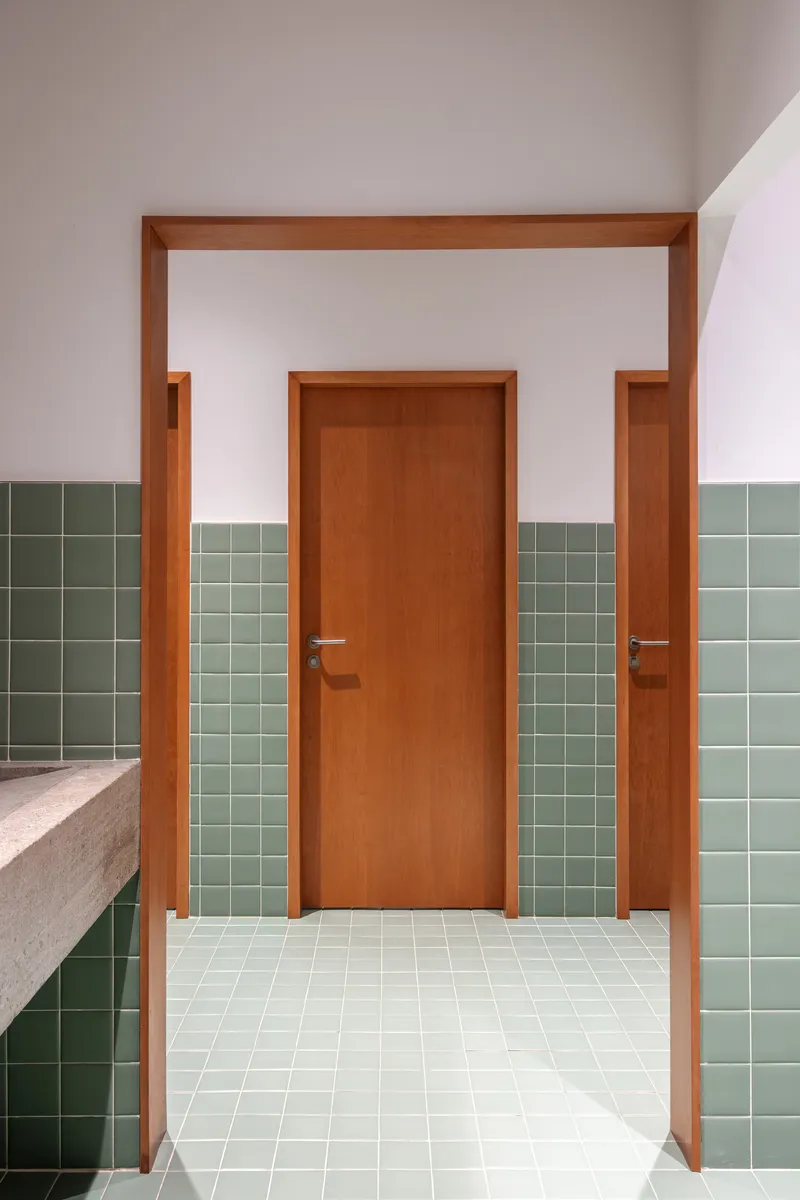
Brick, concrete, timber, and metal form the structural vocabulary. The finish palette leans into muted, earthy hues: terracotta floor tiles, sage green tile wainscoting, cream terrazzo countertops, and pixelated olive-green tiles that appear on various surfaces. Materials were sourced locally wherever possible, and the emphasis throughout is on durability rather than polish. A skateboard wheel is going to grind against that terracotta eventually, and the design welcomes it.
The choice to leave mechanical systems exposed overhead is more than an aesthetic move. It keeps the ceiling height generous and the maintenance accessible, two practical concerns in a space that hosts physical activity alongside food service. Dark wood finishes at the lounge and dining zones provide warmth without making those areas feel separate from the rawer retail zones.
The Retail Spine: Modular, Mobile, Mutable
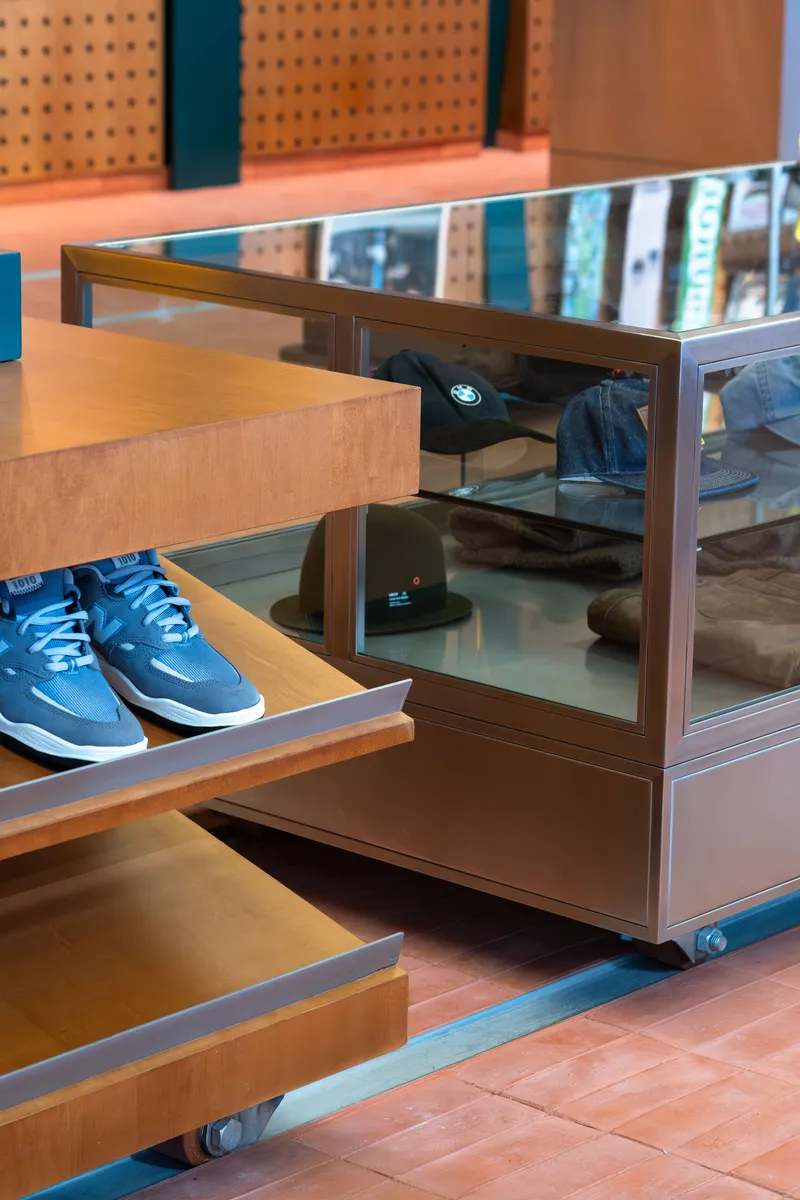
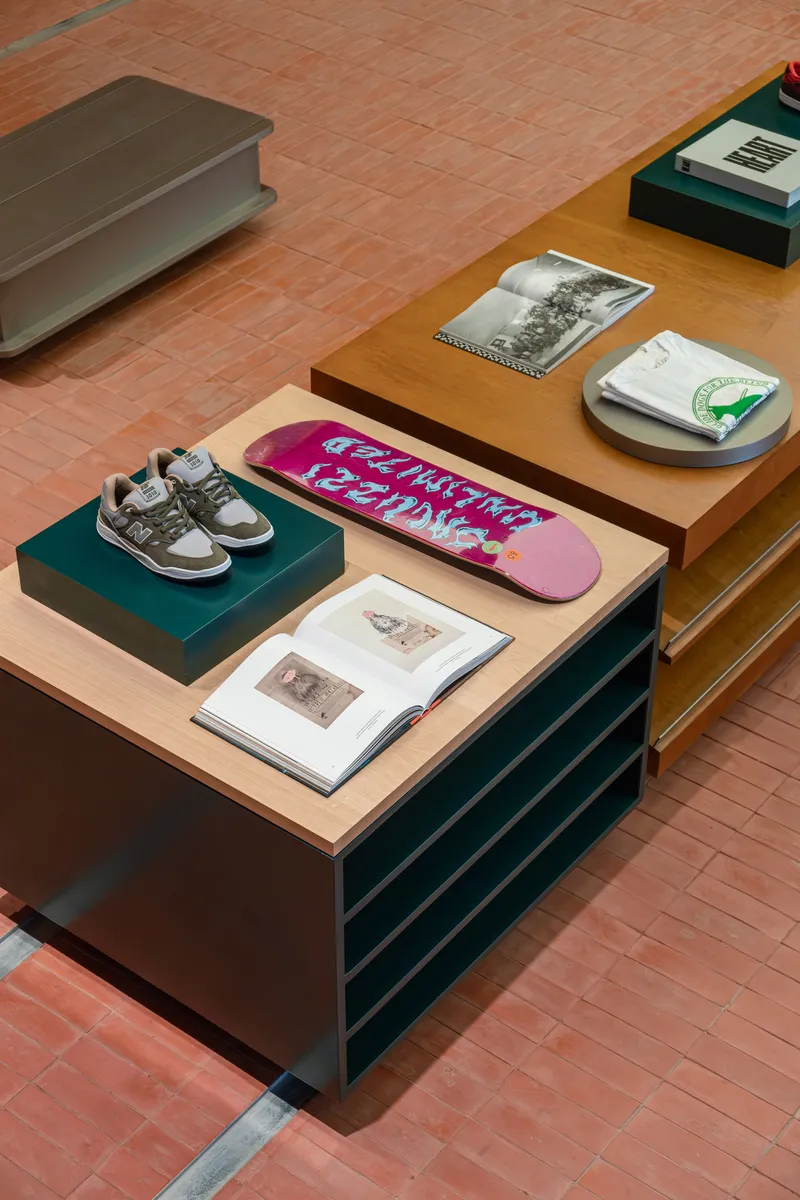
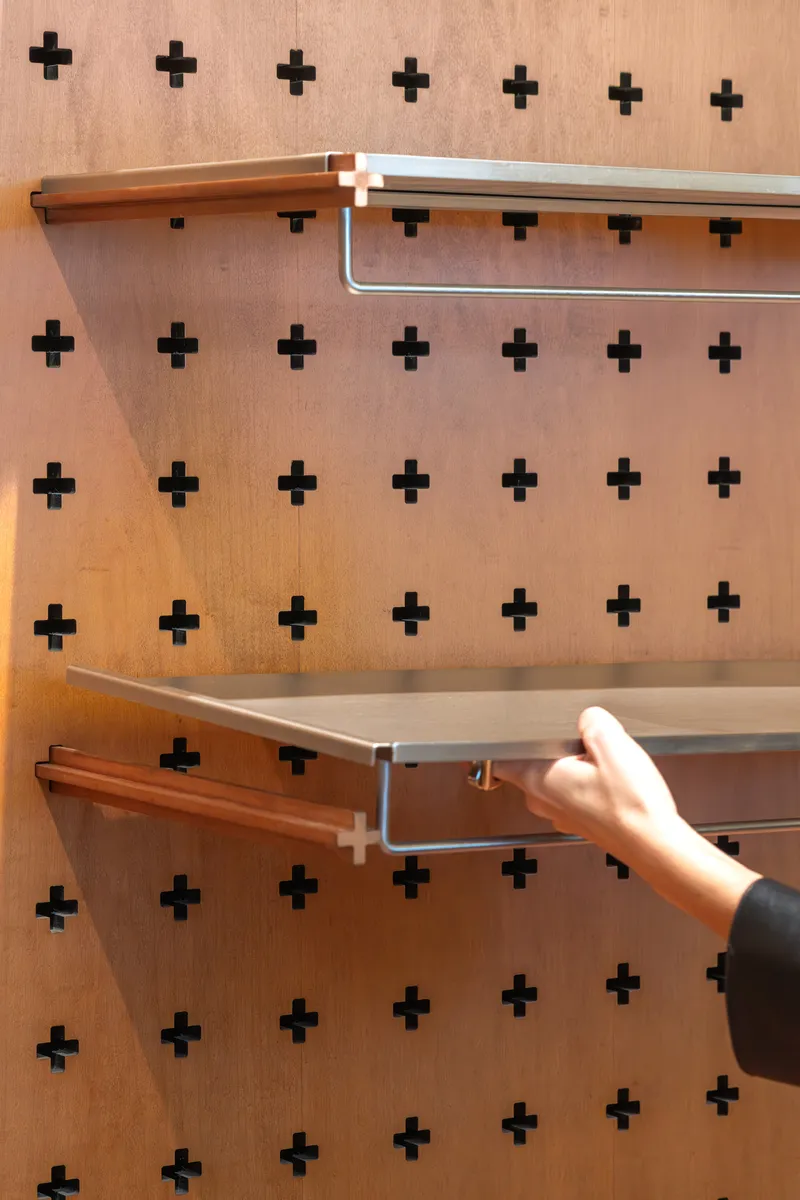
Custom-designed display units sit on casters and run along a central spine. Glass shelves clip into cross-patterned perforated plywood walls with metal brackets, creating a system that can be reconfigured by hand. This is retail architecture that borrows the DIY ethos of skate culture: if you can build a half-pipe in an abandoned pool, you can rearrange a store in an afternoon.
The mobile display units, with their timber tops on green metal bases, reinforce the idea that nothing here is permanently fixed. Publications, merchandise, and skate hardware occupy the same flexible framework. The space is designed to host rotating exhibitions and events, meaning the plan you see today may not be the plan you encounter next month. That adaptability is the real design achievement.
Perforated Surfaces and Filtered Light
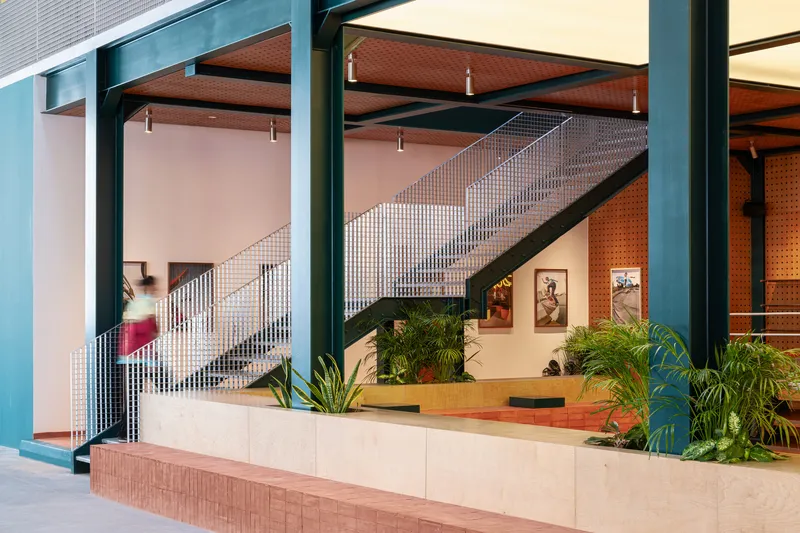
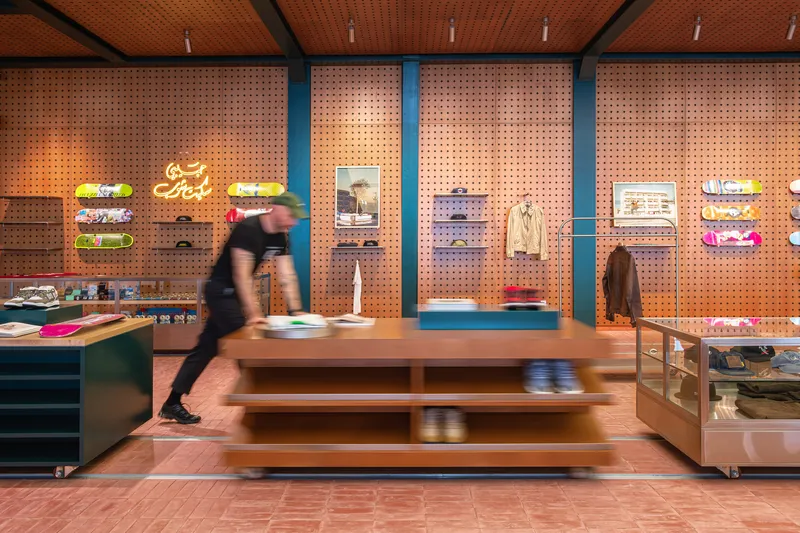
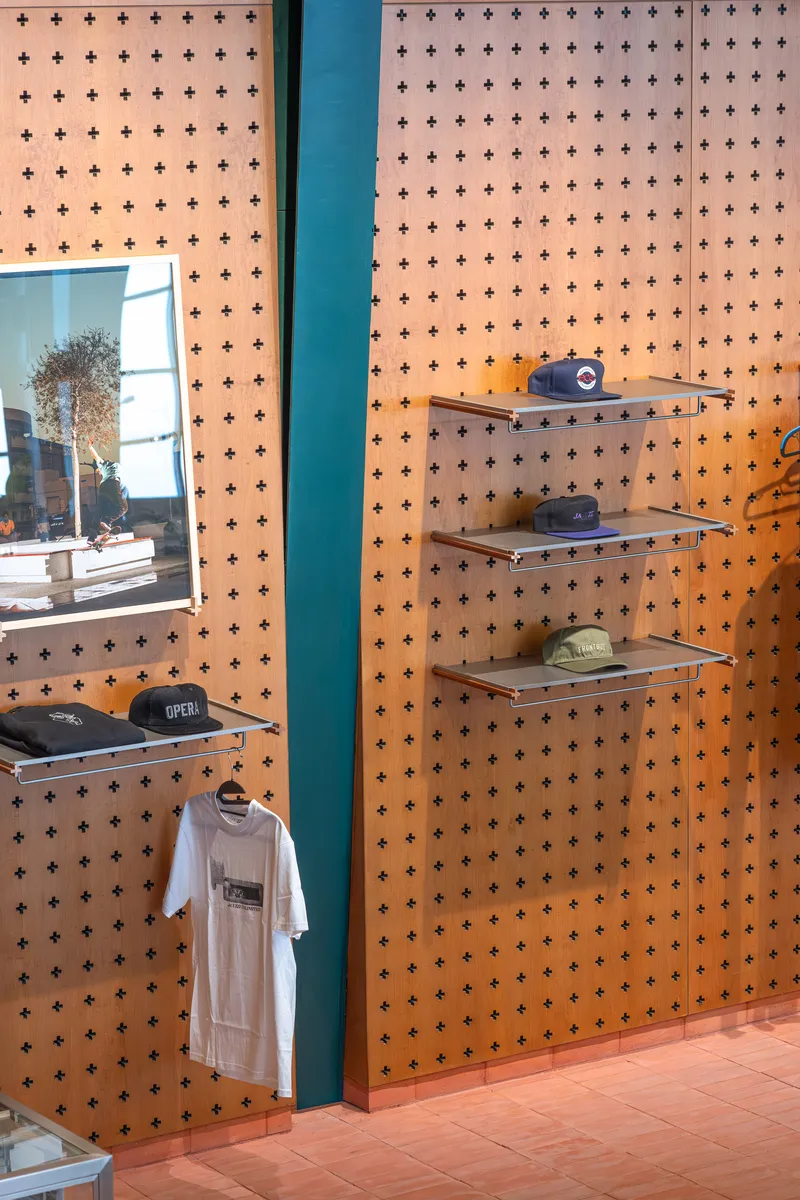
Perforation is the recurring motif. Pegboard walls with blue steel columns organize the retail displays. Orange acoustic panels punctuate the mezzanine stair. Perforated plywood screens with cross patterns create semi-transparent enclosures near the storefront. The effect is a space that breathes, where sightlines extend through layers of material rather than hitting dead ends.
Metal mesh staircases ascend behind planted concrete planters, further blurring the edge between functional circulation and visual display. Light filters through these surfaces differently at every hour, and the interplay of shadow on terracotta tile gives the interior a quality more commonly associated with traditional screened courtyards than with commercial fit-outs.
Dining and Gathering: Damascus Meets Deira
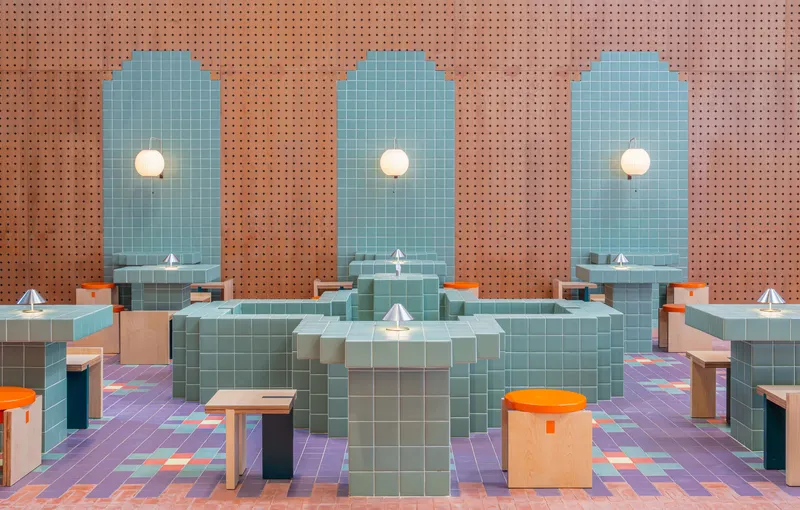
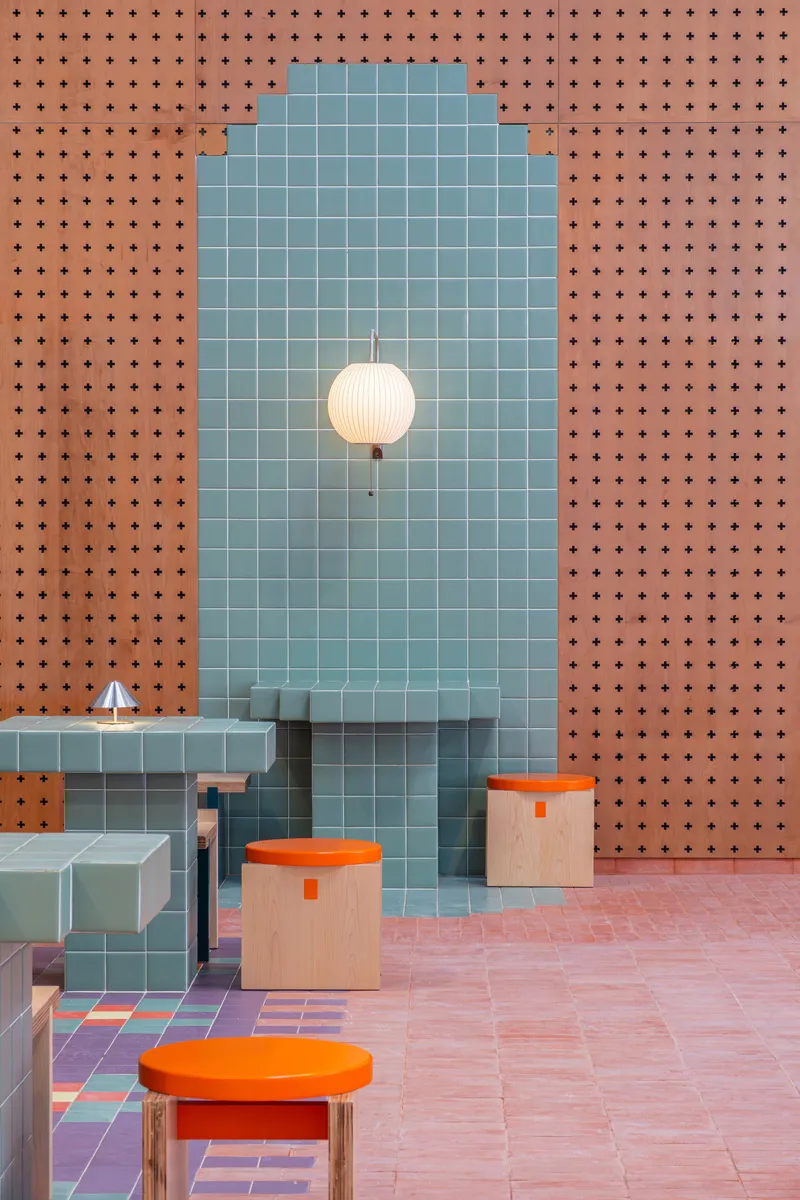
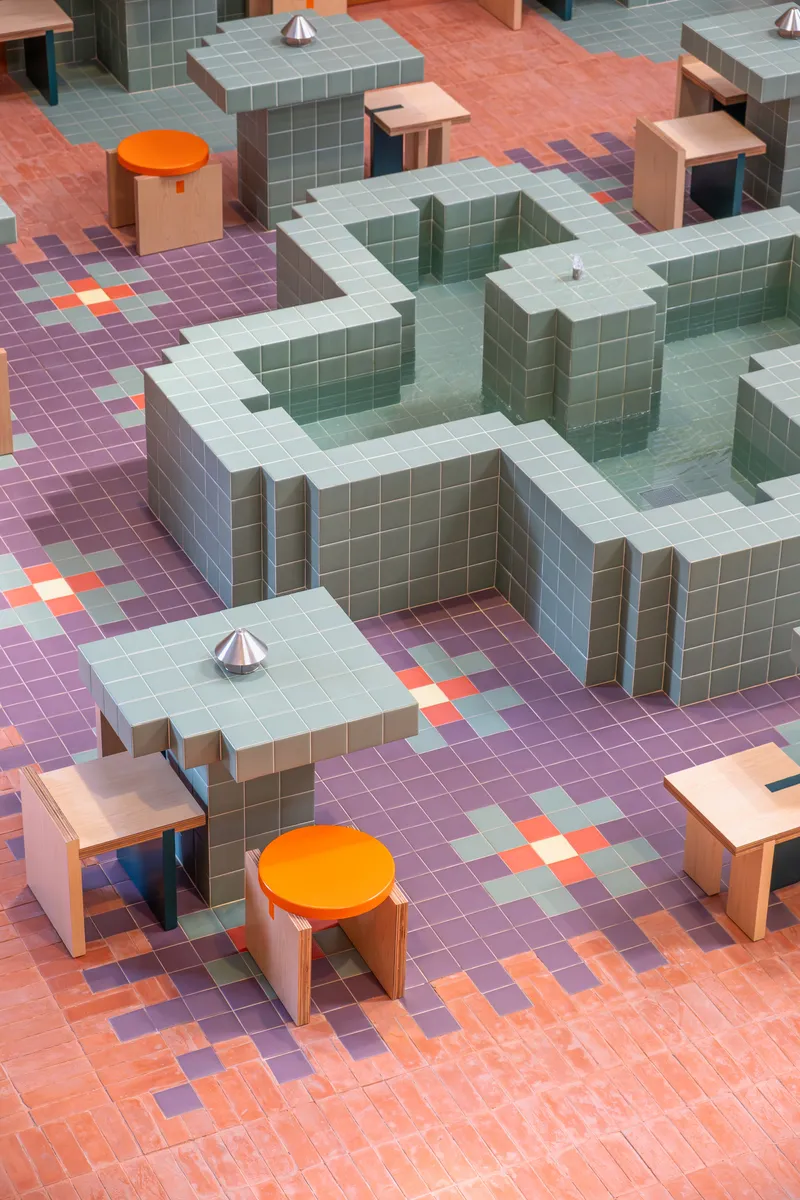
The dining areas, home to Ollie's Pizza and DRVN coffee parlour, are where the regional references become most legible. Arched alcoves lined with blue tile recall Moroccan riads and Ottoman-era interiors. A pixelated mosaic floor in purple and coral tones wraps around tiled cubic volumes and orange seating, creating a micro-landscape that feels almost archaeological. The spherical pendant lights hanging inside the arched niches add a single delicate note to an otherwise muscular palette.
The sculptural fountain at the center ties everything together. It is simultaneously a water feature, a meeting point, and a reference to the founder's Syrian heritage. In a city where public gathering space is often mediated by air conditioning and security guards, placing a courtyard fountain inside a skatepark-retail hybrid is a genuinely subversive act of hospitality.
The Mezzanine: Retreat Within the Storm
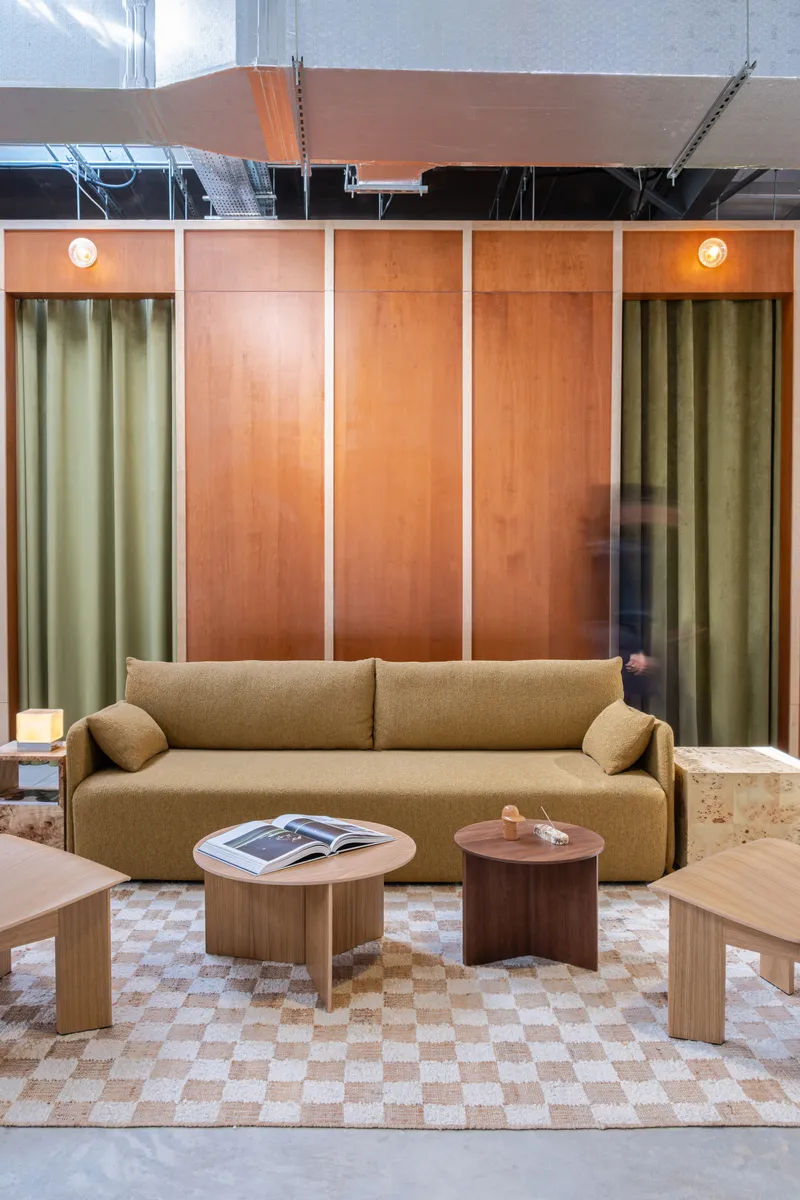
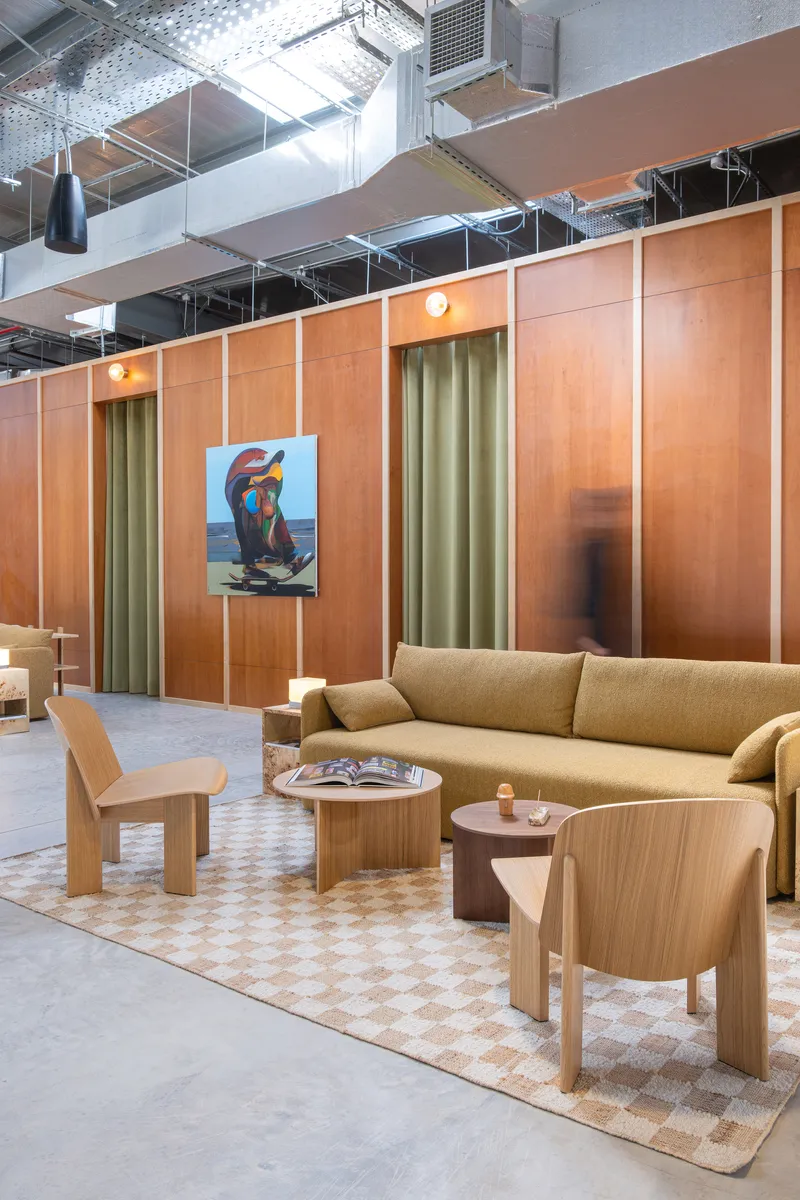
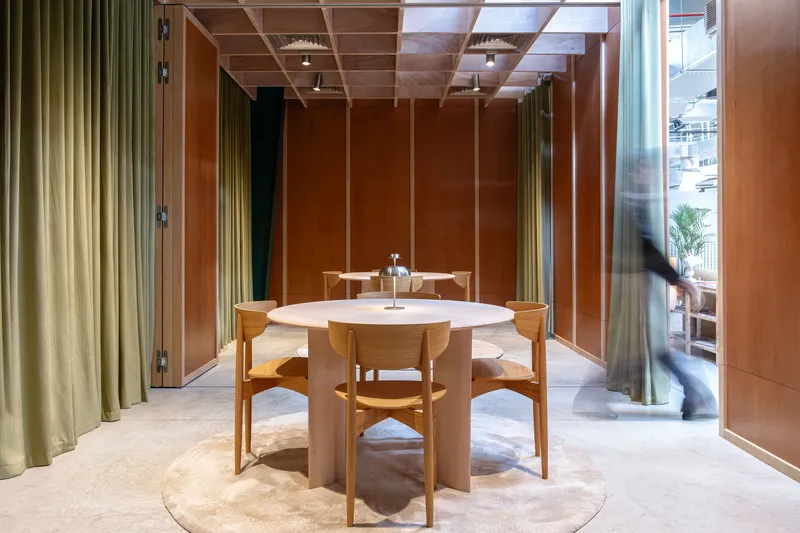
The upper level pivots sharply in mood. Plywood panels, olive curtains, and warm pendant lighting create a quieter register suitable for co-working and conversation. A timber coffered ceiling in the private dining room filters skylight while olive drapery softens the edges. These are spaces designed for dwelling, not browsing.
The transition is managed without hard boundaries. You hear the skatepark below; you glimpse the retail floor through mesh screens. The mezzanine is a retreat, not an escape. That distinction matters. The building holds its contradictions, noise and focus, community and solitude, in productive tension.
Threshold and Facade
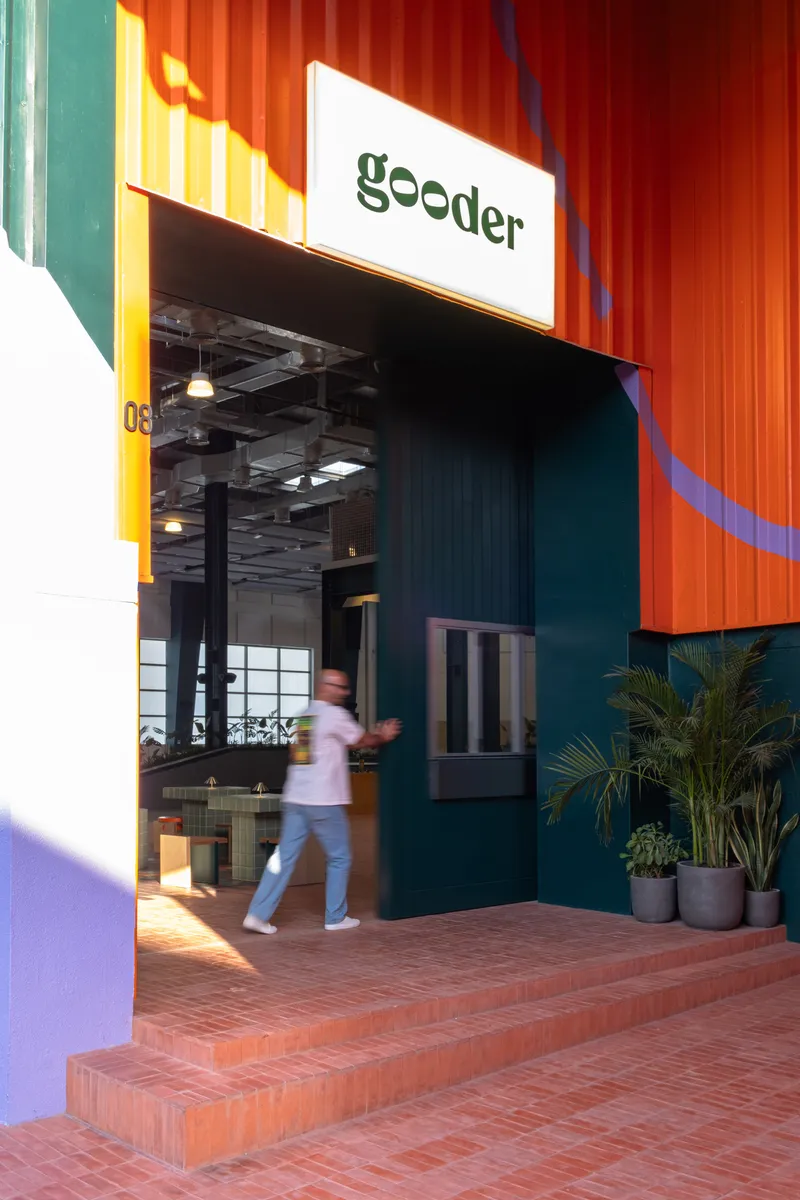
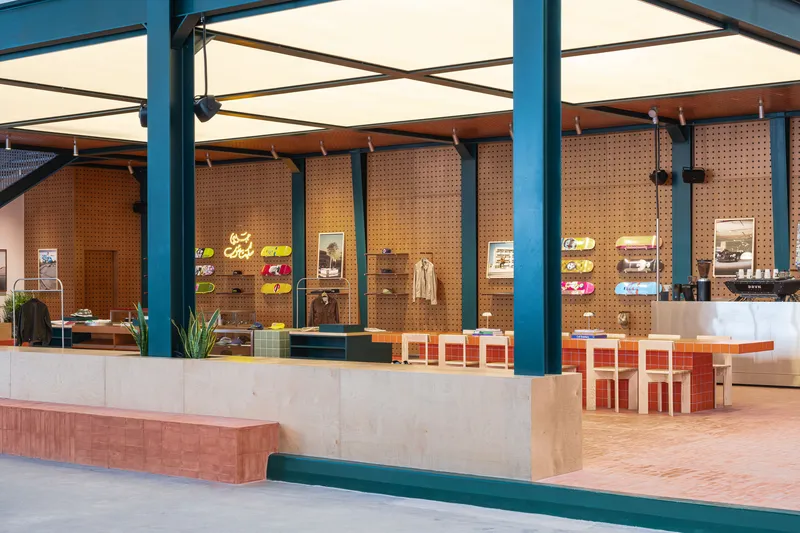
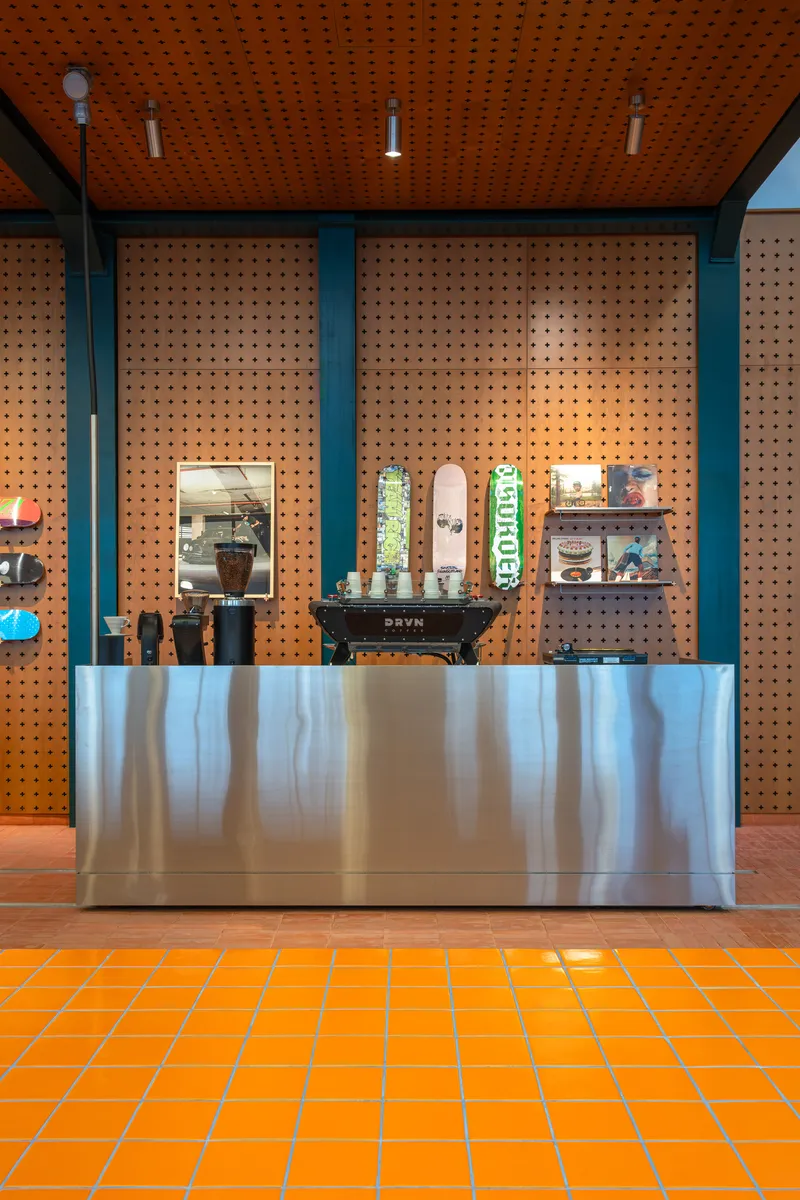
The entrance through Warehouse 07 is marked by a corrugated orange metal facade that reads as industrial signage rather than luxury shopfront. At dusk, the glazed doorway glows against the corrugated skin, creating a lantern effect that pulls passersby in from the avenue. Inside, a retail counter with pegboard display walls and tiled seating sits under exposed steel beams and skylights, establishing the tone immediately: this is a workshop that happens to sell things.
Timber-framed enclosures with perforated metal bases create room-like zones within the open plan without sealing them off. They read as furniture at architectural scale, reinforcing the idea that the entire interior is a system of movable parts rather than a fixed composition.
Plans and Drawings
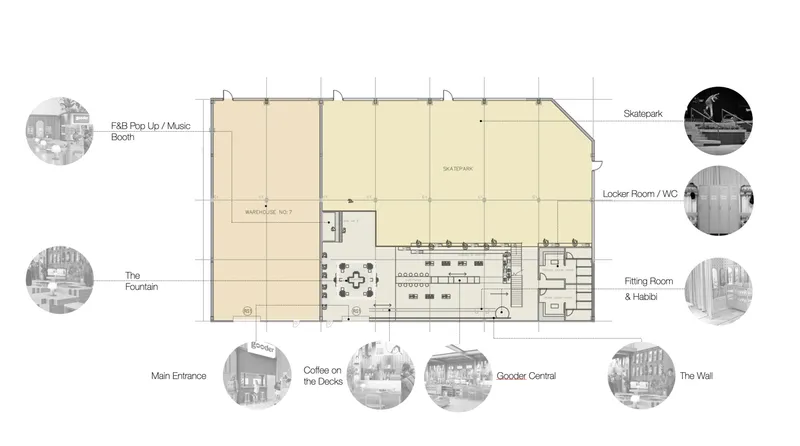
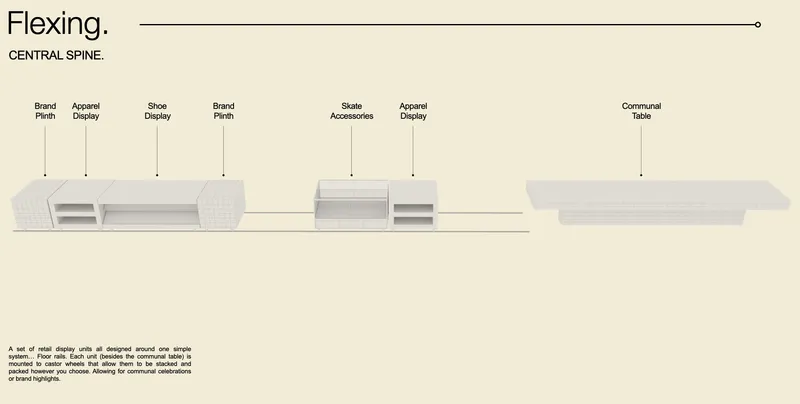
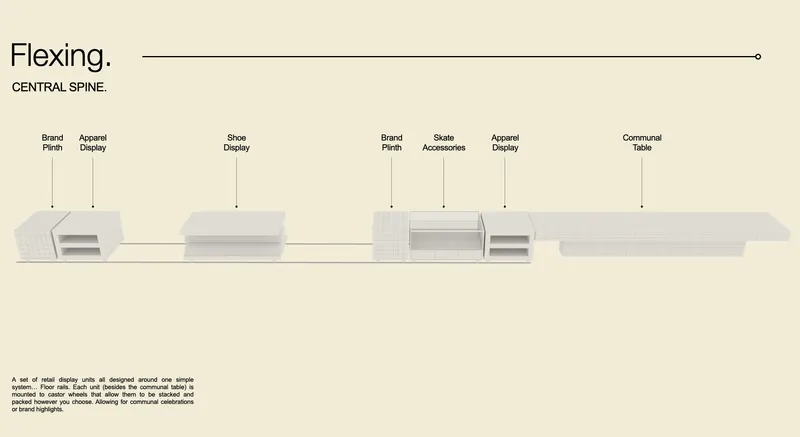
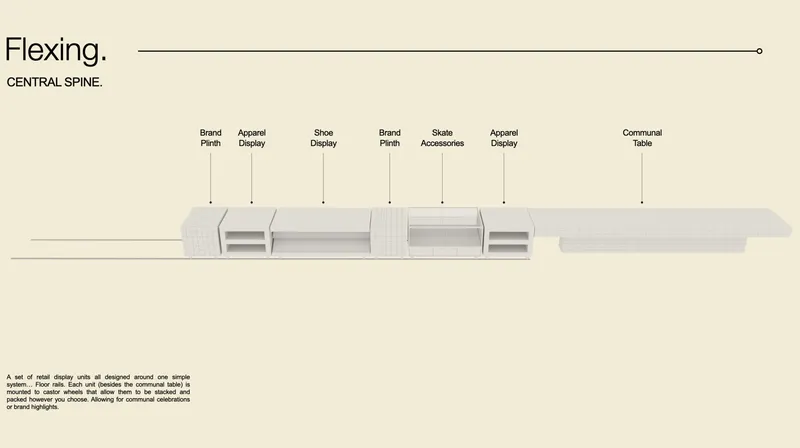
The floor plan reveals the organizational logic: a central spine runs the length of the warehouse, with program zones branching off laterally. The section drawings illustrate how display modules, communal tables, and the flexible retail system attach to this spine, creating a rhythm that is legible without being rigid. The axonometric drawing makes the modularity explicit, showing labeled zones for merchandising arranged along the central corridor like vertebrae along a backbone.
What the drawings confirm is that the apparent casualness of the interior is carefully choreographed. Every movable unit has a default position, every perforated wall a structural rationale. The design is loose by intention, not by accident.
Why This Project Matters
Gooder matters because it proposes a model for commercial architecture that is neither generic nor precious. In a region where retail design often defaults to marble and gold, or to the stripped-back minimalism of European imports, studio pheasant has found a third path rooted in local material traditions and subcultural energy. The Damascus courtyard fountain sitting at the heart of an indoor skatepark is not a gimmick. It is a spatial argument that heritage and counter-culture can coexist, that a store can also be a park, a café, and a workspace without any of those identities cannibalizing the others.
The modular, movable approach to fixtures also raises a broader question about the shelf life of retail interiors. Most commercial fit-outs are demolished and rebuilt every five to seven years. Gooder is designed to evolve continuously without demolition, absorbing new programs and new configurations the way a skatepark absorbs new tricks. If retail is going to survive the post-digital era, it will look less like a showroom and more like this: a place where things happen, and where the architecture gets out of the way just enough to let them.
Gooder Store by studio pheasant, lead architect Talar Bardakjian. Located on Alserkal Avenue, Dubai, United Arab Emirates. 1,500 m². Completed 2026. Photography by Aylul Studio.
About the Studio
Share Your Own Work on uni.xyz
If projects like this are the kind of work you want to make, uni.xyz is a place to publish your own, find collaborators, and enter design competitions.


Popular Articles
Popular articles from the community


graciastudio Turns a Viewless Tijuana Lot Inward Around a Courtyard of Concrete, Timber and Trees
In Tijuana, Jorge Gracia's GA2 House stacks a timber-clad private floor over exposed concrete and replaces a missing view with a planted interior patio.

Cube Design Draws an Ecological Corridor Between Two Shenzhen Hills with the Nankai Building
Beside Shenzhen's container docks, the Nankai Building pairs stacked balconies with a climbing green screen to connect two hillsides across its height.


Aquadapt: An Underwater Habitat That Rewrites Its Rooms by the Hour
Curved modules ring the seabed while one shell shifts from breakfast room to cinema, farm and football pitch as residents' needs change.

Manzana Morphosis: Stretching Barcelona's Grid into a Living Landscape for 2050
A radical reworking of the Eixample manzana turns density into a tool for generous public space, vertical ecology, and environmental performance.

Similar Reads
You might also enjoy these articles

LAVA Architecten Gives Vocational Education a Sawtooth-Roofed Face on a Mechelen School Campus
In Mechelen, Belgium, a 2,053 m² STEM school on a 6×6 m grid turns workshops and classrooms into rooms that can be rearranged as teaching changes.

KEMA Studio Turns a Derelict Marvila Attic into a 60 m² Lighthouse Apartment Above Lisbon
In Lisbon's Marvila district, a rebuilt roof, four skylights and two plywood volumes turn an unlivable attic into a bright home facing the Tagus.

Pixel Gardens: One Repeated Module Stacked Into a Terraced Social Housing Tower for Famagusta
Salem Bader's shortlisted housing tower builds a vertical neighbourhood from one repeated module, offsetting units to carve terraces, light and air.

Bao Huynh Watercolor Atelier: A Serene Art Retreat in Hội An
Bao Huynh Watercolor Atelier in Hội An blends multifunctional art spaces, sustainable design, local materials, and family-friendly living in a serene environment.

Explore Food Generation Hub Competitions
Discover active competitions in this discipline

Challenge to design luxury tourism on rails

VR headsets Storefront design competition

Bring back Drive In's

Designing a staircase for a client
Comments (0)
Please login or sign up to add comments
No comments yet. Be the first to comment!