
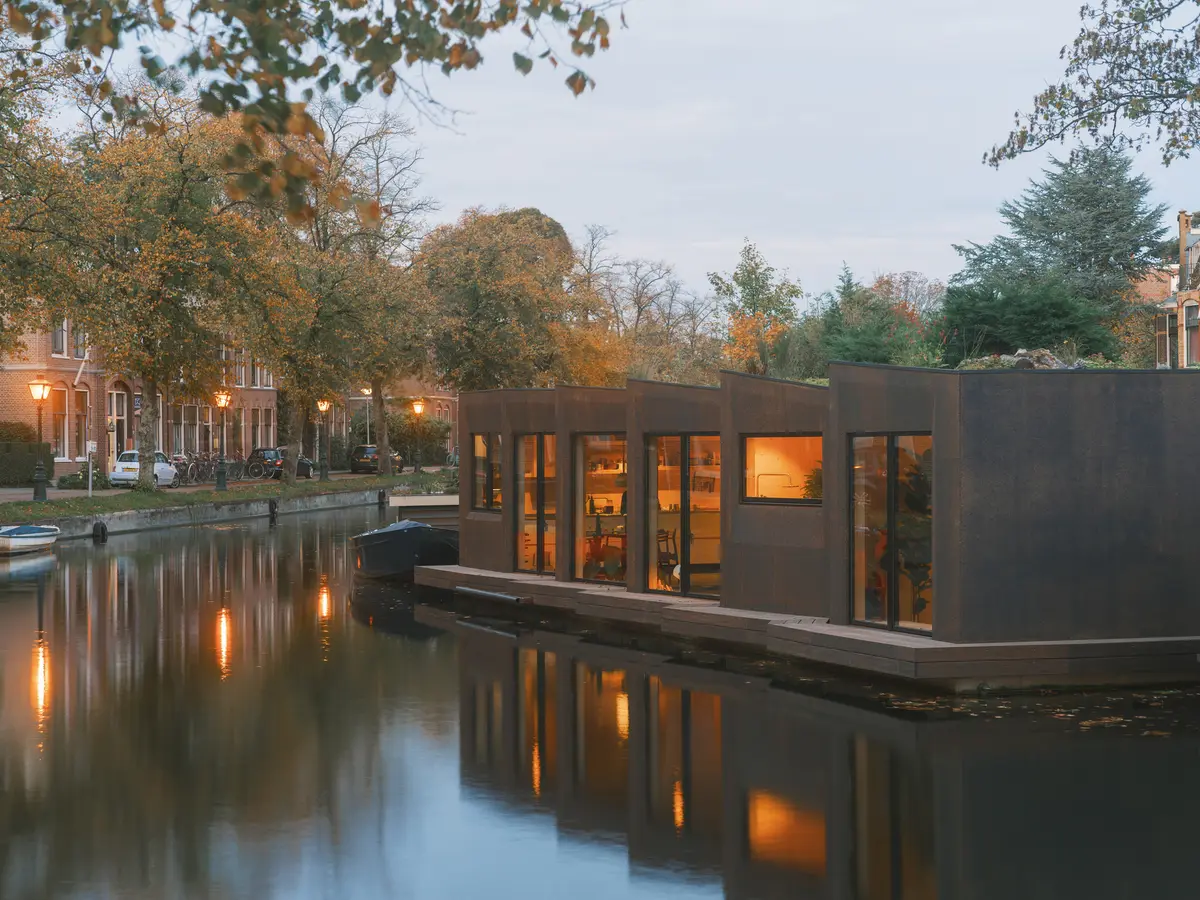
Studio RAP Folds an Origami-Inspired Floating Home from Timber and Cork on a Leiden Canal
An 85-square-meter houseboat on Leiden's historic canals uses parametric design to save over two tons of timber while breathing through cork walls.


Floating houses are nothing exotic in the Netherlands, a country defined by its negotiation with water. But most of them look like shrunken suburban villas perched on pontoons, neither belonging to the water nor really challenging what a dwelling could be. Studio RAP's contribution to Leiden's canal network, called The Float, pushes back against that default. The Rotterdam firm treated the 85-square-meter program not as a single box to be waterproofed but as a series of rotated modules, each angled toward the lush vegetation on the opposite bank and wrapped in a corrugated skin of solid cork.
What makes the project genuinely interesting is how tightly the formal ambition and the sustainability logic are fused. The origami-inspired folds that give the walls and roof their sculptural depth are not decorative: they are structural. Studio RAP parametrically optimized every fold in collaboration with Summum Engineering, shaving over 2,000 kilograms of cross-laminated timber from the load-bearing shell. The cork cladding, CNC-cut into bespoke modules, doubles as insulation and vapor regulation, creating a breathing envelope that eliminates the need for mechanical ventilation membranes. Every design decision feeds the next, and the digital workflow runs unbroken from the first parametric model to the final CNC production data.
A Folded Silhouette on the Canal
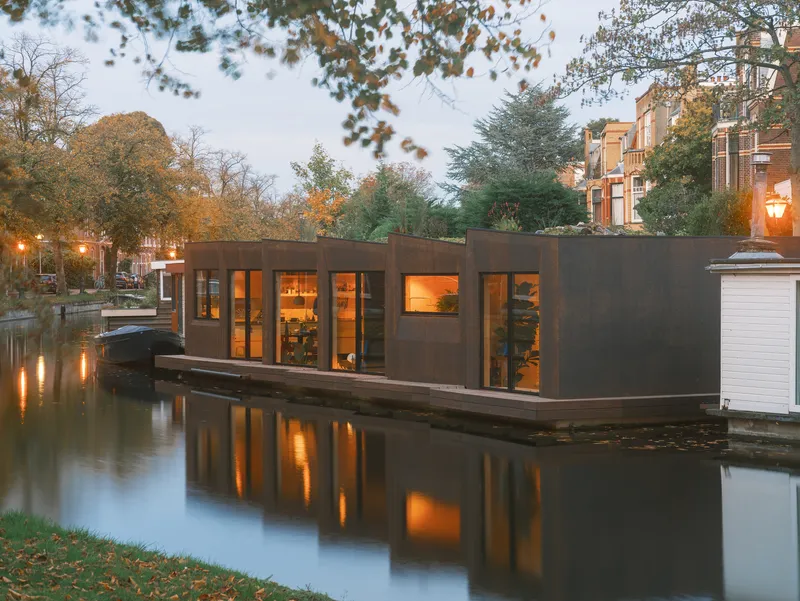
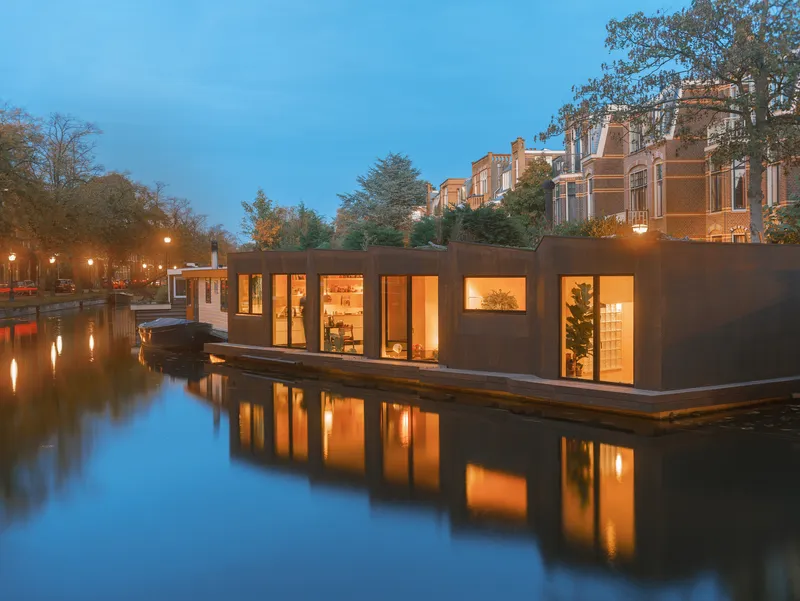
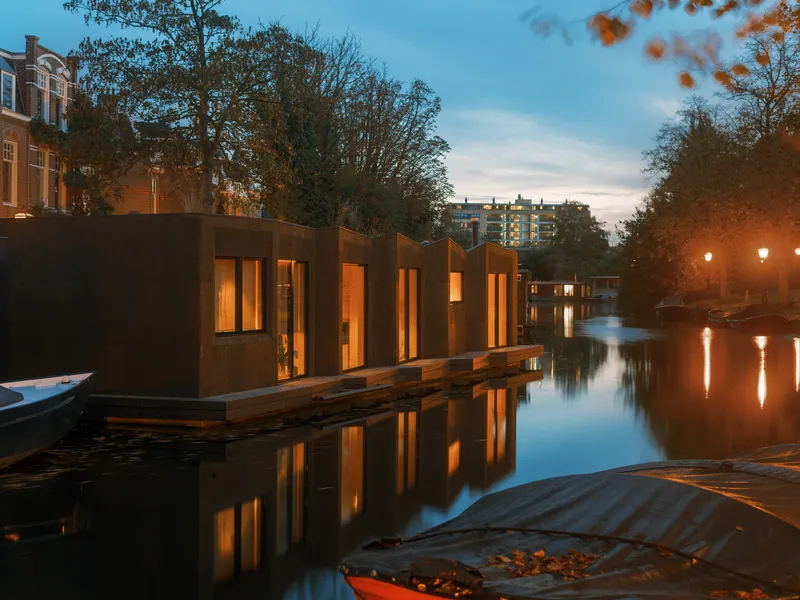
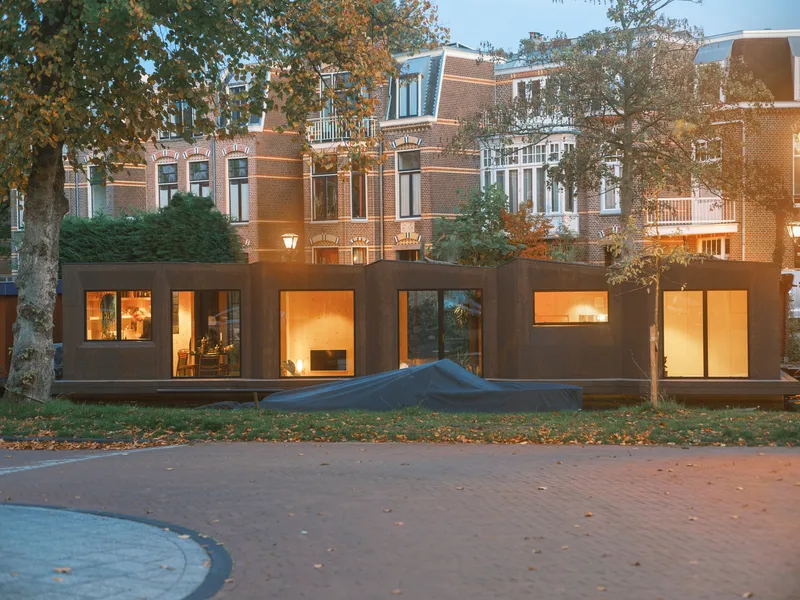
At dusk, The Float reads as a lantern. The dark cork facade absorbs the last daylight while large glazed openings throw warm timber tones across the water. The silhouette is unmistakably not a standard houseboat: its roofline steps and folds where conventional floating homes would present a flat bar. Each module rotates slightly, breaking the linearity and creating a sequence of projecting and receding planes that catch light differently throughout the day.
Moored alongside traditional canal boats and beneath the brick facades of Leiden's historic residential fabric, the house manages to look contemporary without screaming for attention. It is quieter than its formal ambition might suggest, partly because cork weathers into tones that rhyme with aged wood and partly because the scale stays disciplined. At 85 square meters, it never overshadows its neighbors.
Cork as Cladding, Insulator, and Character
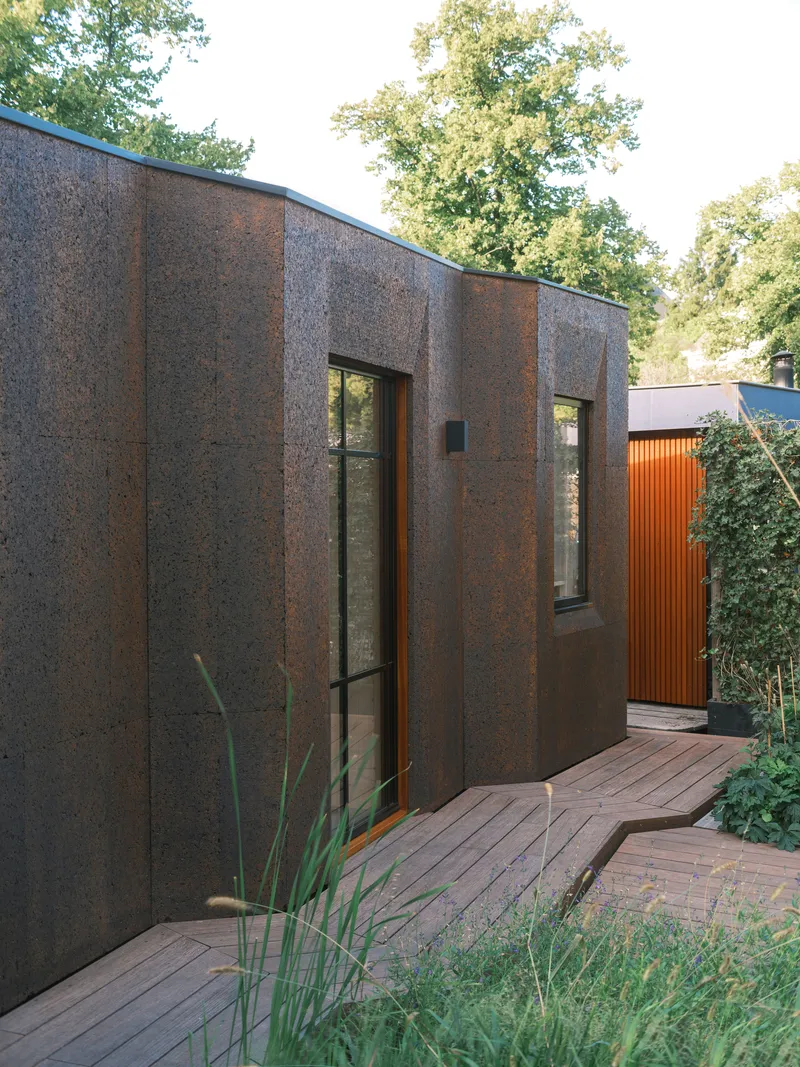
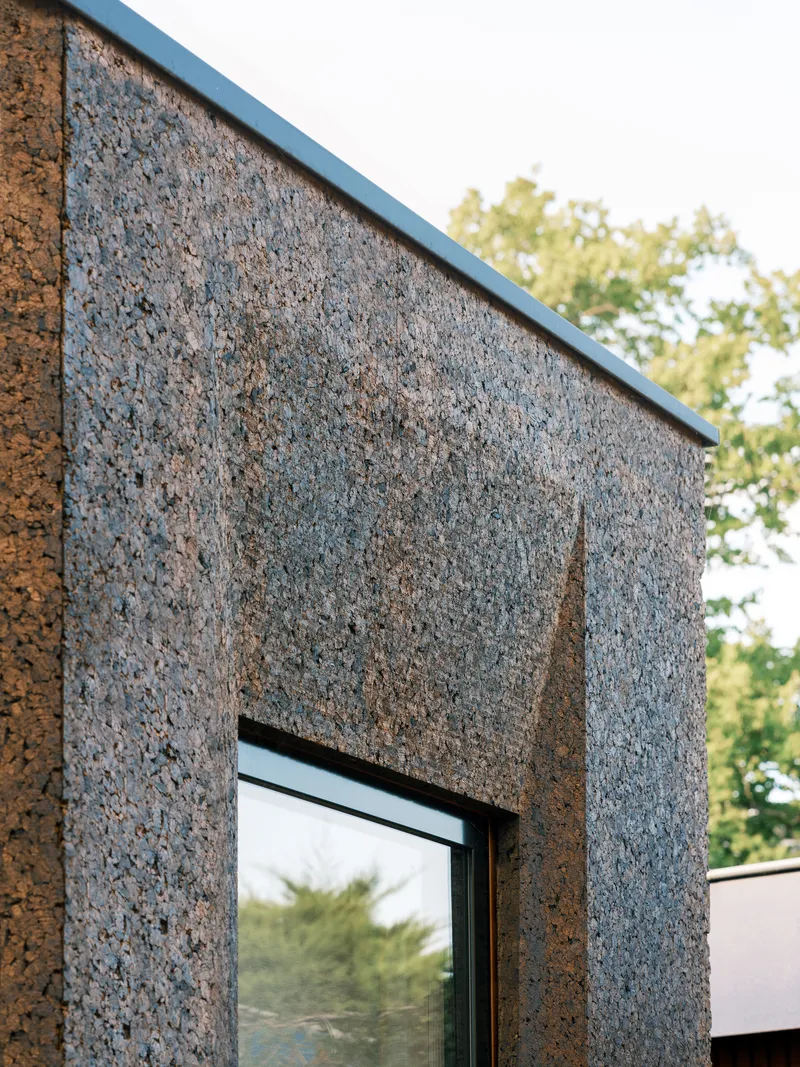
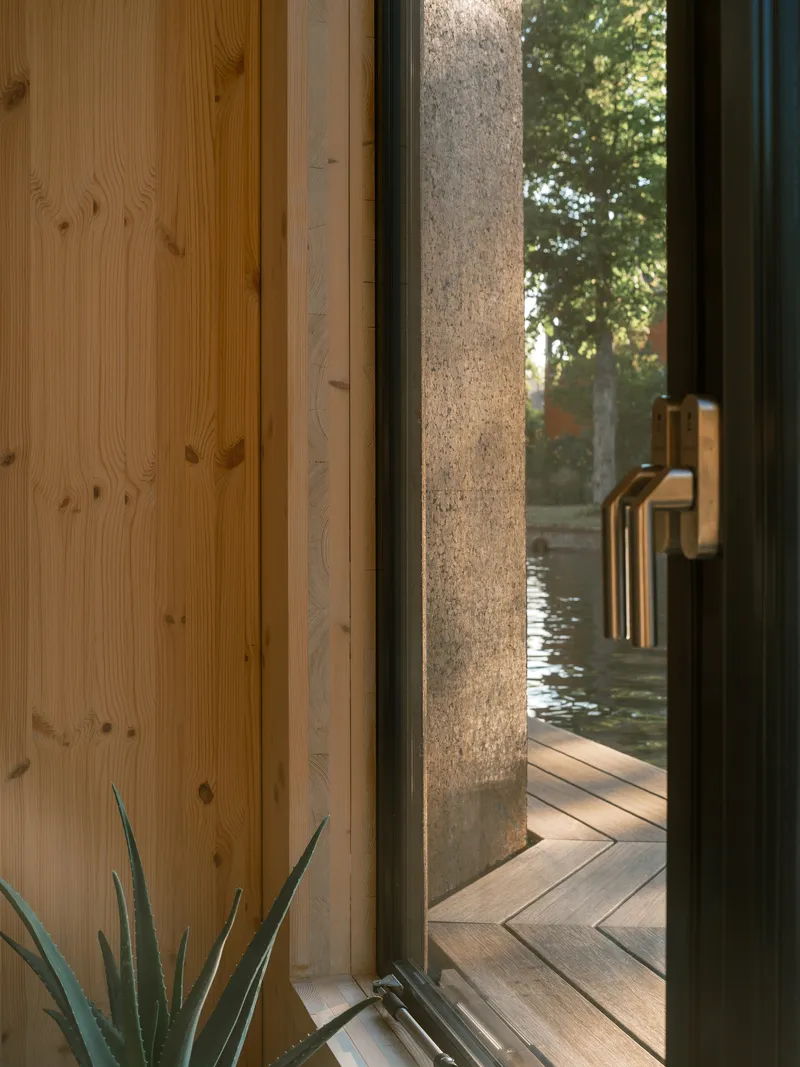
The exterior envelope is a sandwich of two cork densities bonded by a cork mortar layer: a low-density insulation slab sits against the CLT structure, and a high-density outer skin takes the weather. The result is a wall that breathes, regulating humidity passively and contributing to a stable interior climate without relying on synthetic vapor barriers. Cork is also lightweight, a critical advantage when your foundation is a floating pontoon by Hercules.
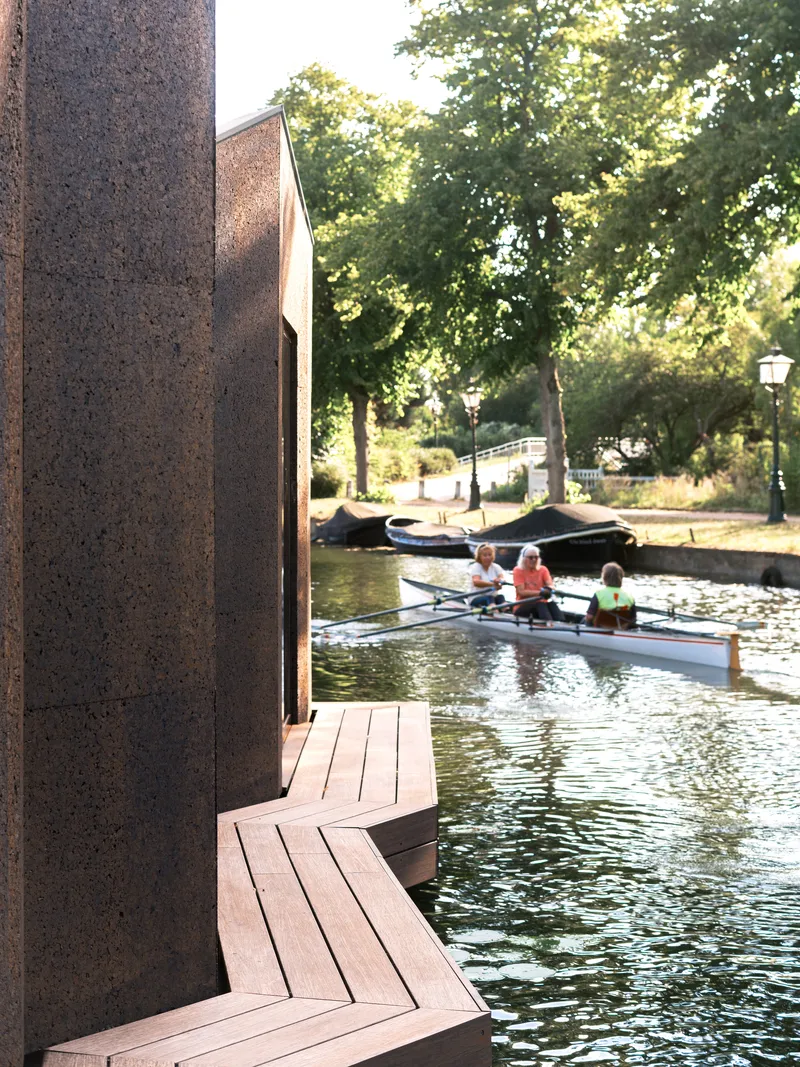
Up close, the material has a granular, almost geological texture. CNC-cutting allowed Studio RAP to produce bespoke modules with tight seams and precise window reveals, avoiding the rough, craft-heavy junctions that typically plague cork construction. The narrow vertical windows punched through the panels create a rhythm that reinforces the corrugated geometry. Where the cork meets the timber deck, a metal cap detail keeps the joint clean and protects the edge from standing water.
Living Inside the Structure
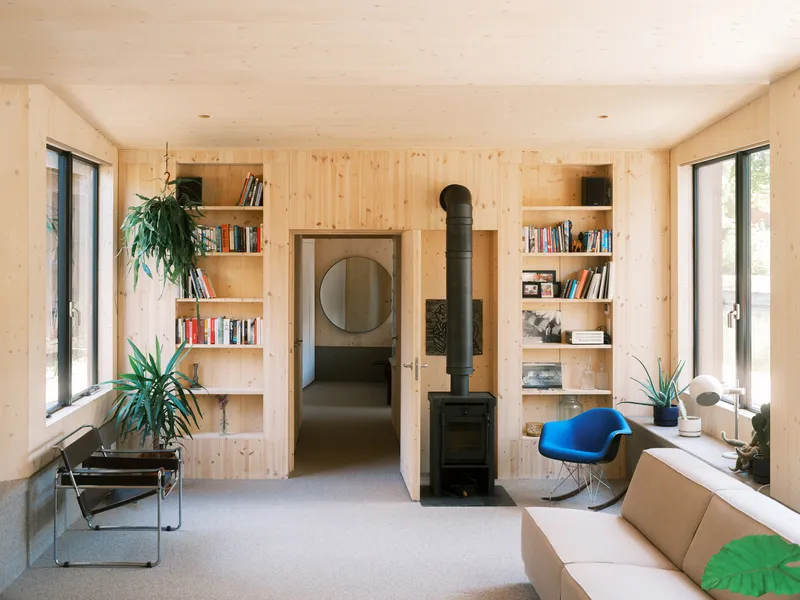
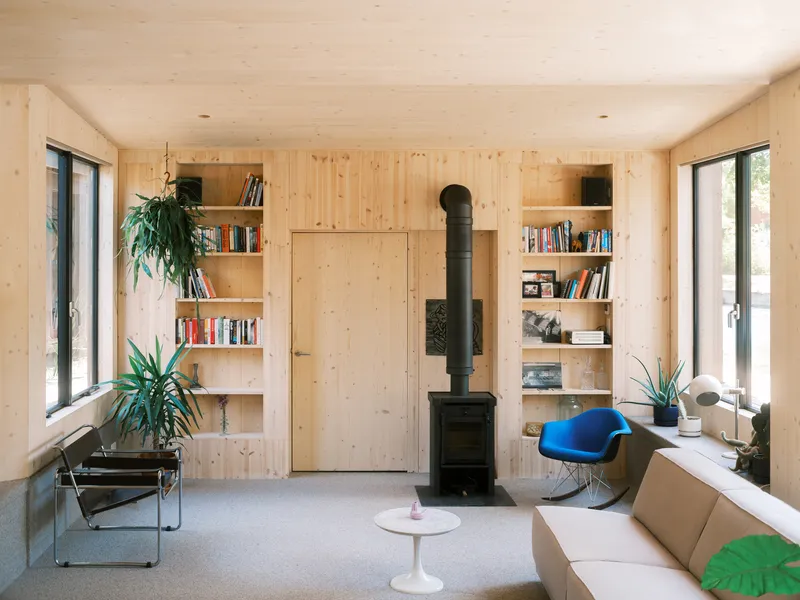
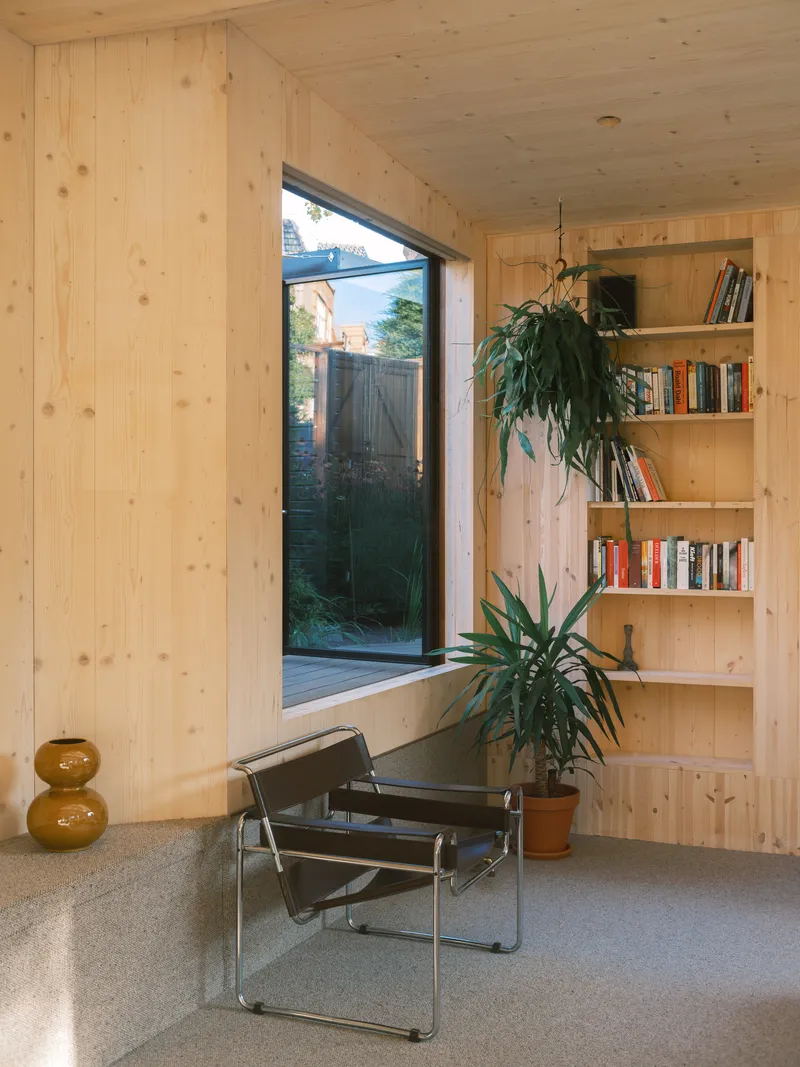
Inside, the CLT is left fully exposed. There are no plasterboard layers, no paint, no suspended ceilings hiding services. The structure is the interior finish, and the pale pine grain gives every room a warm, tactile quality that photographs never quite capture. Built-in bookshelves are milled directly into the wall planes, and the central wood-burning stove anchors the living room without dividing it.
The spatial sequence runs simply: kitchen and dining at one end, living room in the center, bedroom at the other end, with a compact bathroom and toilet threaded through a connecting hallway. Because each module rotates slightly, none of the rooms feels like a corridor. Instead, you move through a series of distinct atmospheres, each framed by different orientations toward the canal and the trees beyond it. That rotational logic turns 85 square meters into something that feels considerably more generous.
Thresholds Between Inside and Water
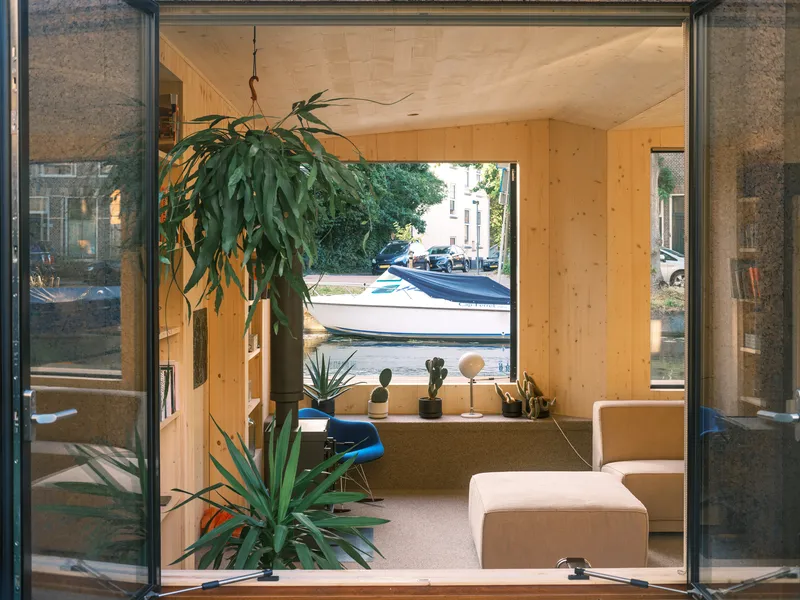
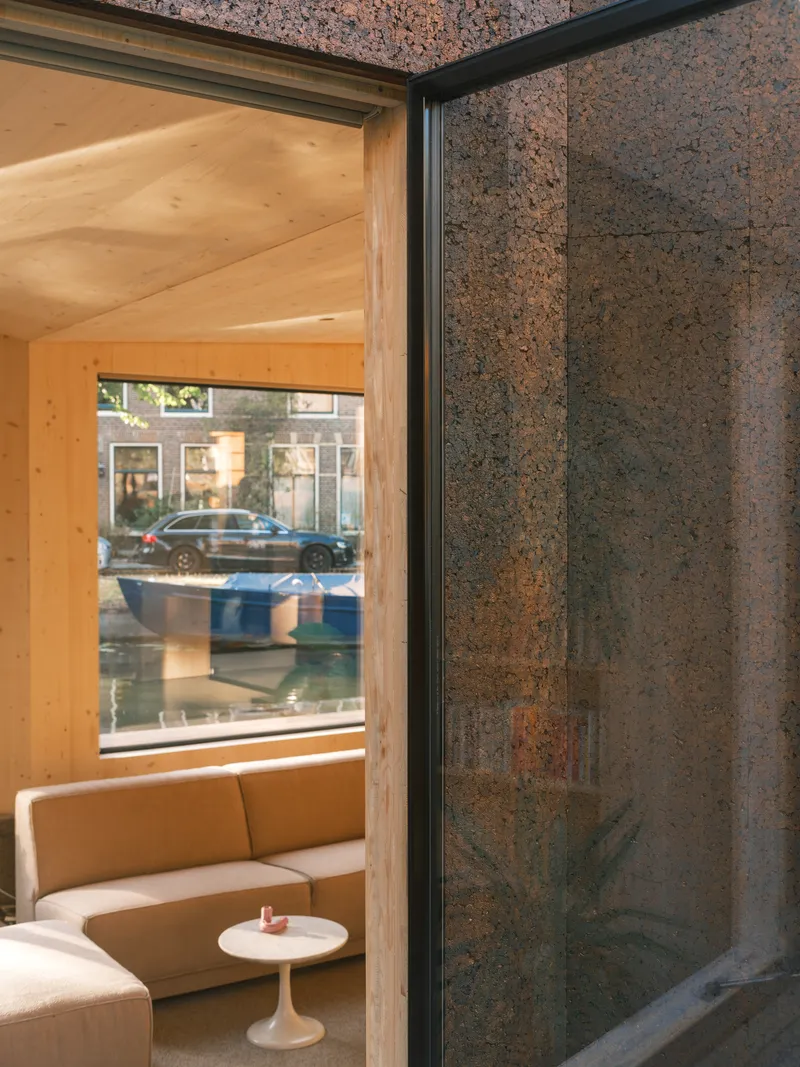
The glazed doors opening onto the timber deck collapse the boundary between the living room and the canal. Hanging plants, moored boats, autumn foliage: the view is composed but never curated, because a canal is a working landscape. Studio RAP leaned into that, designing the openings to frame the opposite bank's vegetation rather than the neighboring houseboats. The threshold moments, where the interior pine paneling meets the exterior cork and the aluminum window frames mediate between the two, are carefully resolved. Brass hardware and stainless steel details signal a considered material palette without overworking the design.
From the street side, the house presents a different face: a more guarded elevation of cork panels punctuated by ribbons of glass. At twilight, the glow from within turns this facade into a soft screen, filtering domestic life into the urban context of Leiden's brick row houses. The duality is effective. The canal side is open and generous; the street side is protective and textured.
Green Roof and Prefabrication
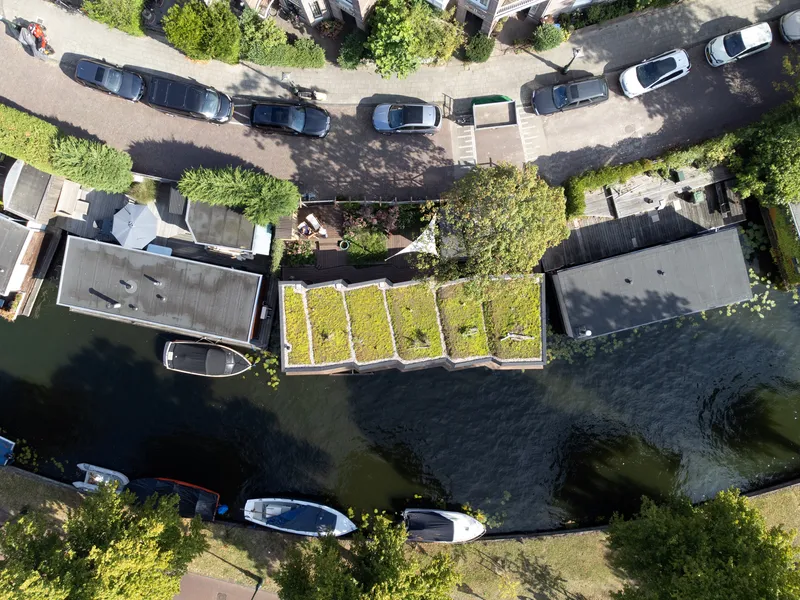
From above, The Float almost disappears. Strips of sedum, a mix of at least eight strains, cover the roof, adding a final insulation layer and softening the building's footprint when seen from the surrounding apartments. The green roof also manages stormwater, though on a floating structure the calculus is slightly different: weight distribution matters as much as drainage.
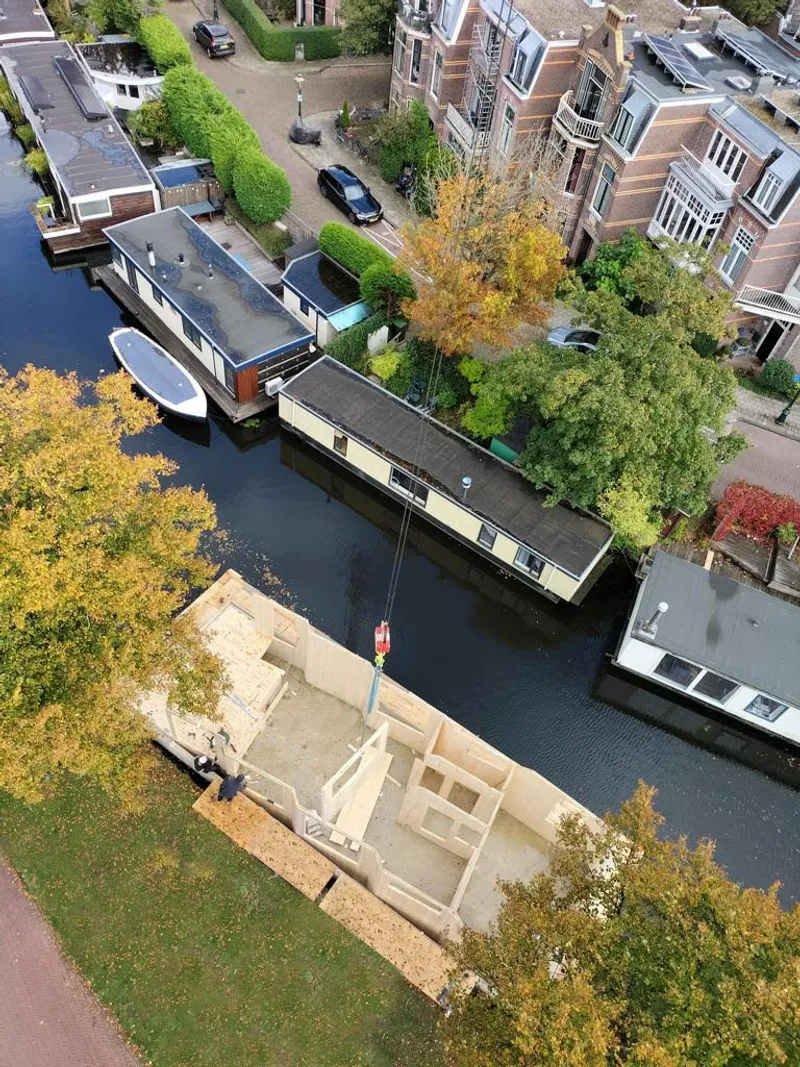
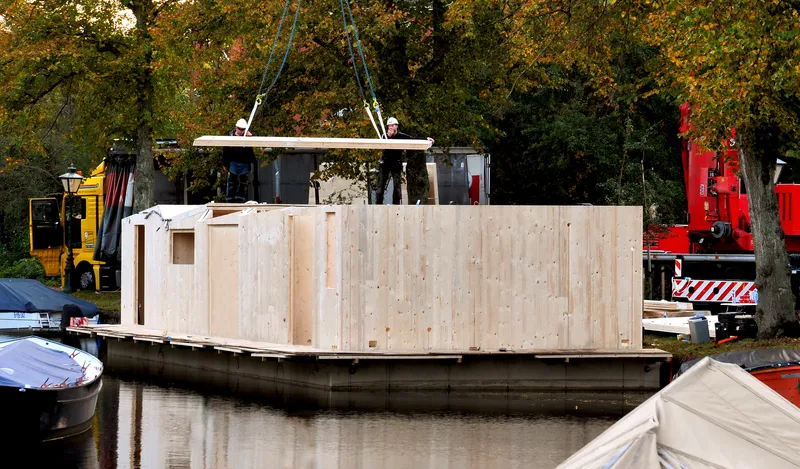
The construction photograph of the prefabricated CLT shell being craned onto the pontoon is perhaps the most revealing image in the set. It shows that the entire timber structure was assembled off-site and lowered into position in one piece, minimizing wet trades, canal disruption, and on-water construction time. The fully digital workflow Studio RAP maintained, from parametric model to CNC production files for both CLT panels (supplied by KLH Austria, fabricated by JM Concepten) and cork modules (supplied by Prosuber and Amorim), made that level of prefabrication possible.
Material Details
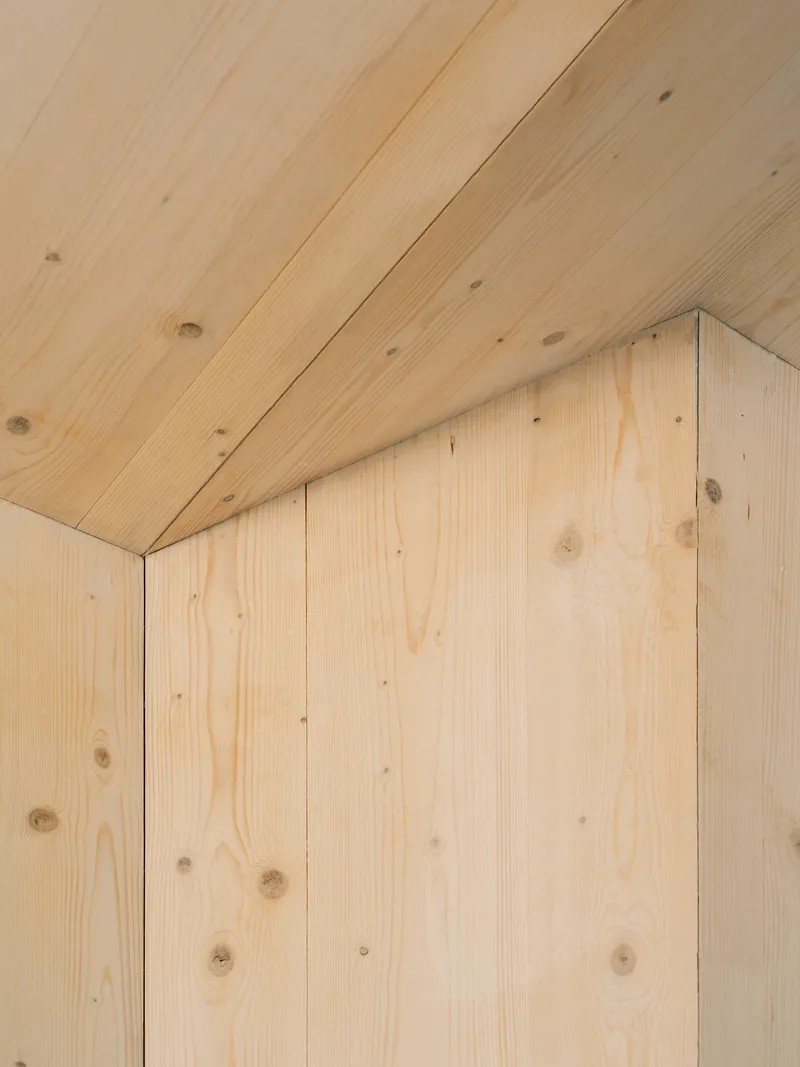
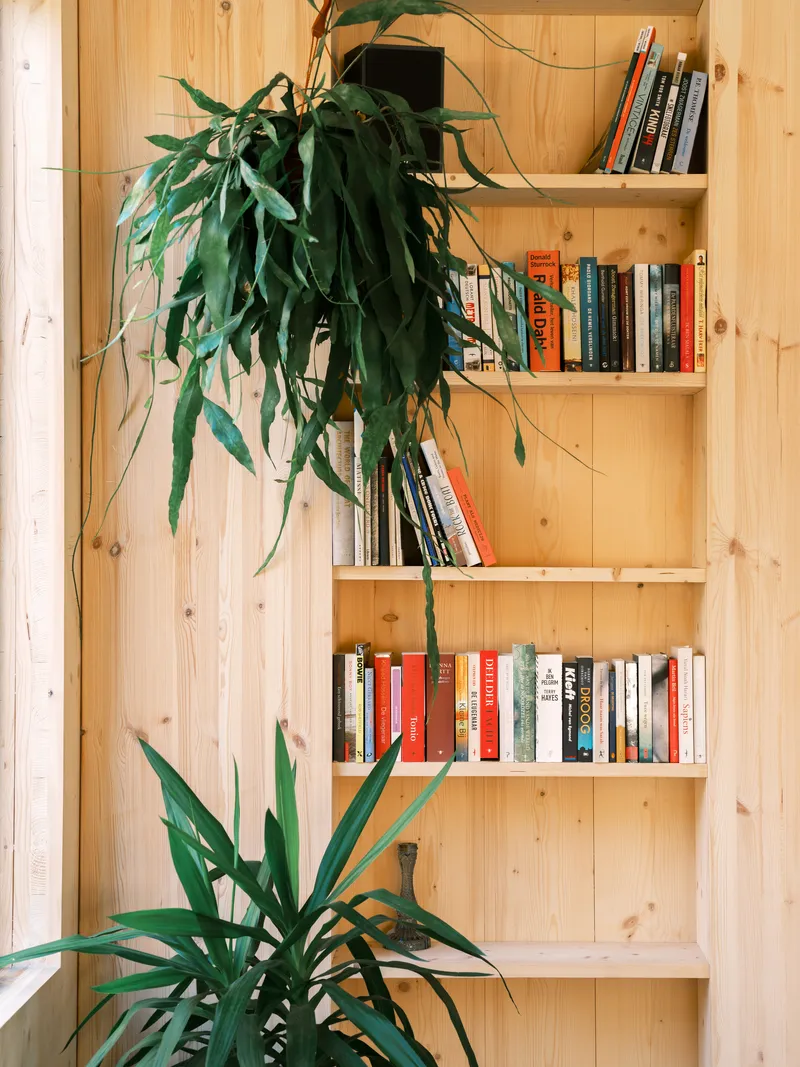
The interior detailing is restrained but not minimal. Timber knots and grain are left visible; joints between CLT panels become a decorative register rather than something to conceal. The built-in shelving, loaded with books and trailing plants, integrates storage into the architecture so completely that freestanding furniture becomes almost optional. A leather chair, a stove, a few ceramics: the rooms are finished by the structure itself.
The timber boardwalk that wraps the exterior provides a generous threshold between water and interior, wide enough for outdoor seating and narrow enough to keep the footprint compact. It also serves a practical purpose: it is the maintenance access route for inspecting the pontoon and the cork facade at water level.
Plans and Drawings
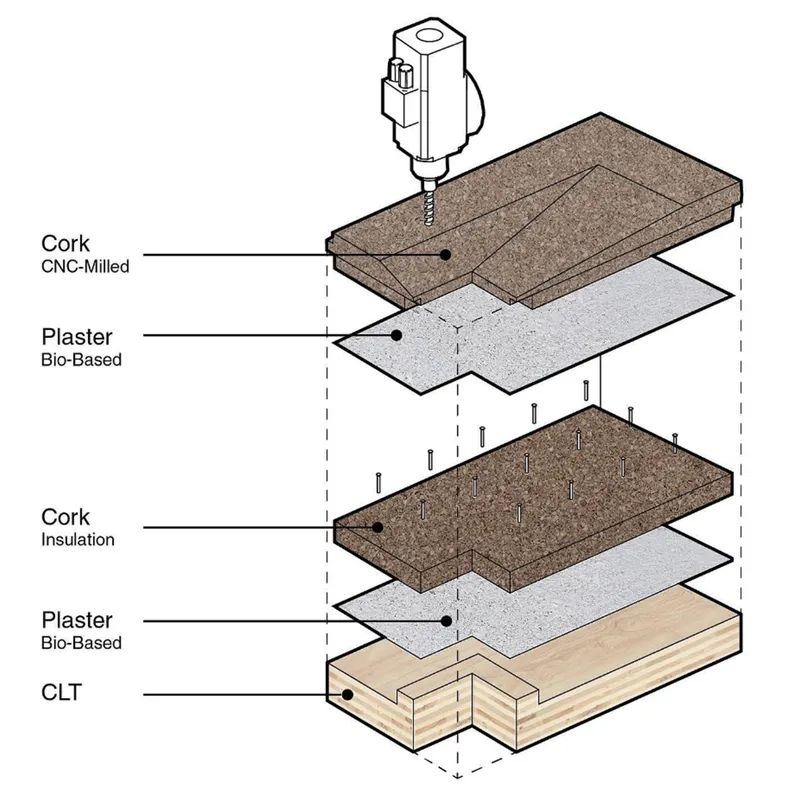
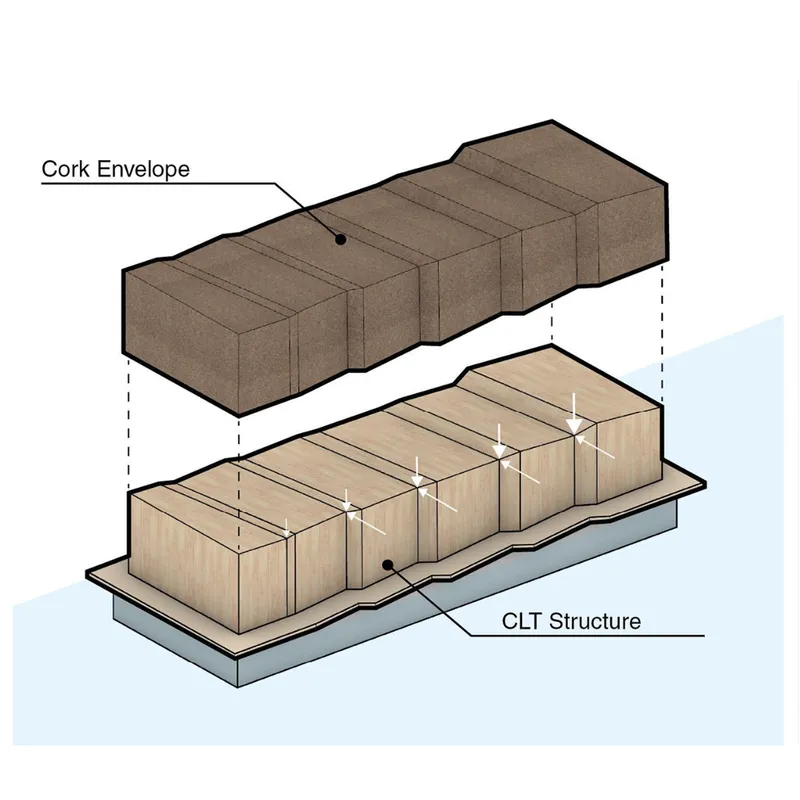
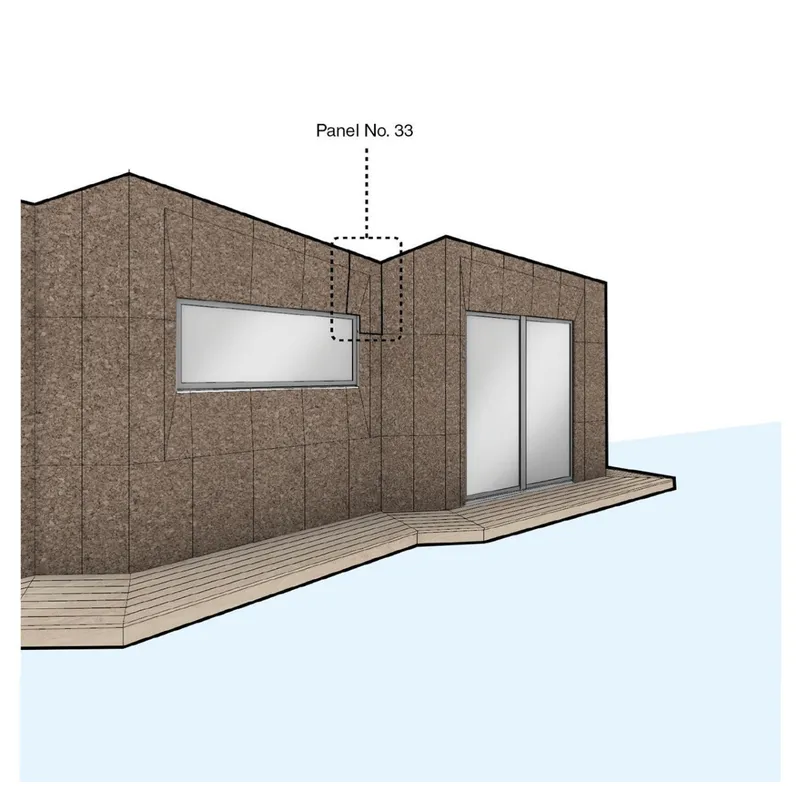
The exploded axonometric drawing reveals the wall assembly in full: CLT structure, bio-based plaster, low-density cork insulation, cork mortar bond, and high-density cork cladding. Each layer is lightweight, renewable, and breathable. The isometric drawing makes the relationship between cork envelope and pontoon base legible at a glance, showing how the folded skin wraps continuously from wall to roof. The elevation drawing, meanwhile, documents the ribbon windows and the cantilevered timber deck that extends the living space over the water.
What the drawings communicate most clearly is the economy of the system. There are very few unique components. The parametric optimization produced a kit of CLT panels and CNC-cut cork modules that could be assembled with minimal waste. The 2,000-kilogram timber saving is not a marginal efficiency gain; it is a structural rethinking enabled by the corrugated geometry.
Why This Project Matters
The Float matters because it treats sustainability and formal invention as the same problem. The origami folds are not applied ornament justified after the fact by a few percentage points of material saving. They are the structural logic, and the material savings are their direct consequence. Studio RAP's fully digital pipeline, parametric design to CNC fabrication to crane-lifted assembly, demonstrates that bio-based construction can be both precise and scalable, even at the small scale of a single houseboat.
It also offers a quiet corrective to the floating-home typology in the Netherlands. Rather than miniaturizing a suburban house and hoping it stays level, Studio RAP started from the specific conditions of water, weight, and canal context and let those constraints generate a form that could not exist on land. The rotation of modules toward the opposite bank, the lightweight cork envelope, the exposed CLT interior: each decision is legible, defensible, and specific to this site. That is what good parametric design looks like when it stops admiring its own algorithms and starts solving a building.
The Float, designed by Studio RAP, Leiden, The Netherlands. 85 m², completed 2021. Structural design by Summum Engineering. CLT by KLH Austria, fabricated by JM Concepten. Cork by Prosuber and Amorim. Photography by Riccardo De Vecchi and Studio RAP.
About the Studio
Share Your Own Work on uni.xyz
If projects like this are the kind of work you want to make, uni.xyz is a place to publish your own, find collaborators, and enter design competitions.


Popular Articles
Popular articles from the community


Opera on the Sea: Driftwood Logic Shapes a Timber Opera House on Estonia's Coast
Trevor Orgill's opera house translates the entangled drift of floating timber into a civic building where wood, water, and music converge.

Extended Shell: Retrofitting Kolkata's Balconies as Living Urban Thresholds
A modular retrofit system recovers the social and environmental intelligence of Kolkata's historic verandas for contemporary Park Street residents.
Tsunami Convergenics: Turning Catastrophic Ocean Forces into Underwater Housing Infrastructure
A speculative underwater settlement off the coast of Onagawa, Japan, treats tsunamis and typhoons as energy sources rather than threats.

Singing Woman: An Opera House That Performs Before the Curtain Rises
Ovidiu Cristian Pavel's conceptual opera house translates Estonia's choral identity into a sculpted waterfront landmark facing the Baltic Sea.

Similar Reads
You might also enjoy these articles

Pixel Gardens: One Repeated Module Stacked Into a Terraced Social Housing Tower for Famagusta
Salem Bader's shortlisted housing tower builds a vertical neighbourhood from one repeated module, offsetting units to carve terraces, light and air.

Bao Huynh Watercolor Atelier: A Serene Art Retreat in Hội An
Bao Huynh Watercolor Atelier in Hội An blends multifunctional art spaces, sustainable design, local materials, and family-friendly living in a serene environment.

Atelier Macri Concept Store Interior Design by CASE-REAL
Atelier Macri store features a "ko" counter, walnut wood details, cork displays, blending retail, gallery, and seamless customer experiences.

Manuel Vargas Izquierdo Stadium and High-Performance Sports Center: Architectural Excellence in Jalpa de Méndez
The Manuel Vargas Izquierdo Stadium blends sustainable design, inclusive sports facilities, and cultural-inspired architecture, revitalizing Jalpa de Méndez’s public spaces.

Explore Floating Competitions
Discover active competitions in this discipline

Challenge to design mud housing for contemporary communities

Challenge to reimagine the Iron Throne

Photograph architecture without architects

Illustrate the lost glory of Angkor Wat - Render Challenge
Comments (0)
Please login or sign up to add comments
No comments yet. Be the first to comment!