

Studio Saransh Stacks a Brick-Clad Jewelry Office atop an Existing Mumbai Building
D10 Corporate House adds two floors of creative workspace to a diamond facility using steel structure, courtyards, and corbelled brickwork.


Vertical expansion is one of the most pragmatic acts in architecture, yet it rarely produces anything worth photographing. Studio Saransh treats the brief differently with D10 Corporate House in Mumbai, adding two new floors to an existing diamond polishing and cutting facility for H. Dipak & Company. The addition houses the jewelry firm's creative design and R&D departments, and rather than defaulting to a generic glass box perched on an older frame, the architects wrap the new volume in richly textured red brick, punctuated by corbelled projections, arched openings, and horizontal banding that give the facade a tectonic depth unusual for a corporate office.
What makes the project genuinely interesting is the decision to use steel and deck slabs for the new floors, keeping the added load on the existing structure to a minimum while opening up plan flexibility. That structural lightness is then counterbalanced visually by the heavy, almost monumental brick skin and a series of courtyards and terraces that pull daylight and ventilation deep into the floor plates. The result is an office building that feels more like a campus fragment than a stack of rentable square meters.
A Brick Facade That Earns Its Complexity


The street-facing elevation layers brick in ways that go well beyond cladding. Corbelled elements project outward to create shadow lines and depth, while recessed niches and punched square openings break the mass into a rhythm that responds to Mumbai's hard afternoon sun. The tapering arched openings on the upper volume recall traditional Indian brickwork without lapsing into pastiche. Horizontal banding ties the composition together and signals the floor levels behind.
Seen from the corner, the building reads as a series of stepped volumes rather than a monolithic block. Rooftop vegetation softens the top edge, and a timber gate at street level sets a domestic scale for the entry. The brick is doing real work here: modulating light, creating ventilation slots, and lending the building an identity that a jewelry R&D facility would not normally possess.
Material Junctions and Tectonic Detail

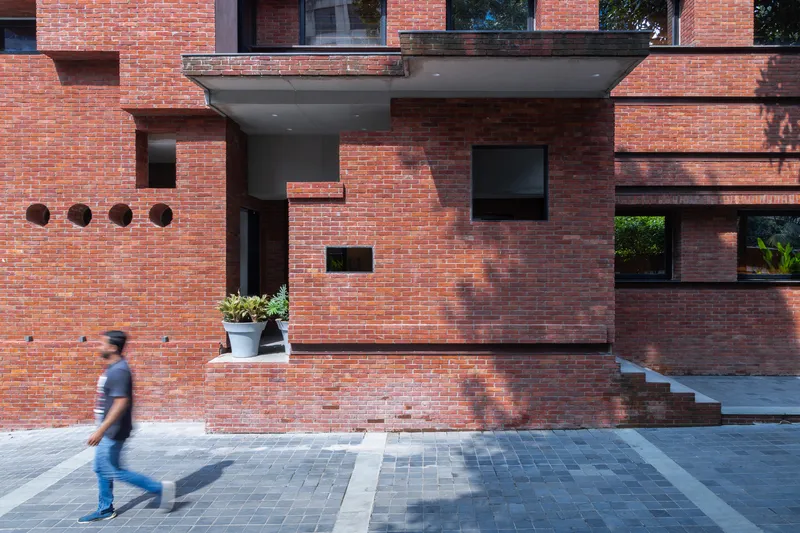

Where smooth concrete panels meet the textured red brick, the architects make the junction legible rather than concealing it. The contrast is deliberate: the concrete reads as structure, the brick as enclosure, and the gap between them becomes a thin shadow line that sharpens the whole composition. It is a small detail, but it communicates an attitude about honesty in assembly that carries through the rest of the building.
At the forecourt level, the brick wall becomes a continuous surface that a passerby can read as almost urban infrastructure: massive, grounded, and unapologetic. Protruding volumes and punched windows give human scale to what could otherwise be an intimidating wall. The paved forecourt keeps things clean and allows the facade to dominate.
Courtyards as Organizing Devices
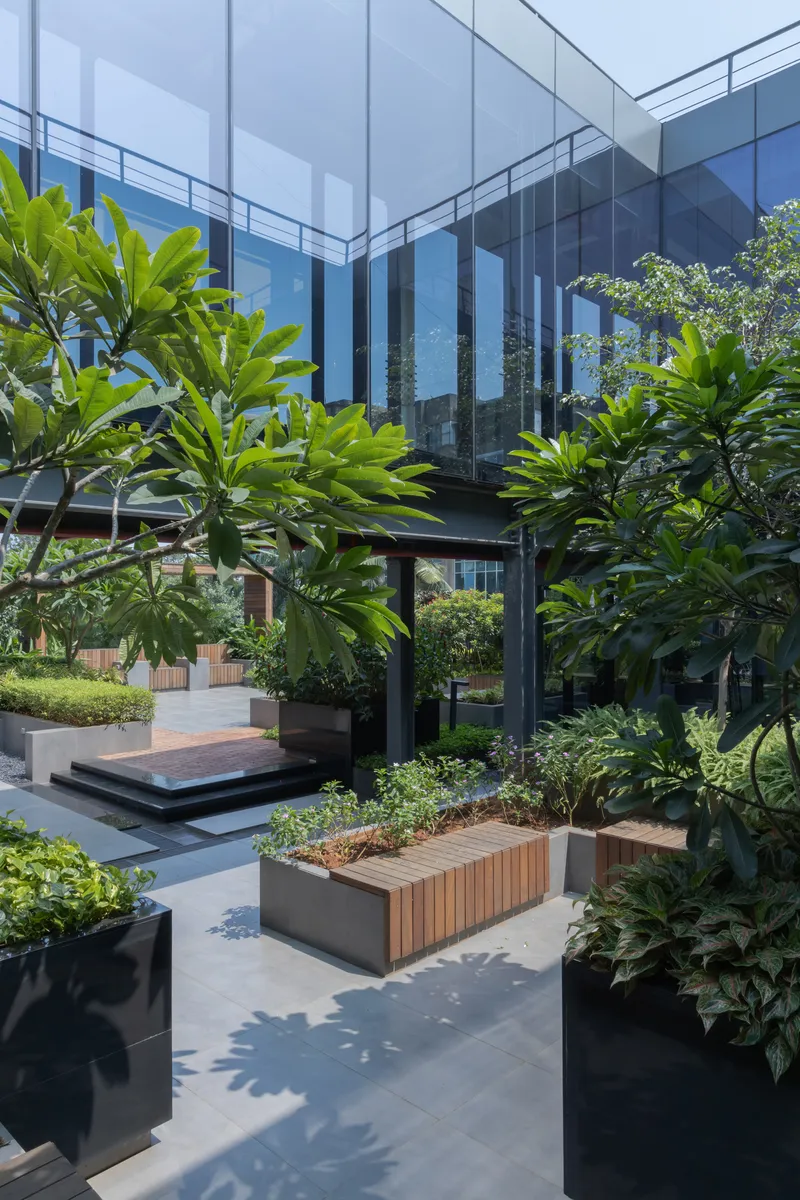
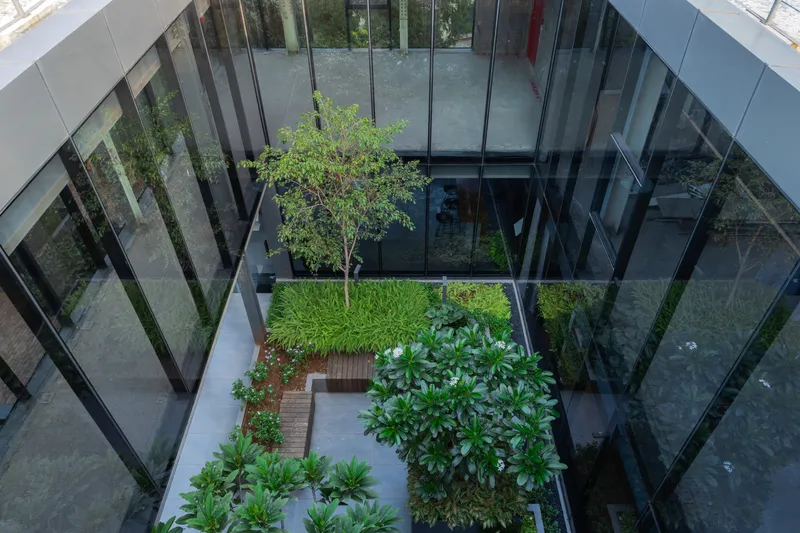
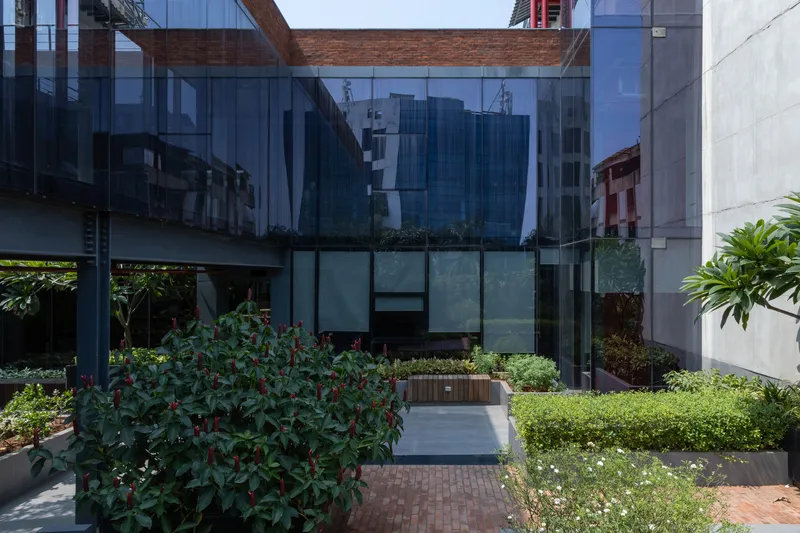
The plan is organized around a series of courtyards that do more than provide visual relief. They function as environmental regulators, pulling natural light and cross-ventilation into the deep floor plates that a jewelry R&D program demands. Planted beds, timber planters, and single specimen trees turn these voids into microclimates within the building footprint, a strategy well suited to Mumbai's hot and humid conditions.
Black steel columns beneath a glass bridge give the primary courtyard a legible structural rhythm, while brick paving extends the facade material into the ground plane. The aerial view reveals how tightly the courtyards are integrated into the plan: they are not leftover gaps but deliberate subtractions that shape every adjacent room.
Interior Courtyards and Communal Spaces

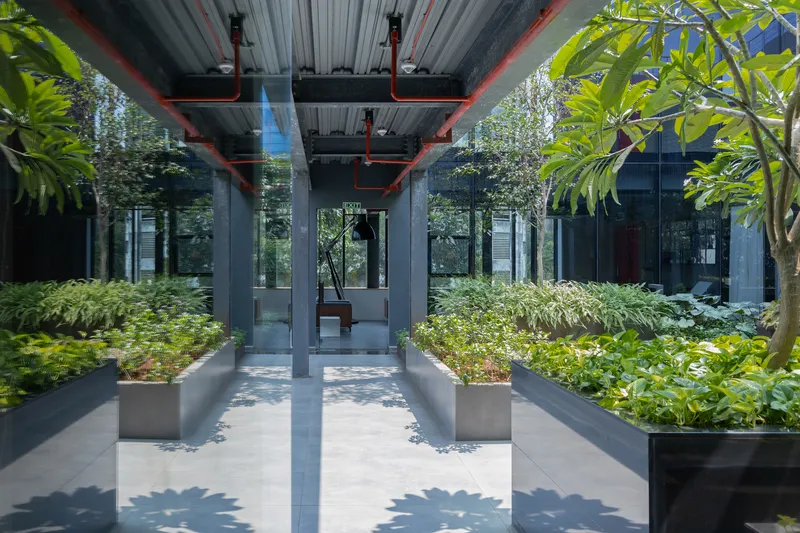

The interior courtyard with its timber terraced seating and dining tables beneath a translucent skylight is the social heart of the building. A single tree anchors the space and gives it a scale that encourages lingering, something creative departments need but corporate architecture seldom provides. The corrugated ceiling of the adjacent covered walkway is left exposed, and red structural supports frame views toward planted beds dappled with sunlight.
These in-between spaces, not quite interior, not quite exterior, are where the building's ambitions come together. They soften the boundary between the conditioned workspace and Mumbai's tropical climate, encouraging employees to move through the building rather than staying fixed at desks.
Open-Plan Workspace and Transparency
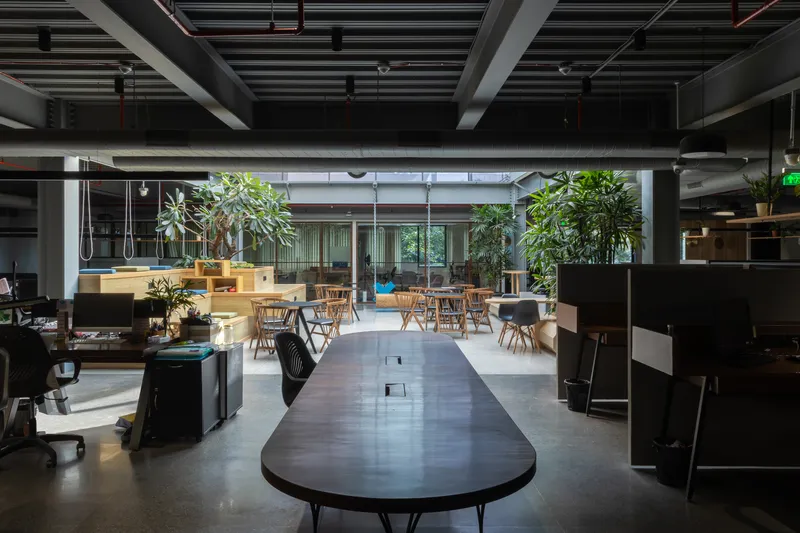


The office floors themselves are straightforwardly open-plan, with exposed ceiling beams, ducts, and mechanical systems left visible overhead. Floor-to-ceiling glazing along the courtyard edges ensures that every workstation benefits from daylight and views of greenery. Timber booth seating along glazed walls offers semi-private zones for focused work or informal meetings without walling anything off.
The exposed infrastructure is not merely an aesthetic choice. By leaving the steel deck slab and services visible, the architects communicate the structural logic of the vertical expansion. You can read the building's history in its ceiling: the lightweight steel frame that made the addition possible is never hidden.
Glazed Corridors and Planted Edges


Corridors lined with floor-to-ceiling glass walls double as viewing galleries overlooking the planted courtyards. Potted plants along the passages blur the threshold between circulation and garden. Blurred figures in motion through the workspaces suggest a building that is used actively, not just occupied.
Rooftop Terraces and Upper Landscape
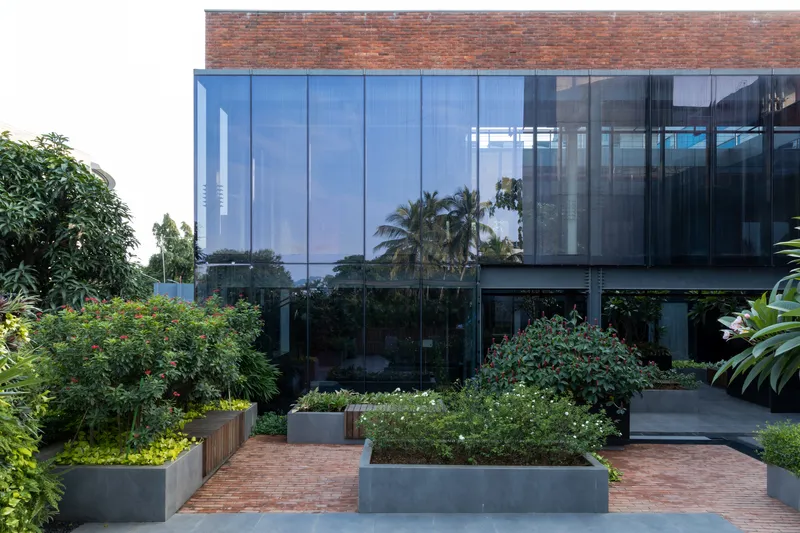

At the roof level, raised metal planters and young trees create an elevated landscape that extends the courtyard strategy upward. Glass-enclosed volumes reflect surrounding palms, and the terrace becomes a usable outdoor space rather than dead mechanical territory. The planting strategy is modest but legible: black planting boxes in a grid, species that will tolerate rooftop exposure, and enough open area for gathering.
Given that the new floors sit on a steel frame designed to minimize load, every kilogram of soil and water on this roof was a conscious decision. The fact that Studio Saransh committed to rooftop planting anyway speaks to how seriously the project takes its environmental and experiential ambitions.
Plans and Drawings
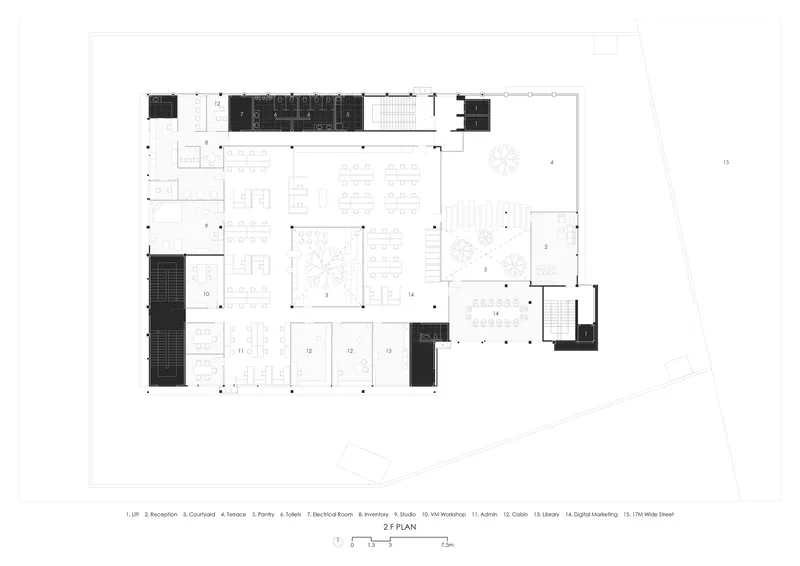


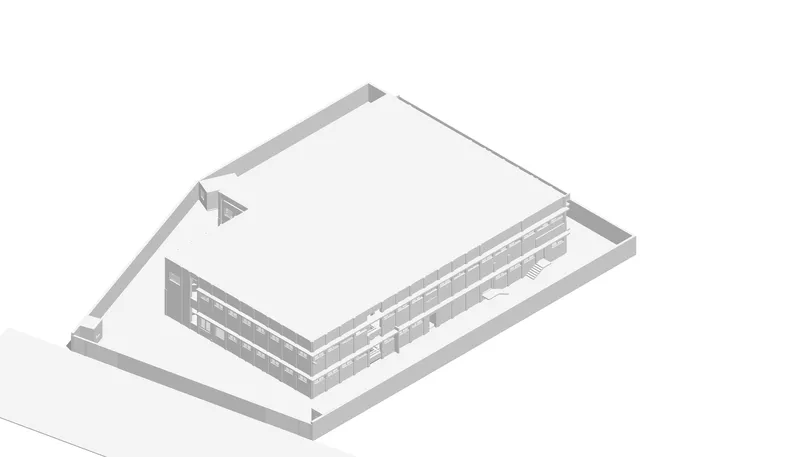
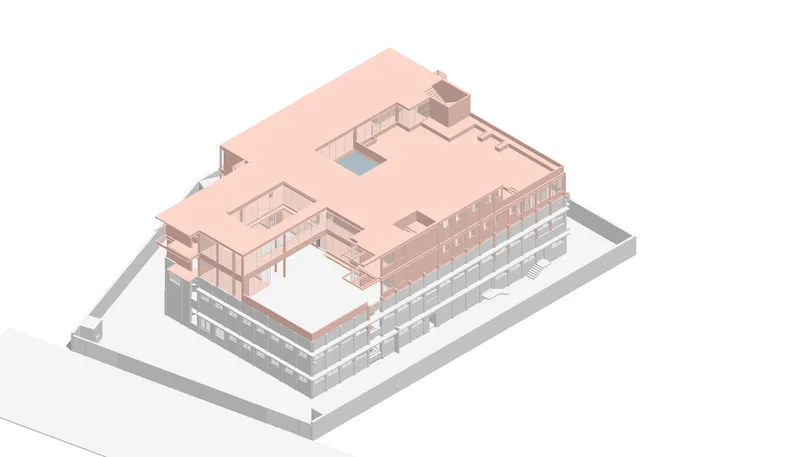
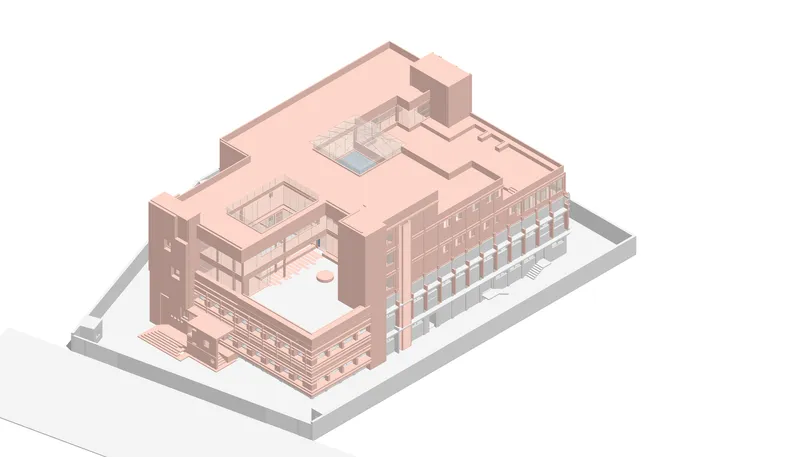
The floor plans confirm what the photographs imply: the courtyards are not decorative insertions but structural voids that organize every floor. The second floor plan shows workstations arrayed around a central courtyard, while the third floor shifts to conference rooms and flexible workspace. The longitudinal section reveals the multi-story volume and the horizontal floor plates that the steel structure supports. Three axonometric drawings progressively peel back the building's layers, exposing interior courtyards and even a rooftop pool within the mass.
Why This Project Matters
Vertical expansions are typically exercises in expediency: add floors, maximize rentable area, move on. D10 Corporate House refuses that script. By wrapping the addition in a richly articulated brick skin, organizing the plan around courtyards, and leaving the steel structure honestly expressed inside, Studio Saransh gives a utilitarian brief an architectural argument. The building demonstrates that adding to an existing structure does not have to mean diminishing it.
For Mumbai, a city where land pressure pushes most expansions toward pure pragmatism, this project offers a credible alternative. It proves that passive strategies like courtyard ventilation and daylight penetration can coexist with the open-plan layouts that corporate clients demand. And it proves that brick, one of the oldest materials available, still has things to say when an architect is willing to let it speak.
D10 Corporate House by Studio Saransh (lead architect: Manish Doshi Structural). Mumbai, India. 2,500 m². Completed 2022. Photography by The Space Tracing Company.
About the Studio
Share Your Own Work on uni.xyz
If projects like this are the kind of work you want to make, uni.xyz is a place to publish your own, find collaborators, and enter design competitions.


Popular Articles
Popular articles from the community


David Macias Steps a Doorless Stone and Plaster House Down a Tropical Colombian Hillside
In the humid hills of Colombia, Threshold House replaces the front door with an open void and terraces its 850 m² down the slope instead of fighting it.

Juan García Correa, John González and Claudia Rueda Sink a Circular Amphitheater into a Manizales Engineering Building
On the La Nubia campus in Manizales, Colombia, the S1 Building folds labs and offices into a hillside of ramped lawns that double as a campus route.

Cube Design Draws an Ecological Corridor Between Two Shenzhen Hills with the Nankai Building
Beside Shenzhen's container docks, the Nankai Building pairs stacked balconies with a climbing green screen to connect two hillsides across its height.

GROUP A Strips a 1969 Rotterdam Harbor Headquarters to Its Frame and Wraps It in Timber Louvers
In Rotterdam's M4H harbor district, Ferro Offices reuses a 1969 frame, adds one timber storey and reaches BREEAM-NL Outstanding.

Similar Reads
You might also enjoy these articles


LAVA Architecten Gives Vocational Education a Sawtooth-Roofed Face on a Mechelen School Campus
In Mechelen, Belgium, a 2,053 m² STEM school on a 6×6 m grid turns workshops and classrooms into rooms that can be rearranged as teaching changes.

KEMA Studio Turns a Derelict Marvila Attic into a 60 m² Lighthouse Apartment Above Lisbon
In Lisbon's Marvila district, a rebuilt roof, four skylights and two plywood volumes turn an unlivable attic into a bright home facing the Tagus.

Pixel Gardens: One Repeated Module Stacked Into a Terraced Social Housing Tower for Famagusta
Salem Bader's shortlisted housing tower builds a vertical neighbourhood from one repeated module, offsetting units to carve terraces, light and air.

Bao Huynh Watercolor Atelier: A Serene Art Retreat in Hội An
Bao Huynh Watercolor Atelier in Hội An blends multifunctional art spaces, sustainable design, local materials, and family-friendly living in a serene environment.

Explore Office Building Competitions
Discover active competitions in this discipline

Challenge to design mud housing for contemporary communities

Competition to design a workstation for architects
Comments (0)
Please login or sign up to add comments
No comments yet. Be the first to comment!