![studio] [Space Builds a Black Barn Office That Disappears Behind the Dutch Landscape](https://img.uni.xyz/eyJidWNrZXQiOiJ1bmktYmxvZyIsImtleSI6IjQ2L2FkNGE2MDM1LTIwMDAtNDMyNS1hMGMxLTYyNDg1MWRjMDE2Mi91bmllZGl0b3JpYWwyMjAyNi0wNS0xNVQwOS01NC0yNi02MTA0MDMuanBnIiwiZWRpdHMiOnsicmVzaXplIjp7IndpZHRoIjo2NH0sImpwZWciOnsicXVhbGl0eSI6MTB9LCJ3ZWJwIjp7InF1YWxpdHkiOjEwfSwiZmxhdHRlbiI6ZmFsc2UsIm5vcm1hbGlzZSI6ZmFsc2V9fQ==)
![studio] [Space Builds a Black Barn Office That Disappears Behind the Dutch Landscape](https://img.uni.xyz/eyJidWNrZXQiOiJ1bmktYmxvZyIsImtleSI6IjQ2L2FkNGE2MDM1LTIwMDAtNDMyNS1hMGMxLTYyNDg1MWRjMDE2Mi91bmllZGl0b3JpYWwyMjAyNi0wNS0xNVQwOS01NC0yNi02MTA0MDMuanBnIiwiZWRpdHMiOnsicmVzaXplIjp7IndpZHRoIjoxMjAwLCJmaXQiOiJpbnNpZGUifSwianBlZyI6eyJxdWFsaXR5Ijo3Mn0sIndlYnAiOnsicXVhbGl0eSI6NzJ9LCJmbGF0dGVuIjpmYWxzZSwibm9ybWFsaXNlIjpmYWxzZX19)
studio] [Space Builds a Black Barn Office That Disappears Behind the Dutch Landscape
A charred timber studio for two architecture practices in Goirle completes a historic farmstead ensemble along a ribbon road.


An office for architects that deliberately refuses to compete with its surroundings is a rare thing. The Black Barn in Goirle, designed by studio] [Space architecten, does exactly that: a 400 square meter shared workspace for the practice itself and landscape architects Studio REDD, conceived as a quiet, dark volume that channels attention toward the adjacent river and the greenery beyond it. The building sits on a historic ribbon development, completing an ensemble of stable, farmhouse, and barn that once characterized this stretch of road.
What makes the project compelling is its precise calibration of opacity and transparency. The street facade is nearly blind, clad floor to ridge in black-stained vertical timber boards. Walk around to the garden side and the building opens completely, with floor-to-ceiling glazing that dissolves the boundary between workspace and landscape. That duality, closed and protective on one face, generous and porous on the other, gives the barn its character without resorting to spectacle.
A Dark Shell on a Historic Road
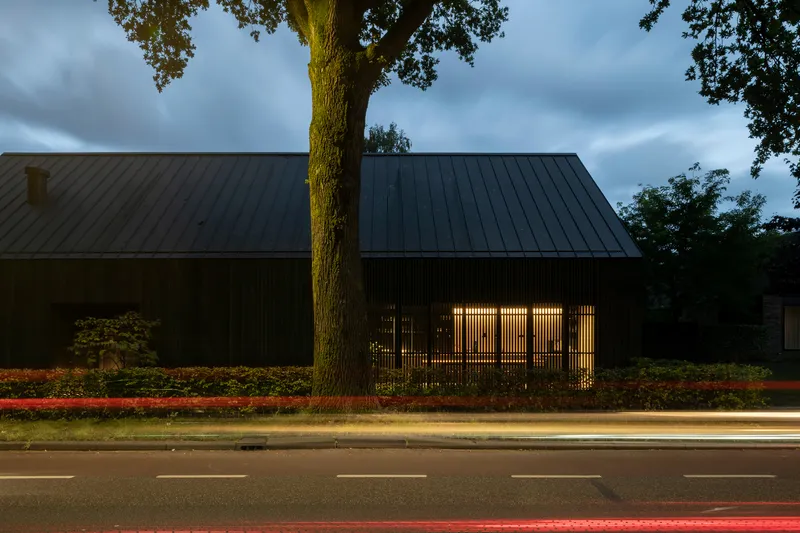
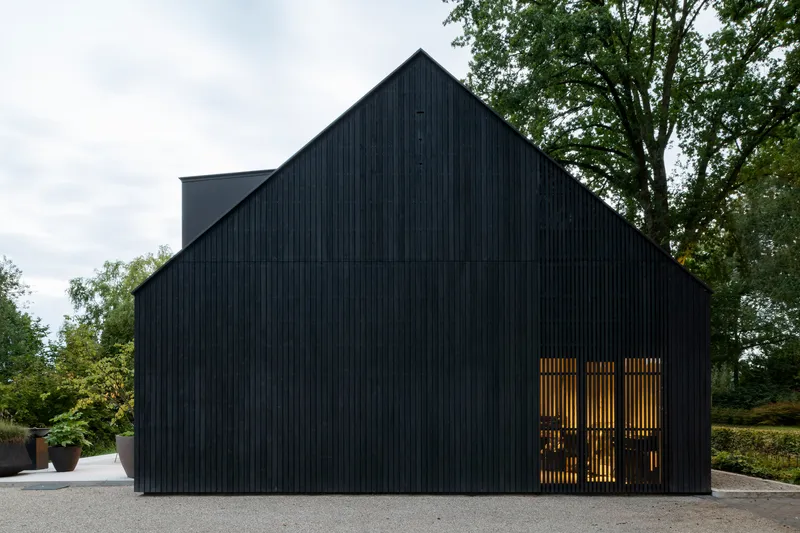
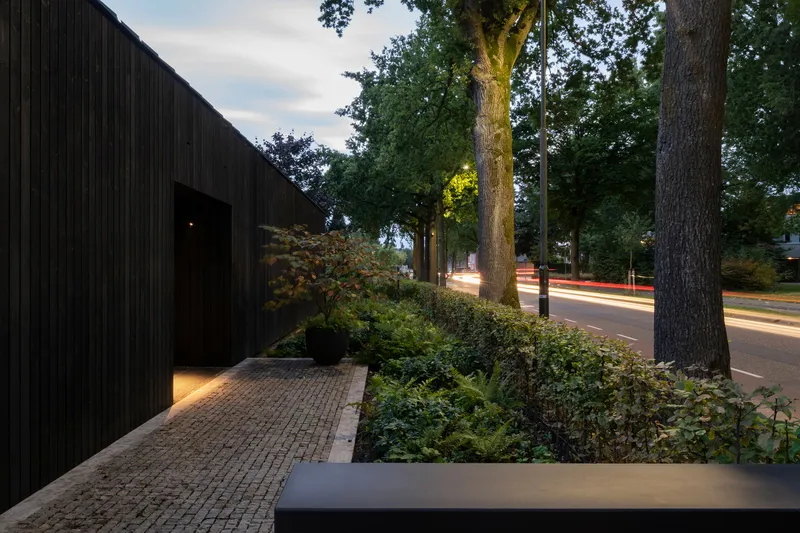
From the street, the Black Barn reads as a simple pitched volume, its silhouette familiar enough to sit comfortably among the older agricultural buildings nearby. The charred timber cladding and zinc roof are deliberately understated, borrowing the vernacular form of a barn while stripping it of ornamental detail. At dusk, a backlit timber screen at the entrance glows softly, the slatted structure creating a translucent lantern effect that signals the building's presence without overpowering it.
Vehicle light trails in the twilight images underscore how the building relates to the road: set back slightly behind a recessed building line, it doesn't crowd the street edge but instead defers to the rhythm of the existing ensemble. That restraint is the project's defining gesture on its public face.
Timber Cladding as Surface and Habitat
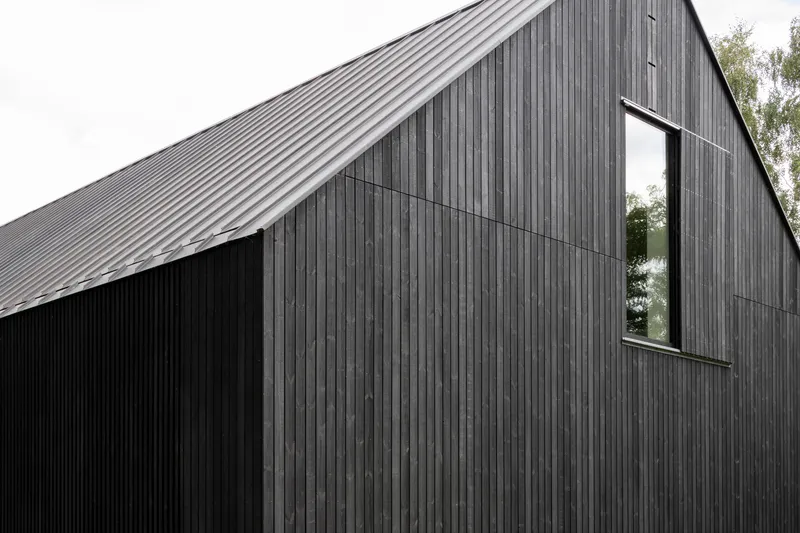
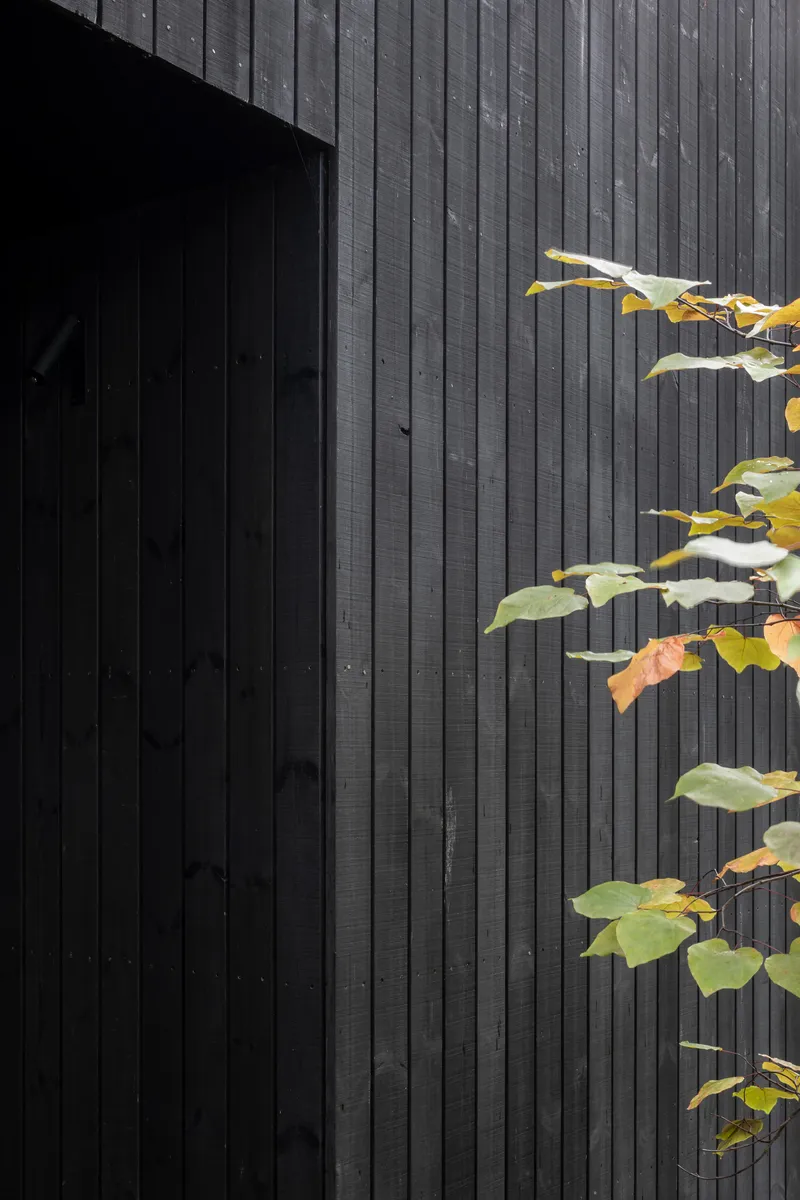
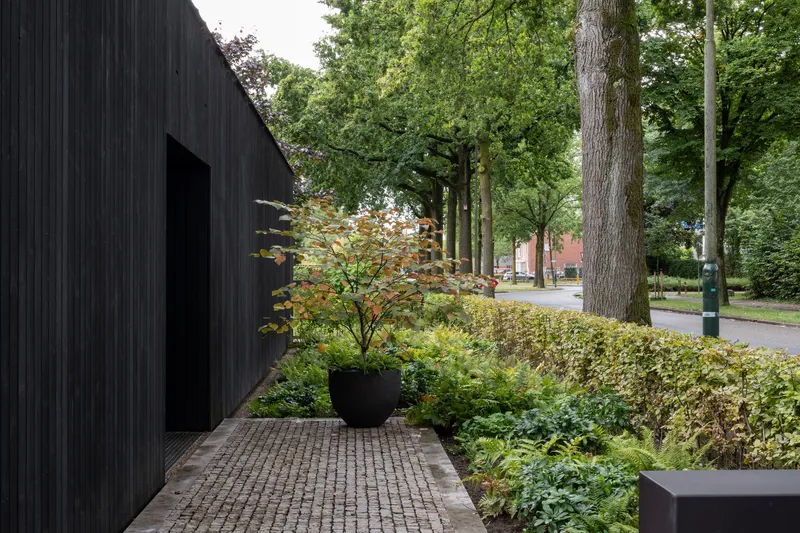
The vertical timber boards are more than a cladding system. Nest boxes for birds and bats are integrated directly into the facade, turning the building's skin into a functional habitat. It is a modest ecological move, but it reflects the practice's partnership with landscape architects and a broader sensibility about buildings as participants in their environment rather than sealed objects dropped onto a site.
Close up, the material reveals its texture: the charred finish deepens the grain, and seasonal changes are already visible as vine leaves colonize corners. The building is designed to age, not to stay pristine, and the dark palette ensures that the patina reads as intention rather than neglect.
Opening Toward the River
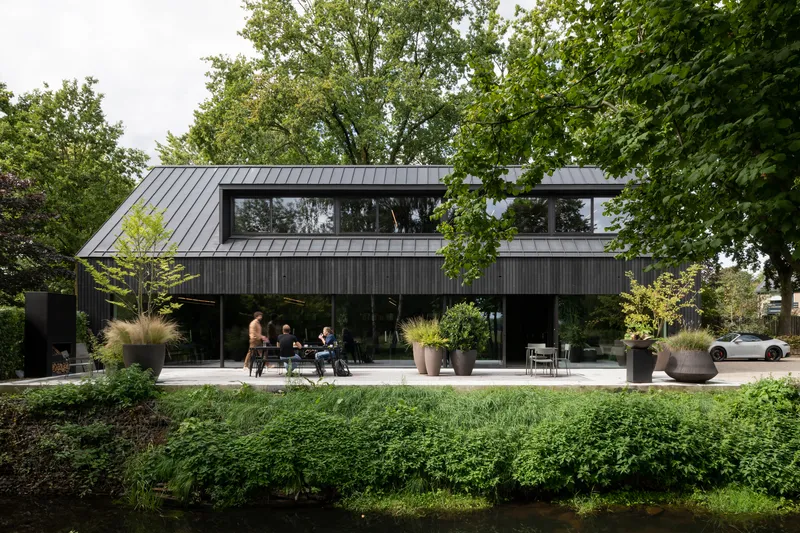
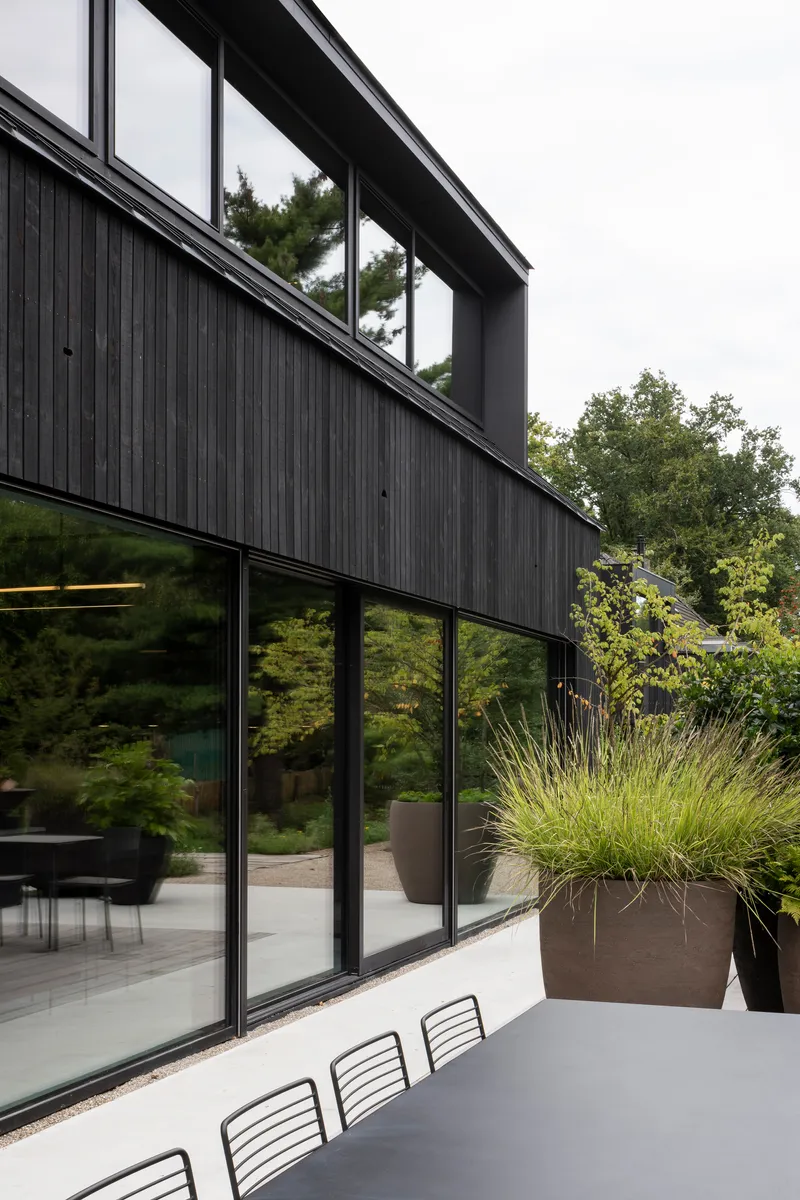
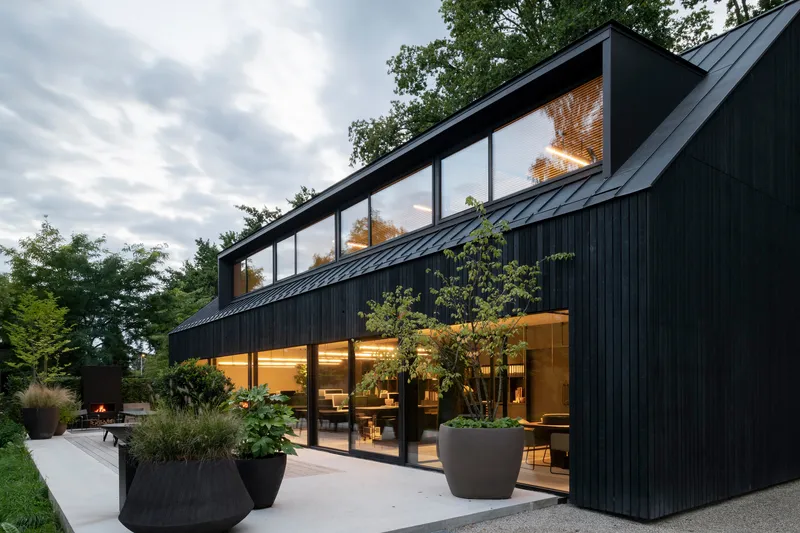
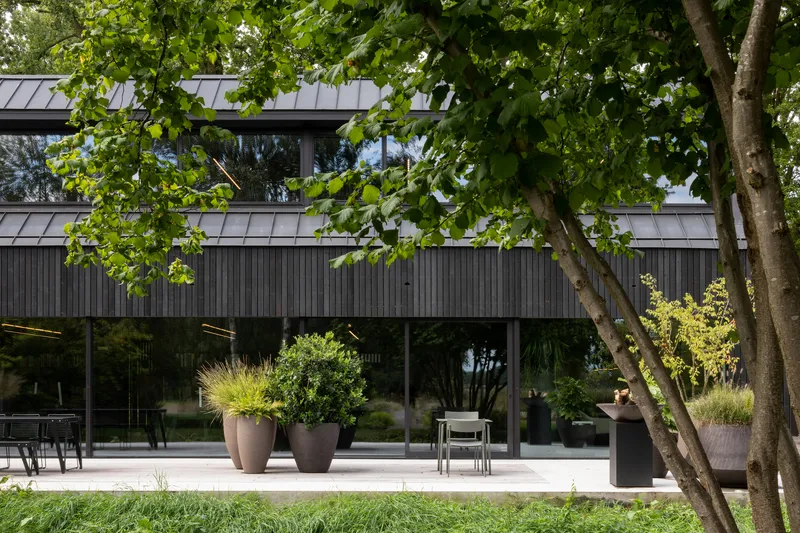
The garden elevation inverts everything the street facade promises. Continuous ground floor glazing runs beneath a clerestory band, and the terrace extends the workspace outdoors with large planters filled with grasses. The effect is closer to a pavilion than a barn: the black timber volume hovers above a transparent base, framing views of the river landscape on the far side.
Sliding glass doors allow the meeting room and main workspace to spill directly onto the paved terrace, collapsing the distinction between inside and outside during warmer months. For a firm of landscape architects, that relationship is not merely aesthetic. It is how they test their own medium against the buildings they occupy.
The Cabinet That Organizes Everything
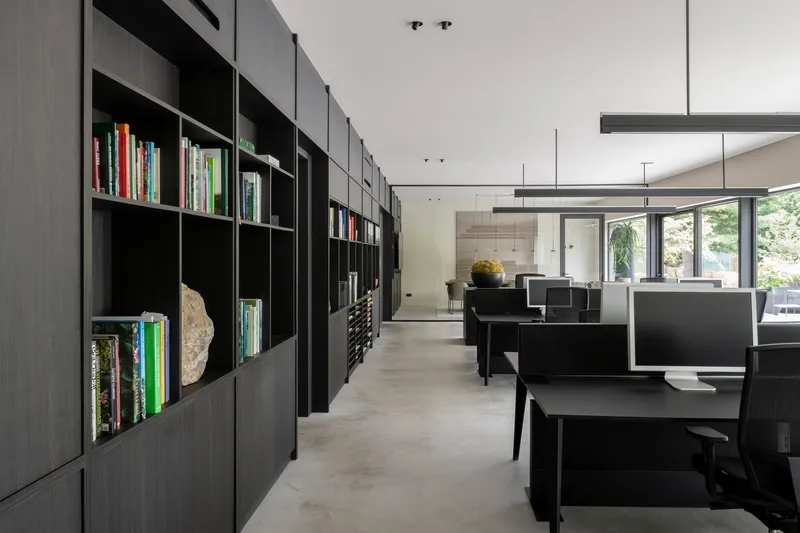
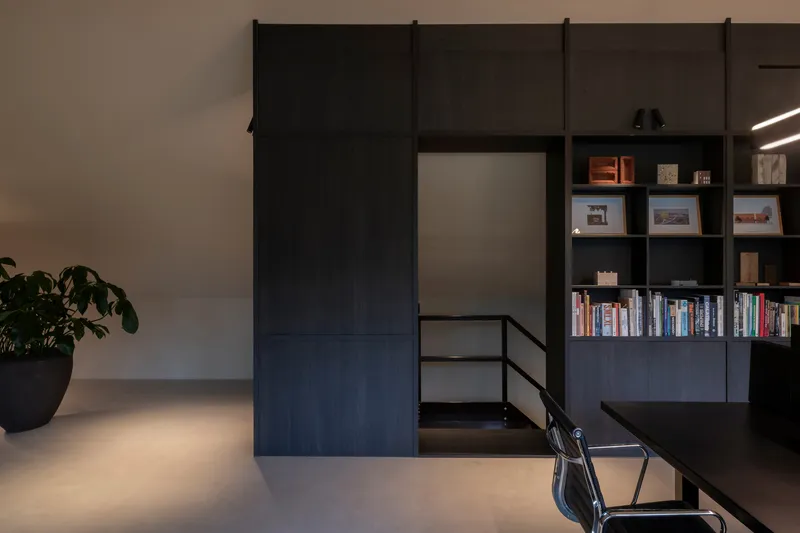
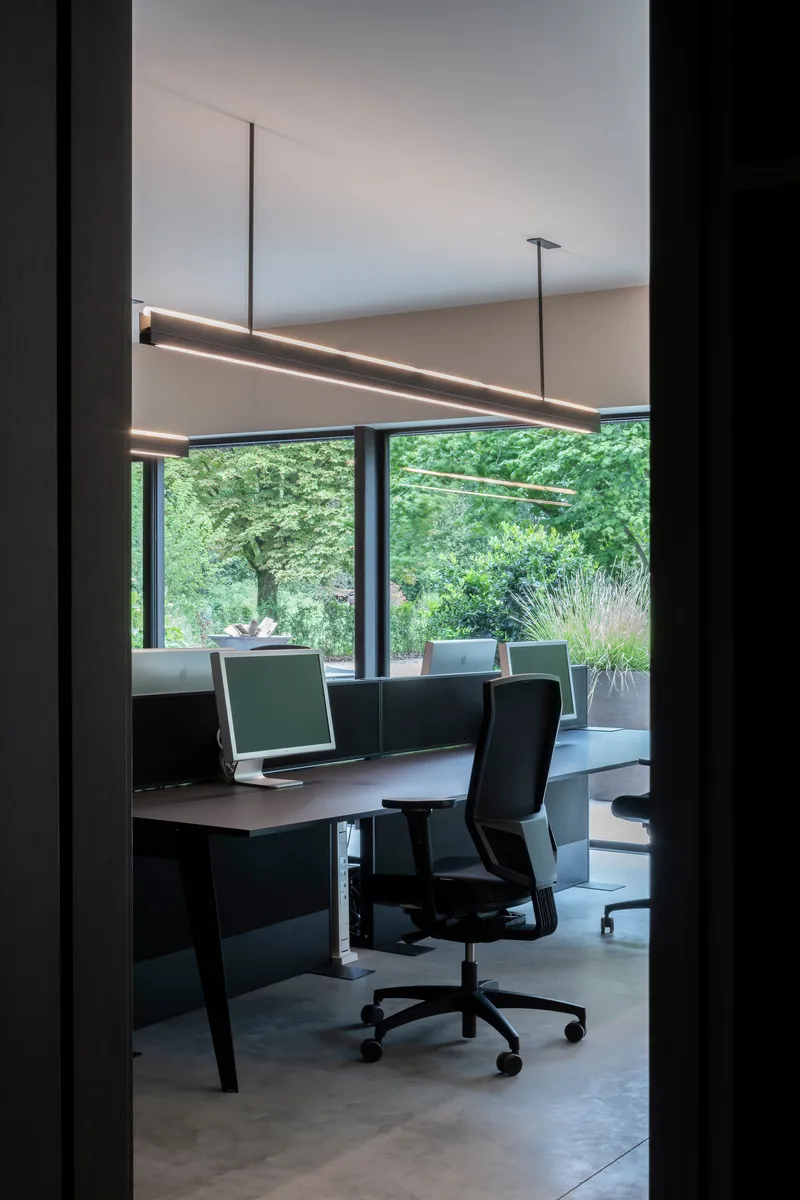
Internally, the plan is organized around a single, bold device: a full-height cabinet that cuts through the building from ground floor to first floor. It is not just a piece of furniture. It separates the open workspace from the staircase and service areas, houses mechanical installations, provides bookshelves and storage, and gives structure to what would otherwise be a loft-like volume. The polished concrete floor and black modular shelving reinforce a monochrome palette that keeps the interior calm.
A sliding barn door on a steel track nods to the agricultural typology without being literal about it. These details, the exposed track, the built-in shelving, the continuous pendant lights over the workstations, suggest a fit-out guided by economy and directness rather than decoration.
Light, Louvers, and the Upper Level
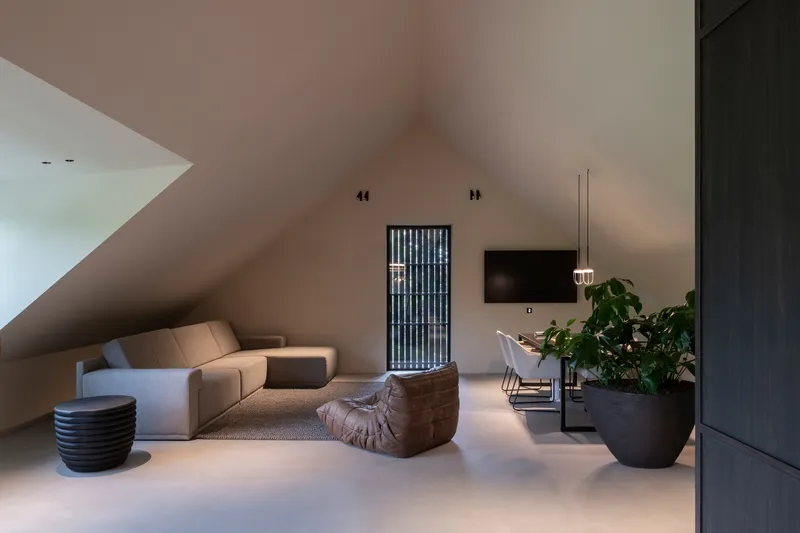
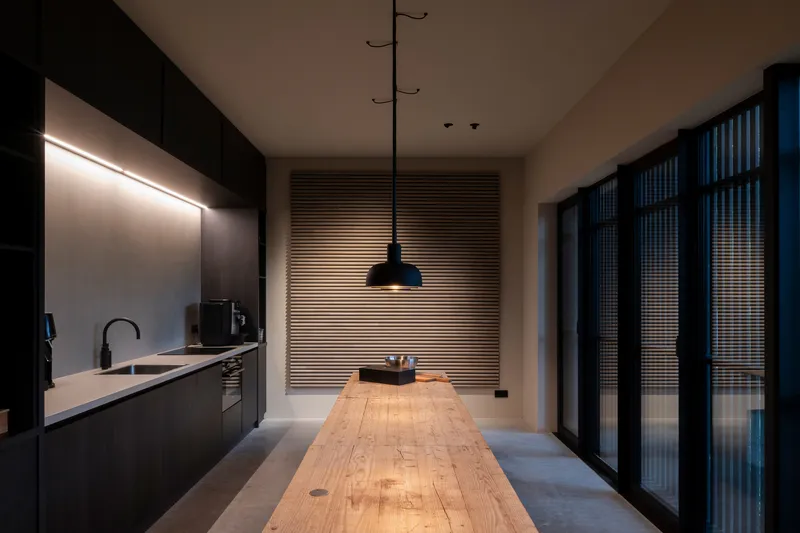
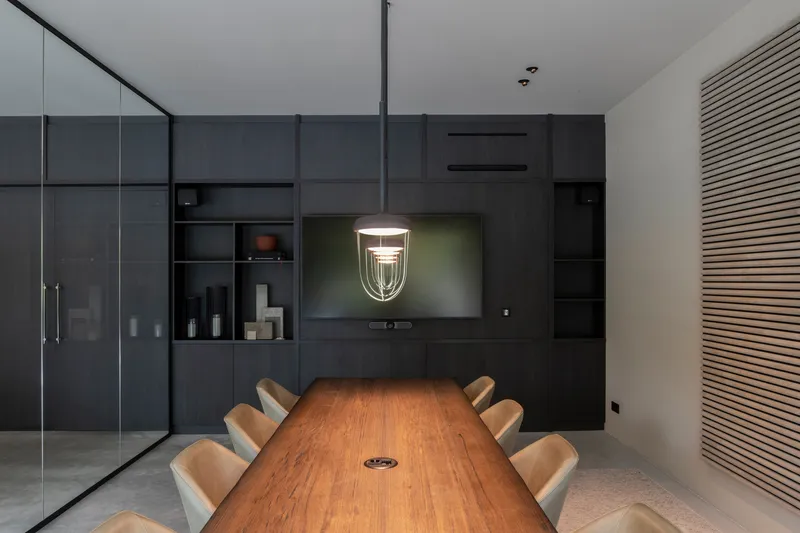
The first floor occupies the pitched roof volume, with the sloped plaster ceiling compressing the space into something more intimate. A long dormer window projects from the roofline, pulling daylight deep into the upper workspace. The lounge area beneath the ridge, with its potted greenery and fluted glass door, feels less like an office and more like a reading room tucked into a rural attic.
Horizontal louvered screens filter light into the kitchen and dining areas on both levels, creating a warm counterpoint to the dark cabinetry and timber table. PSLab handled the lighting design, and the pendant fixtures over the dining table are placed with enough care that the rooms read as composed rather than simply illuminated.
Framing the Landscape from Within
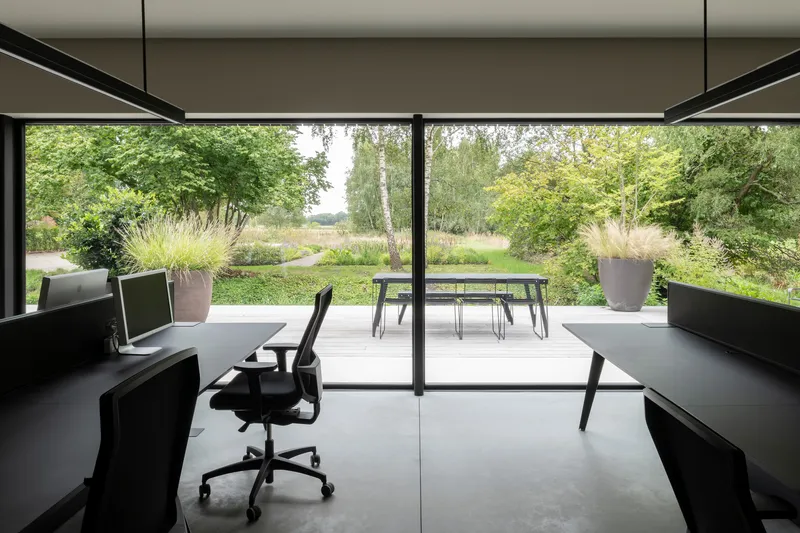
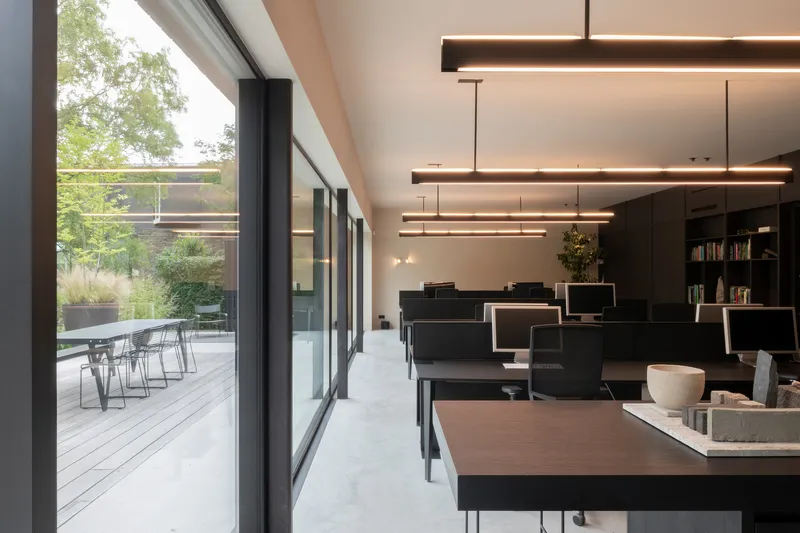
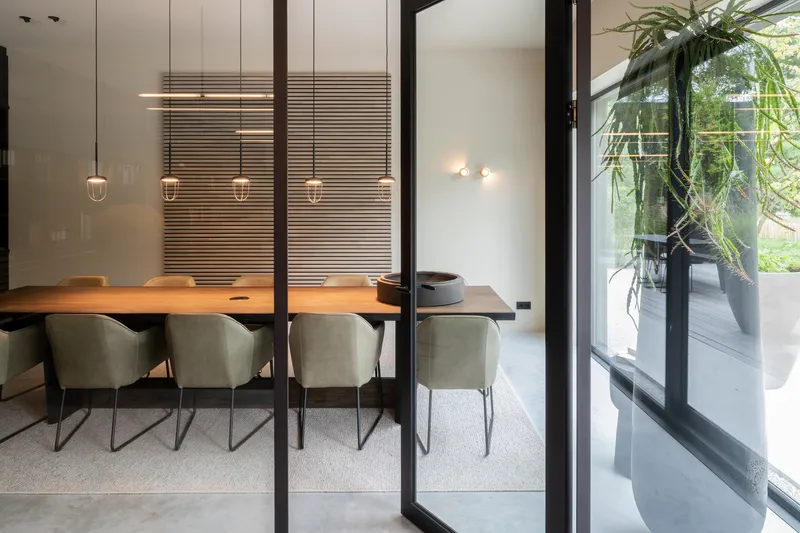
The strongest interior moments happen where the glazing meets the garden. Floor-to-ceiling windows frame the grassy landscape like a slow-moving screen, with the outdoor dining terrace and timber deck acting as intermediate zones between the conditioned interior and the open ground. The deliberate alignment of workstations toward these views is not accidental; it gives the everyday act of sitting at a desk an unusually generous spatial quality.
For a shared office housing both an architecture and a landscape practice, the constant visual access to planting, weather, and seasonal change is more than a perk. It is a working condition that keeps the designers tethered to the material they shape.
Plans and Drawings
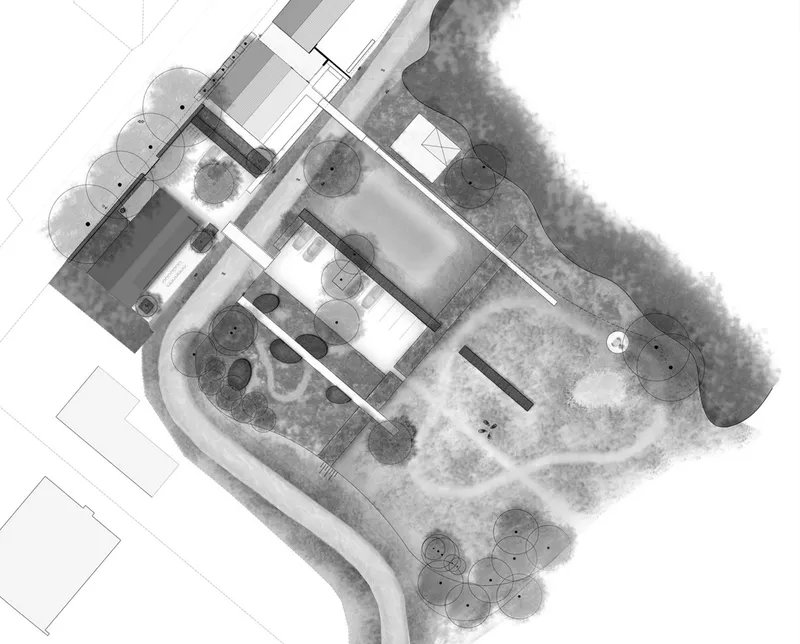
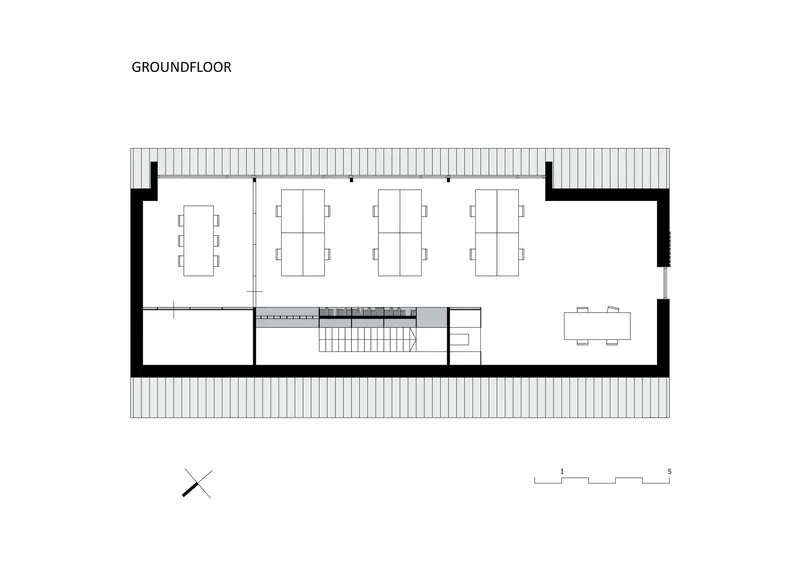
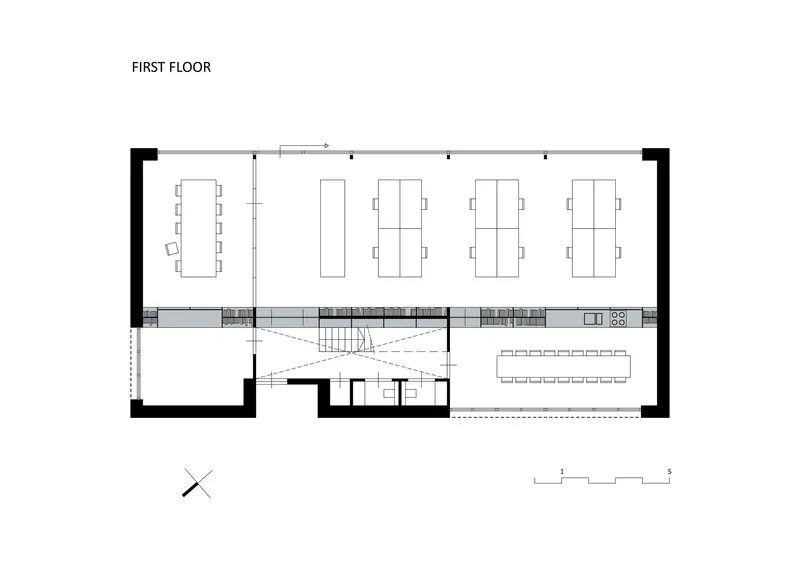
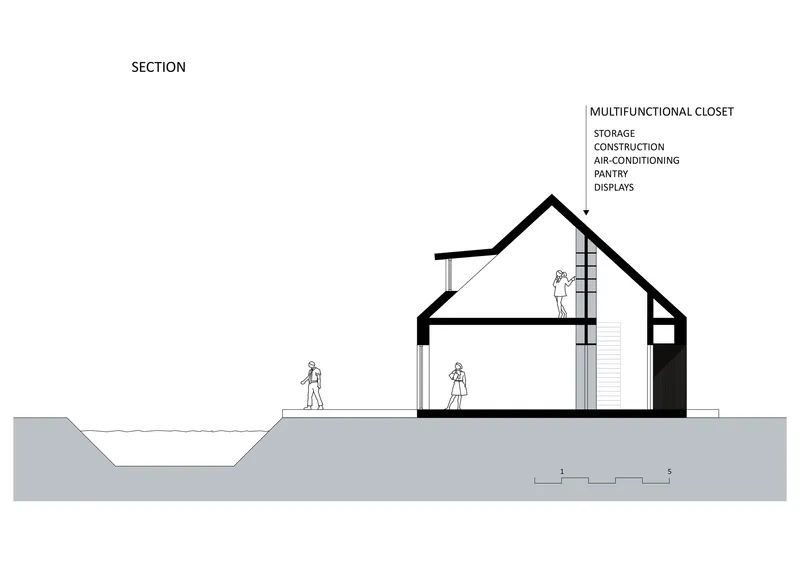
The site plan reveals how the building slots into the existing tree canopy and landscape, recessed from the road and oriented toward the river. The ground floor plan shows a simple arrangement: four meeting rooms, a central stair, and a covered terrace that mediates between interior and garden. Upstairs, workspace areas flank the stair void, with a terrace extension that echoes the outdoor spaces below. The section drawing is perhaps the most instructive, illustrating how the full-height cabinet anchors both levels and how the pitched roof creates distinct spatial characters on each floor.
Why This Project Matters
The Black Barn succeeds because it understands what it is for. It is not a manifesto building or a brand exercise. It is a workspace for people who spend their careers thinking about how buildings meet the ground, and it reflects that preoccupation in every decision, from the nest boxes in the facade to the sliding doors that erase the threshold to the terrace. The choice to use a familiar typology, the pitched barn, and to execute it with discipline rather than novelty is itself a statement about aesthetic durability.
In a period when office design tends toward either corporate blandness or performative eccentricity, studio] [Space architecten offers a third option: a building that is specific to its site, honest about its materials, and generous to the landscape it inhabits. The Black Barn does not demand your attention. It earns it slowly, which is exactly the kind of architecture that lasts.
Black Barn, designed by studio] [Space architecten, Goirle, The Netherlands. 400 m². Completed 2021. Landscape Architect: Studio REDD. Lighting Design: PSLab. Lead Architect: Vincent van Heesch. Photography by Koen van Damme.
About the Studio
Share Your Own Work on uni.xyz
If projects like this are the kind of work you want to make, uni.xyz is a place to publish your own, find collaborators, and enter design competitions.


Popular Articles
Popular articles from the community

Opera by the Sea Estonia: Three Shells Dissolving Architecture into Tallinn's Coastline
A winning opera house proposal replaces monumental form with interconnected shells that blur the boundary between building, park and Baltic Sea.

Singing Woman: An Opera House That Performs Before the Curtain Rises
Ovidiu Cristian Pavel's conceptual opera house translates Estonia's choral identity into a sculpted waterfront landmark facing the Baltic Sea.

Faces of the Soviet Avant-Garde: Turning Moscow's Street Names into an Open-Air Museum
A network of sculptural installations across a Moscow residential district transforms forgotten architect names into spatial encounters with cultural memor
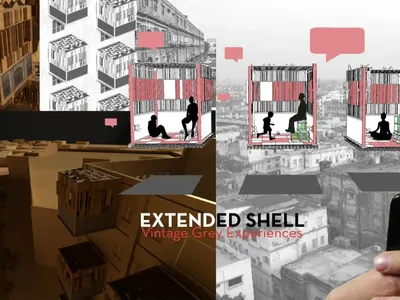
Extended Shell: Retrofitting Kolkata's Balconies as Living Urban Thresholds
A modular retrofit system recovers the social and environmental intelligence of Kolkata's historic verandas for contemporary Park Street residents.

Similar Reads
You might also enjoy these articles

Pixel Gardens: One Repeated Module Stacked Into a Terraced Social Housing Tower for Famagusta
Salem Bader's shortlisted housing tower builds a vertical neighbourhood from one repeated module, offsetting units to carve terraces, light and air.

Bao Huynh Watercolor Atelier: A Serene Art Retreat in Hội An
Bao Huynh Watercolor Atelier in Hội An blends multifunctional art spaces, sustainable design, local materials, and family-friendly living in a serene environment.

Atelier Macri Concept Store Interior Design by CASE-REAL
Atelier Macri store features a "ko" counter, walnut wood details, cork displays, blending retail, gallery, and seamless customer experiences.

Manuel Vargas Izquierdo Stadium and High-Performance Sports Center: Architectural Excellence in Jalpa de Méndez
The Manuel Vargas Izquierdo Stadium blends sustainable design, inclusive sports facilities, and cultural-inspired architecture, revitalizing Jalpa de Méndez’s public spaces.

Explore Barn Conversion Competitions
Discover active competitions in this discipline

Challenge to reimagine the Iron Throne

Photograph architecture without architects

Illustrate the lost glory of Angkor Wat - Render Challenge

Design challenge to reuse E-waste
Comments (0)
Please login or sign up to add comments
No comments yet. Be the first to comment!