

Studio Zhu-Pei Drapes Concrete Tent Roofs Over a Stone Courtyard Art Center in Zibo
Five hyperboloid concrete canopies and rough fieldstone walls form a porous gallery complex on the outskirts of Zibo, Shandong Province.


There is a particular category of building that earns its credibility not through program complexity or metropolitan prominence but through the intensity of a single structural idea pursued to its logical end. The Zibo OCT Art Center by Studio Zhu-Pei belongs squarely in that category. Sited on former wilderness land adjacent to Fenghuangshan, a relic of the Shang and Zhou dynasties, the 2,471 square meter gallery sits far from the urban core of Zibo in Shandong Province. What could have been a generic white-box gallery dropped onto a suburban lot is instead a taut experiment in how structure, material, and courtyard typology can merge into a single, coherent gesture.
The defining move is the roof: five hyperboloid concrete canopies, poured on site, that sag between rough fieldstone walls like fabric stretched between tent poles. The analogy is intentional. Zhu Pei has described the form as derived from the saggy tent structure, a surface simultaneously compressed and strained. Below these drooping planes, three stone volumes enclose a central void, reinterpreting the traditional Chinese courtyard house, or siheyuan, as well as the heyuan academy typology. The result is a building that feels porous, almost geological, as if the landscape had been folded up and a few rooms discovered underneath.
A Roof That Behaves Like Fabric
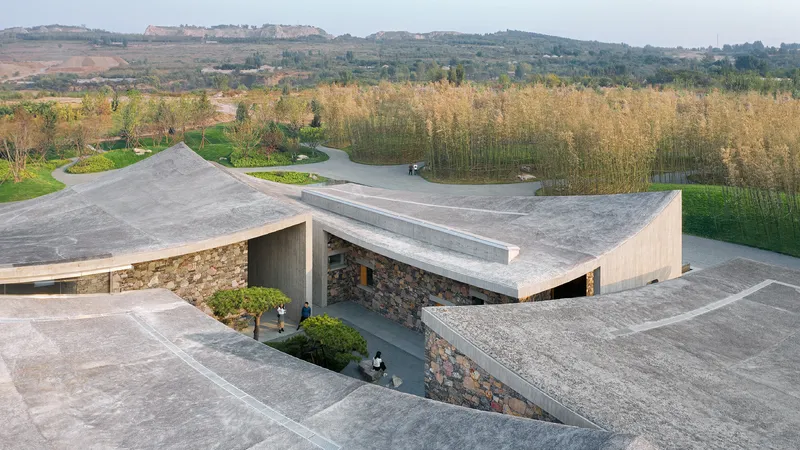
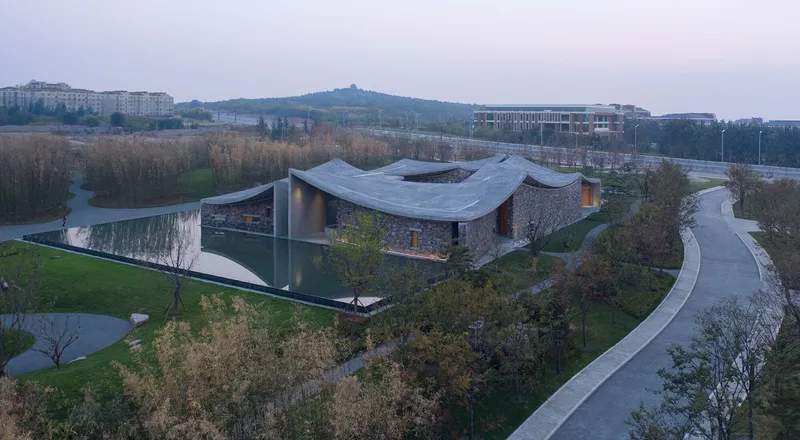
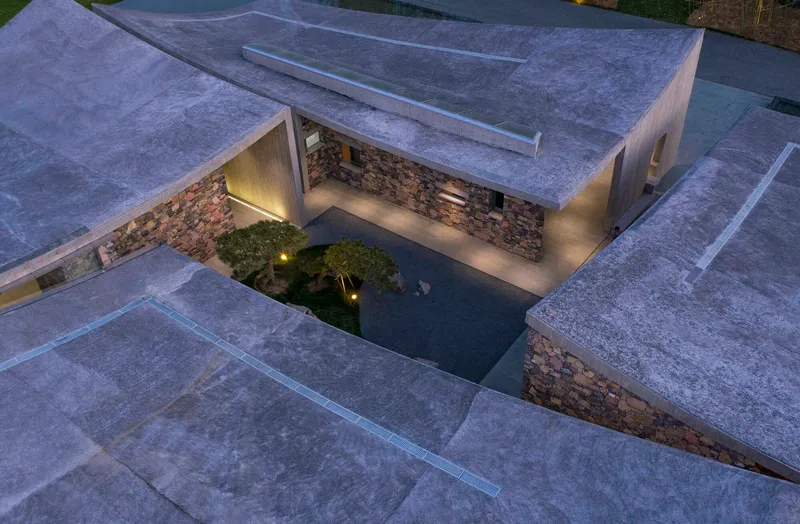
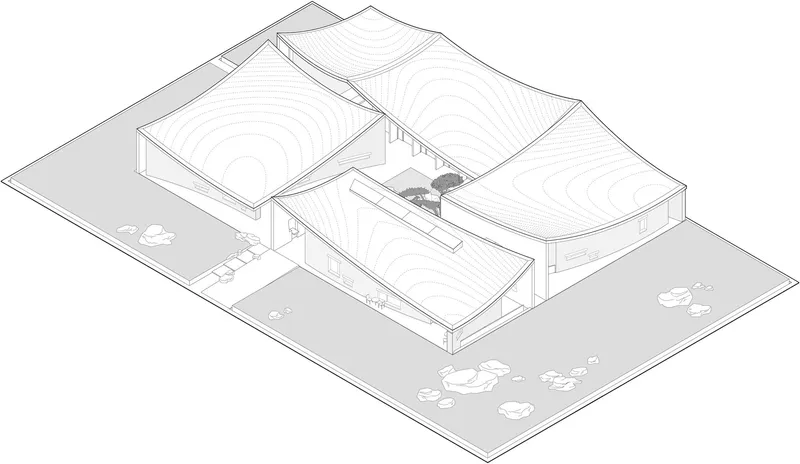
From the air the building reads as a series of pulled and pinched concrete surfaces punctured by courtyards. The roof is column-free: thin reinforced concrete hyperboloids span between walls and columns of different heights, generating a continuously undulating profile that shifts from swelling canopy to pinched valley depending on where you stand. It is a genuinely structural invention rather than a sculptural whim, because the form itself resolves the forces. Compression flows through the high points; tension collects along the sagging curves.
At dusk the effect is amplified. Warm light escapes from beneath the oversized eaves, revealing the degree to which the roof extends beyond the walls. Those deep overhangs are not decorative. Zibo summers are hot and humid, and the eaves produce a continuous band of shade and rain protection, enabling semi-outdoor activity along the building's entire perimeter. It is a passive strategy dressed in expressionist clothing.
Stone Walls and Water
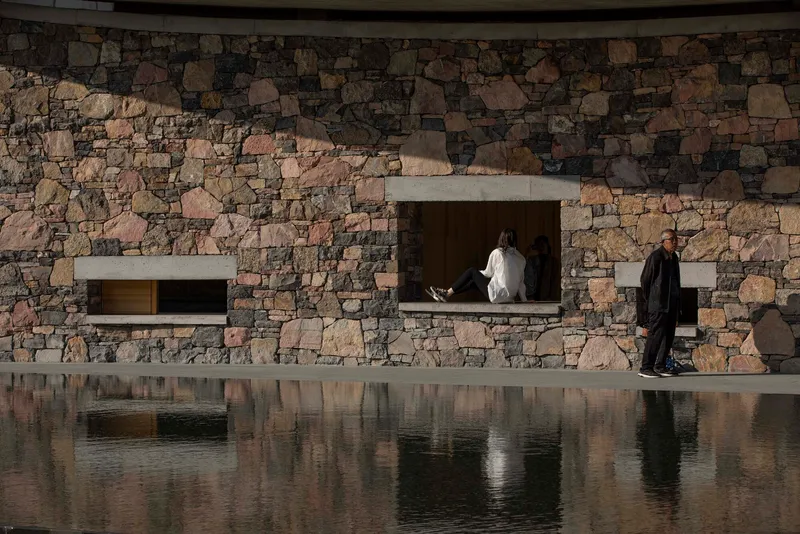
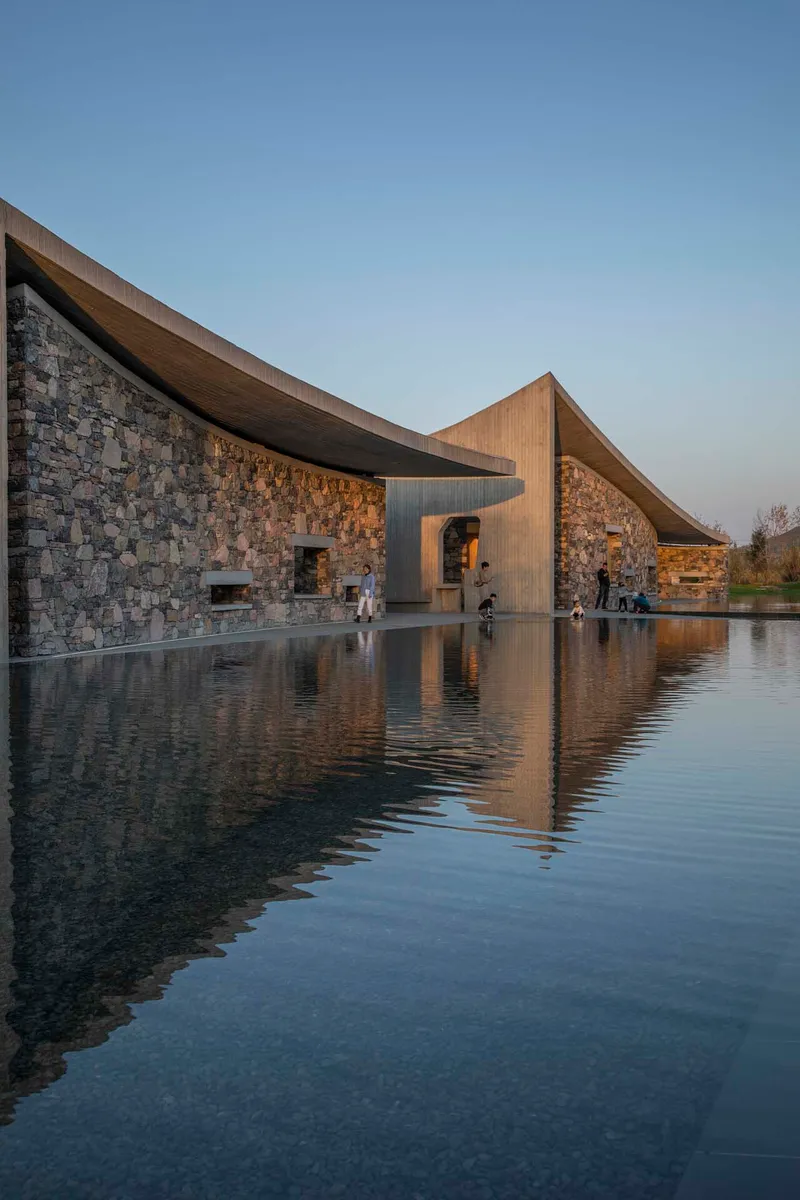
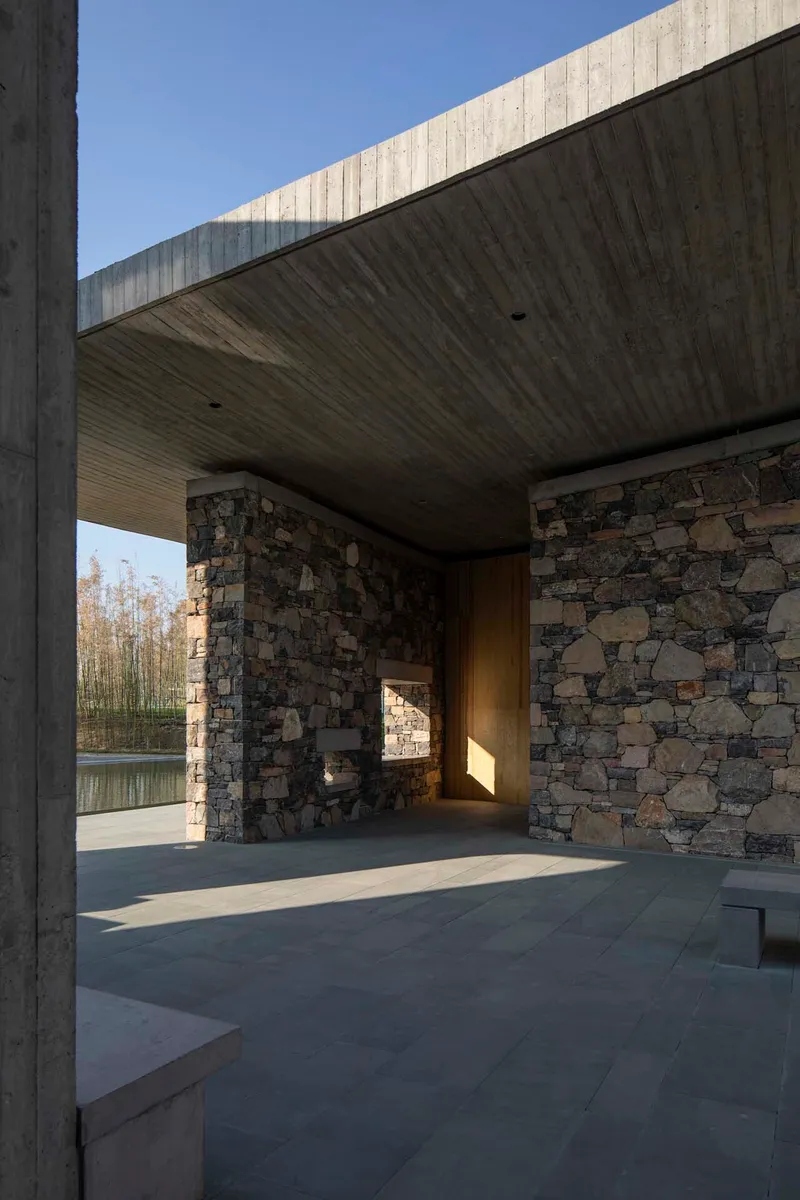
The vertical surfaces are built from local rough masonry stone, dry-stacked or minimally mortared, in grey and tan tones common across northern Shandong. Against the smooth, board-formed concrete overhead, the walls register as something geological: heavy, tactile, rooted. Recessed openings are framed in concrete, creating a deliberate contrast between the handmade and the cast. The material pairing is simple but deeply effective, grounding a formally ambitious roof in regional construction tradition.
An L-shaped reflecting pool wraps two sides of the complex, amplifying the stone facade into a double image at twilight. The pool acts as a modern moat, establishing a psychological threshold between landscape and institution. Standing at its edge, you see the roof's sweeping profile reflected beneath the wall, and the building appears to float on its own shadow.
Courtyard as Organizing Principle
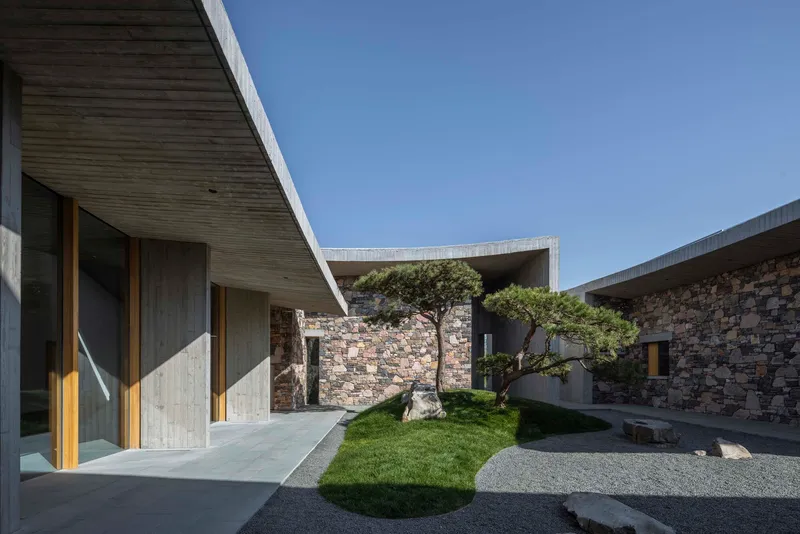
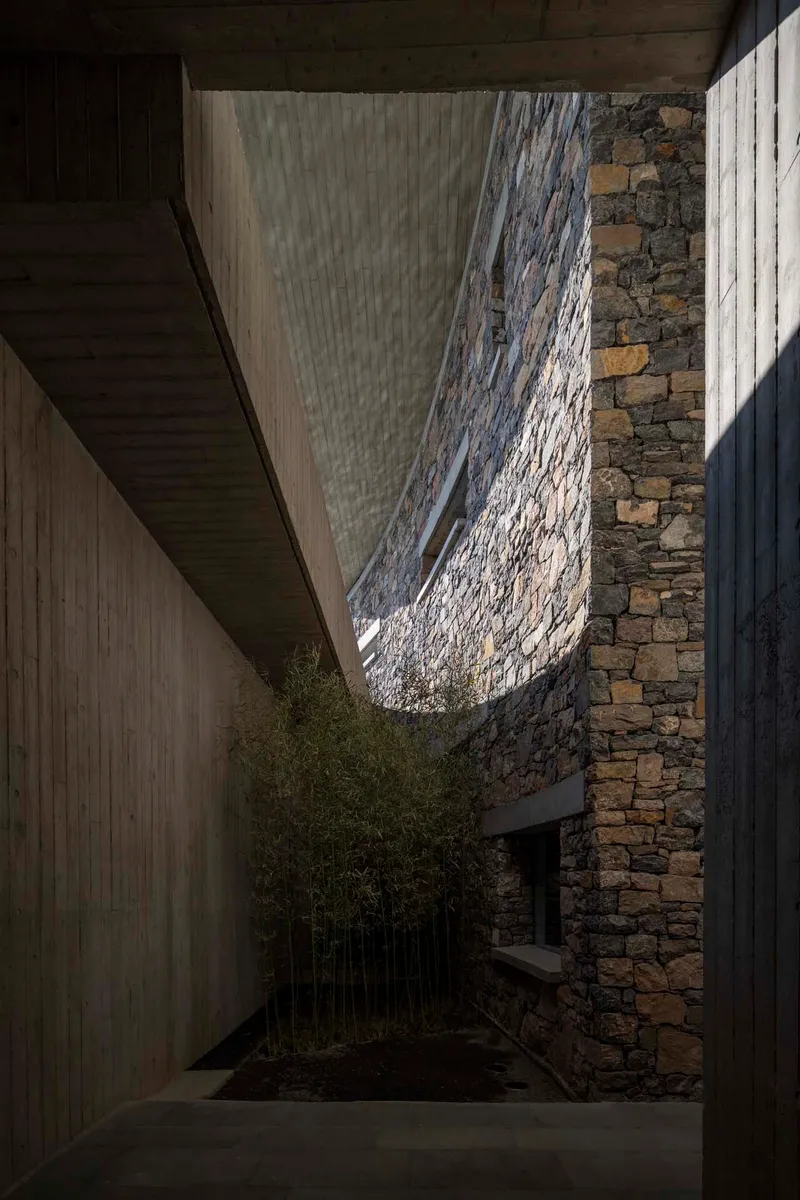
The central courtyard is not leftover space. It is the generative idea. Three pavilion volumes arrange themselves around a planted void containing grass mounds, a mature pine, and shaded terraces. Between the high masonry walls, alleyway-like passages create a wandering sequence of compression and release. You move through narrow, shadowed slots before emerging into the open garden, then back under a canopy, then out to the water. The spatial rhythm borrows from the heyuan, the traditional Chinese academy where rooms ring a communal outdoor room, but here the courtyard is simultaneously below, between, and beneath the architecture.
A sunken courtyard visible from the underground level introduces a second layer of interiority. Trees planted at the lower grade receive light from above while the surrounding underground rooms, including a conference room and service spaces, borrow daylight through these carved voids. It is a quiet solution to a common problem: how to bury program without burying experience.
Interior Atmosphere

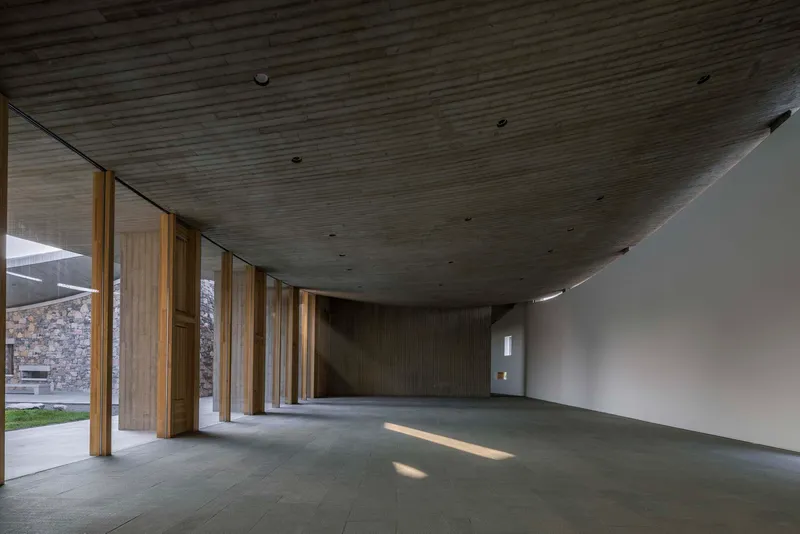
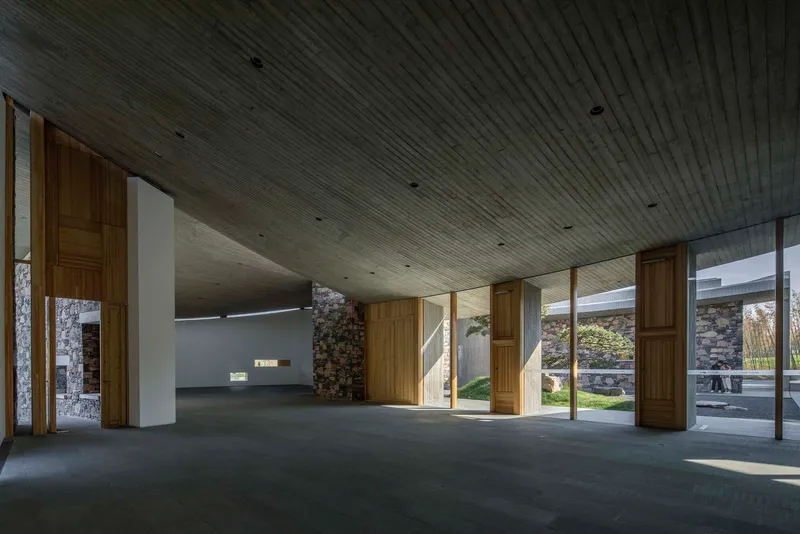
Inside, the drama of the roof becomes intimate. The sloping timber ceilings in the gallery and multifunctional spaces follow the hyperboloid geometry overhead, translating a monumental structural idea into something you can reach up and almost touch. Timber columns and wood flooring warm the palette, while plain white walls provide the neutral backdrop that art demands. The pivoting timber doors between gallery and courtyard collapse the boundary altogether, turning the garden into a potential exhibition room.
The assembly room takes a different tack. Rows of chairs face a gently curved timber wall beneath a wood ceiling, creating an enveloping acoustic shell. It is one of the few enclosed, inward-looking rooms in a building otherwise obsessed with porosity, and the contrast makes it feel earned.
Passages and Thresholds
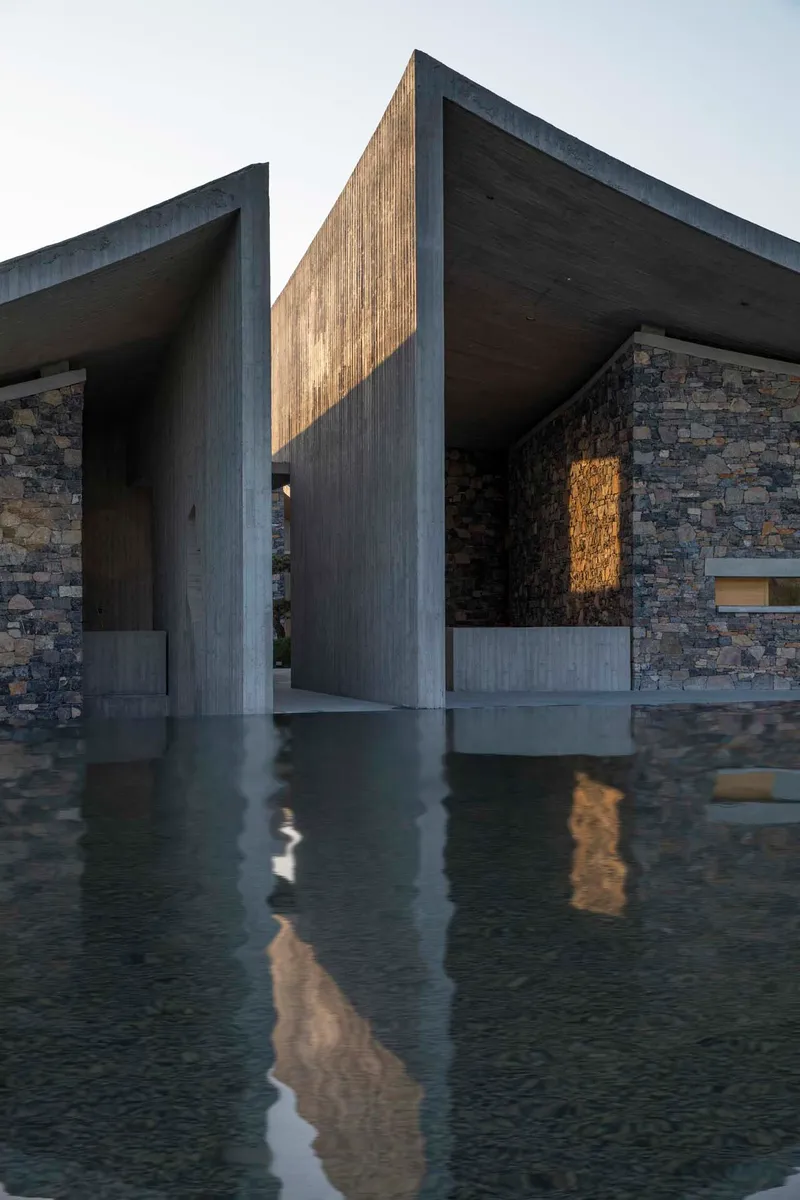
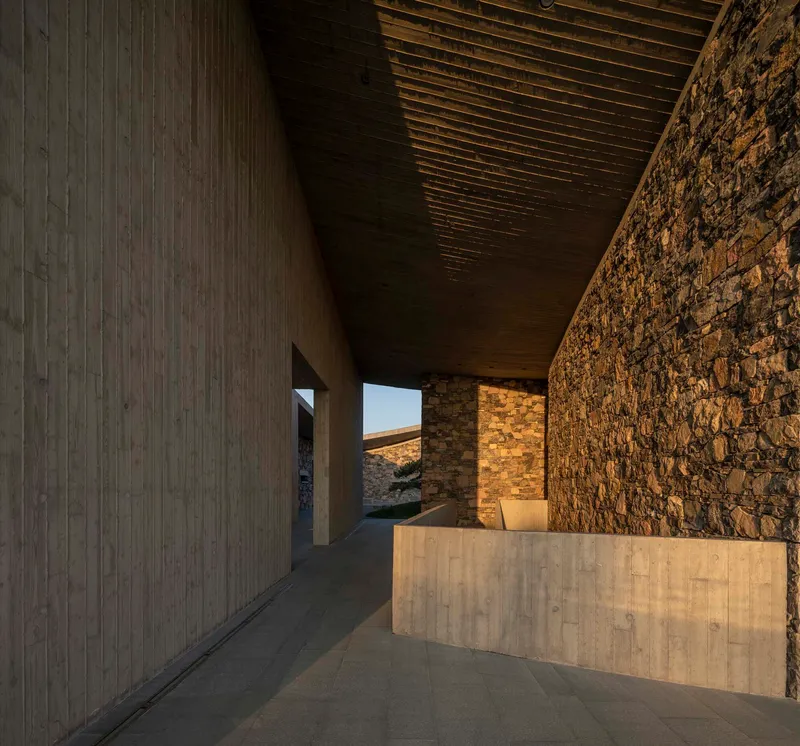
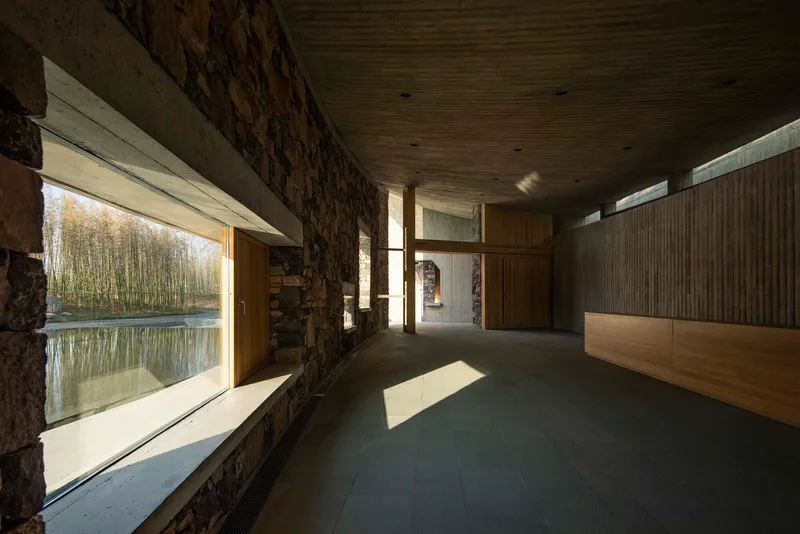
The covered entry passage sets the tone immediately. Board-formed concrete columns frame a shallow reflecting pool at ground level, catching late afternoon light and projecting rippled patterns onto the soffit. You are not entering through a door; you are passing under a landscape. The alleyway corridors between stone walls continue this logic, with horizontal slot windows framing selective views of ponds, birch trees, and distant terrain. Every passage is calibrated to reveal something at its end.
At dusk, the corridors glow with warm light filtered through exposed timber ceiling joists. The stone walls, rough in daylight, become monochromatic backdrops for shadow play. These are not circulation spaces in any bureaucratic sense. They are the building's real program: movement, discovery, atmosphere.
Material Craft Up Close
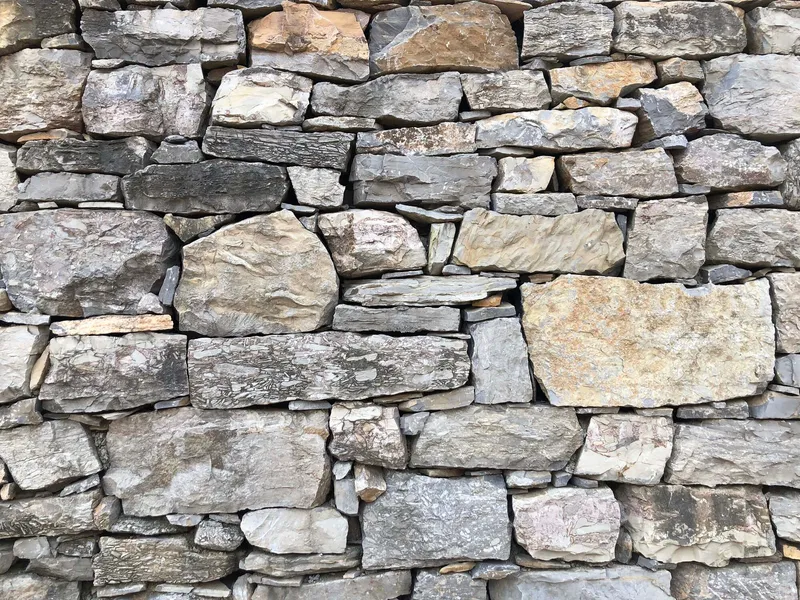

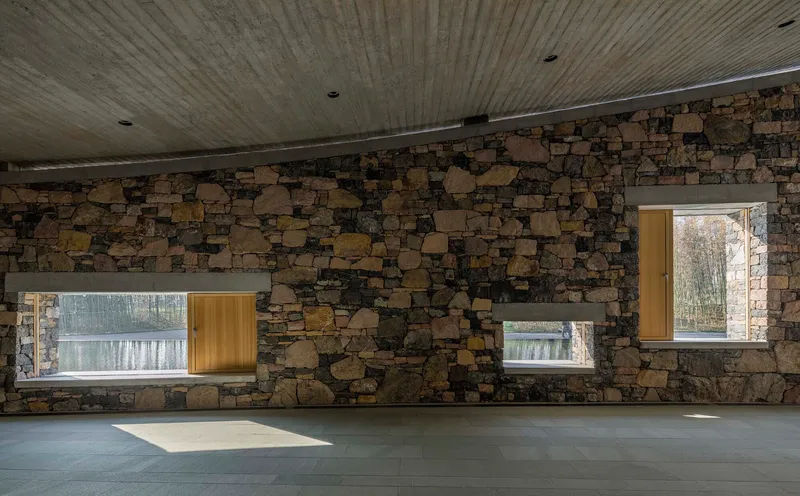
A close look at the fieldstone walls reveals varied coursing, natural patina, and a range of grey and tan tones that resist any reading of mechanical production. These are local stones laid by local methods. The curved drystone retaining walls at the perimeter extend the same vocabulary into the landscape, blurring where building ends and ground begins. Timber-framed windows with clerestory slots punch through the masonry to admit controlled afternoon light, and the joint between stone and concrete is always legible: two systems, two logics, one building.
The inner faces of the roof canopies bear rhythmic striations from the timber shuttering used to cast them. Rather than smoothing these marks away, Zhu Pei leaves them as evidence of process. The concrete roof reads as something made, not manufactured, and the striations echo the horizontal coursing of the stone below. Material honesty, in this case, is also compositional strategy.
Physical Models and Concept Sketches
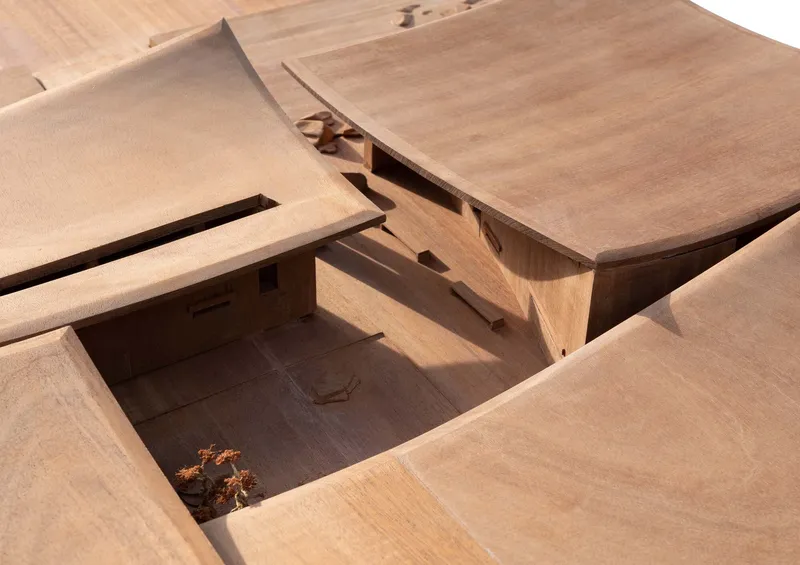
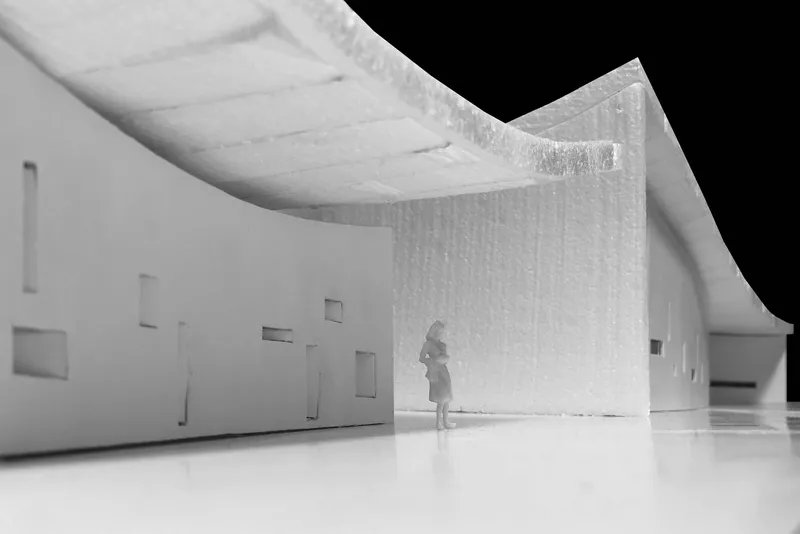
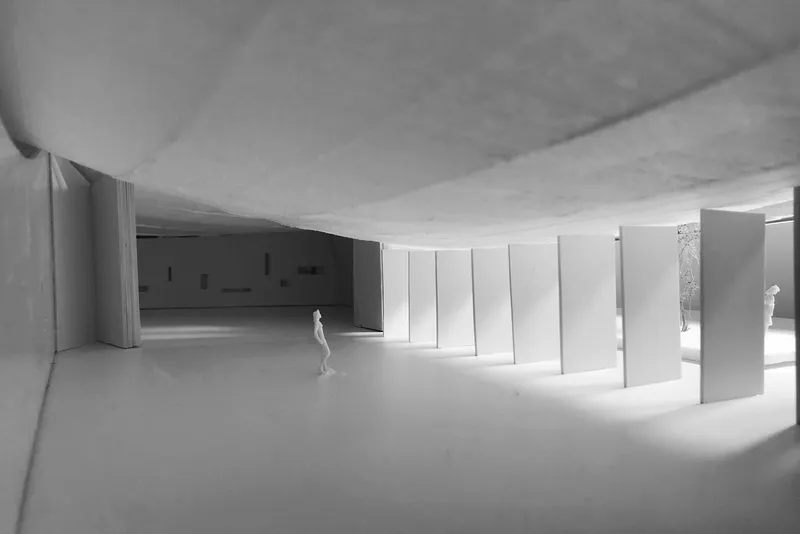
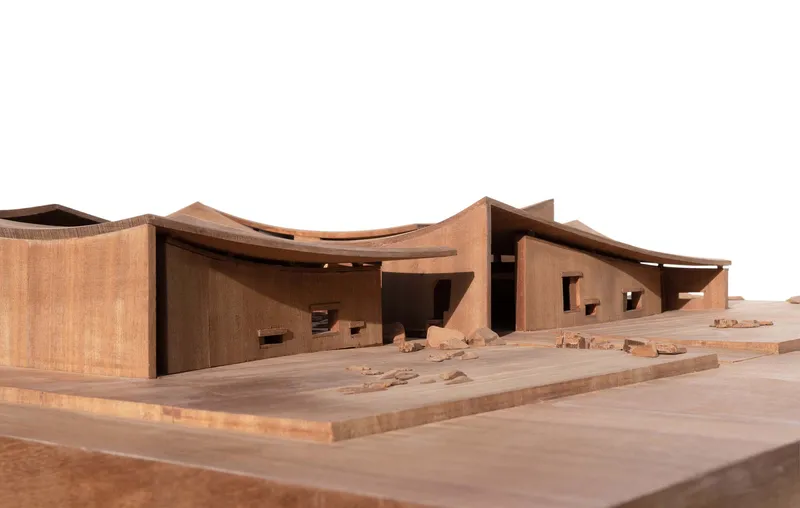
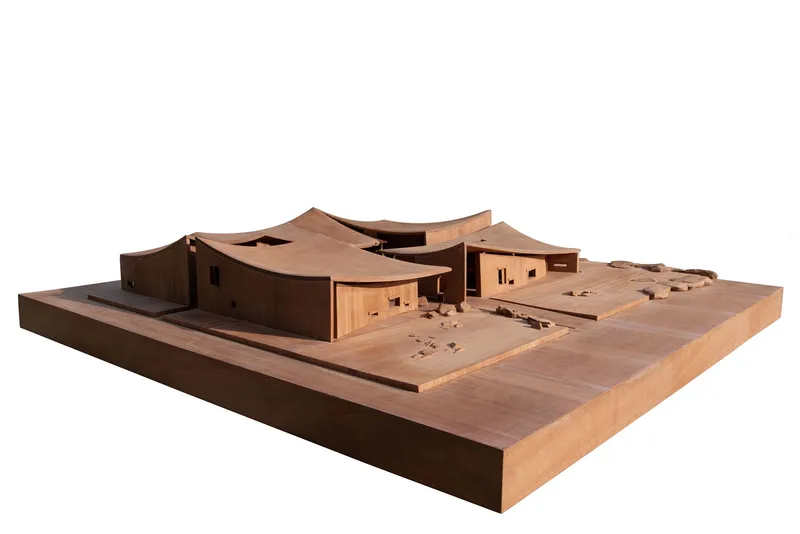
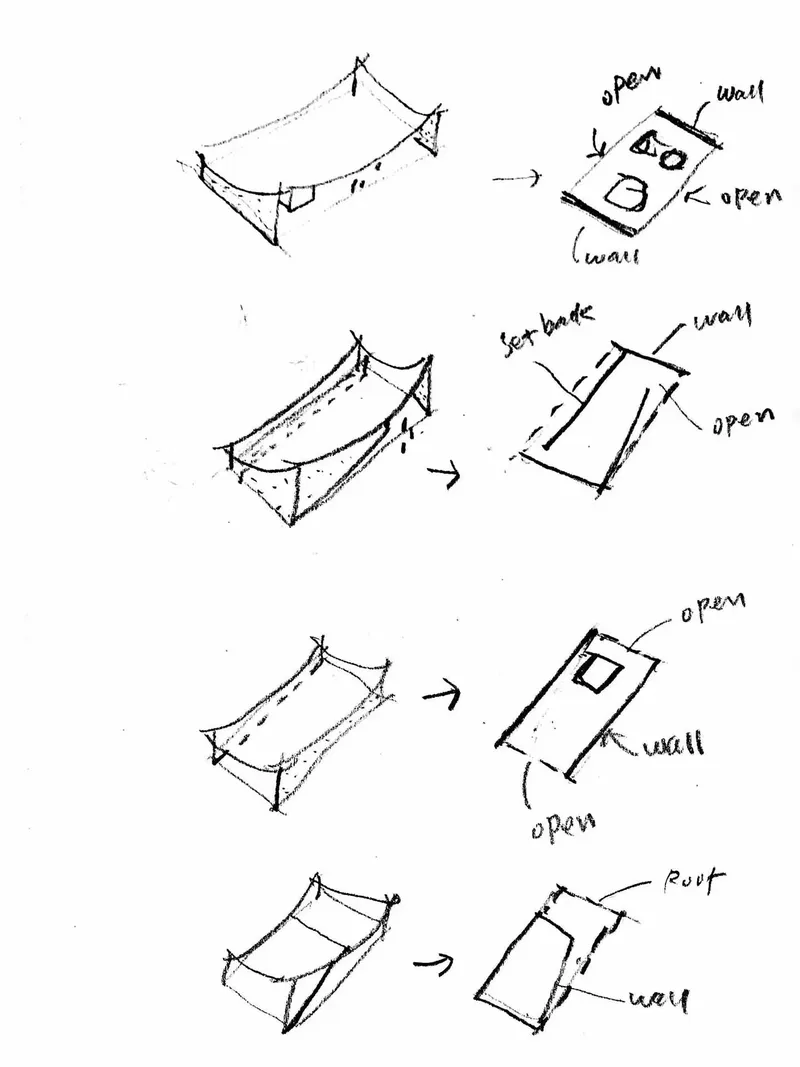
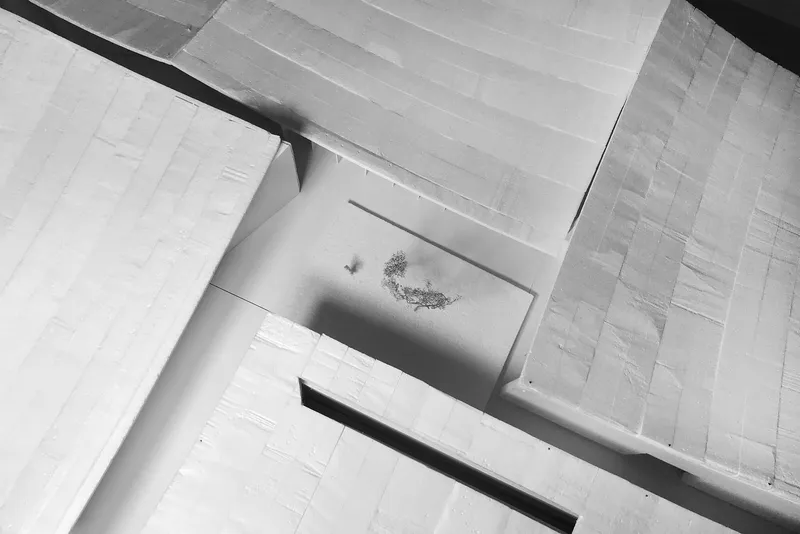
The physical models are unusually revealing. You can see the tent analogy at work: curving roof volumes pulled taut between wall masses, with stepped courtyards carved into the base. The models also show how the building's porosity was studied as a three-dimensional puzzle, small figures placed beneath curving ceilings and beside textured walls to test scale and light. The early sketch diagrams go further, exploring multiple configurations of drooping roof and angled wall before arriving at the final tent-like pavilion structure. It is a reminder that the apparent inevitability of the built form was anything but.
Plans and Drawings
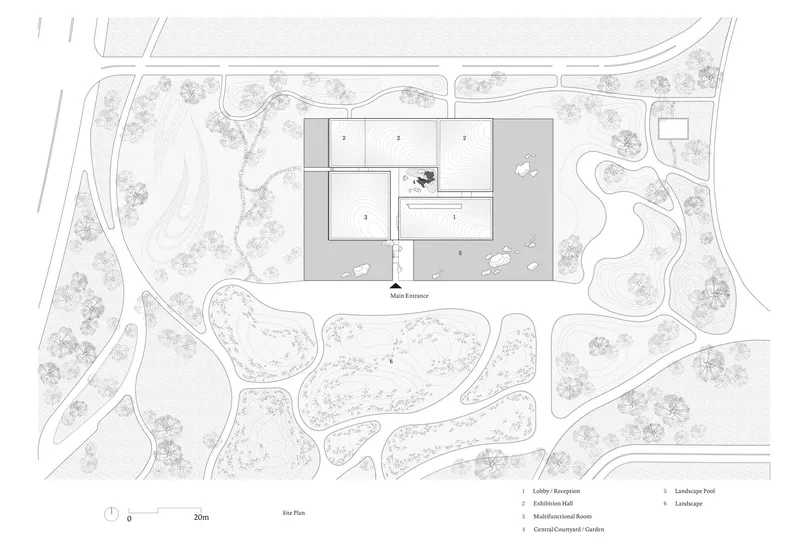
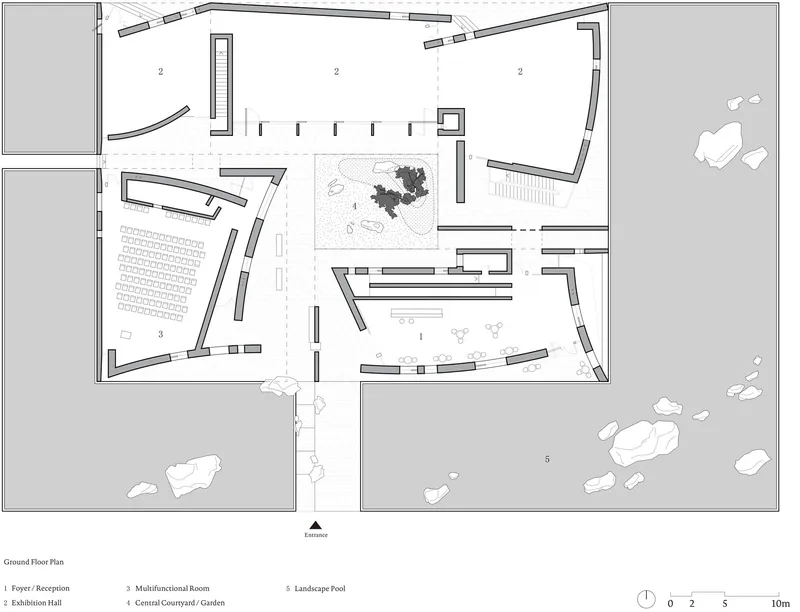
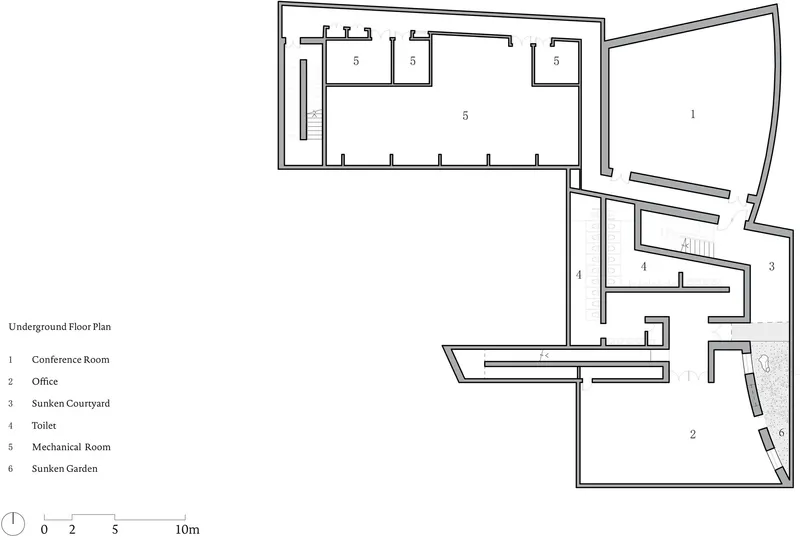
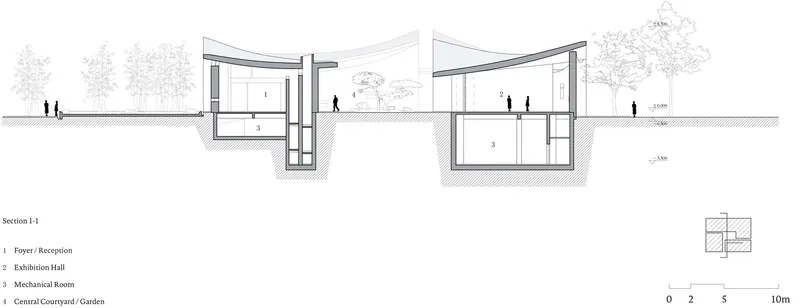
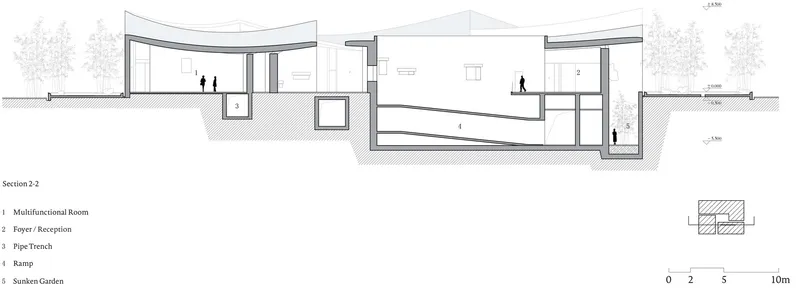
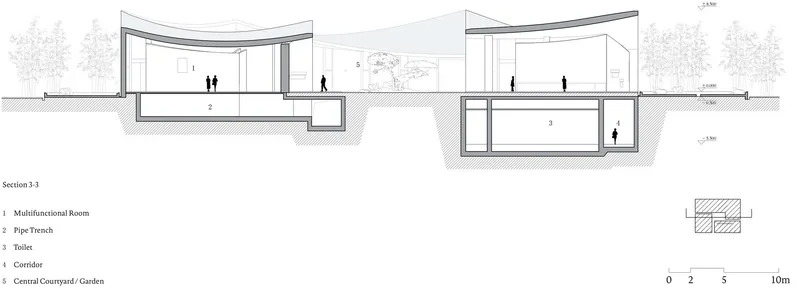
The site plan makes the landscape strategy legible: the building volumes sit within a system of organic paths, tree groupings, and the L-shaped pool, occupying only a fraction of the 27,792 square meter site. The ground floor plan shows the exhibition hall, multifunctional rooms, and central courtyard arranged in a tight ring, while the underground plan reveals a second layer of program including sunken courtyards, a conference room, and mechanical spaces connected by below-grade corridors.
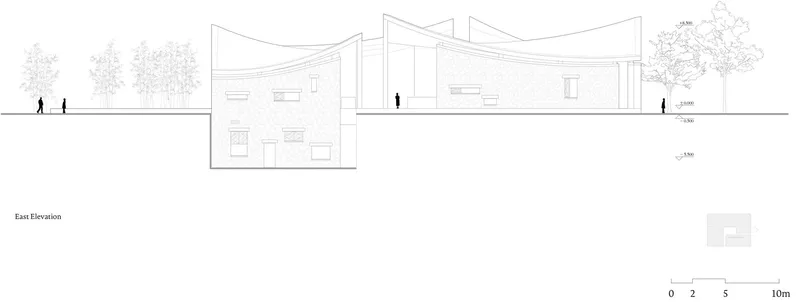
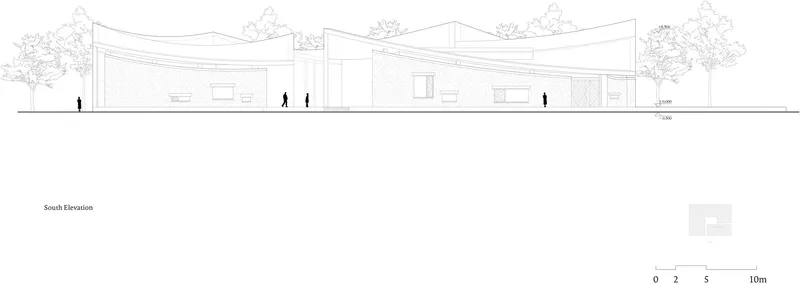
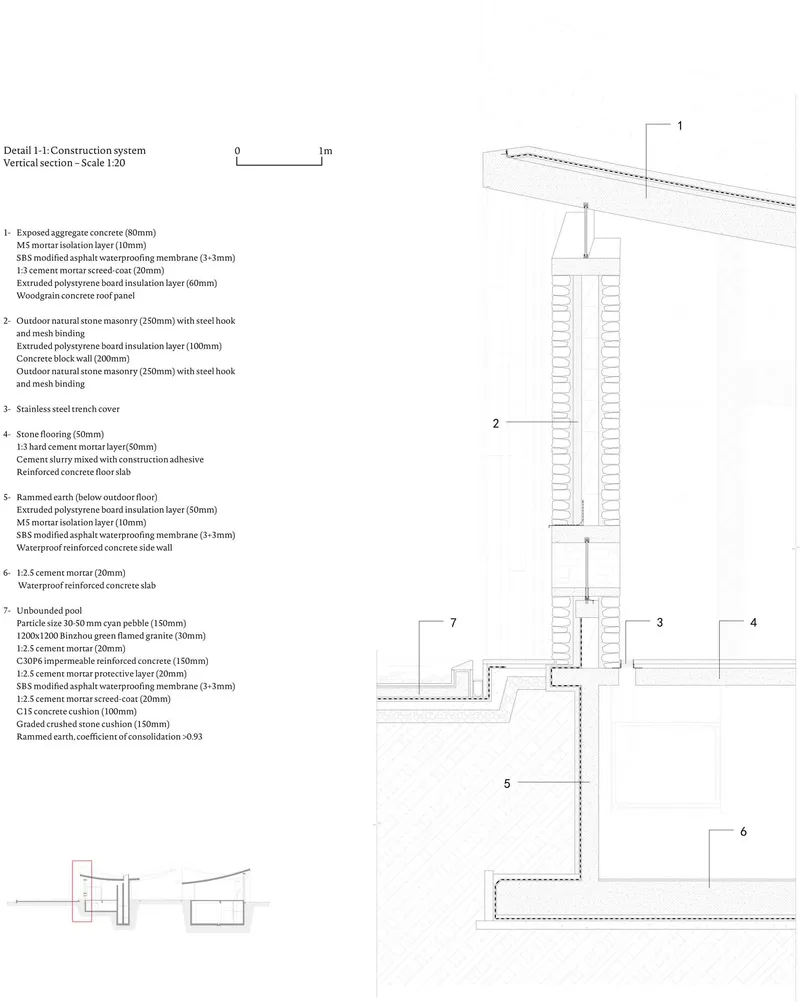
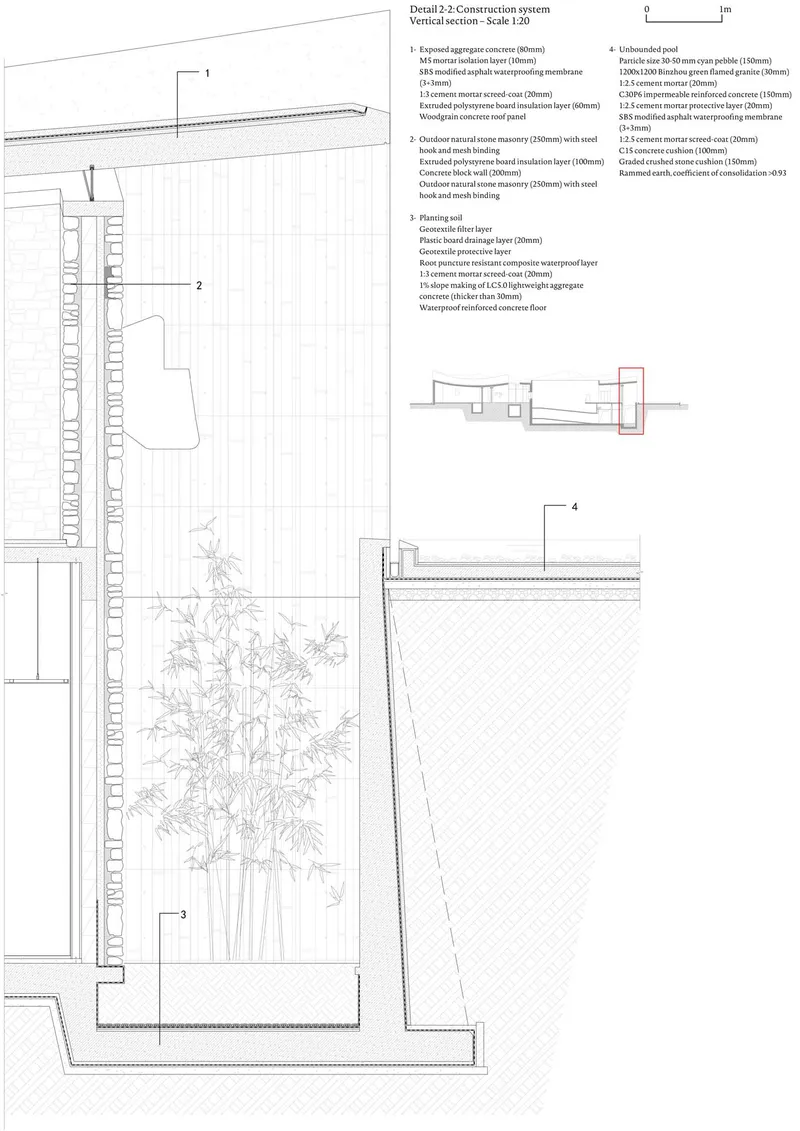
The sections are where the hyperboloid roof geometry reads most clearly. Two semi-submerged volumes rise and fall beneath curving concrete surfaces, with the central courtyard garden occupying the space between them at grade. The axonometric drawing shows three interconnected pavilions following topographic contours, and the construction details document the roof assembly layer by layer: exposed aggregate concrete, waterproofing, and the masonry cavity wall system that mediates between interior and exterior climates.
Why This Project Matters
The Zibo OCT Art Center matters because it demonstrates that structural ambition and vernacular rootedness are not opposites. The hyperboloid concrete roof is a genuine engineering proposition, not a parametric flourish, and it is held in check by the gravity of local stone, courtyard logic, and climate-responsive eaves. In a Chinese cultural building landscape often dominated by either imported minimalism or imported spectacle, this project proposes a third way: regional construction knowledge amplified by structural experimentation.
It also matters as a model for how art institutions can occupy peripheral sites without defaulting to either introverted bunker or attention-seeking icon. The building is quiet from a distance and intense up close. Its porosity, its wandering circulation, and its interplay of shade and light are qualities that accumulate over time rather than registering in a single photograph. That patience, in an era of instant architectural consumption, is itself a form of resistance.
Zibo OCT Art Center by Studio Zhu-Pei, located in Zhangdian District, Zibo, Shandong, China. 2,471 m². Completed 2020. Photography by Weiqi Jin and XIA ZHI PICTURES.
About the Studio
Share Your Own Work on uni.xyz
If projects like this are the kind of work you want to make, uni.xyz is a place to publish your own, find collaborators, and enter design competitions.


Popular Articles
Popular articles from the community


Cloaked Colonization: A Mobile Underwater Habitat That Moves Like a Fish
Micah Abaya's shortlisted EHC Pacific entry reimagines ocean settlement as a dispersed network of self-sustaining architectural organisms.

Faces of the Soviet Avant-Garde: Turning Moscow's Street Names into an Open-Air Museum
A network of sculptural installations across a Moscow residential district transforms forgotten architect names into spatial encounters with cultural memor

Manzana Morphosis: Stretching Barcelona's Grid into a Living Landscape for 2050
A radical reworking of the Eixample manzana turns density into a tool for generous public space, vertical ecology, and environmental performance.

Opera by the Sea Estonia: Three Shells Dissolving Architecture into Tallinn's Coastline
A winning opera house proposal replaces monumental form with interconnected shells that blur the boundary between building, park and Baltic Sea.

Similar Reads
You might also enjoy these articles

Pixel Gardens: One Repeated Module Stacked Into a Terraced Social Housing Tower for Famagusta
Salem Bader's shortlisted housing tower builds a vertical neighbourhood from one repeated module, offsetting units to carve terraces, light and air.

Bao Huynh Watercolor Atelier: A Serene Art Retreat in Hội An
Bao Huynh Watercolor Atelier in Hội An blends multifunctional art spaces, sustainable design, local materials, and family-friendly living in a serene environment.

Atelier Macri Concept Store Interior Design by CASE-REAL
Atelier Macri store features a "ko" counter, walnut wood details, cork displays, blending retail, gallery, and seamless customer experiences.

Manuel Vargas Izquierdo Stadium and High-Performance Sports Center: Architectural Excellence in Jalpa de Méndez
The Manuel Vargas Izquierdo Stadium blends sustainable design, inclusive sports facilities, and cultural-inspired architecture, revitalizing Jalpa de Méndez’s public spaces.

Explore Concrete art Competitions
Discover active competitions in this discipline

Challenge to design public laboratory

Bring back Drive In's
Comments (0)
Please login or sign up to add comments
No comments yet. Be the first to comment!