
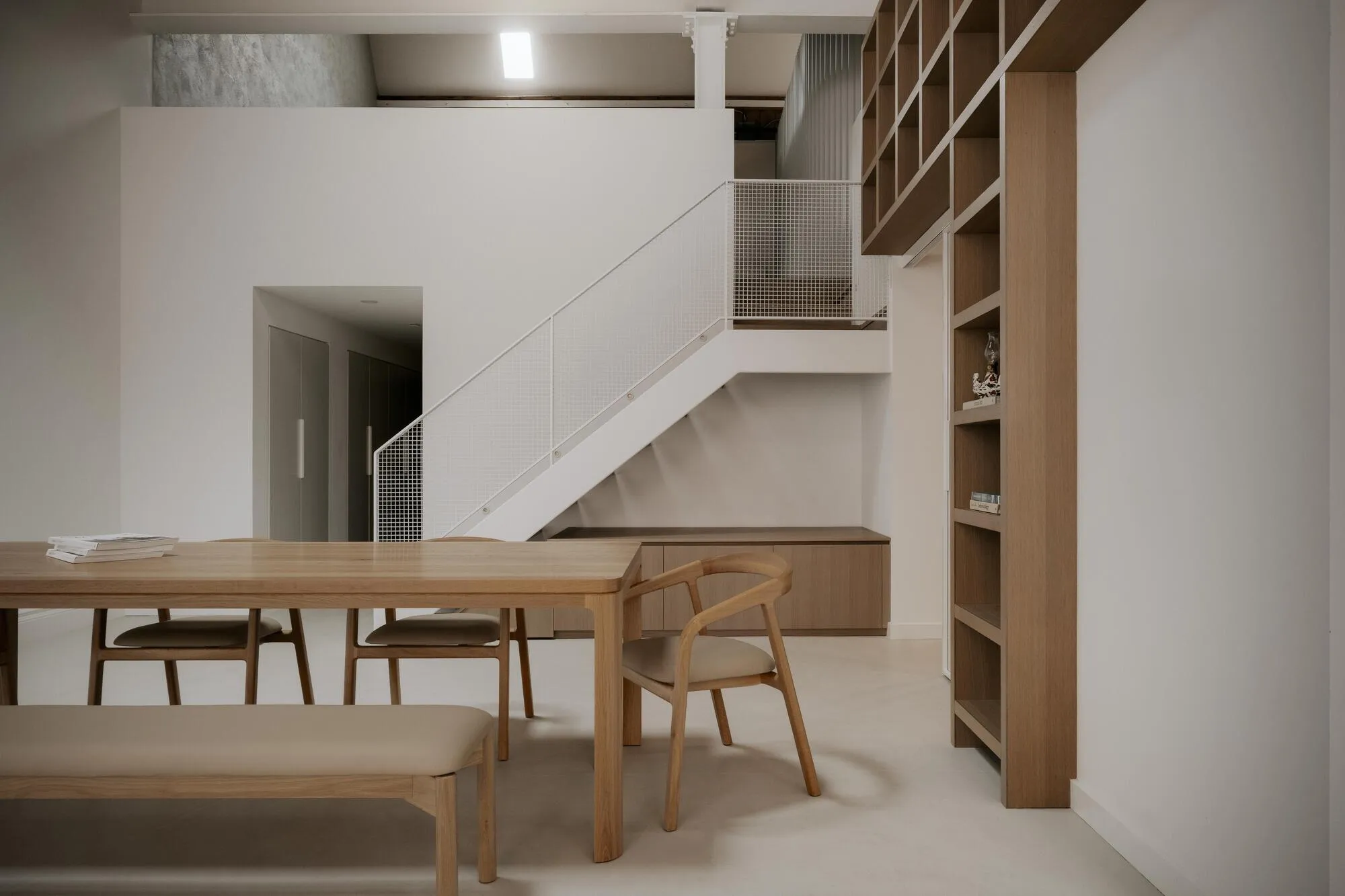
StudioAC Carves a Dollhouse World of Curves and Timber Inside a Toronto Loft
In Leslieville's industrial east end, a split-level loft gets a layered renewal through corrugated curves, timber shelving walls, and mosaic-tiled alcoves.


Loft conversions in Toronto's east end are not rare. What is rare is a renovation that refuses to flatten the character of an industrial shell into the usual white-box gallery treatment. StudioAC's Dollhouse Loft in Leslieville takes a rough split-level volume with exposed brick, heavy timber ceiling joists, and skylights, then threads an entirely new spatial narrative through it: curving screens, corrugated metal staircases, a full-height shelving wall, and a cylindrical mosaic bathtub that feels borrowed from a Roman bathhouse.
The project's real trick is legibility. Despite the density of moves, every intervention reads as a distinct episode rather than background noise. A perforated metal balustrade is not the same gesture as a fluted wall panel, and neither pretends to be the timber ceiling above. StudioAC treats each material as a character in a miniature world, hence the name, and the result is a home that rewards close looking at every turn.
Split Levels and the Double-Height Gambit
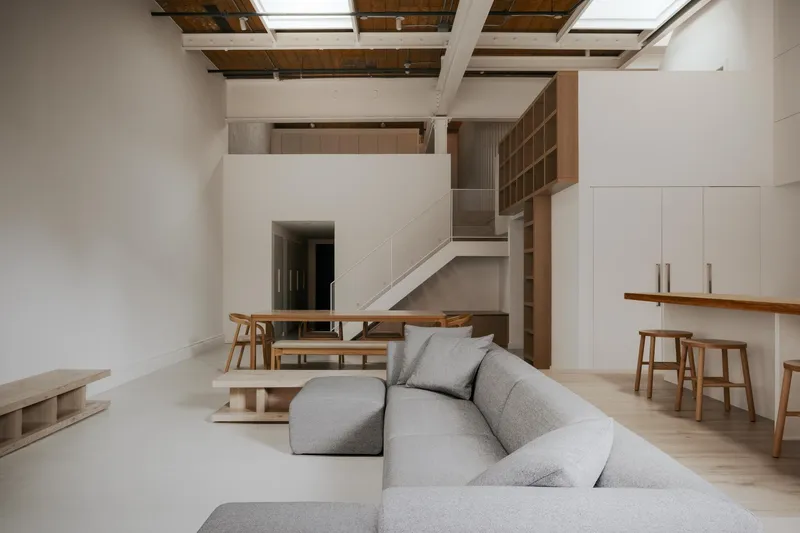
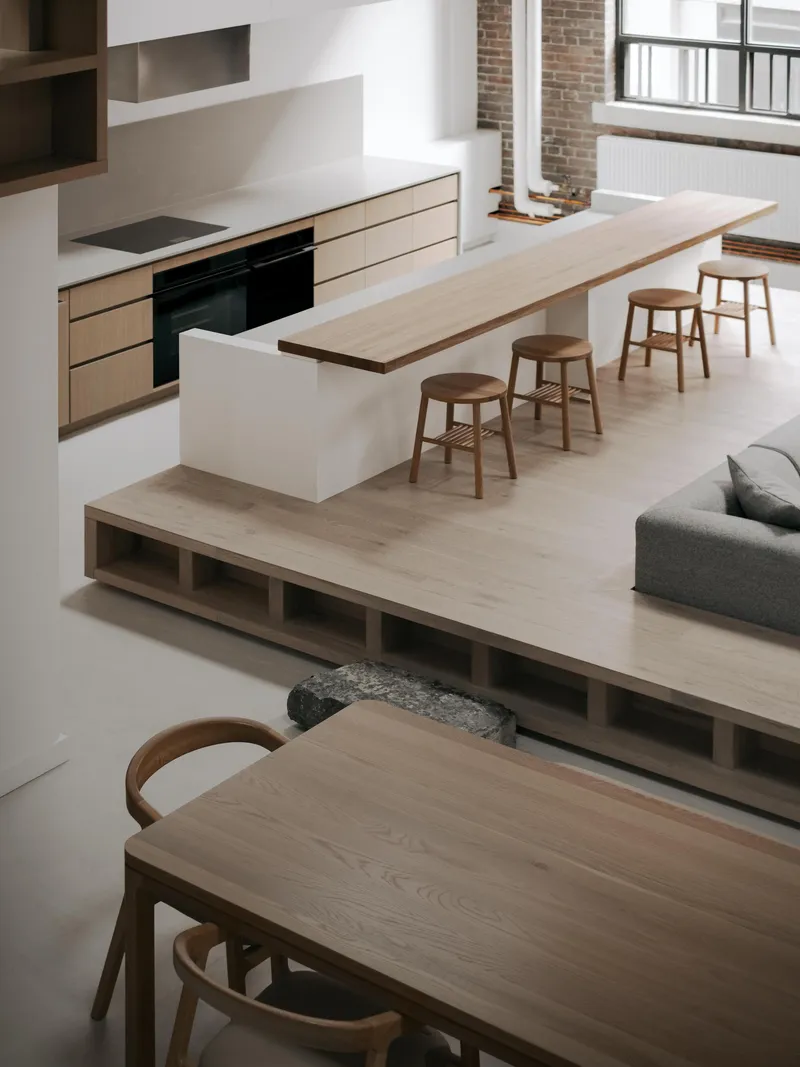

The existing loft already had a pitched roof and a mezzanine, giving StudioAC a vertical canvas most Toronto renovations never get. Rather than closing off the upper level to maximize floor area, the architects kept the double-height section open, allowing the exposed timber joists and skylights to breathe. The split-level section below organizes the kitchen, dining, and living zones on staggered planes, connected by sightlines that run diagonally through the space.
The raised platform at the rear, backed by an exposed brick wall and framed by industrial glazing, acts as a kind of stage. It is both the most intimate zone and the most visually prominent one, which is a deliberate inversion of hierarchy. In a conventional layout, the double-height space would dominate. Here it serves as a generous connector, while the compressed brick alcove earns the emotional weight.
The Staircase as Protagonist
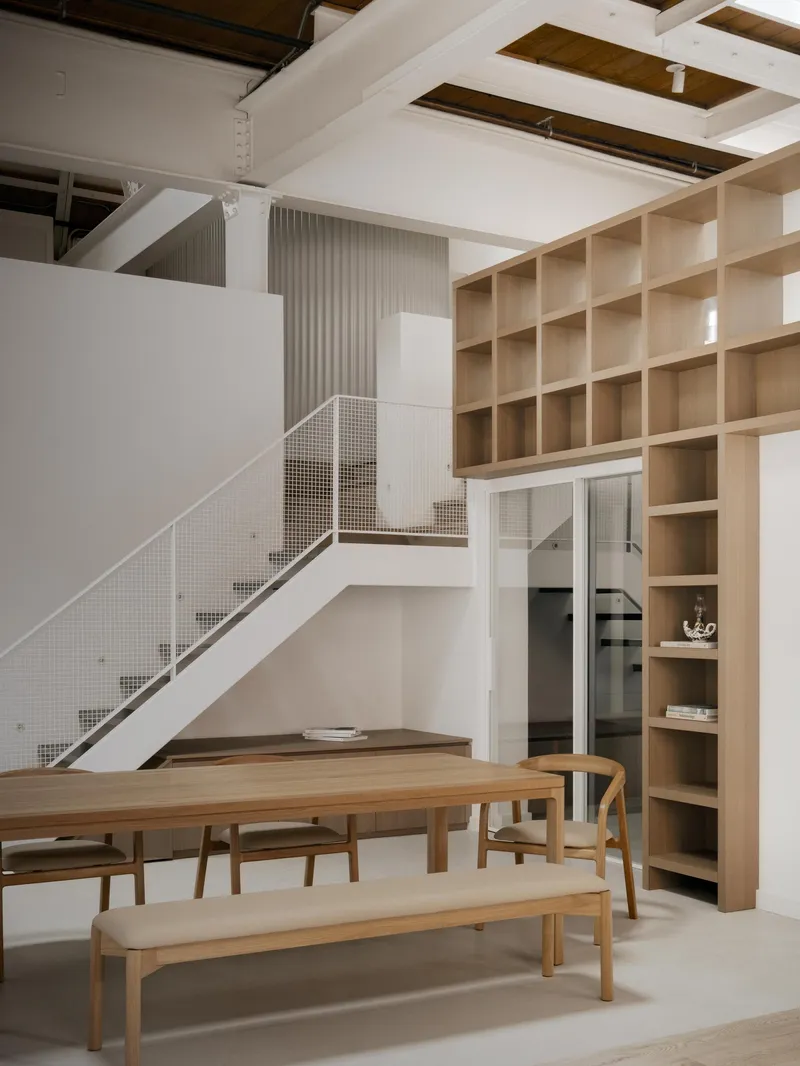
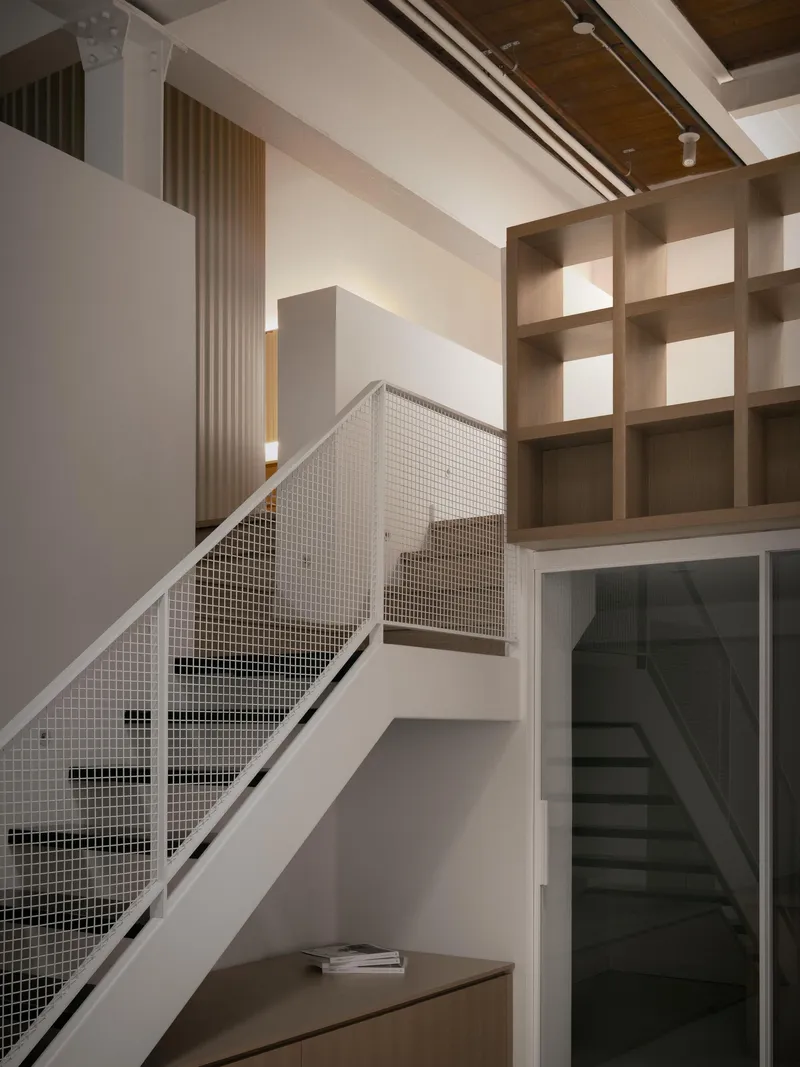

Two staircase conditions define the circulation. The first is a white steel structure with a perforated metal mesh balustrade, set against a floor-to-ceiling timber shelving wall that runs the full height of the double volume. The mesh is open enough to preserve visual continuity, but its pattern gives it a textile-like quality, softening what could have been a hard industrial detail.
The second staircase, wrapped in corrugated metal cladding, curves upward beneath the pitched timber ceiling. Its form is almost sculptural, a smooth tube that contrasts sharply with the raw ductwork and beam structure overhead. StudioAC clearly relishes this juxtaposition: the precise, manufactured curve set against the rough, additive logic of the existing building systems.
Curved Screens and Fluted Surfaces
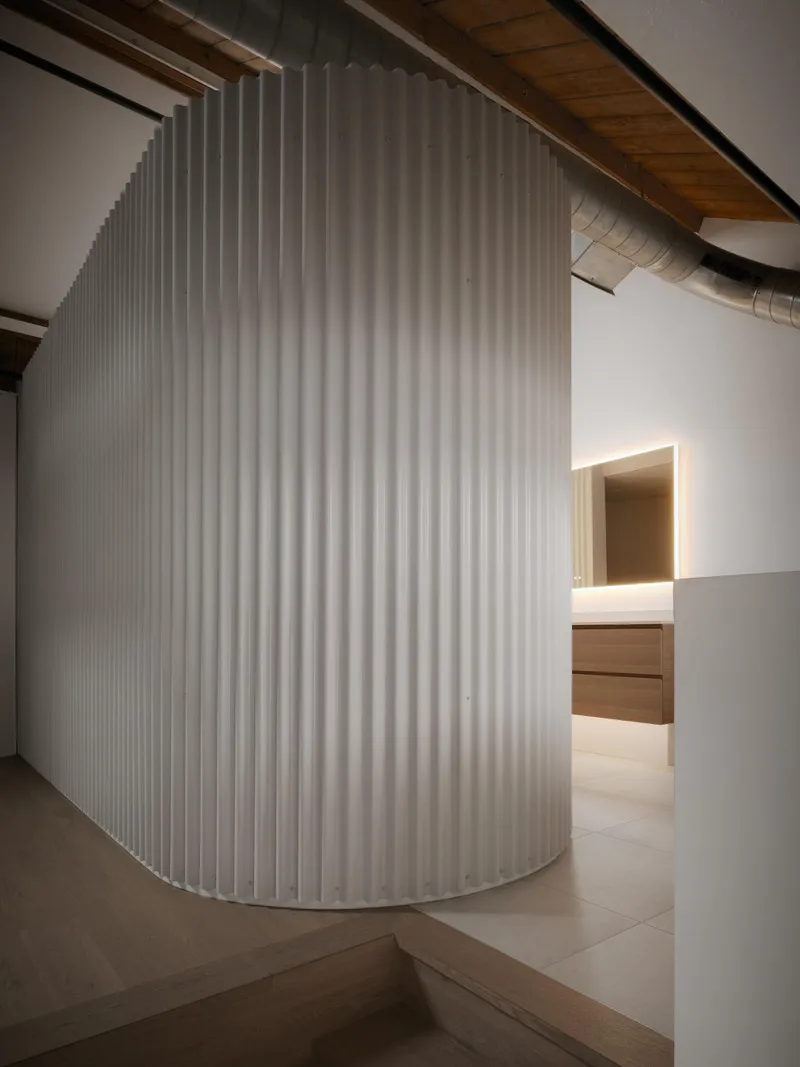
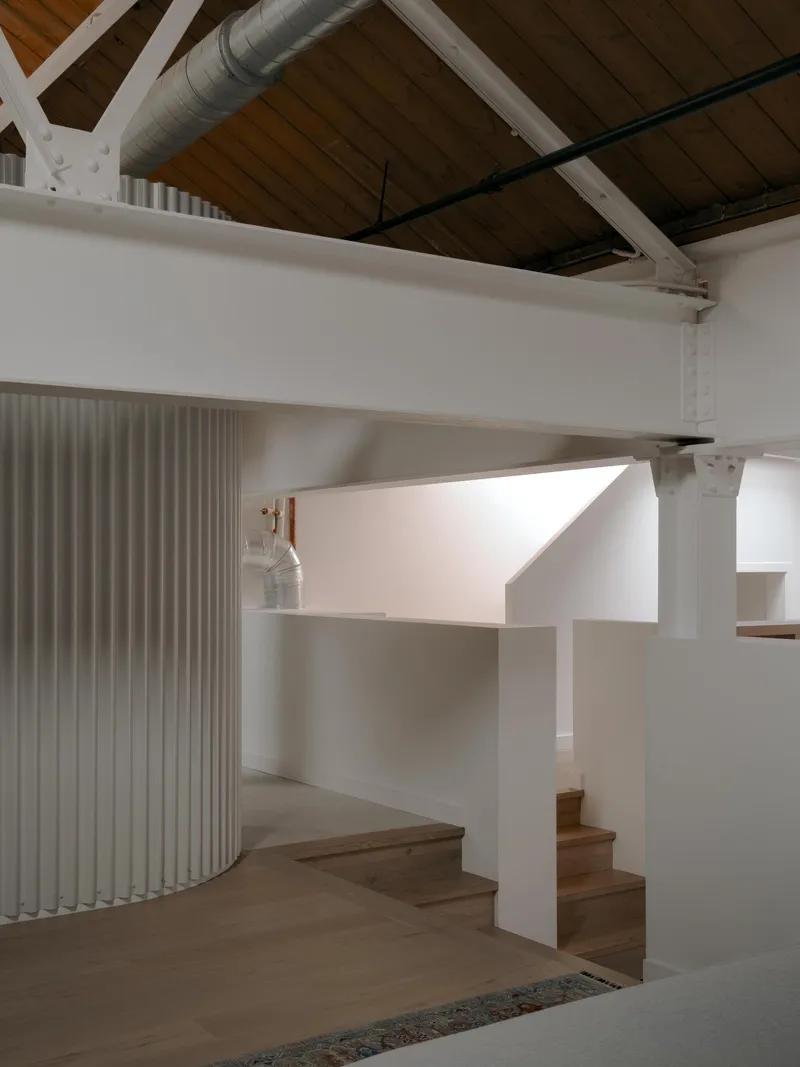

A recurring motif throughout the loft is the curved louver screen, a white volume made of vertical fins that wraps around private zones without fully enclosing them. These screens function as spatial thresholds: they signal a transition from open to intimate without relying on a conventional door. Backlit timber cabinetry glows behind them, turning storage into something closer to a lantern.
The fluted wall panels, visible in hallways and along stairwell walls, add a tactile rhythm that catches raking light from the overhead skylights. Close-up, the vertical metal fins extending from the ceiling are clearly a family of the same gesture, scaled up. StudioAC uses repetition across scales to create coherence, but the material shifts, from painted metal to milled panel, keep things from becoming monotonous.
Timber as Connective Tissue


Timber does the heavy lifting of unifying a project that contains a lot of competing ideas. The ceiling structure is exposed wood plank, the shelving wall is timber-framed, the kitchen counter and dining table are both solid wood, and even the bathroom vanity reads as part of the same material family. Against the white interventions and raw steel ductwork, the wood creates warmth and continuity across floors and zones.
The floor-to-ceiling shelving unit beside the sliding glass doors deserves particular attention. It is not a decorative bookshelf; it is a room divider, a structural gesture, and a display system all at once. By extending to the ceiling grid, it reinforces the verticality of the space and gives the otherwise lightweight mezzanine a grounded edge.
Bathing as Ritual


The bathroom is where the "dollhouse" metaphor lands most clearly. A cylindrical mosaic-tiled bathtub sits in a curved alcove, its scale and materiality making it feel like an object from a miniature palace. The overhead fixture casts a focused pool of light, isolating the tub from the rest of the home. It is a deliberate scene, not just a function.
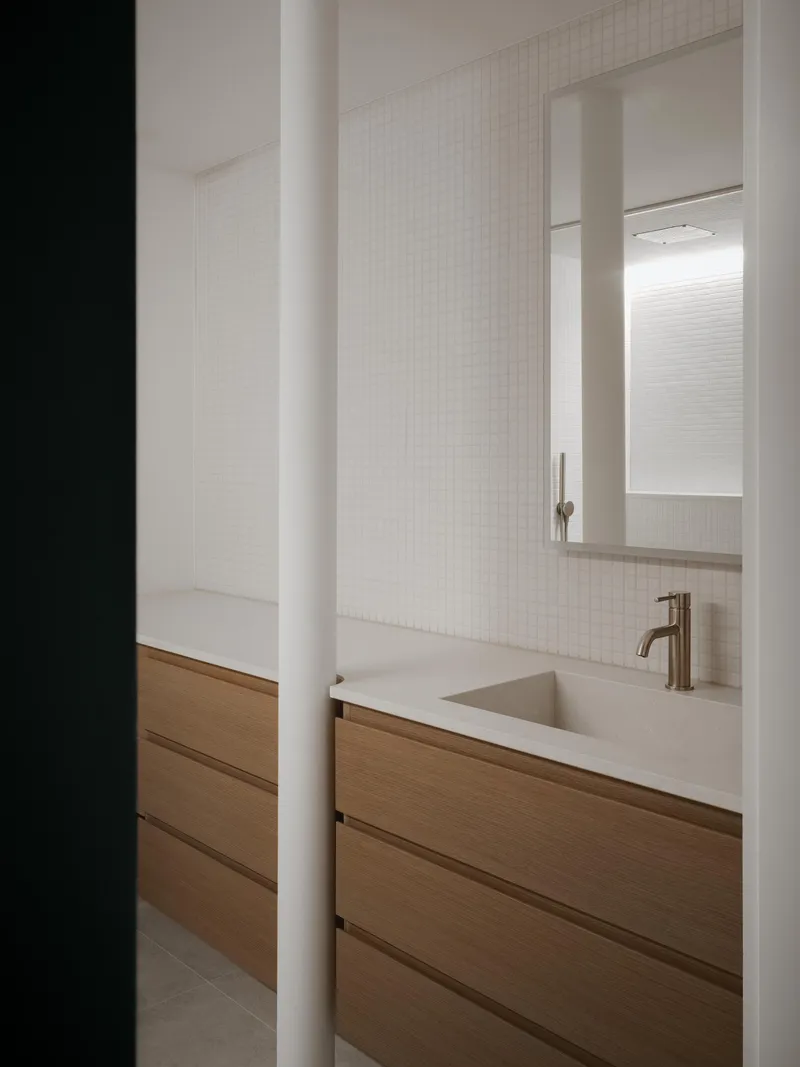
Elsewhere in the bathroom zone, oak-fronted vanity drawers with integrated sinks are glimpsed through dark thresholds, and the linear skylight in the hallway above washes fluted panels with daylight. StudioAC understands that bathrooms are one of the few spaces where a residential project can take real risks. Here, they've used that license to create something genuinely unusual.
Material Contrast and Detailing

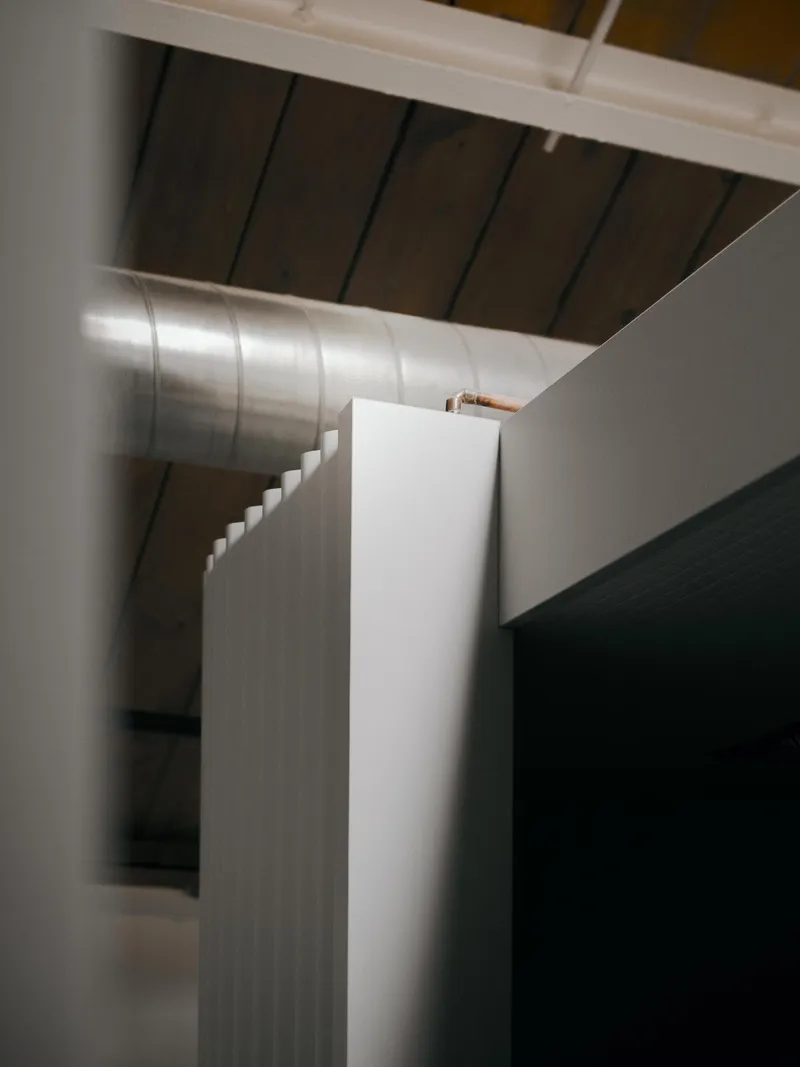

StudioAC's detailing strategy pairs precision with rawness. White steel beams with visible bolted connections sit next to fluted wall panels under ambient lighting. Painted steel columns and exposed ductwork share the frame with crisp white partitions. The architects do not try to hide the mechanical systems; instead, they treat them as a visual counterweight to the more refined insertions.
The result is an interior that feels handmade and industrial simultaneously. Nothing reads as off-the-shelf, yet nothing pretends to be precious. That balance is harder to achieve than it looks, especially in a residential context where clients tend to push for polish. The Dollhouse Loft keeps its rough edges and is better for it.
Plans and Drawings


The hand-drawn sketches on tracing paper reveal StudioAC's design process: quick sectional studies and plan diagrams that map the spatial relationships before committing to final geometry. The first-level plan shows the open living area flowing into kitchen and bathroom zones, while the loft-level plan confirms the bedroom and second bathroom floating above, connected by the twin staircases. The compact footprint makes the vertical ambition all the more impressive.
Why This Project Matters
Toronto's loft market has a tendency toward safe minimalism: exposed brick, polished concrete, a few pendant lights, done. The Dollhouse Loft rejects that template entirely. StudioAC packs an enormous range of spatial ideas, from mosaic bathtubs to corrugated stair enclosures to louvered screens, into a single residential volume without it reading as chaotic. That takes discipline as much as imagination.
More broadly, the project argues for treating a home as a sequence of rooms with distinct identities rather than a single open plan with consistent finishes. Each zone has its own material logic and its own relationship to light. In a city increasingly dominated by condominiums that promise "open-concept living" as though it were a virtue in itself, the Dollhouse Loft offers a welcome counterargument: that complexity, layering, and character can coexist with a functional floor plan.
Dollhouse Loft by StudioAC, Toronto, Canada. Photography by Felix Michaud.
About the Studio
Share Your Own Work on uni.xyz
If projects like this are the kind of work you want to make, uni.xyz is a place to publish your own, find collaborators, and enter design competitions.




Popular Articles
Popular articles from the community


AL-JANNAH: Sustainable Architecture and Permaculture for Afghan Widows
AL-JANNAH uses sustainable architecture and permaculture to create resilient oasis of housing, learning, work and renewal for Afghan widows.

Co-life: Sustainable Architecture for Age-Friendly Community Living
Co-life reimagines sustainable architecture for seniors through courtyards, rammed earth, shared gardens, and spaces designed for belonging.

The Earth Pod: 3D Printed Homes for Resilient Refugee Communities
The Earth Pod reimagines refugee housing through 3D printed homes made from clay, combining resilience, self-sufficiency, and rapid shelter.

The Ocean Hive: Sustainable Architecture for a Self-Sufficient Civilization at Sea
The Ocean Hive imagines sustainable architecture at sea, where modular habitats, algae, wave power and ocean waste sustain a growing colony.


Similar Reads
You might also enjoy these articles

Bao Huynh Watercolor Atelier: A Serene Art Retreat in Hội An
Bao Huynh Watercolor Atelier in Hội An blends multifunctional art spaces, sustainable design, local materials, and family-friendly living in a serene environment.

Atelier Macri Concept Store Interior Design by CASE-REAL
Atelier Macri store features a "ko" counter, walnut wood details, cork displays, blending retail, gallery, and seamless customer experiences.

Manuel Vargas Izquierdo Stadium and High-Performance Sports Center: Architectural Excellence in Jalpa de Méndez
The Manuel Vargas Izquierdo Stadium blends sustainable design, inclusive sports facilities, and cultural-inspired architecture, revitalizing Jalpa de Méndez’s public spaces.

KAKR Buluh Awar Hall: Revitalizing Community and Ecology Through Bamboo Architecture
Community built bamboo hall revitalizes Buluh Awar village, empowering youth, restoring ecology, celebrating vernacular craftsmanship through sustainable architecture and culture.


Explore Cultural Architecture Competitions
Discover active competitions in this discipline


Challenge to design luxury tourism on rails


VR headsets Storefront design competition


Bring back Drive In's


Designing a staircase for a client
Comments (0)
Please login or sign up to add comments
No comments yet. Be the first to comment!