
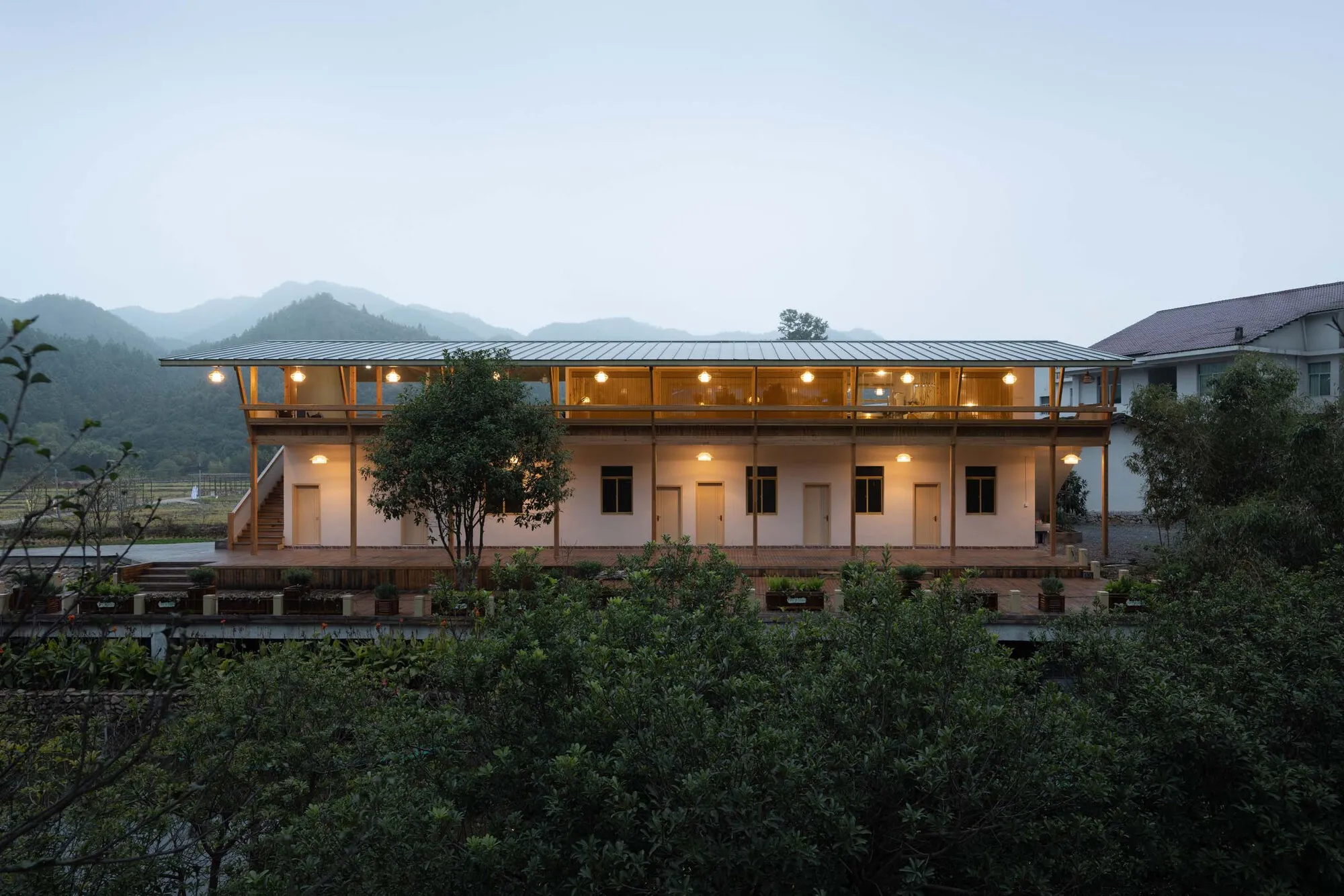
SuiPingYiLi Architecture Studio Saves a Condemned Rural Building and Turns It into a Village Courier Station
A three-month renovation in Fujian Province rescues a doomed structure, giving it new life as the sole tourist destination in Yaoli Village.


In Yaoli Village, nestled among rice paddies and forested mountains in Fujian Province's Shaowu City, a building slated for demolition got a reprieve. SuiPingYiLi Architecture Studio took on the project with a remarkably tight timeline, completing both design and construction in just three months. The result is the Yaoli Village Courier Station, a 425 square meter renovation that has become the village's primary draw for visitors, and in the process, changed how residents think about what architecture can do for a community.
What makes this project worth studying is not the budget or the spectacle but the economy of means. The architects worked with a structure that already existed, layering a new timber-framed identity onto a white stucco base while integrating the building into the surrounding landscape through gravel paths, a retention pond, and careful siting among existing trees. The station functions as a gathering point, a dining venue, and a modest cultural anchor for a village that previously had none. It is rural revitalization stripped of pretension.
A Rescue Operation in Three Months
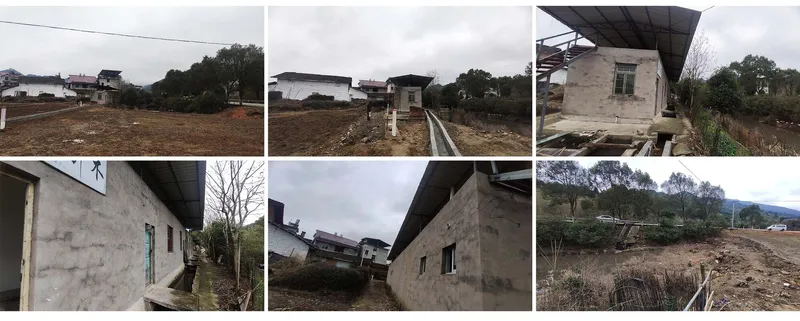
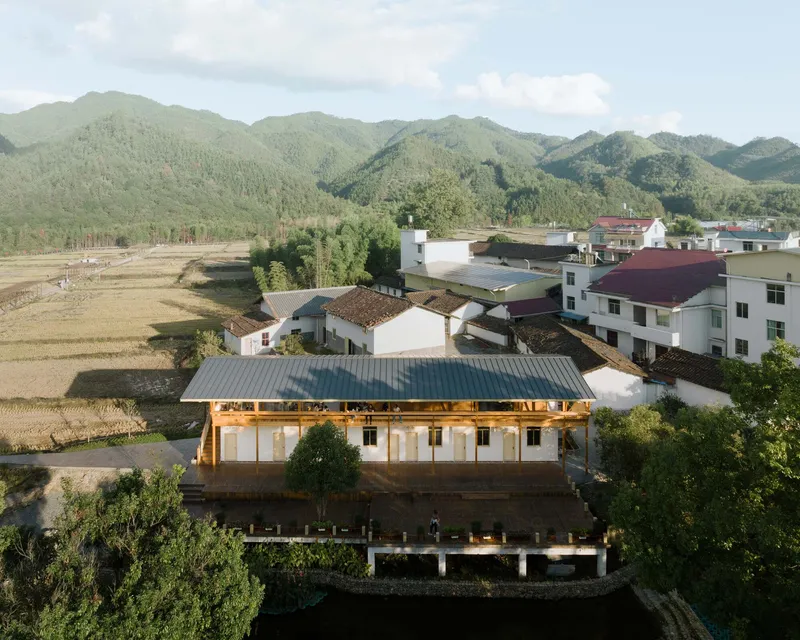
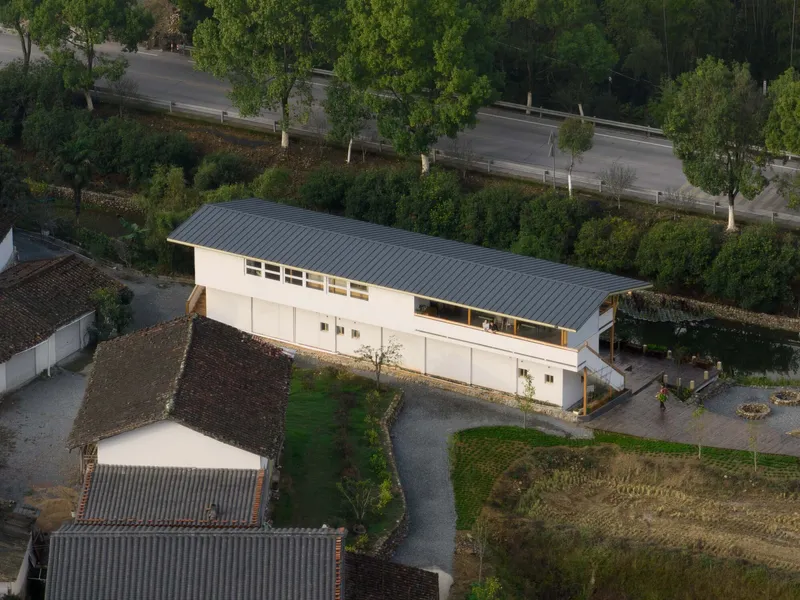
The construction progress images reveal the starting point: a bare concrete skeleton surrounded by churned earth, hemmed in by neighboring village houses. To go from that condition to a finished, functioning building in ninety days required simultaneous design and construction, a process that demands trust between architect and builder and leaves little room for indecision. The aerial views show the completed result sitting comfortably among its neighbors, its corrugated metal roof and clerestory windows distinguishing it without dominating the roofline of the village.
Speed here was not a compromise but a constraint that shaped the design philosophy. By working fast and with available materials, the studio avoided the trap of over-designing for a context that doesn't need it. The building reads as belonging to the village while still being legibly new.
Timber Frame as Identity
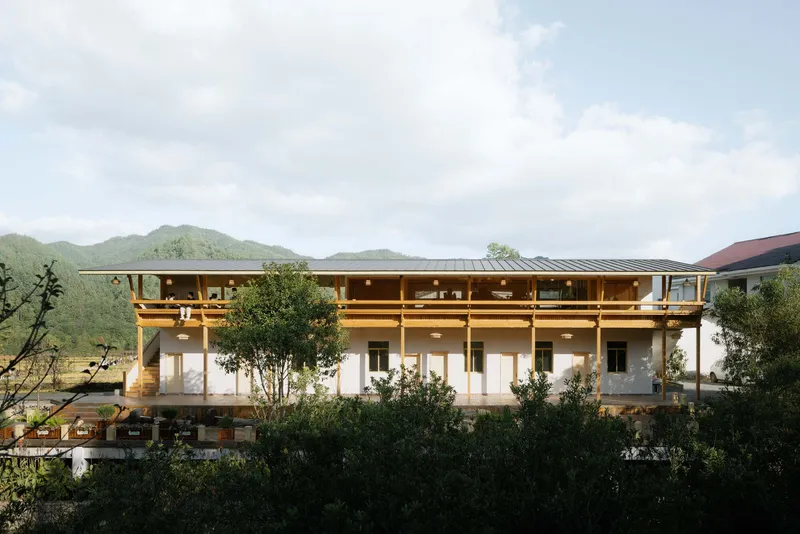


The defining gesture of the Courier Station is its exposed timber structure. On the three-story facade, the frame is fully visible: columns, beams, and cross-bracing creating a rhythm that recalls traditional Fujian carpentry while remaining unmistakably contemporary in its proportions. Deep overhanging eaves shelter the upper levels and cast the ground floor in shadow, a practical response to the subtropical climate that also gives the building visual weight against the mountain backdrop.
At dusk the timber upper level glows from within, turning the building into a lantern visible across the rice fields. The corner detail at image three is particularly revealing: cross-braced timber columns support a cantilevered volume that floats above the ground plane, a structural move that lightens the mass of the building and creates covered outdoor space below without additional construction. It is the kind of detail that earns its keep twice, once as structure and once as atmosphere.
Ground and Landscape


The landscape strategy is restrained but effective. Gravel pathways connect the building to its surroundings, winding beneath overhanging tree branches and past a small retention pond that manages rainwater while providing a reflective surface at the entry. A child running along the path toward the entrance captures the informal, lived-in quality the architects were after. There are no grand gestures, no infinity pools, no statement planting. Just loose gravel, existing trees, and water collected where it falls.
The adjacent white stucco residence with its own timber deck shows the broader village context. SuiPingYiLi calibrated the Courier Station to sit within this vocabulary of simple rendered walls and upper-level decks rather than imposing a foreign language. The elevated timber volume at image seven, framed by tree branches, demonstrates how the building invites approach gradually rather than presenting a singular monumental face.
Interior: Warm and Unfinished in the Best Sense

Inside, the timber frame does double duty as both structure and finish. The dining area visible in image four is defined by the rhythm of exposed beams and bamboo screen partitions that subdivide space without sealing it off. Warm lighting washes the wood surfaces, and the overall effect is closer to a well-built farmhouse kitchen than a designed interior. That quality is deliberate: a courier station in a village of a few hundred people has no use for polished minimalism.
The bamboo screens deserve particular attention. They filter light and views, create zones of relative privacy within the open plan, and reference local material traditions without being literal about it. The screens are screens, not decoration. They work.
The Long Elevation

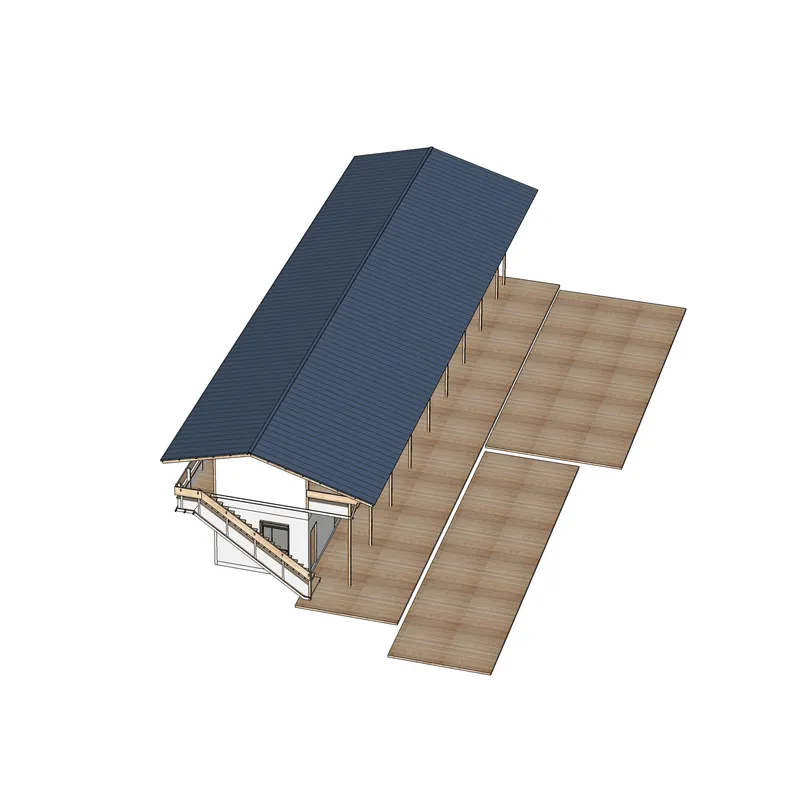
The long elevation at twilight is the most revealing photograph of the project. It shows the bipartite logic clearly: a solid white ground floor with strip windows forms the base, while the glowing timber upper level sits above, its warmth contrasting with the cool stucco below. The proportional relationship between heavy base and lighter crown gives the building a stability that belies its rapid construction. The gabled roof with its dark metal panels and extending timber deck, visible in the axonometric view, completes the composition with a simple profile that reads well from the surrounding fields.
Plans and Drawings
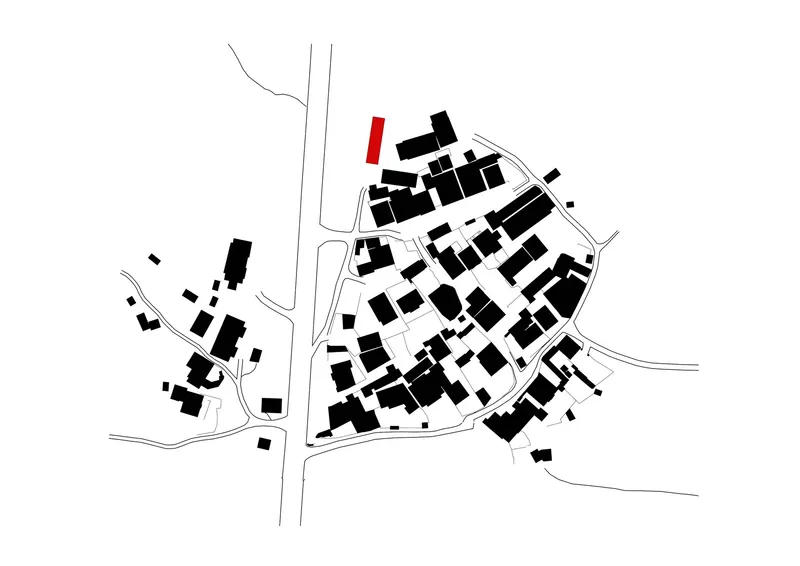
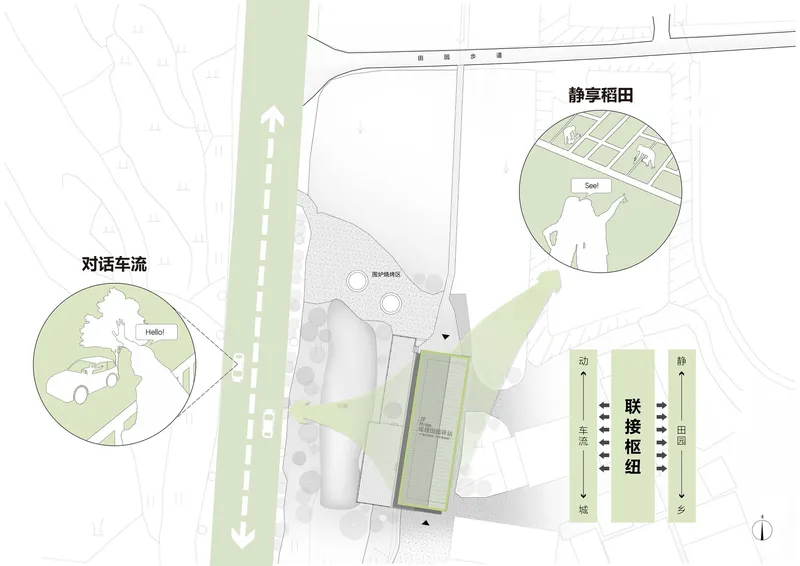


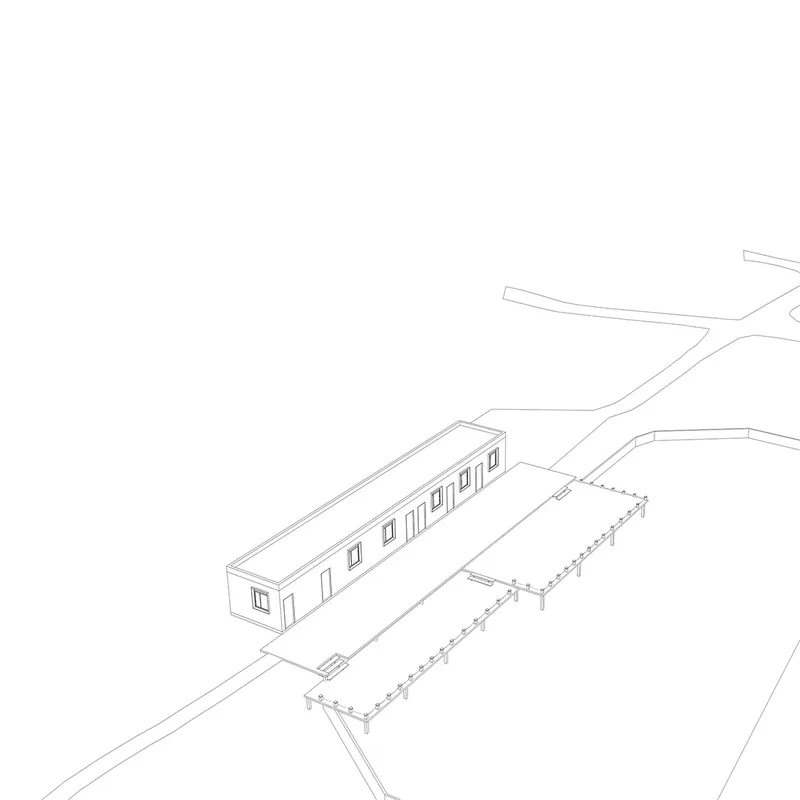


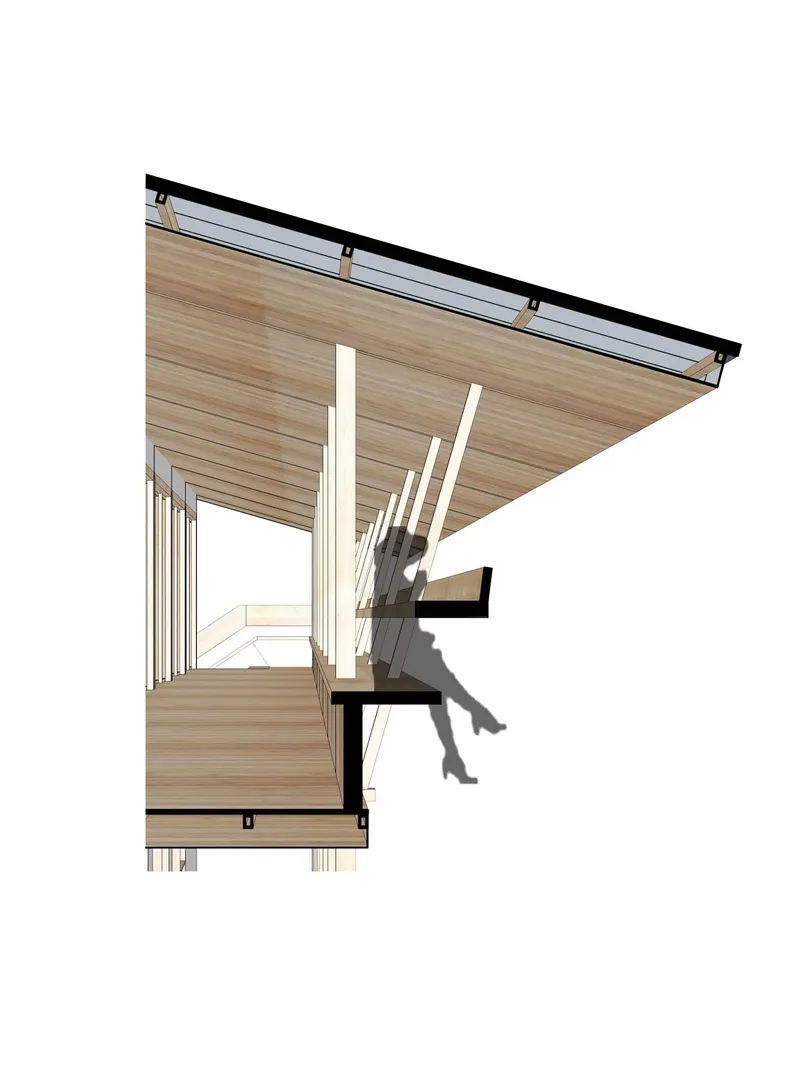


The drawing set tells the story of a project that thought carefully about its place in the landscape. Site plans show the building positioned among existing trees with circulation diagrams that extend paths into the surrounding terrain. The exploded axonometric is particularly useful, breaking the building into its constituent layers: roof panels, structural timber framing, and exterior cladding components. It reveals a relatively straightforward assembly logic, the kind of clarity that makes a three-month build feasible.
The floor plans show a linear arrangement that evolves as it rises. The second floor divides into discrete rooms bracketed by two courtyard voids, while the third floor opens up into a single dining and coffee area with a service counter. The sections confirm the building's relationship to sloping terrain that descends toward a water body, and the elevation drawings of the gabled tower with its exterior stair and horizontal slatted facade bands show a secondary vertical element that anchors the composition.
Why This Project Matters
Rural revitalization in China has produced its share of overwrought gestures: museums without audiences, cultural centers that photograph well and sit empty. The Yaoli Village Courier Station avoids that trap by starting with a building that already existed and a community that needed a functional gathering place, not an icon. The three-month timeline was not a limitation but a discipline that forced the architects to work with what was there rather than imposing what they wished were there. The result is a building that villagers actually use and that has, by the studio's account, changed how they think about what architecture can do for their community.
There is a broader lesson here for anyone working in contexts where resources are scarce and expectations are modest. The Courier Station proves that preservation, even of an unremarkable structure, can yield something greater than demolition and new construction. It proves that exposed timber and bamboo screens, used honestly, can make a space feel specific and cared for. And it proves that a building does not need years of development and a glossy monograph to earn its place. Sometimes ninety days and the decision not to tear something down is enough.
Yaoli Village Courier Station by SuiPingYiLi Architecture Studio. Located in Yaoli Group, Longdou Village, Shuibei County, Shaowu City, Fujian Province, China. 425 m². Completed in 2022. Photography by natureimages- Jianbo Ke.
About the Studio
Share Your Own Work on uni.xyz
If projects like this are the kind of work you want to make, uni.xyz is a place to publish your own, find collaborators, and enter design competitions.



Popular Articles
Popular articles from the community


The Earth Pod: 3D Printed Homes for Resilient Refugee Communities
The Earth Pod reimagines refugee housing through 3D printed homes made from clay, combining resilience, self-sufficiency, and rapid shelter.

Co-Life: Senior Housing Design That Reconnects Older Adults With the City
Co-Life reimagines senior housing design through healing gardens, shared streets, workshops, and a sustainable community across generations.

The Ocean Hive: Sustainable Architecture for a Self-Sufficient Civilization at Sea
The Ocean Hive imagines sustainable architecture at sea, where modular habitats, algae, wave power and ocean waste sustain a growing colony.

Riyadh For All: Intergenerational Urban Design for Active Aging in Rabat
Riyadh For All reimagines urban design in Rabat with intergenerational co-living, adaptive courtyards, and Moroccan cultural exchange today.


Similar Reads
You might also enjoy these articles

Bao Huynh Watercolor Atelier: A Serene Art Retreat in Hội An
Bao Huynh Watercolor Atelier in Hội An blends multifunctional art spaces, sustainable design, local materials, and family-friendly living in a serene environment.

Atelier Macri Concept Store Interior Design by CASE-REAL
Atelier Macri store features a "ko" counter, walnut wood details, cork displays, blending retail, gallery, and seamless customer experiences.

Manuel Vargas Izquierdo Stadium and High-Performance Sports Center: Architectural Excellence in Jalpa de Méndez
The Manuel Vargas Izquierdo Stadium blends sustainable design, inclusive sports facilities, and cultural-inspired architecture, revitalizing Jalpa de Méndez’s public spaces.

KAKR Buluh Awar Hall: Revitalizing Community and Ecology Through Bamboo Architecture
Community built bamboo hall revitalizes Buluh Awar village, empowering youth, restoring ecology, celebrating vernacular craftsmanship through sustainable architecture and culture.

Explore Architecture Competitions
Discover active competitions in this discipline



Challenge to reimagine the Iron Throne


Photograph architecture without architects


Illustrate the lost glory of Angkor Wat - Render Challenge


Design challenge to reuse E-waste
Comments (0)
Please login or sign up to add comments
No comments yet. Be the first to comment!