

Suspended Memory: Industrial Transformation and Kinetic Space in Floating Cabin
Kinetic pavilion in Shanghai transforming industrial dock heritage into suspended, event-driven public space with rotating cabin panels and diffused light.


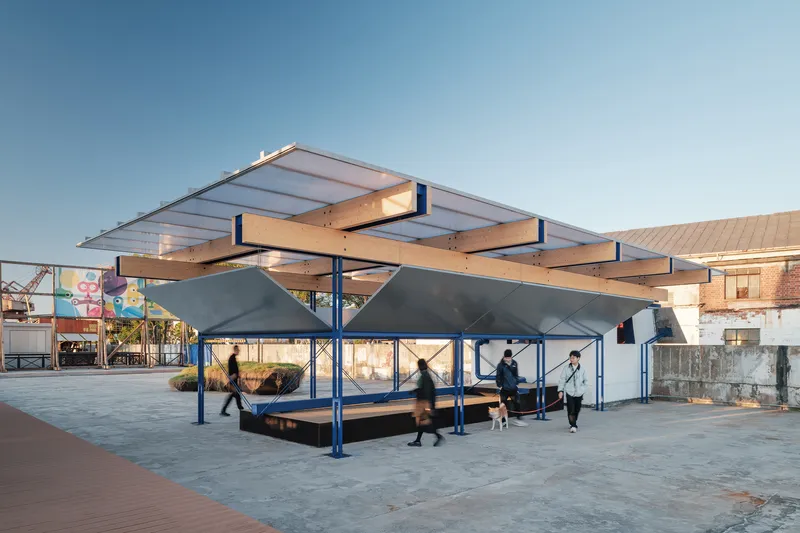
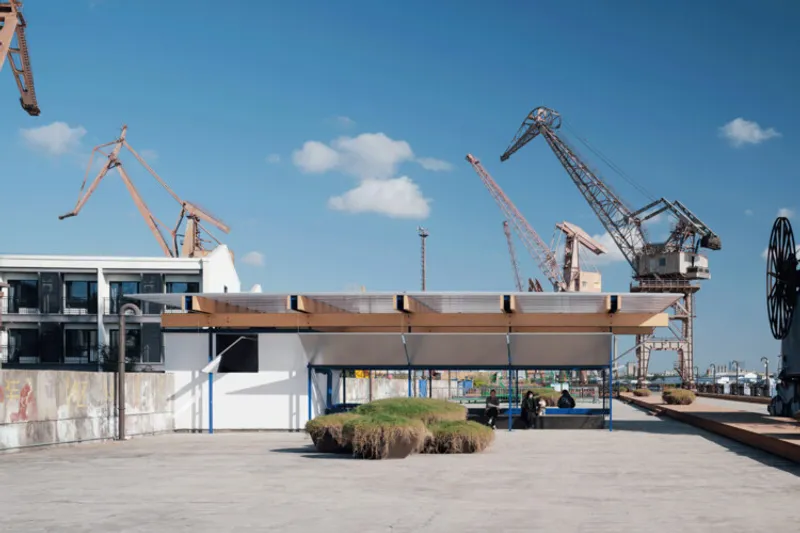
Presented at the 2025 Shanghai Urban Space Art Season (SUSAS), Floating Cabin by Atelier Wen’Arch reimagines an industrial relic as a kinetic public pavilion. Located on the high-pile dock of Fuxing Island Shipyard Park in Yangpu District, Shanghai, the 144-square-meter structure operates simultaneously as installation, performance space, and riverside shelter. More than a pavilion, it is a spatial mechanism: one that suspends memory, structure, and movement within a former industrial landscape.
Industrial Context as Conceptual Origin
The site bears the powerful imprint of Zhonghua Shipyard’s history. Massive cranes, high-pile docks, pump houses, and flood-control walls evoke an era of heavy industry and maritime engineering. Although these elements now remain largely static, they suggest latent motion: the potential of machinery once designed to lift, rotate, and assemble colossal ships.
Atelier Wen’Arch sought to extend this latent dynamism into the design. The name “Floating Cabin” encapsulates this ambition. “Cabin” references the mechanical and maritime vocabulary of the shipyard, an enclosed yet functional unit capable of housing activity. “Floating” suggests suspension, instability, and kinetic potential.
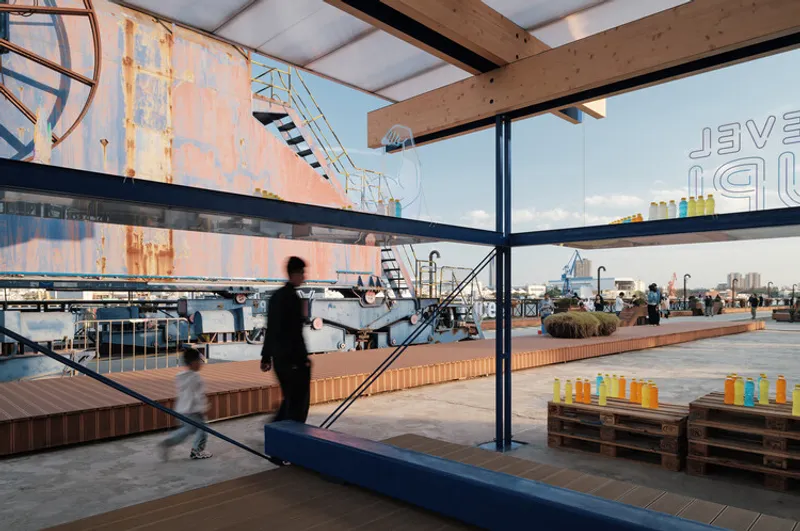

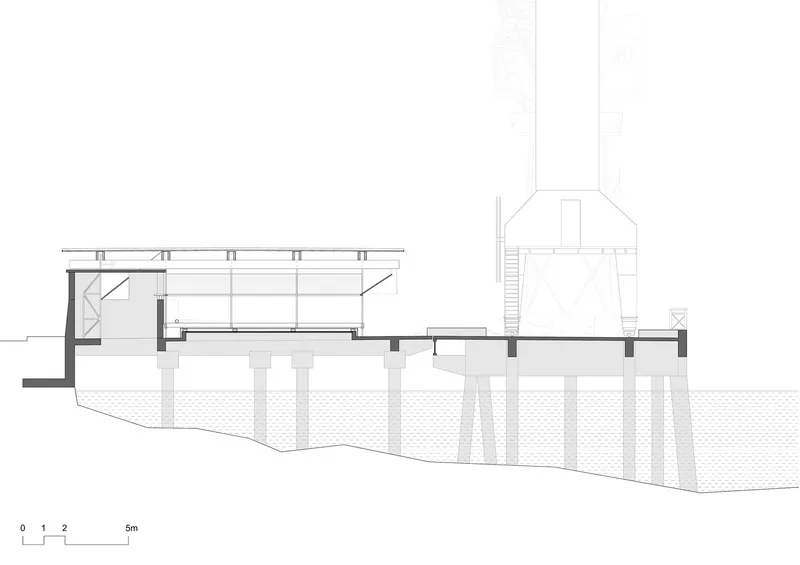
Rather than imposing a new object onto the dock, the architects rooted the project in the site’s existing infrastructure. The abandoned pump house, attached to the flood wall and inaccessible due to the absence of a floor slab, became a central conceptual anchor. Adjacent pipelines and a raised concrete maintenance platform were preserved and incorporated into the new structure, allowing the pavilion to emerge from what was already present.
Structure as Suspension
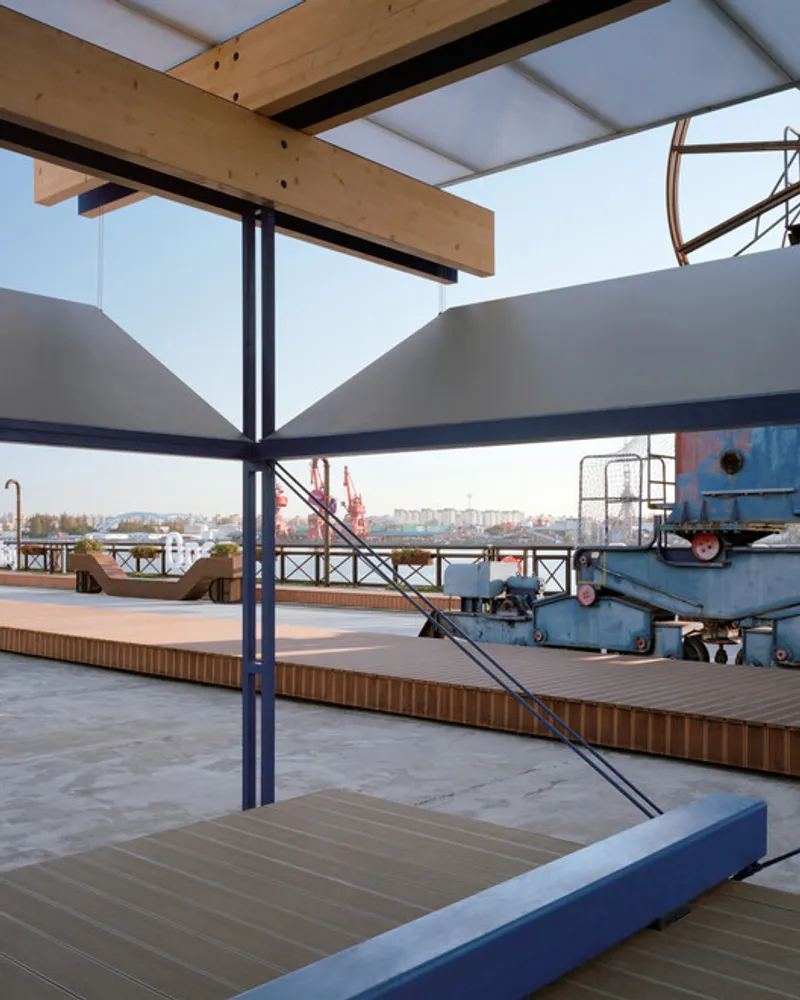
The pavilion’s structural system is deliberately expressive. Slender 50mm steel double columns support a roof composed of overlapping glued laminated timber beams. Between these beams, an integrated equipment zone conceals a mechanical pulley system, an essential component that gives the cabin its transformable character.
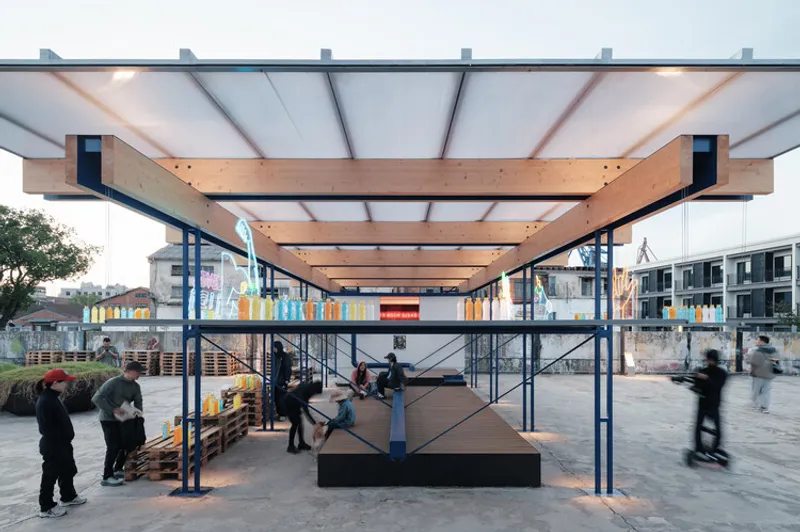

Suspended from cables attached to this system are metal “cabin panels,” painted in Prussian blue, the same hue found on the site’s original industrial components. This chromatic continuity reinforces the pavilion’s connection to the shipyard’s mechanical heritage.
Each panel can rotate at a fixed angle through the pulley system. At their lower ends, diagonal steel tie rods form inverted V-shaped cross-sections, collectively stabilizing the structure while visually evoking tension and suspension. Four sets of these V-shaped tie rods anchor the steel beams to the platform, enhancing lateral stability and reinforcing the pavilion’s dynamic aesthetic.

The entire assembly suggests a ship cabin lifted mid-air, momentarily paused between ascent and descent.
Lightness, Transparency, and Reflection
Despite its mechanical rigor, the pavilion remains open and transparent. The roof, clad in translucent polycarbonate panels, filters direct sunlight into soft, diffused illumination. This gentle light contrasts with the industrial heaviness of the dock, creating a comfortable microclimate beneath.

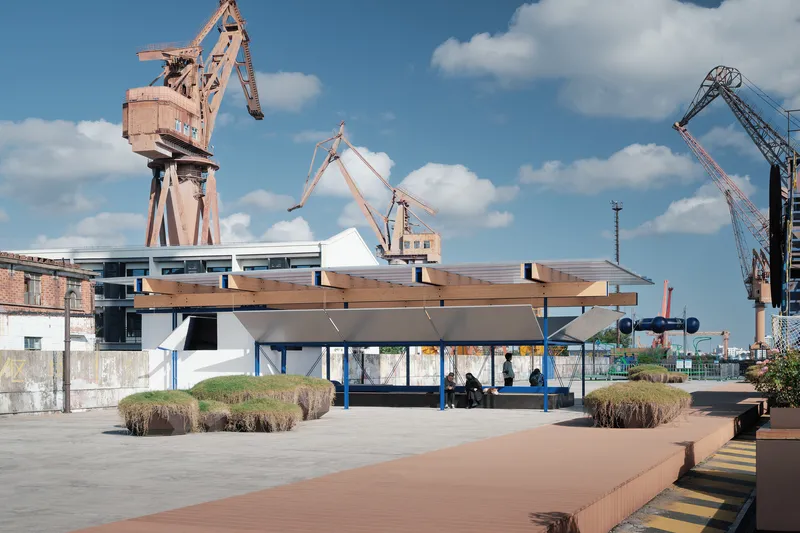
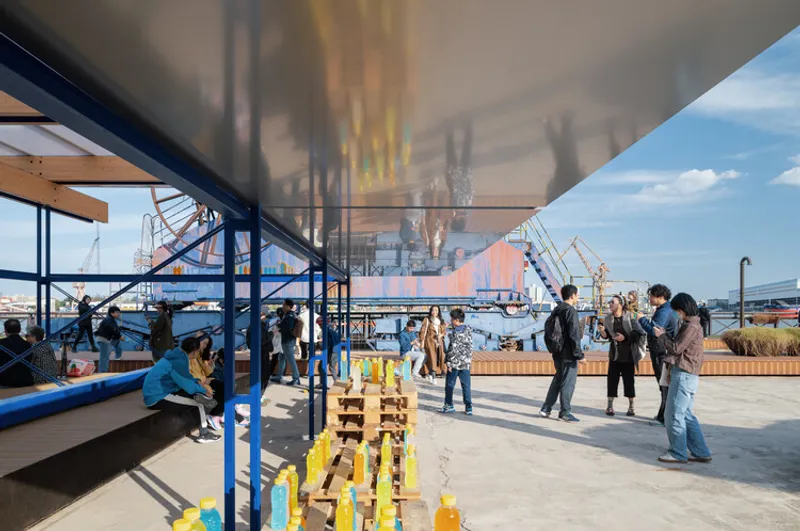
The suspended stainless steel panels subtly mirror their surroundings: the river water, passing pedestrians, and remnants of industrial machinery. These reflections blur boundaries between object and context, allowing the pavilion to absorb and reinterpret its environment.
The original elevated maintenance platform has been transformed into a 40-centimeter-high wooden deck, offering a warm resting surface. While spatially attached to the pump house, the new structure remains structurally detached, preserving the integrity of the historic fabric.

A particularly poetic gesture occurs on the west side, where the eighth suspended panel passes through the pump house’s window opening before shifting direction to align parallel with an eastern panel. This movement frames views of the river and a lighting installation bearing the words “empty room 2025susas.” The inaccessible pump house becomes an artistic “empty room”, a preserved void representing industrial memory.


Kinetic Transformation
In its resting state, the suspended panels tilt upward, forming a stable sheltered volume below. From the outside, the structure appears like a floating industrial module, its angled surfaces defining a calm, shaded refuge for visitors strolling along the riverbank.
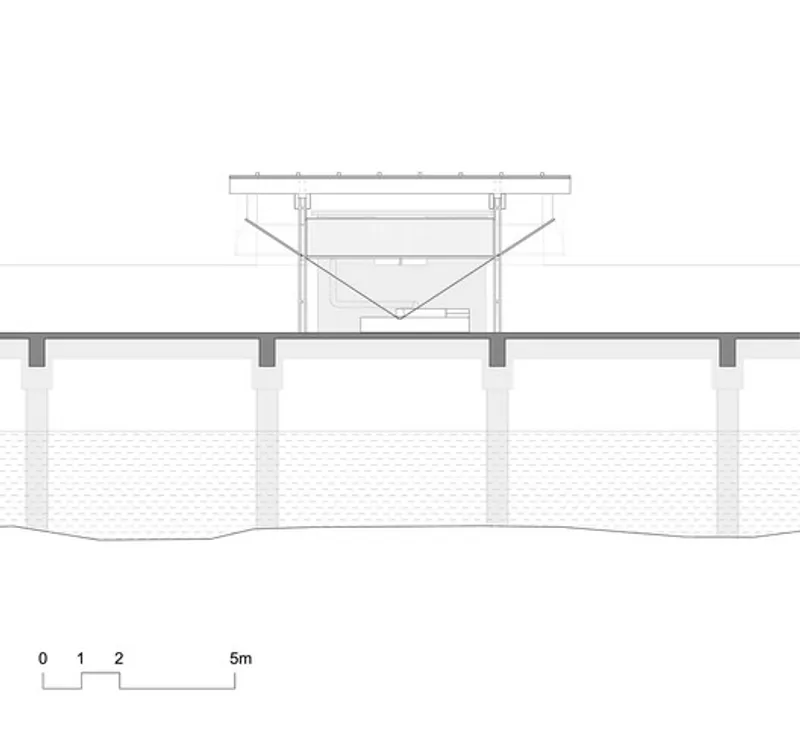
When activated, however, the mechanical pulley system rotates the deck to a horizontal position. The pavilion transforms from an enclosed shelter into an open, layered platform. In this configuration, the horizontal surface functions like a mezzanine in a traditional market hall: capable of hosting exhibitions, temporary installations, or even a future rooftop garden.
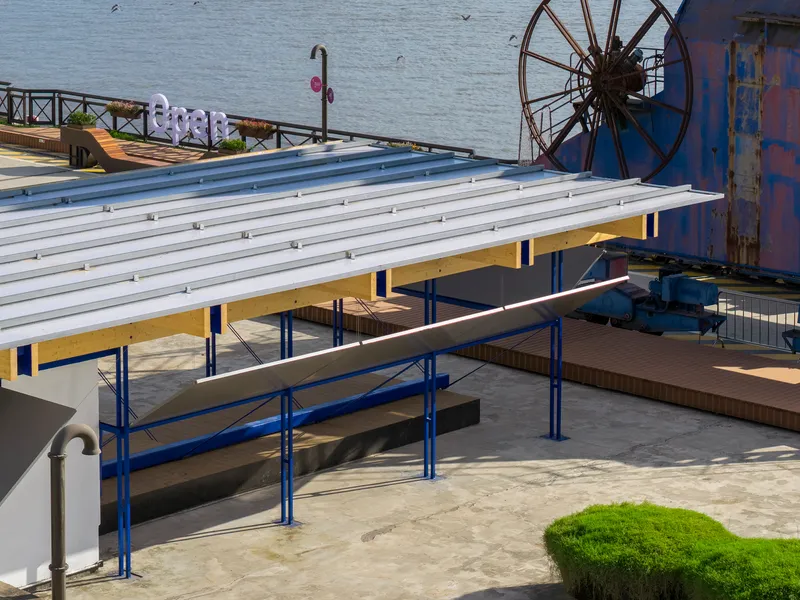

This adaptability redefines the pavilion’s typology. It is neither purely static nor permanently open. Instead, it responds to events and changing conditions, shifting its spatial configuration according to need.
Public Life and Event Activation
Since its inauguration, Floating Cabin has hosted concerts, pop-up markets, and exhibitions. It even served as the finish line for the “Run, Liangzai!” urban running event, where the horizontal deck was adorned with neon lighting and sports refreshments. In such moments, the pavilion’s industrial aesthetic merges with festive vibrancy.
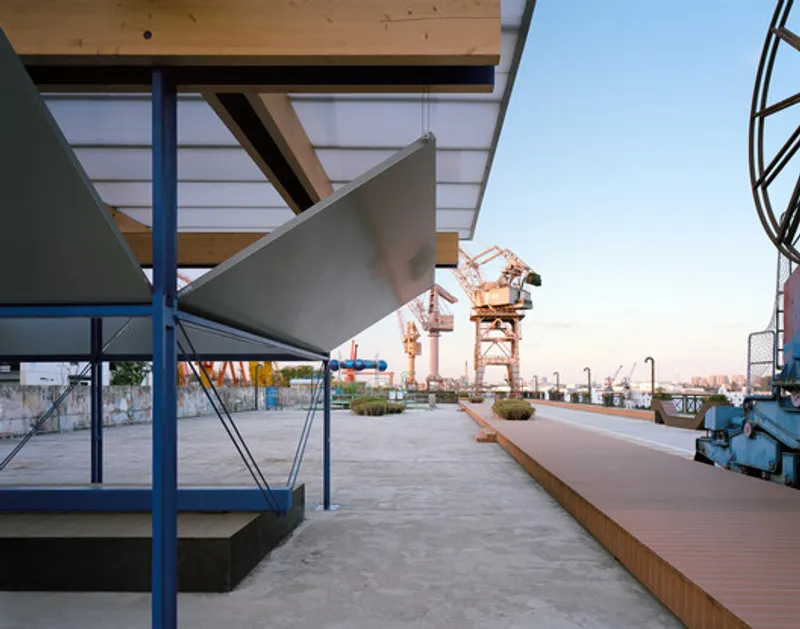

Its flexibility allows it to operate as both contemplative riverside shelter and dynamic event stage. Citizens can rest beneath its angled panels during quiet afternoons, while at night it may transform into a luminous backdrop for performances.

This duality reflects contemporary urban demands. Public spaces must accommodate unpredictability, seasonal programming, and shifting social patterns. Floating Cabin addresses this need through mechanical adaptability rather than fixed form.
Beyond Typology
Atelier Wen’Arch describes the pavilion as a “machine-like structure without fixed typology.” Its identity lies in potential rather than permanence. By embedding kinetic capacity within a historically charged site, the architects bridge industrial memory and contemporary uncertainty.

The pavilion captures the essence of shipyard machinery, static yet capable of movement. As the suspended panels shift from angled suspension to layered horizontality, the space transitions from quiet pause to active platform. This transformation embodies a broader narrative: the evolution of industrial infrastructure into civic cultural space.
Floating Cabin is therefore more than an exhibition piece for SUSAS 2025. It is an experiment in adaptive public architecture, one that honors the past while anticipating fluid urban futures.

All the photograhps are works of Hao Chen, Guowei Liu




Popular Articles
Popular articles from the community

EW PARK: Sustainable Architecture Reimagines the Future of Urban Parking
EW PARK reimagines city parking as a modular wooden tower combining automation, solar energy, electric mobility, and adaptable urban design.

The Earth Pod: 3D Printed Homes for Resilient Refugee Communities
The Earth Pod reimagines refugee housing through 3D printed homes made from clay, combining resilience, self-sufficiency, and rapid shelter.
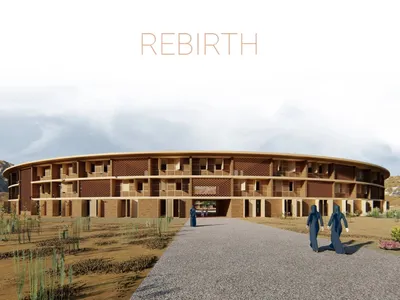
REBIRTH: Sustainable Architecture Shaped by Community, Resilience and Renewal
REBIRTH uses sustainable architecture, circular design, local materials and shared spaces to restore community, dignity and hope for widows.
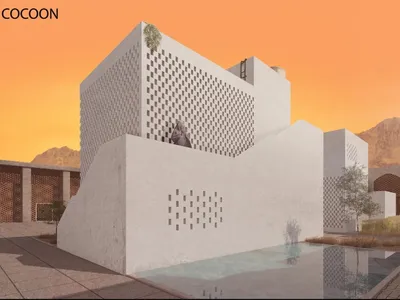
A Reinforced Cocoon: Vernacular Architecture for Security, Healing and Community in Qandahar
A Reinforced Cocoon reimagines Afghan vernacular architecture as secure community space for widowed women, families, healing and resilience.

Similar Reads
You might also enjoy these articles


FAMM Arquitectura Organizes Ten Villas Around Courtyards and Jungle in Nosara, Costa Rica
El Molino pairs two elongated volumes with deep overhangs and timber louvers to build a compact coastal community five minutes from the beach.

Oscar Niemeyer's Ibirapuera Park Pavilions Define São Paulo's Cultural Identity in Concrete and Curve
A constellation of modernist volumes set within São Paulo's most important urban park, conceived for the city's 400th anniversary in 1954.
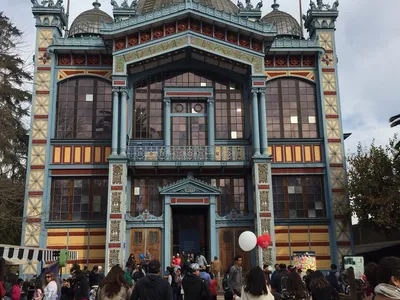
How Henri Picq's 1889 Paris Pavilion Traveled 11,000 Kilometers to Become Santiago's Artequín Museum
A prefabricated iron and glass pavilion built for the Paris Universal Exposition found a second life as a children's art museum in Chile.

Sanjay Puri Architects Wraps a Jaipur Office Tower in Capsule-Shaped Green Buffers
A nine-level climate-responsive workplace near Jaipur Airport uses stacked planter terraces and aluminium screens to fight 40°C heat.


Explore Architecture Competitions
Discover active competitions in this discipline



The International Standard for Design Portfolios


The Global Benchmark for Architecture Dissertation Awards


The Global Benchmark for Graduation Excellence


Challenge to reimagine the Iron Throne
Comments (0)
Please login or sign up to add comments
No comments yet. Be the first to comment!