
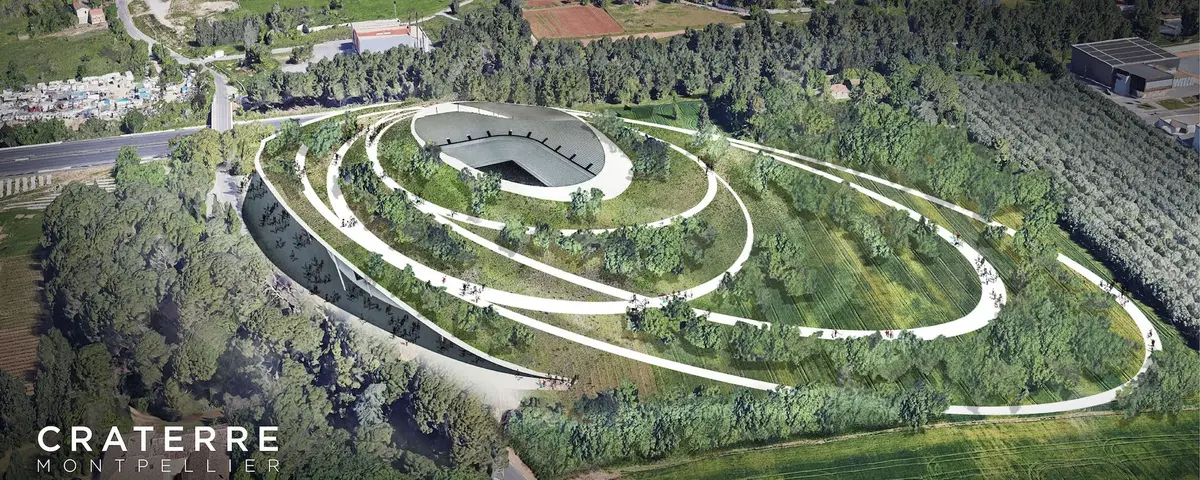
Craterre Montpellier: A Stadium Designed to Disappear into a Park
A modular green stadium along a north-south ecological corridor that transforms into public landscape after its sporting life ends.


What happens to a stadium when the crowds stop coming? Most cities are left with concrete husks that drain maintenance budgets for decades. Craterre Montpellier proposes a radically different exit strategy: a high-capacity football venue whose structure, materials, and site logic are calibrated from day one to dissolve into a public park. The stadium is not merely green-washed; it is conceived as a temporary phase in the life of a permanent landscape.
Designed by Giovanni Vaccarini, the project received the Organizer's Choice Award in the Staydium 2020 competition, which challenged entrants to rethink stadium typologies for sustainability and community value. Sited in Montpellier, Craterre positions itself along a "green corridor" running from Le Bosses Nature Reserve in the north all the way south toward the sea, threading through the city's urban fabric to stitch ecology and infrastructure together.
A Dome on a Highway Edge: Anchoring the Green Corridor
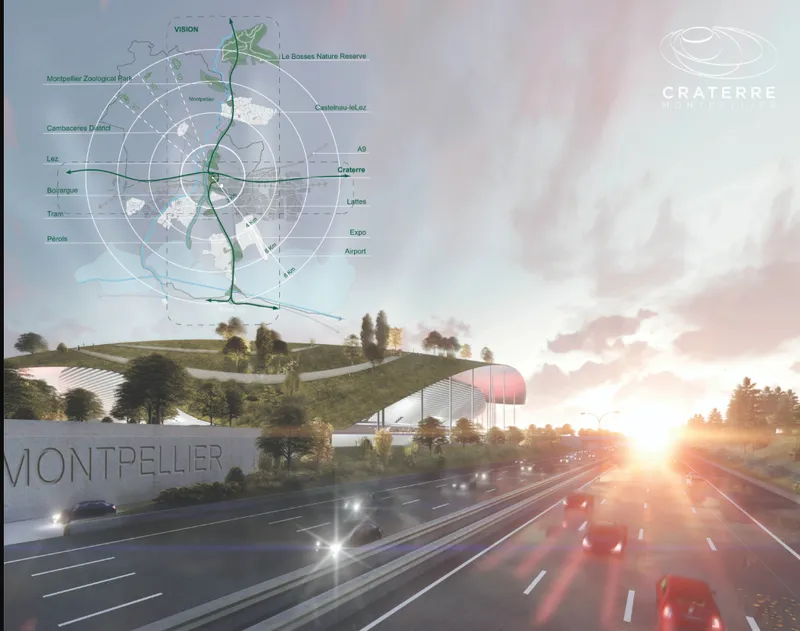
The opening rendering places the domed stadium structure alongside a highway, its curved profile silhouetted against a sunset sky. A radial site diagram overlaid on the image reveals the project's broader ambition: the building is not an isolated object but a node within a territorial ecological strategy. The green corridor concept means that the stadium's landscape is continuous with habitat beyond its boundaries, connecting the nature reserve to the coast. Positioning the venue at the intersection of highway corridors gives it visibility and access while reinforcing the idea that infrastructure and ecology can coexist rather than compete.
After the Final Whistle: Pavilion, Lawn, and Public Life
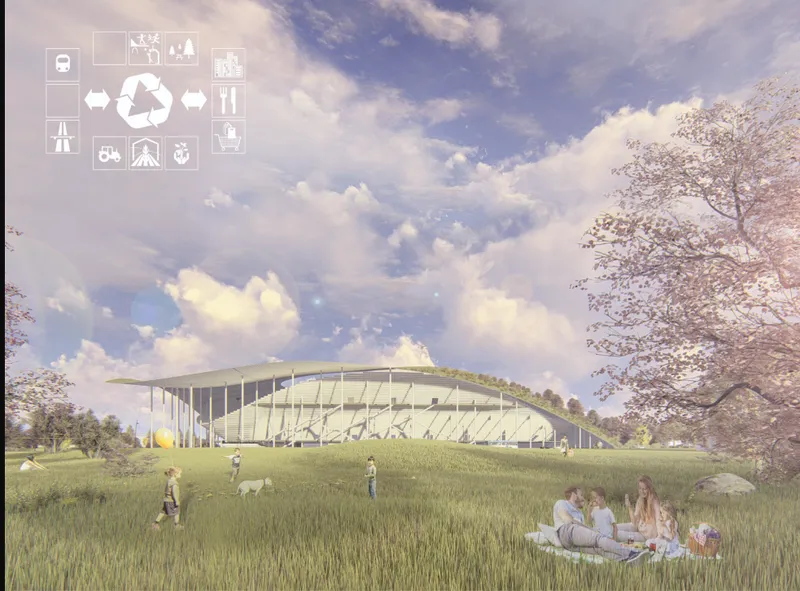
The second image offers a glimpse of the project's afterlife. A faceted glass pavilion with a planted green roof overlooks a generous lawn where families picnic under open sky. This is the stadium's second act: once modular seating and event infrastructure are removed, what remains is a public landscape with walking trails, recreational areas, and a thriving ecosystem for wildlife and flora. The pavilion's crystalline geometry suggests that certain permanent elements are designed with enough architectural ambition to justify their persistence, serving as community gathering points long after the sporting program has moved on.
Inside the Bowl: Open Sky and Collective Energy
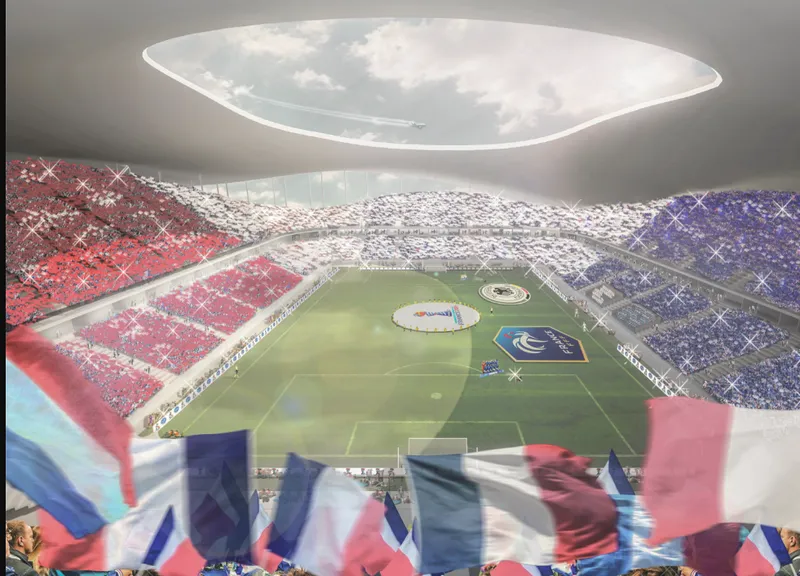
From within, the stadium reads as a focused, intense sporting environment. An oval roof opening frames the sky above the pitch while packed stands of flag-waving spectators generate the atmosphere any football venue needs. The oculus is more than dramatic; it floods the playing surface with natural light and ventilation, reducing reliance on artificial systems during its operational life. The tension between this roaring interior and the serene parkland shown in the previous image is precisely the point: Craterre is designed to hold both realities, separated not by demolition but by a planned, graceful transition.
Terraced Landscape Between Two Highways
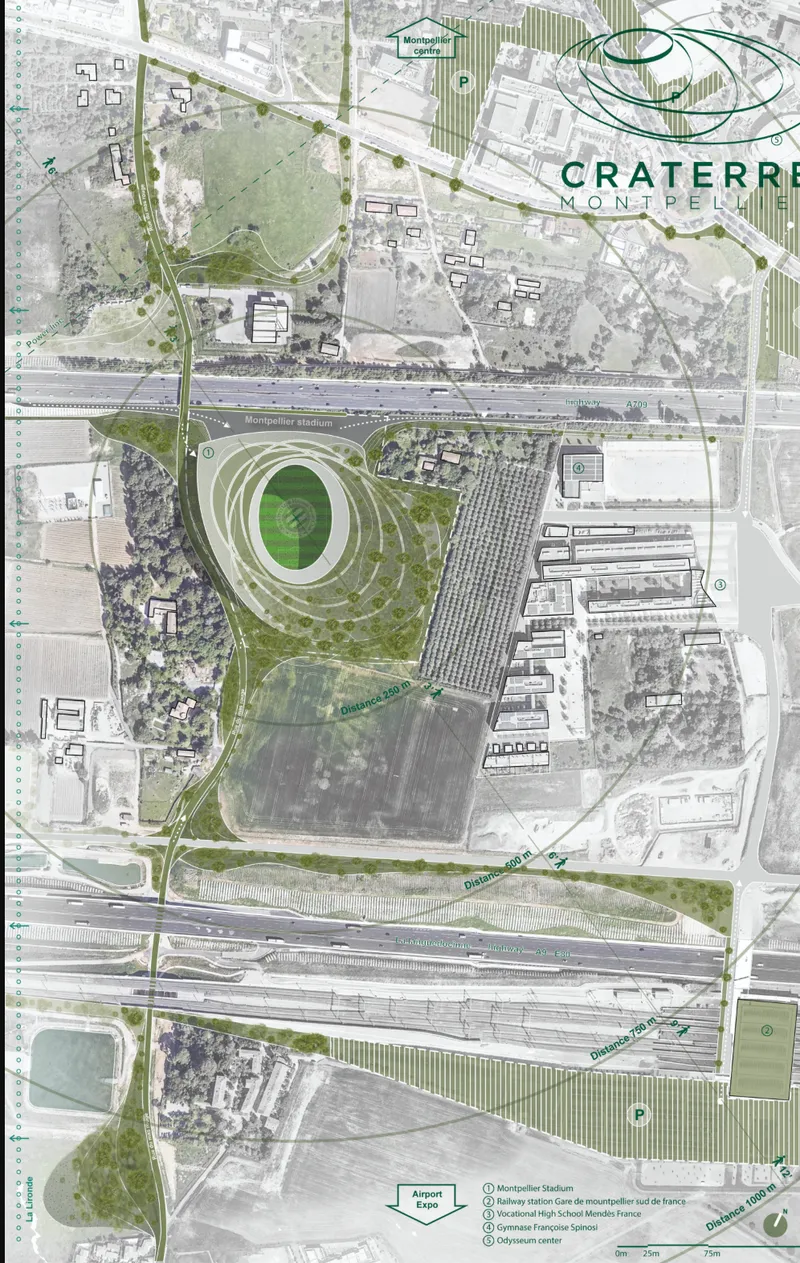
The site plan drawing clarifies the project's spatial logic. The oval stadium footprint sits within a terraced landscape that cascades outward, negotiating the grade between two flanking highway corridors. These terraces serve a dual purpose: during the venue's active years, they manage pedestrian flow and provide informal gathering space; in the park phase, they become topographic features that define walking trails and planting zones. The drawing shows how seriously the project takes its site, treating the surrounding ground not as leftover space but as the very medium through which architecture and ecology merge.
Why This Project Matters
Stadium design discourse tends to oscillate between spectacle and sustainability as though the two are mutually exclusive. Craterre Montpellier sidesteps this false choice by embedding an end-of-life scenario into the design brief from the outset. The modular, adaptive structure acknowledges that a city's needs shift over decades, and that the most responsible thing a building can do is plan for its own graceful obsolescence.
Giovanni Vaccarini's proposal also reframes what it means for a stadium to be "community-centered." Rather than bolting on token public amenities, the project makes the community park the primary long-term program, with the stadium functioning as a temporary, revenue-generating phase that funds the landscape's establishment. It is a compelling inversion of priorities, and one that cities grappling with post-event white elephants would do well to study.
View the Full Project
About the Designers
Designer: Giovanni Vaccarini
Enter a Design Competition on uni.xyz
uni.xyz runs architecture and design competitions year-round that reward proposals with spatial conviction and real site intelligence.
Project credits: Craterre by Giovanni Vaccarini Staydium 2020 (uni.xyz).


Popular Articles
Popular articles from the community


David Macias Steps a Doorless Stone and Plaster House Down a Tropical Colombian Hillside
In the humid hills of Colombia, Threshold House replaces the front door with an open void and terraces its 850 m² down the slope instead of fighting it.

David Ortega Stacks a Two-Story Mexico City Penthouse Around a Steel Stair and a Pergola-Shaded Roof Terrace
In Colonia Roma, a 300 m² penthouse uses oak joinery, a planted steel stair and a slatted roof pergola to make a new-build apartment feel like a house.

GROUP A Strips a 1969 Rotterdam Harbor Headquarters to Its Frame and Wraps It in Timber Louvers
In Rotterdam's M4H harbor district, Ferro Offices reuses a 1969 frame, adds one timber storey and reaches BREEAM-NL Outstanding.

Cube Design Draws an Ecological Corridor Between Two Shenzhen Hills with the Nankai Building
Beside Shenzhen's container docks, the Nankai Building pairs stacked balconies with a climbing green screen to connect two hillsides across its height.

Similar Reads
You might also enjoy these articles

Gil Mello Arquitetura Tilts a Single Roof Toward the Waterfalls on a Plateau Above Aiuruoca, Brazil
In Aiuruoca, Minas Gerais, a 200 m² house of local labor and reclaimed poles pairs a low valley veranda with a tall mountain one.

U.GA Architects Wraps an Oval Rooftop Pool in Curved Board-Formed Concrete on Busan's Jeollidan-gil
In Busan's Jeonpo-dong, a 454 m² mixed-use block stacks a neighborhood facility, guest rooms and an oval rooftop pool inside spiraling concrete walls.

Felipe Hess Arquitetos Turns a Blind Stone Wall to the Street and Opens a Brazilian House onto a Courtyard and Canal
A canal-front house in Brazil hides behind painted stone and planting, then opens to an olive-tree courtyard, a reed-ceilinged porch and a curving pool.
David Macias Steps a Doorless Stone and Plaster House Down a Tropical Colombian Hillside
In the humid hills of Colombia, Threshold House replaces the front door with an open void and terraces its 850 m² down the slope instead of fighting it.

Explore Stadium Competitions
Discover active competitions in this discipline

Challenge to design a barrier free sports center

Challenge to design an outdoor ice-rink and park
Comments (0)
Please login or sign up to add comments
No comments yet. Be the first to comment!