
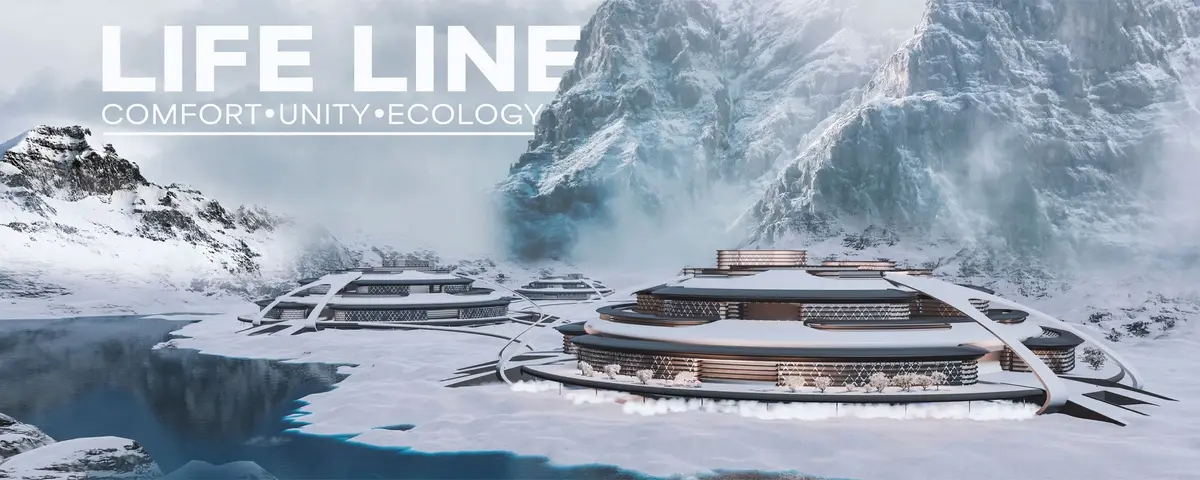
Life Line: A Self-Sustaining Arctic City Built on Euler Circles
Concentric circular zones organize work, leisure, and ecology into a living urban organism on the northernmost settlement on Earth.


What if a city could grow like a living organism at the edge of the habitable world? The Life Line project takes that provocation seriously, proposing a self-sustaining urban settlement for the Arctic that organizes its entire programme around concentric circular geometries derived from Euler Circles. Each ring serves a distinct function (work, leisure, education, community) while overlapping zones create shared spaces that reinforce social cohesion and resource efficiency. The result is not a fortress against the cold but a symbiotic extension of the landscape, designed to restore glaciers as much as to shelter inhabitants.
Designed by Филипп Трофимчук as a runner-up entry in the EHC - Arctic competition, Life Line situates itself at what the designer calls the northernmost settlement on Earth, marking both the final point of the Arctic's past and the beginning of its sustainable future. The project confronts the core obstacles of Arctic urbanization: extreme cold, limited daylight, fragile ecosystems, and the logistical nightmare of supplying a remote community. Its answer is a closed-shell architecture that retains heat internally while deploying reflective surfaces and controlled ecological zones to maintain environmental balance externally.
Circular Modules Against a Frozen Horizon
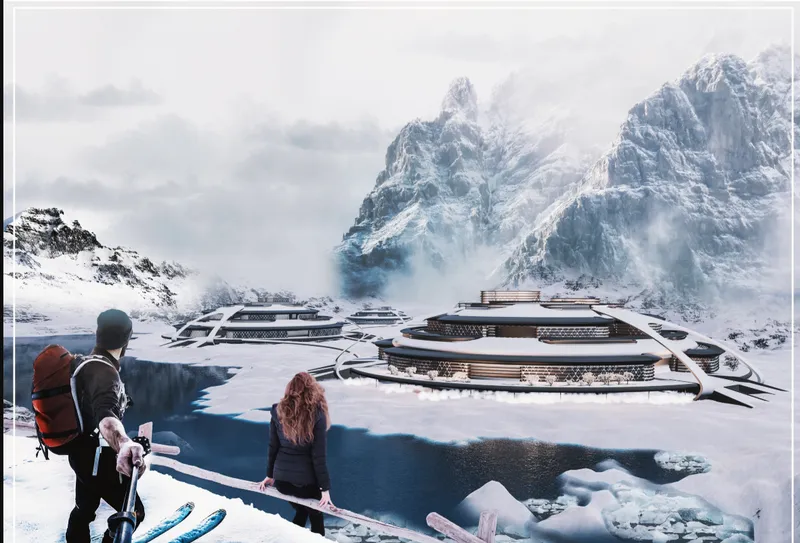
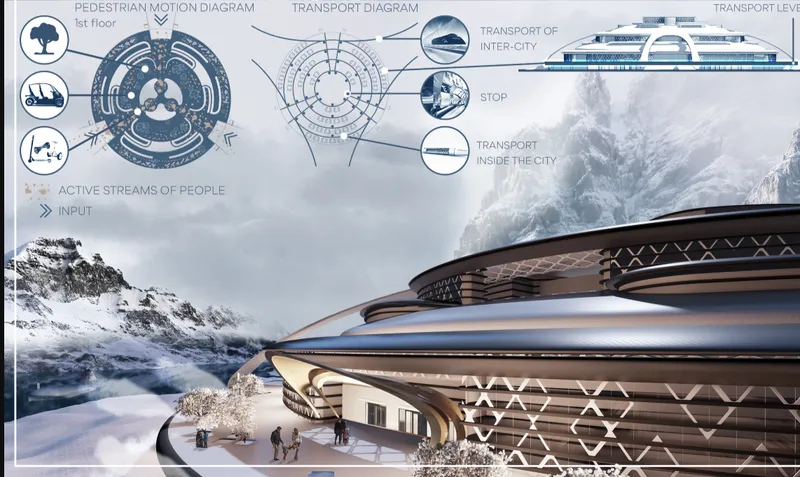
The first views of Life Line establish its essential relationship with the terrain. Circular modular structures sit on a frozen lake, framed by snow-covered peaks, their layered horizontal bands and diamond-patterned glazing catching what little Arctic light is available. The forms read as geological formations as much as buildings, their low profiles minimizing wind exposure while their curved surfaces shed snow loads naturally. Two figures with skis survey the settlement from a ridge, a small but important compositional choice that grounds the scale of the proposal in human experience rather than abstract urbanism.
Euler Circles as Urban Logic
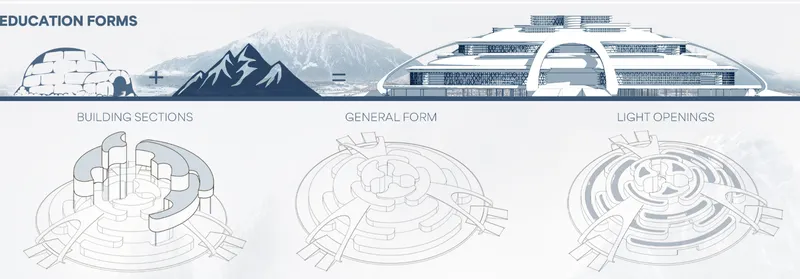
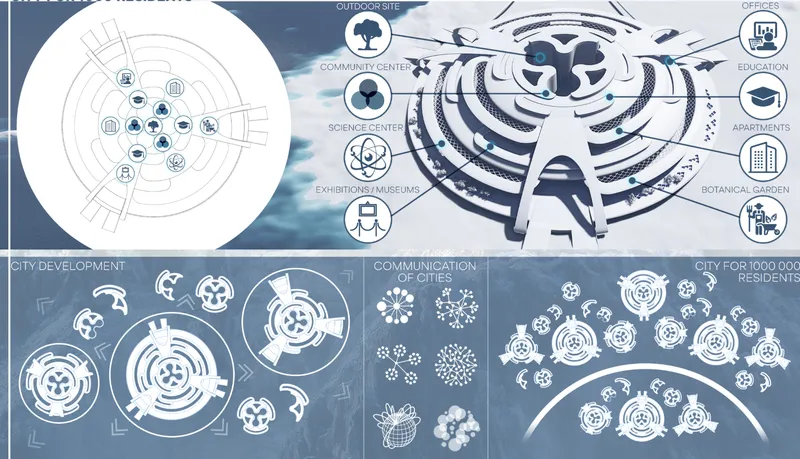
The conceptual engine of Life Line becomes legible in its diagrammatic drawings. Sectional and plan views reveal how each circular building form is organized around light openings that funnel daylight deep into interior spaces, a critical strategy where polar night can last months. The Euler Circle logic is clearest in the plan diagrams: concentric rings define programmatic zones, and where circles overlap, hybrid spaces emerge for community interaction. The city development patterns shown in the axonometric views suggest a phased growth model, where new circular modules are added over time, each one locking into the existing network like cells in a tissue.
This organizational strategy does more than solve a planning problem. It ensures that no single function is isolated, that a resident walking from a workspace to a leisure zone necessarily passes through a communal threshold. The intersections are where the social life of the city concentrates, a deliberate inversion of the typical Arctic settlement where buildings are scattered and movement between them is an ordeal.
Energy Systems Under the Dome
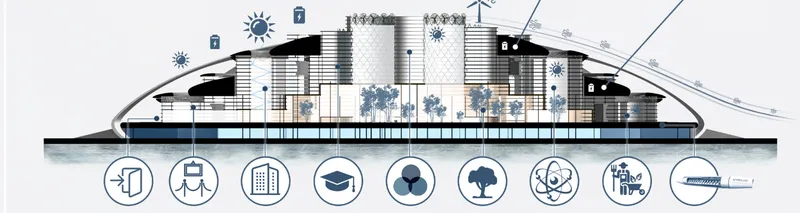
A key section drawing reveals the energy infrastructure embedded within Life Line's domed structures. Wind turbines and solar panels are integrated into the building envelope itself, not appended as afterthoughts. The closed-shell design retains heat generated by inhabitants and equipment, while innovative cooling and irrigation systems counteract localized warming effects. Interior programme icons indicate a dense vertical stacking of functions beneath each dome, from residential levels to agricultural zones, compressing what would normally be a sprawling settlement into a compact, energy-efficient volume.
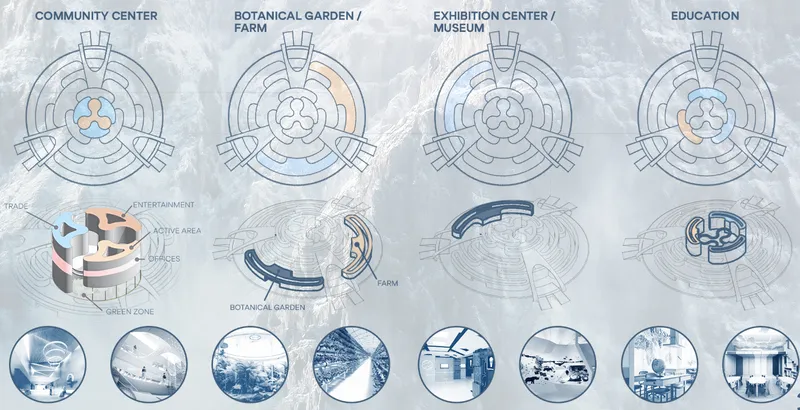
Further plan and axonometric diagrams break down four distinct circular building types, each with a different programmatic core and spatial configuration. Some prioritize residential density, others concentrate on research or food production. The variety is deliberate: the designer identifies diversity of the built environment and its functions as the primary factor in urban development. By differentiating each module while connecting them through shared infrastructure, Life Line avoids the monotony that plagues many proposals for extreme-environment habitation.
Landscape as Architecture, Architecture as Restoration
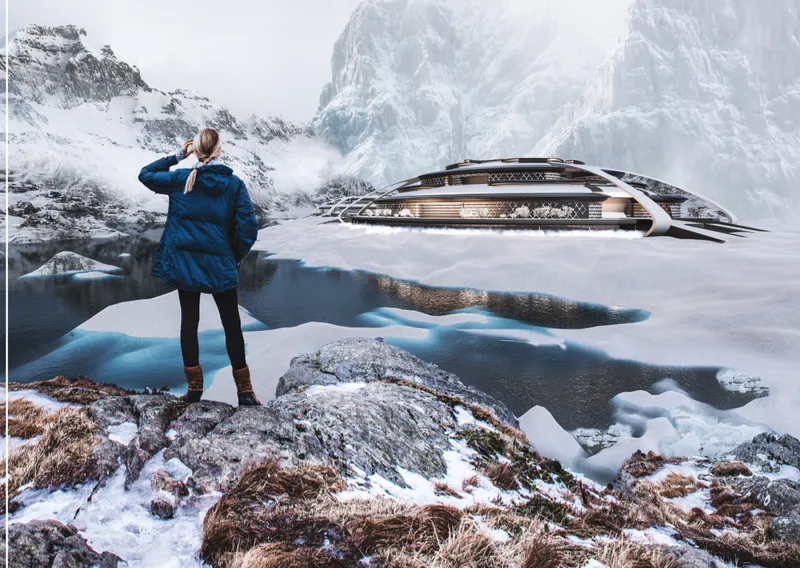
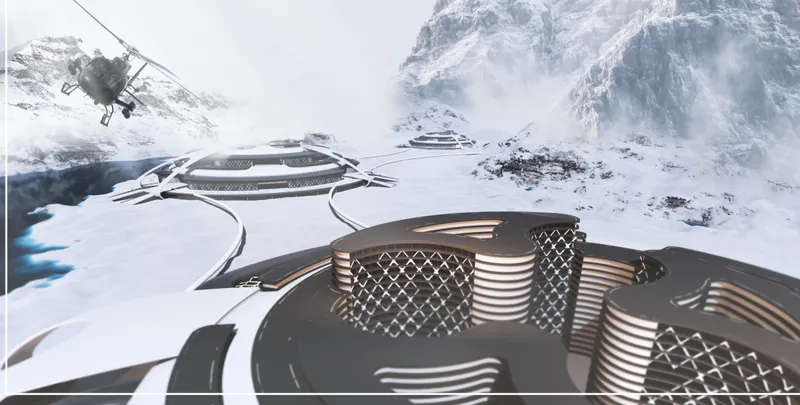
The final renders pull back to show Life Line in its full environmental context. A solitary figure stands on a snowy rock ledge, looking across an alpine lake toward a horizontally layered structure that barely distinguishes itself from the strata of the surrounding mountains. From above, curved roof volumes with lattice and ribbed openings nestle into snow-covered terrain, their apertures suggesting a building that breathes with the landscape rather than sealing itself off from it. The use of reflective surfaces across these roofs serves a dual purpose: bouncing solar radiation to mitigate localized warming and visually dissolving the architecture into its icy surroundings.
Perhaps the most ambitious element of the project is its glacier restoration initiative. Water intake, desalination, and controlled freezing processes are proposed to create new ice formations, actively counteracting climate change rather than merely adapting to it. The city becomes an instrument of ecological repair, a settlement that leaves its environment in better condition than it found it. For a project that accommodates both permanent residents and tourists, this dual mandate of habitation and restoration sets a provocative benchmark.
Why This Project Matters
Most Arctic architecture proposals default to survival mode: keep the cold out, keep the people in, minimize contact with a hostile environment. Life Line rejects that premise entirely. By treating the Arctic as a landscape to collaborate with rather than defend against, the project opens a far more productive line of inquiry. Its Euler Circle planning logic, its phased growth model, and its glacier restoration systems all point toward an architecture that is generative rather than merely protective.
As a runner-up in the EHC - Arctic competition, Филипп Трофимчук's entry demonstrates that the conversation about extreme-environment design has matured beyond bunker aesthetics and sci-fi speculation. The real challenge is not building in the cold; it is building in a way that acknowledges responsibility for the ecosystems we inhabit. Life Line takes that responsibility as its starting point and builds an entire urban vision from it.
View the Full Project
About the Designers
Designer: Филипп Трофимчук
Enter a Design Competition on uni.xyz
uni.xyz runs architecture and design competitions year-round that reward proposals with spatial conviction and real site intelligence.
Project credits: "LIFE LINE by Филипп Трофимчук EHC - Arctic (uni.xyz).


Popular Articles
Popular articles from the community


Faces of the Soviet Avant-Garde: Turning Moscow's Street Names into an Open-Air Museum
A network of sculptural installations across a Moscow residential district transforms forgotten architect names into spatial encounters with cultural memor

Temporary Home for Dogs: A Reversed Zoo Rethinks Animal Shelter Architecture
In Bucharest, a sinuous corridor and freed landscape flip the logic of containment, designing a shelter that works to make itself unnecessary.

The Amber Palace Opera: A Geological Fiction Surfaces on Tallinn's Baltic Waterfront
Pierre Brillard reimagines a Baltic legend as a public landscape, opera house, and waterfront promenade rooted in Tallinn's coastal identity.

Cloaked Colonization: A Mobile Underwater Habitat That Moves Like a Fish
Micah Abaya's shortlisted EHC Pacific entry reimagines ocean settlement as a dispersed network of self-sustaining architectural organisms.

Similar Reads
You might also enjoy these articles

Shakur's House: Exposed Brick as an Interior Organiser in a 168 m² Mashhad Residence
Brick moves indoors in this Mashhad residence, where masonry walls, glass partitions and teal planes sequence a compact home without closing it off.

Day and Night Park: A Time-Based Urban Newsstand in Beijing
A temporary urban newsstand in Beijing blending travel, light, and reading through poetic colors, compact form, and community-focused design.

Modernist Patio Renovation in El Masnou, Barcelona by Oliver Segura Arquitectura + Cebrià Arquitectura
Modernist patio renovation blending tradition and innovation with a movable pool, leveled floors, and Catalan materials in El Masnou.

Alto Residencial Coop: Cooperative Housing Development in Santiago de Compostela by Carbajo Barrios Arquitectos
A linear cooperative housing complex blending white volumes and perforated metal façades, enhancing community living, natural light, privacy, and urban integration.


Comments (0)
Please login or sign up to add comments
No comments yet. Be the first to comment!