

Fieldwork Design and Architecture Builds an Off-Grid Park That Channels the Cascades in Bend, Oregon
Alpenglow Community Park pairs weathering steel pavilions and a railroad-spanning bridge with 100% solar power across 37 acres of high desert.


Public parks rarely get the architectural attention they deserve. Most municipalities treat park structures as afterthoughts: a prefab restroom here, a metal picnic shelter there, all dropped onto a site with little regard for context. At Alpenglow Community Park in Bend, Oregon, Fieldwork Design and Architecture took the opposite approach, treating three modest park buildings and a pedestrian bridge as opportunities to build a civic identity rooted in the volcanic geology, ponderosa forests, and high desert light of Central Oregon.
The 37-acre park, completed in 2023, centers on an event pavilion, a picnic and restroom shelter, and a weathering steel bridge that vaults over an active BNSF railroad to connect western neighborhoods. All three structures run entirely off the grid, generating 100% of their electricity through roof-mounted solar panels. The angular rooflines fold in deliberate imitation of the Three Sisters peaks visible on the horizon, while the material palette of Corten steel, ribbed concrete, locally sourced Ponderosa Pine, and columnar basalt makes the buildings feel like geological outcroppings rather than civic infrastructure. Less than 8% of the park is lawn. The rest is native landscape, mature tree stands, and a basalt ridge designated as an area of special interest. It is a park that takes its site seriously.
Mountain Silhouettes in Steel and Concrete

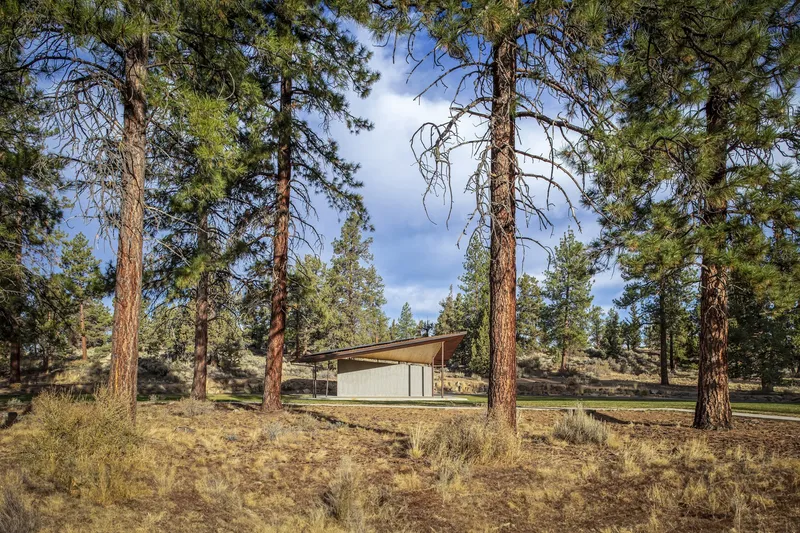

The event pavilion and restroom shelter share a clear design language: low-slung profiles, corrugated metal cladding, and wide roof overhangs that fold at sharp angles to echo the Cascade Range. Seen from a distance through the scattered ponderosa pines, the buildings register as dark, angular masses that sit low against the sky. The proportions are deliberate. Rather than competing with the mature trees around them, the structures defer to the canopy, keeping their ridgelines well below the treetops.
Ribbed concrete walls at the base of each building reference the columnar basalt formations found throughout the site. Weathering steel panels age in concert with the surrounding landscape, developing a rust patina that mirrors the reddish bark of the ponderosa pines. Nothing here reads as imported. The material palette was derived from site walks and geological surveys, not a manufacturer's catalog, and the result is architecture that looks like it could have grown from the ground.
Interior Warmth Beneath Folded Roofs
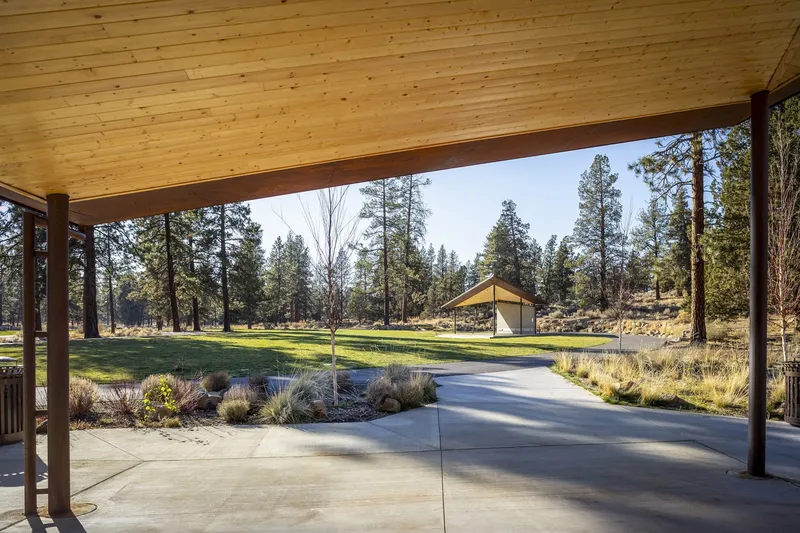

Step underneath the overhangs and the mood shifts. Locally sourced Ponderosa Pine lines the ceilings in warm, tight-grained planks that contrast sharply with the rawness of the exterior steel and concrete. Clerestory glazing at the ridge allows controlled daylight to wash down the angled timber surfaces, creating interiors that feel luminous even under Bend's frequently overcast skies. The covered porch of the restroom shelter, with its tongue-and-groove ceiling and slender steel columns, frames views across a grassy clearing and into the pine forest beyond.
The detailing rewards close attention. Where the weathered steel cladding meets a timber soffit, a crisp shadow line separates the two materials without the need for heavy trim. Metal downspouts are integrated into the geometry of the folds, disappearing into the angular silhouette. These are buildings designed at the scale of the hand as much as the landscape.
Bridging the Railroad

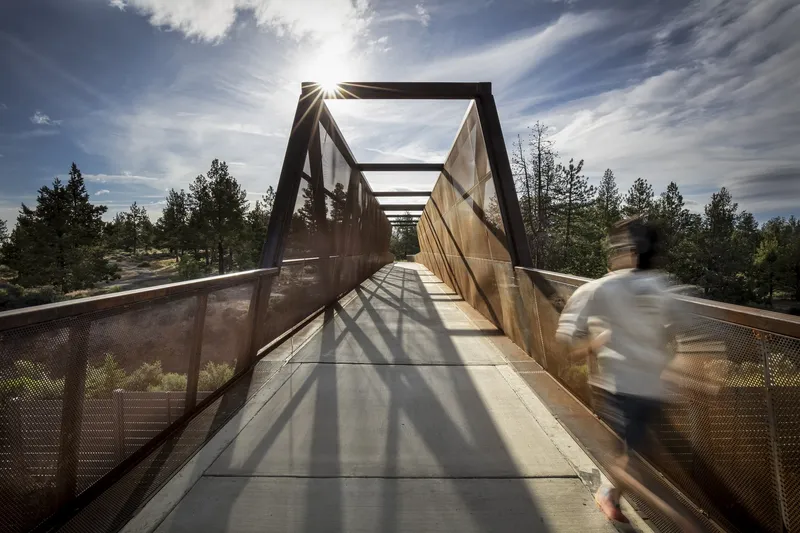

The pedestrian bridge is the park's most visible gesture and its most technically constrained. Spanning an active BNSF rail corridor, the bridge had to comply with the railroad's stringent fence protection standards while still feeling open enough for daily use by cyclists and pedestrians. Fieldwork's solution was a tube-frame structure clad in perforated weathering steel panels. The perforations satisfy code requirements for enclosure but allow air, light, and views through the walls, casting geometric shadow patterns across the concrete deck as the sun moves.
From the air, the bridge reads as a curving ribbon connecting the parking area to the park's trail network. From inside, a cyclist passing through at midday experiences a kaleidoscope of dappled light. The steel will continue to darken and weather over the decades, eventually matching the rust tones of the railroad infrastructure below. It is a piece of connective tissue that will only improve with age.
Landscape as the Primary Architecture
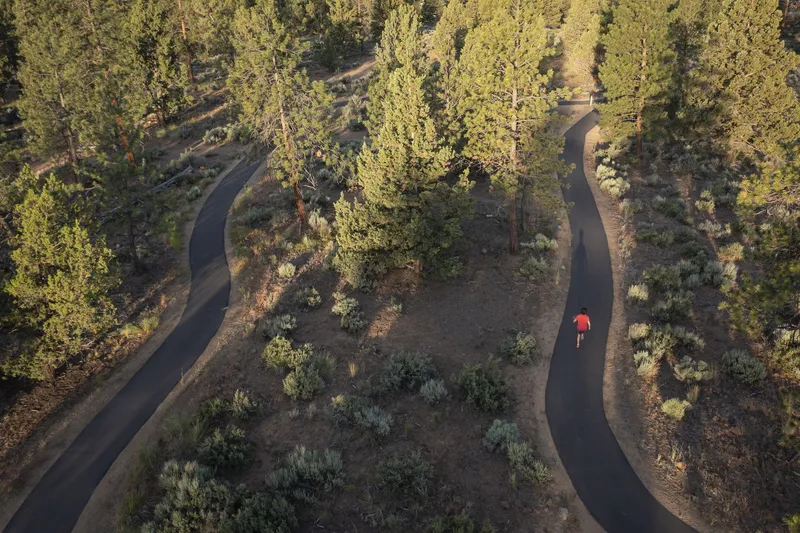
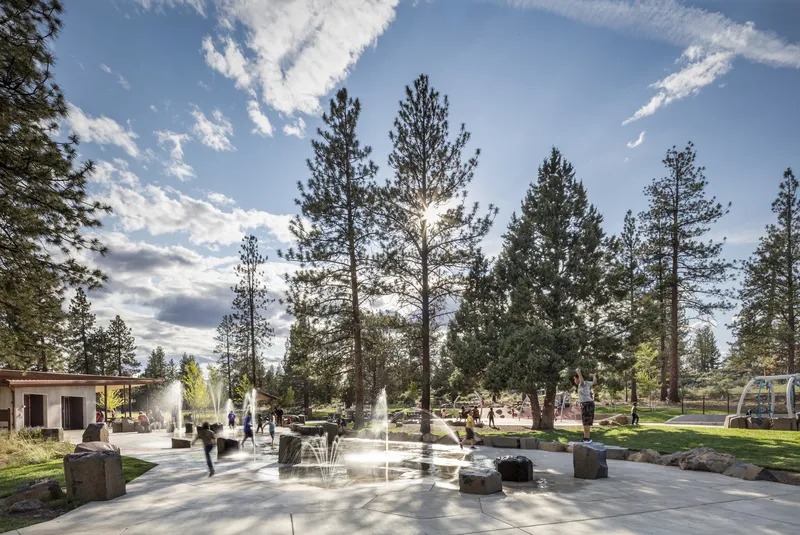

The real design move at Alpenglow is the decision to build almost nothing. With less than 8% of the 37-acre site given over to irrigated lawn, the park preserves and restores the native high desert landscape: mature ponderosa pine and juniper stands, sagebrush, dry grasses, and exposed basalt. A 2.2-mile network of ADA-accessible paved paths, including a 0.9-mile perimeter loop, threads through the forest alongside 1.3 miles of soft-surface natural trail. The circulation system is generous but never dominates the ground plane.
Programmatic elements like the splash pad, bouldering wall, and playground are tucked into clearings within the tree cover rather than centralized on an open lawn. Montana Rainbow Rock anchors the splash pad area, and columnar basalt appears again at viewpoints and seating areas. The landscape strategy treats the existing ecology as the primary amenity and positions the built structures as punctuation marks within it.
Off-Grid Performance by Design

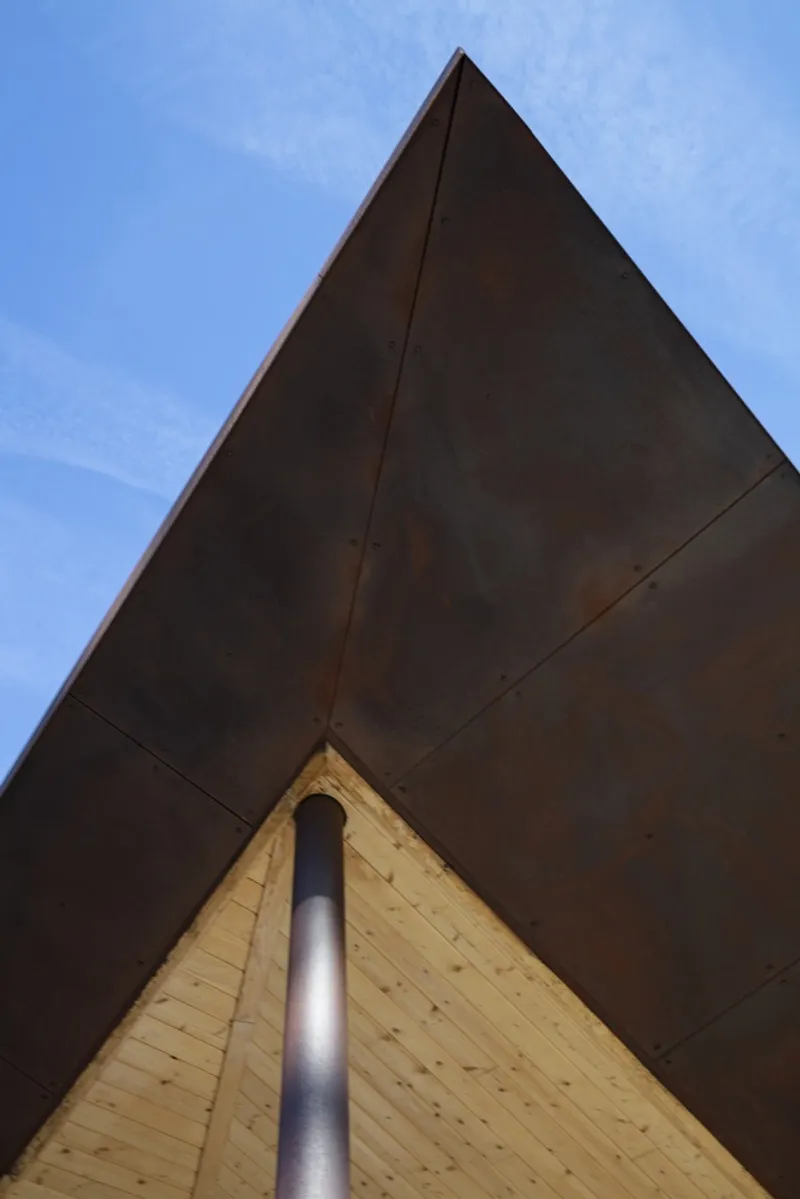
Every folded roof at Alpenglow is a solar collector. Through sun studies conducted early in the design process, the architects determined the optimal orientation and pitch for photovoltaic panels, then integrated those constraints into the formal language of the buildings. The result is that the angular, mountain-inspired silhouettes are not purely aesthetic: they are the direct expression of a passive energy strategy. Both the event pavilion and the picnic shelter generate 100% of their electricity on site.
For a park in one of Bend's fastest-growing residential areas, this independence from the grid is both practical and symbolic. It demonstrates that even modest civic buildings can achieve full energy autonomy without sacrificing design ambition. The cantilevered wood roofs, the deep eaves that shade gathering spaces in summer, and the clerestory windows that pull in winter light all serve double duty as environmental controls and spatial experiences.
Community as Client
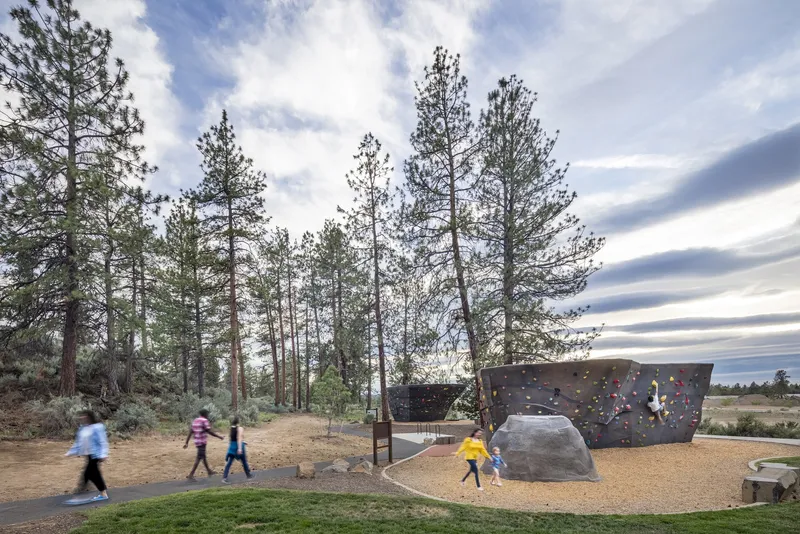
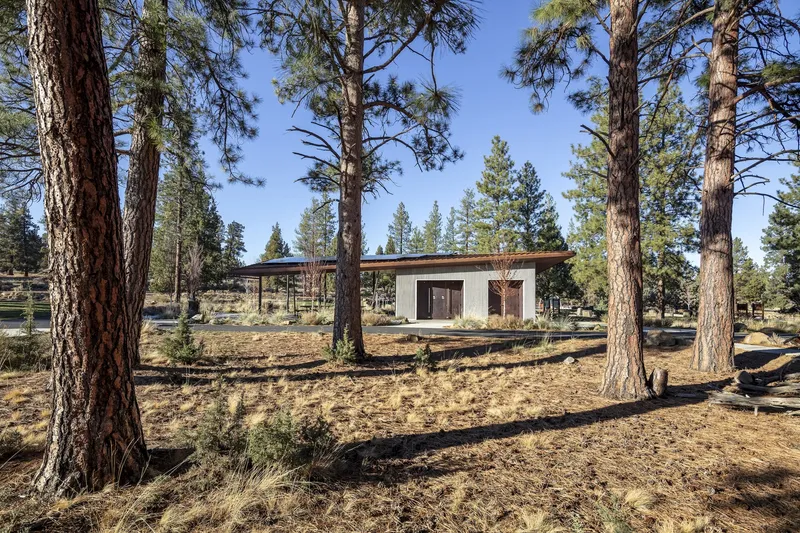
The park sits on 37 acres acquired from the J.L. Ward family in 2014 for $3.77 million, bordered by the Burlington Northern railroad, the Central Oregon Irrigation District canal, and Caldera High School. Its design was shaped through extensive community engagement, with Fieldwork soliciting feedback from area residents to determine which amenities mattered most. The integrated design process brought architects, landscape architects, and structural engineers from Walker Structural Engineering together from the masterplan stage through the smallest construction detail, with Griffin Construction executing the build.
That collaborative process shows in the finished product. The bouldering wall, the plaza water features, and the trail network feel like they were placed by people who understand how this particular community uses outdoor space, not imposed by a design team parachuting in with a generic park typology. Alpenglow belongs to its neighborhood in a way that transcends ownership.
Plans and Drawings

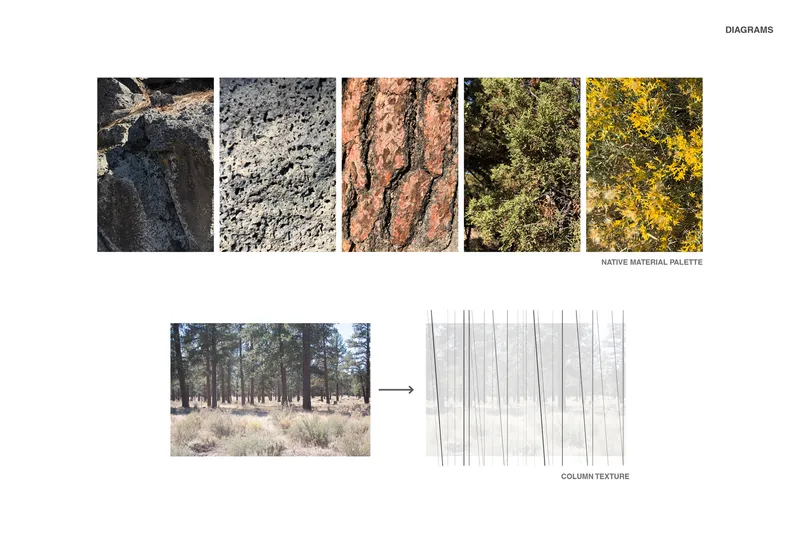
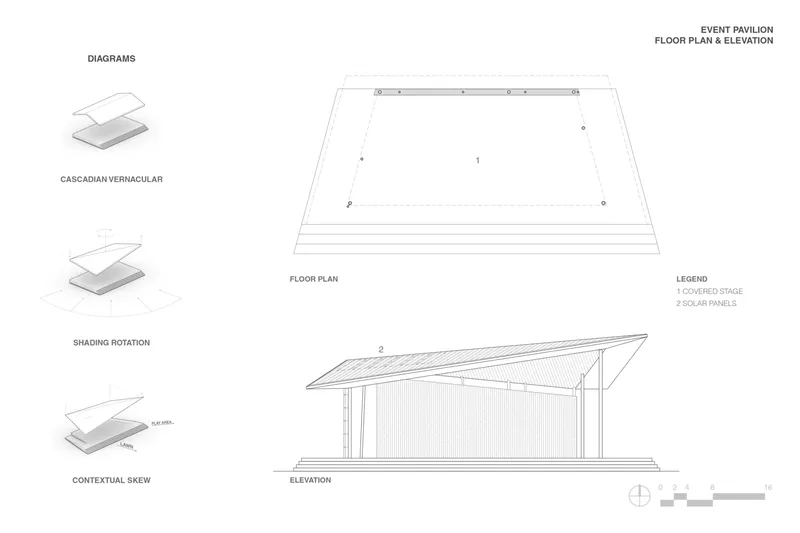
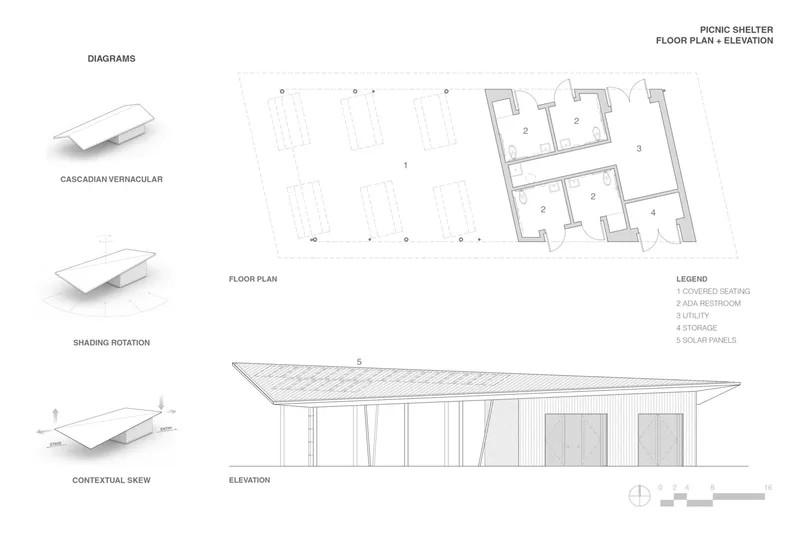
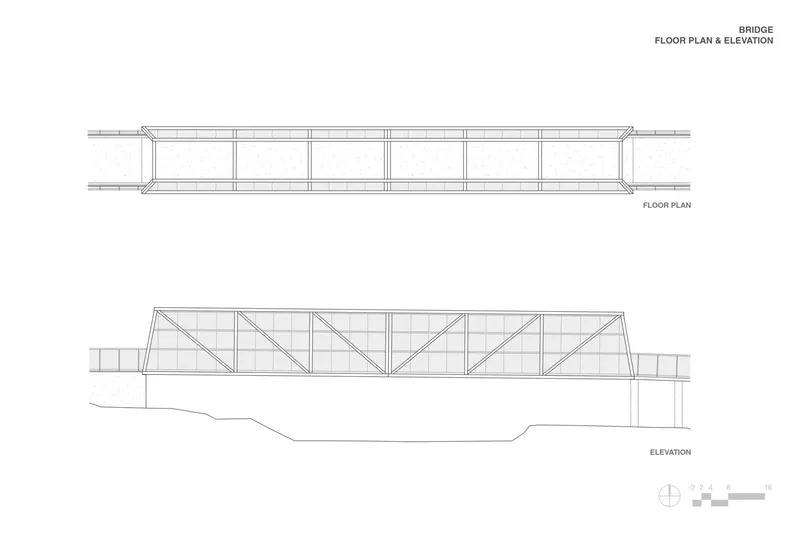
The site plan reveals the discipline behind the park's apparently casual layout. Paths curve gently through the wooded terrain, connecting parking areas to building footprints positioned at strategic clearings. The material palette diagram makes the design logic explicit: native textures, forest imagery, and columnar basalt abstraction inform every surface choice. Floor plans and elevations of the pavilion, shelter, and bridge show how compact these structures actually are. The sloped solar panel roofs, the covered stage within the event pavilion, the service rooms tucked into the restroom shelter, and the diagonal truss members of the bridge are all legible in section, confirming that the angular silhouettes serve structural and environmental purposes as much as formal ones.
Why This Project Matters
Alpenglow Community Park matters because it treats park architecture as real architecture. The buildings here are small in footprint but rigorous in their material logic, energy strategy, and relationship to site. In a profession that often reserves its best thinking for private commissions and cultural institutions, Fieldwork's work in Bend demonstrates what happens when that same intensity is directed toward a public restroom, a picnic shelter, and a pedestrian bridge. The results are buildings that reward sustained attention and will age with the landscape rather than against it.
More broadly, the park challenges the assumption that sustainability and civic generosity require large budgets or high-tech solutions. Solar panels on a folded roof, locally sourced pine on a ceiling, native planting instead of irrigated turf: none of these moves are revolutionary in isolation. Together, applied with consistency and conviction across 37 acres, they produce a public space that feels inevitable rather than designed. That is the hardest thing to achieve and the most valuable lesson Alpenglow has to offer.
Alpenglow Community Park by Fieldwork Design and Architecture. Bend, Oregon, United States. 4,475 m² built area across a 37-acre site. Completed 2023. Photography by Chris Murray.
About the Studio
Share Your Own Work on uni.xyz
If projects like this are the kind of work you want to make, uni.xyz is a place to publish your own, find collaborators, and enter design competitions.


Popular Articles
Popular articles from the community


longwave studio Reorganizes a 112 m² Tainan Apartment Around the Daily Routines of a Family and Two Cats
In Tainan, Taiwan, birch plywood, rust-red furniture and a freestanding plaster wall link arrival, storage, work and family life in one apartment.

Architekt Andreas Gruber Scatters 23 Dark Timber Chalets Across a South Tyrolean Forest Edge
In Molini di Tures, Amonti Chalets breaks a resort into a hamlet of gabled timber houses, with parking, storage and services pushed into the slope.

Cube Design Draws an Ecological Corridor Between Two Shenzhen Hills with the Nankai Building
Beside Shenzhen's container docks, the Nankai Building pairs stacked balconies with a climbing green screen to connect two hillsides across its height.

Juan García Correa, John González and Claudia Rueda Sink a Circular Amphitheater into a Manizales Engineering Building
On the La Nubia campus in Manizales, Colombia, the S1 Building folds labs and offices into a hillside of ramped lawns that double as a campus route.

Similar Reads
You might also enjoy these articles


Hodi-Mandai Geram
Project Function: Preservation and revitalization of the Intangible heritage and socio-spatial identity of the Hodi by Housing, Cultural Memory Center, Sacred Grove, landscape, local tourism economy


Olio Towers: A Mid-Rise for Performers That Fuses Housing, Rehearsal, and Stage
Located blocks from Houston's Theater District, this modular tower stacks living units around a central performance atrium.

Oasis: Modular Green Housing Carved into Dhaka's Urban Fabric
A shortlisted Plugin Housing entry reclaims unauthorized settlements in Dhaka with stepped concrete volumes, green roofs, and ventilation-driven design.

Black Hole: A Floating Megastructure for the Post-Physical Era
Emiliano Mazzarotto envisions a spherical, self-scaling arena where e-sports, digital hotels, and holographic stadiums replace traditional public space.

Explore Sustainable Features Competitions
Discover active competitions in this discipline

Challenge to reimagine the Iron Throne

Photograph architecture without architects

Illustrate the lost glory of Angkor Wat - Render Challenge

Design challenge to reuse E-waste
Comments (0)
Please login or sign up to add comments
No comments yet. Be the first to comment!