
Sordo Madaleno Arquitectos Stacks a Jungle-Bound Residential Block Like a Mayan Ruin in Tulum
Amelia Tulum raises 38 condominiums above the forest floor on a checkerboard frame clad in chukum stucco and jiles wood screens.


Tulum's building boom has not been kind to the jungle. Across Aldea Zamá, one of the Riviera Maya's fastest-growing urban zones, construction has often treated the landscape as an obstacle rather than a collaborator. Sordo Madaleno Arquitectos takes the opposite position with Amelia Tulum, a 14,185 square meter residential complex of 38 condominiums that deliberately lifts itself off the ground, threads native vegetation through its corridors, and wraps its volumes in materials that age toward the jungle rather than away from it.
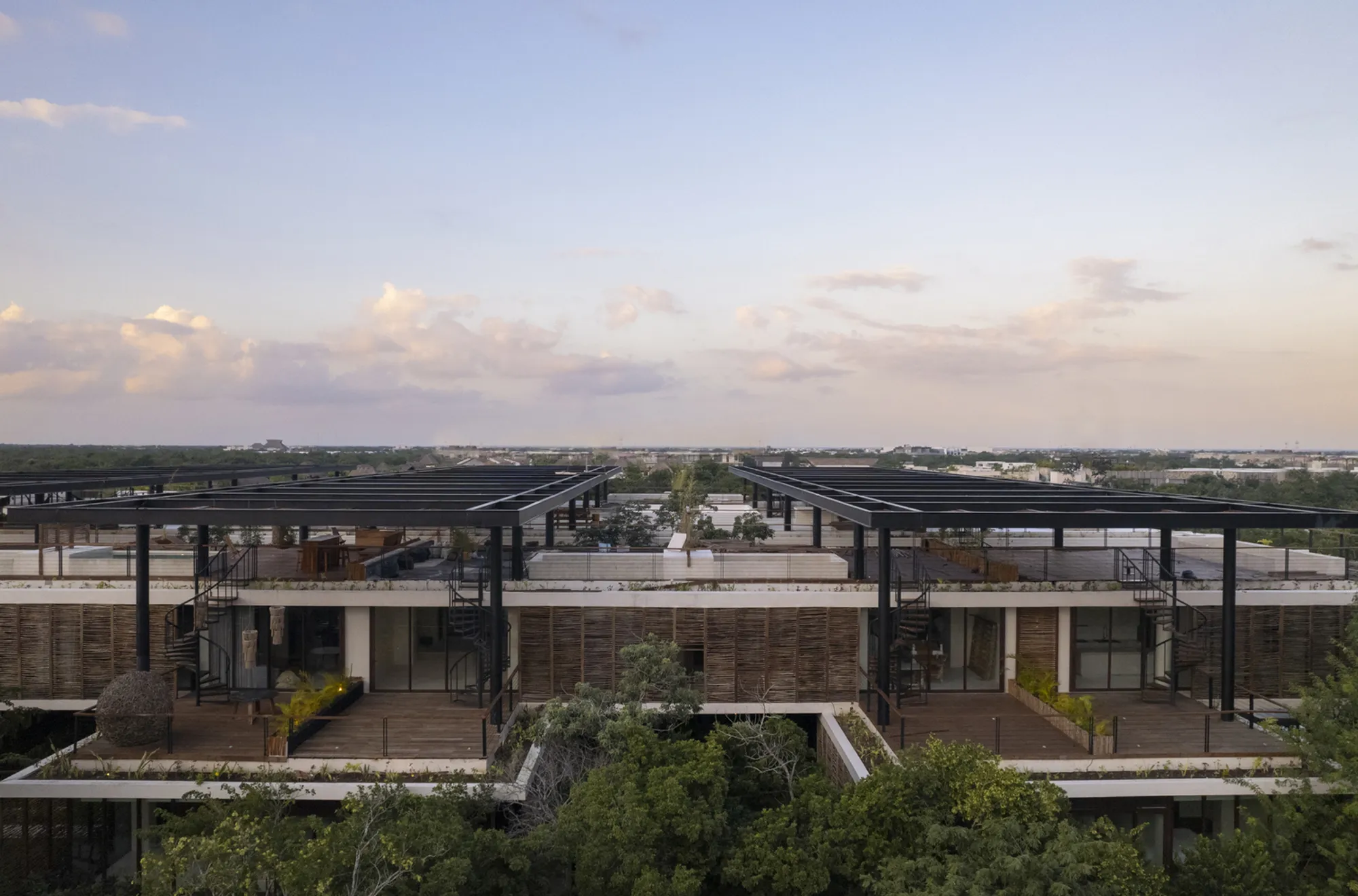
The most interesting move here is structural: three upper floors of residential units are stacked in alternating, opposite orientations, producing a checkerboard pattern that reads from the street like a game of Jenga. The voids between shifted volumes are not wasted space. They become gardens, terraces, and patios that channel cross-ventilation and shade in a climate that punishes sealed boxes. Ground-level bays house commercial program, and a rooftop deck at the maximum allowable building height just breaches the tree canopy with pools, a bar, and lounging areas. The entire composition sits on a raised reinforced concrete frame that keeps the building's footprint minimal and lets the existing terrain breathe underneath.
A Facade That Belongs to the Forest
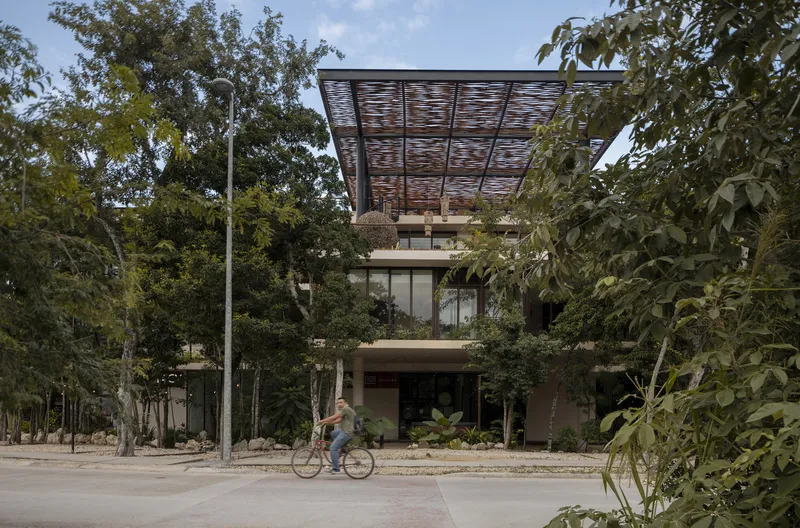
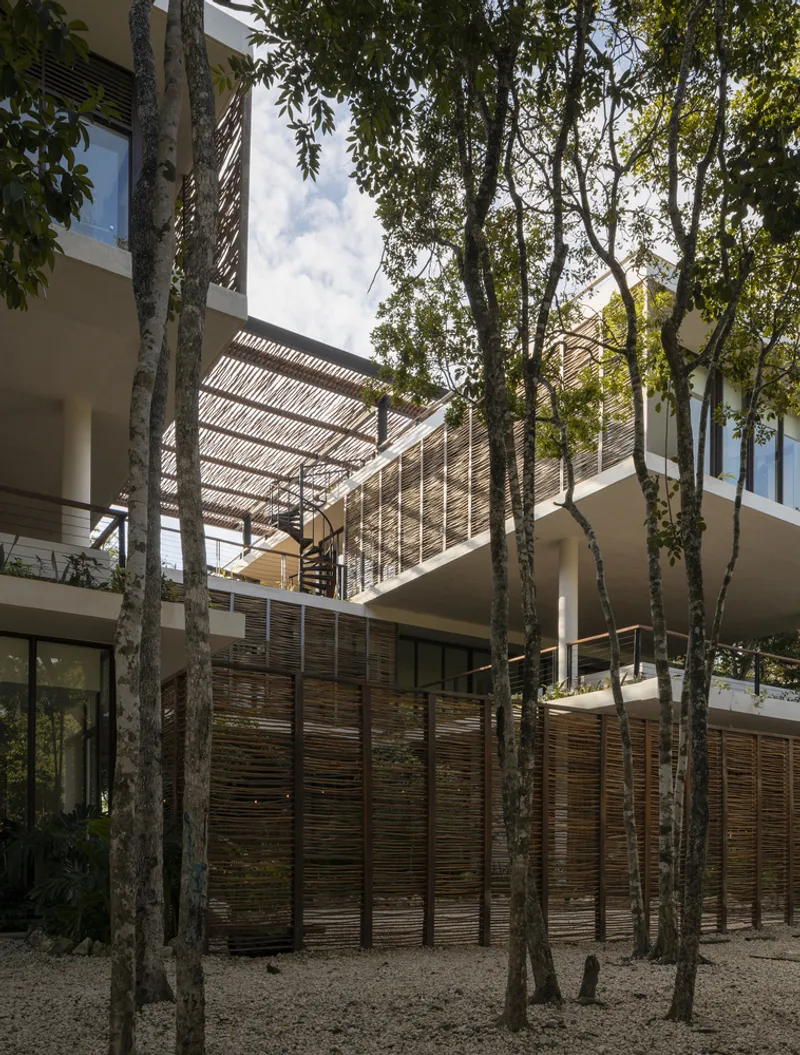
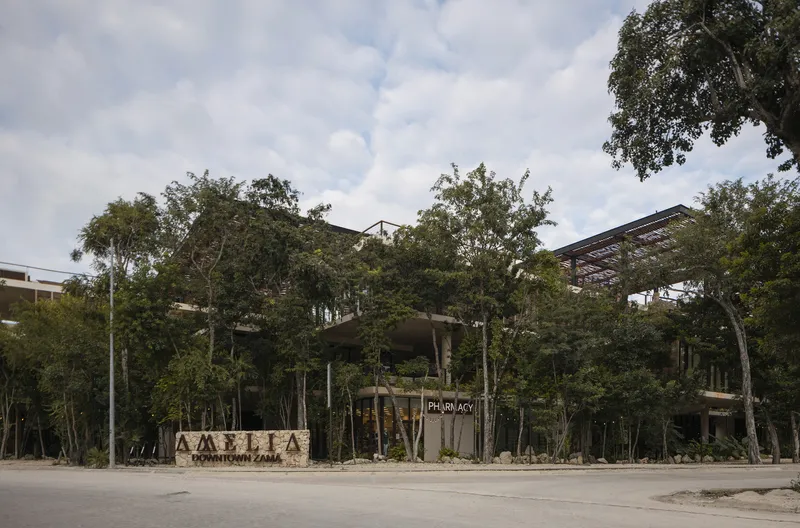
From street level, Amelia Tulum reads as a tiered composition of horizontal timber louvers, planted balconies, and exposed concrete slabs, all framed by mature trees that were preserved during construction. The building's skin is not decorative. Pergolas and woven screens made from jiles, a locally sourced wood, control solar gain while letting the Yucatán breeze pass through. Chukum, a traditional Mayan stucco derived from tree resin, coats concrete surfaces with a finish that will patinate over time, pushing the building closer to the color palette of the surrounding jungle.
The reference point, according to the architects, is not the resort aesthetic that dominates current Tulum construction but the appearance of abandoned Mayan structures slowly reclaimed by vegetation. Whether you find that romantic or strategic, the material choices support the ambition. Preserved trees emerge directly from gravel beds at the base of the facade, blurring the line between site and structure.
The Checkerboard Logic
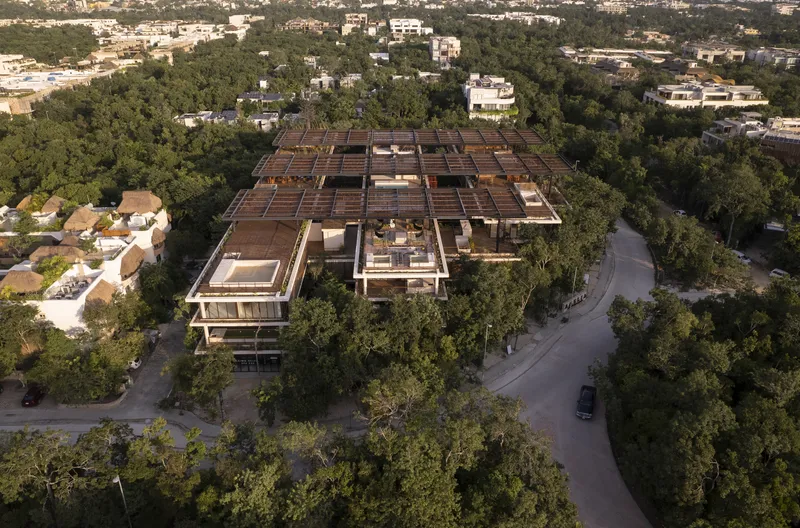
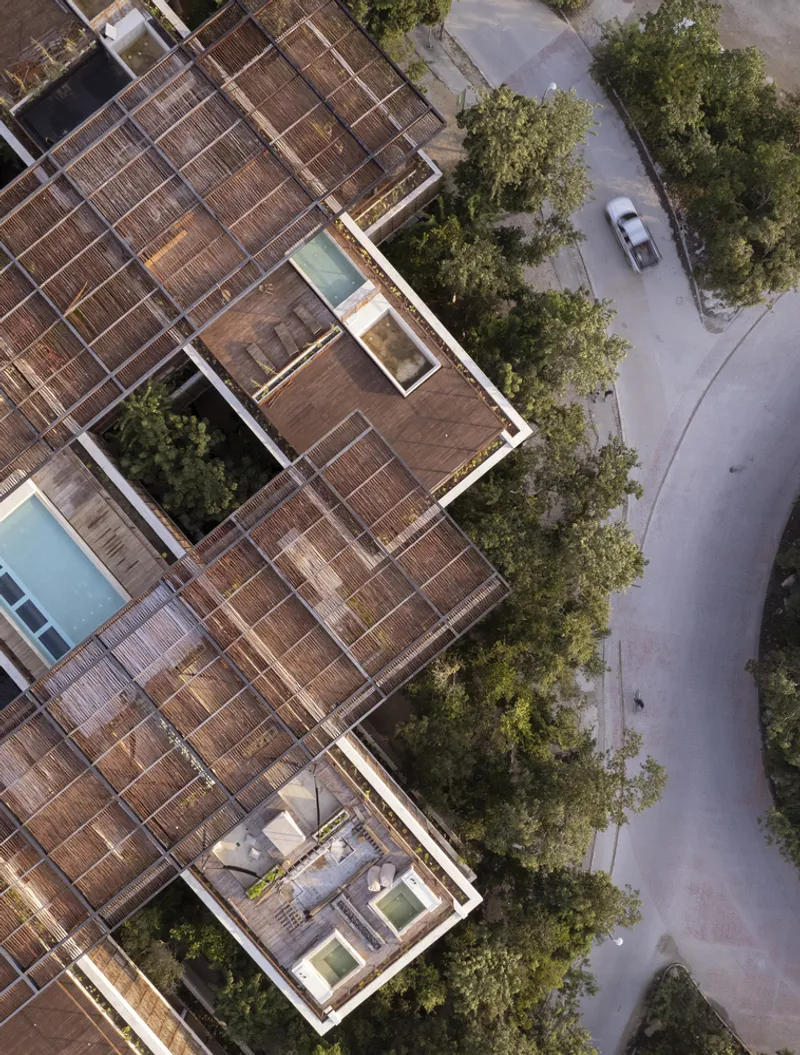
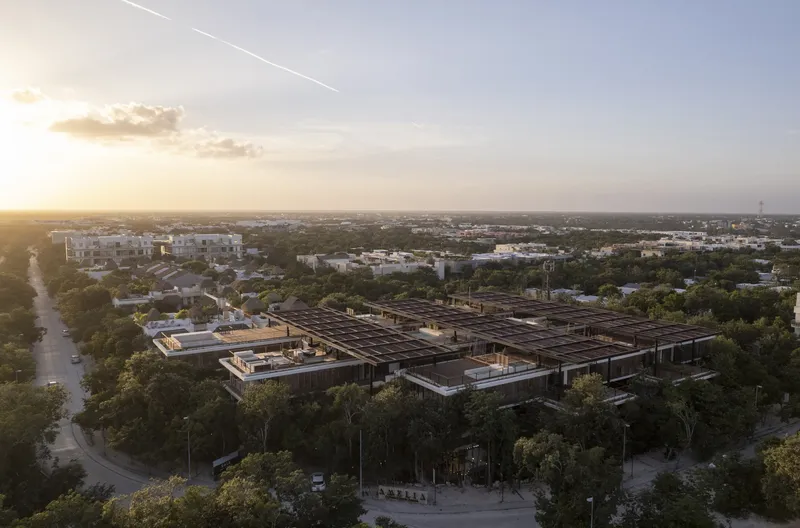
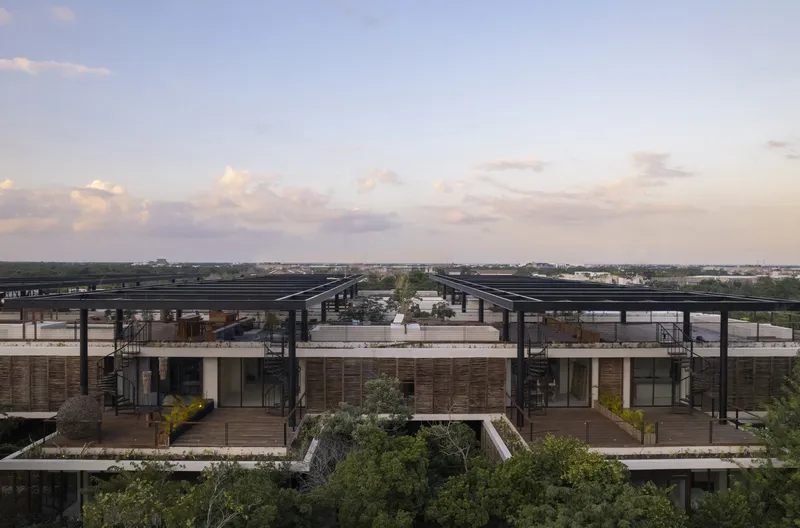
Seen from above, the interplay of solid volumes and open voids is unmistakable. Three parallel residential bars are woven together with staggered floor plates that create a rhythm of shade and exposure across the roofscape. The timber louver canopy that crowns the building filters sunlight onto rooftop courtyards below, producing dappled conditions that change throughout the day.
The checkerboard arrangement is more than a formal gesture. In a region where air conditioning is the default response to heat, this configuration generates private shaded terraces and communal courtyards that function as passive cooling devices. Each shift in the massing opens a new channel for airflow and a new pocket for planting. The result is a building that does not rely on a single green wall or token roof garden to justify its sustainability credentials but builds climate response into its skeleton.
Ground Floor: Commerce Meets Canopy
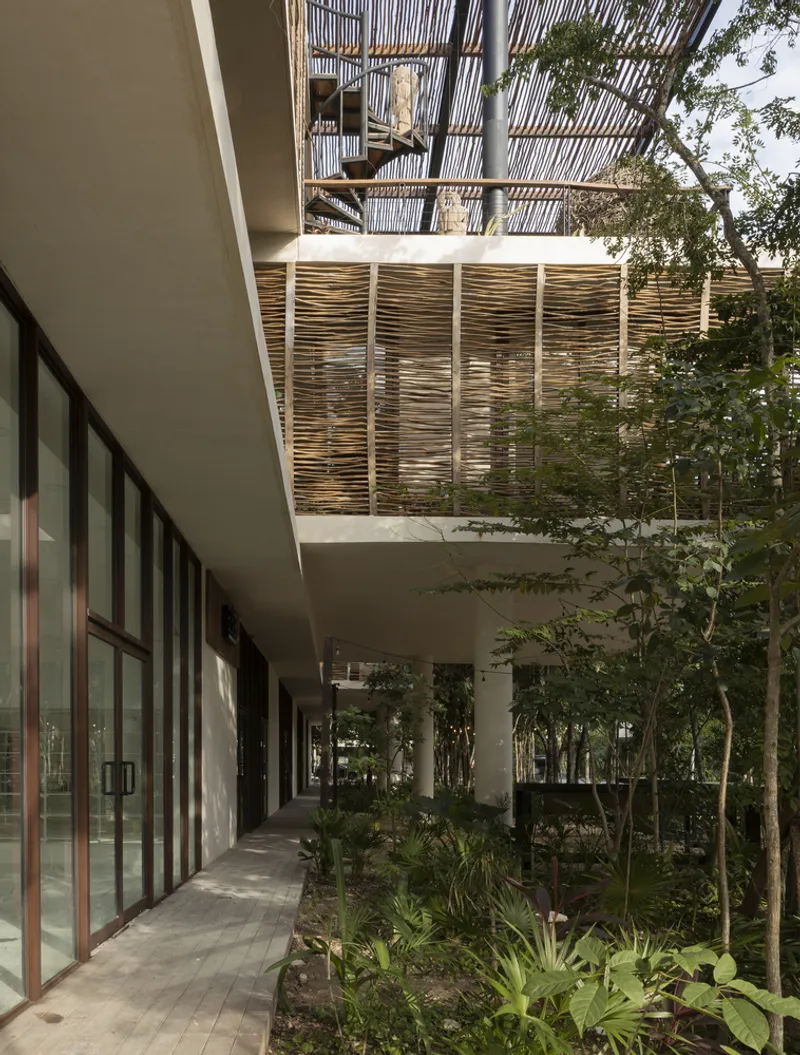
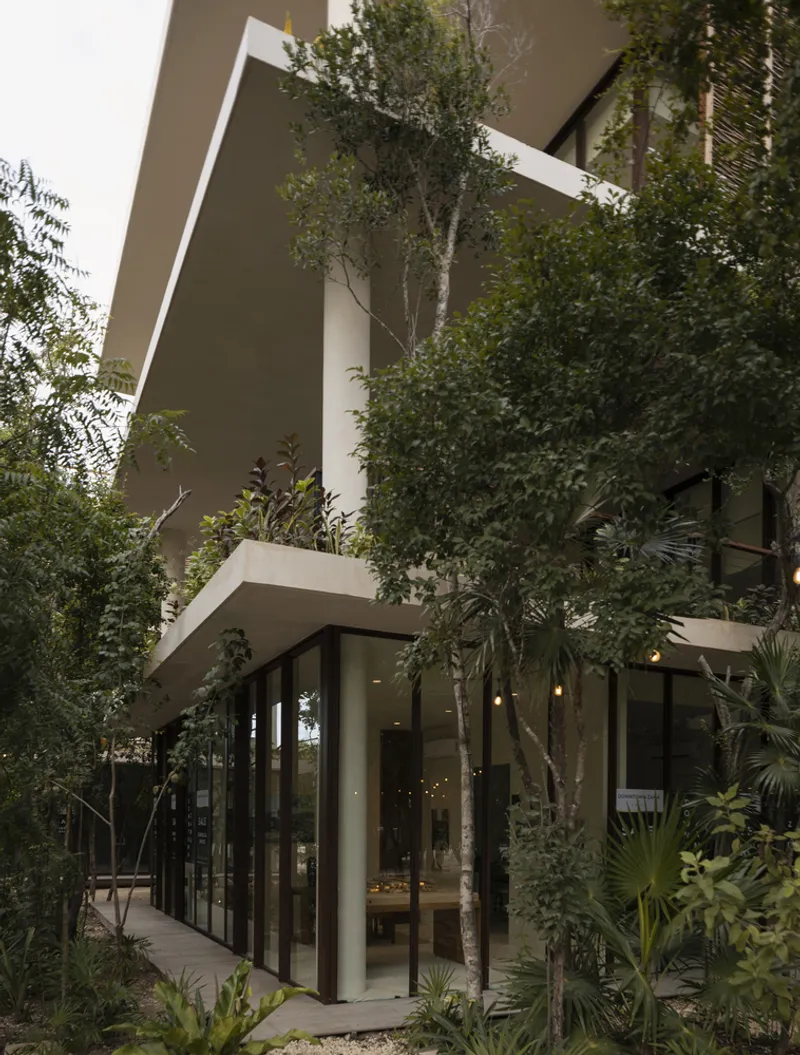
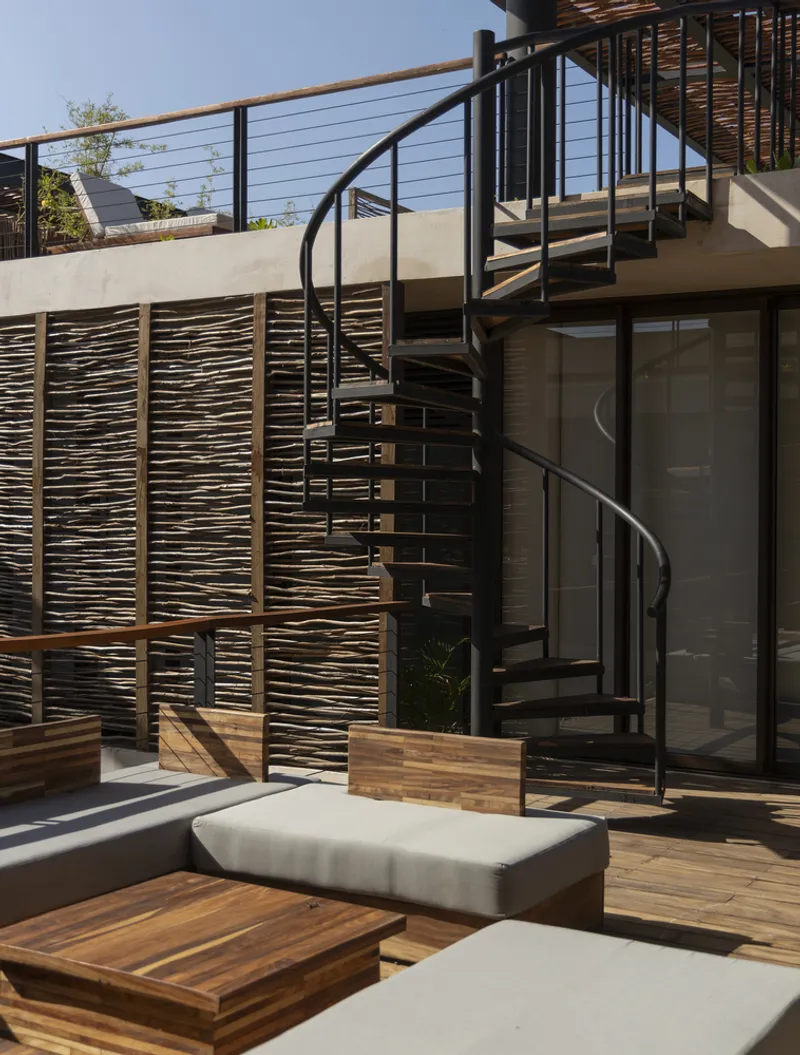
The first three bays at ground level are given over to commercial program: glazed storefronts sheltered beneath cantilevered concrete slabs and timber screens. The walkways that serve these spaces are lined with planted beds dense enough to feel like jungle corridors rather than retail promenades. Palms, birch trees, and low shrubs border the circulation paths, kept alive by a landscape strategy developed with Gabayet 101 paisaje that temporarily housed existing site flora in a nursery during construction, then transplanted everything back into the finished building.
A black spiral staircase punctuates the transition between levels, its steel profile standing in deliberate contrast to the organic textures of woven timber and concrete. The coexistence of commerce and residence is handled without fuss: the commercial program occupies the street edge, the residential units begin above, and the planting binds both together.
Living Between Inside and Outside
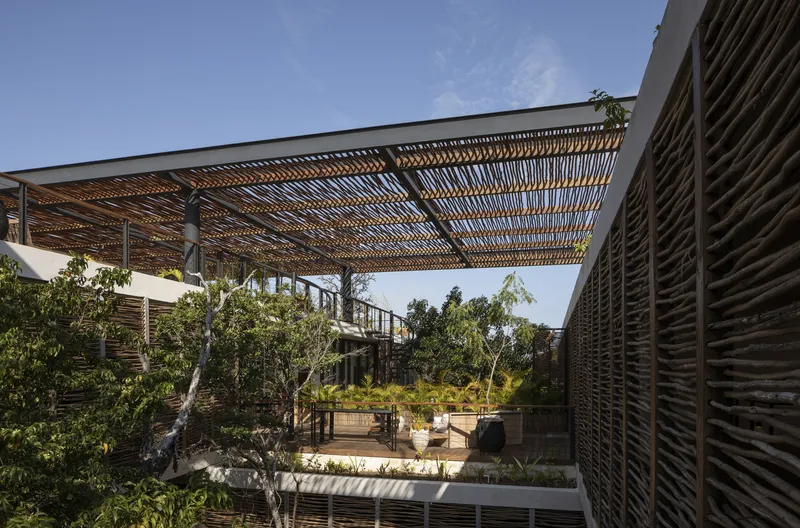
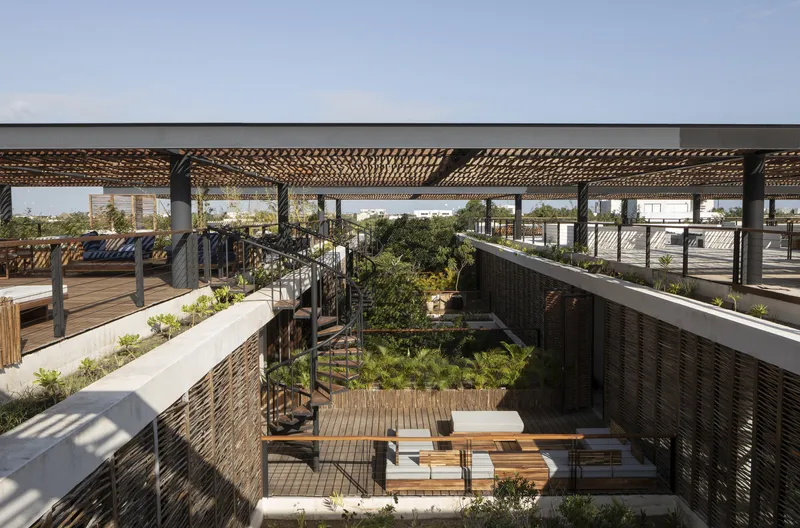
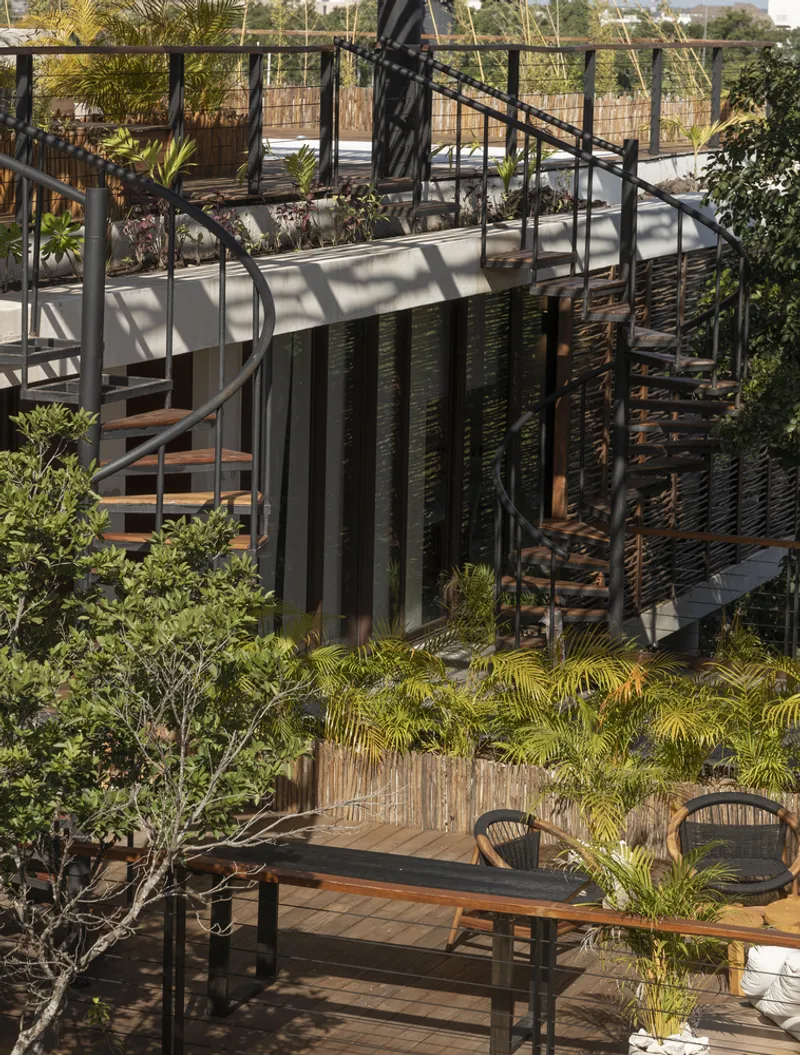
The courtyards formed by the checkerboard massing are the real living rooms of Amelia Tulum. Timber lattice canopies filter overhead light into dappled patterns across planted beds and decked seating areas. These spaces are neither fully enclosed nor fully exposed, sitting in a productive middle ground that the tropical climate rewards. The pergolas and horizontal louver screens surrounding these zones slow the sun without stopping the wind.
Individual units range from 90 to 150 square meters, each with terrace access and independent bedroom entries. But the quality of living here depends less on what happens inside the apartment walls and more on the gradient of outdoor spaces that surround them. A resident moves from air-conditioned interior to shaded terrace to planted courtyard to rooftop pool without ever crossing a hard boundary. That gradient is the project's strongest spatial idea.
Materiality as Cultural Argument
The reinforced concrete structure with post-tensioned slabs is standard engineering for this scale, but the material palette laid over it carries a pointed argument. Chukum stucco is not a finish you can order from a catalog; it is made from the resin of the Havardia albicans tree and applied using techniques that predate the Spanish colonial period. Jiles wood screens and pergolas are handcrafted by local artisans. Sordo Madaleno positions these choices not just as aesthetic preferences but as a way to route construction spending into the regional economy and away from imported industrial products.
The risk with this approach, always, is that local materials become decoration on a conventional concrete frame. Amelia Tulum avoids the worst of that trap by giving the artisan-made elements real performance roles: the woven screens control solar gain, the chukum finish is naturally water-resistant, and the jiles wood pergolas define the spatial character of the courtyards. These are not appliqués. They do work.
Plans and Drawings
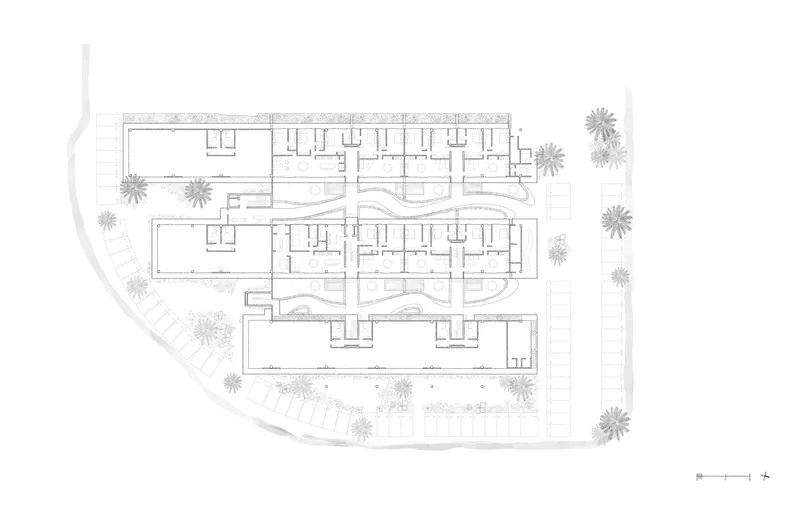
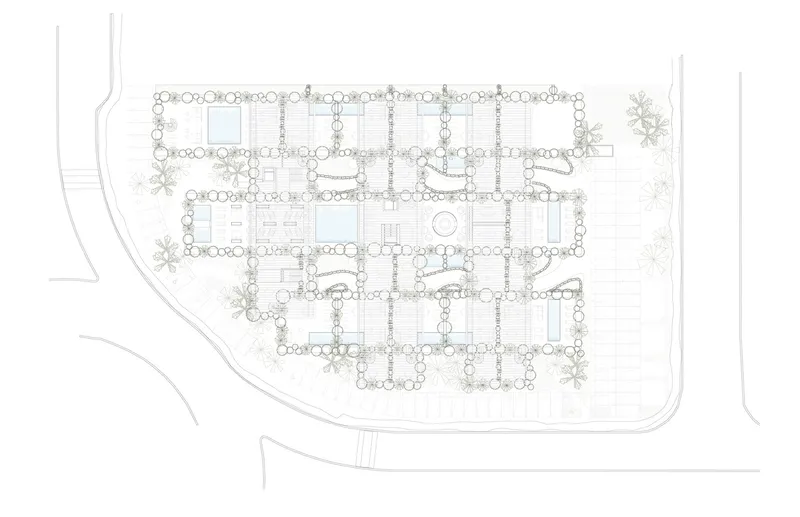
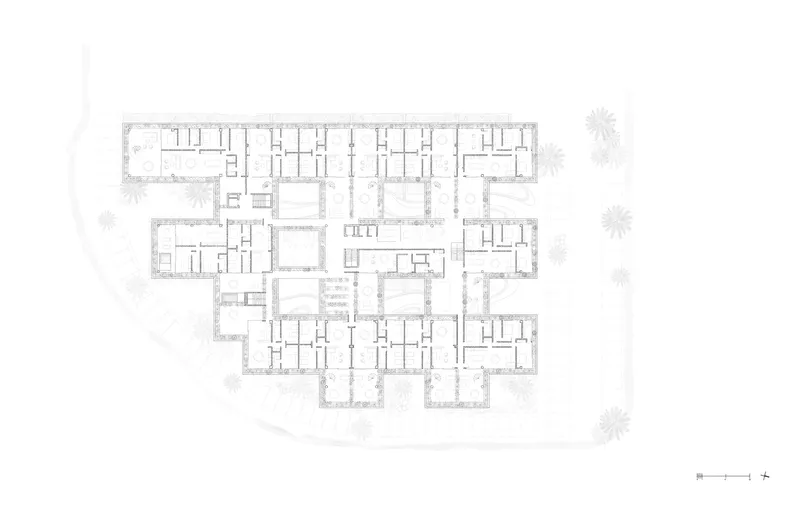
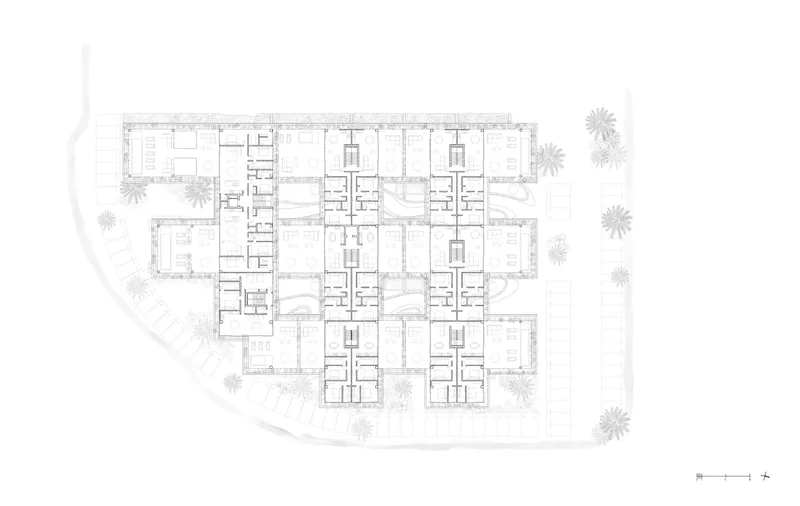
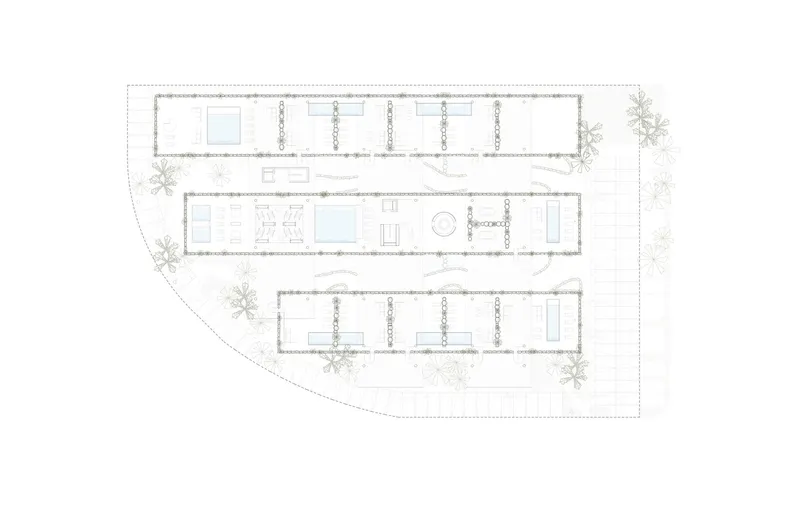
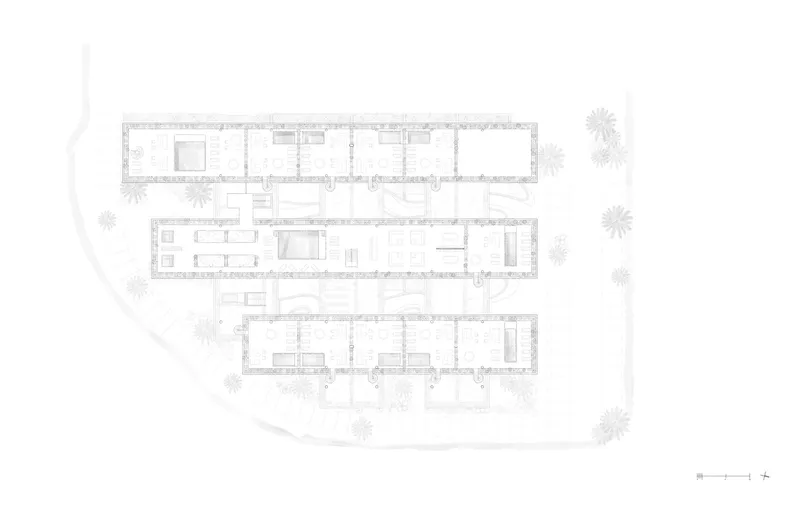
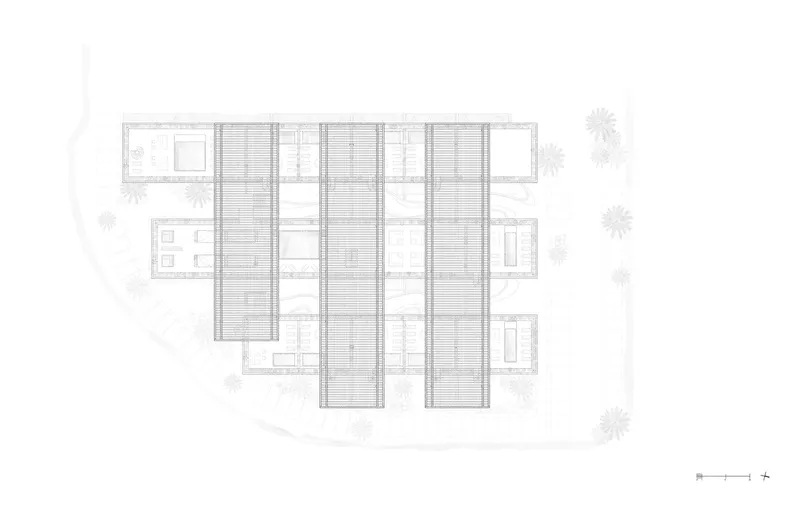
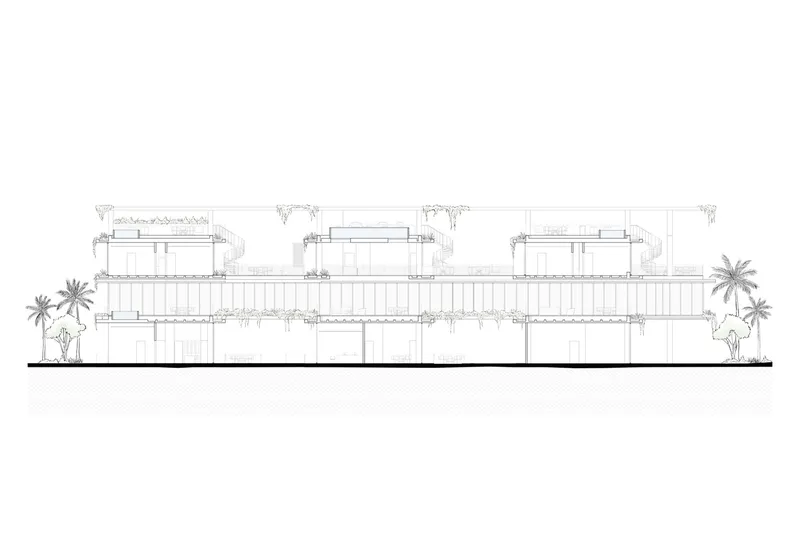
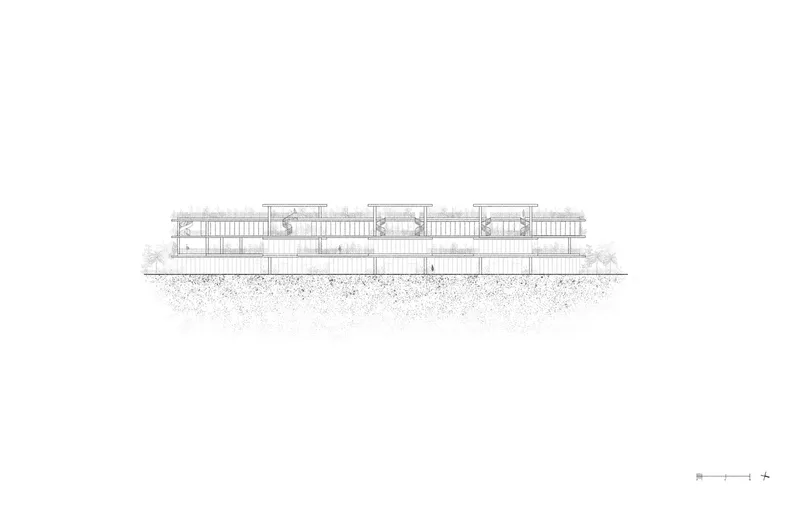
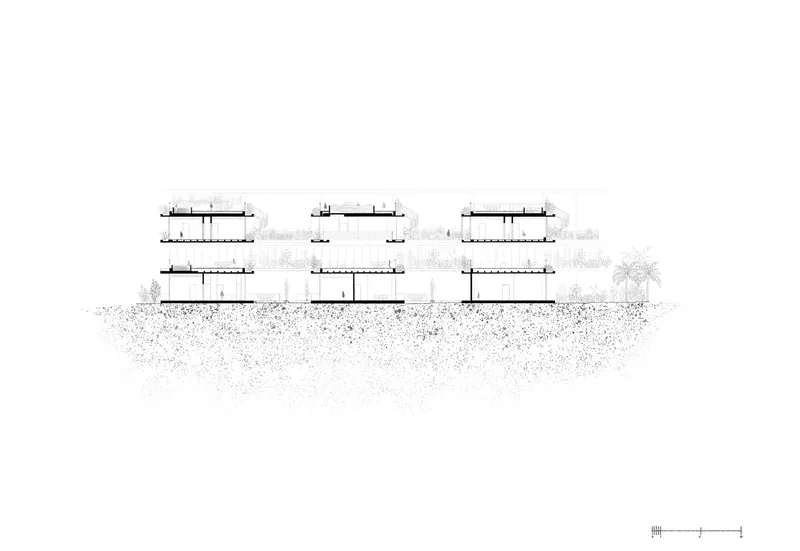
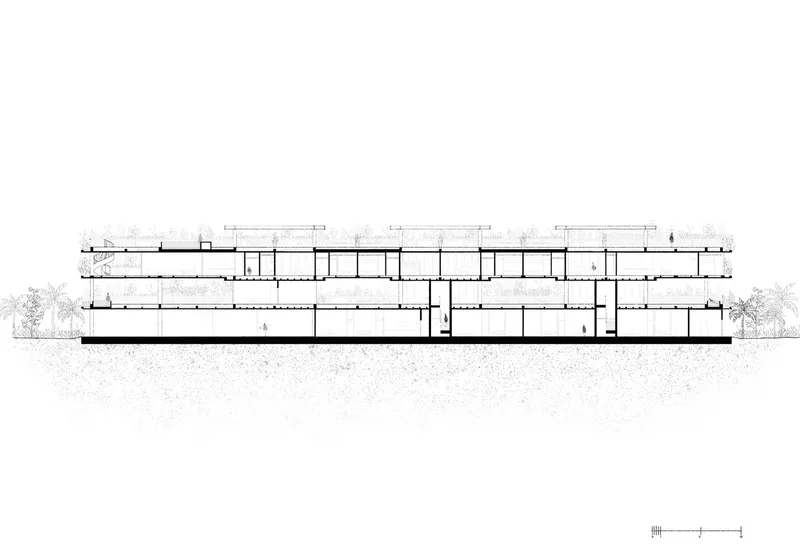
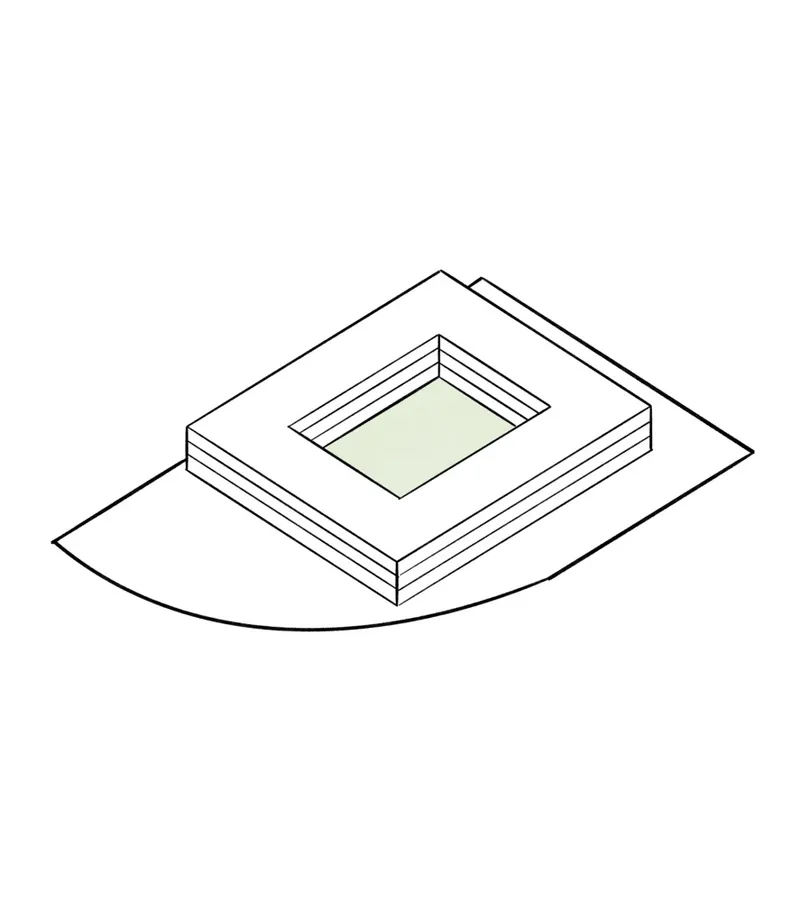
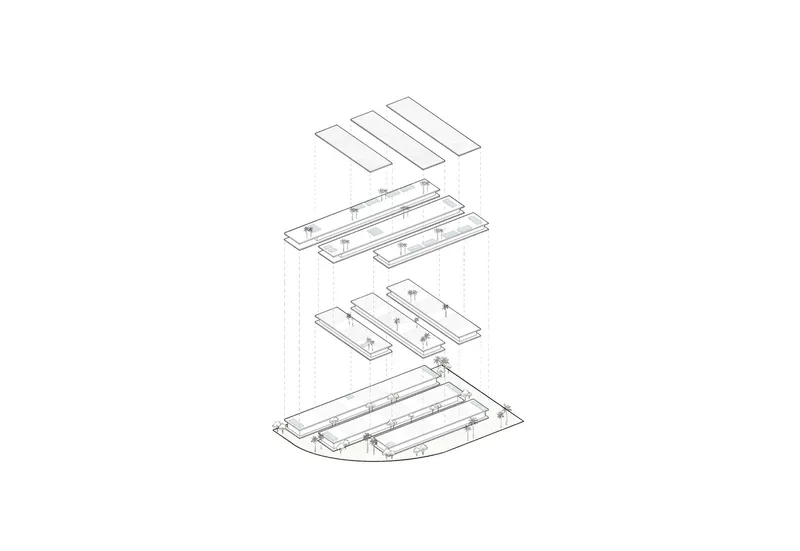
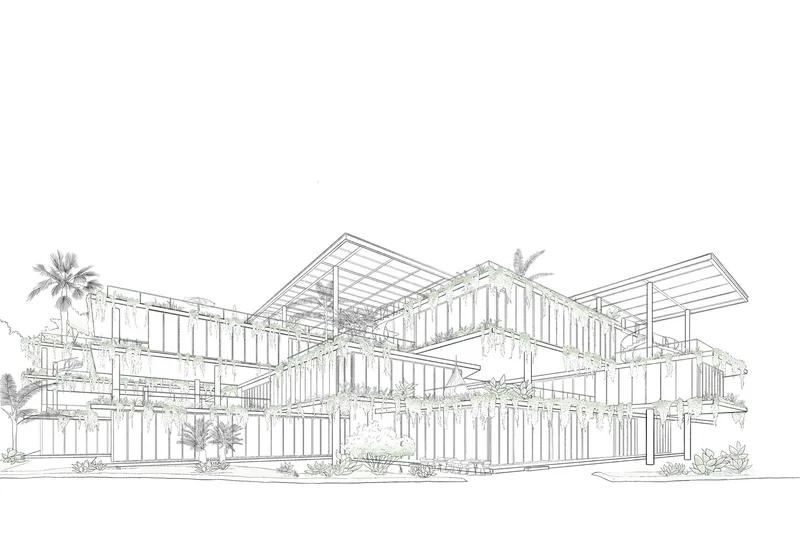
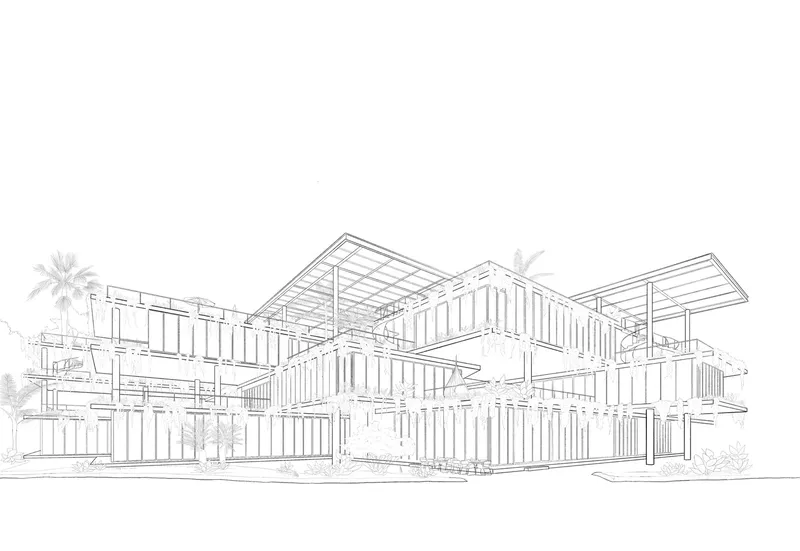
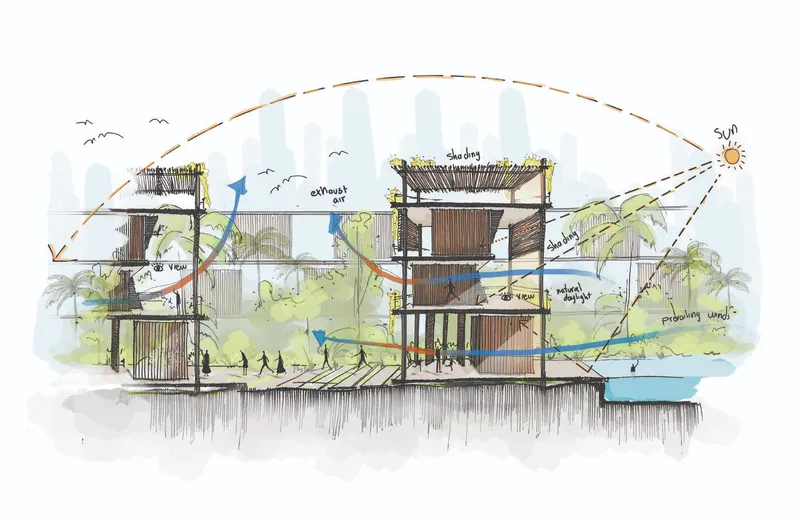
The drawing set reveals the project's organizational clarity. The site plan shows three parallel residential bars connected by undulating central circulation, with circular columns forming a perimeter colonnade at ground level. Upper floor plans confirm the alternating unit orientations that produce the checkerboard massing, with central voids carved out for courtyards and vertical planting. Sections illustrate how the building is raised above the ground plane on its podium base, with rooftop vegetation at the crown and mature trees flanking both ends of the composition.
The exploded axonometric is particularly useful: it separates the layered floor plates from the structural frame and the curved base, making legible a stacking logic that reads as organic from the exterior but is, in fact, rigorously systematic. The watercolor section sketch annotated with a sun path diagram gives the clearest summary of the passive strategy, showing how eaves, screens, and vegetation work together to shade interior spaces throughout the day.
Why This Project Matters
Tulum is a test case for whether tourism-driven development can coexist with the ecosystems that attract visitors in the first place. Most evidence so far says no. Amelia Tulum does not solve that problem on its own, but it demonstrates a viable alternative to the sealed, air-conditioned boxes that have proliferated across Aldea Zamá. The checkerboard massing, the passive cooling strategy, the raised footprint, and the preservation of existing flora all point toward a development model that treats the jungle as infrastructure rather than an obstacle to be cleared.
Sordo Madaleno's decision to ground the project in Mayan materiality rather than imported modernism is the sharper provocation. In a market that defaults to polished concrete and imported tile, building with chukum stucco and handcrafted jiles screens is a deliberate statement about where value should flow. Whether Amelia Tulum becomes a precedent or remains an exception will depend on whether the next developer in Aldea Zamá sees this project as proof that sustainability sells, or just as a beautiful outlier.
Amelia Tulum by Sordo Madaleno Arquitectos, with landscape design by Gabayet 101 paisaje and construction by PROESUR. Located in Aldea Zamá, Tulum, Mexico. 14,185 m². Completed 2023. Photography by Óscar Caballero.
About the Studio
Share Your Own Work on uni.xyz
If projects like this are the kind of work you want to make, uni.xyz is a place to publish your own, find collaborators, and enter design competitions.




Popular Articles
Popular articles from the community


Hill & Cross Opera: Sculptural Opera House Architecture Shaped by Tallinn’s Landscape and Identity
Hill & Cross Opera reimagines opera house architecture in Tallinn through its sculptural hill, civic plaza, glass wave and a luminous cross.

Co-Life: Senior Housing Design That Reconnects Older Adults With the City
Co-Life reimagines senior housing design through healing gardens, shared streets, workshops, and a sustainable community across generations.

The Earth Pod: 3D Printed Homes for Resilient Refugee Communities
The Earth Pod reimagines refugee housing through 3D printed homes made from clay, combining resilience, self-sufficiency, and rapid shelter.

Co-life: Sustainable Architecture for Age-Friendly Community Living
Co-life reimagines sustainable architecture for seniors through courtyards, rammed earth, shared gardens, and spaces designed for belonging.


Similar Reads
You might also enjoy these articles


Hodi-Mandai Geram
Project Function: Preservation and revitalization of the Intangible heritage and socio-spatial identity of the Hodi by Housing, Cultural Memory Center, Sacred Grove, landscape, local tourism economy


Olio Towers: A Mid-Rise for Performers That Fuses Housing, Rehearsal, and Stage
Located blocks from Houston's Theater District, this modular tower stacks living units around a central performance atrium.

Oasis: Modular Green Housing Carved into Dhaka's Urban Fabric
A shortlisted Plugin Housing entry reclaims unauthorized settlements in Dhaka with stepped concrete volumes, green roofs, and ventilation-driven design.

Black Hole: A Floating Megastructure for the Post-Physical Era
Emiliano Mazzarotto envisions a spherical, self-scaling arena where e-sports, digital hotels, and holographic stadiums replace traditional public space.


Explore Architecture Competitions
Discover active competitions in this discipline



Challenge to reimagine the Iron Throne


Photograph architecture without architects


Illustrate the lost glory of Angkor Wat - Render Challenge


Design challenge to reuse E-waste
Comments (0)
Please login or sign up to add comments
No comments yet. Be the first to comment!