
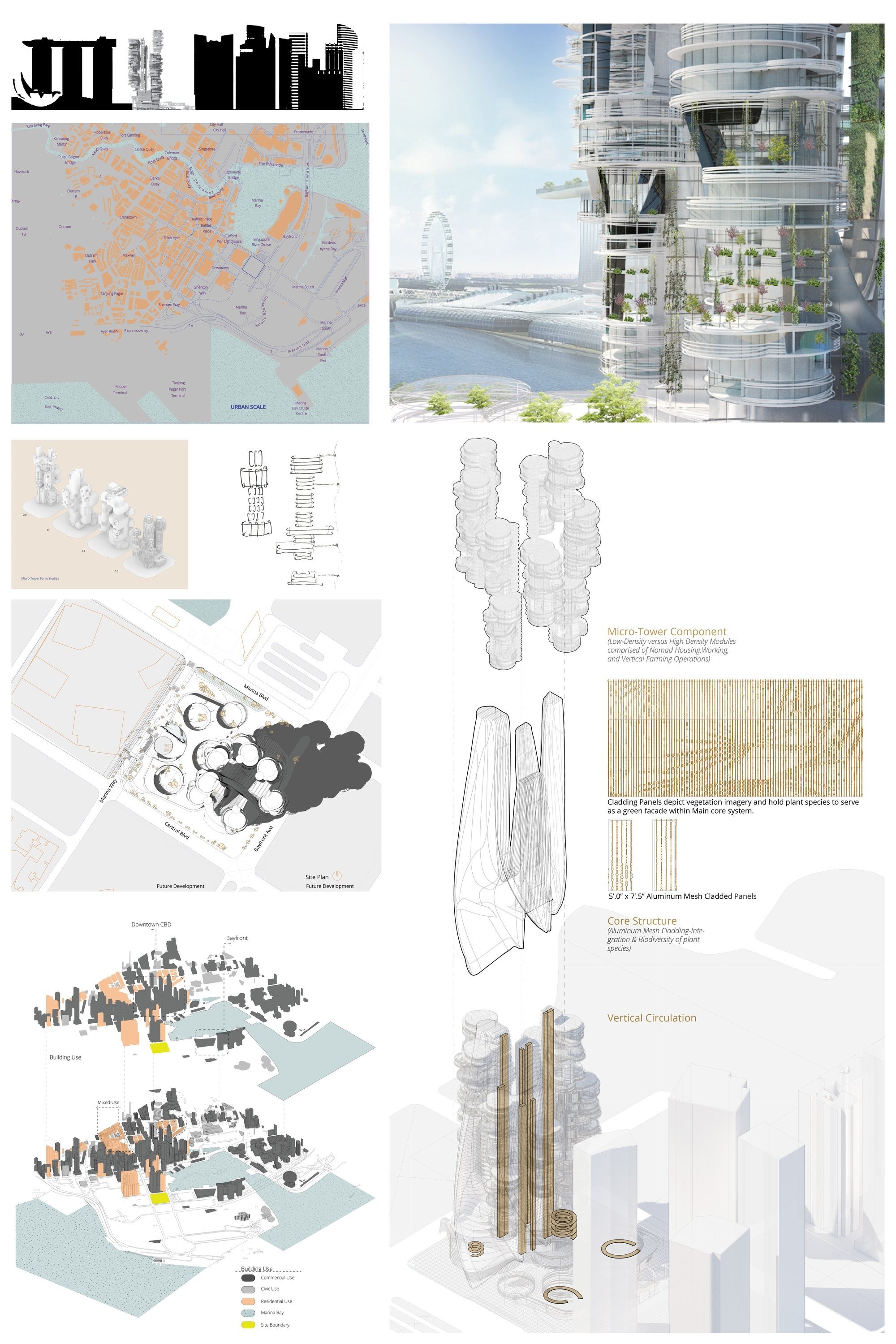
Sustainable Vertical Architecture: Reimagining Urban Density Through the Micro-Tower Concept
A visionary sustainable vertical architecture proposal by Collin Pierce combining urban farming, modular living, and elevated social spaces.

As cities continue to grow vertically, architects are increasingly challenged to create environments that are not only space-efficient but also socially engaging, environmentally regenerative, and adaptable to future urban needs. The project Micro-Tower by Collin Pierce, a Runner-up entry of NomadHouse 2020, proposes an innovative response to this challenge through a new model of sustainable vertical architecture.
The proposal introduces a system of compact radial tower formations designed to minimize ground-level footprints while maximizing environmental performance, community interaction, and urban agriculture. Instead of relying on conventional skyscraper typologies, the project rethinks density itself by combining modular living units, vertical farming systems, elevated green infrastructure, and shared social environments into an interconnected architectural ecosystem.
At its core, Micro-Tower is not simply a high-rise building concept. It is an experimental urban framework that merges architecture, ecology, and modular construction into a highly adaptive living organism for future cities.
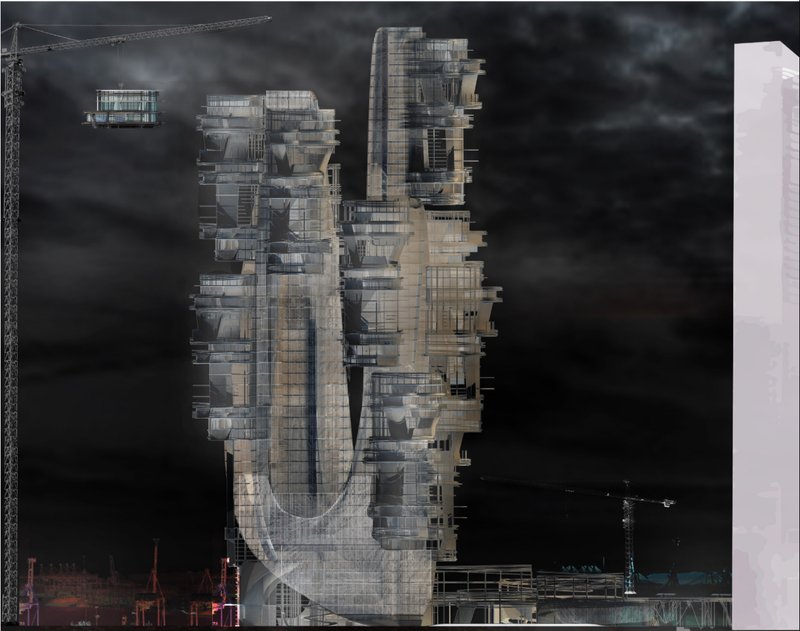
Redefining Density Through Modular Urban Systems
The project explores two distinct tower conditions: High-Density and Low-Density Micro-Towers. These systems work together to create an urban environment that balances compact habitation with open communal space.
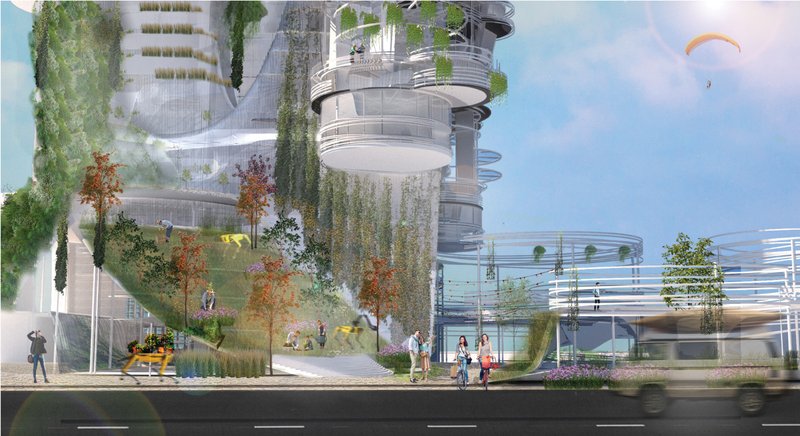
Unlike traditional towers that prioritize stacked floor plates and repetitive programming, the Micro-Tower system utilizes modular basket-like formations composed of petal-shaped structures. These formations rotate and aggregate vertically, creating varied spatial relationships, shifting balconies, suspended gardens, and elevated pocket parks throughout the building mass.
This approach generates a hybrid architectural language where structure, circulation, landscape, and habitation merge into a singular integrated system. The result is a highly porous vertical environment that encourages visual connectivity, natural airflow, daylight penetration, and shared social interaction.
By reducing the building footprint at the ground plane, the proposal frees significant urban space for public landscapes, recreation, and ecological systems. Rather than consuming the city, the tower contributes back to it.
Sustainable Vertical Architecture and Urban Agriculture
One of the most compelling aspects of the project is its integration of vertical farming into the architectural core. Agriculture is not treated as a decorative feature or secondary sustainability gesture. Instead, food production becomes a fundamental organizational element of the tower.
The project incorporates dense arrays of vertical farming spaces distributed throughout the modular basket structures. Hanging gardens, suspended agricultural systems, water collection methods, and micro-parks work together to create a self-supporting ecological network within the tower itself.
The proposal’s vertical farming method utilizes pulley-system baskets and integrated irrigation systems to sustain agricultural production in elevated urban environments. These systems transform unused vertical space into productive green infrastructure while simultaneously improving air quality, thermal comfort, and occupant wellbeing.
This integration of urban agriculture addresses several future urban concerns simultaneously:
- Food security in dense metropolitan regions
- Reduction of transportation-related emissions
- Increased biodiversity within cities
- Improved mental health through biophilic environments
- Passive environmental regulation through vegetation
The architecture therefore becomes both an inhabitable structure and a living environmental system.
Architectural Form Inspired by Ecology
Visually, the Micro-Tower departs dramatically from conventional high-rise architecture. Rather than rigid orthogonal geometries, the tower adopts fluid radial formations inspired by organic growth systems and natural aggregation patterns.
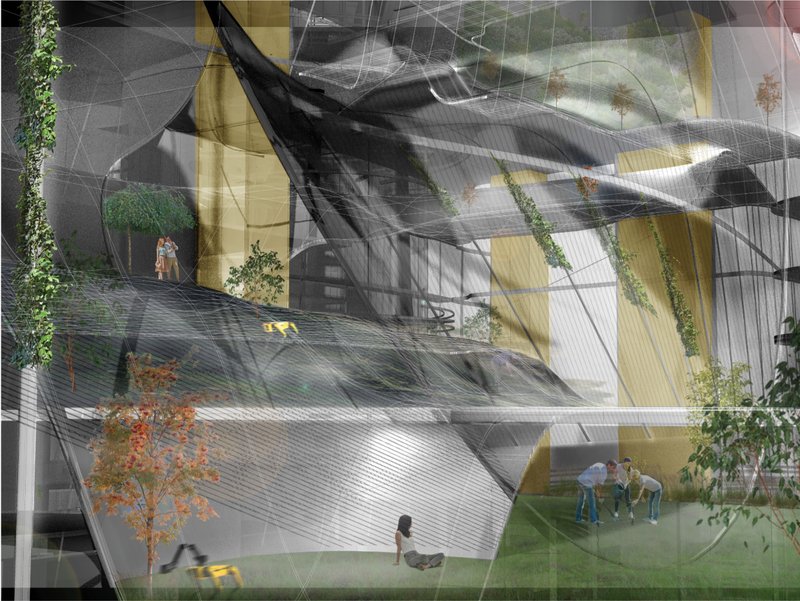
The petal-like modules create an ever-changing silhouette that appears simultaneously lightweight and infrastructural. The layering of terraces, farming systems, translucent enclosures, and exposed circulation paths produces a building that feels alive and continuously evolving.
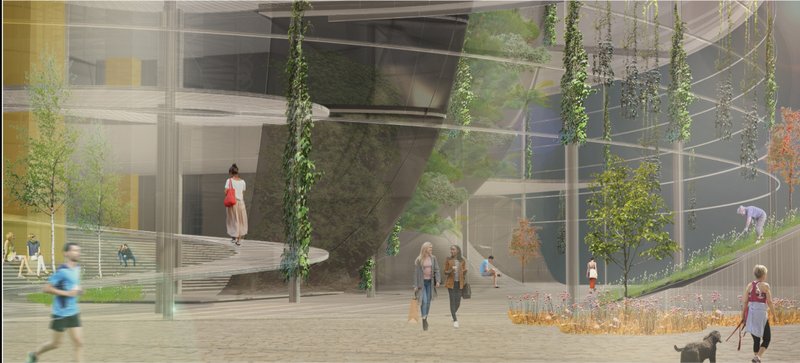
This architectural strategy allows the project to blur distinctions between interior and exterior space. Residents move through gardens, open-air circulation platforms, shaded communal zones, and semi-private landscapes distributed vertically across the tower.
The integration of elevated parks and landscape systems creates a new type of urban public realm in the sky. Instead of concentrating social activity solely at street level, the project distributes public life throughout the entire vertical section of the building.
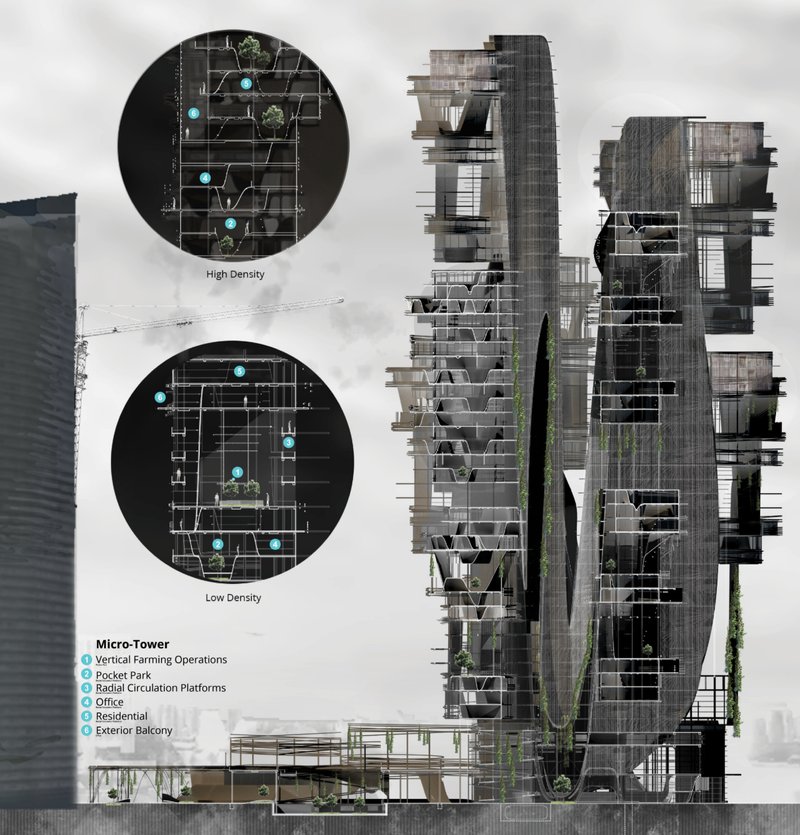
Flexible Living Through Modular Units
The residential strategy of the project emphasizes adaptability and spatial efficiency. The living units are organized as modular radial formations capable of supporting varying occupancy conditions and lifestyle requirements.
Single and double living modules are integrated into the petal configurations, allowing units to connect flexibly depending on programmatic needs. This modular logic enables the architecture to evolve over time while supporting mixed-use occupancy patterns.
The project also explores how compact urban living can coexist with access to generous communal amenities. Shared terraces, elevated recreation spaces, farming areas, and circulation platforms reduce the need for isolated private environments by encouraging collective urban experiences.
This approach reflects a broader shift in contemporary architecture toward community-oriented living models where social infrastructure becomes equally important as private dwelling space.
Structural Innovation and Prefabrication
The project demonstrates a sophisticated understanding of prefabricated construction systems and modular assembly techniques. Diagrams reveal how concrete slabs, radial timber enclosures, prefabricated steel structural frames, and adaptable façade systems combine to create an efficient construction methodology.
The modular nature of the system suggests the possibility for scalable deployment across different urban contexts. Towers could potentially adapt to varying densities, site conditions, or environmental requirements while maintaining a consistent structural and ecological framework.
This flexibility positions the proposal as more than a singular architectural object. It becomes a replicable urban strategy capable of evolving alongside future cities.
Public Space Beyond the Ground Plane
One of the strongest conceptual contributions of the project is its redefinition of public space in vertical urban environments.
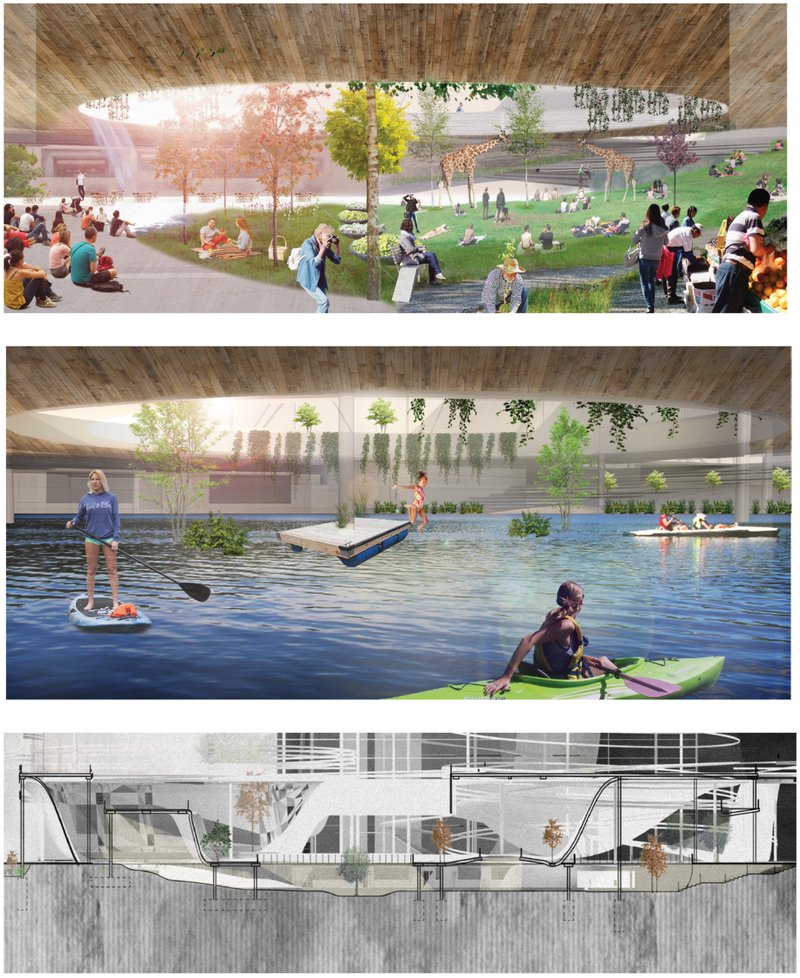
Instead of isolating recreational activity at the podium or street level, the proposal introduces elevated pocket parks, suspended circulation platforms, interior landscapes, and water-integrated communal zones throughout the building section.
The architecture creates opportunities for gathering, recreation, farming, relaxation, and movement at multiple vertical layers. These spaces transform the tower into a social ecosystem rather than a purely residential or commercial structure.
This strategy directly challenges conventional skyscraper typologies that often separate occupants from nature and public interaction. In contrast, the Micro-Tower continuously reconnects inhabitants with greenery, open space, and community engagement.
A Vision for Future Urban Living
As climate change, rapid urbanization, and housing pressures continue reshaping cities worldwide, architecture must move beyond static building typologies toward adaptable environmental systems. The Micro-Tower proposal by Collin Pierce offers a compelling vision for how sustainable vertical architecture can address these evolving urban realities.
By combining modular construction, urban farming, elevated public space, ecological infrastructure, and compact living strategies, the project demonstrates how density can become both environmentally regenerative and socially enriching.
Rather than treating sustainability as an added technological layer, the architecture embeds ecological thinking directly into its structural, spatial, and social organization.
The result is an ambitious architectural vision that reimagines the future of urban density through living systems, community interaction, and environmental integration.
As cities search for new models of resilient development, projects like Micro-Tower reveal the transformative potential of architecture when ecology, infrastructure, and human experience are designed as one interconnected system.


Popular Articles
Popular articles from the community

PLATAFORMArq Folds a Concrete Roof Over the Portuguese Mountains in House #474
A 220-square-meter residence in Teixoso, Portugal, wraps board-formed concrete into an angular canopy that frames the Serra da Estrela foothills.

Milan Crossover: Sustainable Architecture for a New Fashion Culture in Milan
Milan Crossover transforms fashion culture through sustainable architecture, linking material libraries, remake studios, and public runways.
The Faith: Modular Architecture for Play, Learning, and Hope in Kutupalong Refugee Camp
A modular playground architecture project in Bangladesh where play, learning, safety, and hope rebuild childhood inside a refugee camp anew.
Kerry Kounnapis Packs 800 Daily Coffees into a 43-Square-Metre Melbourne Laneway Bar
Palace Coffee channels Pellegrini's and European standing bars through oxide-red steel and spotted gum timber in a Ridgway Place sliver.


Similar Reads
You might also enjoy these articles
Eco Chapel: A Green Architecture Pavilion Designed in Symbiosis with the Forest
Eco Chapel uses green architecture to weave prayer, learning and reuse into a forest pavilion shaped by modular hexagonal canopies for life.
Kaffeebühnen: Coffee Shop Architecture Designed as a Civic Stage Between Vienna’s City and Park
Kaffeebühnen turns coffee shop architecture into a civic stage, linking Vienna’s park edge, urban life, warm timber yards, and coffee craft.
Healing Façade: Sustainable Architecture for Reforestation, Community, and Sacred Ecology in Ethiopia
Healing Façade reimagines sustainable architecture as a living wall that restores soil, catches water and renews Ethiopia's forest churches.


Urban Forest: A Vertical Ecosystem for 5,000 Workers in Singapore's Changi Business Park
Radially stacked pods and layered green decks turn a 7-acre plot into 47 acres of ecological workspace projected for 2040.


Explore Architecture Competitions
Discover active competitions in this discipline




The International Standard for Design Portfolios


The Global Benchmark for Architecture Dissertation Awards


The Global Benchmark for Graduation Excellence


Challenge to reimagine the Iron Throne
Comments (0)
Please login or sign up to add comments
No comments yet. Be the first to comment!