

SV60 Arquitectos Wraps 134 Homes Around a Green Lung in Eastern Seville
A permeable perimeter block in Sevilla Este uses cross-ventilation, ribbed metal cladding, and a shared courtyard to domesticate a heterogeneous suburb.


Sevilla Este is not the Seville of postcards. The eastern expansion of the city is a patchwork of schools, retail sheds, and apartment blocks that never quite agreed on a common language. Into this context, SV60 Arquitectos, led by Antonio G. Liñán, has placed a 134-unit residential complex that does something deceptively simple: it closes a city block and turns the resulting void into a generous shared landscape. The move is old, almost Cerdà-old, but the execution is tuned precisely to the Andalusian climate and to a neighborhood that needed a calm anchor more than another spectacle.
What makes Habitat Seville Este worth studying is less a single formal gesture and more a system of decisions that reinforce one another. The building perimeter is conceived as a permeable membrane: openings punch through the mass to connect street and courtyard, cross-ventilation routes are embedded in every unit plan, and the facade itself oscillates between solid ribbed panels, louvered screens, and cantilevered balconies that modulate solar gain throughout the day. The result is a nearly 19,000-square-meter complex that reads as both unified and varied, quiet from the street yet social at its core.
A Perimeter Strategy for a Fragmented District
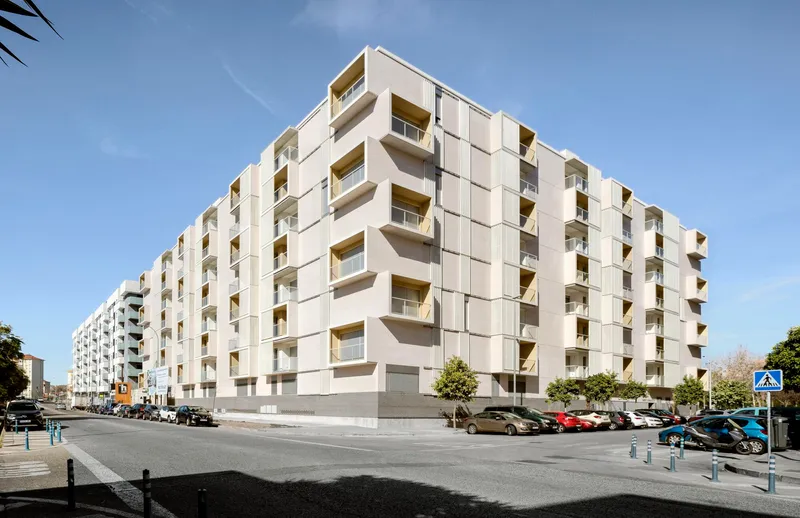


The building wraps the full perimeter of its plot, creating a clear boundary between the noisy, car-lined streets of Sevilla Este and the private courtyard within. From different street corners the complex presents slightly different faces: staggered volumes, stepped massing, and alternating depths of balcony projection break down the scale so that 134 units never feel monolithic. The white ribbed cladding provides continuity, but the way balconies advance and retreat creates pockets of shadow and light that change character with the seasons.
Viewed through gaps between neighboring buildings, the project registers as a composed, deliberate presence in a district that generally lacks one. SV60's strategy is not to mimic the surrounding heterogeneity but to oppose it quietly with a consistent material palette and a clear volumetric logic. That restraint gives the neighborhood something to orient itself around.
Ribbed Panels and Louvered Screens as Climate Tools
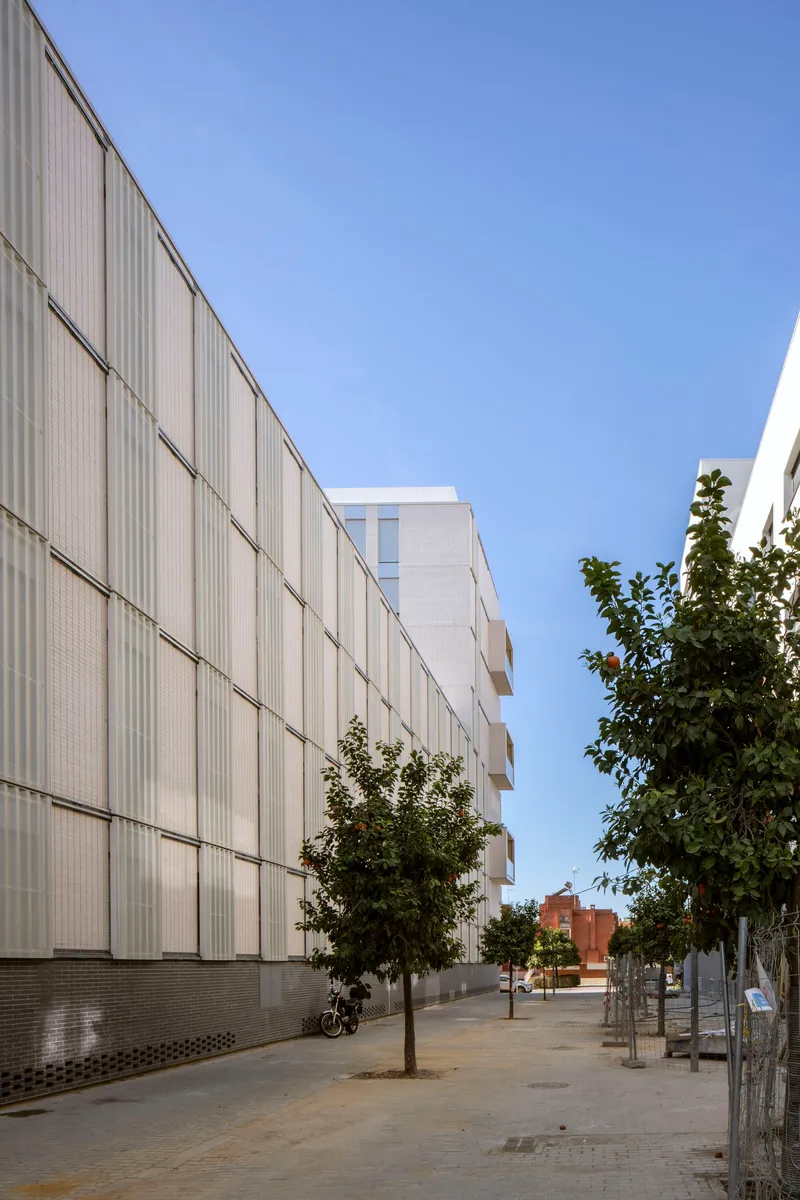
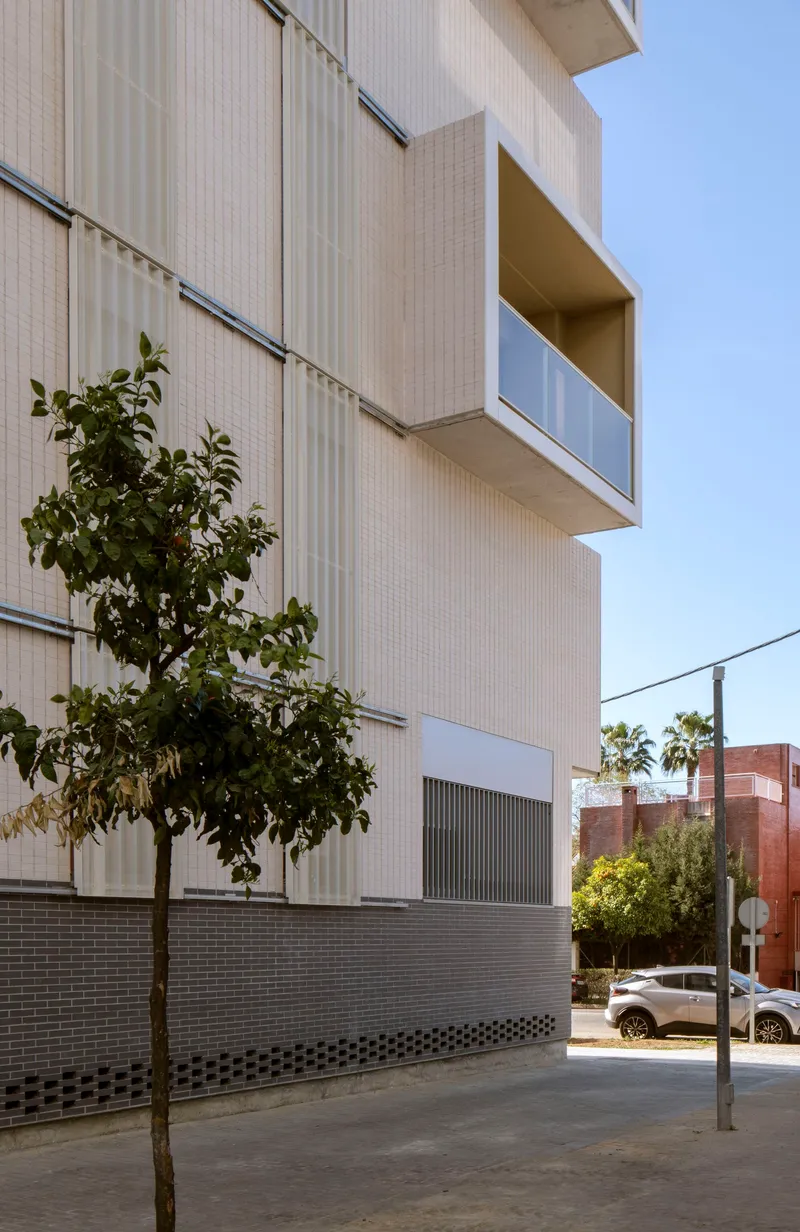

The facade is doing real work here, not just performing texture. The ribbed metal panels, produced in collaboration with manufacturers like Cortizo and Cerámica Malpesa, cast fine shadows across the building surface, reducing radiant heat gain on south- and west-facing walls. Vertical louvered screens at balcony edges filter low-angle sun while still admitting air. The effect is a building that breathes rather than seals itself against the Sevillian summer.
Close up, the cladding has a tactile, almost textile quality. The ribs catch light at different angles and give what could be a flat white surface genuine depth. Combined with glass balcony railings and the occasional yellow reveal at a balcony soffit, the facade achieves variety without resorting to collage. Every variation serves a climatic or spatial purpose.
Balconies That Modulate the Envelope


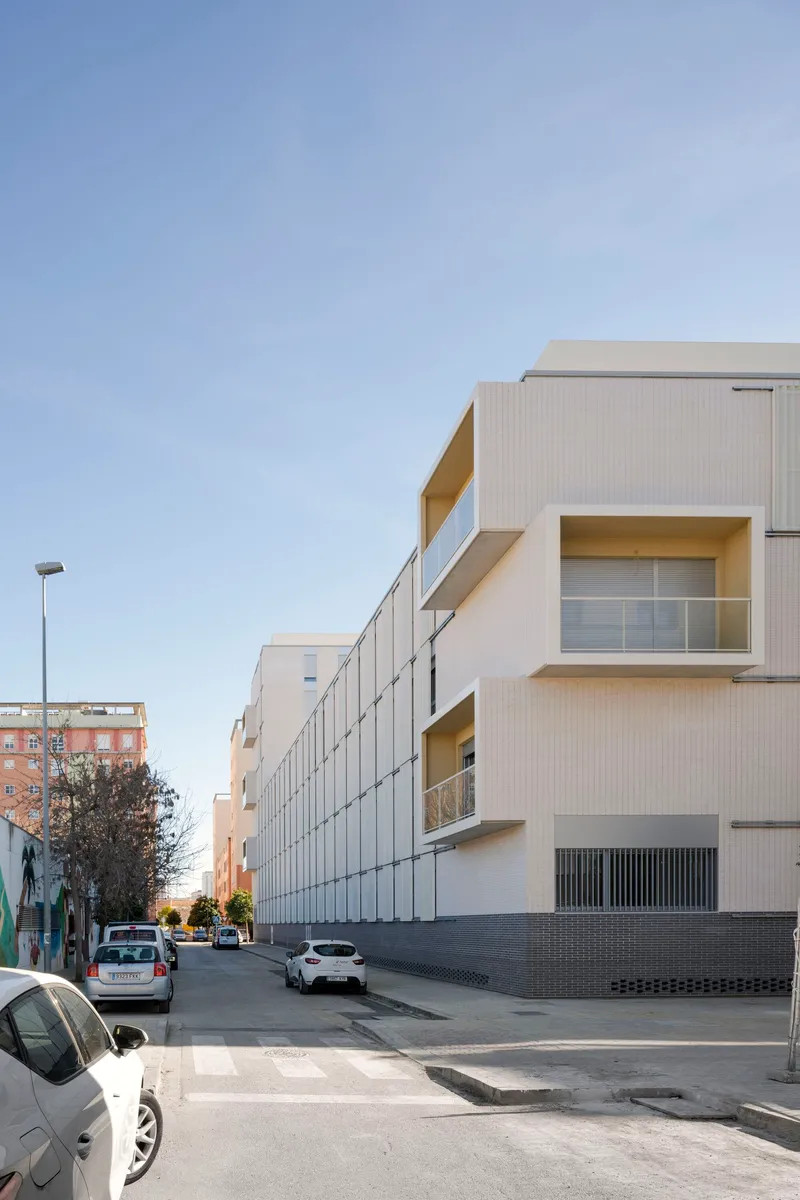
The balconies deserve separate attention because they are doing double duty. Structurally, they alternate between cantilevered projections and deep recesses, which staggers the load path and gives the facade its rhythmic, almost syncopated section. Environmentally, the projecting balconies shade the glazing below, while the recessed ones create sheltered outdoor rooms that remain usable even on the hottest afternoons. Residents get genuine outdoor living space, not a token ledge.
The yellow soffits visible in several corners are a small but effective gesture. They bounce warm reflected light into the rooms above, counteracting the coolness of all that white metal, and they signal entrances and corners where the building meets the street. It is the kind of detail that suggests SV60 was thinking about human perception, not just plan efficiency.
The Courtyard as Shared Infrastructure
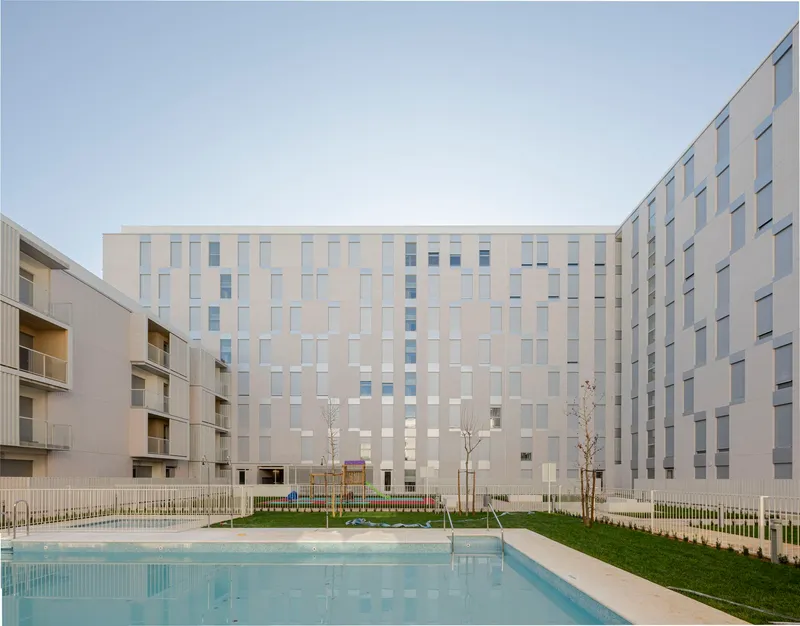


The central courtyard is the social engine of the project. A reflecting pool, a swimming pool, timber decking, newly planted trees, and children's play areas all occupy the space, organized so that no single use dominates. The courtyard facades differ from the street facades: here, the vertical louvers and perforated screens are more prominent, creating a layered visual field that gives privacy to ground-floor units while keeping the interior space luminous.
What works is the scale. The courtyard is large enough to register as genuine landscape, not a light well. It functions as a green lung for the complex, providing cooled air that feeds into the cross-ventilation routes designed into each unit. In Seville's 40-degree summers, that airflow is not a luxury but a prerequisite for comfort. The landscape design, with its mix of local vegetation and hardscape, suggests it will mature into a genuine garden within a few years.
Thresholds and Ground-Floor Life

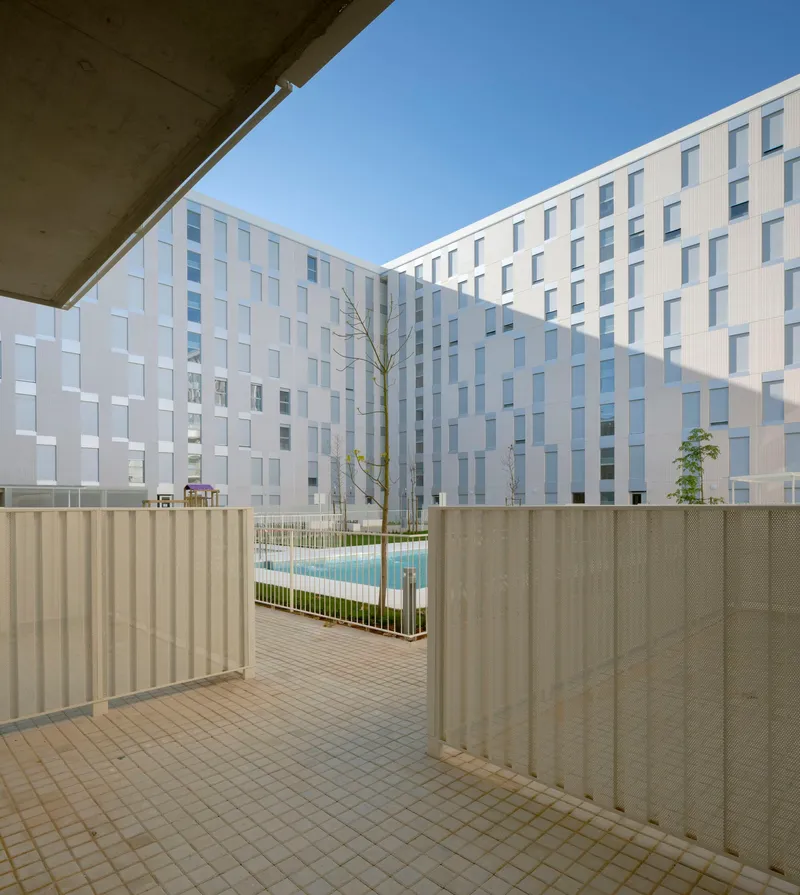
The lobby and ground-floor transitions are handled with care. A glazed passage connects street to courtyard, with ribbed wall panels carrying the exterior language inside. Metal mailbox walls and polished floors give the common areas a civic quality that elevates them above the typical developer corridor. The perforated metal screening on the courtyard terrace filters views and light simultaneously, making the transition from enclosed lobby to open garden feel gradual rather than abrupt.
These threshold moments matter because they determine how residents experience the building daily. SV60 has invested enough architectural attention in the lobbies and passages that they feel designed rather than leftover, which is rarer than it should be in housing of this scale.
Street Presence at Different Hours


The facade transforms at dusk. The ribbed panels, which appear crisp and almost industrial in direct sunlight, soften as the light drops, and the vertical metal screening becomes a lantern-like filter as interior lights begin to glow through. The street trees planted along the pedestrian sidewalks already establish a scale relationship between the building and the passerby, and within a few growing seasons the canopy will further mediate the building's height.
From the street, parked cars and recycling bins compete for attention, as they do in every real neighborhood. SV60 cannot control that, but the building's proportions and material consistency hold their own against the visual noise. The long facade along the pedestrian street reads as a wall of fine vertical grain, almost a screen rather than a mass, which keeps it from feeling oppressive at close range.
Plans and Drawings


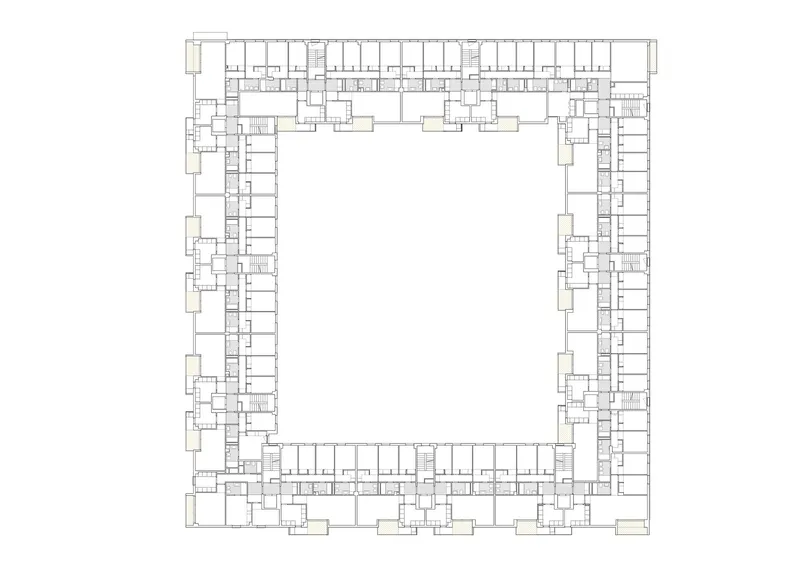


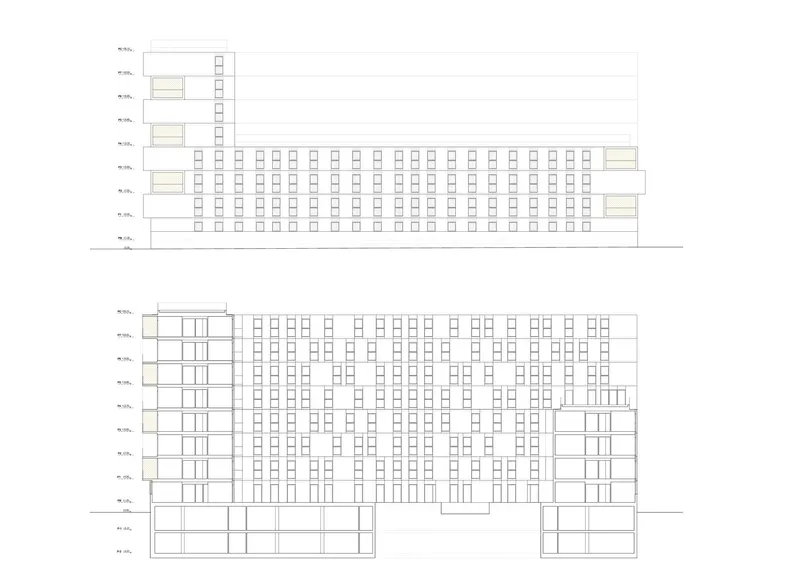
The site plan reveals the full perimeter-block strategy: the building encloses its plot completely, with the central courtyard functioning as a clearly bounded green space set within the larger urban grid. Floor plans show units of two, three, and four bedrooms arranged around central stair and elevator cores, each unit organized to achieve cross-ventilation between the street facade and the courtyard facade. The symmetry of the core plans allows efficient repetition without making the building feel monotonous from the outside, because the facade system introduces variation independently of the plan.
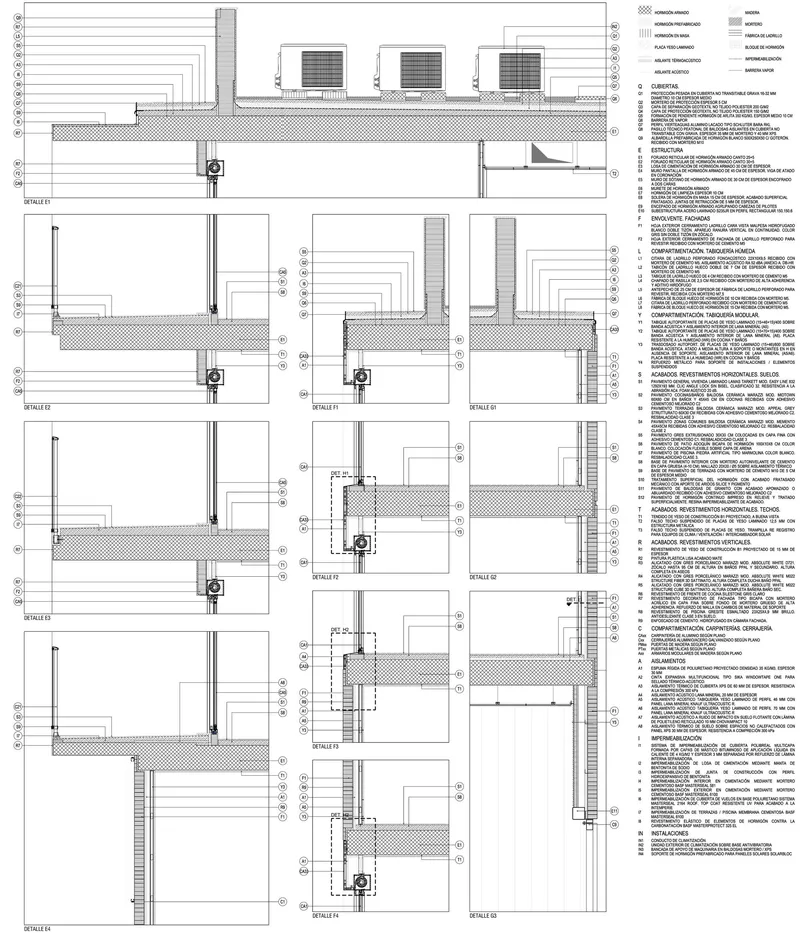
The section and elevation drawings confirm the consistent floor-to-floor height and the precise placement of projecting and recessed balconies. The construction detail sections are particularly revealing, showing wall assemblies that integrate insulation, the ribbed metal cladding system, and floor slab connections with the kind of resolution that indicates close coordination between SV60 and structural engineers Next Force Engineering. The detail at the balcony edge, where the cladding wraps the projection and meets the glass railing, is cleanly resolved.
Why This Project Matters
Habitat Seville Este is not a landmark building, and it is better for it. What SV60 Arquitectos has produced is a piece of urban repair: a large housing complex that takes its obligations to the street, the climate, and its residents' daily comfort seriously, without relying on formal novelty. The perimeter-block typology, the cross-ventilation strategy, the shared courtyard, and the carefully modulated facade are all proven ideas, but they are assembled here with a precision and consistency that many larger firms fail to achieve at this scale.
In a district defined by architectural indifference, this project demonstrates that 134 apartments can coexist with generous landscape, that climatic responsibility can coexist with visual refinement, and that collective housing does not have to choose between efficiency and dignity. If Sevilla Este eventually coheres into a real neighborhood, projects like this one will be the reason.
Habitat Seville Este Collective Housing by SV60 Arquitectos (lead architect: Antonio G. Liñán), Sevilla, Spain. 204,385 ft² (approximately 18,990 m²). Completed 2022. Photography by Jesús Granada.
About the Studio
SV60 Arquitectos
Official website of SV60 Arquitectos, one of the studios behind this project.
sv60.esShare Your Own Work on uni.xyz
If projects like this are the kind of work you want to make, uni.xyz is a place to publish your own, find collaborators, and enter design competitions.


Popular Articles
Popular articles from the community


Jaramillo Van Sluys Arquitectura and Urbanismo Turn a Demolished Registry Lot in Quito into an Orchard Plaza
In Quito's Centro Histórico, a 2,800 m² plaza exposes the San Agustín convent wall and redraws its lost Augustinian orchard in volcanic stone.

Juan García Correa, John González and Claudia Rueda Sink a Circular Amphitheater into a Manizales Engineering Building
On the La Nubia campus in Manizales, Colombia, the S1 Building folds labs and offices into a hillside of ramped lawns that double as a campus route.

longwave studio Reorganizes a 112 m² Tainan Apartment Around the Daily Routines of a Family and Two Cats
In Tainan, Taiwan, birch plywood, rust-red furniture and a freestanding plaster wall link arrival, storage, work and family life in one apartment.

Architekt Andreas Gruber Scatters 23 Dark Timber Chalets Across a South Tyrolean Forest Edge
In Molini di Tures, Amonti Chalets breaks a resort into a hamlet of gabled timber houses, with parking, storage and services pushed into the slope.

Similar Reads
You might also enjoy these articles


LAVA Architecten Gives Vocational Education a Sawtooth-Roofed Face on a Mechelen School Campus
In Mechelen, Belgium, a 2,053 m² STEM school on a 6×6 m grid turns workshops and classrooms into rooms that can be rearranged as teaching changes.

KEMA Studio Turns a Derelict Marvila Attic into a 60 m² Lighthouse Apartment Above Lisbon
In Lisbon's Marvila district, a rebuilt roof, four skylights and two plywood volumes turn an unlivable attic into a bright home facing the Tagus.

Pixel Gardens: One Repeated Module Stacked Into a Terraced Social Housing Tower for Famagusta
Salem Bader's shortlisted housing tower builds a vertical neighbourhood from one repeated module, offsetting units to carve terraces, light and air.

Bao Huynh Watercolor Atelier: A Serene Art Retreat in Hội An
Bao Huynh Watercolor Atelier in Hội An blends multifunctional art spaces, sustainable design, local materials, and family-friendly living in a serene environment.

Explore Social Housing Competitions
Discover active competitions in this discipline

Challenge to reimagine the Iron Throne

Photograph architecture without architects

Illustrate the lost glory of Angkor Wat - Render Challenge

Design challenge to reuse E-waste
Comments (0)
Please login or sign up to add comments
No comments yet. Be the first to comment!