

Lowén Widman Arkitekter Lifts a Gabled Timber Cabin over an Untouched Forest Slope near Stockholm
In Svinninge, outside Stockholm, a 90 m² timber cabin sits on gapped stone walls so the pines, rock and forest floor continue beneath it undisturbed.


Most forest cabins claim to touch the ground lightly. Few are honest about what that costs in a sloping, rocky plot with tight boundaries and difficult soil. Lowén Widman Arkitekter, led by Daniel Widman and Ulrika Lowén af Franzién, took on exactly that kind of site in Svinninge, just outside Stockholm. They answered with a 90 m² house completed in 2020 that reads at first glance like the archetypal Swedish house: stone base, timber frame, timber facade, gable roof.
The interesting move is in the base. The traditional stone plinth is a solid, ground-sealing element. Here it is cast and laid in masonry from local natural stone, and the walls are deliberately punctured. Those gaps let the forest keep growing under and beside the house, and a raised terrace extends the same idea outward. The result is a familiar silhouette with an unfamiliar relationship to the land, and we think that tension is what makes the project worth studying.
The Classic Swedish House, Quietly Rewritten
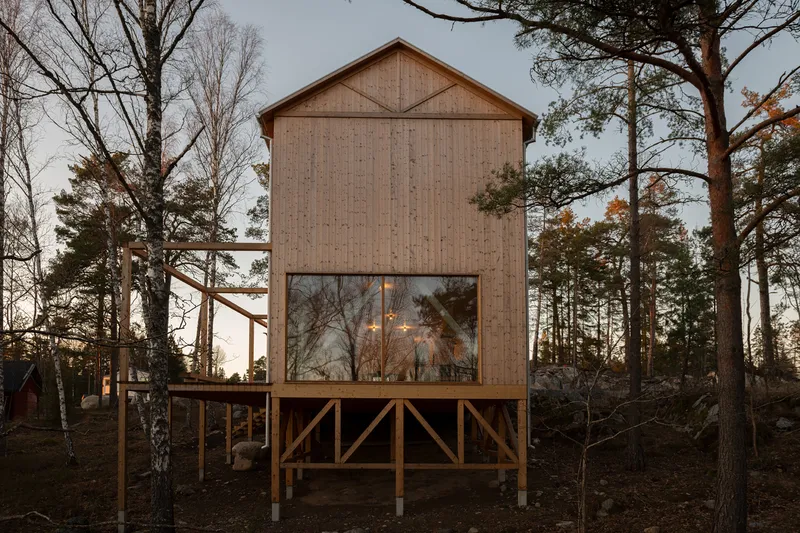
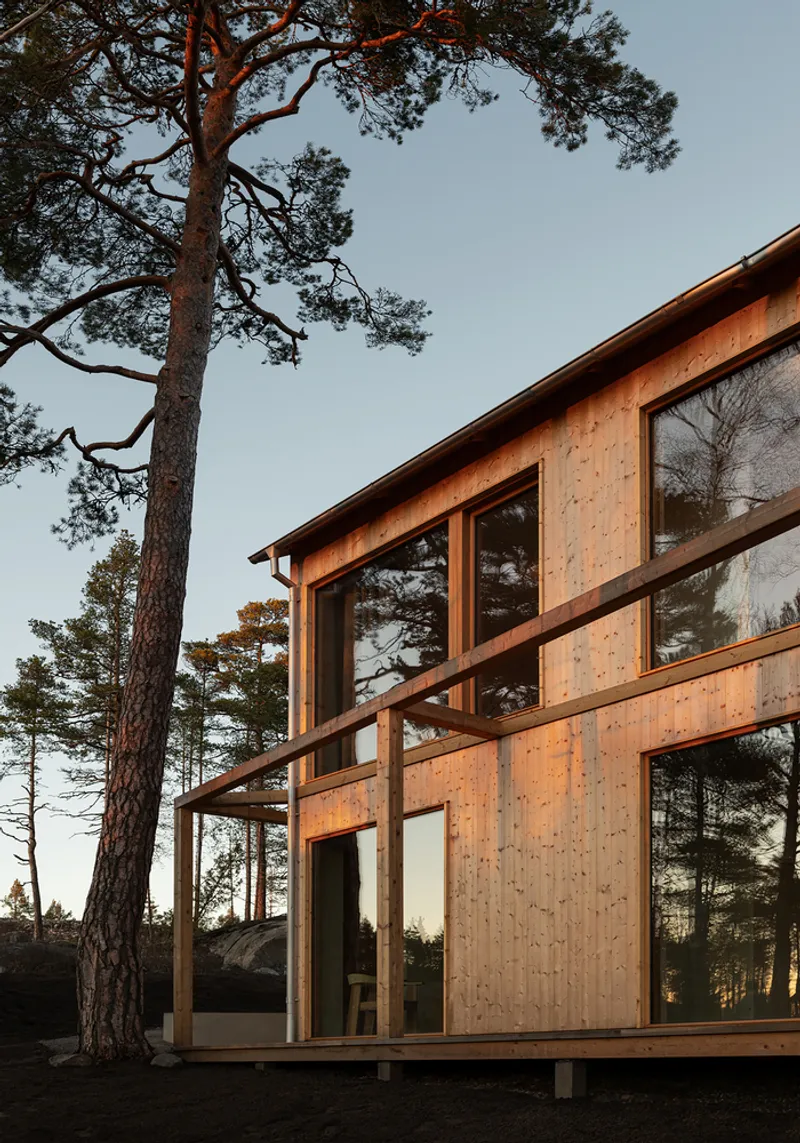
The gable does most of the cultural work. A simple pitched roof with a clearly expressed gable end makes the cabin legible to anyone who has driven through rural Sweden. The architects resist decorating it. The timber cladding stays plain, and the openings are large and few, so the shape reads cleanly against the pines.
What shifts the typology is the glazing. Large windows are cut into the gable and corners and placed according to orientation and sun, so at dusk the house turns into a lantern rather than a closed box. The open timber frame at the corner reinforces this, letting structure stand in for wall where the view matters most.
Lifting Off the Forest Floor
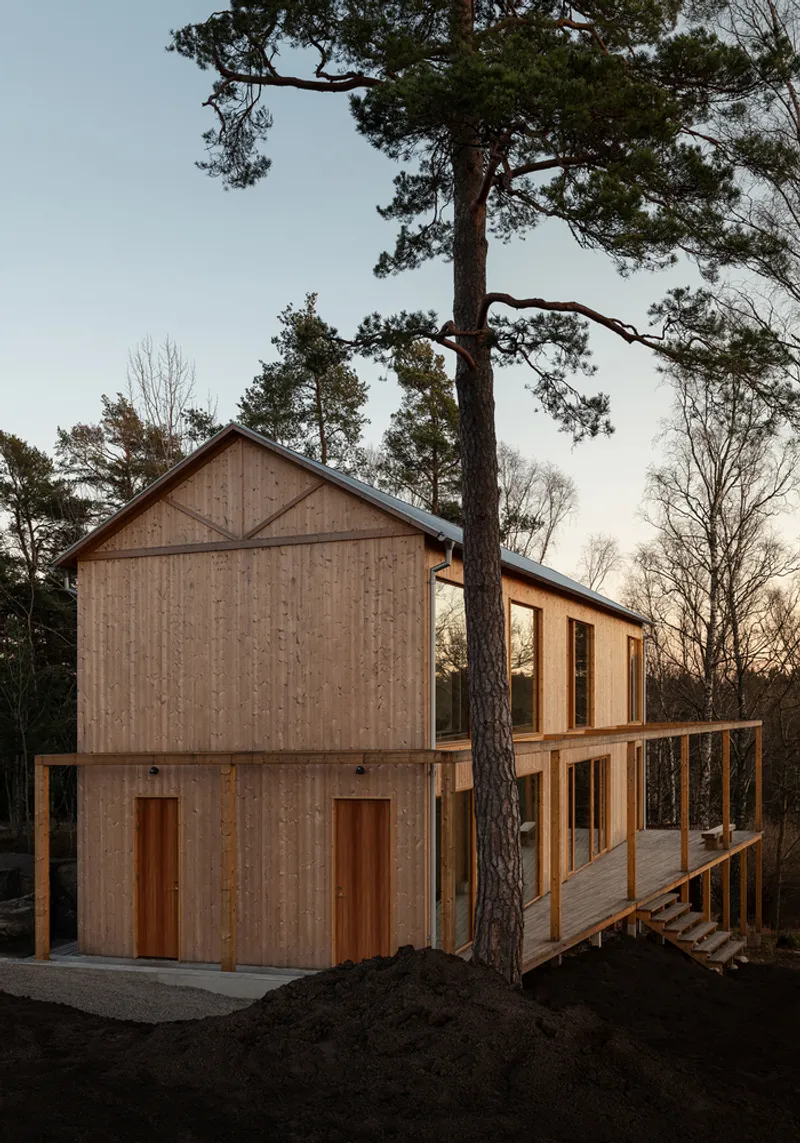
The plot came with restrictive dimensions, a rock outcrop, tall pines and an intact forest slope. Rather than blast a level pad, the team let the house hover. The gapped foundation walls and the raised deck are one strategy expressed twice: keep the ground continuous and let the building sit above it.
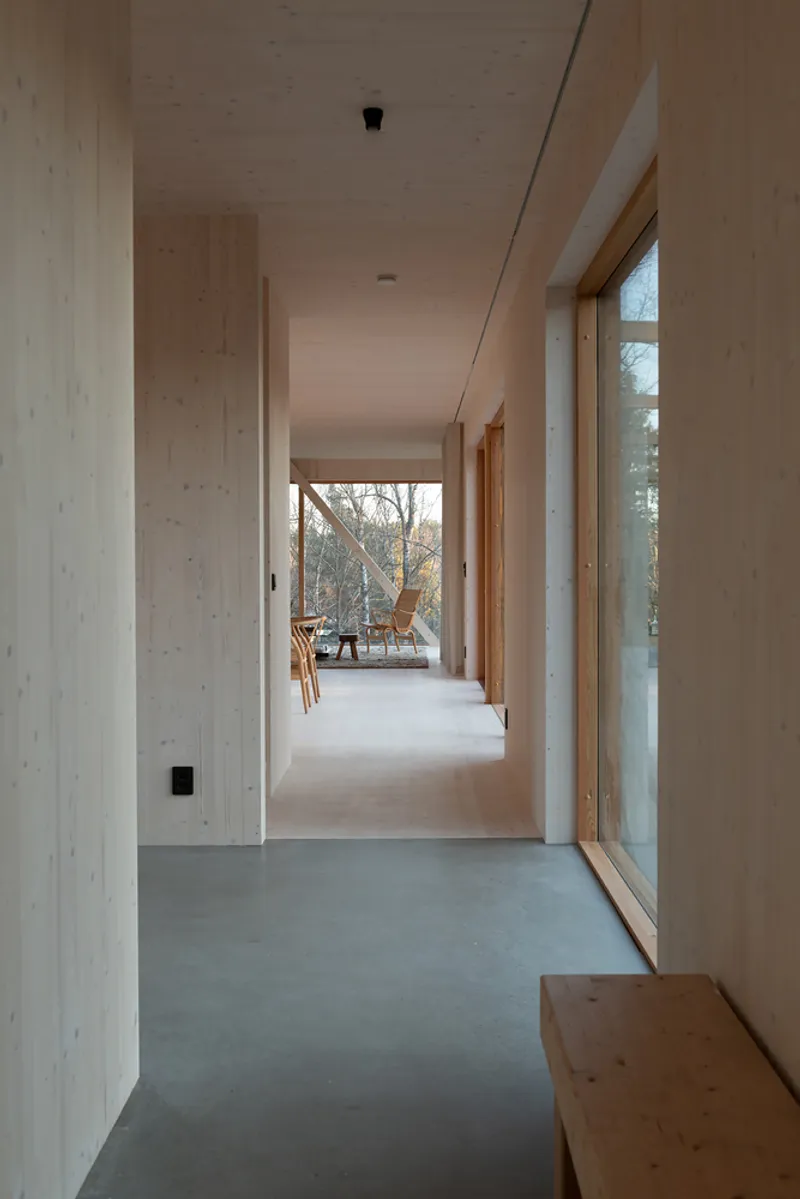
The deck wrapping around a mature pine is the clearest proof that the trees came first. The porch at the end of the corridor matters too. It turns the threshold into a room of its own, a sheltered outdoor seat that keeps you elevated among the trunks rather than down on the slope.
One Pale Timber, Every Surface
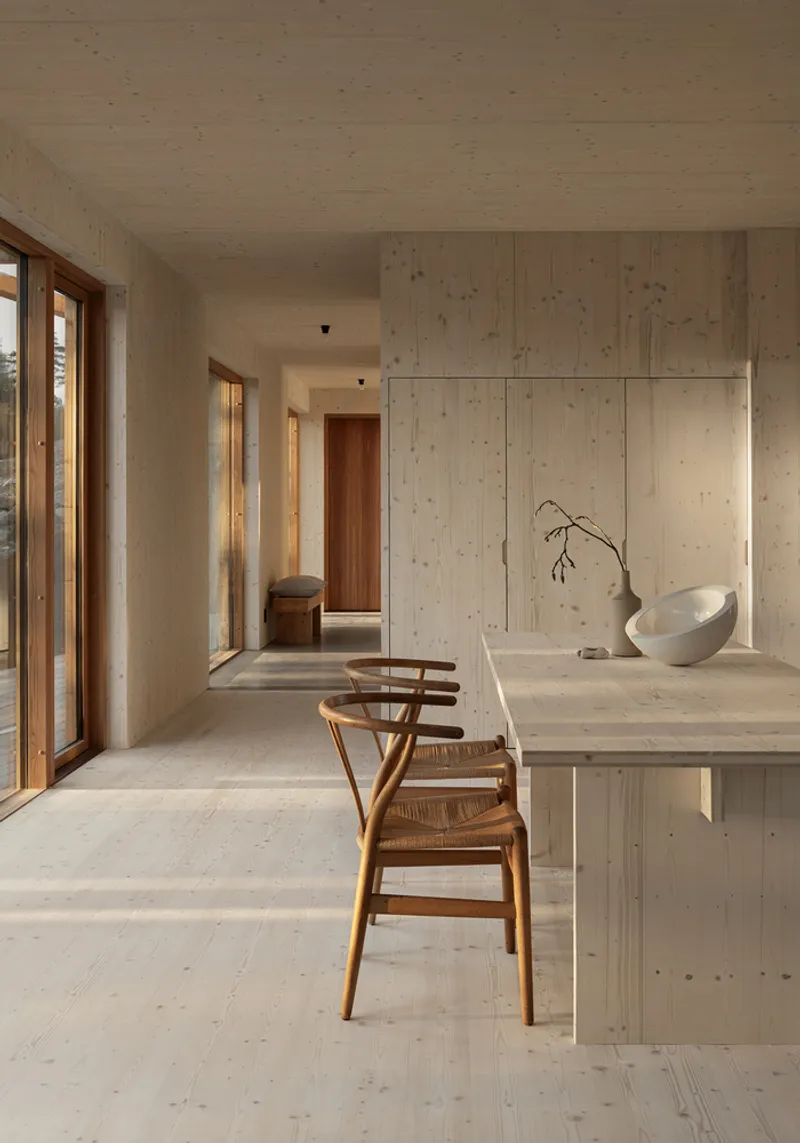
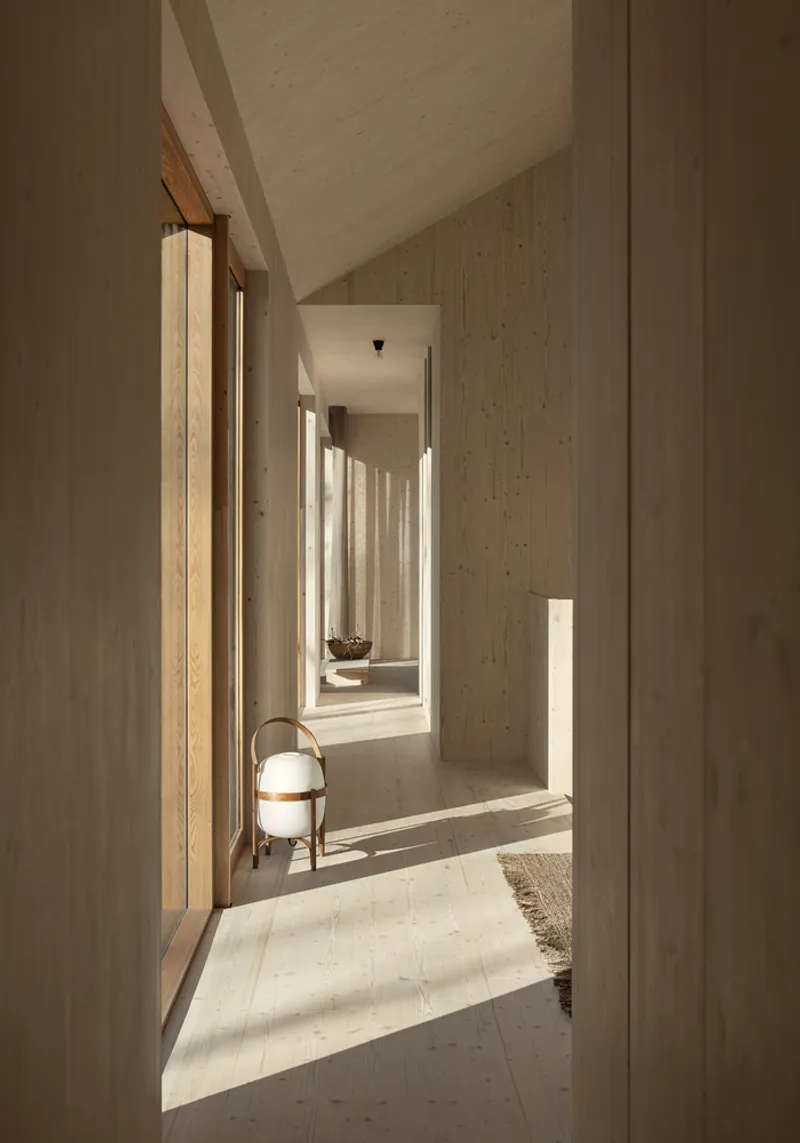
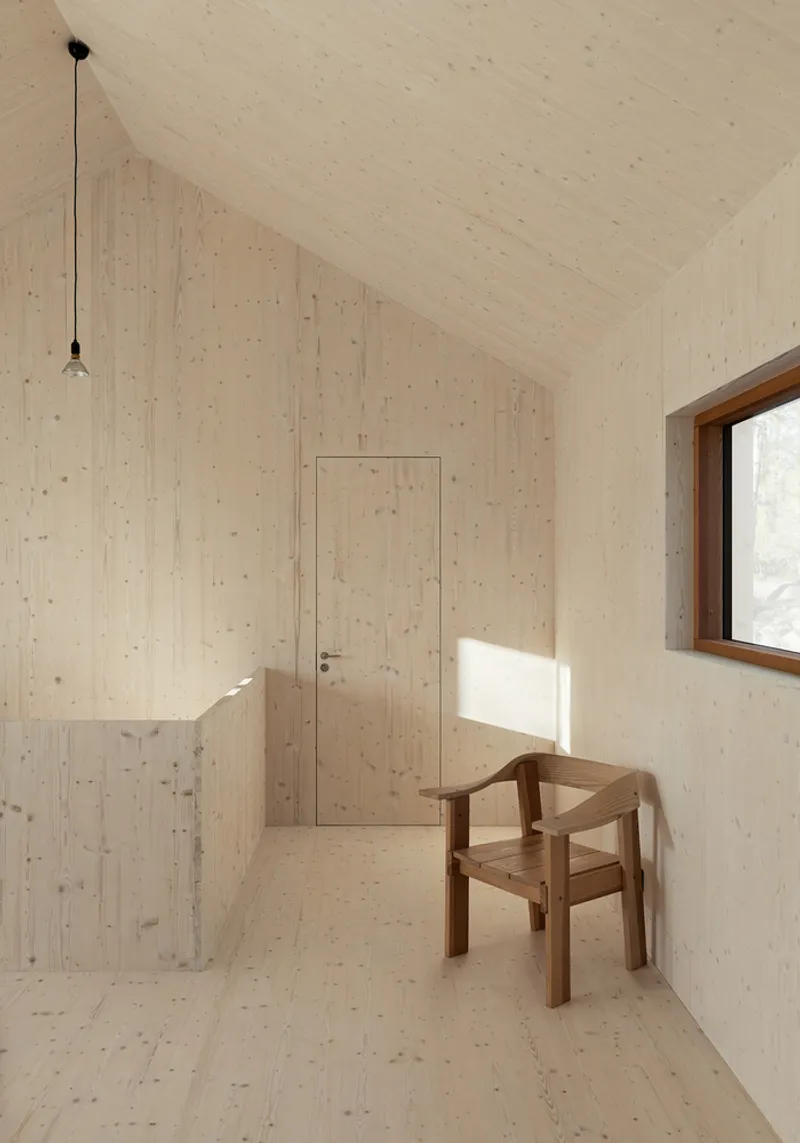
Inside, a single light wood covers floors, walls and ceilings, and the dining table matches it. This is a risky choice. Total timber interiors can feel like saunas. The architects avoid that by keeping the joinery flush and the details minimal, so the planking reads as a continuous lining rather than a theme.
Under the roof, the attic landing shows the gable from inside: the ceiling folds along the pitch, and a flush door disappears into the wall. The hallway does the same with almost nothing in it. A paper lantern on the floor is enough, because the surfaces are already doing the work.
Kitchen, Table and the View Above the Counter
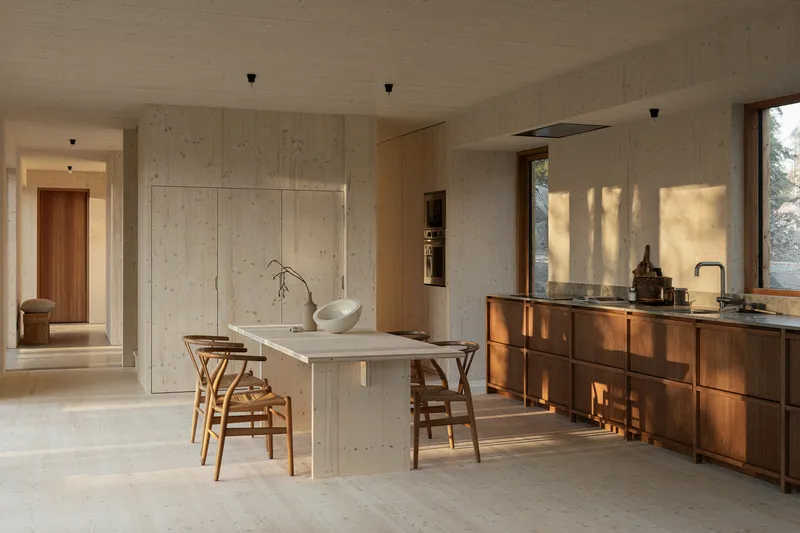
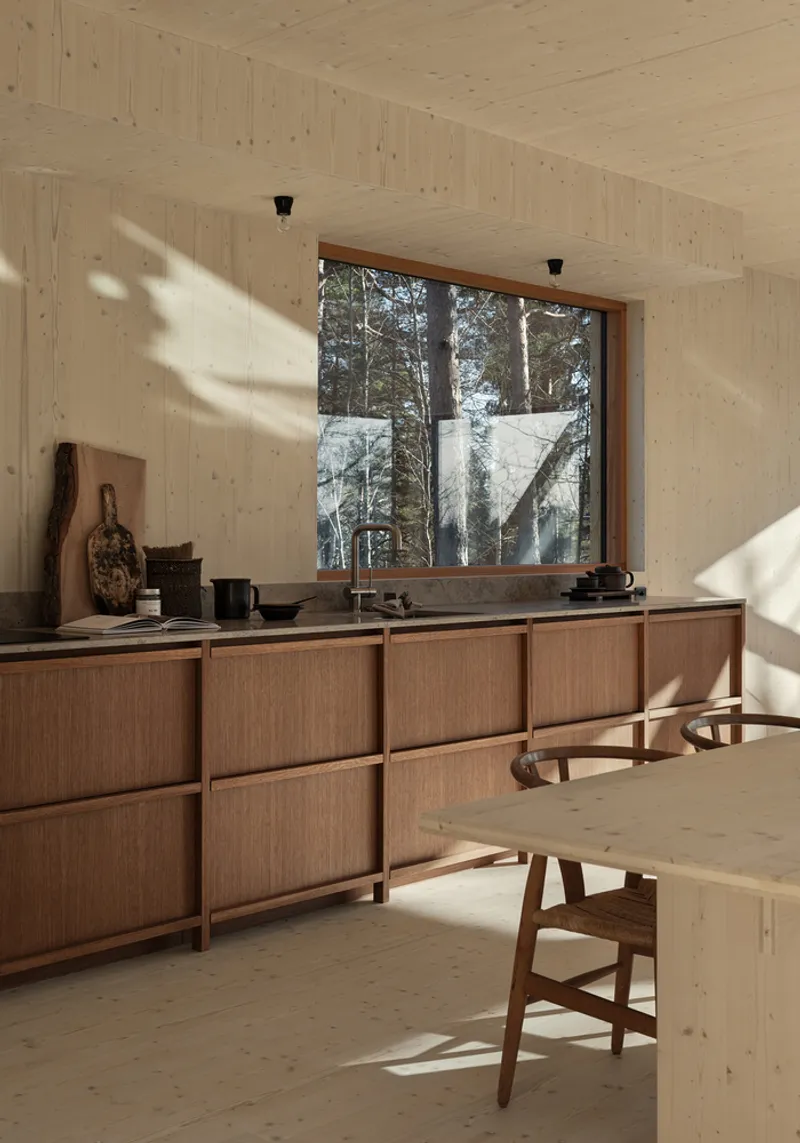
The furnishings and cabinetry are a shade darker than the shell, a small calibration that gives the kitchen weight without breaking the palette. The plank dining table sits at the centre of the open plan, where kitchen, dining and living merge into a single room.
The best decision here is the picture window over the kitchen run. Instead of a backsplash, you get pine trunks. It is a simple gesture, but it shows that the window placement came from the forest rather than from a facade grid.
Structure You Live Alongside
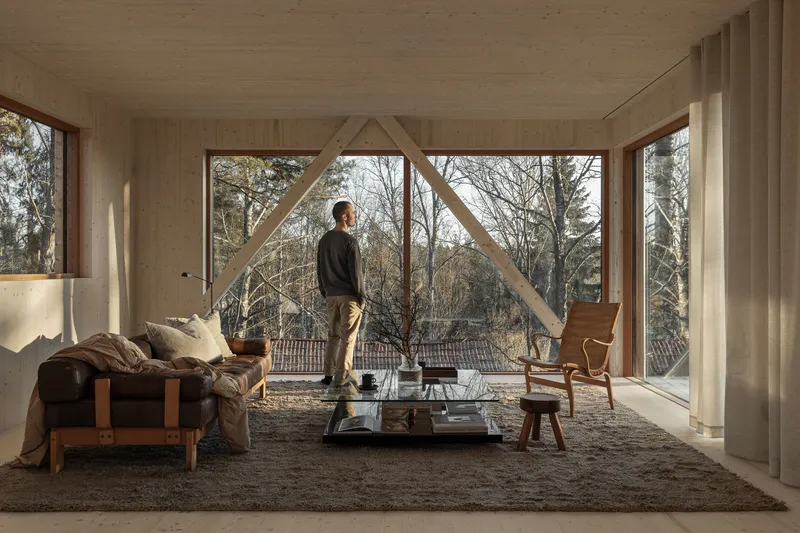
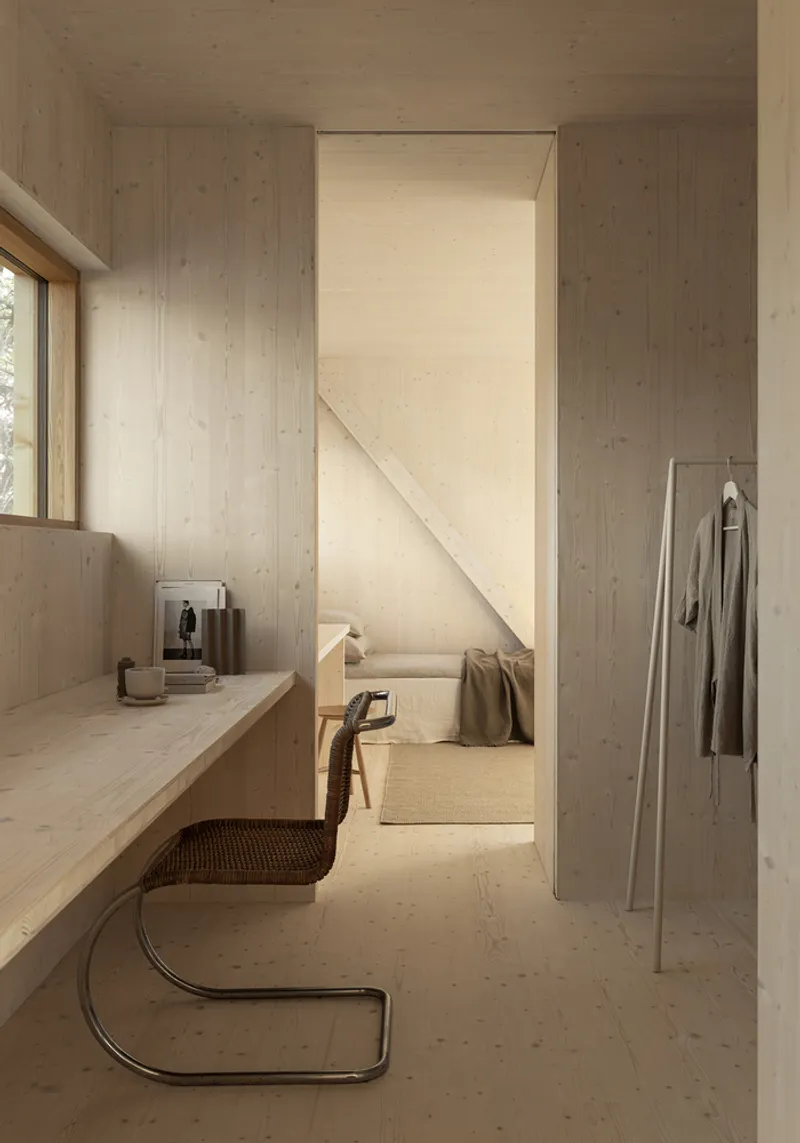
Diagonal timber braces cross the living room and continue into the bedroom, where one passes above the bed. They are left exposed and unapologetic. In the living room they frame the view of bare trees like mullions on a much larger scale, and they tie the interior to the cross-bracing visible outside.
Not everyone will want to sleep beneath a structural diagonal. We think it is the right call for a cabin. It keeps the frame honest and gives a 90 m² plan a sense of construction that a smooth plasterboard interior would erase. The built-in desk shows the same restraint: a plank, a chair and a doorway, nothing more.
Sunlight as a Building Material
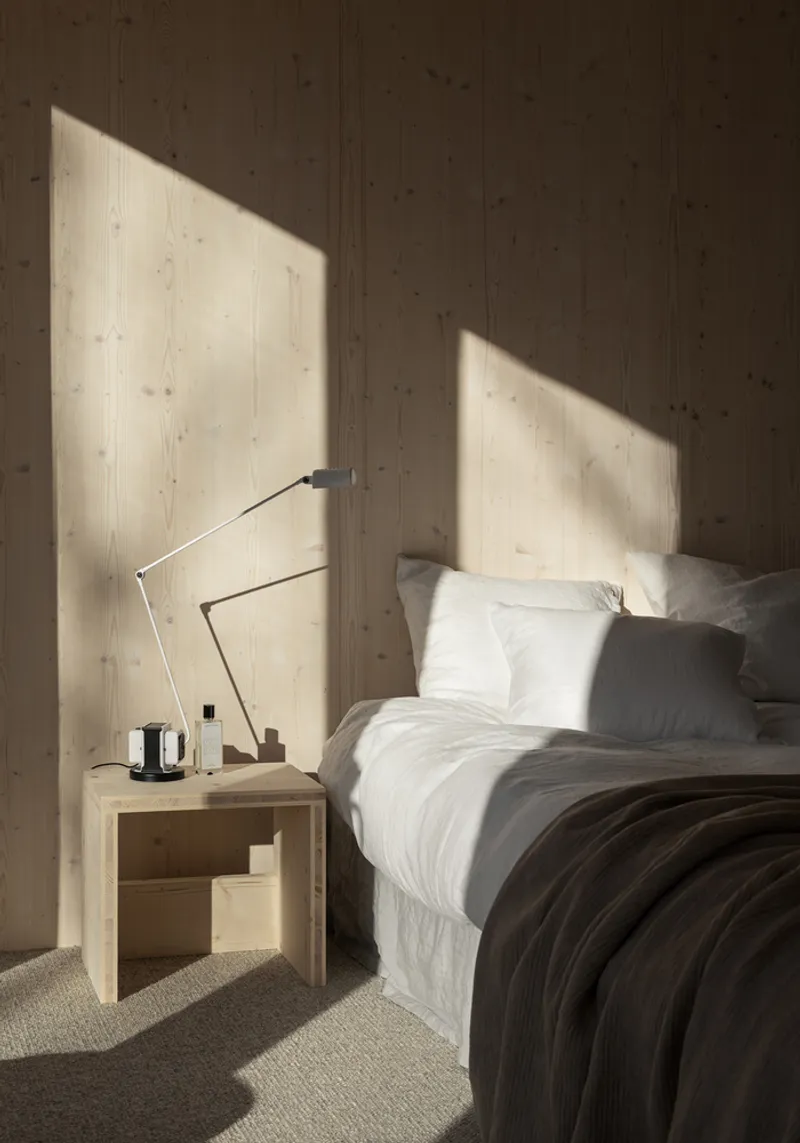
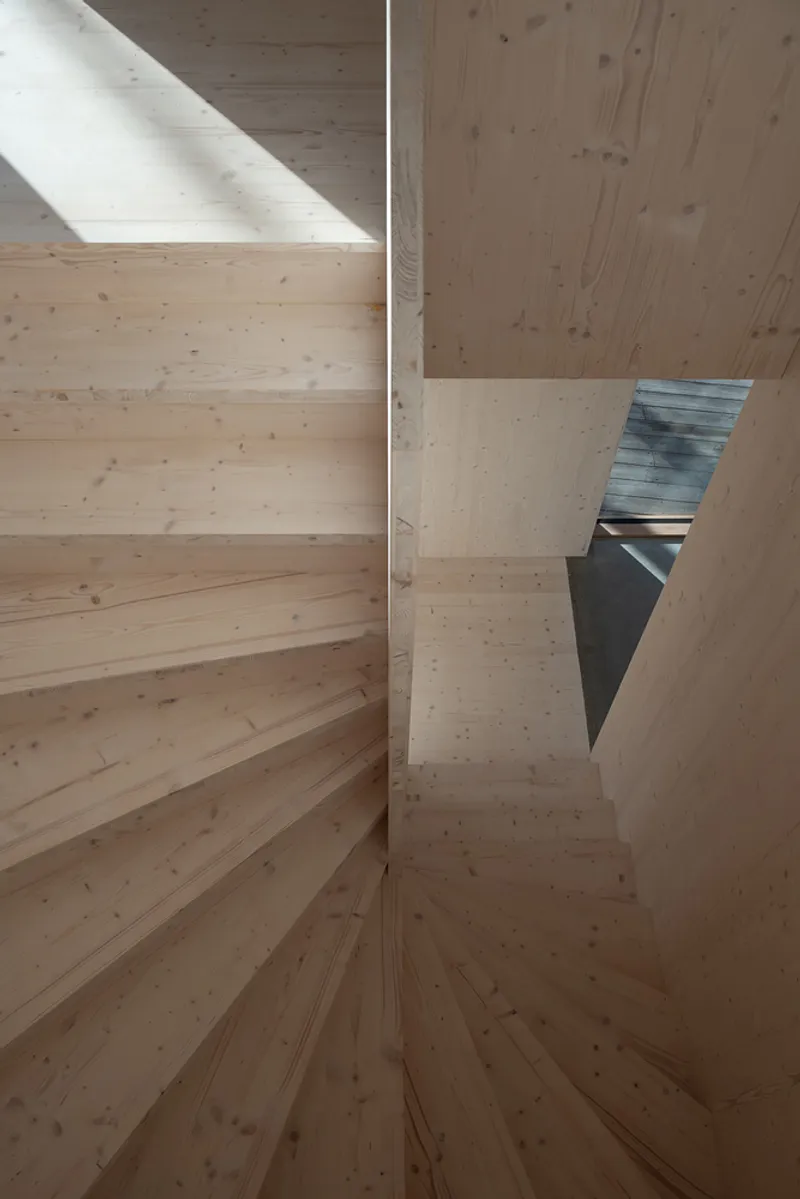
Because the openings were set by orientation and solar conditions, low Swedish sun reaches deep into the pale interior and lands in hard-edged patches on beds, floors and stairs. Against uniform timber, those patches become the main ornament and they change by the hour.
The winding stair, with its wedge-shaped treads, is the most sculptural element in the house and makes good use of a compact footprint. Seen from above with light falling across it, it shows how much the project gains from a limited palette: geometry and daylight carry the space. The bathroom reverses the logic with dark materials, a deliberate counterpoint to the bright rooms around it.
Why This Project Matters
Svinninge Cabin shows that site sensitivity does not require a new architectural language. Lowén Widman Arkitekter kept the most recognisable Swedish house form and changed one thing, the base, so it stops sealing the ground and starts letting it through. That is a more transferable lesson than any bespoke form, because it can apply to countless traditional typologies on difficult plots.
It also argues for restraint as a strategy. One timber species, a darker accent, exposed bracing and carefully aimed windows produce an interior that feels generous at 90 m². For anyone designing small rural houses, the takeaway is clear: settle the relationship with the ground first, then let a disciplined material palette and real sunlight finish the job.
Svinninge Cabin by Lowén Widman Arkitekter (chief architects Daniel Widman and Ulrika Lowén af Franzién), Svinninge, Sweden. Area: 90 m². Year: 2020. Photography by Erik Levander.
About the Studio
Share Your Own Work on uni.xyz
If projects like this are the kind of work you want to make, uni.xyz is a place to publish your own, find collaborators, and enter design competitions.


Popular Articles
Popular articles from the community

Opera by the Sea Estonia: Three Shells Dissolving Architecture into Tallinn's Coastline
A winning opera house proposal replaces monumental form with interconnected shells that blur the boundary between building, park and Baltic Sea.
Temporary Home for Dogs: A Reversed Zoo Rethinks Animal Shelter Architecture
In Bucharest, a sinuous corridor and freed landscape flip the logic of containment, designing a shelter that works to make itself unnecessary.
Faces of the Soviet Avant-Garde: Turning Moscow's Street Names into an Open-Air Museum
A network of sculptural installations across a Moscow residential district transforms forgotten architect names into spatial encounters with cultural memor
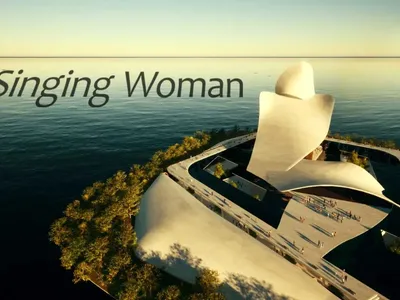
Singing Woman: An Opera House That Performs Before the Curtain Rises
Ovidiu Cristian Pavel's conceptual opera house translates Estonia's choral identity into a sculpted waterfront landmark facing the Baltic Sea.

Similar Reads
You might also enjoy these articles

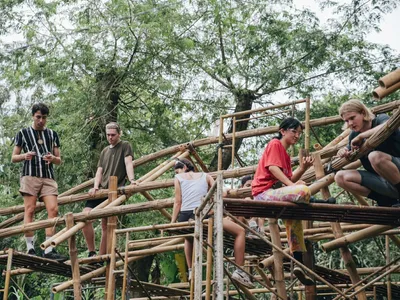
Bamboo Housing Challenge 2026: Design Affordable, Sustainable Homes Using Bamboo
An international design competition by Bamboo U and IBUKU inviting architects and designers to reimagine affordable housing using bamboo — with the winning design built full-scale in Bali.

Computational Design & Education: Beegraphy Design Awards Introduces 7th Category (Featuring Jiyun's Innovative Approach)
Dive into Beegraphy’s 7th Design Awards category, where computational design meets education to create immersive, interactive learning tools, inspired by Jiyun’s work.
From Parametric Lighting to Urban Furniture: Join the 2nd Workshop in Beegraphy’s Computational Design Series
Dive into Cutting-Edge Design Techniques and Practical Applications with Industry Experts

Last Call: Unleash Your Architectural Genius in SHAK's Kindergarten Design Competition
Urgent call for architects to join SHAK's kindergarten design competition before the looming deadline

Explore Architecture Competitions
Discover active competitions in this discipline

Challenge to reimagine the Iron Throne

Photograph architecture without architects

Illustrate the lost glory of Angkor Wat - Render Challenge

Design challenge to reuse E-waste
Comments (0)
Please login or sign up to add comments
No comments yet. Be the first to comment!