
t and m design office Turn a 35-Square-Meter Hanoi Alley Plot into a Vertical Microcosm
Loli House stacks life, light, and greenery through six floors on a 3.6-meter-wide frontage in one of Hanoi's dense village neighborhoods.


Hanoi grew out of villages, and that origin still defines how most of the city feels at street level. Dense, self-built neighborhoods are stitched together by narrow alleys called ngõ, corridors that function less as roads and more as communal living rooms. At the dead end of one such alley on Tran Cung Street, in the Co Nhue 1 ward of Bac Tu Liem district, t and m design office completed Loli House in 2023: a 157-square-meter home for a young family built on a site barely larger than a parking space.
What makes the project worth studying is not the smallness itself, which is unremarkable in Hanoi, but what the architects decided to spend the limited floor area on. Nearly 30 percent of the house is given over to circulation. A rectangular helical staircase runs the full height of the building, widening at landings into reading nooks, play platforms, and planted balconies. The staircase is not leftover space. It is the main event, a continuous vertical room that reframes climbing as dwelling.
A Facade for the Alley
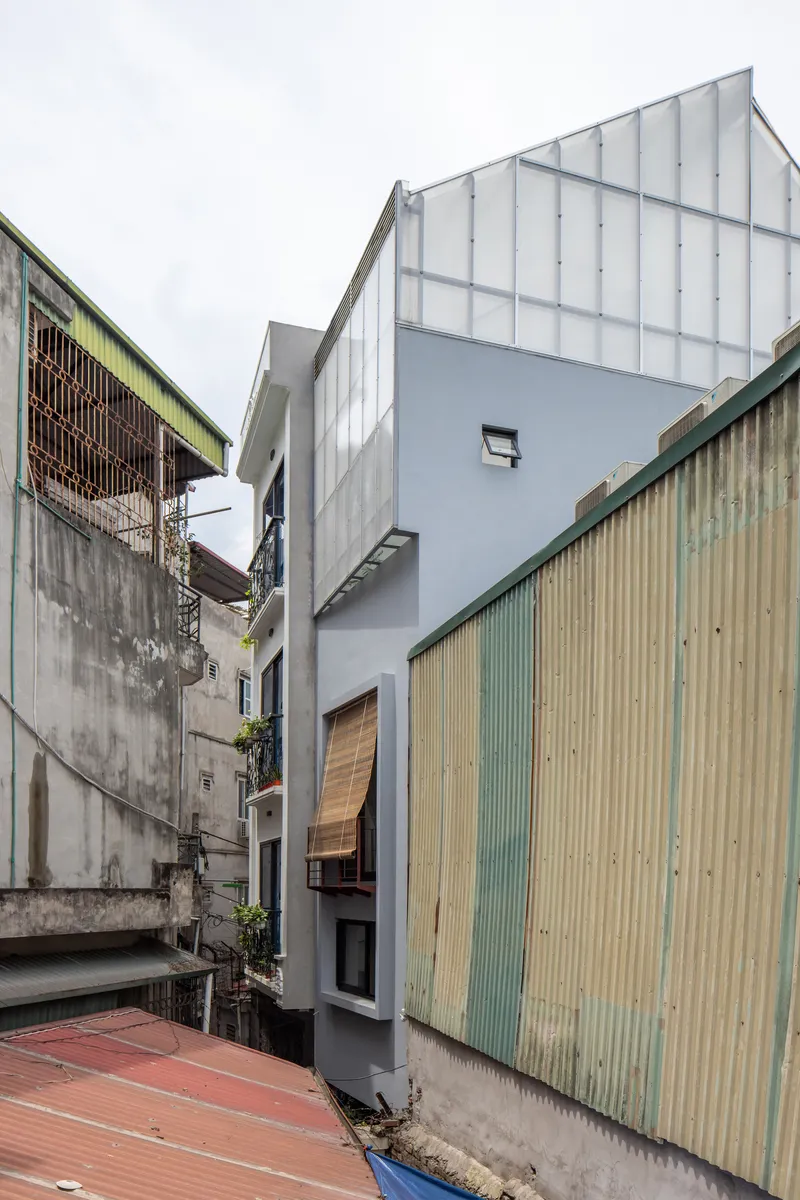
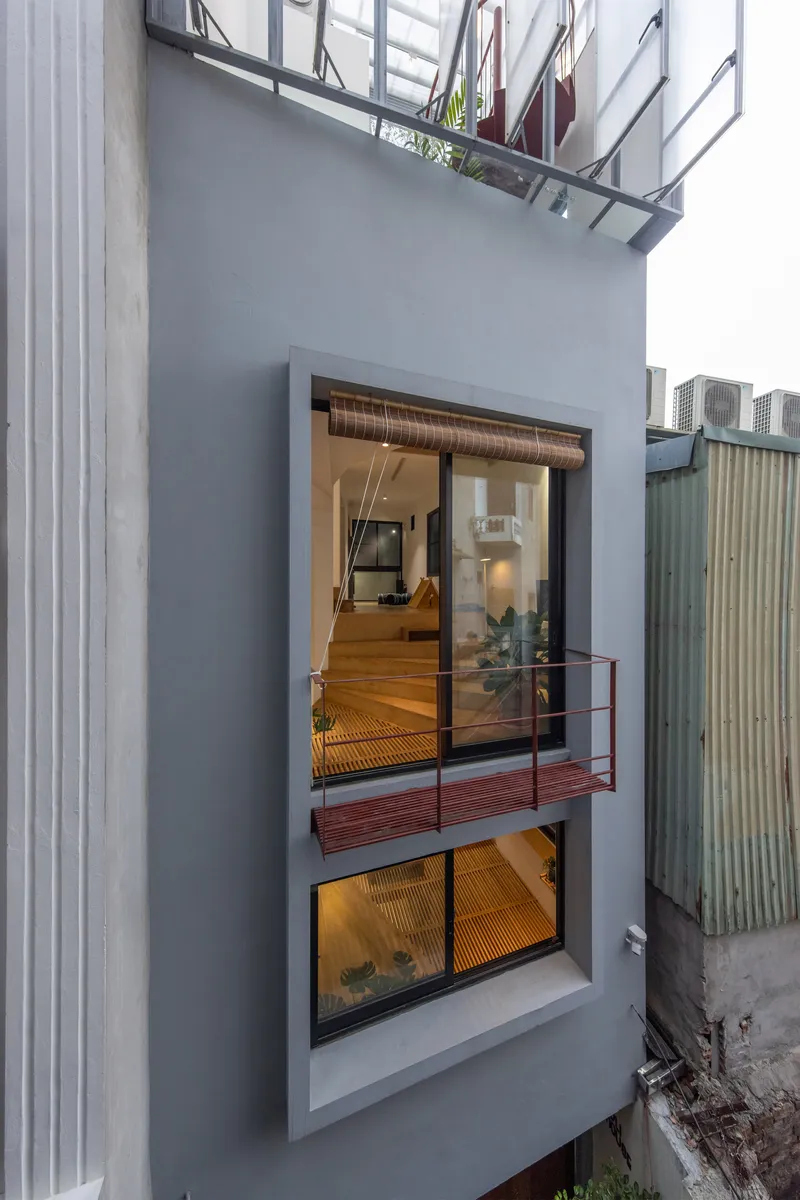
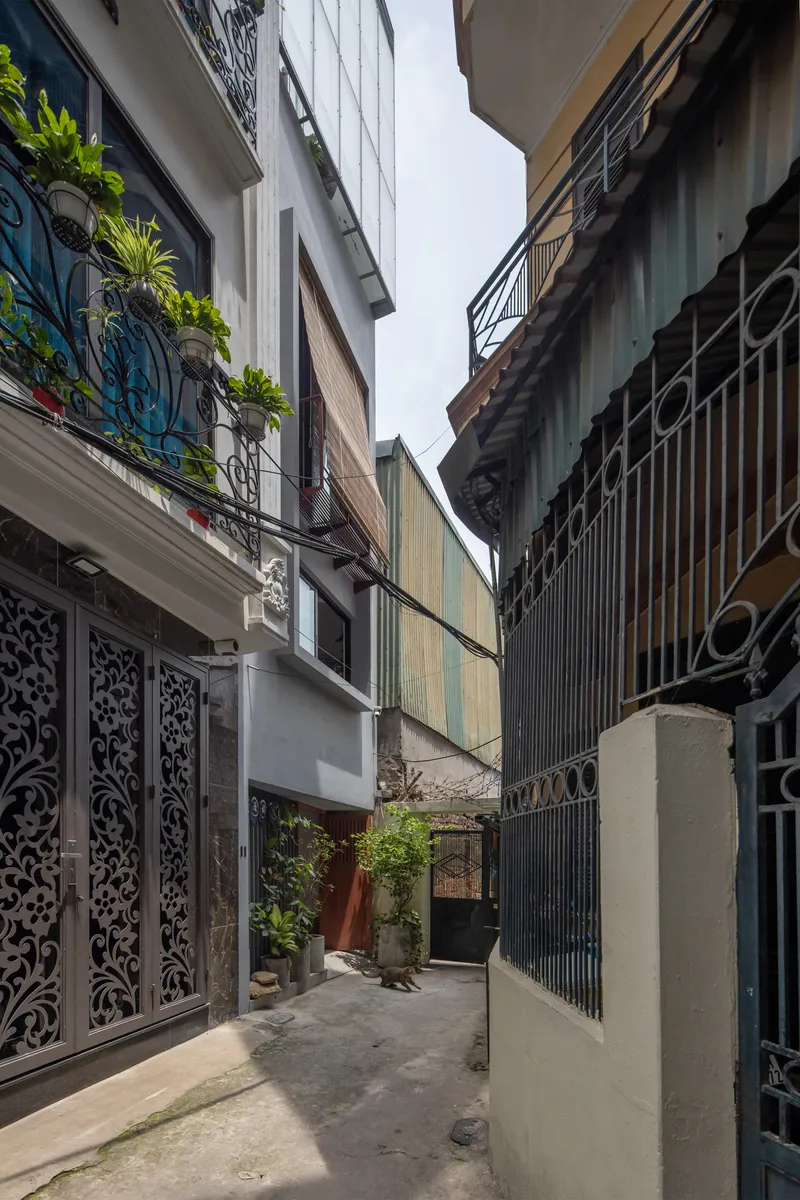
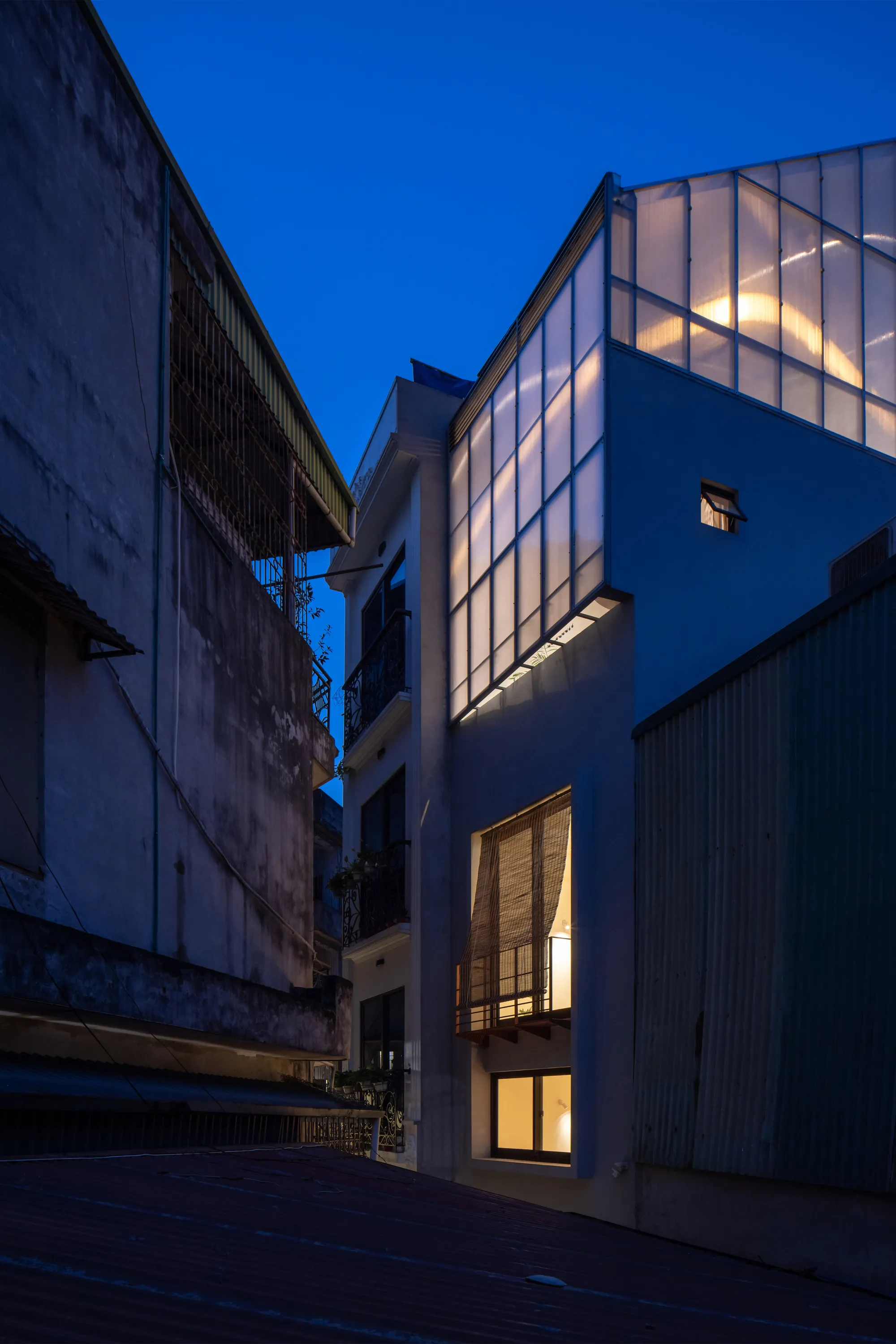
Squeezed between corrugated metal neighbors, Loli House presents a restrained face to the alley. The 3.6-meter-wide frontage stacks glazed openings and a red metal balcony in a composition that reads as both assertive and polite. At ground level, the entrance is set back from the property line, widening the ngõ just enough to reinforce its role as a shared gathering space rather than treating it as dead infrastructure.
At dusk the translucent polycarbonate cladding that wraps the upper terrace level transforms the building into a lantern. The glow is soft, almost domestic in scale, the kind of light that signals inhabitation without spectacle. It is a considered gesture in a context where facades are often left raw or hidden behind security grilles.
The Polycarbonate Veil
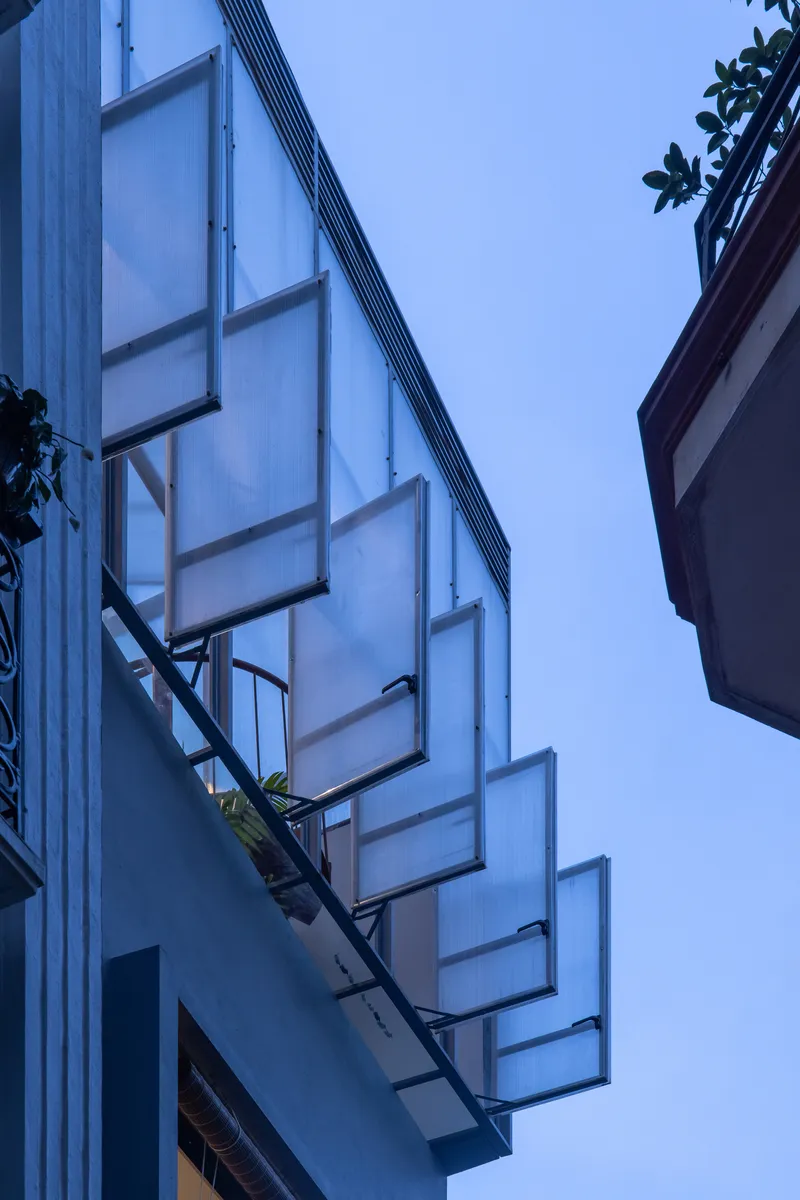
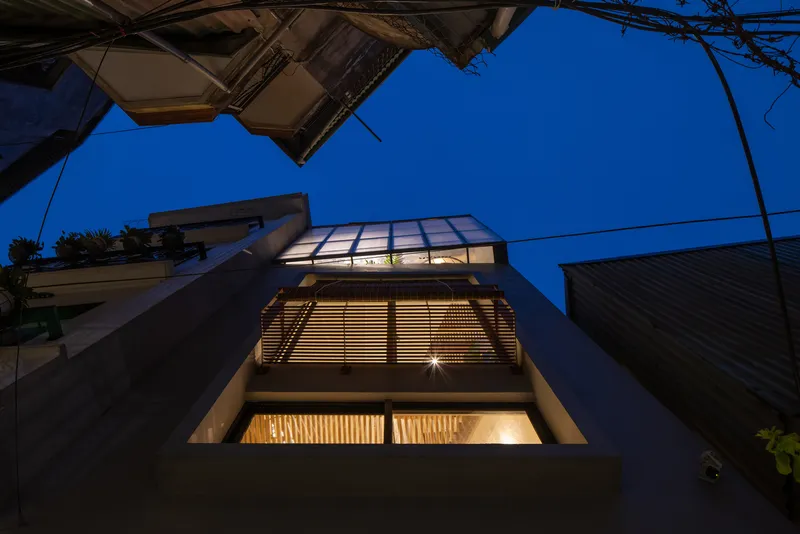
Polycarbonate is the workhorse material here, used not as a budget substitute for glass but as a deliberate filter. The translucent sheets wrap the topmost garden level, allowing daylight to flood interior planting zones while diffusing direct sun. From outside, the effect is a luminous volume that hovers above the heavier masonry floors below, giving the narrow tower a visual lightness it would otherwise lack.
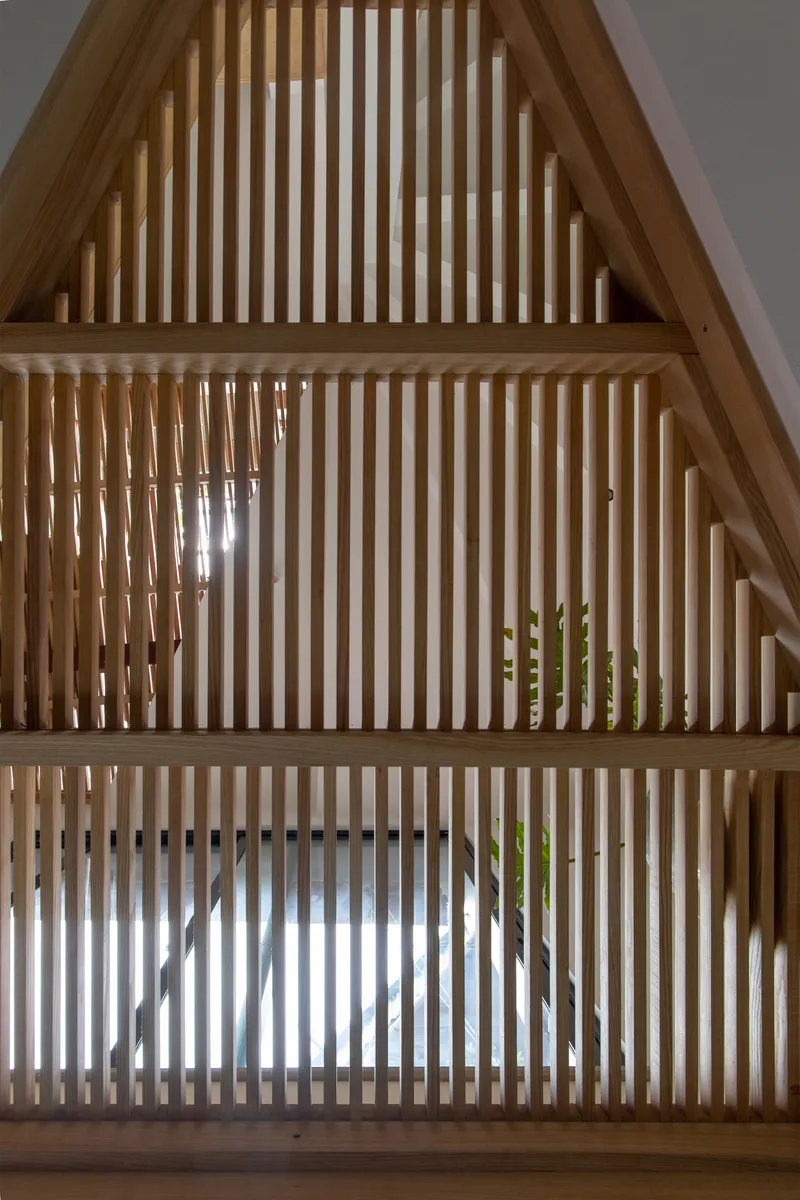
Triangular timber slat screens complement the polycarbonate at intermediate landings. Light passes through the vertical members in fine lines, shifting with the sun's angle and creating a changing interior atmosphere without any mechanical intervention. The interplay between translucent sheet and opaque slat is the project's primary climate strategy: passive, low-cost, and visually rich.
Circulation as Living Space
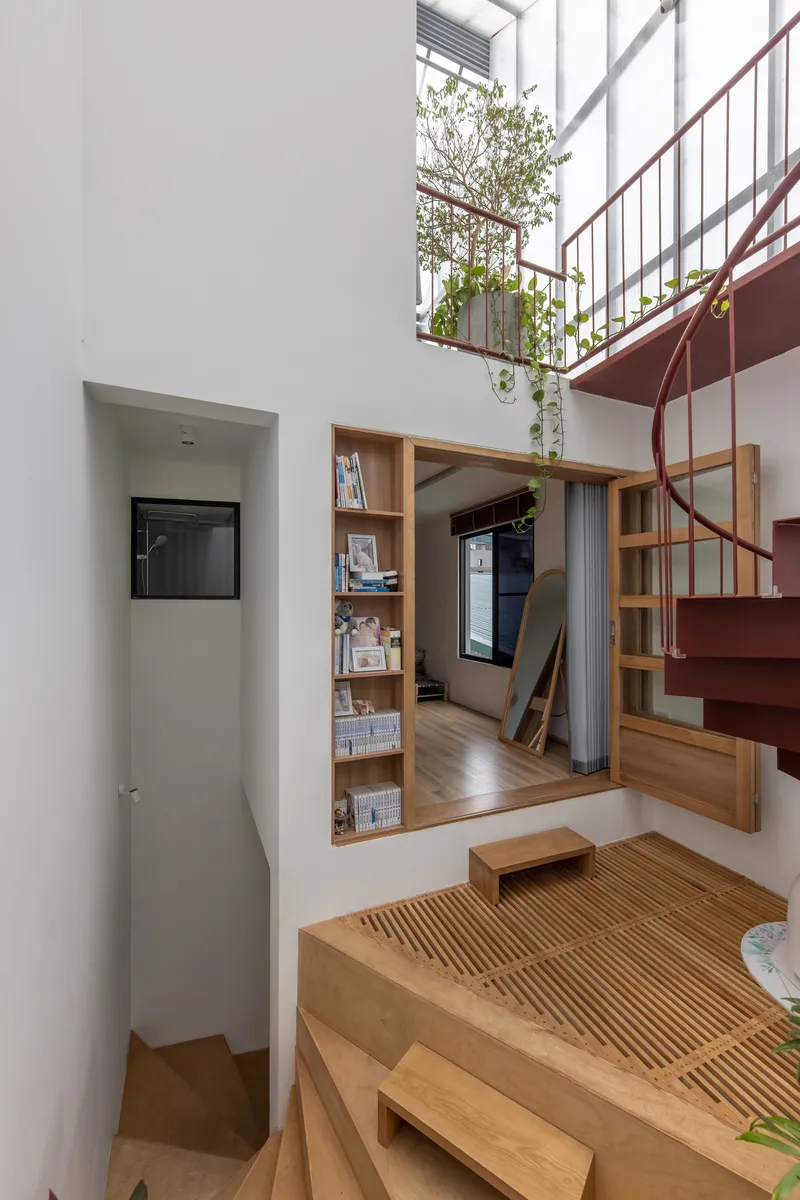
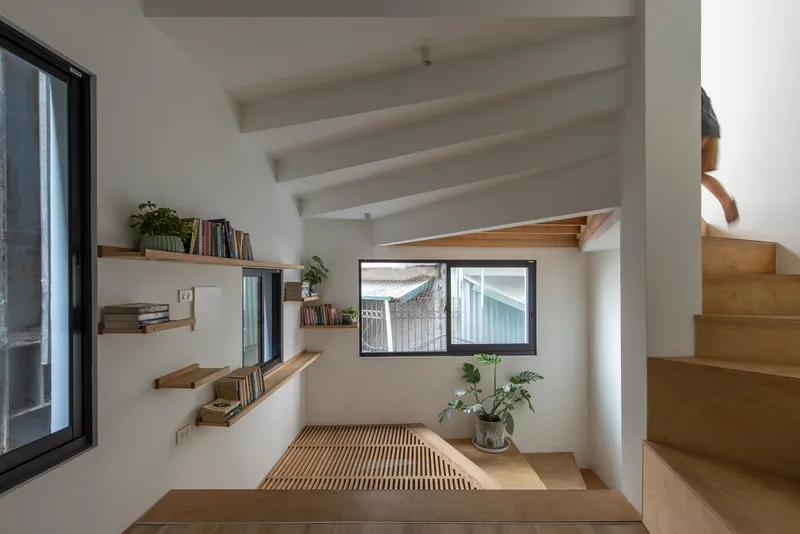
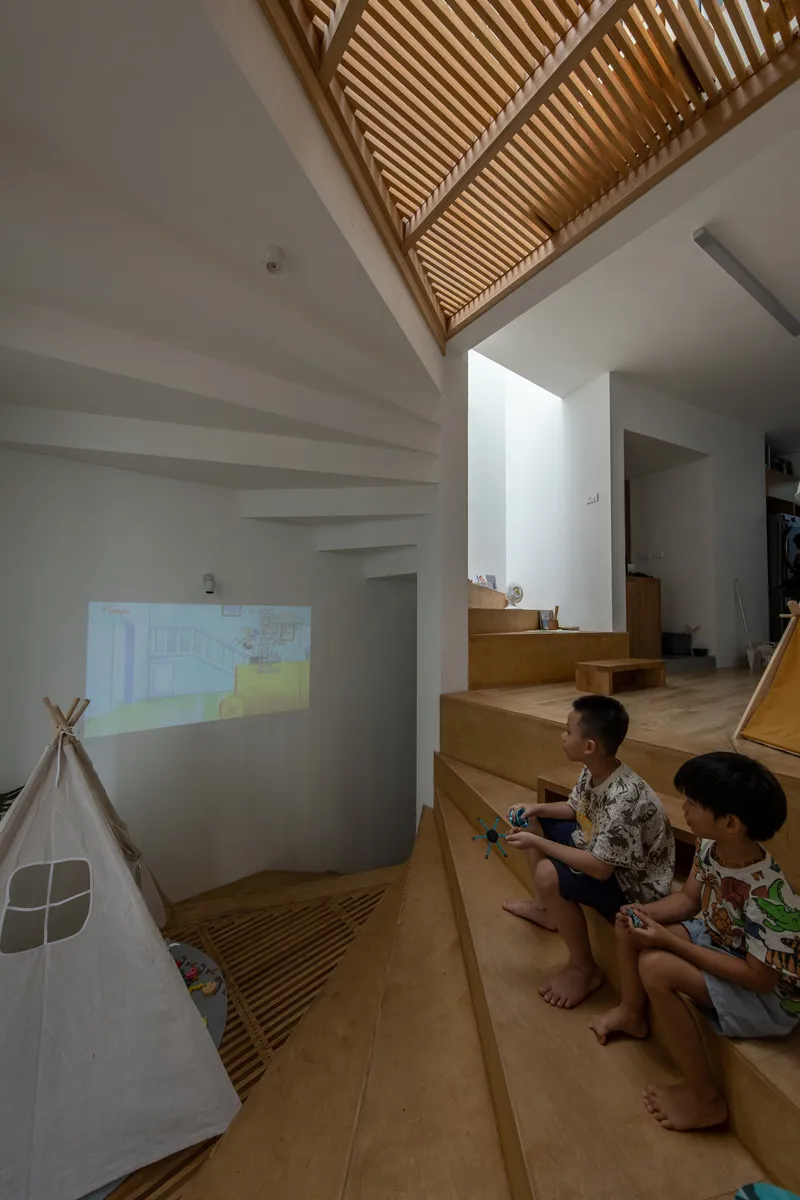
The architects' boldest decision is treating the staircase as program rather than corridor. Wide timber treads double as seating. Landings expand into reading platforms with floating shelves. Children draw on the steps, adults read on the mezzanine, and the vertical section becomes a single interconnected room where family life happens on the move.
In a house this narrow, conventional room-by-room planning would produce a stack of cramped boxes. By dissolving the boundary between stair and room, t and m design office create the illusion of generosity. You are never more than a few steps from another family member, another pocket of daylight, another planted edge. The staircase makes the house feel larger than its 35-square-meter footprint has any right to.
Timber, Warmth, and Tactile Detail
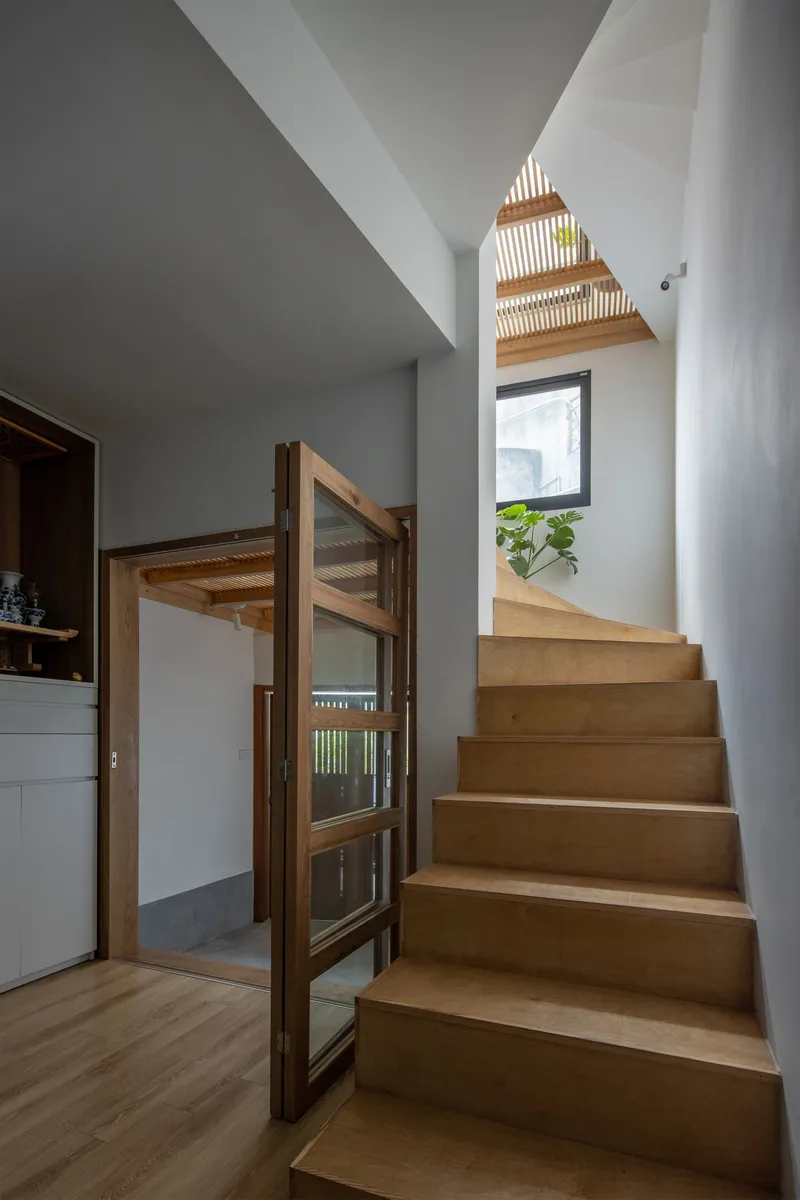
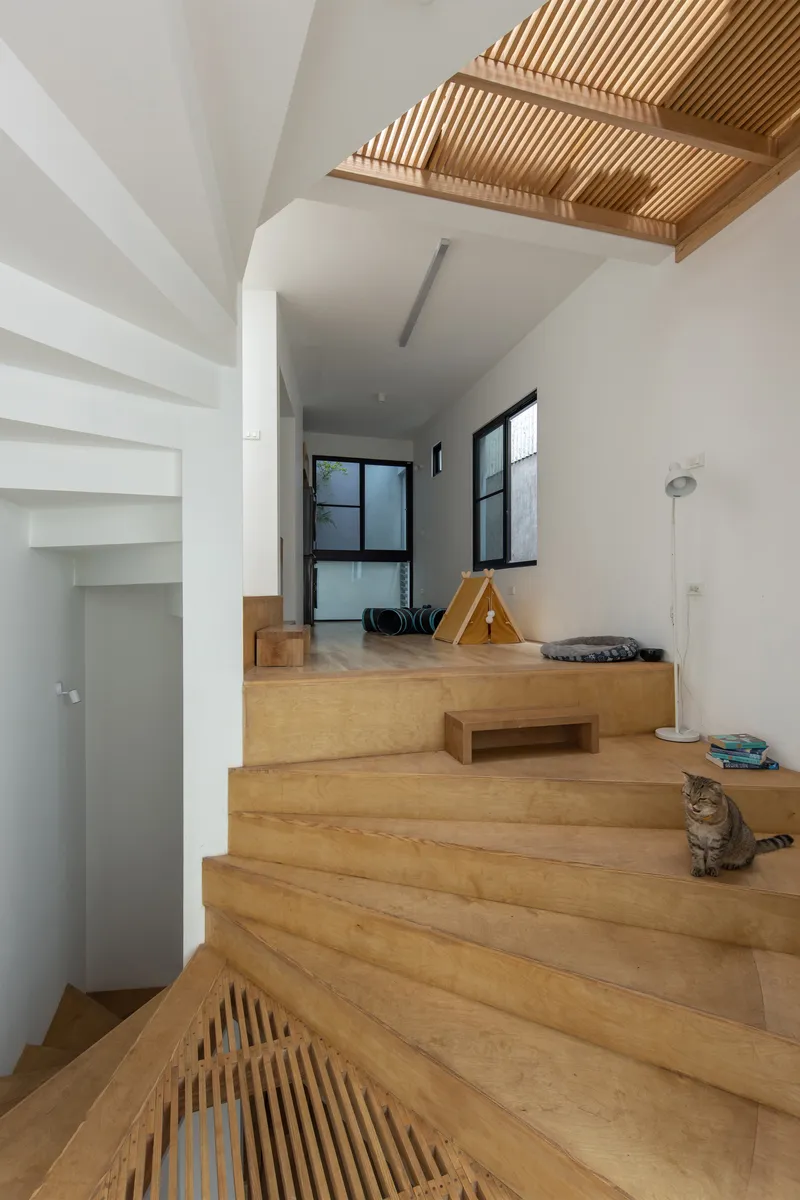
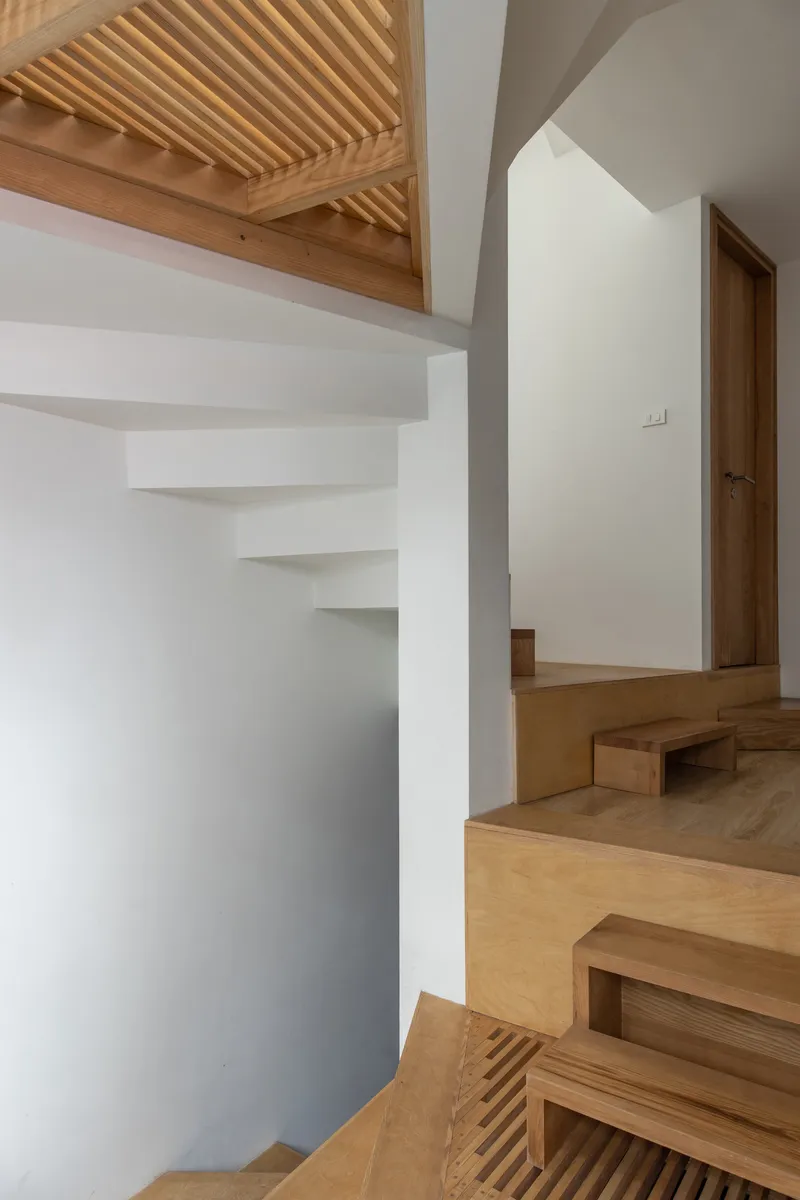
Wood dominates the interior palette: stair treads, slatted ceilings, louvered screens, built-in shelving, and vanity tops. The consistency gives the tall, narrow volume cohesion. Every floor reads as part of one continuous space rather than a series of disconnected levels. Slatted ceiling panels overhead let light filter down from skylights, reinforcing the sense of vertical continuity.
Integrated storage beneath the stairs and corner shelving units prove that the architects treated every cubic centimeter as a design opportunity. Nothing feels like an afterthought. The craftsmanship is quiet but precise, a quality that becomes apparent only when you notice how cleanly timber meets concrete, how snugly shelves tuck under risers.
Ground Floor: Threshold and Hospitality
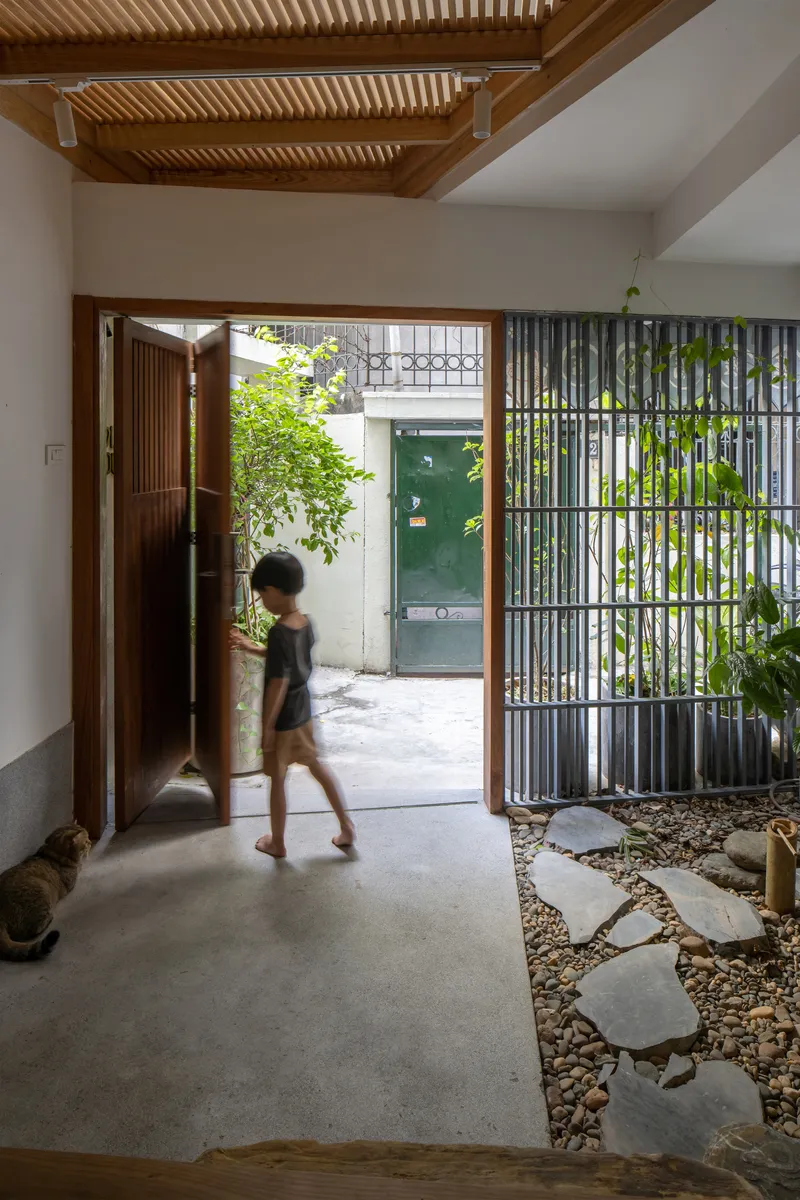
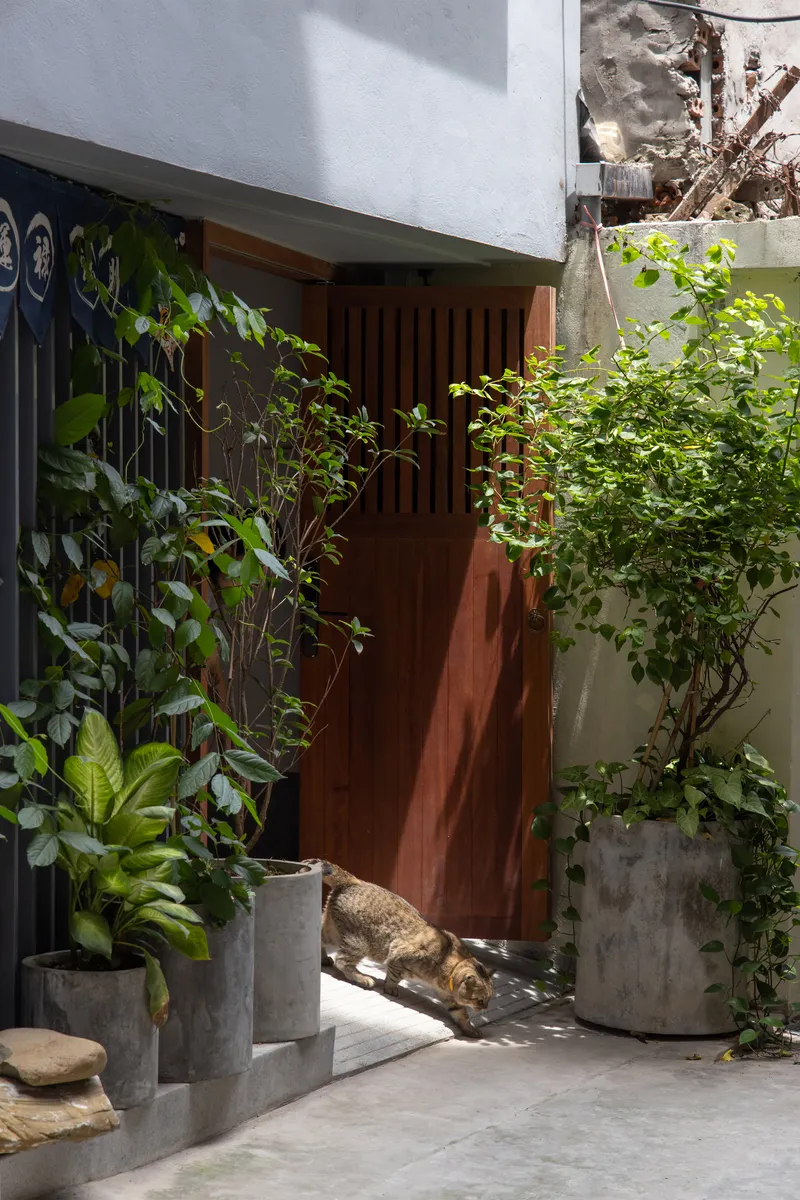
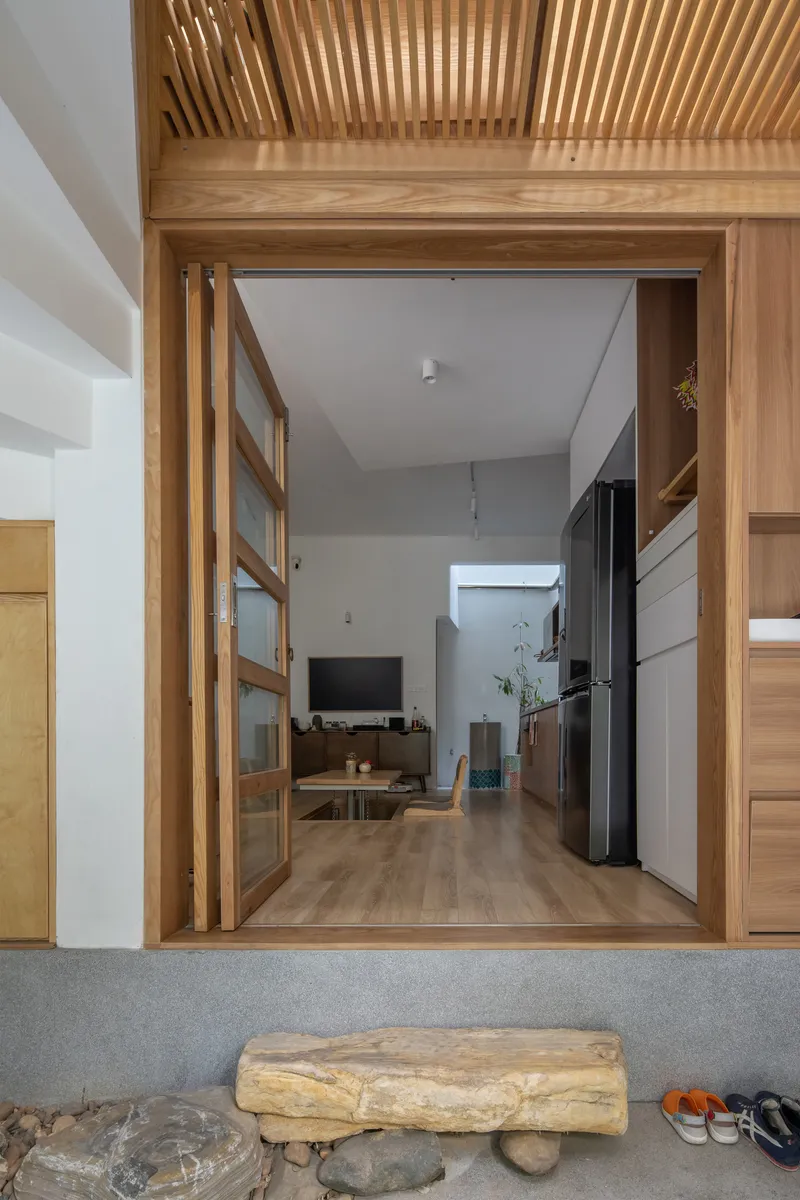
The ground level negotiates between public alley and private home. A folding timber door opens onto a pebbled courtyard that mediates the transition, and the entrance vestibule is generous enough to welcome neighbors without exposing the kitchen beyond. A cat rests in dappled sunlight near concrete planters. The scene is unremarkable and entirely deliberate: the architects designed for the informal social rituals that define ngõ life.
Kitchen and dining are placed just off the foyer, reinforcing the public character of the ground floor. Private rooms stack above. The sectional logic mirrors the traditional Hanoi tube house hierarchy, communal at the base, intimate at the top, but the vertical circulation adds a layer of porosity that the tube house typology rarely achieves.
Staggered Verandahs and the Red Spiral
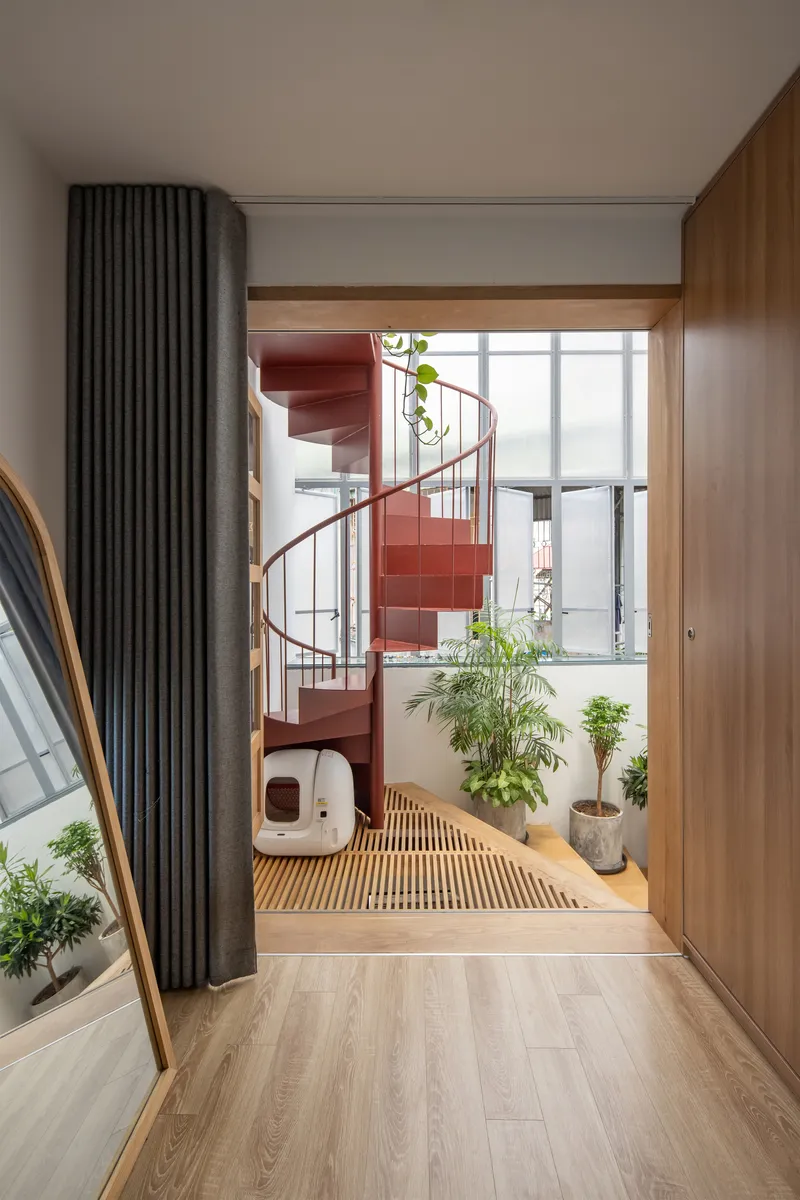
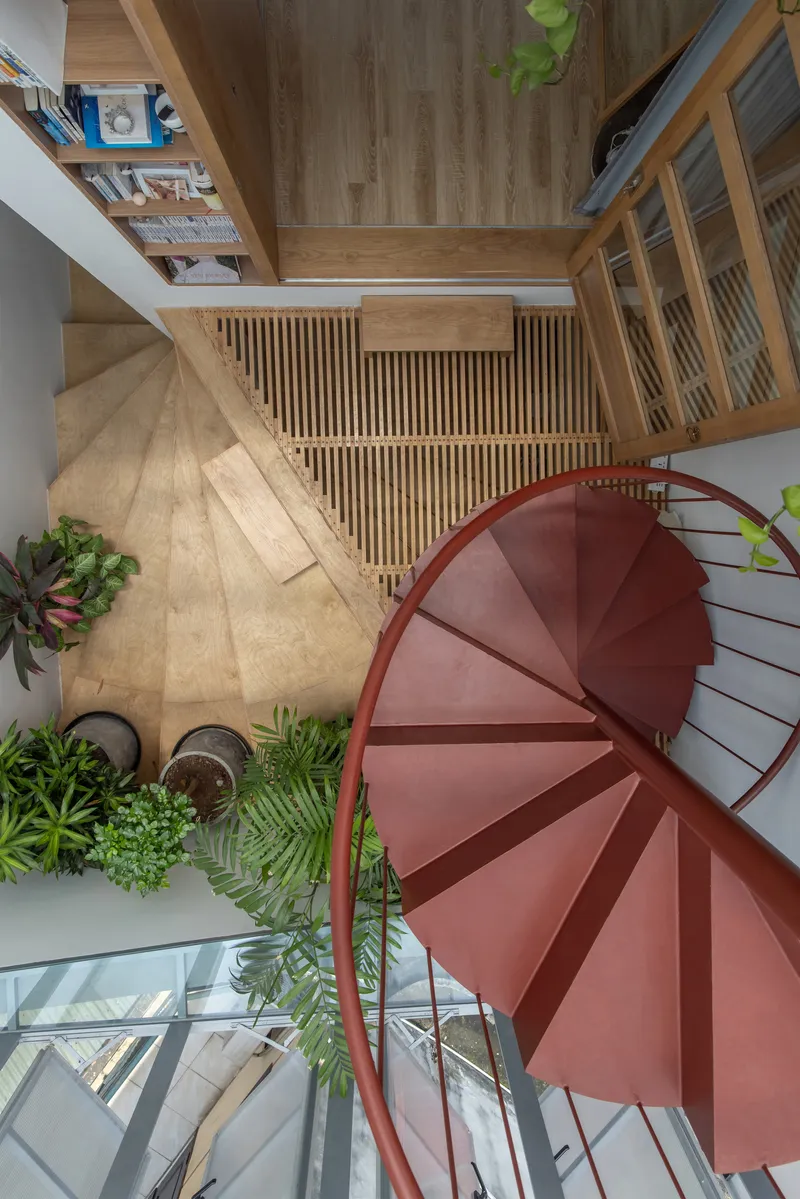
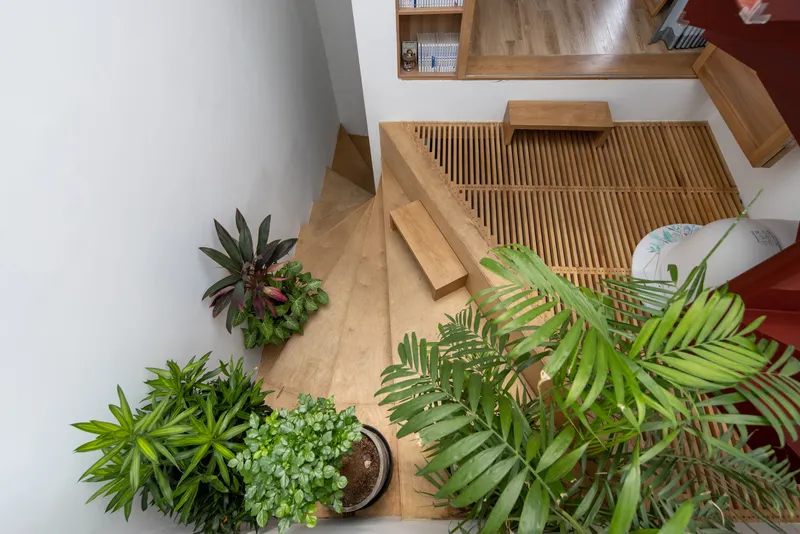
Balconies and verandahs are arranged in a staggered pattern up the facade, each offset to catch light and air from different angles. The result is a cascade of planted edges visible from inside the stairwell. A red spiral stair, enclosed in a glass balcony volume, connects two of these outdoor platforms and introduces a jolt of color into an otherwise neutral palette.
Potted greenery fills every available horizontal surface, turning circulation zones into micro-gardens. The strategy is pragmatic: in a house with almost no ground-level garden, distributing planting vertically ensures every floor has contact with nature. The timber-slatted floors on these verandahs allow water to drain and roots to breathe, a small detail that keeps the greenery viable long term.
The Rooftop Bath
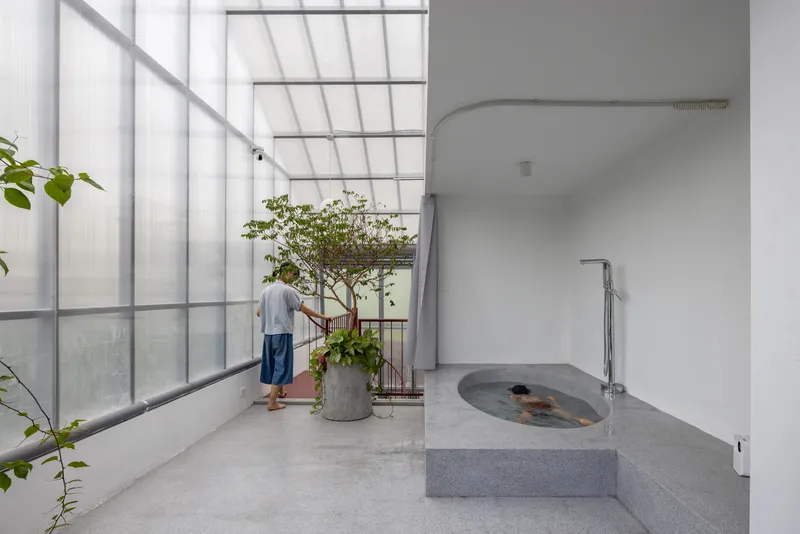
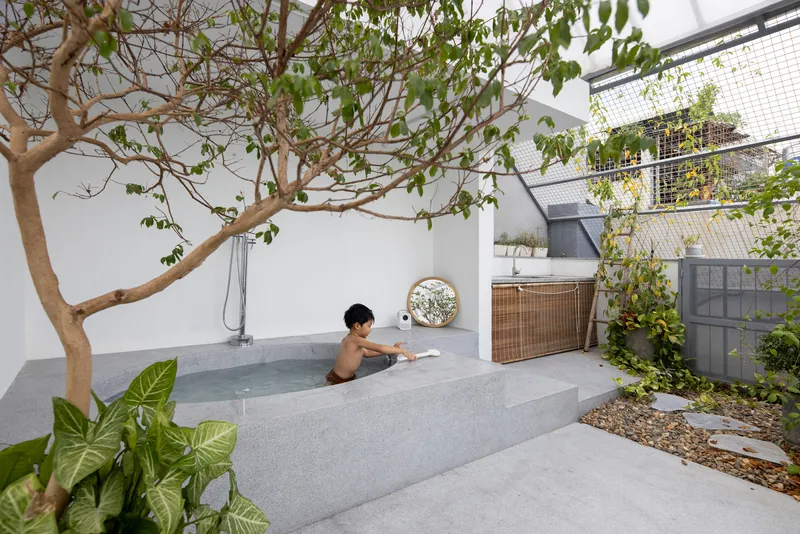
At the very top, behind the polycarbonate veil, sits a raised concrete soaking tub surrounded by planting beds and a single tree. It is an improbable luxury for a house this modest, a private outdoor bath elevated above the alley and screened by translucent walls. The space is the quietest in the building, the furthest from the communal ground floor, and the clearest expression of the architects' belief that constraint should not mean deprivation.
The bath terrace also serves a passive-design function. The polycarbonate enclosure traps warm air on cool Hanoi mornings and vents through operable panels when temperatures climb. The planted beds moderate humidity and surface temperature. What looks like pure indulgence turns out to be an extension of the project's environmental logic.
Domestic Scenes
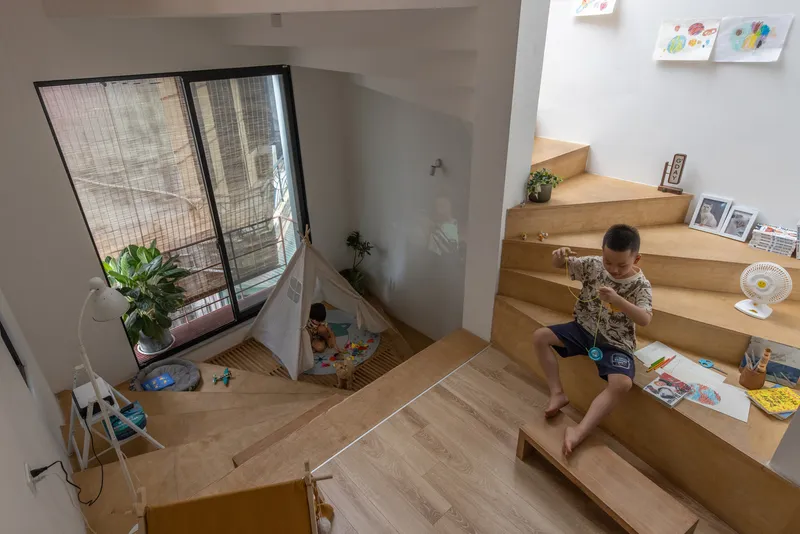
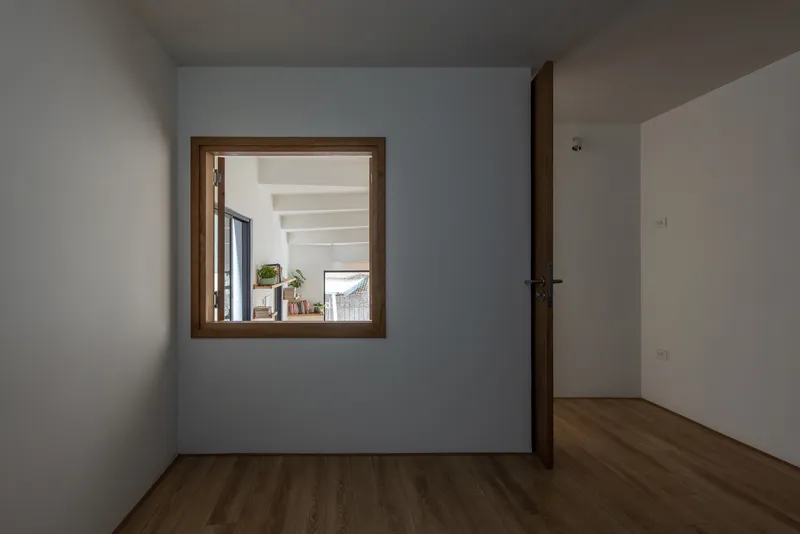
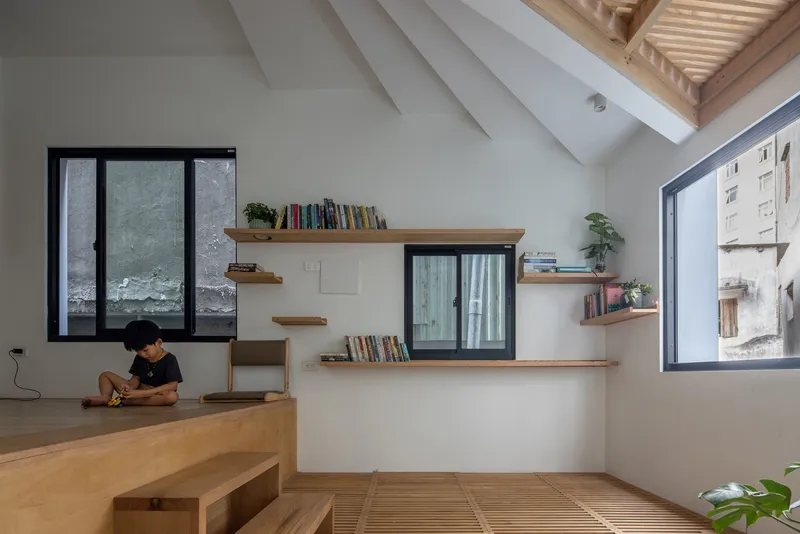
The photographs capture Loli House in use, children drawing, adults reading, bodies in motion on the stairs, and that is the most convincing evidence of the design's success. A house built around circulation only works if people want to linger there. The wide treads, the shelves within arm's reach, the constant natural light: these details make pausing on the stairs feel natural, not awkward.
White walls and timber framing define the bedroom and upper living spaces, where the palette simplifies further. Exposed ceiling beams and timber-framed window openings keep the material language consistent without making any single room feel precious. The house is designed to be lived in hard, not curated for photographs.
Plans and Drawings
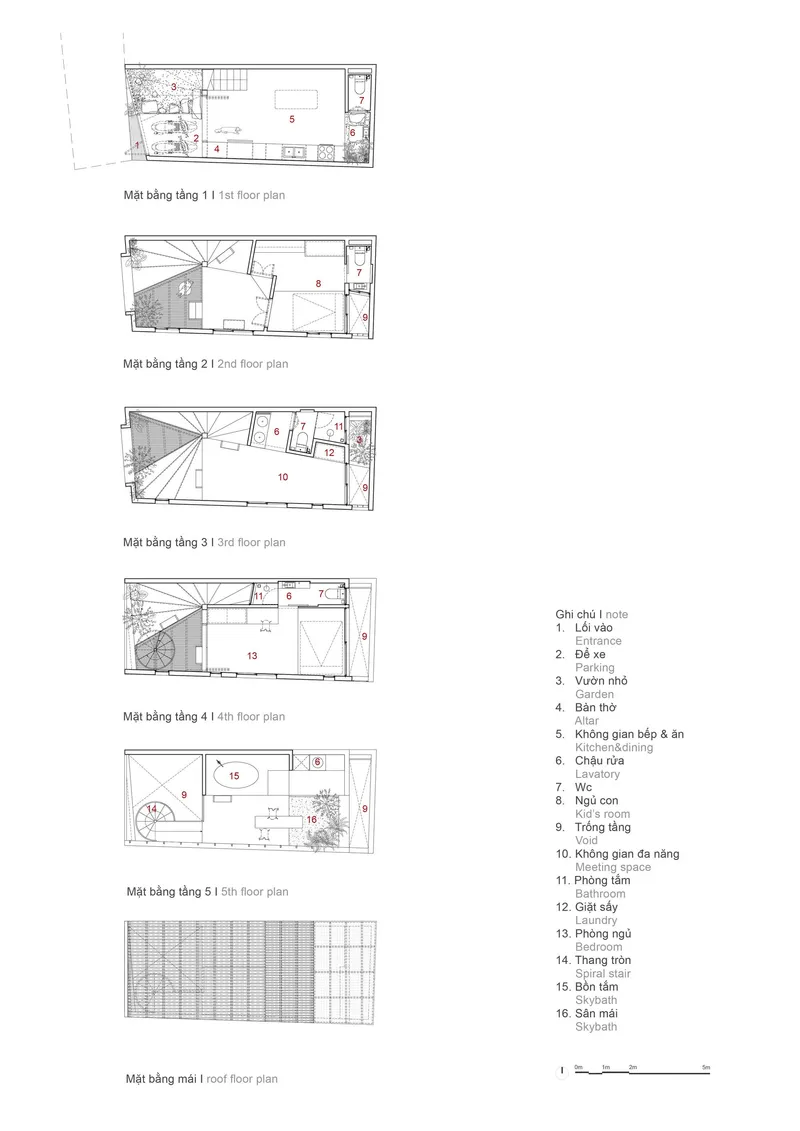
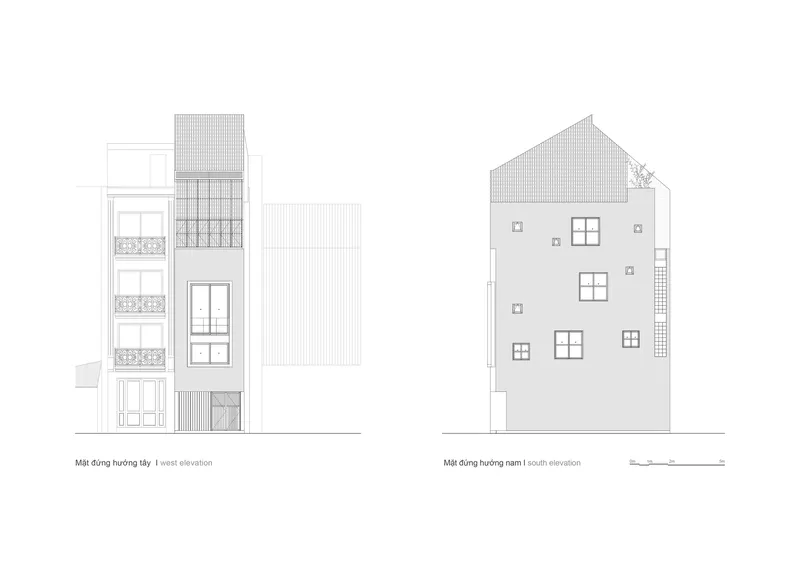
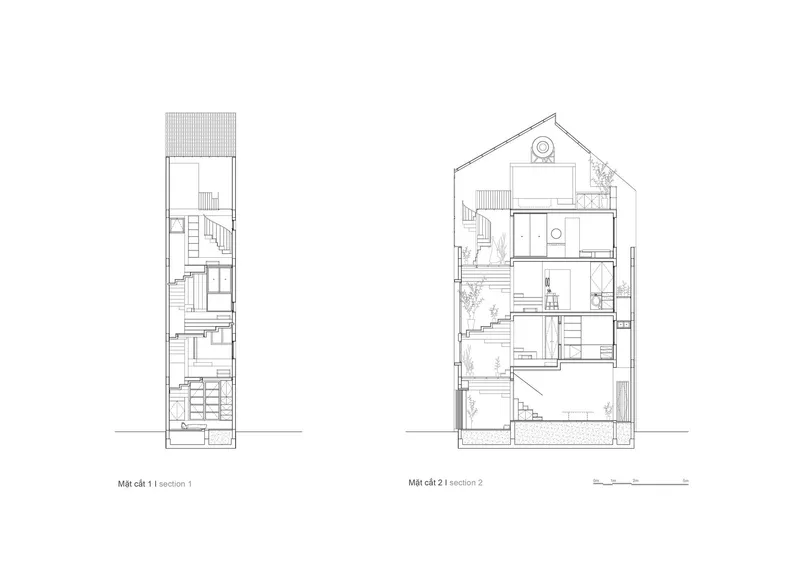
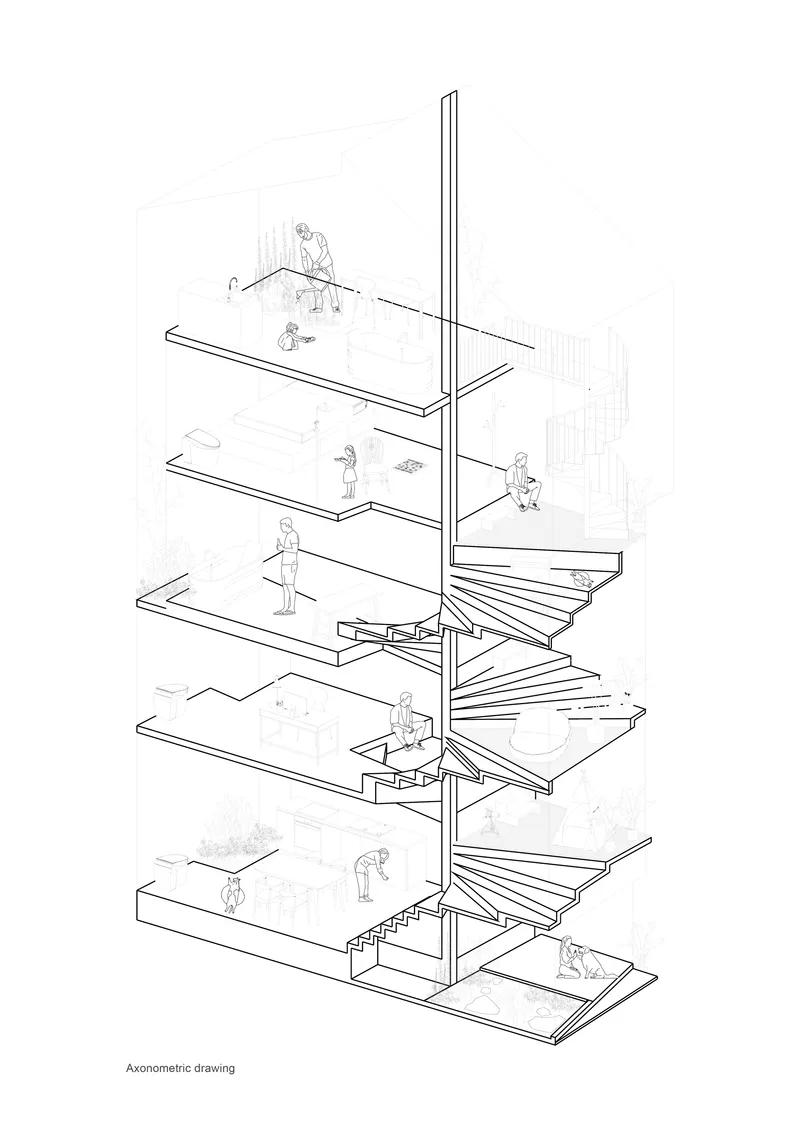
The floor plans across six levels reveal the spatial economy at work. The staircase occupies the same zone on every floor, anchoring the plan while rooms shift around it. Elevations show how the street facade and south facade manage openings for light and ventilation across the narrow frontage. The sections are where the design argument becomes clearest: the stair is not a void punched through floor plates but a continuous inhabited volume, wider at landings, narrower at risers, always in dialogue with adjacent rooms.
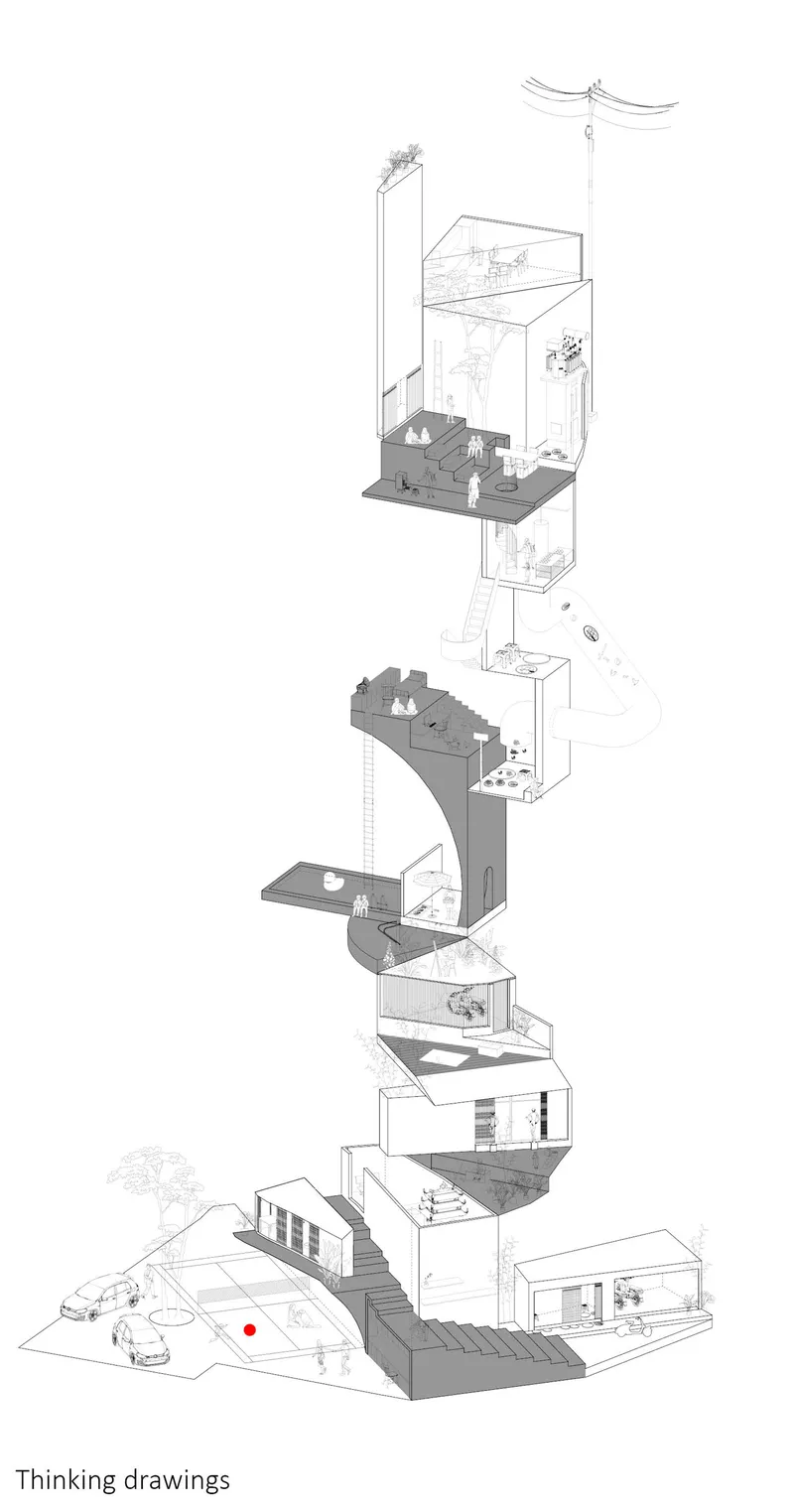
The axonometric drawings make the stacking logic legible. Floor plates spiral around the central stair core, each slightly different in plan, each offering a distinct relationship to exterior air and greenery. The gabled roof profile visible in section accommodates the bath terrace and its polycarbonate enclosure, capping the composition with a light, translucent crown.
Why This Project Matters
Loli House matters because it refuses to accept that density must produce misery. In a city where millions live on plots this small, the default response is to maximize usable floor area, close off the facade, and stack rooms like shipping containers. t and m design office do the opposite. They spend a third of the house on stairs, open the facade to the alley, and crown the building with a bath garden. The result is a home that breathes, connects, and gives its residents room to move through their day with a sense of openness that the footprint alone would never predict.
The project also demonstrates that working within a specific urban tradition, in this case the Hanoi ngõ and its tube house typology, can produce architecture that feels contemporary without being imported. The set-back entrance, the staggered balconies, the communal ground floor: these are local strategies refined and redeployed with precision. Loli House does not reinvent the Hanoi house. It reminds us why the typology existed in the first place and shows what it can still become.
Loli House by t and m design office, Hanoi, Vietnam. 157 m², completed 2023. Photography by Hoang Le.
About the Studio
Share Your Own Work on uni.xyz
If projects like this are the kind of work you want to make, uni.xyz is a place to publish your own, find collaborators, and enter design competitions.




Popular Articles
Popular articles from the community


Hill & Cross Opera: Sculptural Opera House Architecture Shaped by Tallinn’s Landscape and Identity
Hill & Cross Opera reimagines opera house architecture in Tallinn through its sculptural hill, civic plaza, glass wave and a luminous cross.

Play: Fragments of Their World
Familiar architecture becomes modular playground design, creating safe spaces where displaced children can learn, connect, imagine and play.

The Earth Pod: 3D Printed Homes for Resilient Refugee Communities
The Earth Pod reimagines refugee housing through 3D printed homes made from clay, combining resilience, self-sufficiency, and rapid shelter.

Conexión: Biophilic Design Reimagines High-Rise Living in Hong Kong
Conexión reimagines high-rise living in Hong Kong through biophilic design, green facades, shared spaces, daylight, water and nature within.


Similar Reads
You might also enjoy these articles

Bao Huynh Watercolor Atelier: A Serene Art Retreat in Hội An
Bao Huynh Watercolor Atelier in Hội An blends multifunctional art spaces, sustainable design, local materials, and family-friendly living in a serene environment.

Atelier Macri Concept Store Interior Design by CASE-REAL
Atelier Macri store features a "ko" counter, walnut wood details, cork displays, blending retail, gallery, and seamless customer experiences.

Manuel Vargas Izquierdo Stadium and High-Performance Sports Center: Architectural Excellence in Jalpa de Méndez
The Manuel Vargas Izquierdo Stadium blends sustainable design, inclusive sports facilities, and cultural-inspired architecture, revitalizing Jalpa de Méndez’s public spaces.

KAKR Buluh Awar Hall: Revitalizing Community and Ecology Through Bamboo Architecture
Community built bamboo hall revitalizes Buluh Awar village, empowering youth, restoring ecology, celebrating vernacular craftsmanship through sustainable architecture and culture.

Comments (0)
Please login or sign up to add comments
No comments yet. Be the first to comment!