
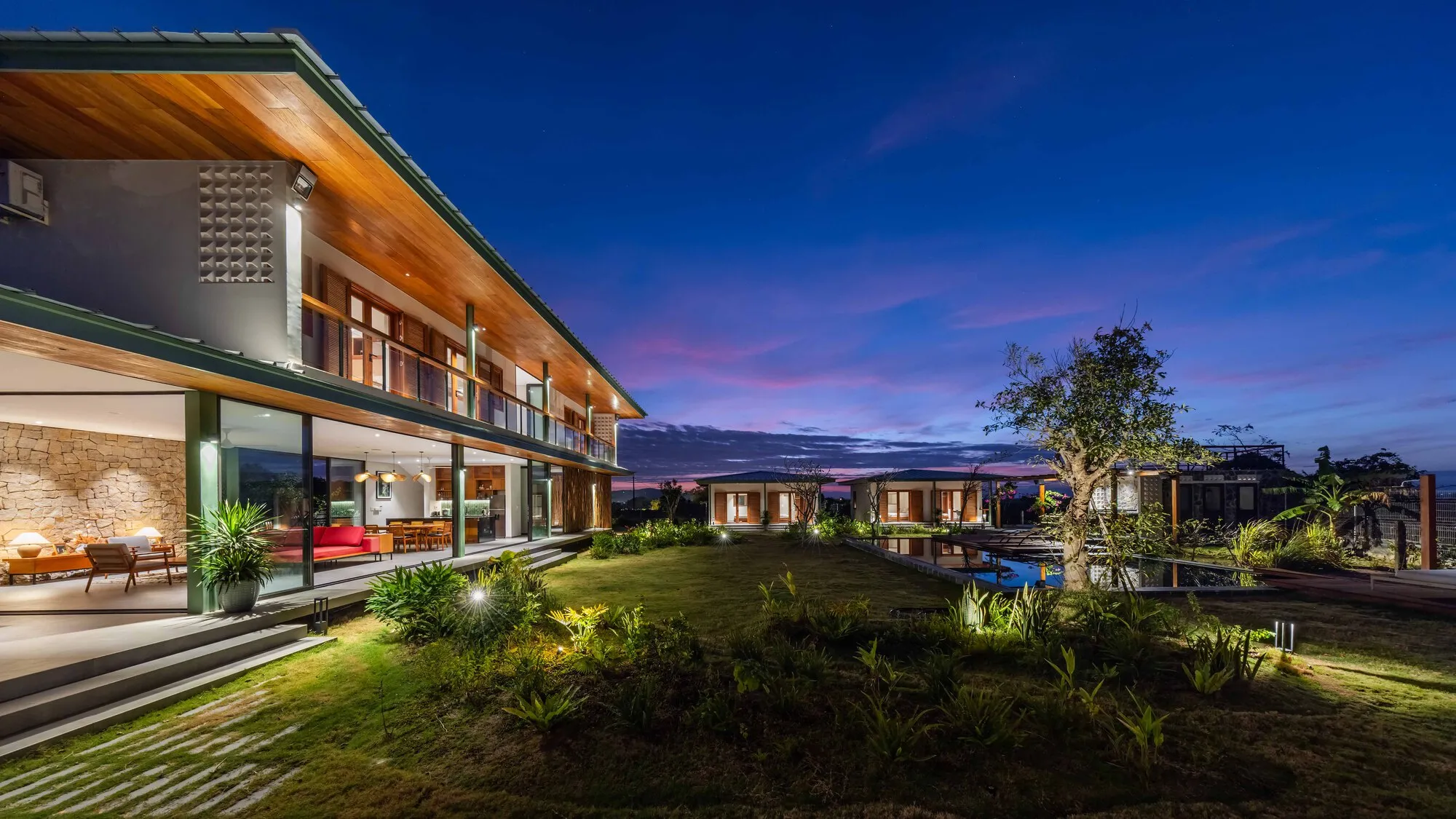
T3 Architects Organize a Vietnamese Coastal Retreat Around a Central Garden and Sea Breeze
KeGa Villa sits between a national park and the South China Sea, using climate-responsive design to dissolve the line between indoors and landscape.


There is a particular kind of tropical house that tries so hard to be open it forgets to be a house. KeGa Villa, designed by T3 Architects under the direction of Charles and Tereza Gallavardin, avoids that trap. Sited between a national park and the sea in Ke Ga, Vietnam, the 350 square meter weekend retreat reads as a cluster of volumes organized around a central garden, each calibrated to channel coastal breezes while still offering the enclosure and privacy a family actually needs. Completed in 2025, the project treats climate response not as an overlay of technology but as the fundamental generator of plan, section, and material.
What makes this project worth studying is its refusal to compress everything into a single monolithic form. The compound includes a two-story main villa and a set of smaller bungalows arranged around a pool and planted courtyard, a layout visible in the site plan. Rather than a single heroic gesture, the architecture distributes program across discrete pavilions, each with its own relationship to sun, wind, and vegetation. The result is a weekend house that feels simultaneously generous and intimate, a place where shared life happens in the open living spaces at the ground floor while bedrooms retreat to the upper level or to independent structures screened by timber and bamboo.
A Compound, Not a House
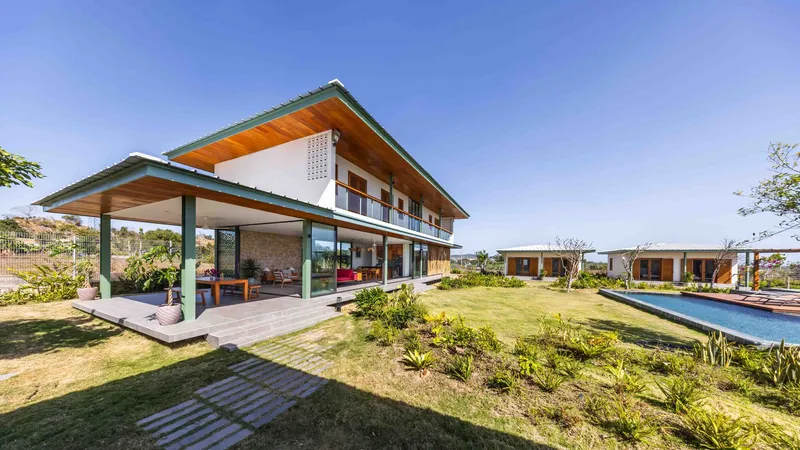
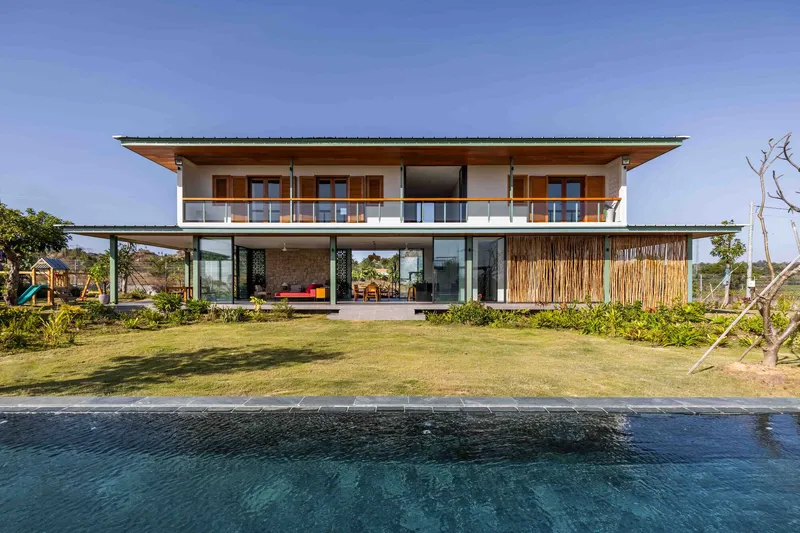
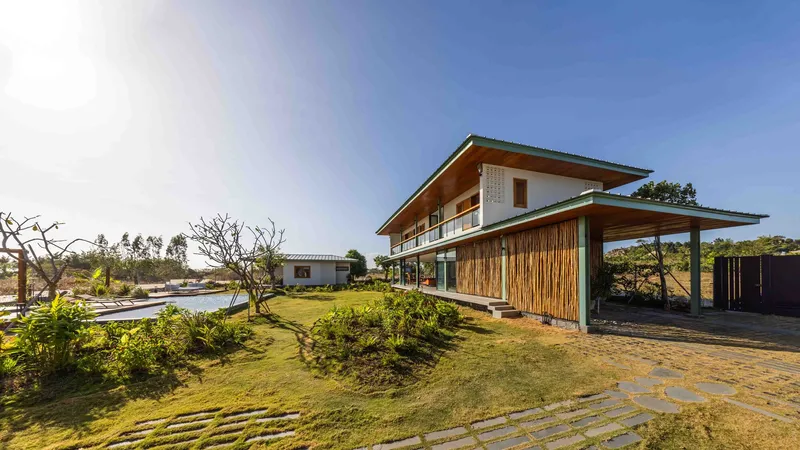
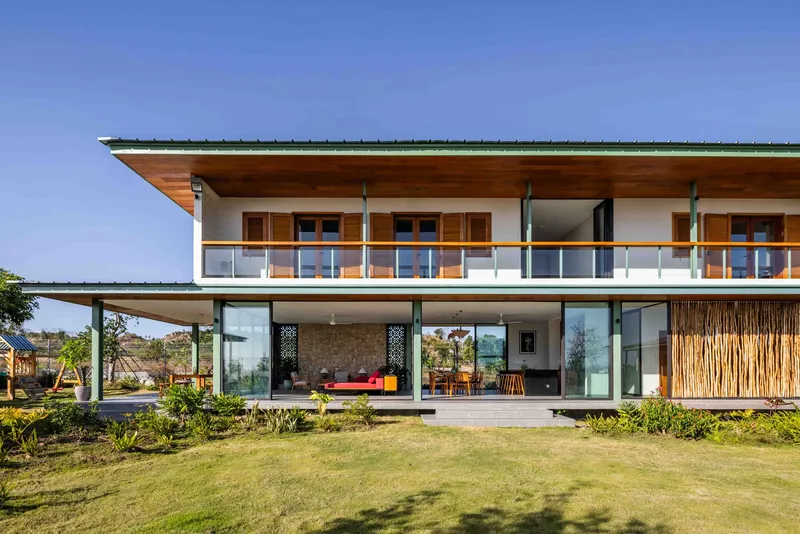
Seen from the garden, the main villa presents a two-story elevation with timber-lined eaves stretching well beyond the building envelope. The ground floor is almost entirely glazed, while the upper level introduces vertical bamboo cladding and enclosed balconies that modulate light and sightlines. Adjacent to the main volume, a separate wing clad in the same bamboo sits beside an open carport, establishing a more restrained street presence. The compound strategy means no single elevation carries the entire compositional weight, and movement between buildings becomes a sequence of passages through landscape rather than corridors.
The two-story elevation across the reflecting pool is particularly telling. The open ground floor and enclosed upper balcony create a clear hierarchy: social life at grade, private life above. It is a straightforward diagram, but T3 executes it with discipline, letting the broad overhanging roof unify both levels under a single horizon line.
The Roof as Climate Device
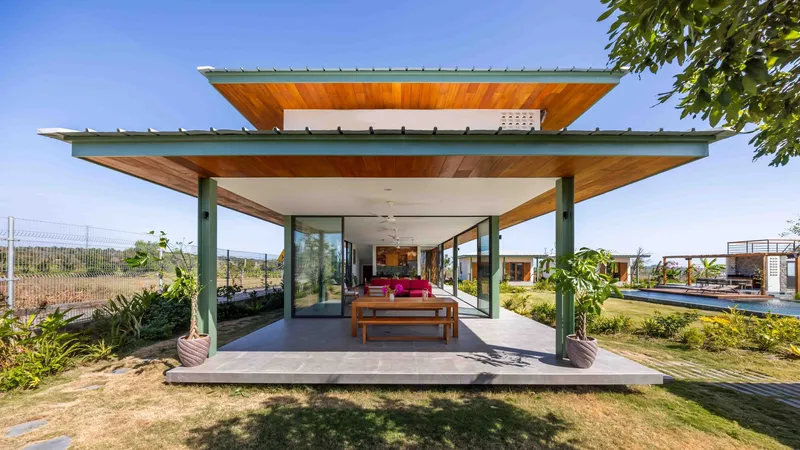
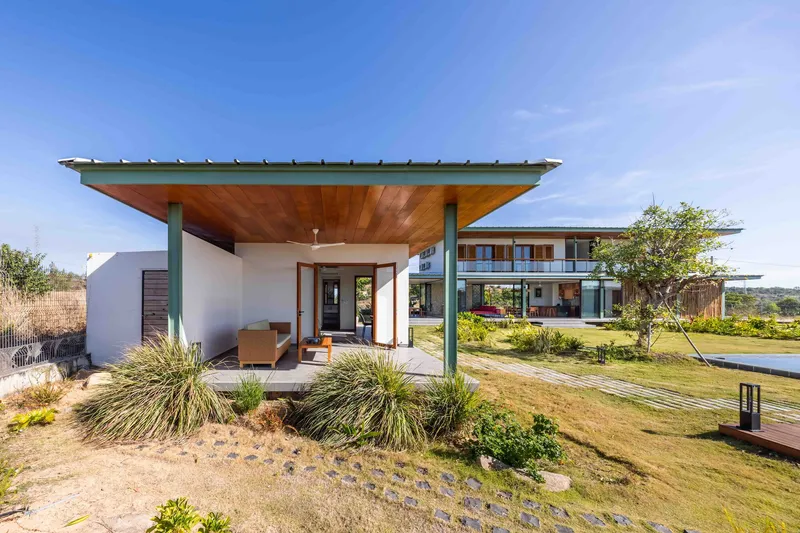
The most assertive architectural element here is the roof. Deep overhangs with timber soffits extend over terraces and glazed walls, providing shade while allowing the ground floor to remain almost entirely open to the garden. The covered entry pavilion demonstrates this logic clearly: exposed timber ceiling, steel columns, and planted beds of ornamental grasses create a transitional zone between exterior and interior that feels neither fully inside nor fully out. This is where the house does its most important work, creating comfort without mechanical intervention by governing how sunlight and air reach occupied spaces.
The planted courtyard framed through the outdoor pavilion reinforces the idea that every covered space here is designed as a frame for vegetation and sky. The architecture consistently positions itself as an intermediary between the occupant and the climate, never as a barrier.
Open Living at Ground Level
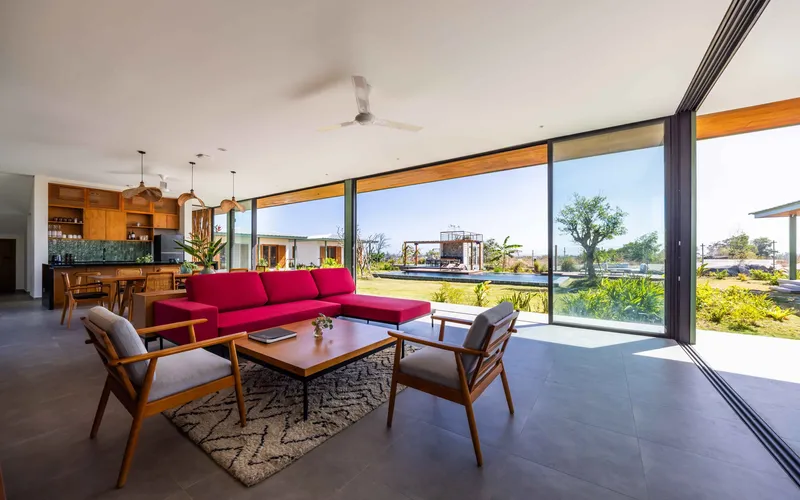
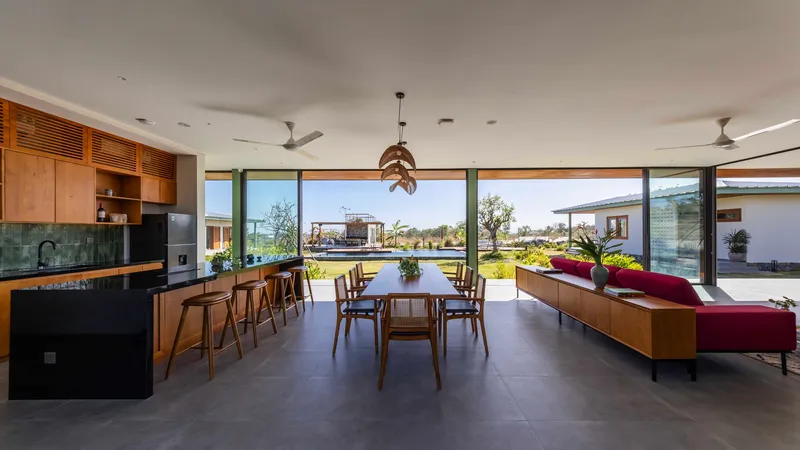
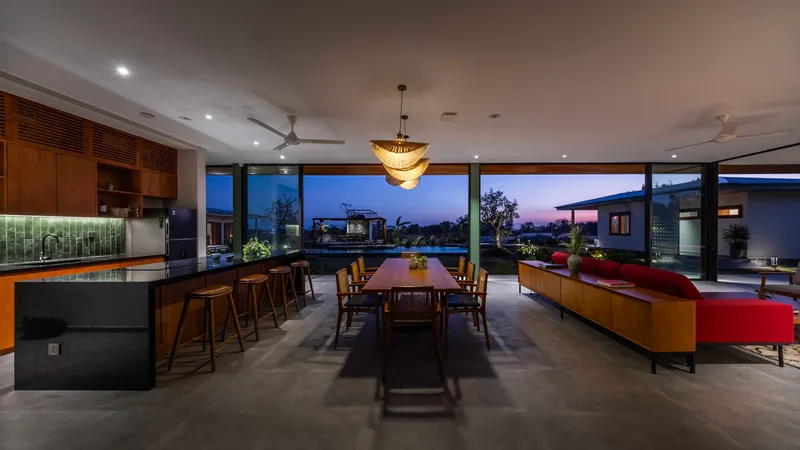
The shared living spaces occupy the heart of the ground floor, where continuous floor-to-ceiling glazing dissolves the wall between interior and landscape. The open-plan living room looks out across the pool pavilion and landscaped grounds, establishing a visual axis that extends well beyond the building footprint. At dusk, the full-height glazing transforms the kitchen, dining, and living space into a lantern set within the garden, the domestic interior becoming part of the broader landscape composition.
What keeps these spaces from feeling overexposed is the careful placement of elements that anchor them: a stone accent wall behind the living area, a black-countertop kitchen island framed by corner glazing, woven pendant lights over the dining table. These are deliberate points of density and texture set against the expansive transparency. The house is open, but it is not vacant.
Material Palette: Timber, Stone, and Filtered Light
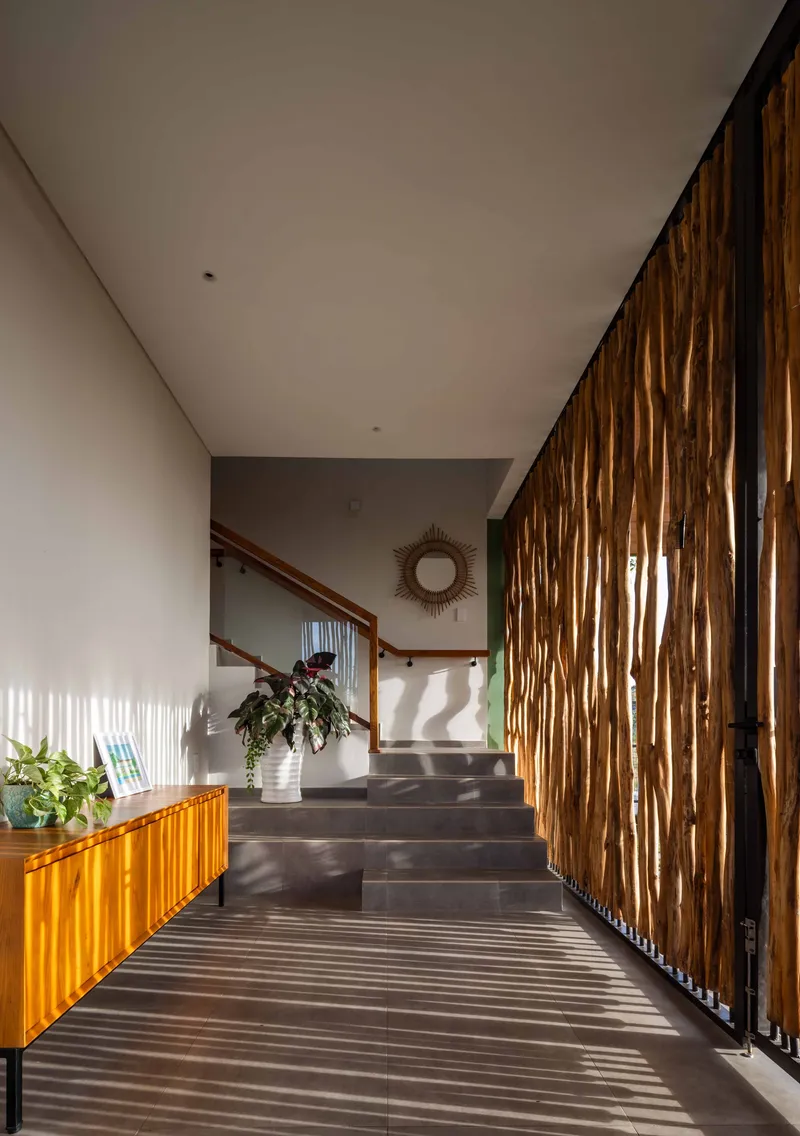
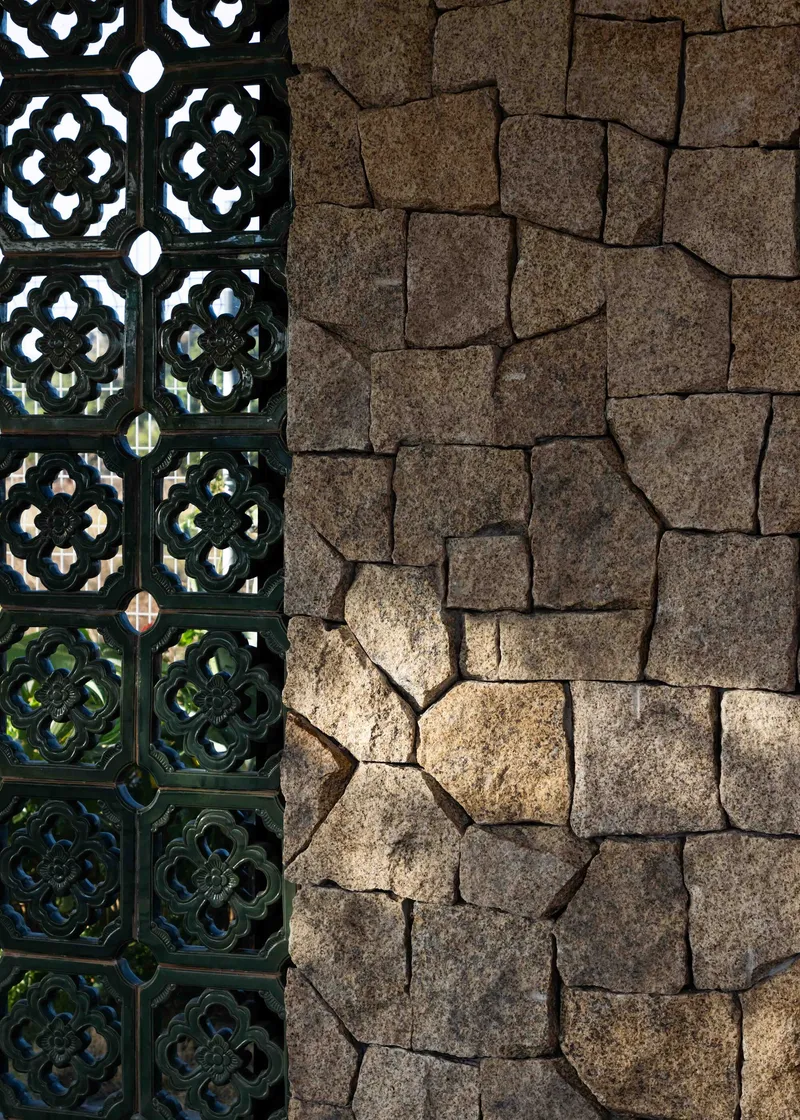
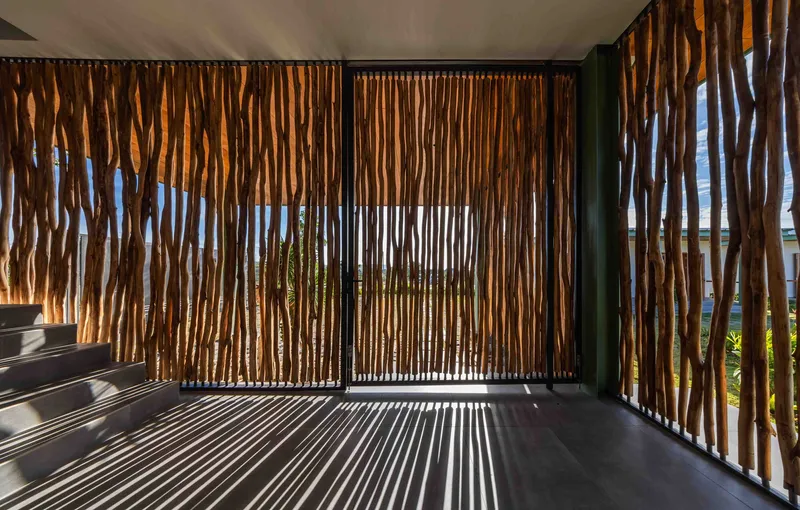
The material story is told through a restrained palette of timber, rough-cut stone, and patterned concrete screen. The interior staircase is the standout moment: vertical timber battens cast dappled sunlight across dark stone treads, turning a piece of circulation into a sensory event. Nearby, a curved timber slat screen wraps the interior balcony, filtering views to the courtyard greenery and creating a layer of visual privacy without solid walls. A detail of patterned concrete screen set against rough-cut stone shows how T3 layers textures at junctions, using the interplay of cast shadow and material grain to add richness without decoration.
These are familiar tropical materials, but the detailing is specific and well resolved. The timber battens are spaced precisely enough to produce the shadow patterns the architects clearly intended. Nothing is left to accident.
Private Rooms Under Timber Eaves
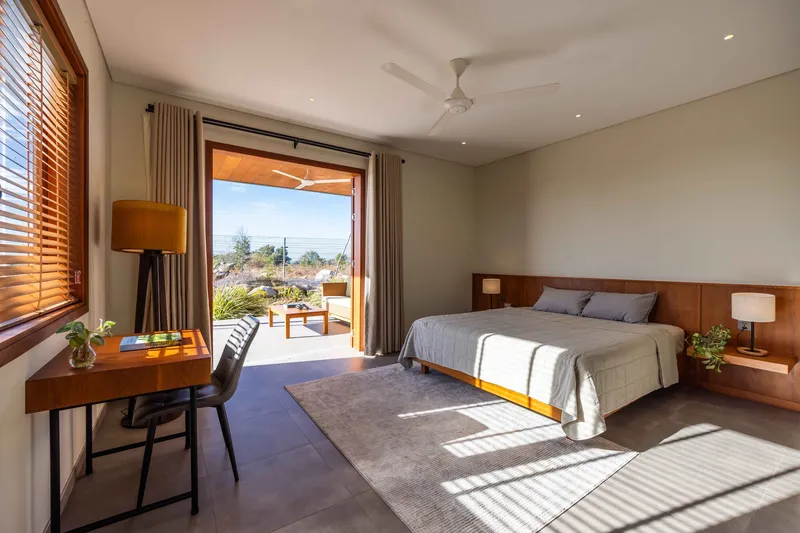
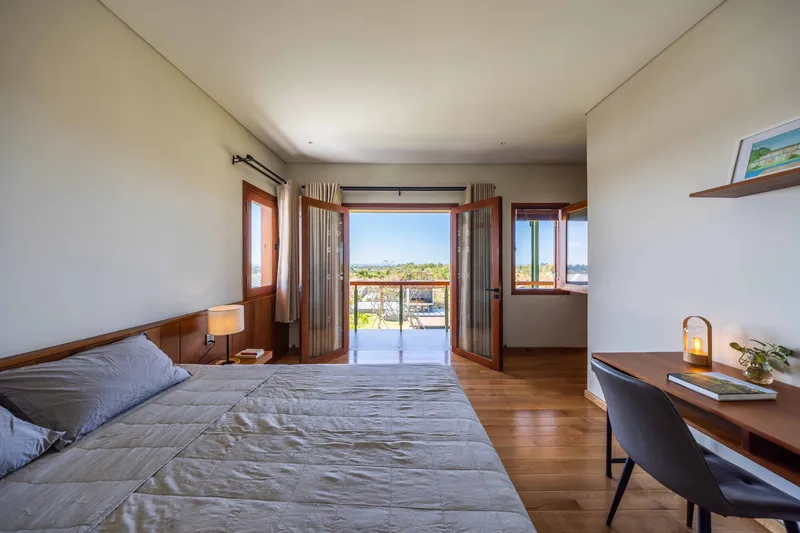
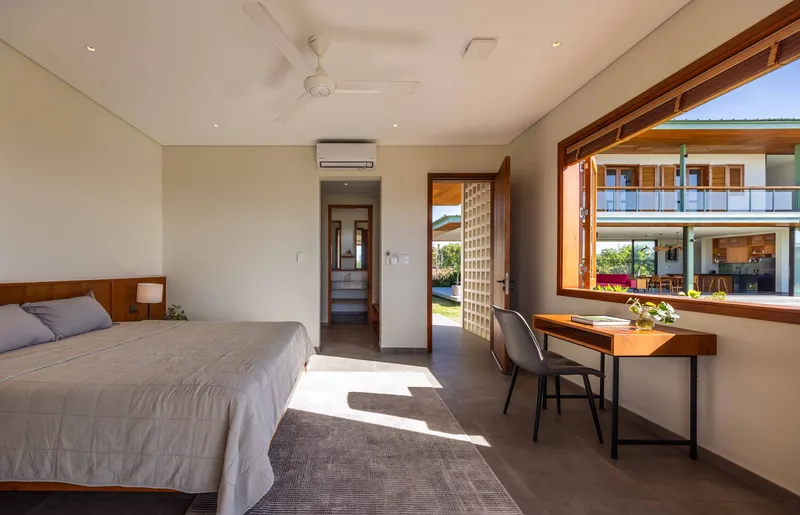
Upstairs and in the bungalows, bedrooms trade the ground floor's radical openness for something more measured. Sliding glass doors open to terraces, but striped shadow patterns from timber joinery and eaves moderate the incoming light. One bedroom frames the opposite wing and courtyard through timber-framed windows, establishing a controlled view corridor. Another opens through folding doors to a balcony under clear sky, the timber structure providing a sense of shelter even when fully open.
The twin-bed bungalow room, with its corner windows and glass doors to the garden courtyard, suggests how T3 adapted the compound's spatial logic to smaller, independent units. Each bedroom across the compound has its own relationship to landscape and breeze, avoiding the repetition that plagues resort-style layouts.
Between Day and Night
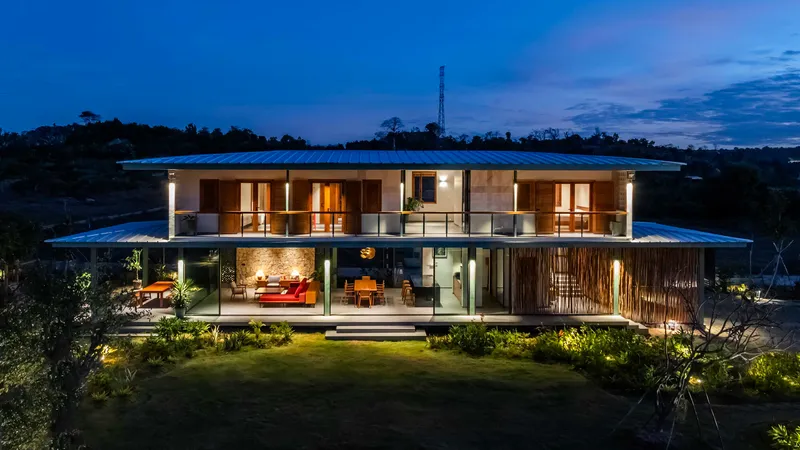
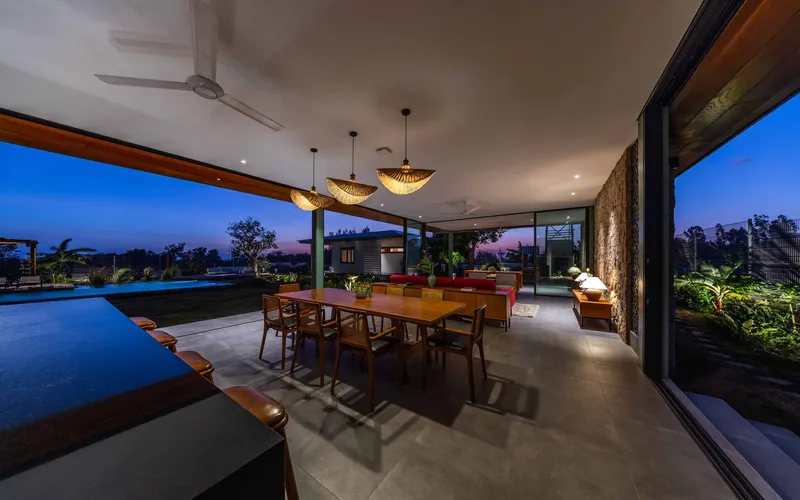
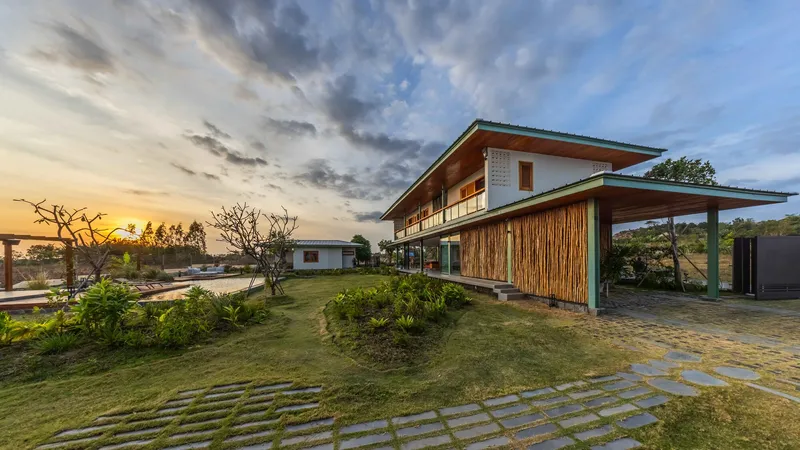
The project reveals a second personality at dusk. The night view of the illuminated facade shows how the overhanging roof becomes a reflecting surface, casting diffused light across the lawn. The covered terrace with its dining table and pendant lights adjacent to the pool transforms into the social center of the compound. And the front elevation at sunset, with bamboo cladding silhouetted against dramatic clouds, demonstrates that the architects considered how the building would perform not just thermally but photographically across the full cycle of a day.
These twilight views also confirm the strength of the site strategy. The dispersed volumes, the water, the planting between structures: all of it gains depth as artificial lighting replaces sunlight. The compound reads as a small village at the edge of the sea, not a single villa dropped on a lot.
Plans and Drawings
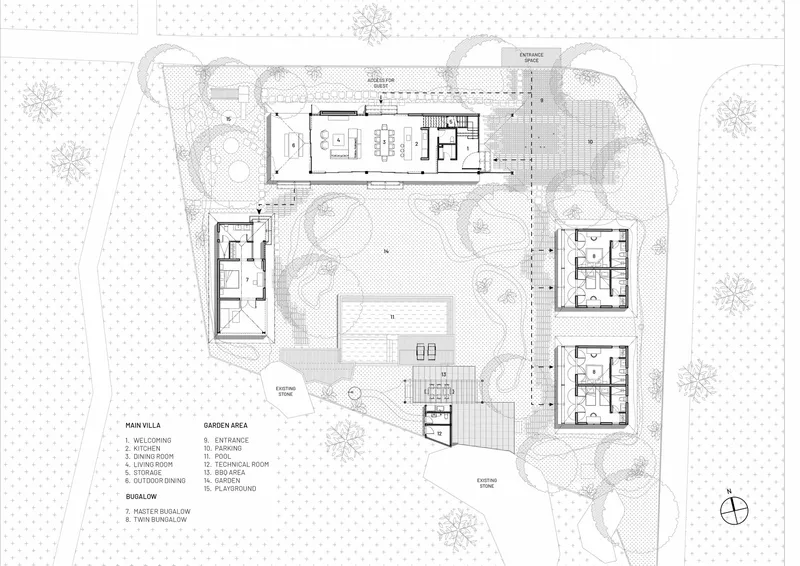
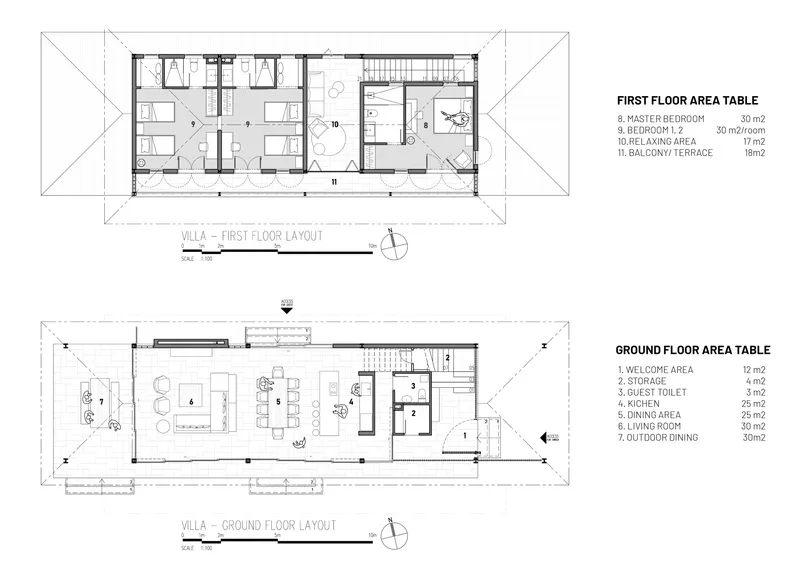
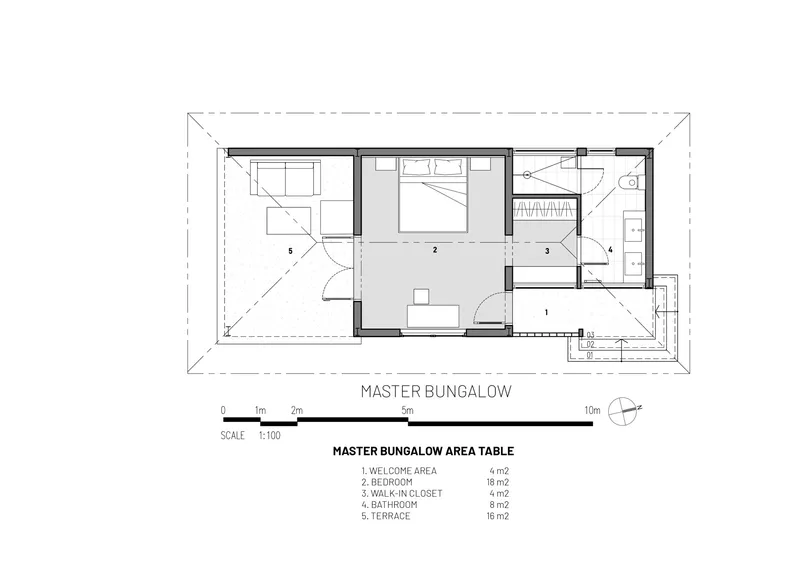
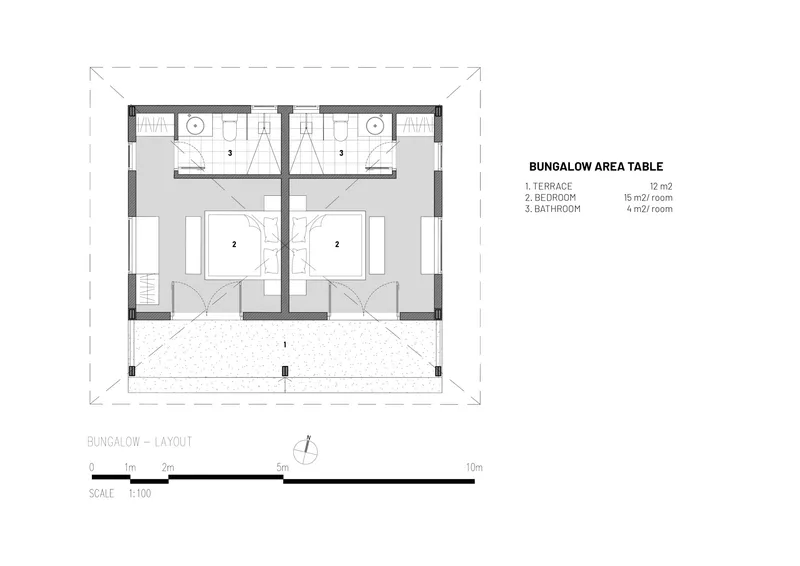
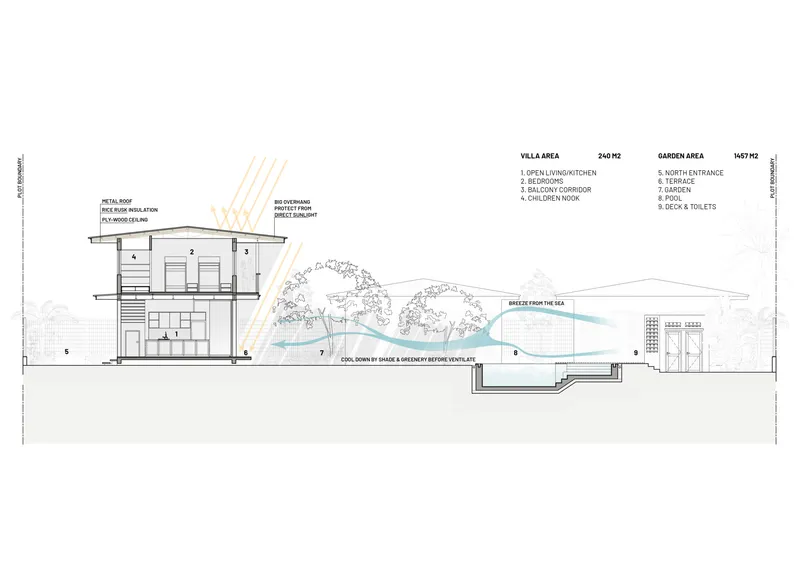
The site plan confirms the compound reading: the main villa and three bungalows are arranged around a central pool and garden, each structure oriented to capture prevailing breezes and frame specific views. The two-story villa plan shows bedroom suites on the upper level and open living areas below, while the bungalow plans illustrate compact single-room and twin-bedroom configurations with terraces facing the shared garden. The section drawing is perhaps the most revealing, cutting through villa, garden, and landscape to show how airflow from the sea is channeled through the compound. It makes explicit what the photographs suggest: this is a project where every decision traces back to the movement of air.
Why This Project Matters
KeGa Villa is not breaking new typological ground. The compound weekend retreat with open-plan living and climate-responsive design is well established in Southeast Asian practice. What T3 Architects achieve here is a level of coherence between site strategy, section logic, and material execution that makes the project instructive rather than merely attractive. The section drawing showing breeze flow from the sea through the garden to the villa is not a marketing diagram; it is the actual organizing principle visible in every photograph. That kind of alignment between intention and result is rarer than it should be.
For architects working in tropical coastal contexts, KeGa Villa offers a useful model of how to distribute program across a site without losing compositional control, how to be radically open at ground level while maintaining privacy above, and how to let climate dictate form without surrendering architectural specificity. It is a well-made house that knows exactly what it is.
KeGa Villa by T3 Architects (Charles Gallavardin, Tereza Gallavardin). Located in Ke Ga, Vietnam. 350 m². Completed 2025. Photography by Hirouyki Oki.
About the Studio
Share Your Own Work on uni.xyz
If projects like this are the kind of work you want to make, uni.xyz is a place to publish your own, find collaborators, and enter design competitions.




Popular Articles
Popular articles from the community


Riyadh For All: Intergenerational Urban Design for Active Aging in Rabat
Riyadh For All reimagines urban design in Rabat with intergenerational co-living, adaptive courtyards, and Moroccan cultural exchange today.

Co-Life: Senior Housing Design That Reconnects Older Adults With the City
Co-Life reimagines senior housing design through healing gardens, shared streets, workshops, and a sustainable community across generations.

The Ocean Hive: Sustainable Architecture for a Self-Sufficient Civilization at Sea
The Ocean Hive imagines sustainable architecture at sea, where modular habitats, algae, wave power and ocean waste sustain a growing colony.

Play: Fragments of Their World
Familiar architecture becomes modular playground design, creating safe spaces where displaced children can learn, connect, imagine and play.


Similar Reads
You might also enjoy these articles

Bao Huynh Watercolor Atelier: A Serene Art Retreat in Hội An
Bao Huynh Watercolor Atelier in Hội An blends multifunctional art spaces, sustainable design, local materials, and family-friendly living in a serene environment.

Atelier Macri Concept Store Interior Design by CASE-REAL
Atelier Macri store features a "ko" counter, walnut wood details, cork displays, blending retail, gallery, and seamless customer experiences.

Manuel Vargas Izquierdo Stadium and High-Performance Sports Center: Architectural Excellence in Jalpa de Méndez
The Manuel Vargas Izquierdo Stadium blends sustainable design, inclusive sports facilities, and cultural-inspired architecture, revitalizing Jalpa de Méndez’s public spaces.

KAKR Buluh Awar Hall: Revitalizing Community and Ecology Through Bamboo Architecture
Community built bamboo hall revitalizes Buluh Awar village, empowering youth, restoring ecology, celebrating vernacular craftsmanship through sustainable architecture and culture.




Comments (0)
Please login or sign up to add comments
No comments yet. Be the first to comment!