

TAISEI DESIGN Sculpts a Concrete Landform on the Kobe Waterfront to House an Aquarium and Food Hall
Kobe Port Museum channels the tectonic history of Japan's seismic coast into a faceted concrete volume holding 60 aquarium tanks and a rooftop garden.


Where the Seto Inland Sea meets the volcanic slopes of Mount Rokko, Kobe occupies a strip of land defined by geological violence. The Hanshin-Awaji Great Earthquake of 1995 shattered the port district, and the jetty area where the Kobe Port Museum now stands was set aside to preserve the memory of that rupture. TAISEI DESIGN Planners Architects & Engineers responded with a building whose form reads as though the earth itself buckled upward and the sea carved into it: faceted concrete volumes rising in stacked, angular masses, topped with trees and shallow pools. Completed in 2021, the 7,283 square meter facility packs an aquarium, a food hall, a bridal desk, and a rooftop garden into a single sculptural mass that defies the tidy rectangles of its port neighbors.
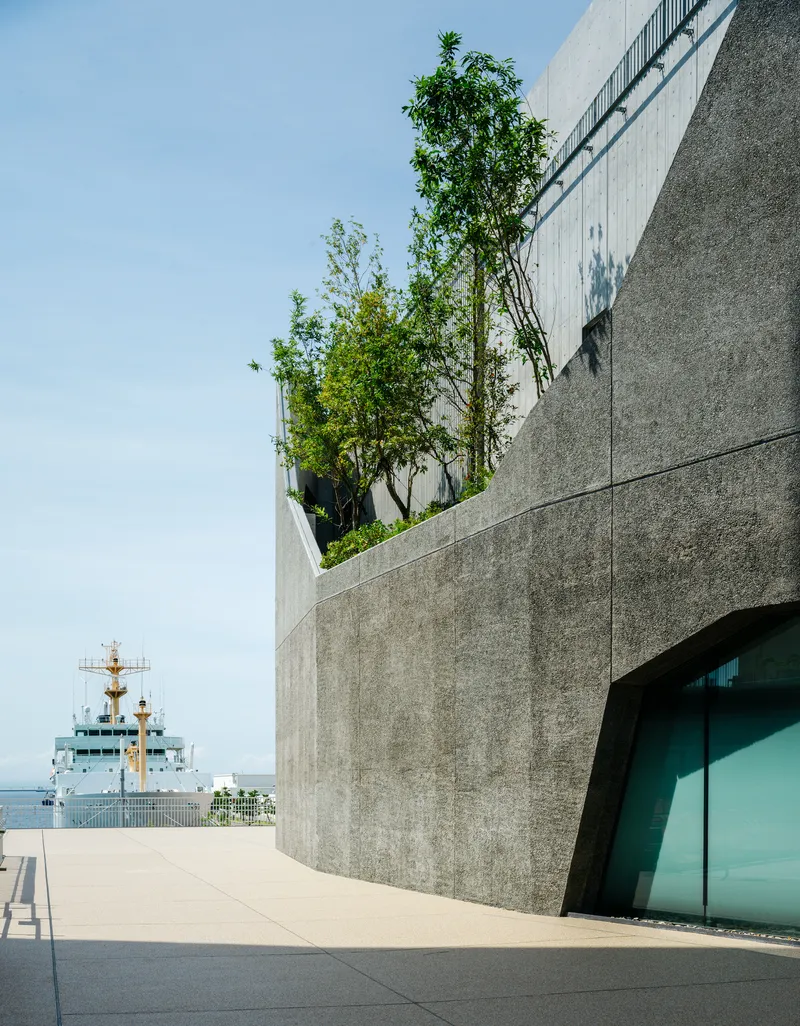
What makes this project worth studying is not merely the program mashup (aquarium plus food hall plus event venue is unusual enough) but the way the architects weaponize material honesty. The concrete is not smoothed or painted; it is left exposed in two distinct aggregate types, one evoking mountain rock, the other sea stone, alternating across the four levels. The building is, in a very literal sense, a geological section turned inside out. Every staircase, every terrace, every deep portal recessed into the facade reinforces the idea that you are moving through strata rather than rooms.
A Landform, Not a Box
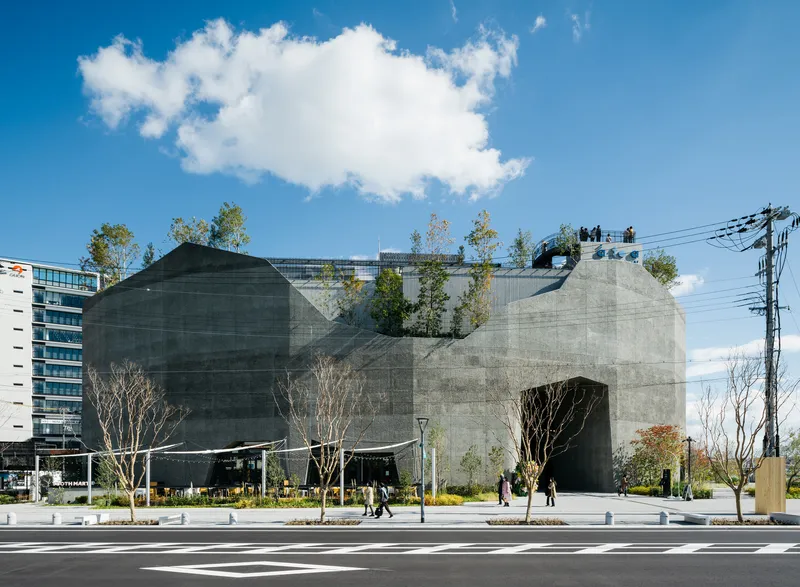
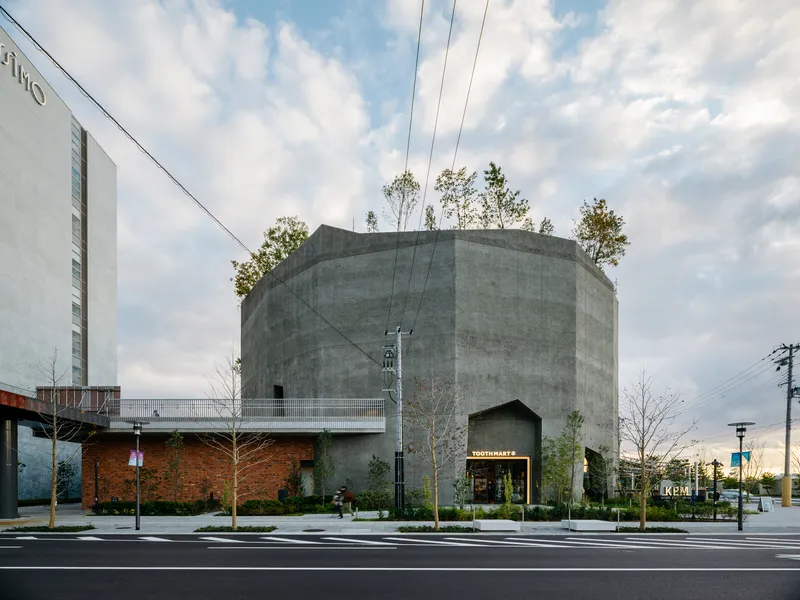
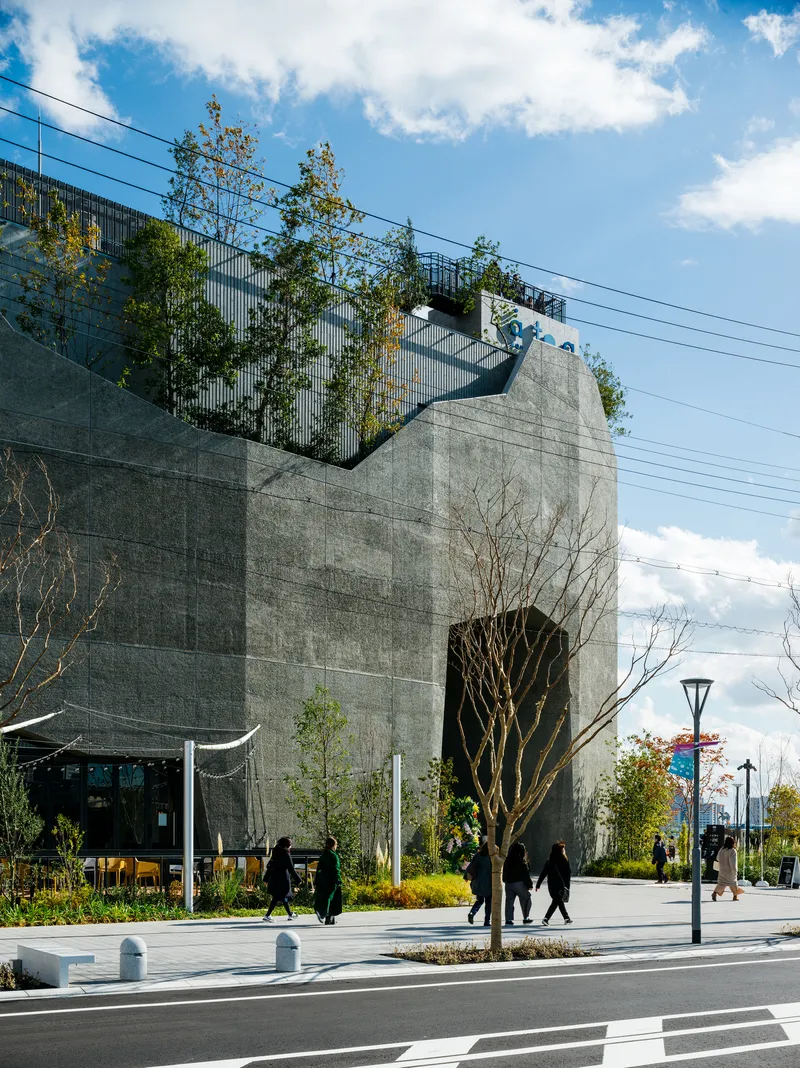
From the street, the Kobe Port Museum does not announce itself as a cultural building. It reads more like a chunk of fractured coastline dropped onto the harbor edge: massive, angular, and covered in vegetation that softens its upper edges. The cylindrical concrete tower on one side and the stepped terraces on the other give the massing an asymmetry that feels geological rather than designed. Pedestrians pass beneath it on the sidewalk the way they might walk along a cliff face.
Rooftop planting is not decorative here. It is integral to the concept of earth rising through concrete. Trees grow from pockets carved into the upper levels, and their roots anchor the building visually to the sky the way a hilltop forest would. The effect is strongest on overcast days, when the gray of the concrete and the gray of the clouds merge and the greenery becomes the only color.
The Deep Portal
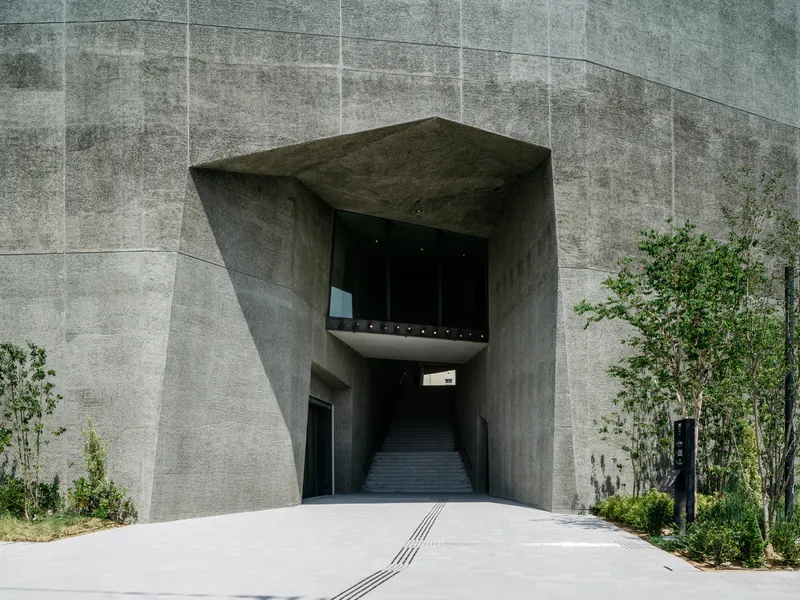
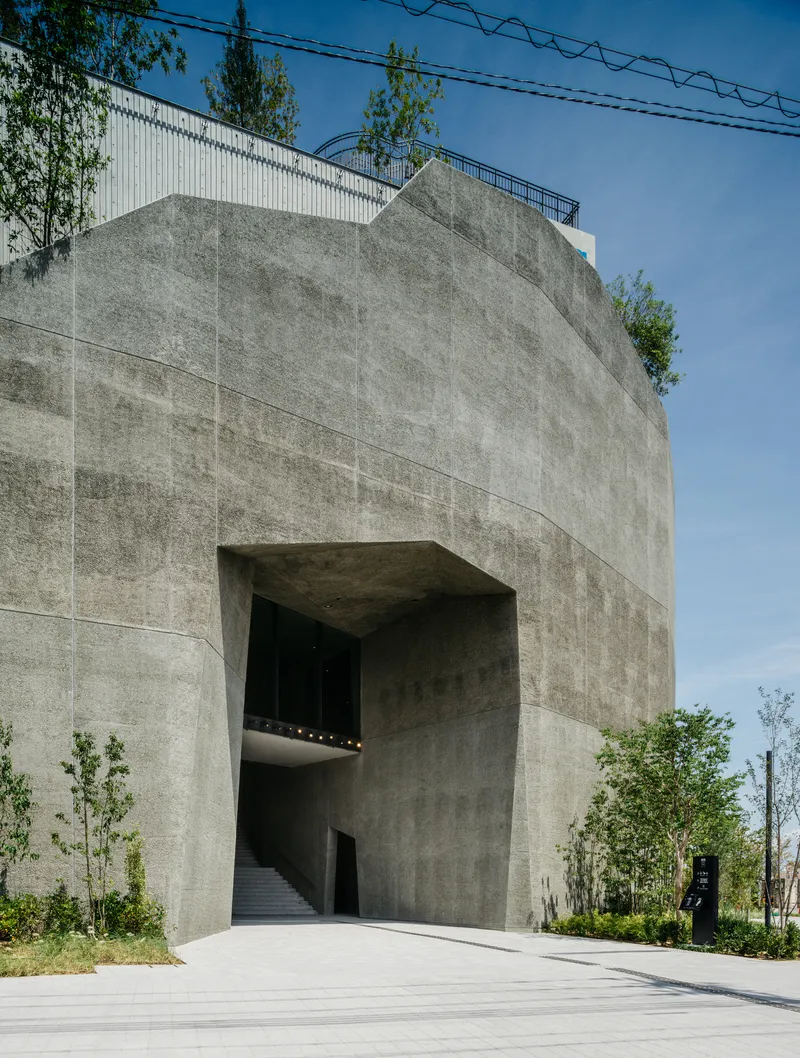
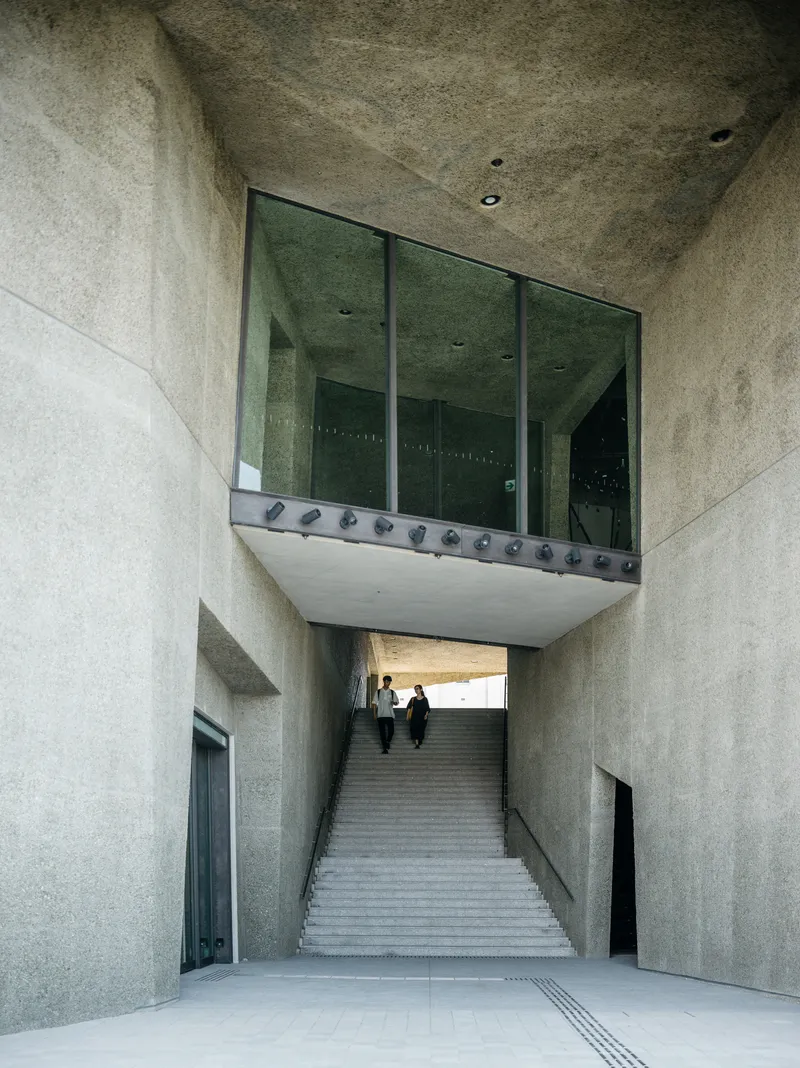
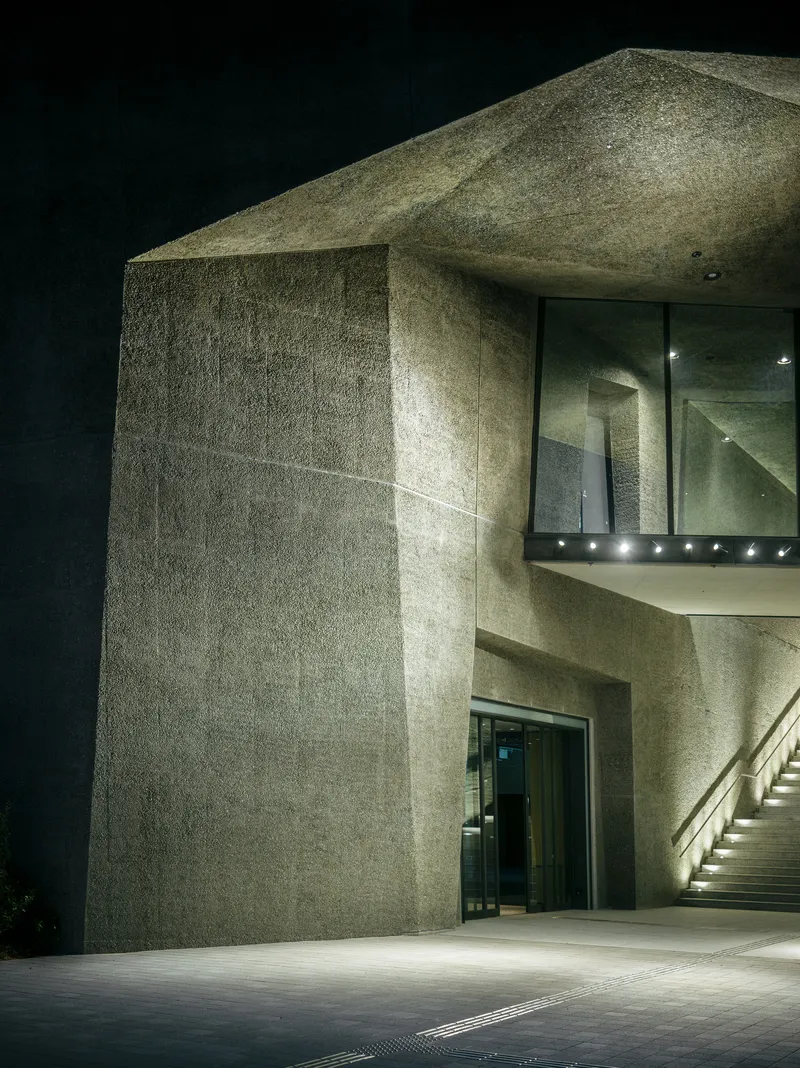
The entrance is the building's most theatrical gesture. A deep, angled cut in the concrete mass reveals an interior staircase ascending toward a suspended glass viewing box. The proportions are deliberately overwhelming: the opening is tall enough and deep enough to swallow you. At night, when the staircase is lit from within and the glass box glows overhead, the portal becomes a beacon visible from across the harbor.
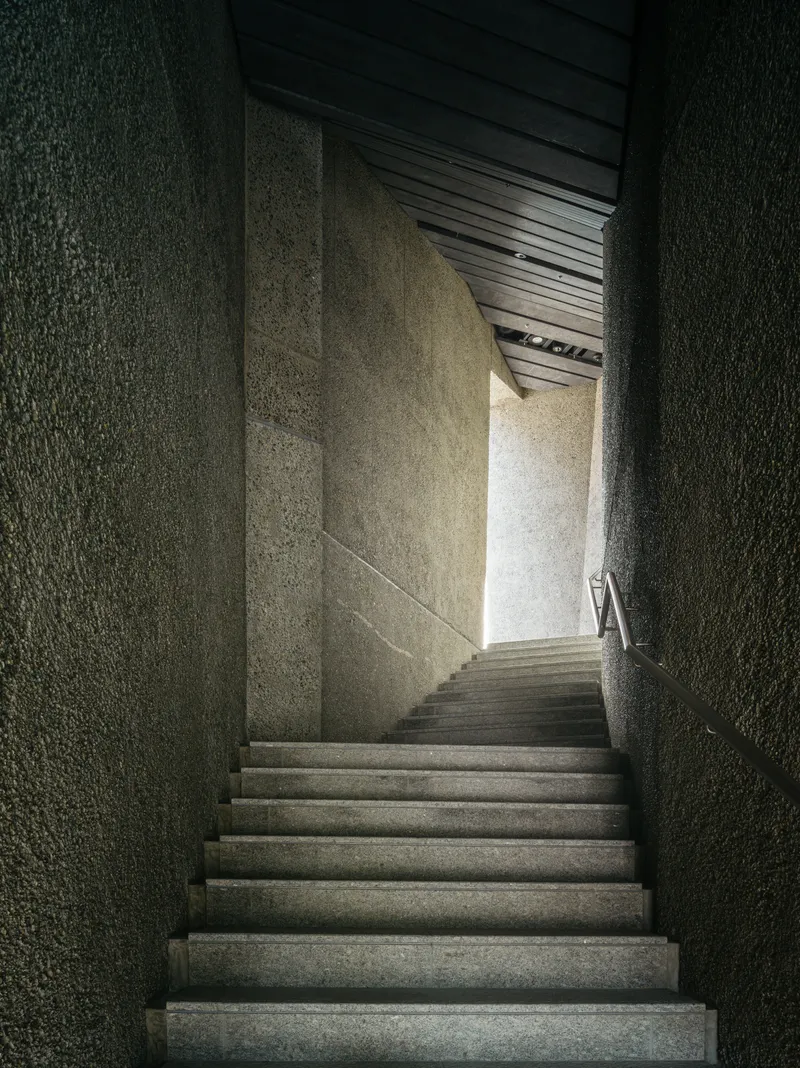
This is not a lobby in the conventional sense. There is no reception desk, no threshold moment of transition. You simply walk into the void and begin climbing. The concrete staircase is raw, the handrails minimal, the walls left in board-formed finish. Two visitors ascending the steps give you a sense of scale that the photographs alone cannot: they are small against all that mass.
Concrete as Geological Record
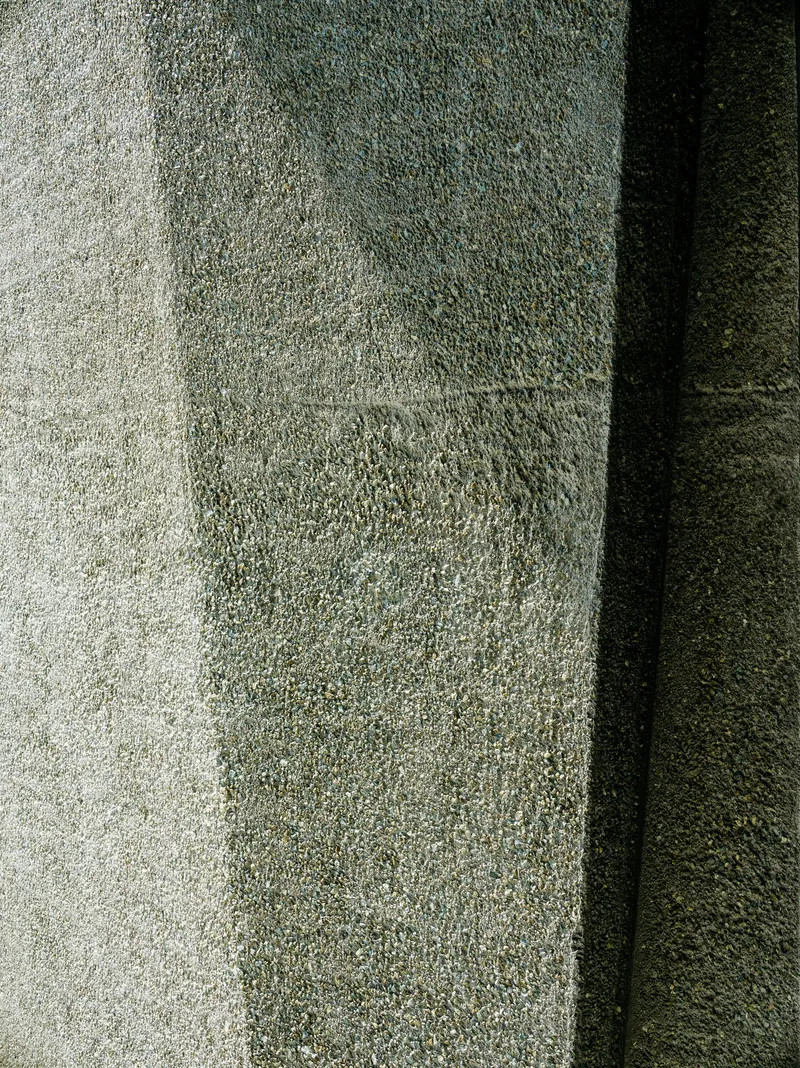
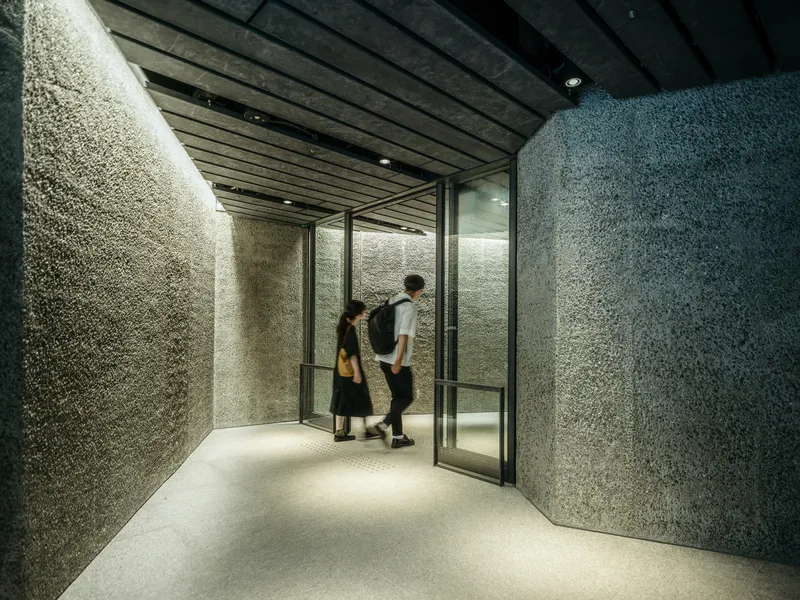
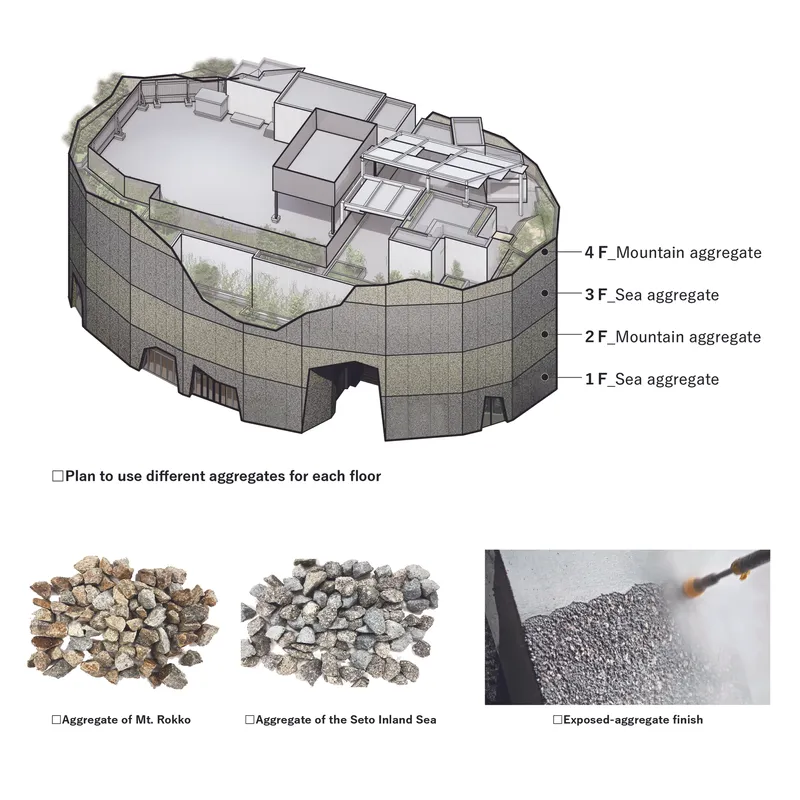
TAISEI DESIGN made a decision that elevates the entire project: they varied the concrete aggregate to distinguish between mountain and sea across the building's four floors. Close up, the wall surfaces tell two different stories. One mix is coarse and granular, recalling volcanic rock from the Rokko range. The other is smoother, rounded, suggestive of stones tumbled by tidal action. The axonometric drawings confirm this alternation is systematic, not arbitrary.
In the corridors, the aggregate walls are paired with timber-clad ceilings, creating a warm compression that makes the transition spaces feel intentional rather than leftover. Light enters through horizontal slots and angled doorways, casting diagonal lines across landings. These are not circulation corridors to rush through; they are inhabitable thresholds designed to slow you down between zones.
Water Inside the Walls
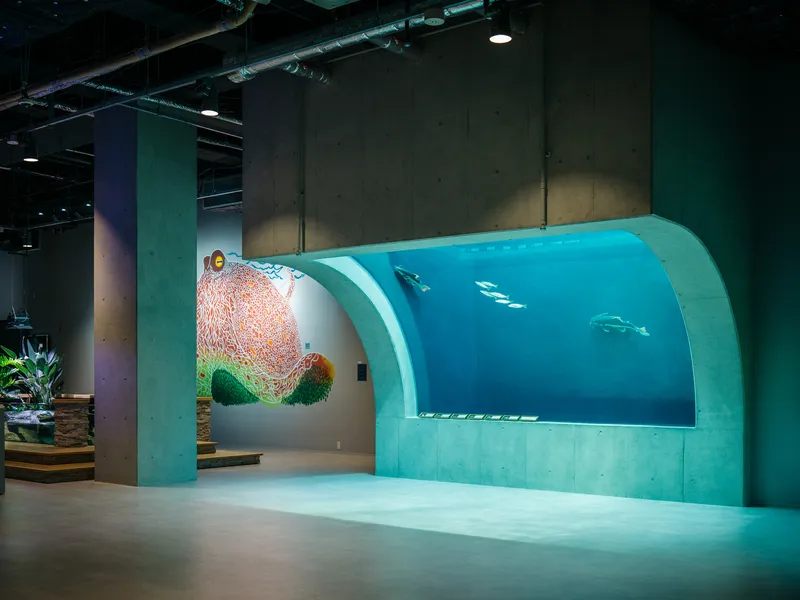
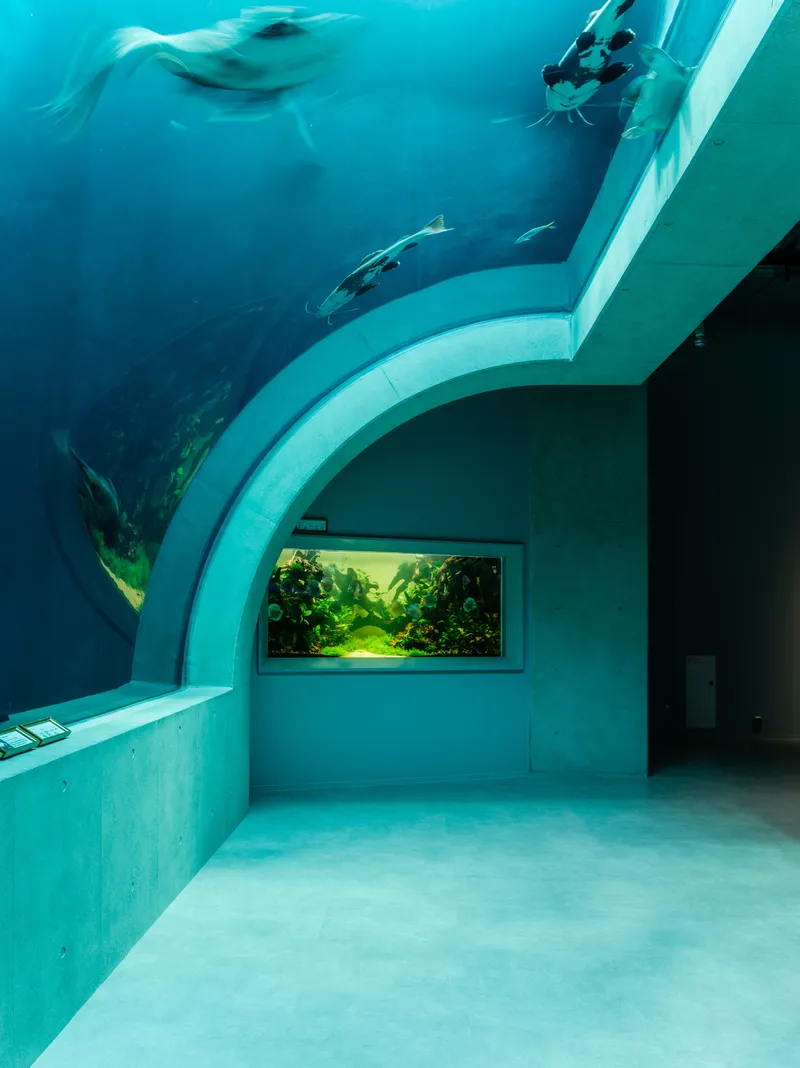
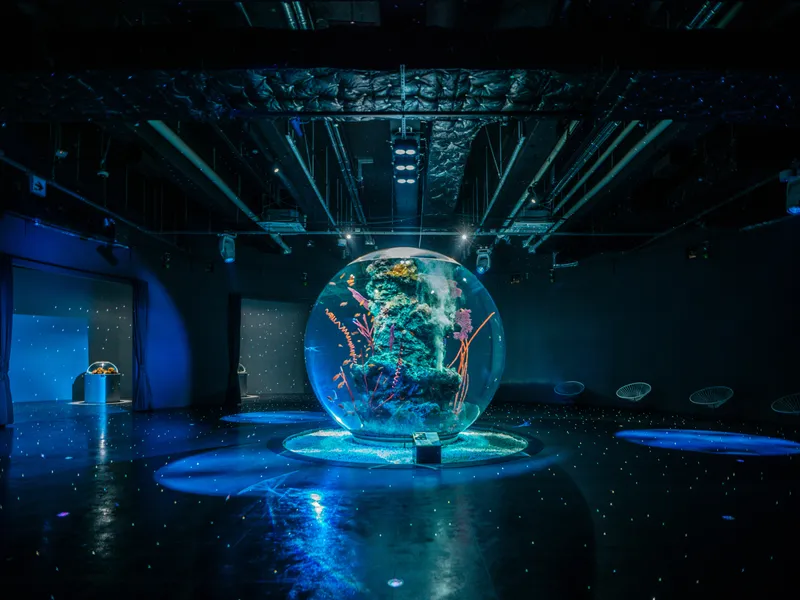
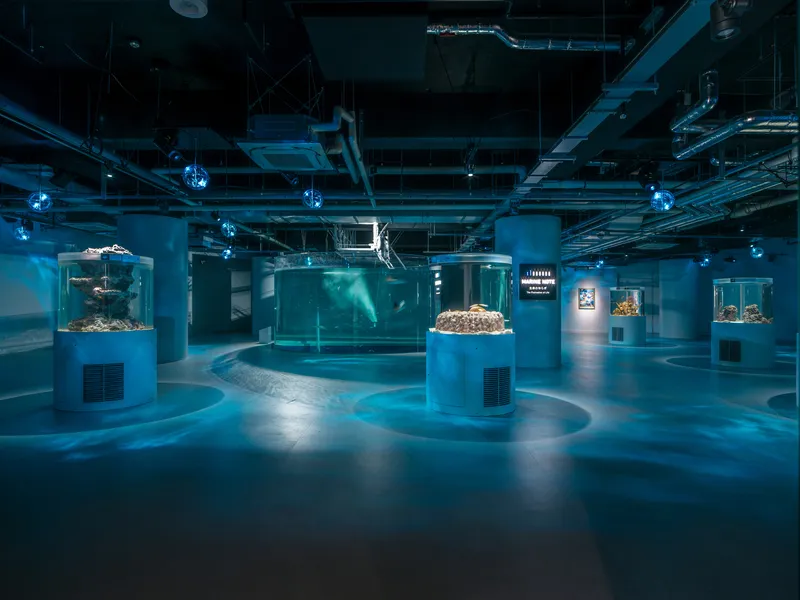
The aquarium, branded as "átoa," occupies the second through fourth floors and houses around 60 tanks with approximately 100 species and 3,000 individual creatures. But the design ambition here is not the standard darkened corridor with glowing rectangles of water. Seven themed exhibition zones integrate theatrical lighting, stage art, and digital projections. Curved turquoise walls wrap around viewing windows, and a full tunnel lets you stand beneath swimming rays.
The spherical aquarium, filled with coral and fish under blue light, is the standout moment. It floats within the industrial ceiling grid like a planet suspended in a factory. The contrast is intentional: exposed mechanical ducts and structural steel above, luminous marine life below. TAISEI DESIGN clearly wanted the infrastructure to be visible, reinforcing the idea that this is a working building, not a black box.
Dining Beneath the Sea
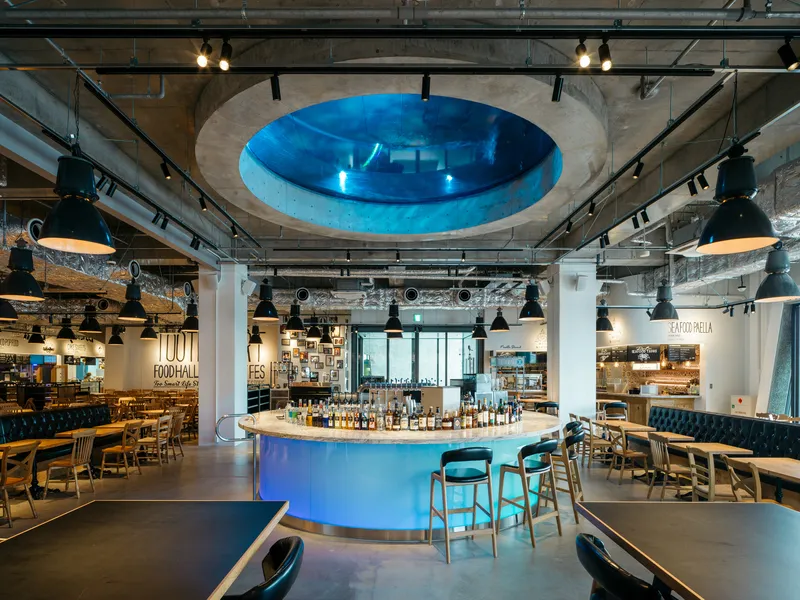
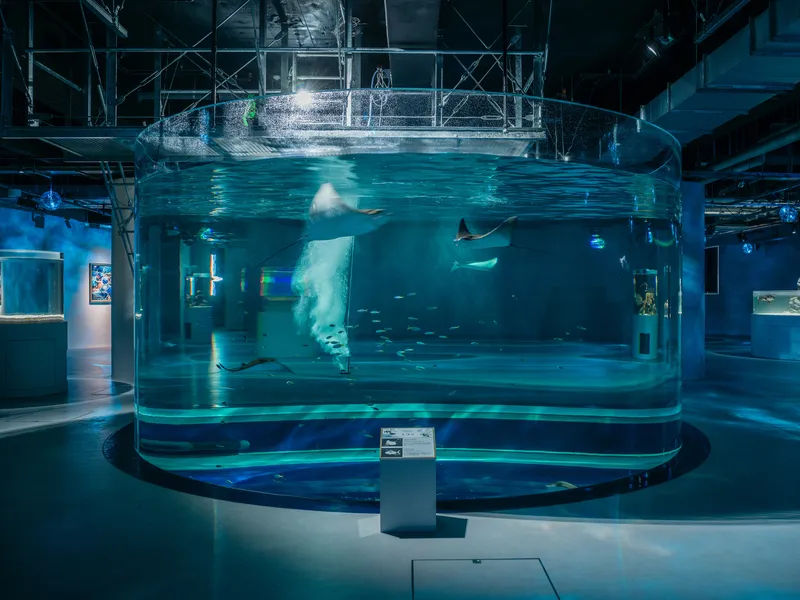
The food hall on the first floor is described as Japan's first to offer a view of a giant aquarium on the ceiling. Sit at the central bar, look up, and you see a circular opening filled with water, fish, and light. It is a surreal inversion: the sea hangs above you. The beluga whales in their cylindrical tank nearby reinforce the scale of the aquatic program, and the industrial ceiling grid keeps the space feeling honest rather than theme-park glossy.
Programmatically, combining a food hall with an aquarium is a risk. The smells, the humidity, the acoustic demands of each function are fundamentally opposed. That the building manages to keep them distinct yet visually connected, primarily through vertical apertures and ceiling openings, is a real achievement of section design.
Rooftop Harbor and Planted Terraces
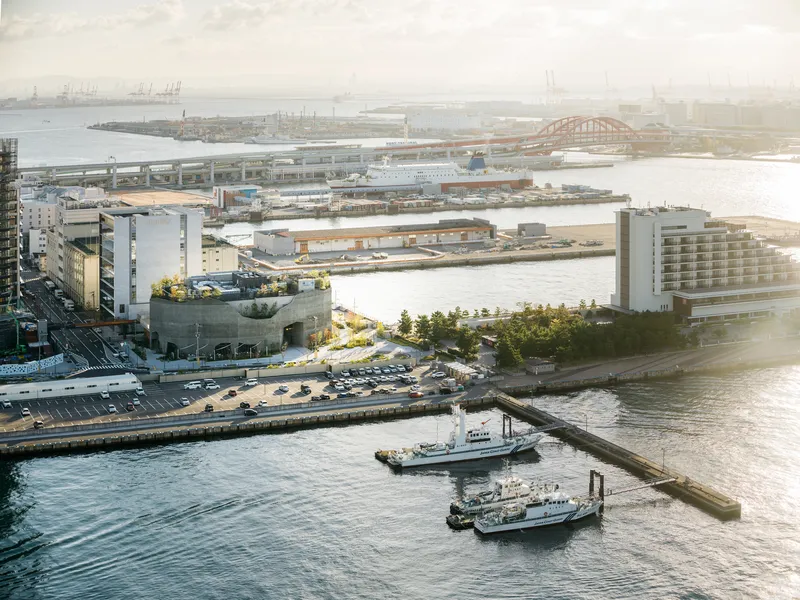
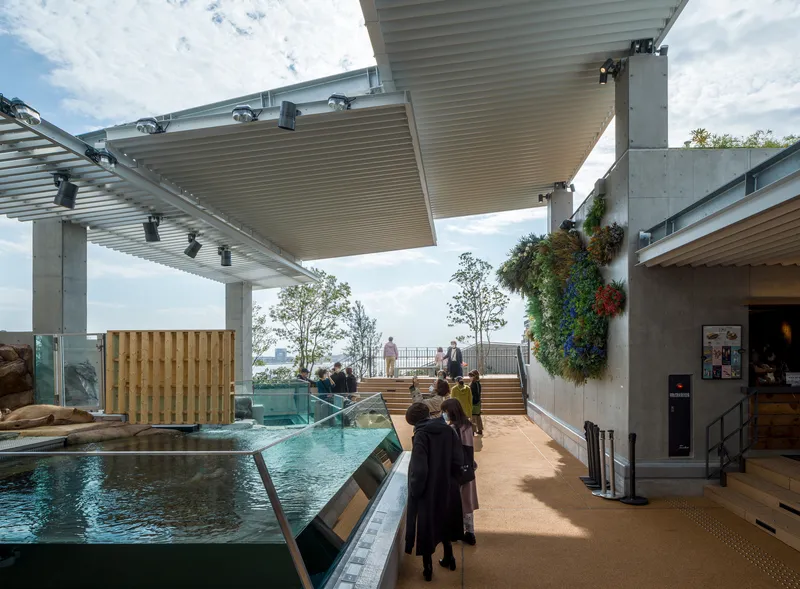
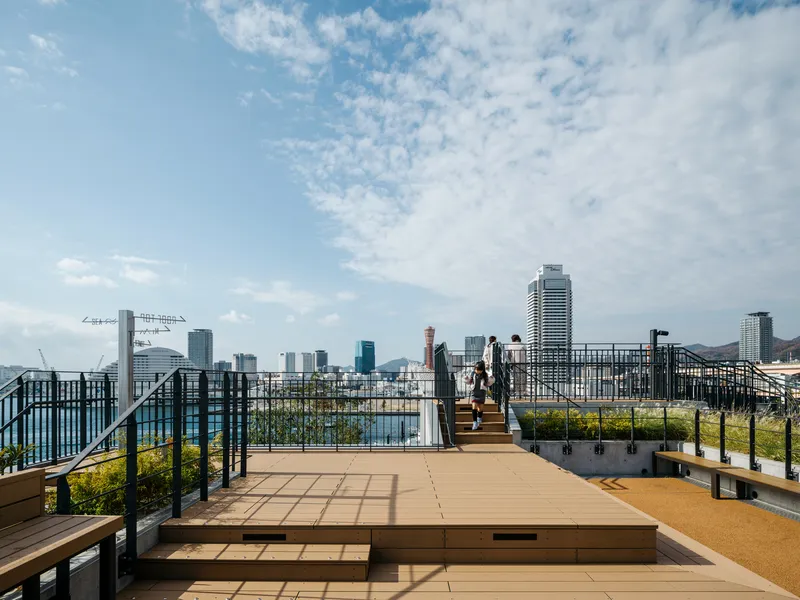
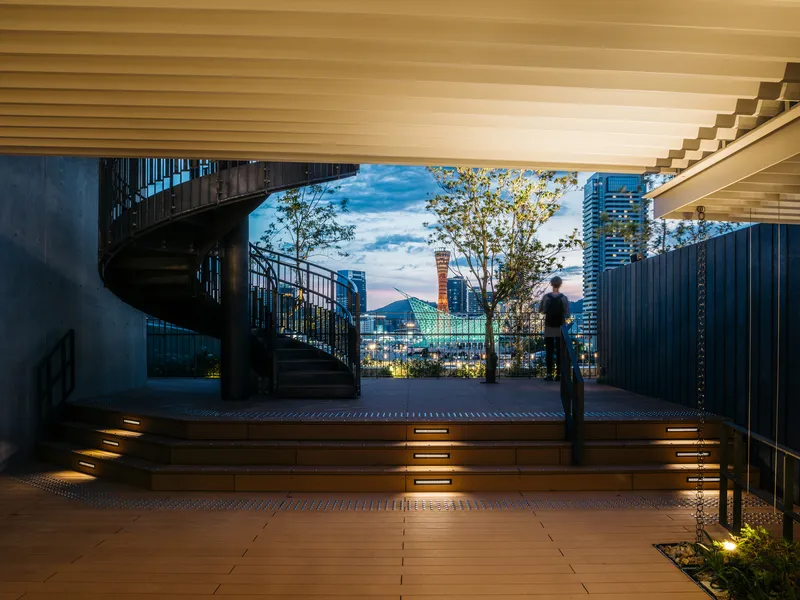
The roof terrace is the payoff for all that climbing. Timber decking, shallow reflecting pools, cantilevered metal canopies, and planted pockets open out to a panorama of the harbor. Boats sit docked below, and the Kobe waterfront skyline stretches to the horizon. A spiral staircase at one edge connects down to a covered deck, offering a secondary route back into the building.
From the aerial view, the extent of the rooftop planting becomes clear. The building reads as an occupied hillside rather than a flat-roofed institution. Greenery overflows the edges, and the irregular plan shape means no two sides of the terrace offer the same view. For a museum on a jetty, this sense of elevated landscape is the most direct expression of the project's core idea: land rising from water.
Night and Dusk
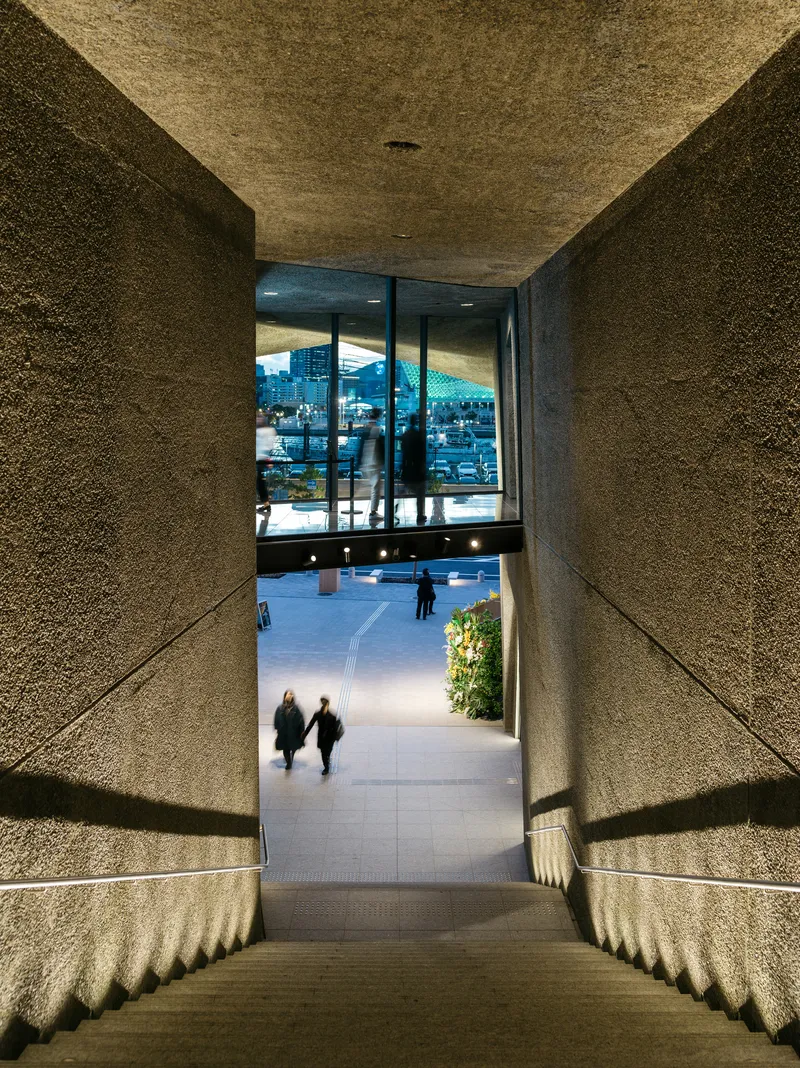
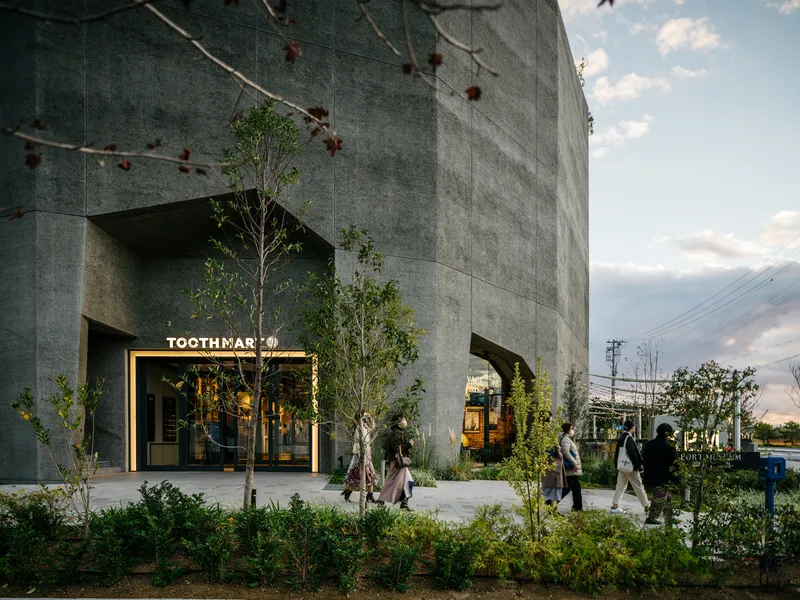
At dusk, the building undergoes a tonal shift. The heavy concrete turns dark and monolithic, and the recessed openings glow with warm interior light. The stepped passage leading to the plaza channels visitors between textured walls that feel tighter and more cavernous as the sky dims. Pedestrians gathering at the arched openings of the planted garden at golden hour suggest that the ground-level edges have become a kind of public living room for the neighborhood.
The nighttime entrance, with its lit stairs and hovering glass box, is the image that will define this building in most people's minds. It is the single most cinematic moment in the project: a cave mouth glowing from within, inviting you to climb into it. TAISEI DESIGN understood that a museum on a port needs to be visible from the water, and this luminous portal does the job without signage or spectacle.
Plans and Drawings
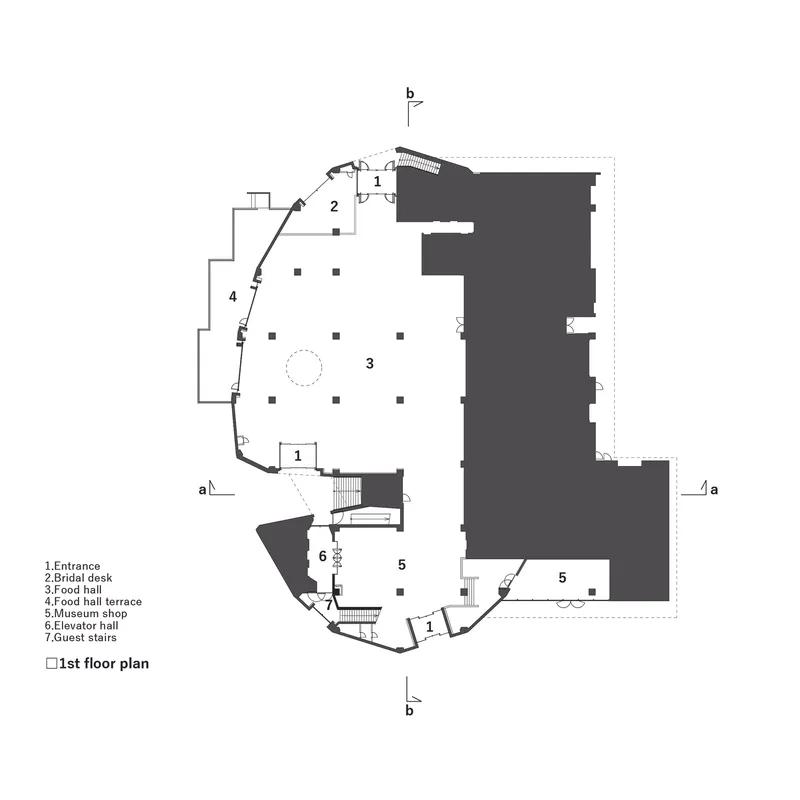
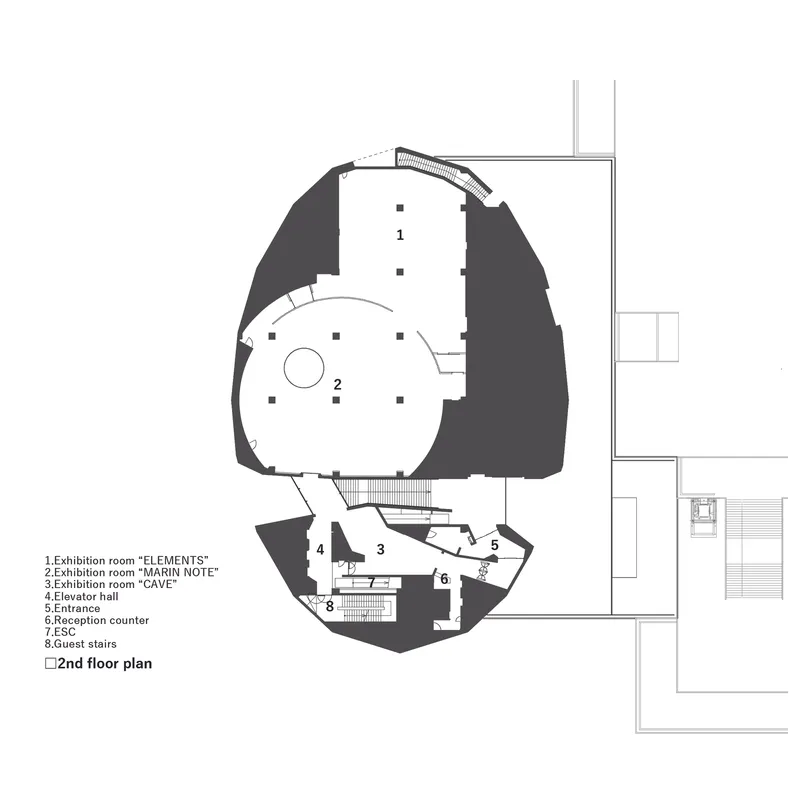
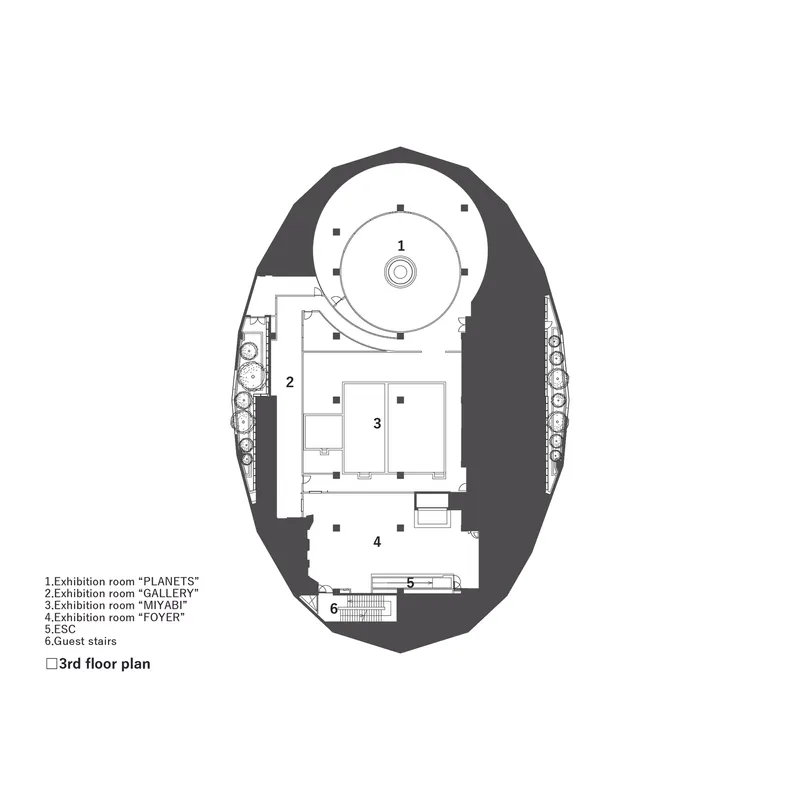
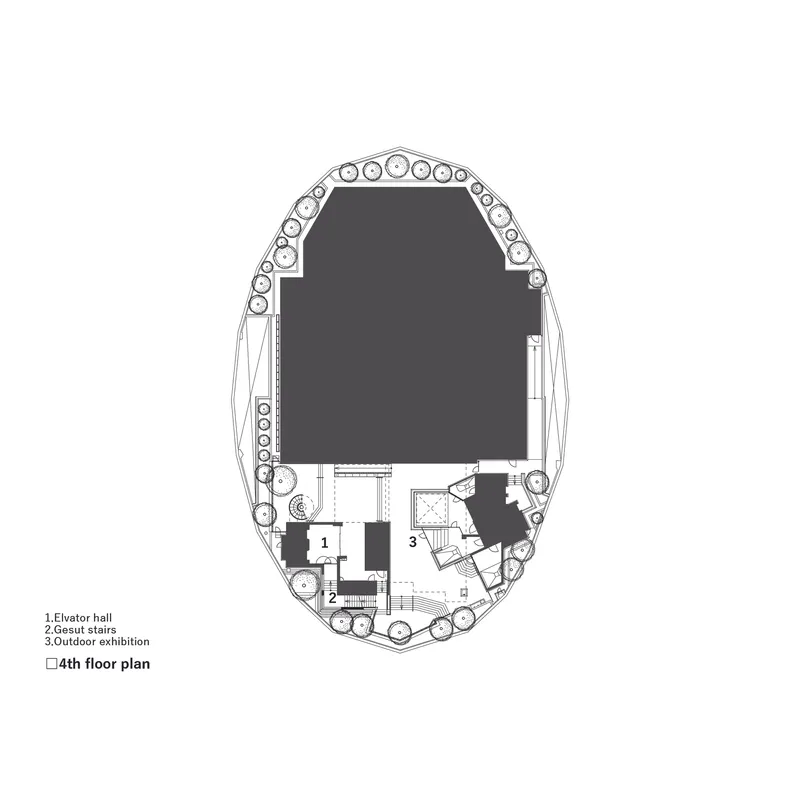
The floor plans reveal an irregular, organic footprint that shifts at every level. The first floor spreads wide to accommodate the food hall and entrance terrace. The second and third floors pull inward, organizing rounded exhibition spaces and circular galleries around elevator cores. By the fourth floor, the plan has contracted to an outdoor exhibition zone with circular planting pockets cut into the roof slab. Nothing is orthogonal. The building reads in plan the way a natural cave system reads in survey: each level a different shape, each chamber a different size.
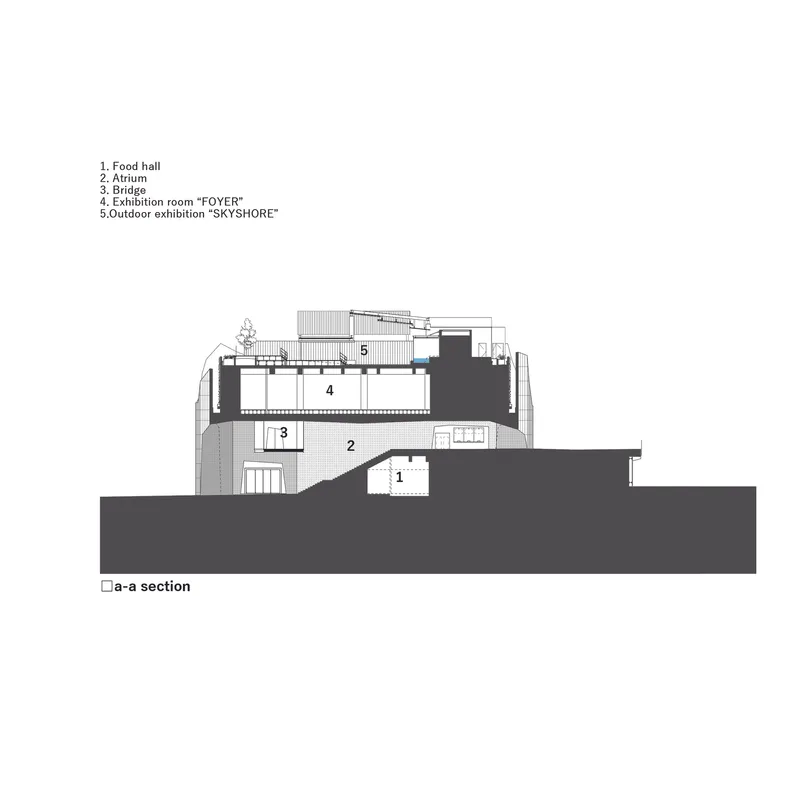
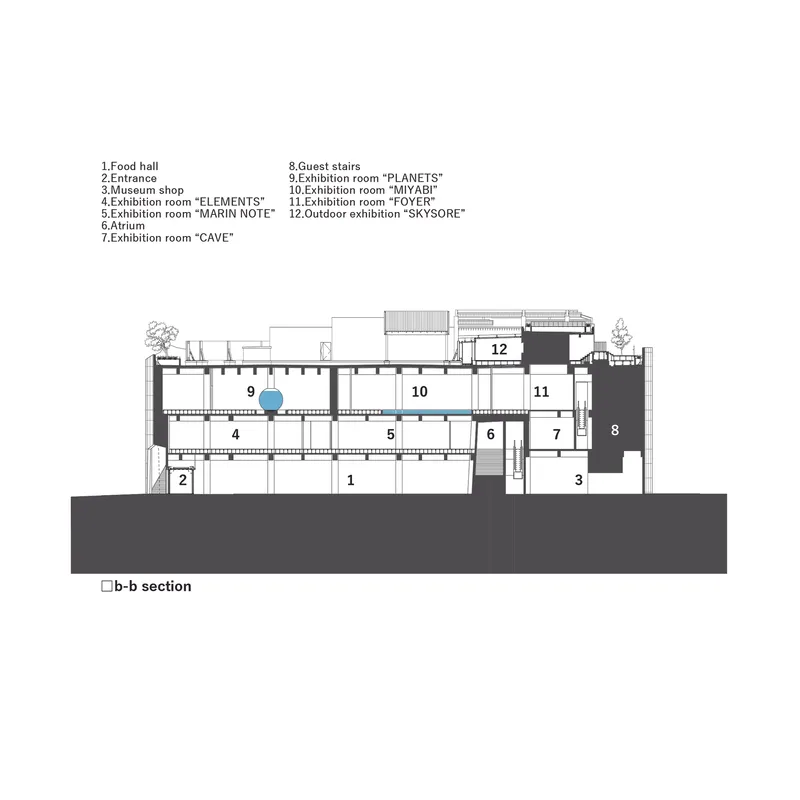
The axonometric drawing is the key to understanding the material strategy. It shows the alternation of mountain and sea aggregate across the four concrete floors, confirming that the geological metaphor is not applied decoration but baked into the structure itself. The sections reveal the vertical drama: the atrium connecting food hall to upper galleries, the bridge spanning interior voids, and the cascading stairs that stitch the whole thing together. These are generous sections, with double- and triple-height spaces that let you see (and hear) the aquarium from unexpected vantage points.
Why This Project Matters
Kobe Port Museum matters because it refuses to separate program from metaphor. An aquarium is a container for water; a food hall is a container for gathering; a bridal venue is a container for ceremony. TAISEI DESIGN wrapped all three inside a single geological conceit, the collision of land and sea, and made the building's material palette do the conceptual work. The alternating aggregates, the eroded portals, the planted upper strata: these are not gestures. They are the architecture.
On a jetty that preserves the scars of the 1995 earthquake, it would have been easy to build something transparent and light, a glass pavilion signaling renewal and optimism. TAISEI DESIGN chose the opposite: a heavy, opaque, geological mass that acknowledges the land's violent history rather than erasing it. The trees growing from its roof are not symbols of hope; they are evidence of time. Given enough decades, this building will look less like it was built and more like it erupted from the ground. That is the point.
Kobe Port Museum, designed by TAISEI DESIGN Planners Architects & Engineers. Kobe, Japan. 7,283 m². Completed 2021. Photography by Katsumasa Tanaka.
About the Studio
Share Your Own Work on uni.xyz
If projects like this are the kind of work you want to make, uni.xyz is a place to publish your own, find collaborators, and enter design competitions.


Popular Articles
Popular articles from the community


David Ortega Stacks a Two-Story Mexico City Penthouse Around a Steel Stair and a Pergola-Shaded Roof Terrace
In Colonia Roma, a 300 m² penthouse uses oak joinery, a planted steel stair and a slatted roof pergola to make a new-build apartment feel like a house.

Opera on the Sea: Driftwood Logic Shapes a Timber Opera House on Estonia's Coast
Trevor Orgill's opera house translates the entangled drift of floating timber into a civic building where wood, water, and music converge.

The Amber Palace Opera: A Geological Fiction Surfaces on Tallinn's Baltic Waterfront
Pierre Brillard reimagines a Baltic legend as a public landscape, opera house, and waterfront promenade rooted in Tallinn's coastal identity.

Cube Design Draws an Ecological Corridor Between Two Shenzhen Hills with the Nankai Building
Beside Shenzhen's container docks, the Nankai Building pairs stacked balconies with a climbing green screen to connect two hillsides across its height.

Similar Reads
You might also enjoy these articles

LAVA Architecten Gives Vocational Education a Sawtooth-Roofed Face on a Mechelen School Campus
In Mechelen, Belgium, a 2,053 m² STEM school on a 6×6 m grid turns workshops and classrooms into rooms that can be rearranged as teaching changes.

KEMA Studio Turns a Derelict Marvila Attic into a 60 m² Lighthouse Apartment Above Lisbon
In Lisbon's Marvila district, a rebuilt roof, four skylights and two plywood volumes turn an unlivable attic into a bright home facing the Tagus.

Pixel Gardens: One Repeated Module Stacked Into a Terraced Social Housing Tower for Famagusta
Salem Bader's shortlisted housing tower builds a vertical neighbourhood from one repeated module, offsetting units to carve terraces, light and air.

Bao Huynh Watercolor Atelier: A Serene Art Retreat in Hội An
Bao Huynh Watercolor Atelier in Hội An blends multifunctional art spaces, sustainable design, local materials, and family-friendly living in a serene environment.


Comments (0)
Please login or sign up to add comments
No comments yet. Be the first to comment!