

TALC Builds a Brick House in Three Bodies Around a Sequence of Courtyards in Mexico City
On the self-built periphery of Tláhuac, Shark House turns exposed brick into a quiet argument for chromatic contrast and spatial depth.


Tláhuac sits at the edge of Mexico City, a borough where most buildings are assembled over years by their own inhabitants: gray concrete block stacked incrementally, rooms added when budgets allow, rooftops crowned with rebar waiting for the next floor. It is a landscape of perpetual incompleteness, and it is precisely this condition that TALC, led by José Luis Jiménez, chose to engage rather than resist. Shark House does not arrive as a corrective. It absorbs the logic of staged construction and replays it in red brick and poured concrete, producing a 180 square meter home that reads like three distinct volumes built at three different times, even though it was designed and constructed as a single gesture.
What makes the project worth studying is its central organizational move: three interconnected bodies arranged around a sequence of courtyards. Each courtyard serves a different role. The first is a threshold, mediating between the street and the interior. The second is hidden, a silent nucleus that pulls daylight into the deepest parts of the plan. The third is social, revealing itself progressively as you move through the house. Together they transform a narrow lot into something far more spatially generous than its footprint suggests, proving that on the periphery of one of the world's largest cities, good architecture can emerge not from imported typologies but from a close reading of what is already there.
A Facade That Borrows the Neighborhood's Grammar
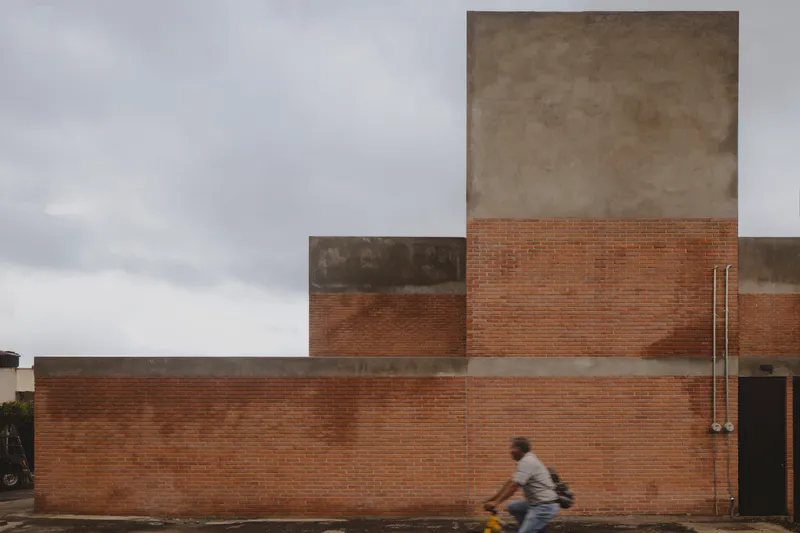

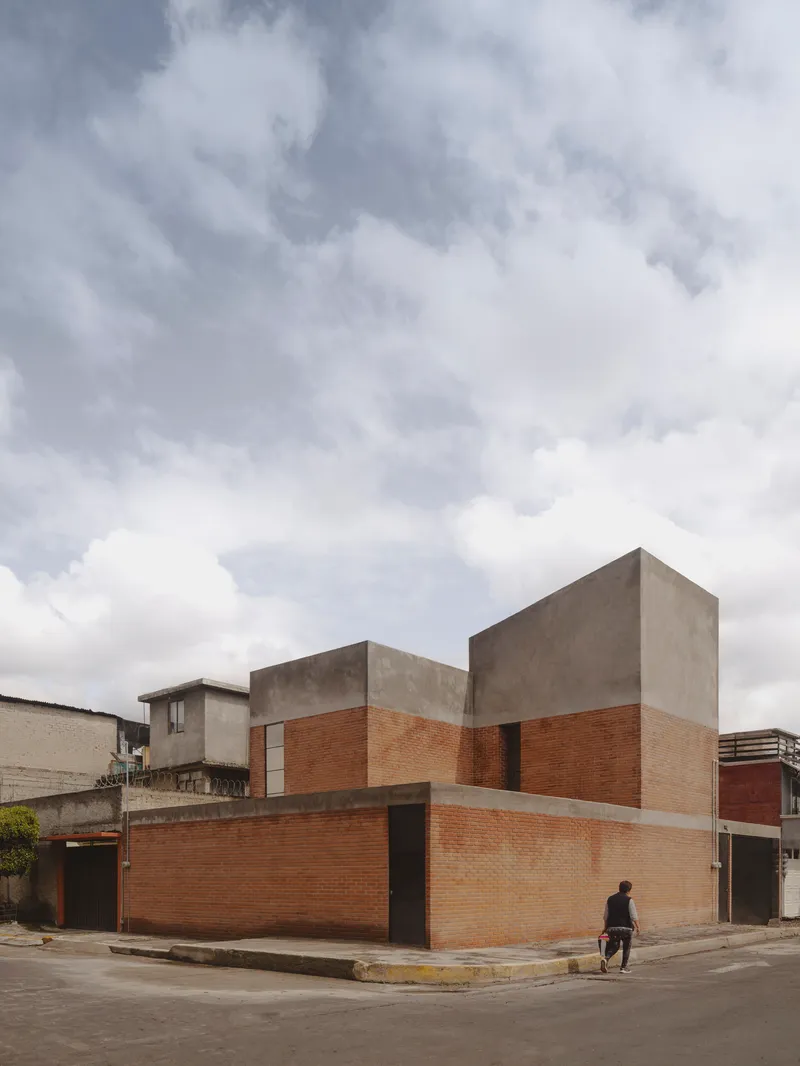
From the street, Shark House presents itself as a stack of volumes in varying materials and heights. Red brick sits next to poured concrete; walls step back and then jut forward. The effect is deliberate: it mimics the incremental massing of self-built neighbors while introducing a chromatic warmth that breaks from the dominant gray palette of exposed block. A cyclist passes and barely notices, which is arguably the highest compliment for a house that wants to belong to its context.
The staggered facade is not decorative. It corresponds directly to the three internal bodies, each of which occupies a slightly different footprint and height. Concrete bands wrap corners and cap volumes, creating horizontal datum lines that organize the composition without resorting to the flush planes and hidden gutters typical of contemporary residential design. The materials are honest: Cemento Tolteca concrete, Novaceramic ceramic elements, and a lot of carefully laid brick.
Brick, Concrete, and the Space Between
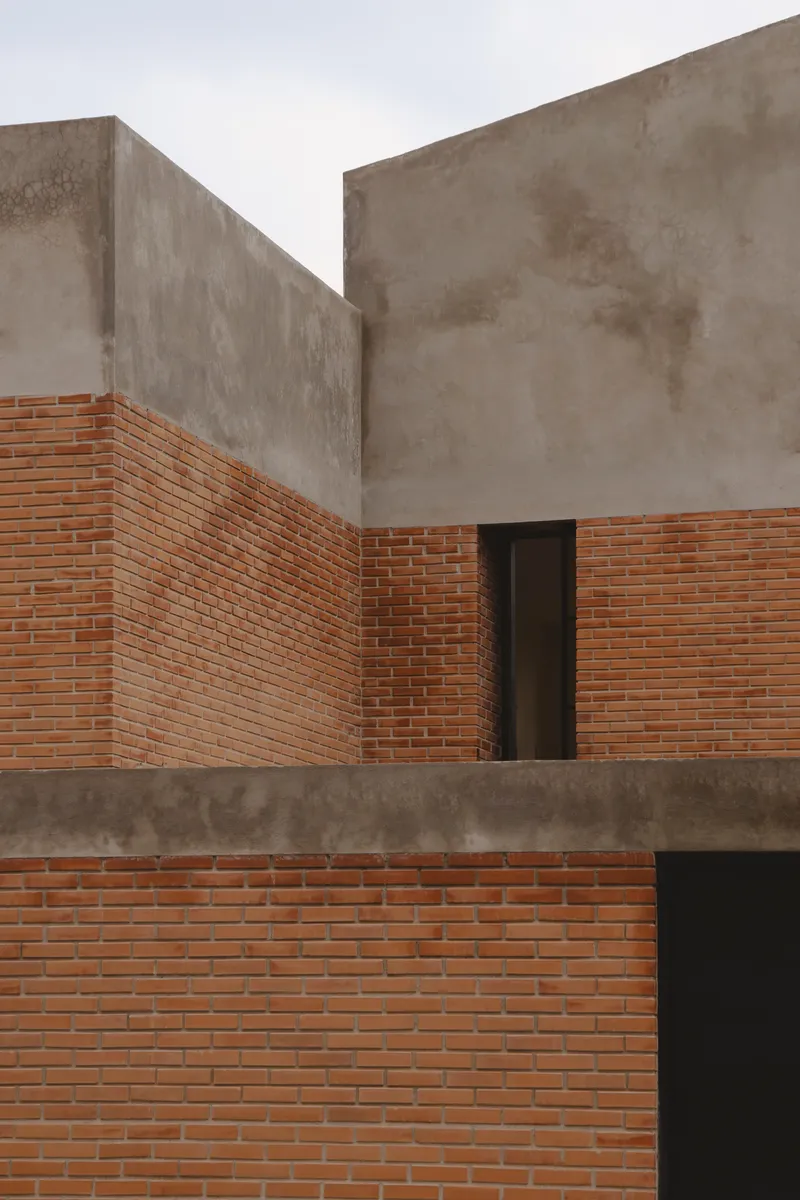
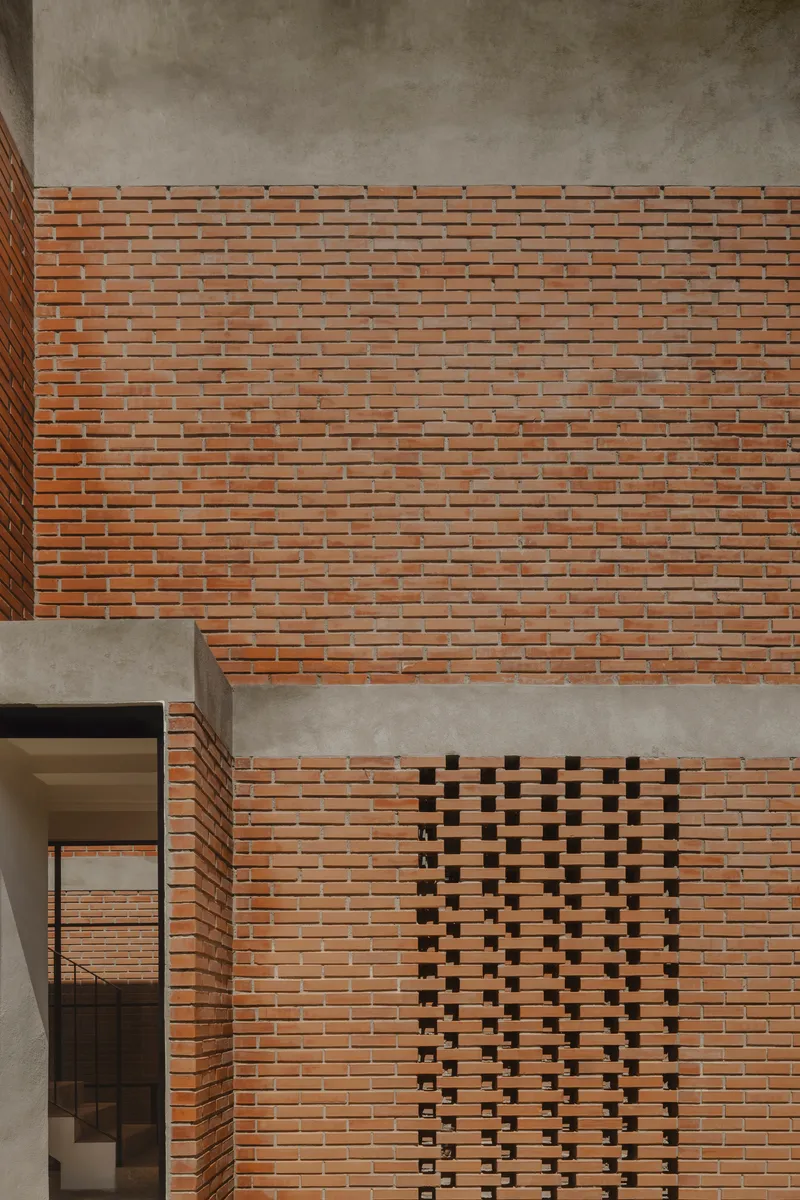
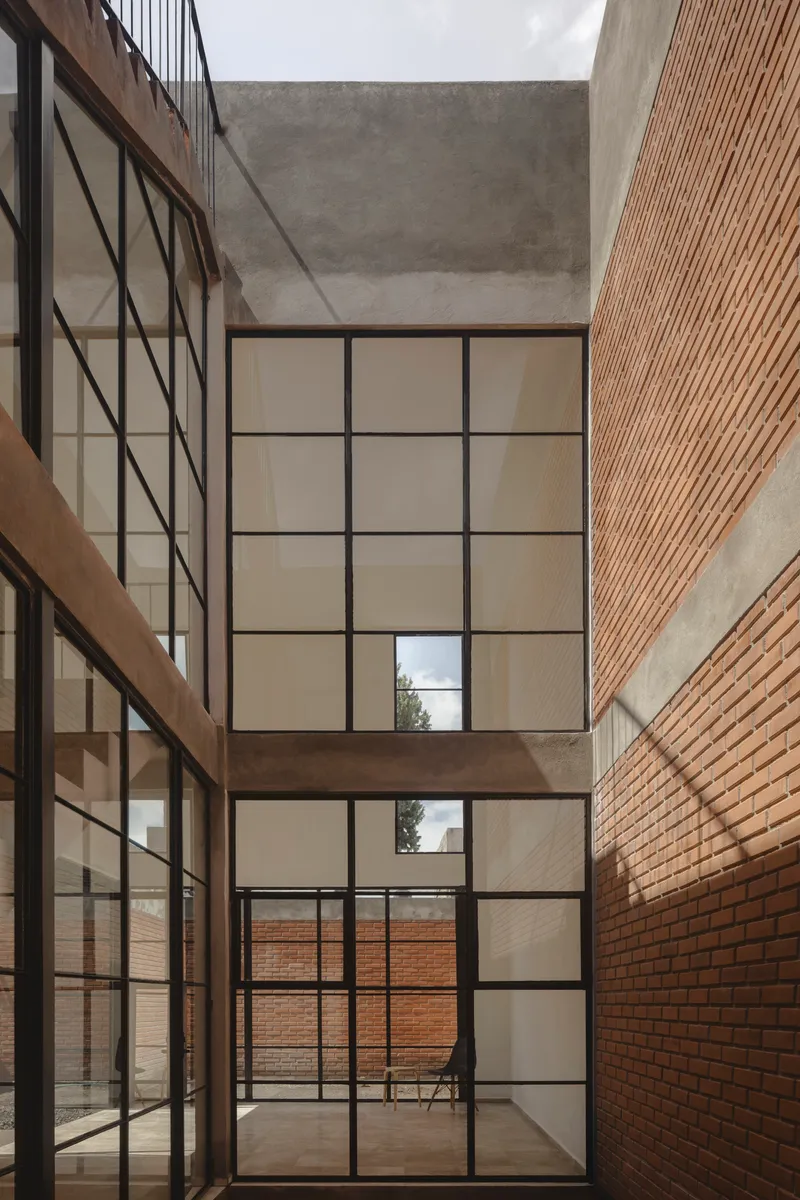
Up close, the material strategy becomes more legible. Patterned ventilation openings in the brick allow air to move through the facade while filtering light. Concrete bands wrap around corners to form balcony edges, their raw surface sitting in tactile opposition to the warm, textured brick. These are not expensive finishes. They are the same materials available to everyone in Tláhuac, just assembled with greater intentionality.
The vertical courtyard captured in image five is the clearest expression of the project's interest in mass and void. Brick and concrete surfaces rise on either side of a narrow gap, punctuated by stacked steel-framed windows. Light enters from above and bounces between surfaces, creating a luminous well that serves the bedrooms and circulation spaces deeper in plan. It is the kind of section that only works when you commit fully to depth over width, and TALC commits.
Courtyards as Spatial Sequence

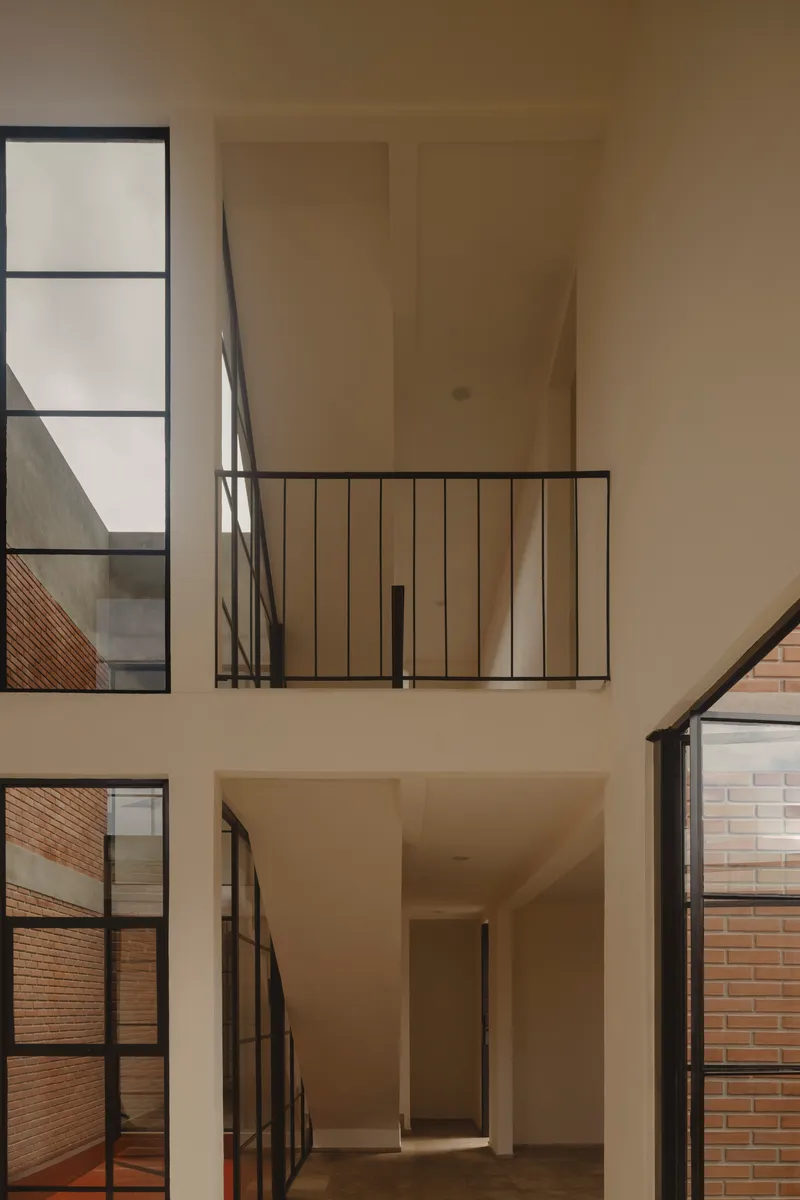
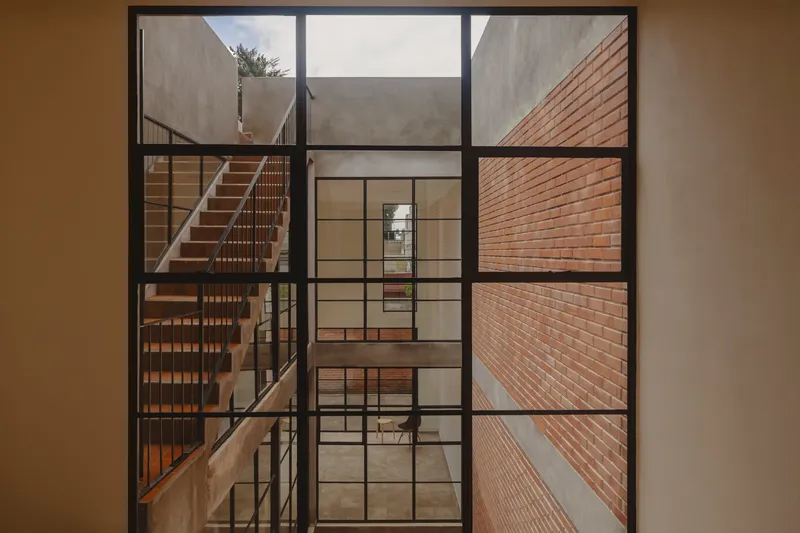
The three courtyards are the real architecture here. The first, at the entrance, is a transitional space that slows you down, pulling you away from the street before admitting you into the house. The second is the one shown most dramatically in the interior shots: a hidden courtyard ringed by interlocking brick and concrete volumes, flooded with diffused daylight from above. It acts as the spatial heart of the house, the room from which all other rooms borrow light and air.
The double-height void shown in image six reveals how the courtyards connect vertically as well as horizontally. Black steel-framed windows and railings define the edges without enclosing them, allowing sightlines to travel diagonally across levels. A timber staircase appears through a framed opening, pulling you deeper into the sequence. The progression from threshold to nucleus to social space is legible even in photographs, which suggests it is even more powerful in person.
Interior Rooms and Calibrated Light
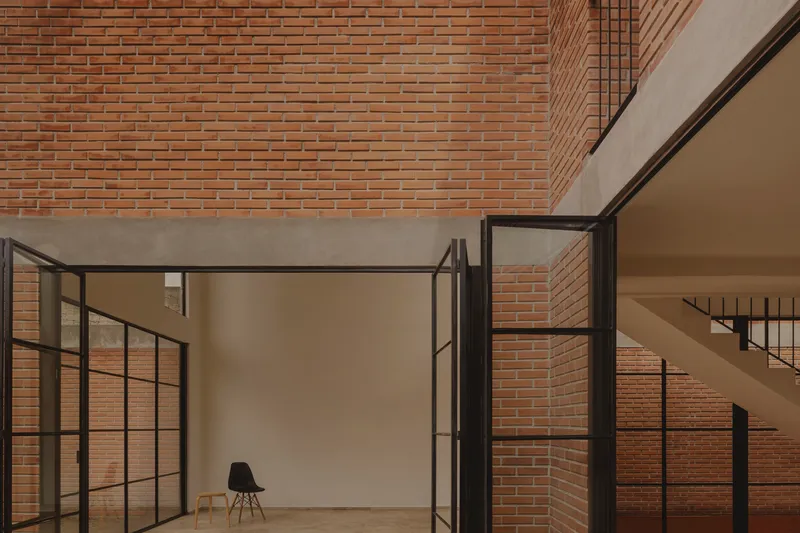

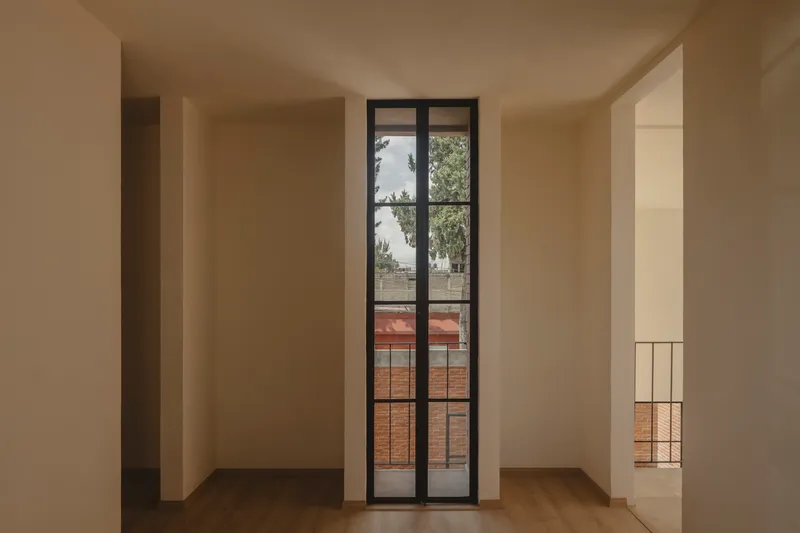
Inside, the palette remains spare. Exposed brick, white plaster, black steel. A single chair against a wall tells you that the rooms are not oversized; they are precisely proportioned to the program of a family home. What elevates them is the quality of light. Steel-framed openings are positioned to cast diagonal shadows across white walls, animating surfaces that would otherwise be static. In image eleven, a tall door opens onto a balcony looking out over tree canopy and brick rooftops, collapsing the boundary between the house and its neighborhood.
The structural engineering by Miguel Ángel Trujano deserves mention. The split levels and staggered floor plates require careful load-path management, particularly where the three bodies connect. Concrete stairs with black metal railings and glass panels thread between levels, maintaining visual continuity through what could easily become a disorienting section. The fact that it all reads as calm and logical is evidence of disciplined coordination between architect and engineer.
The Rooftop and the Horizon
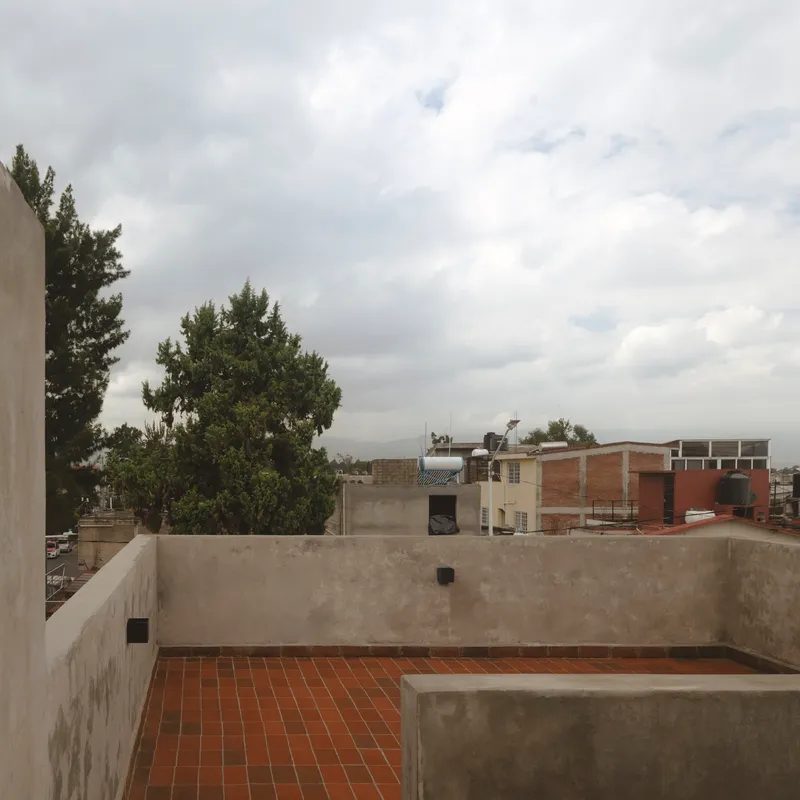
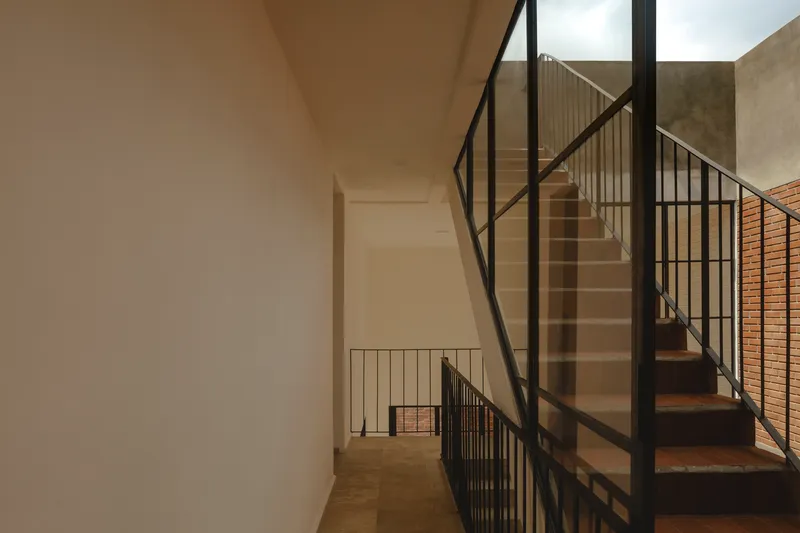
The rooftop terrace, paved in red clay tile and bounded by concrete parapets, is the payoff at the top of the spatial sequence. Under the overcast skies typical of the Valley of Mexico, it becomes an outdoor room that extends the living area upward. The parapet height is generous enough for privacy but low enough to maintain views across the roofscape. In a neighborhood where rooftops are perpetual construction zones, this one is finished, intentional, and usable.
Plans and Drawings
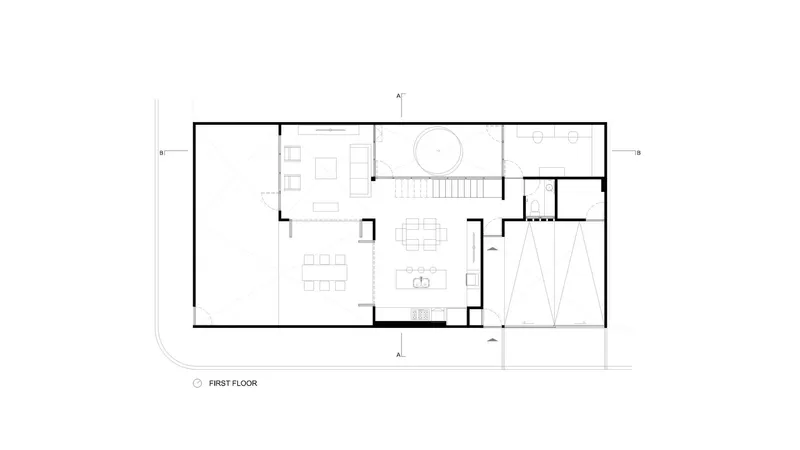
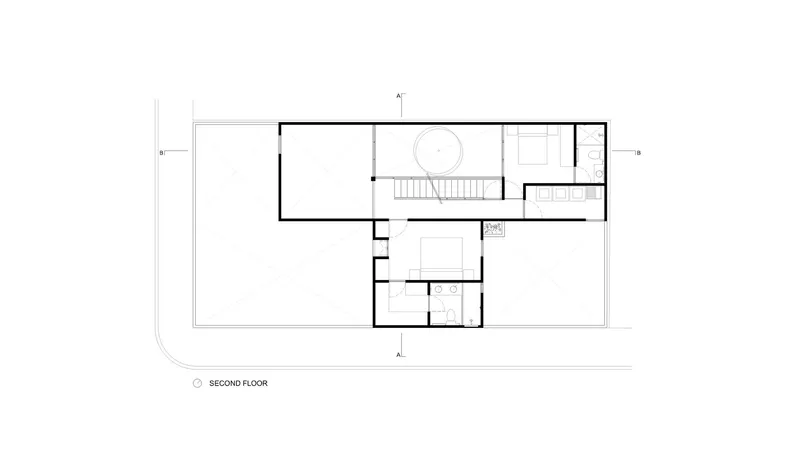
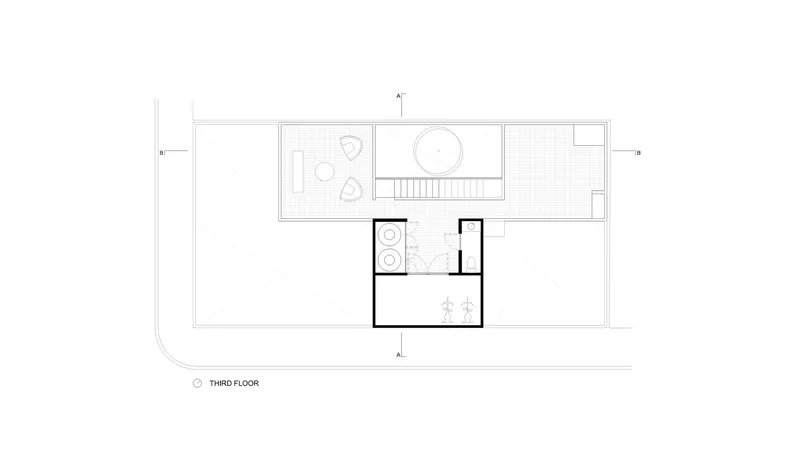


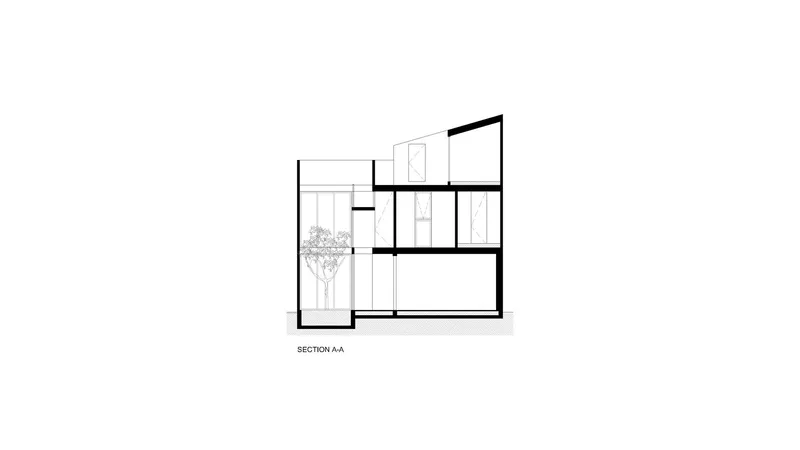
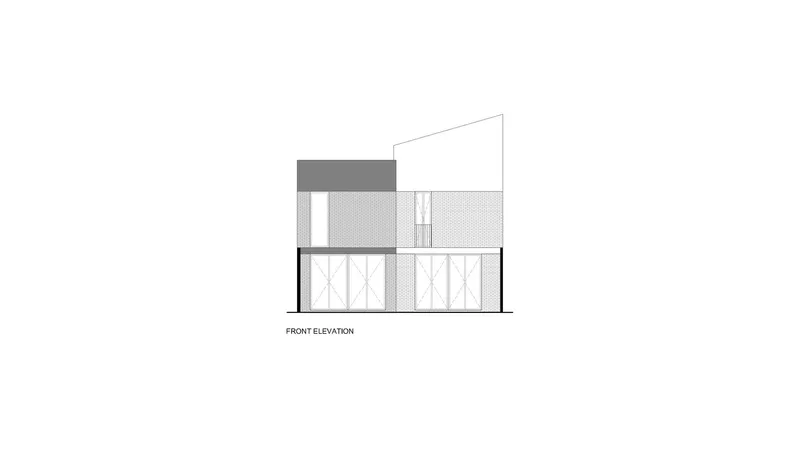
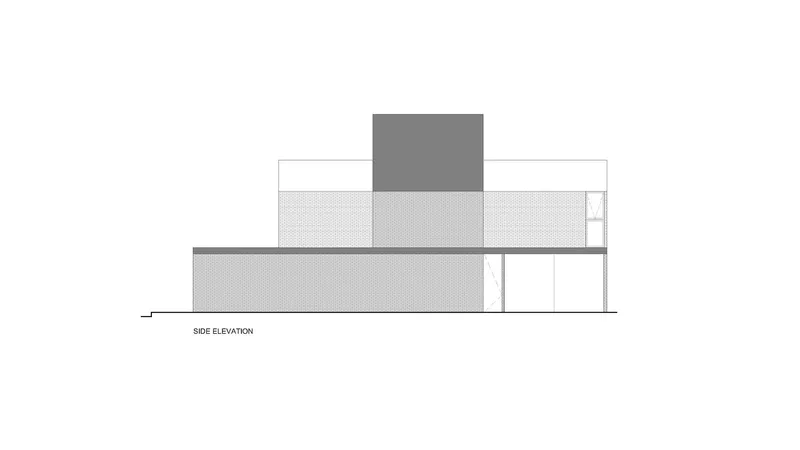


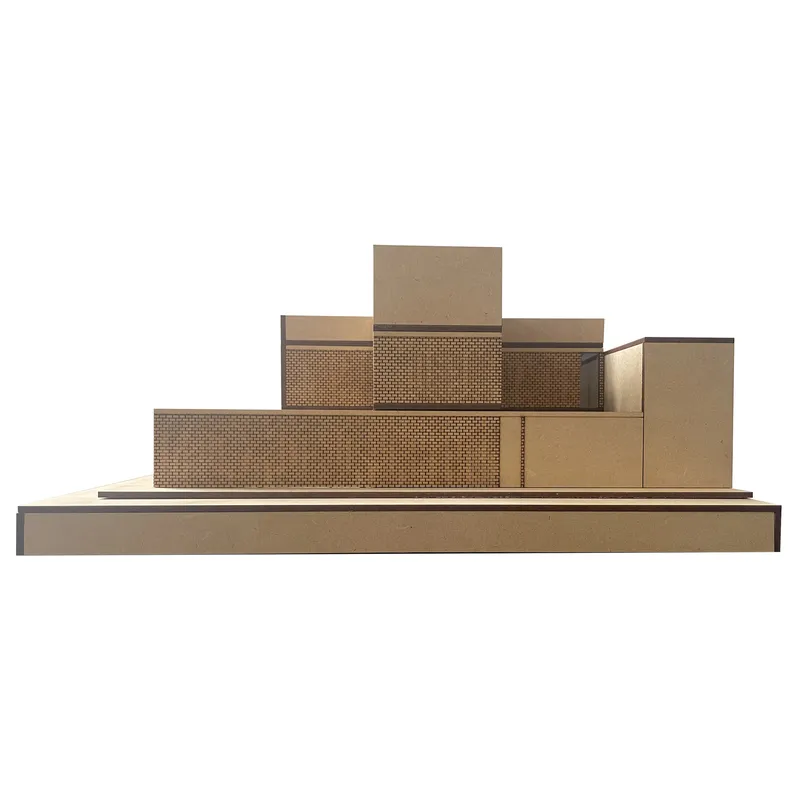
The floor plans confirm what the photographs suggest: a central circular stairwell connects three levels, each organized around the courtyard sequence. The first floor holds open living and dining areas oriented toward the social courtyard. The second floor groups bedrooms around the hidden courtyard, borrowing its light. The third floor is more compact, housing a bathroom and access to the roof terrace. Sections reveal how the split-level strategy creates spatial overlap: you are never more than a half-level away from a courtyard view.
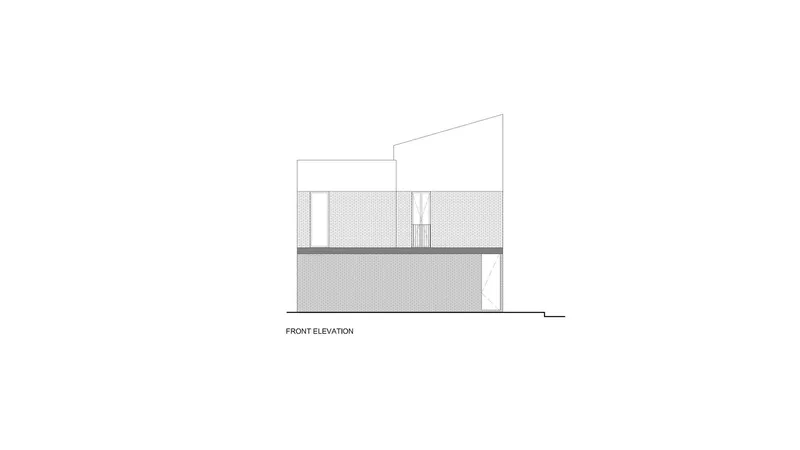
The elevations and axonometric sketch are equally instructive. The front elevations show how different surface treatments, stippled brick versus smooth concrete versus diagrid-patterned glazing, break up the facade into legible components. The exploded axonometric makes the roof geometry visible: pitched planes with diagonal infill and a central skylight that feeds the hidden courtyard below. The physical model, shown in two views, strips the project down to pure massing, making the stepped terrace strategy and the role of perforated screens immediately clear.
Why This Project Matters
Shark House matters because it refuses the two easiest positions available to architects working in informal peripheries: ignore the context and build a glass box, or romanticize the context and build a simulacrum. TALC does neither. The house takes self-construction as a point of departure, absorbing its volumetric logic, its exposed materials, and its incremental massing into a cohesive architectural proposition. The result is a building that belongs to Tláhuac without capitulating to it.
More practically, the courtyard sequence is a model worth replicating. In dense, low-rise urban fabrics where lots are narrow and party walls are the norm, courtyards remain the most effective way to deliver light, air, and spatial generosity. Three courtyards in 180 square meters is ambitious. That each one performs a distinct role in the domestic program, from threshold to light well to gathering space, is what separates a good idea from a resolved project. José Luis Jiménez and TALC have resolved this one thoroughly.
Shark House, designed by TALC, lead architect José Luis Jiménez, structural engineering by Miguel Ángel Trujano. Located in Tláhuac, Mexico. 180 m². Completed in 2025. Photography by Zaickz Moz.
About the Studio
Share Your Own Work on uni.xyz
If projects like this are the kind of work you want to make, uni.xyz is a place to publish your own, find collaborators, and enter design competitions.


Popular Articles
Popular articles from the community

Tsunami Convergenics: Turning Catastrophic Ocean Forces into Underwater Housing Infrastructure
A speculative underwater settlement off the coast of Onagawa, Japan, treats tsunamis and typhoons as energy sources rather than threats.
Temporary Home for Dogs: A Reversed Zoo Rethinks Animal Shelter Architecture
In Bucharest, a sinuous corridor and freed landscape flip the logic of containment, designing a shelter that works to make itself unnecessary.

Faces of the Soviet Avant-Garde: Turning Moscow's Street Names into an Open-Air Museum
A network of sculptural installations across a Moscow residential district transforms forgotten architect names into spatial encounters with cultural memor

Opera on the Sea: Driftwood Logic Shapes a Timber Opera House on Estonia's Coast
Trevor Orgill's opera house translates the entangled drift of floating timber into a civic building where wood, water, and music converge.

Similar Reads
You might also enjoy these articles

Pixel Gardens: One Repeated Module Stacked Into a Terraced Social Housing Tower for Famagusta
Salem Bader's shortlisted housing tower builds a vertical neighbourhood from one repeated module, offsetting units to carve terraces, light and air.

Bao Huynh Watercolor Atelier: A Serene Art Retreat in Hội An
Bao Huynh Watercolor Atelier in Hội An blends multifunctional art spaces, sustainable design, local materials, and family-friendly living in a serene environment.

Atelier Macri Concept Store Interior Design by CASE-REAL
Atelier Macri store features a "ko" counter, walnut wood details, cork displays, blending retail, gallery, and seamless customer experiences.

Manuel Vargas Izquierdo Stadium and High-Performance Sports Center: Architectural Excellence in Jalpa de Méndez
The Manuel Vargas Izquierdo Stadium blends sustainable design, inclusive sports facilities, and cultural-inspired architecture, revitalizing Jalpa de Méndez’s public spaces.


Comments (0)
Please login or sign up to add comments
No comments yet. Be the first to comment!