

Shirakawa-Go Cultural Center: Tectonic Craft as a Strategy for Heritage
A modular facade system drawn from Saori weaving and wood joinery anchors a cultural hub in Japan's UNESCO World Heritage village.


What happens when a building's skin is woven the same way a village weaves cloth? In the mountains of Gifu Prefecture, where Shirakawa-Go's steep-roofed farmhouses have survived centuries of heavy snowfall, a proposed cultural center treats its facade as a kind of loom. Modular panels of wood and concrete stretch open to frame mountain views in communal zones and fold tight for privacy in exhibition galleries. The pattern of light and shadow they cast on interior floors reads like Saori fabric: intentionally imperfect, shaped by the hand that made it.
Designed by Sara AlJaljuli and Habiba Mohamed, the Shirakawa-Go Cultural Center received the Institutional Excellence Award in the Cultural Conserve competition. The project sits within a UNESCO World Heritage village and positions itself as a bridge between secluded local traditions and a global audience, housing exhibition spaces, a library, workshops, a café, and outdoor gathering decks within a cluster of volumes defined by lattice screens and green roofs.
Clustered Volumes Under a Mountain Canopy
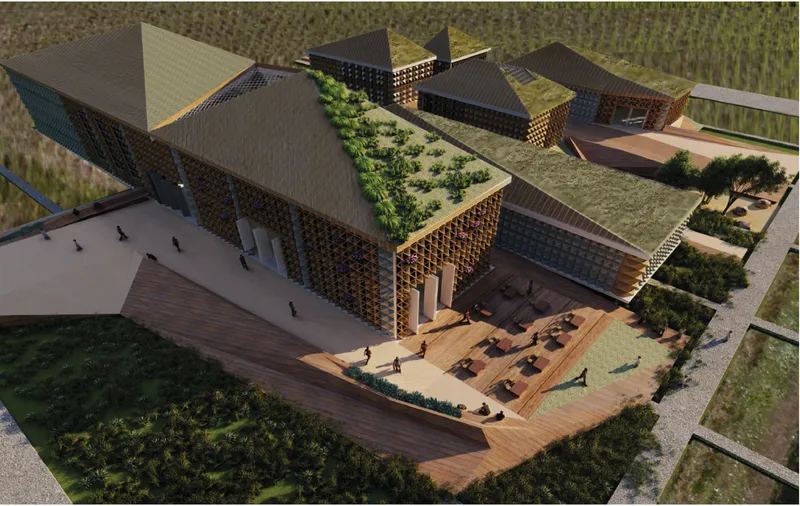
Seen from above, the center reads as a family of low-slung volumes rather than a single monolithic institution. Green roofs soften the footprint, and a terraced outdoor courtyard with seating steps down between buildings, offering multiple points of entry so that local residents and staff can circulate without being funneled through tourist-heavy spaces. The aerial view reveals how the lattice facades wrap each volume differently, their density calibrated to program: open weaves for the workshop and café, tighter screens for gallery zones.
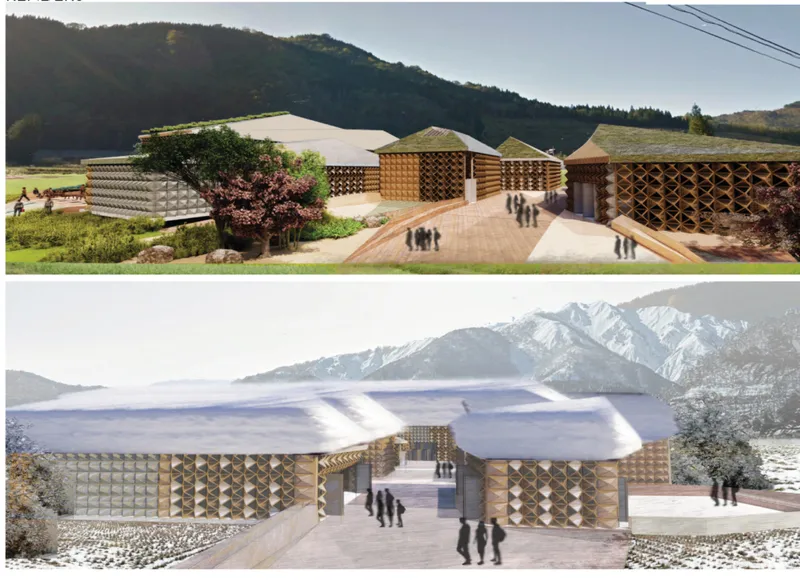
The seasonal elevations show the complex held against the mountain backdrop in summer green and winter white. The building's horizontal profile defers to the surrounding gassho-zukuri farmhouses, never competing with the village's iconic steep rooflines. On-site cast concrete appears at the base of enclosed areas, its surface subtly imprinted with the silhouette of the crafted wall modules above, grounding the lighter timber lattice to the earth.
Filtered Light and the Courtyard as Threshold
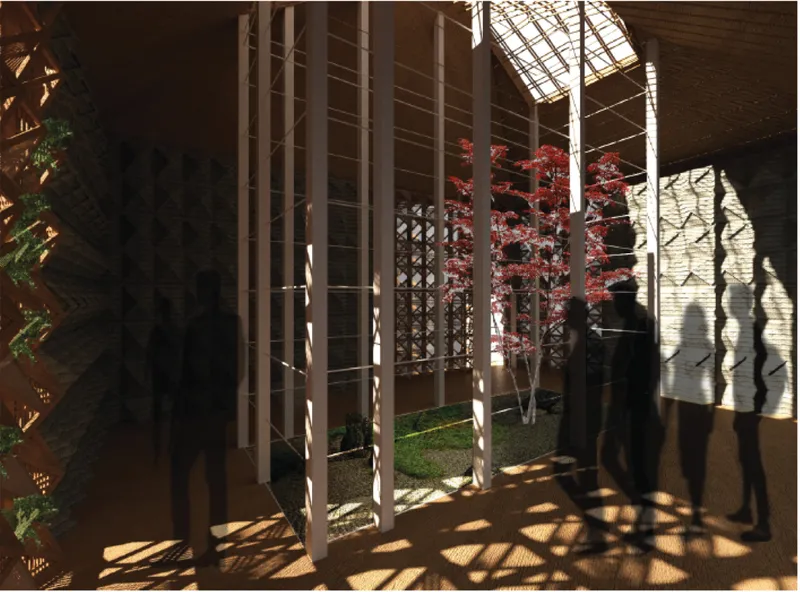
The interior courtyard is arguably the project's most evocative space. Vertical timber slats rise to frame a red maple tree, and afternoon sunlight passes through the gaps to cast rhythmic shadow lines across the ground plane. Visitors move through dappled light as though walking beneath a forest canopy. The effect is spatial and temporal: the patterns shift with the sun's angle, making the courtyard a different room at noon than it is at dusk. This is tectonic expression at its most literal, where the structure itself produces the atmosphere.
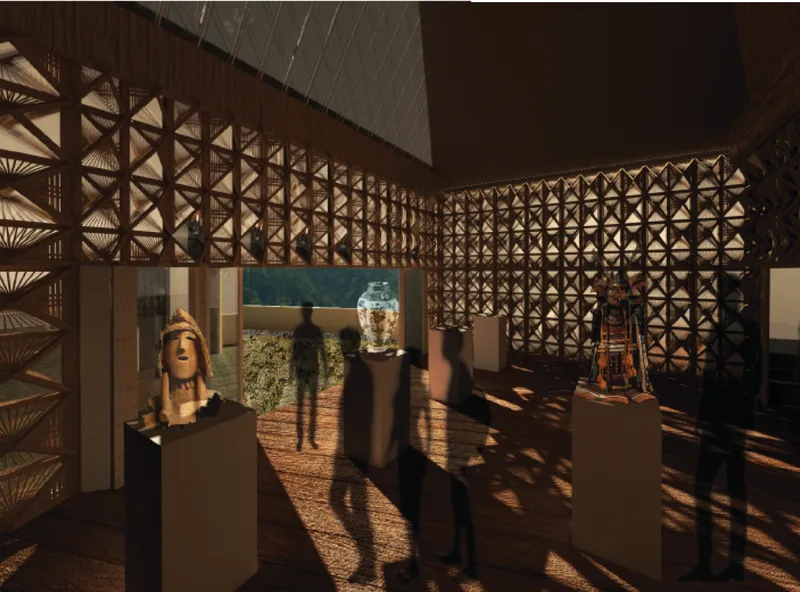
Inside the gallery, the lattice wall reappears at a finer grain. Display cases holding artifacts sit within a field of filtered afternoon light, and the lattice acts as both environmental screen and curatorial frame, directing attention inward while maintaining a visual connection to the landscape beyond. The materials here, shoji paper and wood joinery among them, are not simply displayed in the vitrines; they are embedded in the walls that contain them. The building becomes its own exhibit.
A Reading Room Wrapped in Woven Light
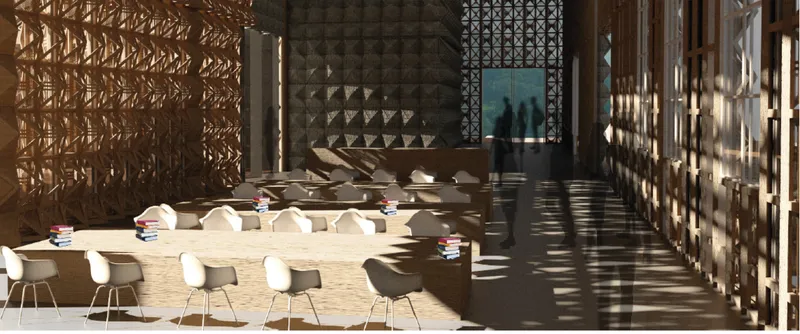
The library and reading room anchor the center's educational program. Long tables and white chairs sit beneath patterned screens that filter daylight along the walls, creating a quiet, evenly lit atmosphere suited to study. The screens reference the same modular logic as the exterior facade, but at a domestic scale: thinner members, tighter rhythm, softer shadows. It is a space designed for prolonged occupation, where the interplay of light and material rewards patience. As an educational portal to village history, the library positions knowledge not behind glass but within a sensory environment shaped by the very crafts it documents.
Four Elevations Against the Mountains
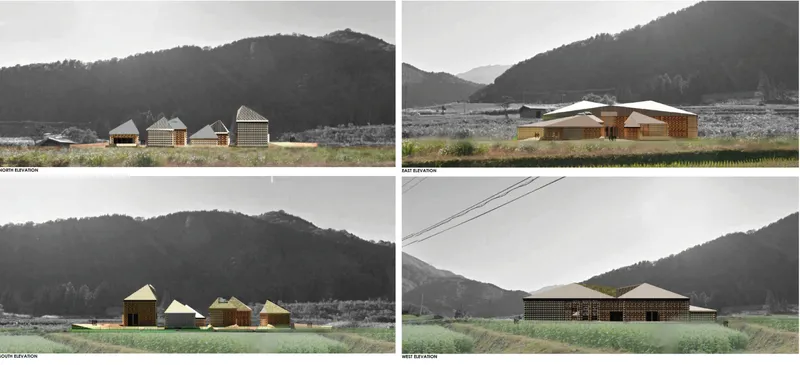
The four elevation drawings confirm how the facade system adapts as it wraps the complex. From one side, the strips open wide to reveal generous glazing; from another, they compress into near-solid surfaces. Varying corridor widths between volumes produce outdoor decks that function as transitional zones, some intimate enough for a conversation between two people, others scaled for communal gathering. The elevations also show how locally sourced wood dominates the material palette, with concrete appearing only where structural stability in enclosed zones demands it. The result is a building that looks different from every cardinal direction, yet holds together through a single tectonic logic.
Why This Project Matters
Cultural centers in heritage villages face a persistent dilemma: how to serve tourism without turning a living community into a museum. AlJaljuli and Mohamed address this by designing a building that generates local employment through the use of traditional building techniques and locally sourced materials, actively countering the urban migration that threatens small mountain villages. Multiple entry points and a strategically placed admin core ensure that residents access workspaces and the library without navigating tourist circuits. The architecture serves two publics without privileging one over the other.
More broadly, the project reframes tectonic expression as a cultural strategy rather than a formal exercise. The facade is not decorative; it performs environmental work (controlling sun, ventilation, and privacy) while encoding craft traditions (Saori weaving, shoji paper, wood joinery) into the very skin of the building. Visitors experience Shirakawa-Go's heritage not through signage but through the quality of light on their hands, the rhythm of shadow on the floor, the texture of a wall panel assembled by a local carpenter. That is preservation operating at the scale of atmosphere, and it is a model worth studying.
View the Full Project
About the Designers
Designers: Sara AlJaljuli, Habiba Mohamed
Enter a Design Competition on uni.xyz
uni.xyz runs architecture and design competitions year-round that reward proposals with spatial conviction and real site intelligence.
Project credits: tectonic variation by Sara AlJaljuli, Habiba Mohamed Cultural Conserve (uni.xyz).


Popular Articles
Popular articles from the community


Juan García Correa, John González and Claudia Rueda Sink a Circular Amphitheater into a Manizales Engineering Building
On the La Nubia campus in Manizales, Colombia, the S1 Building folds labs and offices into a hillside of ramped lawns that double as a campus route.

David Ortega Stacks a Two-Story Mexico City Penthouse Around a Steel Stair and a Pergola-Shaded Roof Terrace
In Colonia Roma, a 300 m² penthouse uses oak joinery, a planted steel stair and a slatted roof pergola to make a new-build apartment feel like a house.

GROUP A Strips a 1969 Rotterdam Harbor Headquarters to Its Frame and Wraps It in Timber Louvers
In Rotterdam's M4H harbor district, Ferro Offices reuses a 1969 frame, adds one timber storey and reaches BREEAM-NL Outstanding.

longwave studio Reorganizes a 112 m² Tainan Apartment Around the Daily Routines of a Family and Two Cats
In Tainan, Taiwan, birch plywood, rust-red furniture and a freestanding plaster wall link arrival, storage, work and family life in one apartment.

Similar Reads
You might also enjoy these articles

Gil Mello Arquitetura Tilts a Single Roof Toward the Waterfalls on a Plateau Above Aiuruoca, Brazil
In Aiuruoca, Minas Gerais, a 200 m² house of local labor and reclaimed poles pairs a low valley veranda with a tall mountain one.

U.GA Architects Wraps an Oval Rooftop Pool in Curved Board-Formed Concrete on Busan's Jeollidan-gil
In Busan's Jeonpo-dong, a 454 m² mixed-use block stacks a neighborhood facility, guest rooms and an oval rooftop pool inside spiraling concrete walls.

Felipe Hess Arquitetos Turns a Blind Stone Wall to the Street and Opens a Brazilian House onto a Courtyard and Canal
A canal-front house in Brazil hides behind painted stone and planting, then opens to an olive-tree courtyard, a reed-ceilinged porch and a curving pool.

David Macias Steps a Doorless Stone and Plaster House Down a Tropical Colombian Hillside
In the humid hills of Colombia, Threshold House replaces the front door with an open void and terraces its 850 m² down the slope instead of fighting it.

Explore Cultural Architecture Competitions
Discover active competitions in this discipline

Challenge to reimagine the Iron Throne

Photograph architecture without architects

Illustrate the lost glory of Angkor Wat - Render Challenge

Bring back Drive In's
Comments (0)
Please login or sign up to add comments
No comments yet. Be the first to comment!