
Tens Atelier and FANAF Turn a 1970s Chinese Village Auditorium into a Stone-Oven Bakery
A Cold War-era rural hall in Shaoxing's bamboo-covered mountains becomes a communal bread workshop with a six-meter kiln at its heart.


There is a particular category of adaptive reuse that earns its complexity not from the building itself but from the distance between what a structure once meant and what it is being asked to become. In the western mountains of Shangwang Village, Shaoxing, a rural auditorium built in the 1970s to support the diplomatic staging around Nixon's visit to China has been quietly reborn as a stone-oven bakery and restaurant. The building sat among bamboo groves and farmlands for decades, a relic of collectivist assembly, until the bread brand Cycle&Cycle acquired its usage rights in 2022 and set about giving it a second life.
What makes the project genuinely interesting is the collaboration between two studios and the layered timeline of decision-making. FANAF handled the initial renovation and reconstruction of the shell, while Tens Atelier took over the interior redesign when the brief pivoted in 2025 from a general renovation to a dedicated rural stone-kiln workshop. The result is a 420 m² open hall that refuses partitions, instead organizing itself around a single monumental gesture: a stone oven rising roughly six meters from floor to ceiling, its brass-clad chimney punching through the timber-lined roof like a secular altar.
A Building Among Bamboo
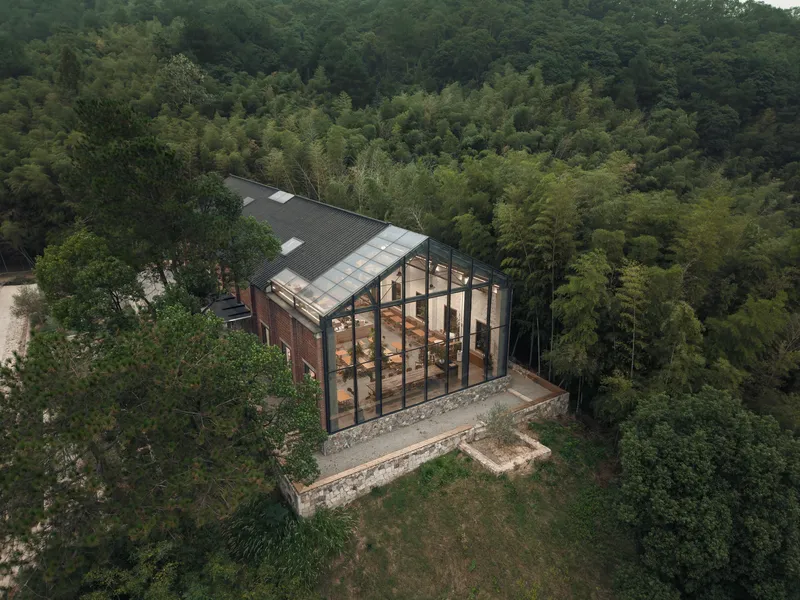
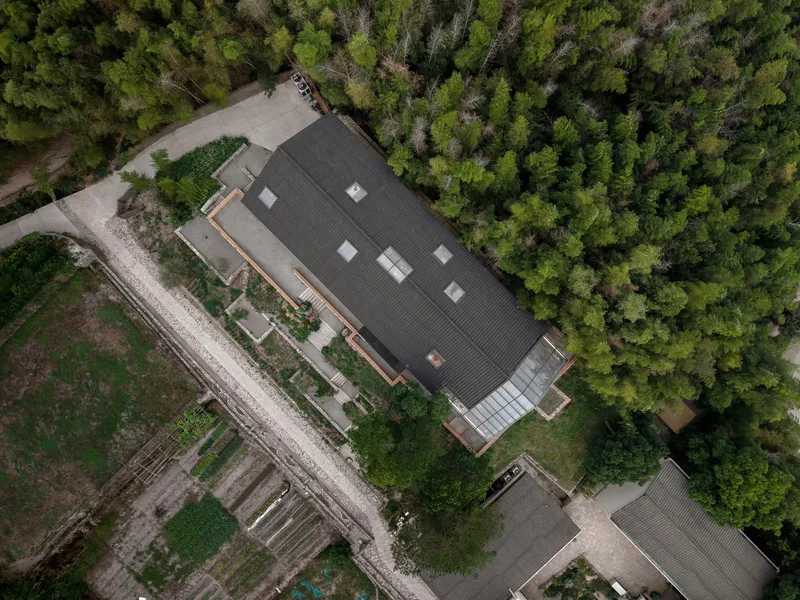
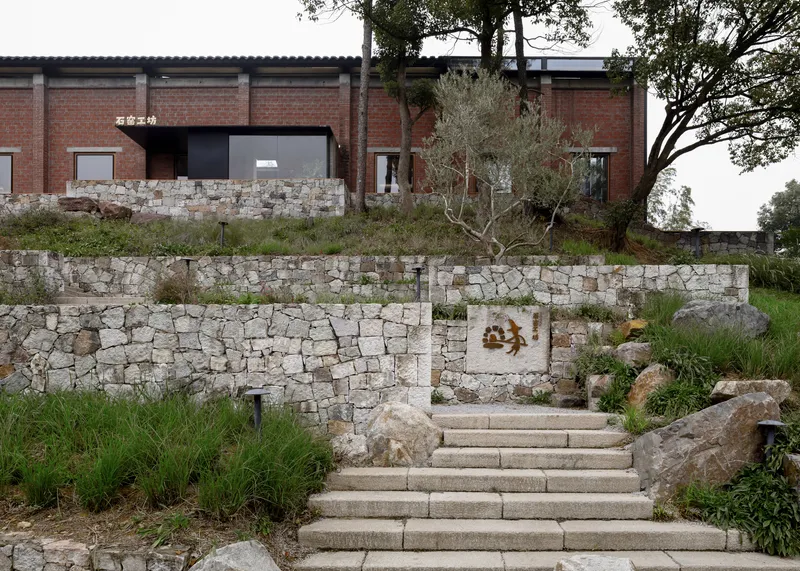
The aerial views reveal just how thoroughly this building disappears into its context. The dark corrugated metal roof, punctuated by a grid of skylights, reads almost as a clearing in the forest canopy rather than an architectural imposition. Dense bamboo and mixed broadleaf trees press in from three sides, while dry-stone retaining walls and rough stone steps establish the approach, signaling a terrain-first attitude to site design. You climb to reach the bakery, and the ascent through terraced walls built from local stone functions as a decompression chamber between village life and the interior world.
The east facade is the deliberate exception to this embeddedness: a full glass curtain wall that opens up to the village and the mountain range beyond. The other three facades use brick walls with carefully placed timber-framed window openings, balancing privacy with glimpses of the surrounding bamboo forest. It is a directional building, one that hides on three sides and reveals on the fourth.
The Six-Meter Kiln as Spatial Anchor
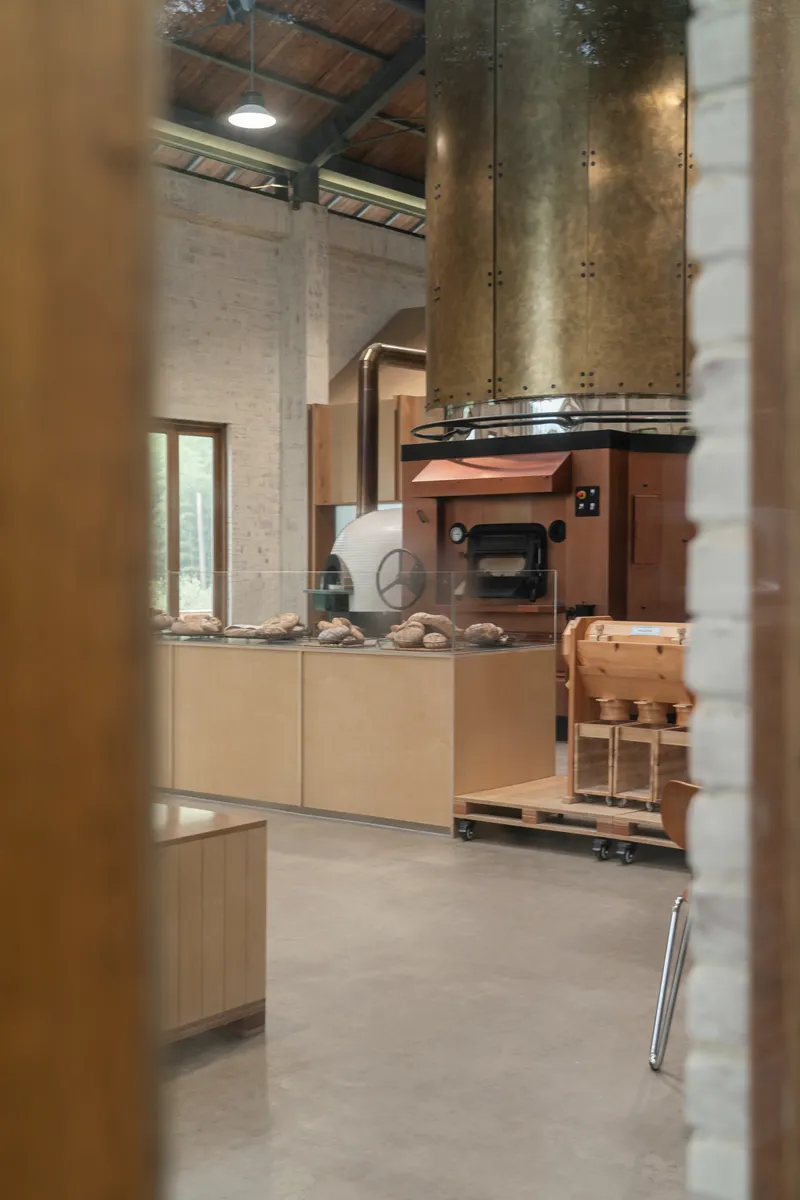
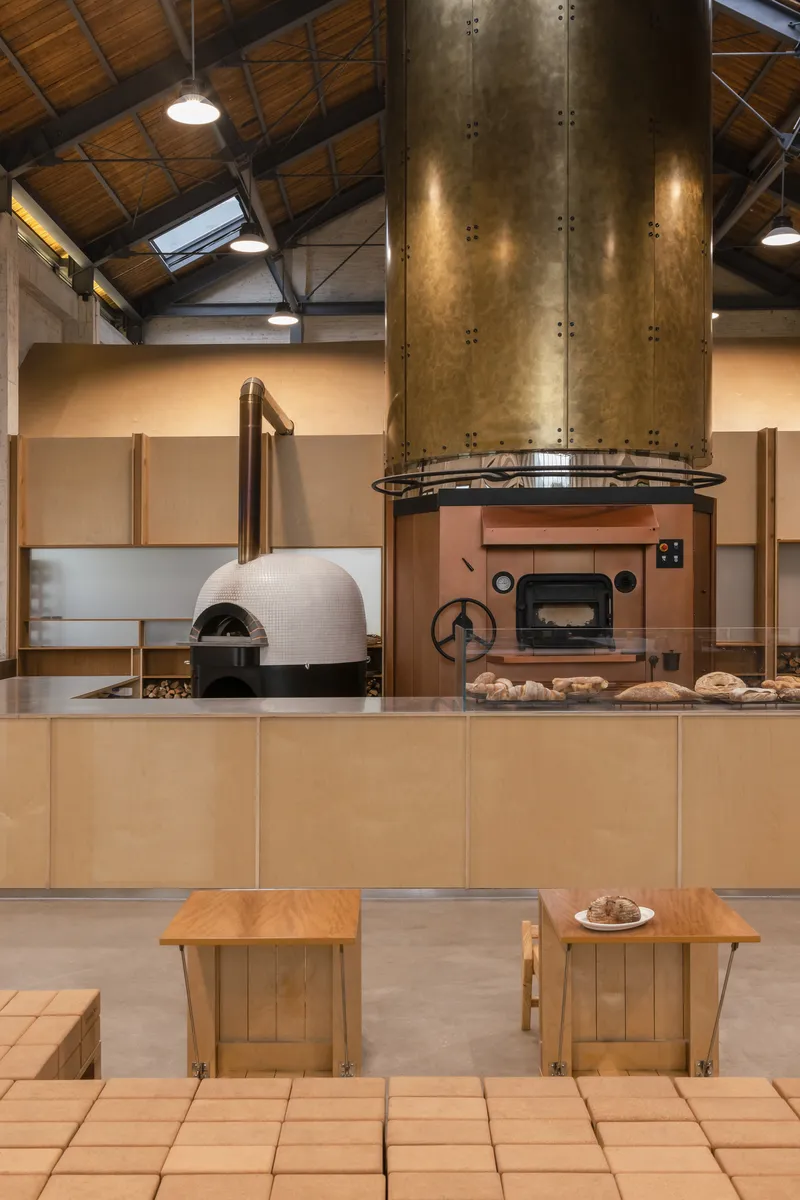
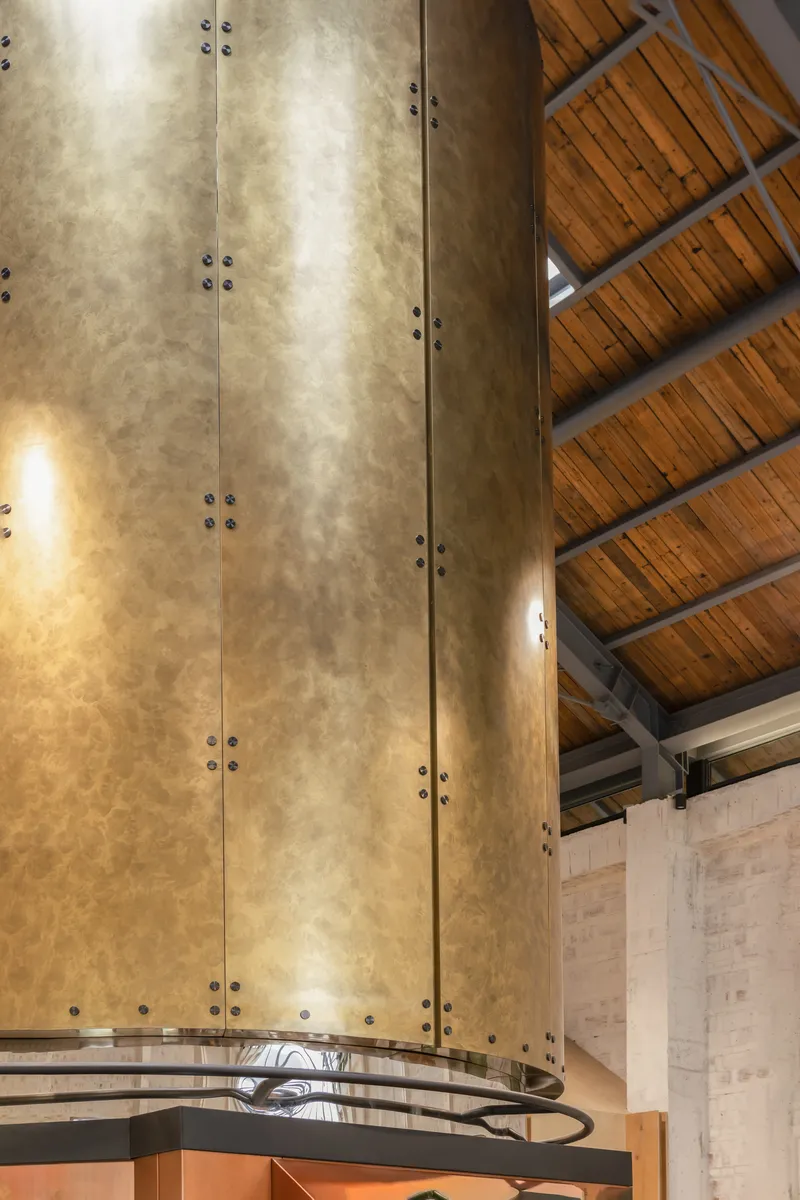
The client's stated ambition was to return bread to its rural roots while producing kiln-baked loaves at the highest possible standard. That intention finds its most literal expression in the stone oven itself, a white-tiled dome paired with a copper deck oven, both vented through a brass chimney flue that becomes the room's vertical spine. At approximately six meters, the flue extends from the working bakery counter through the full height of the timber ceiling, visible from nearly every seat in the house.
This is not decorative. The oven is doing real work, and the chimney's brass cladding, complete with exposed bolts and patinated seams, telegraphs function rather than ornament. What Tens Atelier understands here is that in a partition-free space, the focal point has to earn its centrality through program. The kiln is both the productive heart and the spatial organizer, the thing around which communal tables, bread displays, and the coffee counter orbit.
Timber, Brick, and the Question of Rusticity
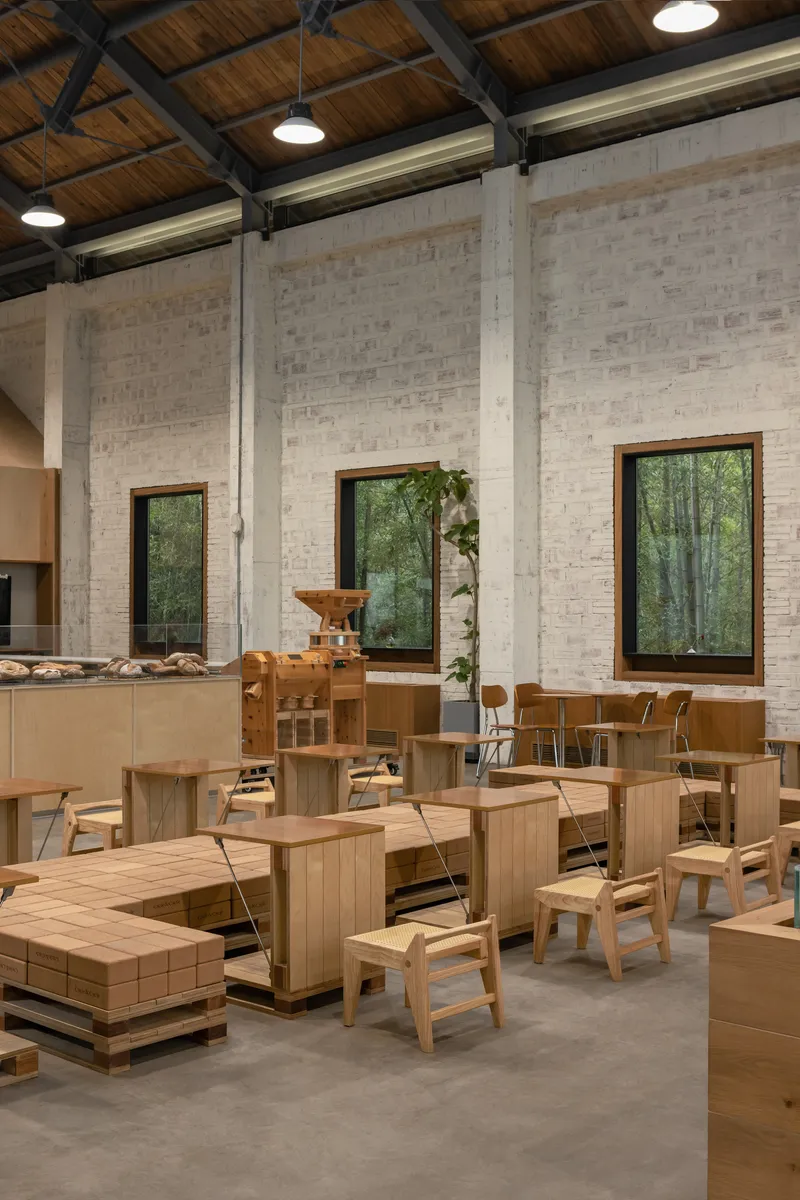
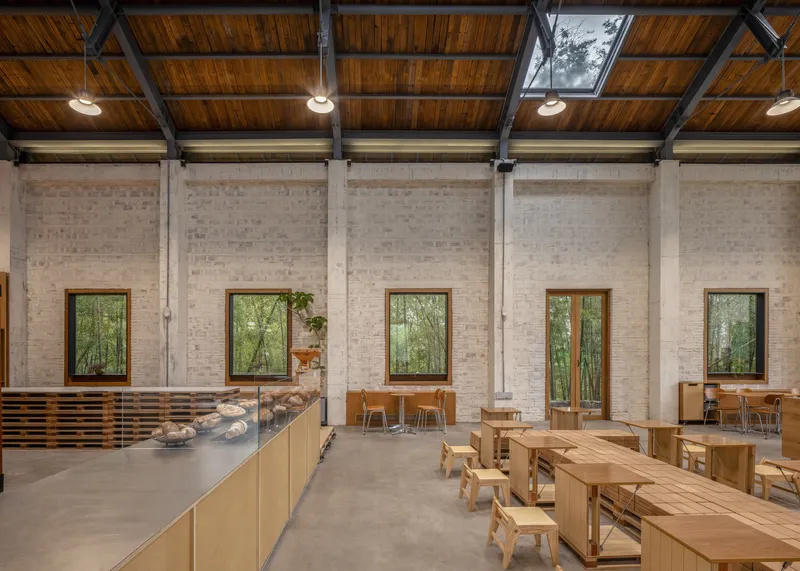
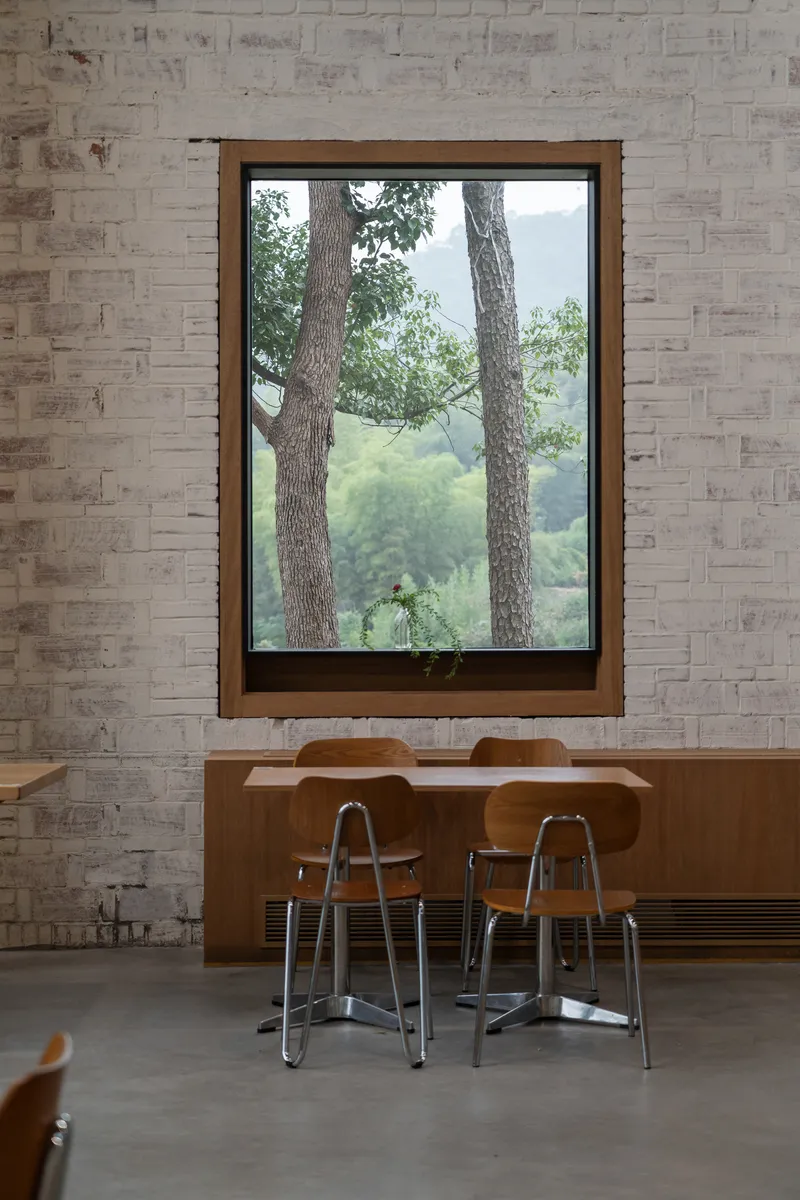
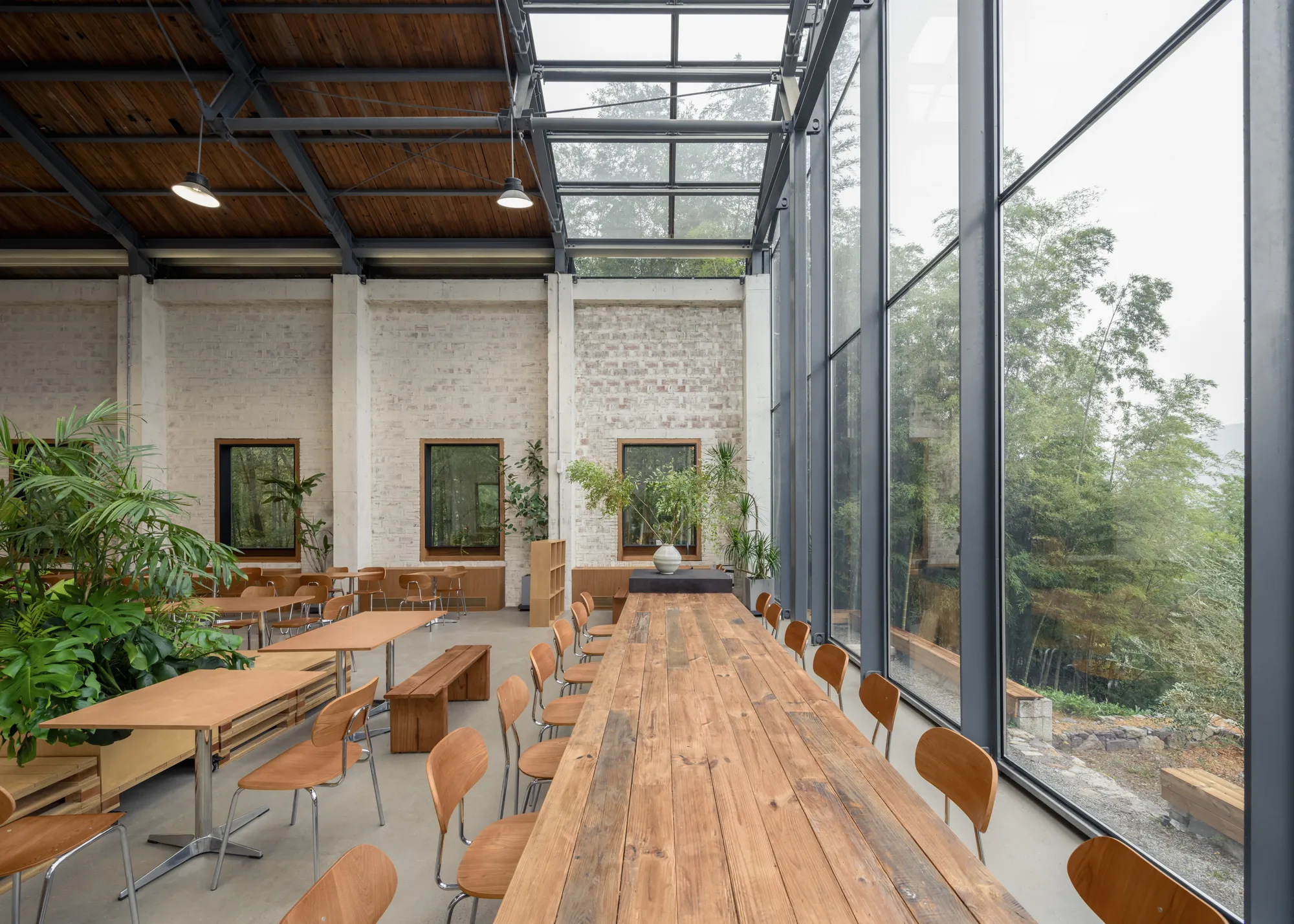
The interior palette is remarkably restrained: whitewashed pale brick, timber-planked ceilings, exposed steel trusses, and polished concrete floors. Early in the project, the team attempted to recycle old furniture and waste wood combined with bamboo for on-site construction, a genuinely ambitious material strategy that ultimately proved too costly and difficult to implement at scale. What replaced it was a more standardized approach, materials processed on site, that still reads as honest and rough without tipping into contrived rusticity.
The brick walls deserve particular attention. They are not accent surfaces but structural enclosures, their texture and color varying subtly depending on light conditions. The timber-framed windows set into these walls feel appropriately agricultural, more barn than boutique. Afternoon light filtering through them onto the concrete floor creates the kind of warmth that no designer can fully control but that good material choices make possible.
The Open Hall and Its Civic Memory
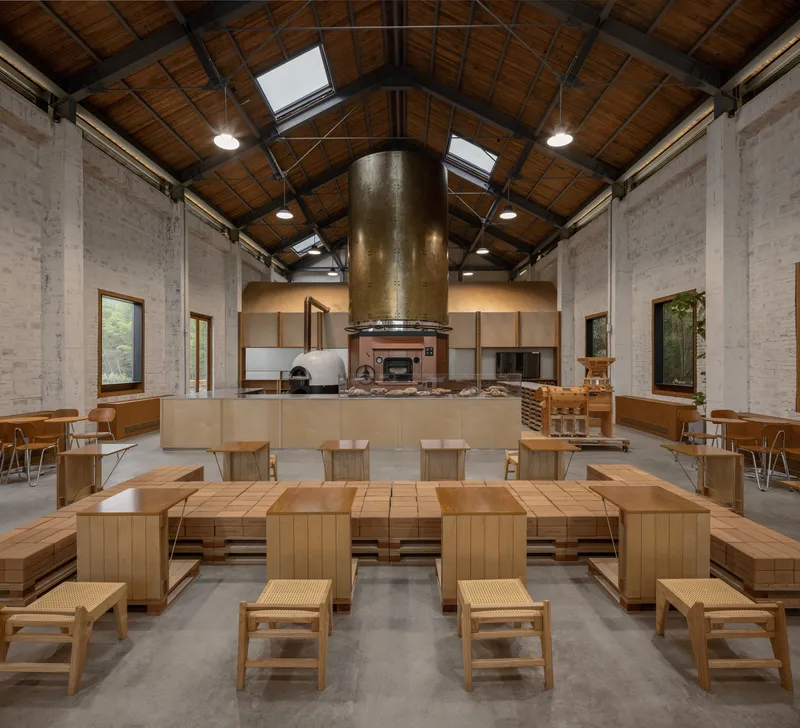
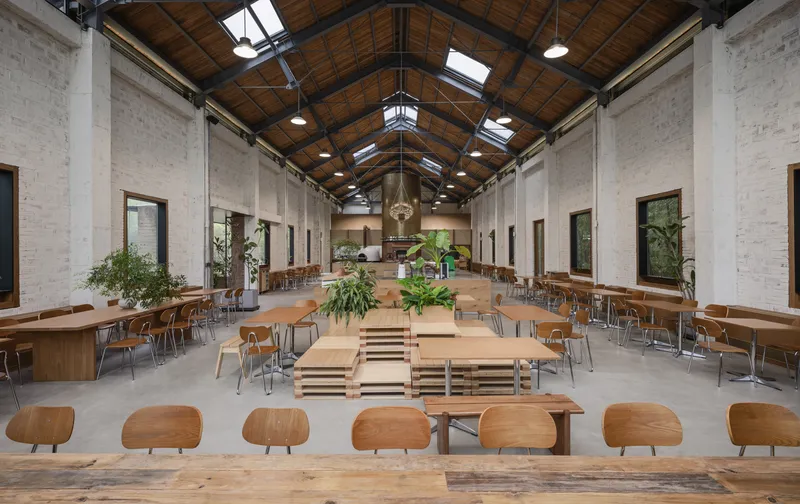
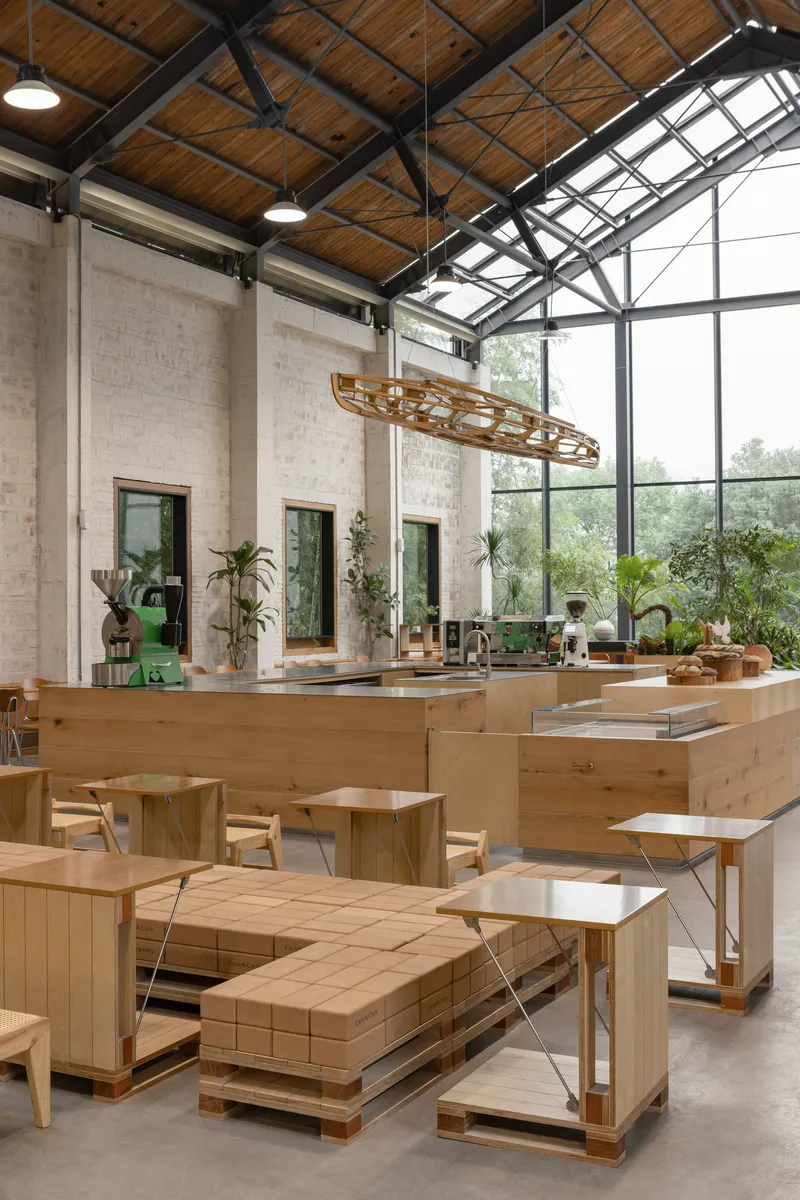
The decision to keep the interior entirely free of partitions is not just a spatial preference. It is a direct inheritance from the building's original program as a village auditorium, a gathering hall designed for collective presence. By preserving that openness and filling it with long communal tables, Tens Atelier effectively re-presents the memory of assembly while redirecting its purpose. Where villagers once gathered for political meetings, they now gather for bread and coffee. The shift is democratic in both eras, and the architecture acknowledges this continuity rather than erasing it.
The exposed steel roof trusses, combined with the concrete frame, support the long-span space that an auditorium requires and a bakery restaurant benefits from. Pendant lights hang from the trusses at varying heights, breaking the volume into zones of intimacy without physical barriers. Potted trees and hanging greenery provide additional softness, blurring the line between the bamboo forest outside and the dining hall within.
The Glass Gable and the Landscape Frame
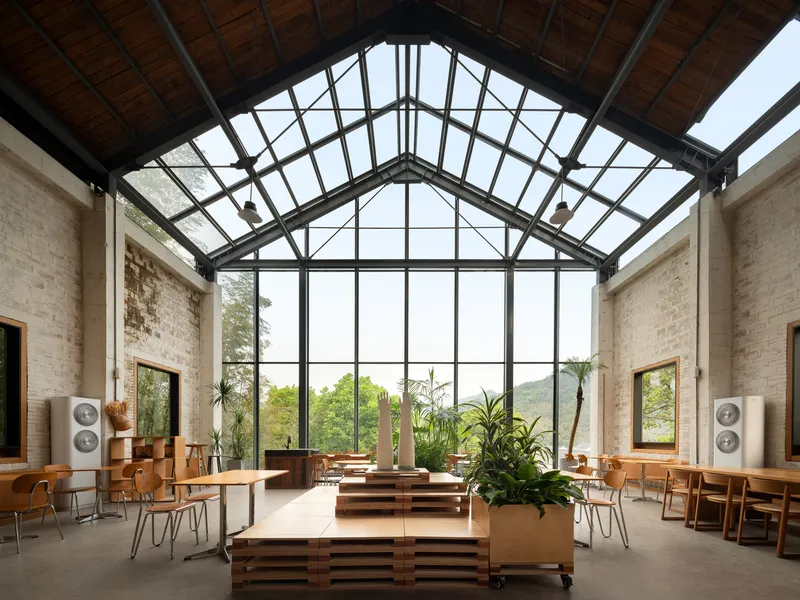
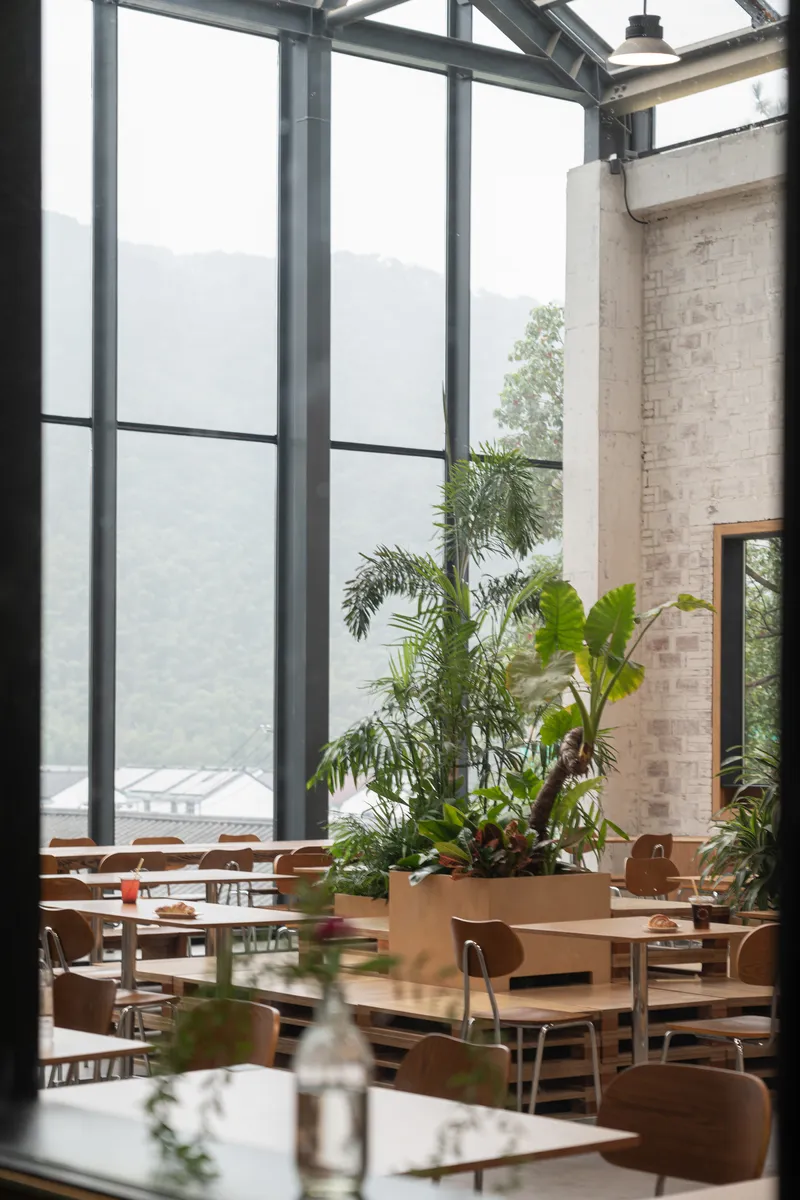
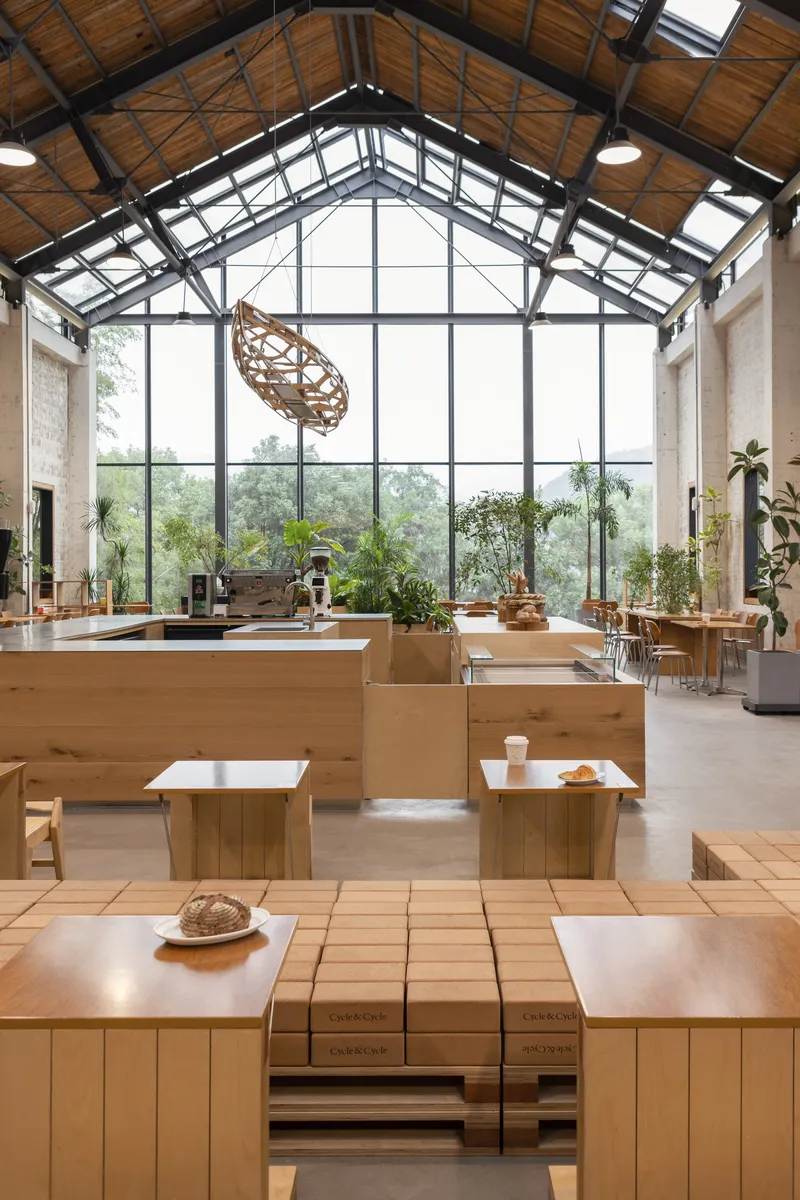
The east-facing glazed gable end is the building's most theatrical element: a full-height steel-framed window wall that frames the surrounding hills like a landscape painting you happen to be dining inside. At dusk, the relationship inverts, and the interior glows outward, visible from the village below as a lantern in the hillside. The steel frame's proportions are deliberately slender, minimizing visual interruption between interior and terrain.
A suspended timber sculpture hangs in front of this glass wall, a piece that reads somewhere between art installation and functional screen. Planted beds along the window line soften the threshold between polished concrete and wild mountainside. One image captures a cat resting on a bench beside a gridded window overlooking misty hills, and it tells you more about the atmosphere of this place than any rendering could.
Details That Accumulate
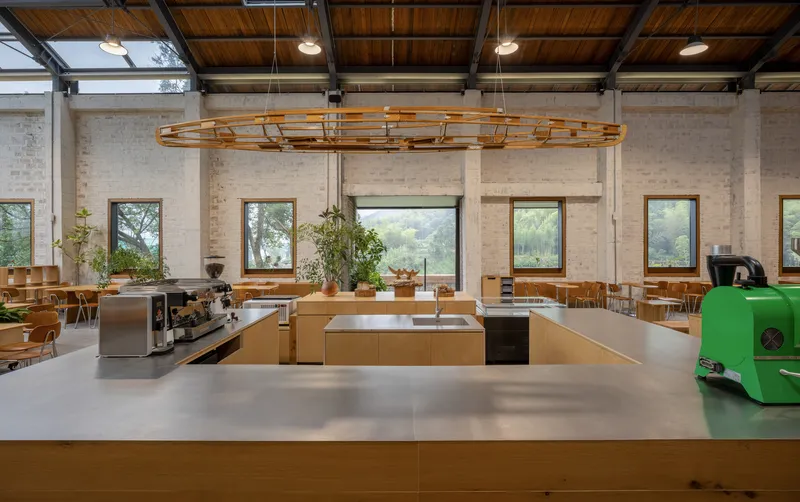
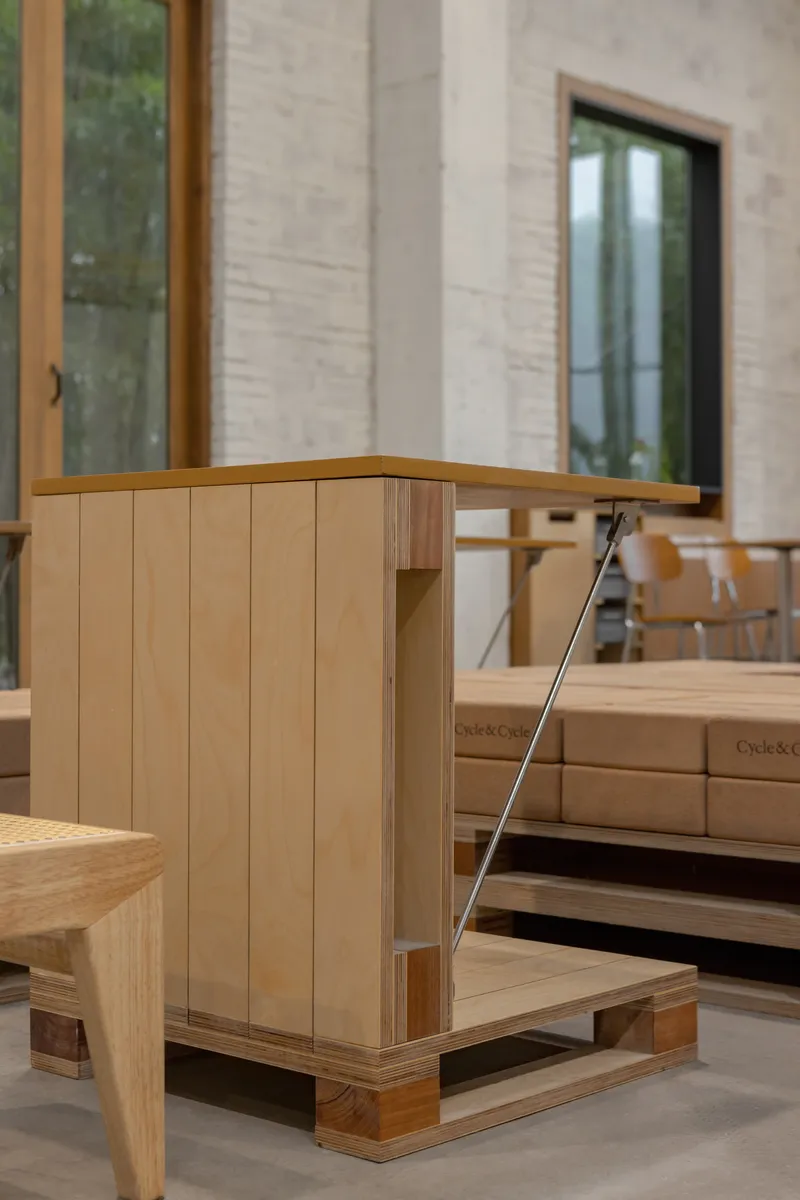
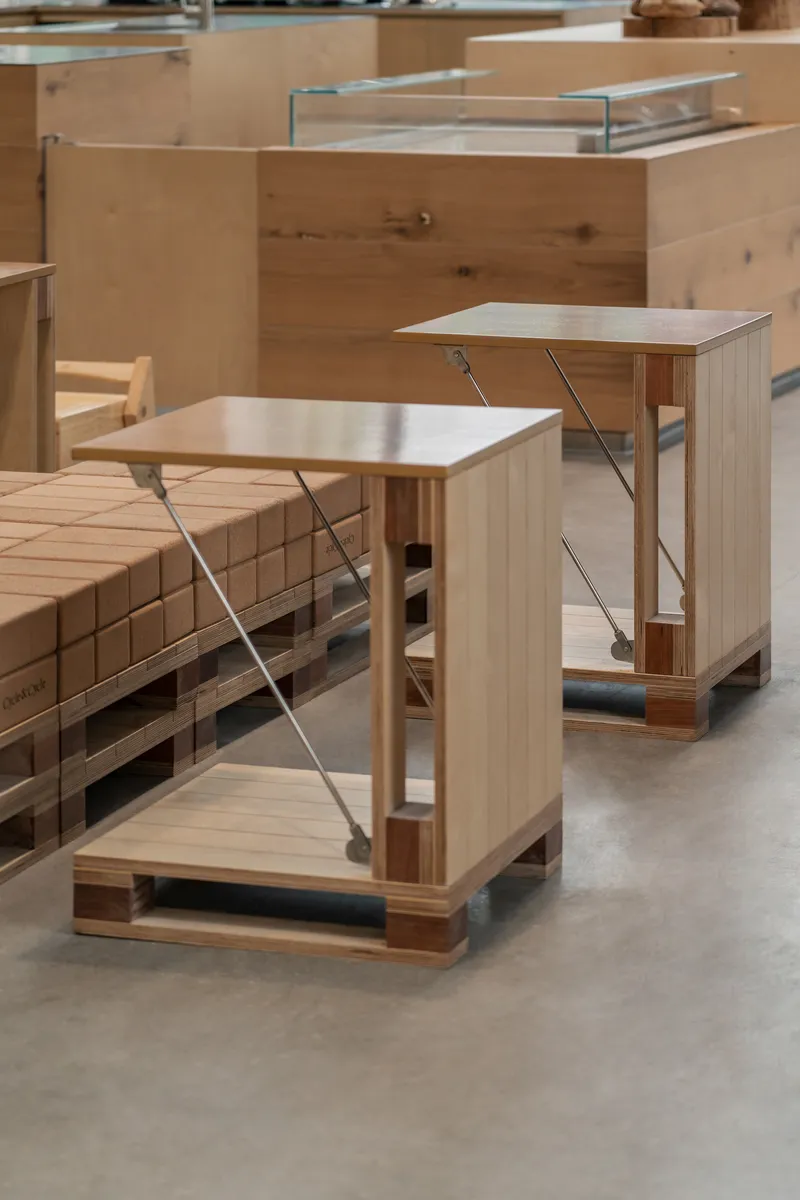
The coffee counter with its suspended timber lattice frame and overhead skylights operates as a secondary spatial event, a smaller-scale version of the kiln's verticality. Timber display cabinets with vertical slat cladding and glass-topped plinths with steel cable bracing serve the retail program without cluttering the open plan. These are carefully considered objects, not afterthoughts, and their industrial-agricultural character aligns with the overall material language.
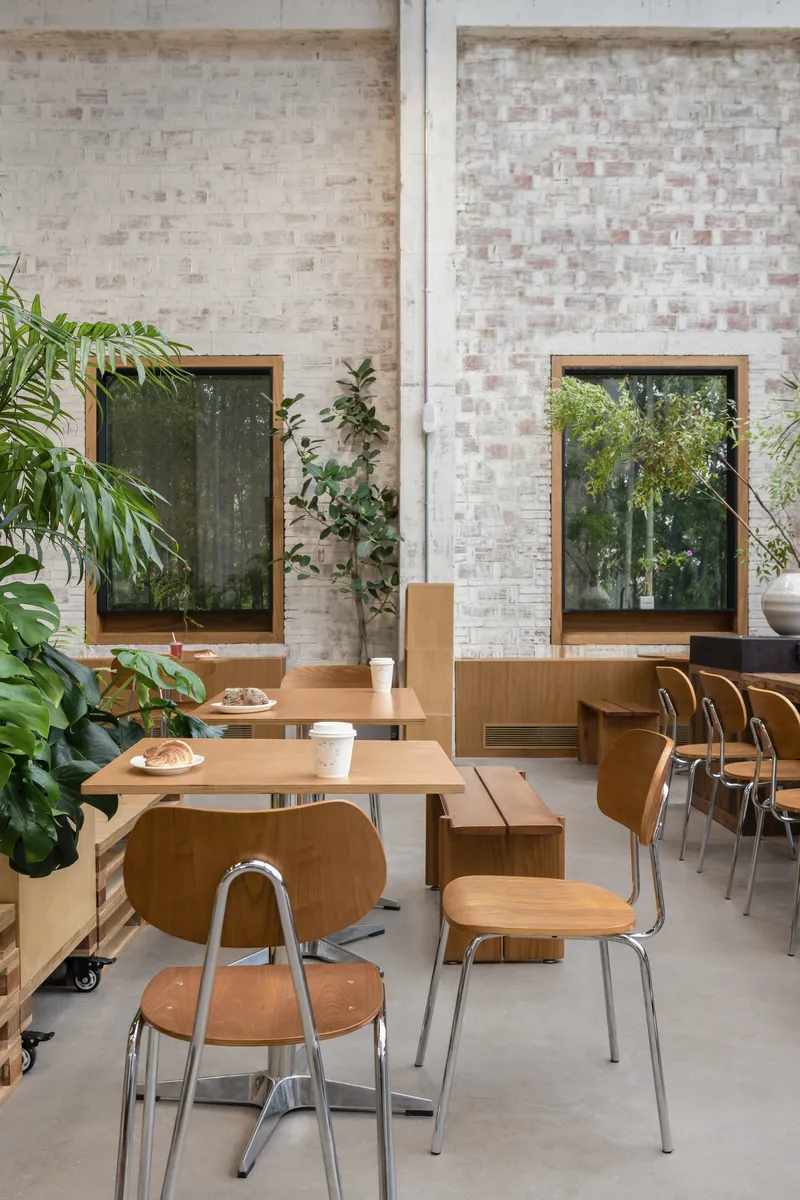
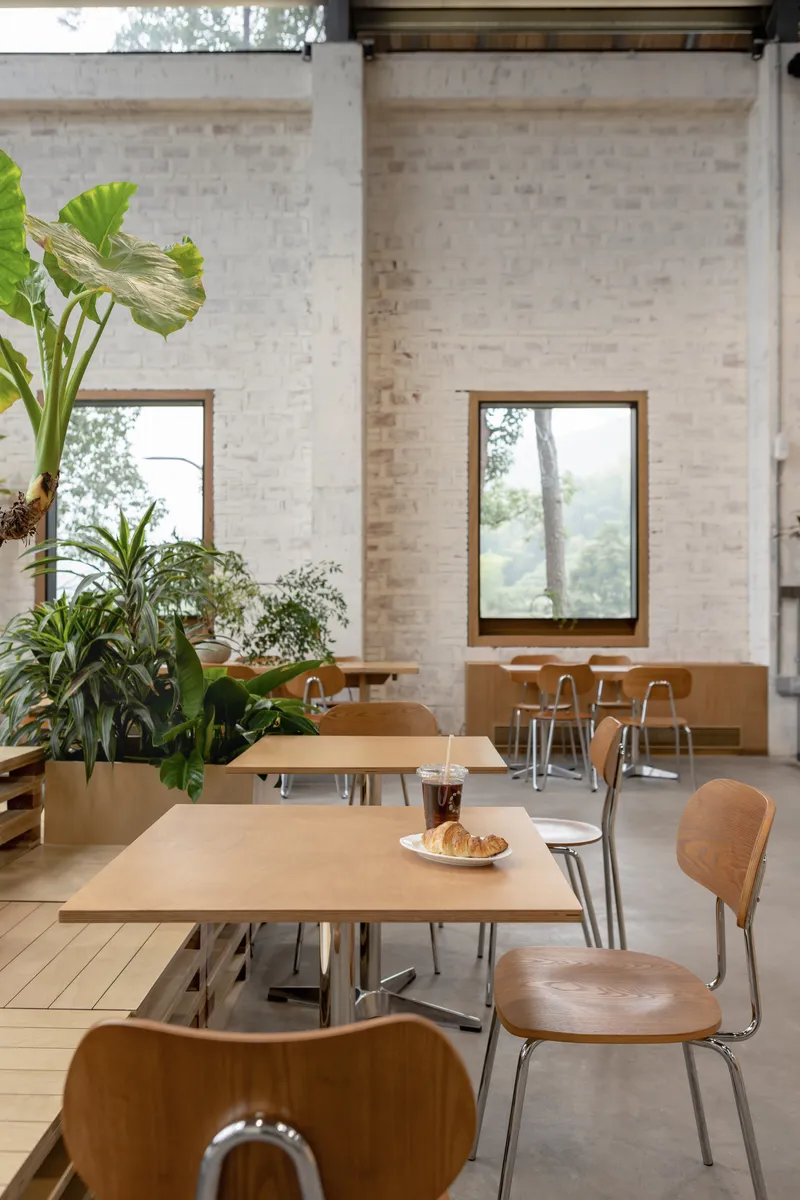
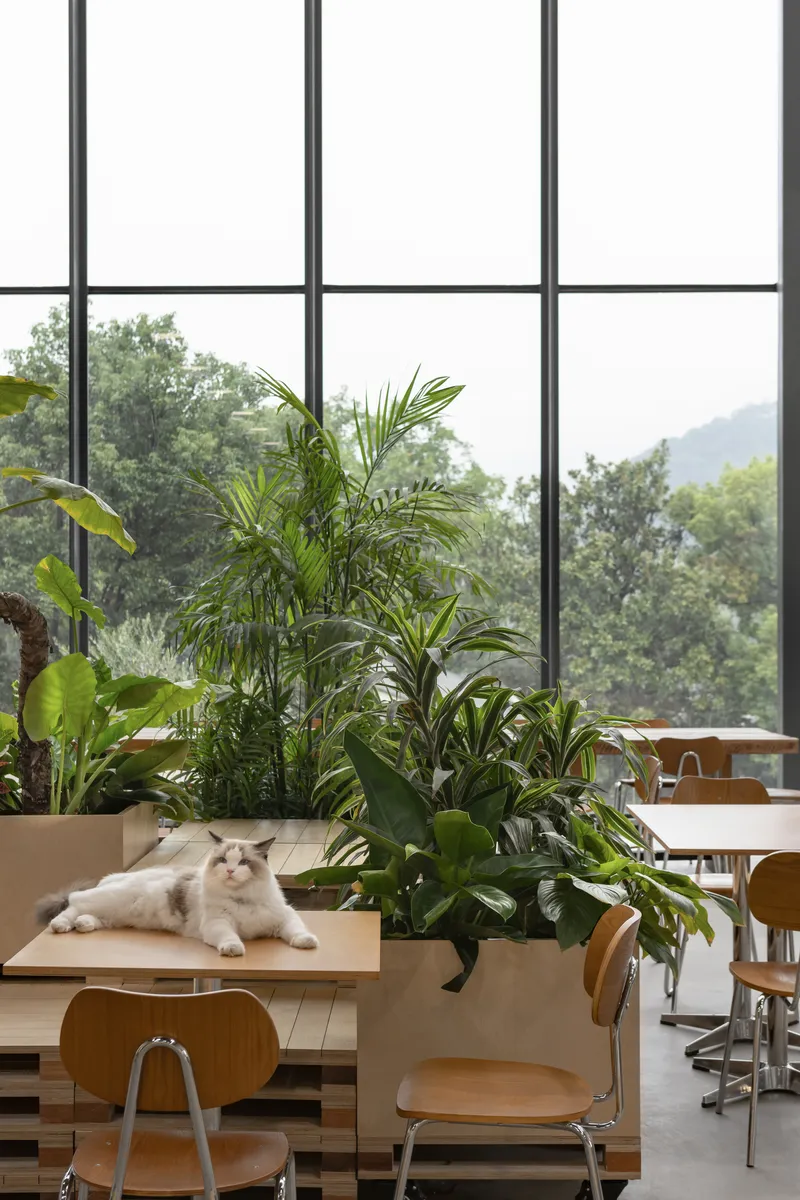
The movable wooden tables, the metal stools, the terracotta tile flooring in certain zones: each element reinforces the sense that this is a working space rather than a curated showroom. Plants appear frequently but never in a gratuitous way. They are positioned where the architecture needs biological softness, near hard brick surfaces and at transitions between interior and exterior. The dining furniture is robust enough to survive heavy daily use, which is exactly right for a bakery that takes its craft seriously.
Structure and Light
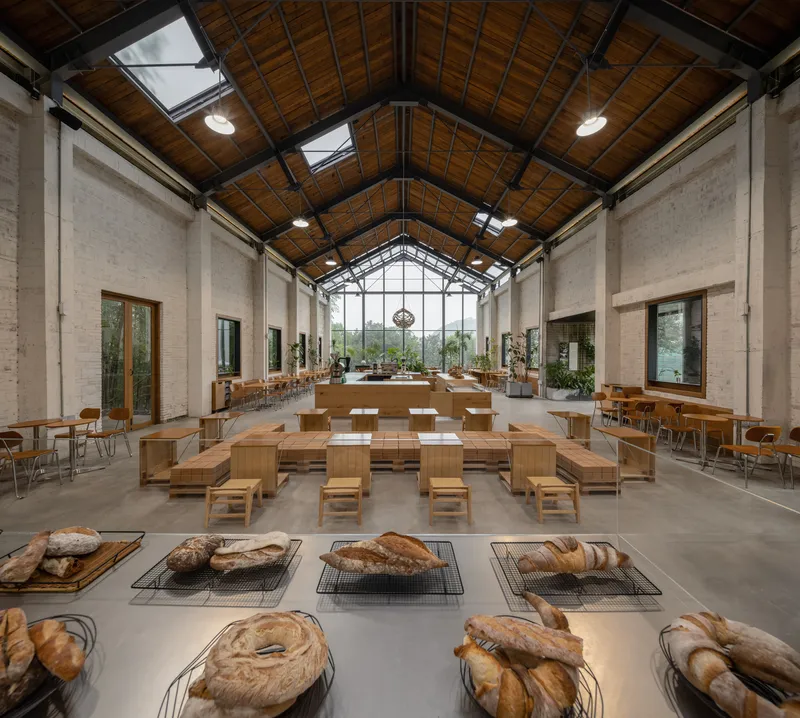
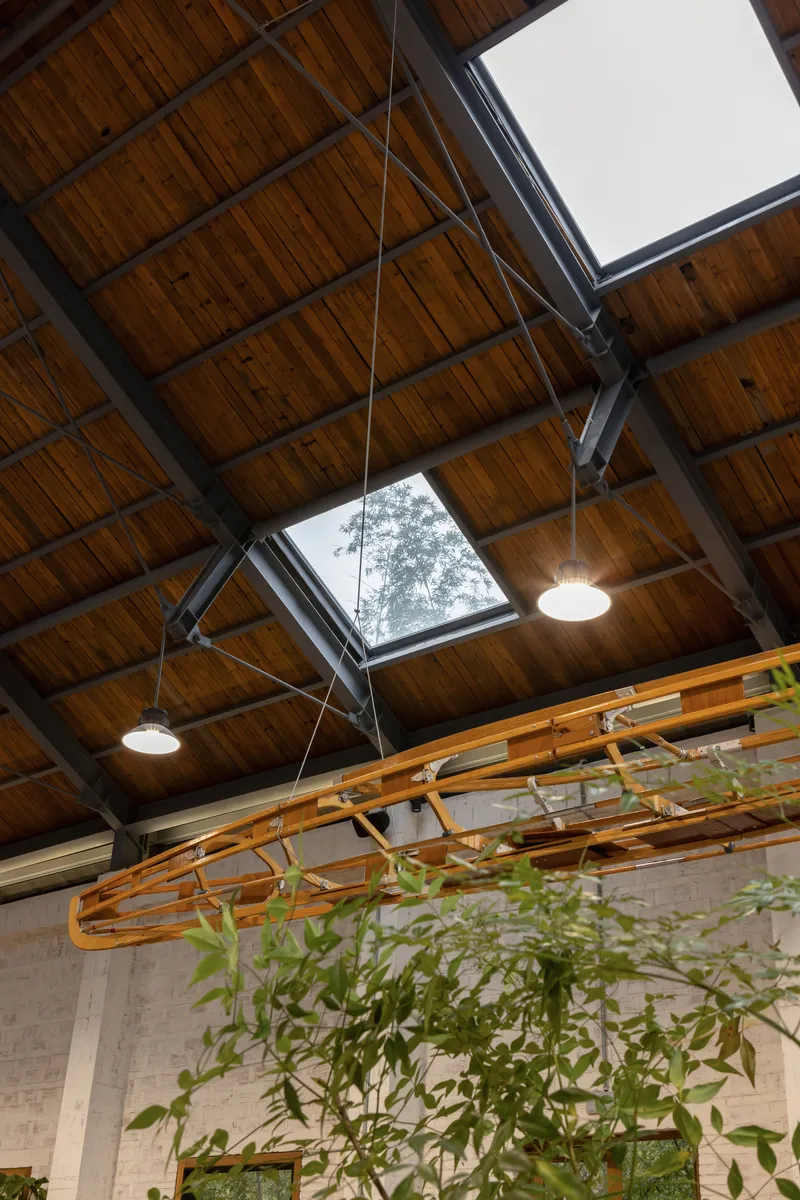
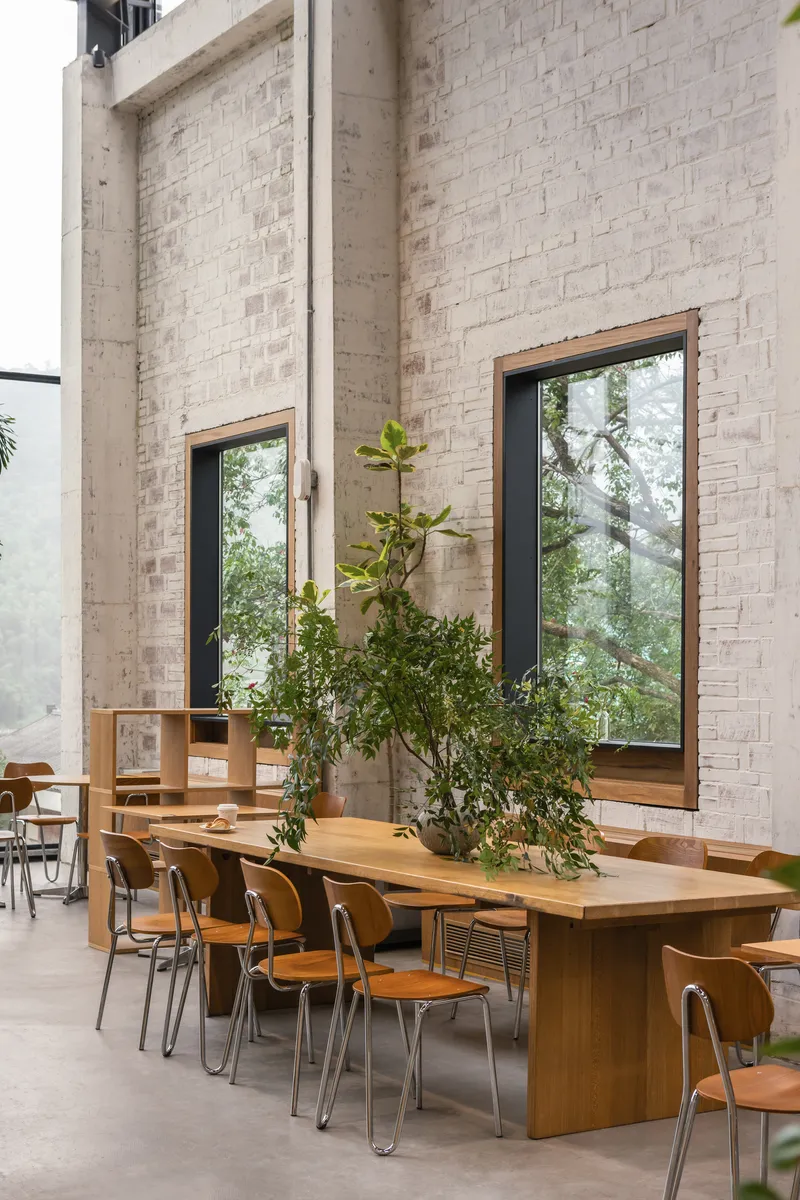
The timber-planked ceiling is the project's fifth facade, the surface you look up at while waiting for your bread. Exposed steel beams march across it at regular intervals, and skylights punch through at strategic points to wash the interior with diffused daylight. The combination of steel and timber at the roof level is honest about the hybrid structural system: concrete frames carry the walls and floor loads, while steel trusses handle the long-span roof. Neither material pretends to be the other.
In the double-height bakery area, painted brick walls rise to meet tall windows, and the resulting volume feels genuinely generous without being wasteful. Rows of baked bread visible in the foreground of one image confirm that this is an operational kitchen, not an architectural conceit. The smell of bread must be extraordinary here, and that is a dimension no photograph can capture but that the spatial openness makes possible: scent travels freely when there are no walls to stop it.
Plans and Drawings
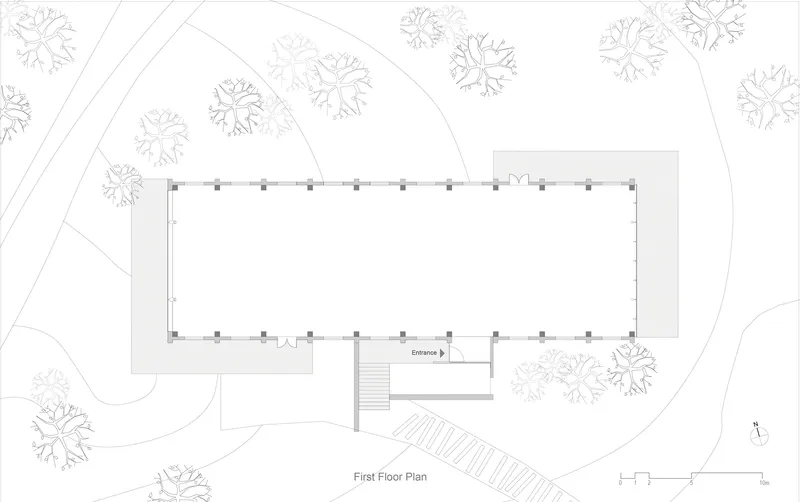
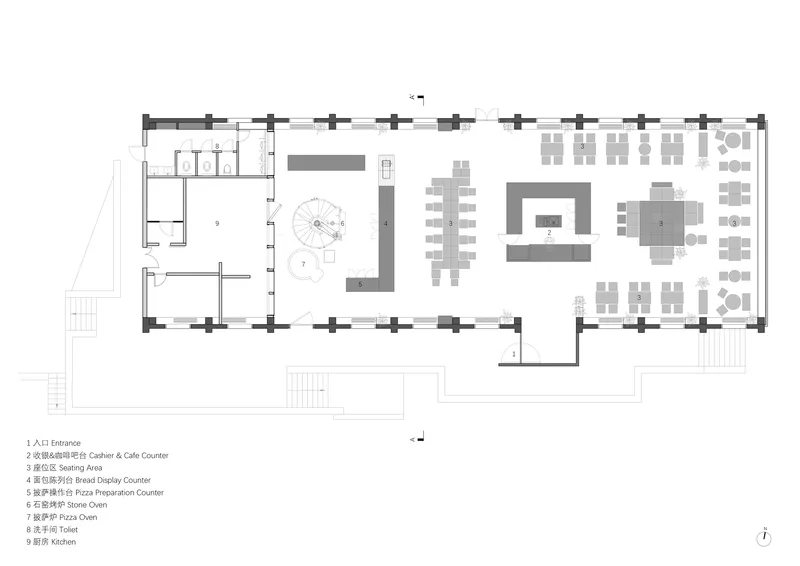
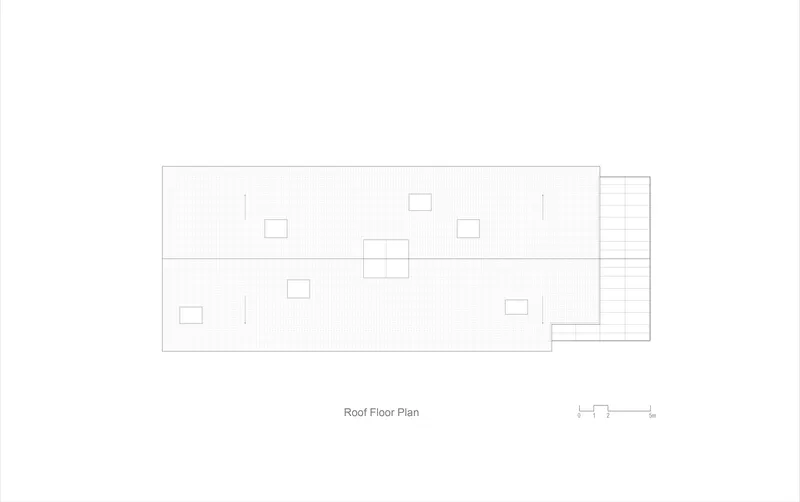
The site plan confirms the building's strategic isolation: a single rectangular footprint surrounded by dense tree cover, approached by a stepped path from below. The floor plan reveals just how committed the design is to openness. Seating areas, kitchen, and service zones occupy a single continuous volume with minimal internal walls. The roof plan shows the skylight strategy clearly, with multiple openings distributed across the rectangular volume to ensure even daylighting throughout the long hall.
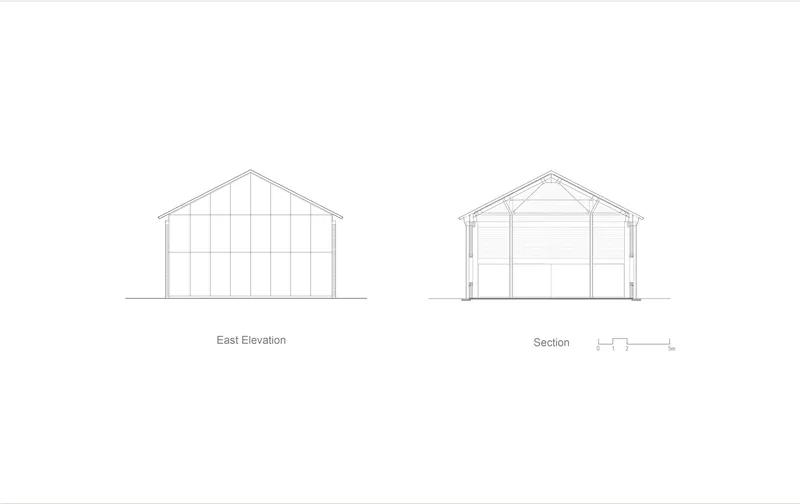
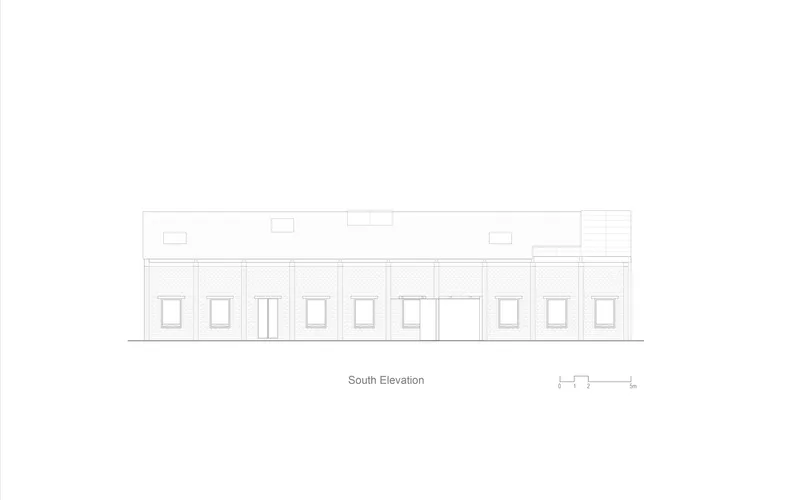
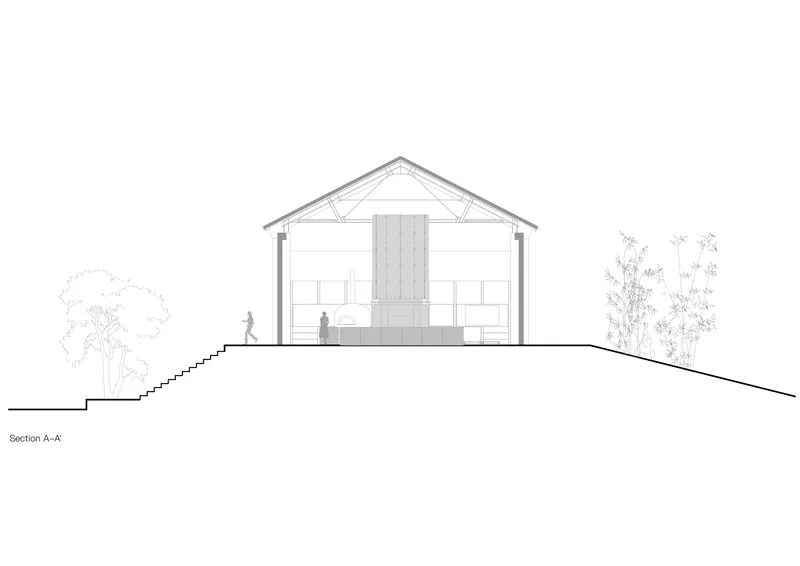
The elevation and section drawings are particularly revealing. The south elevation shows the long, low facade with its patterned brickwork and regular window rhythm, a quietly disciplined composition that contrasts with the dramatic glass gable at the east end. The section through the central fireplace illustrates the six-meter kiln flue in context, confirming its role as the vertical datum around which the entire interior organizes. The gabled profile with vertical cladding references agricultural building typologies without mimicking them, an important distinction that keeps the design from slipping into pastoral nostalgia.
Why This Project Matters
The conversion of a Cold War-era auditorium into a stone-oven bakery could easily have become a sentimental exercise in rural nostalgia or, worse, an urban transplant dressed in countryside clothing. What Tens Atelier and FANAF have produced is neither. The building takes its communal origins seriously, preserving the auditorium's open-plan generosity while giving it a new productive purpose. The six-meter kiln is not a sculptural indulgence but the functional core of a working bakery, and the spatial organization flows from that reality. In a landscape saturated with café conversions that prioritize aesthetics over program, this project insists that the oven comes first.
More broadly, the project contributes to an ongoing conversation about what rural revitalization looks like when it is led by craft rather than tourism. Cycle&Cycle's ambition to create a world-class stone-kiln bread house in a mountain village is inherently risky, dependent on people making the journey to a place that is deliberately hard to find. The architecture supports that risk by rewarding arrival: the climb through stone terraces, the first glimpse of the glass gable against green hills, the warmth of a timber ceiling above a table loaded with bread. These are sequential experiences that no delivery app can replicate, and that is precisely the point.
Cycle&Cycle Stone-oven Bakery Restaurant, designed by Tens Atelier (interior) and FANAF (renovation and reconstruction), Shaoxing, Zhejiang Province, China. 420 m², completed 2025. Photography by half.half.photography and Ingallery.
About the Studio
Share Your Own Work on uni.xyz
If projects like this are the kind of work you want to make, uni.xyz is a place to publish your own, find collaborators, and enter design competitions.


Popular Articles
Popular articles from the community


The Earth Pod: 3D Printed Homes for Resilient Refugee Communities
The Earth Pod reimagines refugee housing through 3D printed homes made from clay, combining resilience, self-sufficiency, and rapid shelter.

Co-Life: Senior Housing Design That Reconnects Older Adults With the City
Co-Life reimagines senior housing design through healing gardens, shared streets, workshops, and a sustainable community across generations.

Hill & Cross Opera: Sculptural Opera House Architecture Shaped by Tallinn’s Landscape and Identity
Hill & Cross Opera reimagines opera house architecture in Tallinn through its sculptural hill, civic plaza, glass wave and a luminous cross.

Riyadh For All: Intergenerational Urban Design for Active Aging in Rabat
Riyadh For All reimagines urban design in Rabat with intergenerational co-living, adaptive courtyards, and Moroccan cultural exchange today.
Similar Reads
You might also enjoy these articles

Bao Huynh Watercolor Atelier: A Serene Art Retreat in Hội An
Bao Huynh Watercolor Atelier in Hội An blends multifunctional art spaces, sustainable design, local materials, and family-friendly living in a serene environment.

Atelier Macri Concept Store Interior Design by CASE-REAL
Atelier Macri store features a "ko" counter, walnut wood details, cork displays, blending retail, gallery, and seamless customer experiences.

Manuel Vargas Izquierdo Stadium and High-Performance Sports Center: Architectural Excellence in Jalpa de Méndez
The Manuel Vargas Izquierdo Stadium blends sustainable design, inclusive sports facilities, and cultural-inspired architecture, revitalizing Jalpa de Méndez’s public spaces.

KAKR Buluh Awar Hall: Revitalizing Community and Ecology Through Bamboo Architecture
Community built bamboo hall revitalizes Buluh Awar village, empowering youth, restoring ecology, celebrating vernacular craftsmanship through sustainable architecture and culture.
Explore Cultural Architecture Competitions
Discover active competitions in this discipline


Challenge to design luxury tourism on rails


VR headsets Storefront design competition

Bring back Drive In's

Designing a staircase for a client
Comments (0)
Please login or sign up to add comments
No comments yet. Be the first to comment!