
The Black Taj: An Arch of Oblivion Frames the Twilight of an Empire
A speculative monument reimagines Shah Jahan's mythic counterpart to the Taj Mahal as a dystopian landscape of loss, ruin, and fading light.


What if the Taj Mahal had a twin, not born of love but of its collapse? The legend of the Black Taj, a dark marble mirror Shah Jahan allegedly planned to build across the Yamuna, has captivated historians and architects for centuries. In this speculative entry, the myth is not resolved but deepened: the Black Taj is not a building at all. It is a condition of light, a psychological landscape, a colossal fractured arch that frames the original monument through the haze of a setting sun. The result is less a counter-monument than a spatial allegory for the end of an empire.
Designed by Kiranmayi Yenduri, Gokul, Bhavini, and Anam, this shortlisted entry for The Black Taj competition on uni.xyz positions the setting sun as its central architectural agent. Rather than proposing a symmetrical dark replica, the team constructs an experiential threshold they call the "Arch of Oblivion," a twisted metal gateway that reframes the Taj Mahal as a celestial vision dissolving into dusk. The project draws on Mughal mythology, Islamic geometric traditions, and the melancholic final years of Shah Jahan's reign to produce a narrative that is equal parts architectural provocation and poetic meditation.
Framing the Monument Through Catastrophe
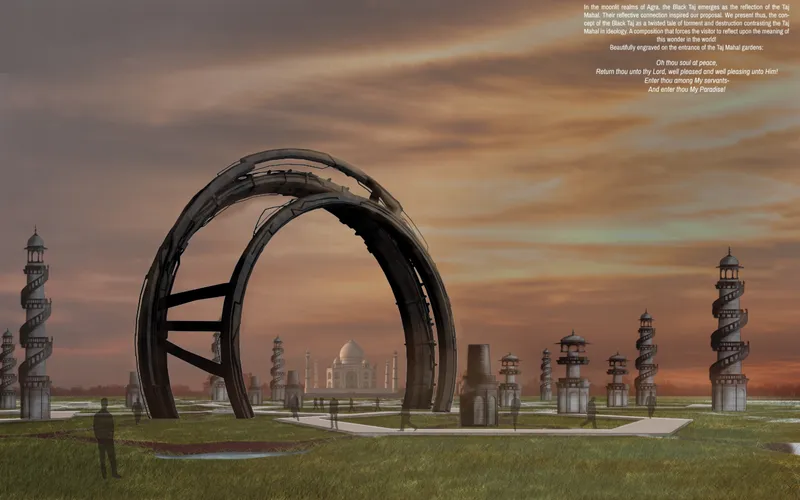
The hero image establishes the project's central spatial move: a monumental arch, scarred and fractured, rises from the landscape to frame a distant view of the Taj Mahal's dome and minarets bathed in sunset light. The arch does not compete with the original monument. It mediates the visitor's encounter with it, forcing every approach to the Taj through a threshold of ruin. The twisted metal form reads as both a gate and a wound, suggesting that access to the memory of Shah Jahan's love can only come through an acknowledgment of its destruction. The setting sun, positioned precisely behind the Taj, transforms the white marble into gold while the arch remains in silhouette, a permanent shadow cast across the visitor's path.
The designers describe this element as a "celestial scar" that crashes upon the Mughal garden, its fractured geometry sending ripples of disruption across the otherwise ordered landscape. It is a powerful inversion: the Taj Mahal's garden is one of the most controlled landscapes in architectural history, and the Arch of Oblivion violates that control deliberately. Visitors are not mere spectators here. They traverse through the arch, experiencing the Black Taj as both monument and metaphor, occupying the space between reverence and ruin.
Cast Iron Columns and the Materiality of Decay
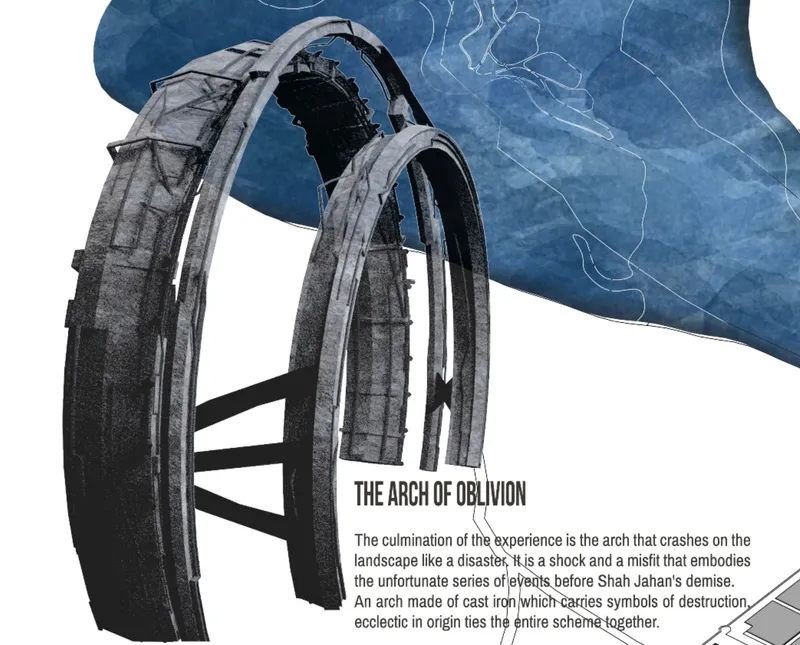
A collage illustration reveals the arch's materiality in closer detail: weathered cast iron columns support the structure against a watercolor sky, their surfaces corroded, their joints exposed. The choice of iron against the Taj Mahal's pristine marble is pointed. Where the original monument was built to defy time, the Black Taj embraces it. Oxidation, patina, and structural fatigue become design strategies rather than maintenance concerns. The collage technique itself reinforces this sensibility, layering textures and fragments as if the project were assembled from the remnants of a memory rather than from a clean set of construction documents.
This material contrast carries conceptual weight. The Taj Mahal's marble was quarried, polished, and inlaid with semi-precious stones to suggest paradise on earth. The Arch of Oblivion's twisted metal suggests the opposite: the collapse of paradise, the entropy that follows when power and love are severed. The designers position this dialogue between ruin and reverence as the project's experiential core, arguing that the colossal arch embodies Shah Jahan's downfall while reflecting the impermanence of both power and devotion.
Spiraling Minarets and a Distorted Skyline
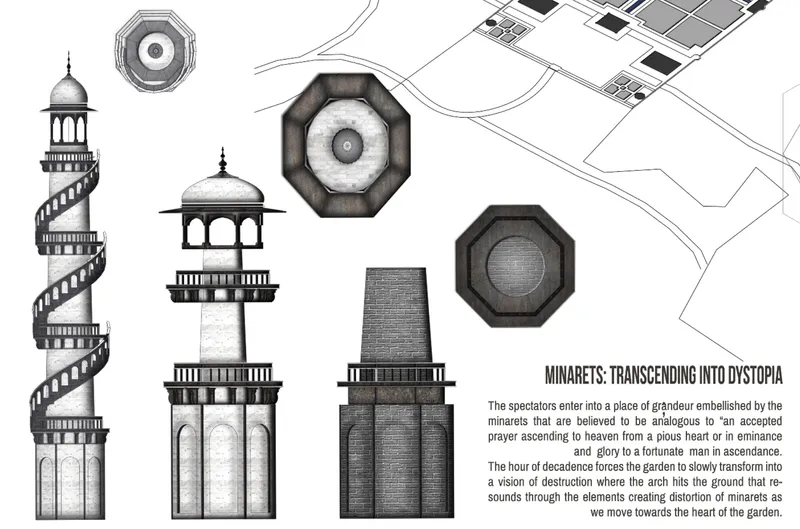
The elevation drawings reveal a secondary vocabulary of architectural forms: spiral minarets that twist upward in distorted trajectories, and octagonal pavilion structures that echo Mughal precedents while breaking from their symmetry. Plan details above the elevations show how these elements organize around the central arch, each one narrating a fragment of Shah Jahan's trajectory from grandeur to grief. The spiraling minarets are particularly effective; the designers describe them as "a prayer caught between heaven and ruin," and the drawings bear this out. Their upward motion is unmistakable, but their warped profiles suggest a devotion that has lost its object.
What the elevations make clear is that this is not a single monument but a landscape of interlocking elements, each calibrated to a specific moment in the narrative. The visitor moves through a labyrinth of loss, encountering pavilions, shattered gardens, and the looming arch in a choreographed sequence. The architecture functions less as enclosure and more as stage direction, guiding the body through emotional territory.
Sacred Geometry, Deconstructed
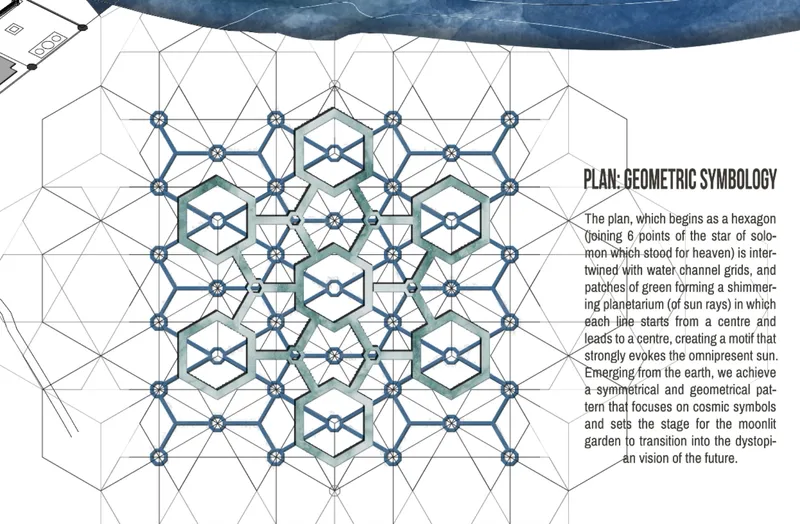
The plan drawing reveals the project's geometric foundation: a hexagonal pattern derived from Islamic sacred geometry, interwoven with star motifs and bisected by water channels. In Mughal architecture, these patterns symbolize divine order, cosmic harmony, the perfection of paradise translated into stone and garden. Here, the pattern begins intact at its center and dissolves outward into abstraction, its edges fraying, its symmetry collapsing. The designers describe this as a transition from "celestial order to chaotic geometry," mirroring Shah Jahan's mental and emotional descent during his final years of imprisonment.
The water channels, a hallmark of the chaharbagh garden tradition, persist through the plan but follow increasingly irregular paths, as if the infrastructure of paradise were leaking. It is a subtle and effective device: the plan reads as both functional landscape diagram and psychological map. The geometric dissolution raises a question the designers pose explicitly: is beauty eternal, or does it exist only in memory? The plan suggests the latter, presenting order and perfection as inherently temporary conditions.
Why This Project Matters
Speculative architecture competitions often produce work that prioritizes spectacle over substance, rendering dramatic images with thin conceptual foundations. The Black Taj team avoids this trap by grounding their proposal in a coherent reading of Mughal history and Islamic spatial traditions. The Arch of Oblivion is not simply a dramatic form; it is a threshold that restructures the visitor's relationship to one of the world's most familiar monuments. The geometric dissolution in the plan is not decorative experimentation; it maps a psychological collapse onto landscape. Every design decision serves the narrative.
What makes this entry compelling is its refusal to build a literal twin. By treating the Black Taj as an ideological reflection rather than a physical replica, the designers open a space for architecture to function as critique, elegy, and warning simultaneously. The setting sun is the final architect here: painting the Taj in gold while its shadow darkens, reminding us that monuments, no matter how divine their ambition, exist within time. They are bound to the same twilight that consumed Shah Jahan's empire. That recognition, translated into twisted metal, fractured geometry, and dissolving garden plans, is what gives this project its lasting weight.
View the Full Project
About the Designers
Designers: Kiranmayi Yenduri, Gokul, Bhavini, Anam
Enter a Design Competition on uni.xyz
uni.xyz runs architecture and design competitions year-round that reward proposals with spatial conviction and real site intelligence.
Project credits: The Black Taj - The Setting Sun - NDIL83 by Kiranmayi Yenduri, Gokul, Bhavini, Anam The Black Taj (uni.xyz).



Popular Articles
Popular articles from the community


Co-life: Sustainable Architecture for Age-Friendly Community Living
Co-life reimagines sustainable architecture for seniors through courtyards, rammed earth, shared gardens, and spaces designed for belonging.

The Earth Pod: 3D Printed Homes for Resilient Refugee Communities
The Earth Pod reimagines refugee housing through 3D printed homes made from clay, combining resilience, self-sufficiency, and rapid shelter.

Hill & Cross Opera: Sculptural Opera House Architecture Shaped by Tallinn’s Landscape and Identity
Hill & Cross Opera reimagines opera house architecture in Tallinn through its sculptural hill, civic plaza, glass wave and a luminous cross.

Conexión: Biophilic Design Reimagines High-Rise Living in Hong Kong
Conexión reimagines high-rise living in Hong Kong through biophilic design, green facades, shared spaces, daylight, water and nature within.

Similar Reads
You might also enjoy these articles
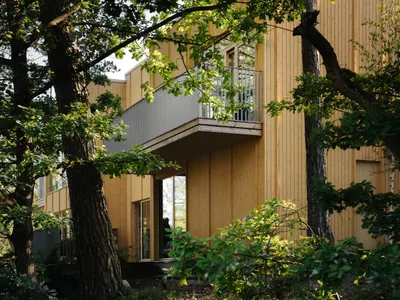
Sustainable Architecture Design: Embracing Nature and Modernity at Villa Solsidan
The article explores Villa Solsidan by AndrénFogelström, showcasing its sustainable architecture design and integration with the natural surroundings in Saltsjöbaden, Sweden.
Scientific and Educational Monitoring Center of the Yenisei, Krasnoyarsk
Architecture as an instrument for ecological research, education, and environmental awareness along Russia’s largest river.
Development of Andretta Artist’s Village, Palampur, Himachal Pradesh, India
Reimagining Andretta as a living cultural landscape where art, architecture, and community converge to shape a global creative village.
Street Children Rehabilitation Center: A Model of Social Architecture for Community Rehabilitation
An inclusive social architecture project that transforms streets into nurturing environments, restoring dignity, identity, and opportunity for vulnerable children.





Comments (0)
Please login or sign up to add comments
No comments yet. Be the first to comment!