

UnBox: Completing the Black Taj's Unfinished Story Through Contemporary Architecture
A shortlisted competition entry reimagines the mythic twin of the Taj Mahal as a public cultural complex along Agra's Yamuna riverfront.


What if the most famous unbuilt building in history was never meant to be replicated, but reinterpreted? The legend of the Black Taj, the supposed dark mirror of the Taj Mahal that Shah Jahan allegedly planned but never realized, has persisted for centuries as a story about incompleteness. UnBox takes that incompleteness as its founding design principle: rather than recreating a lost monument, it builds a contemporary cultural infrastructure that finishes the narrative through public space, performance, and ecological sensitivity.
Designed by D. Sai, Azil, Priyali, and Adithya, the project was shortlisted in The Black Taj competition on uni.xyz. Sited along the Yamuna River in Agra, directly behind the Taj Mahal, UnBox proposes a public cultural complex that unites an underground museum, an open-air amphitheatre, and a continuous riverfront promenade, all organized around three guiding principles: Educate, Interact, and Sustain.
A Perforated Arch as Symbolic Counterpart
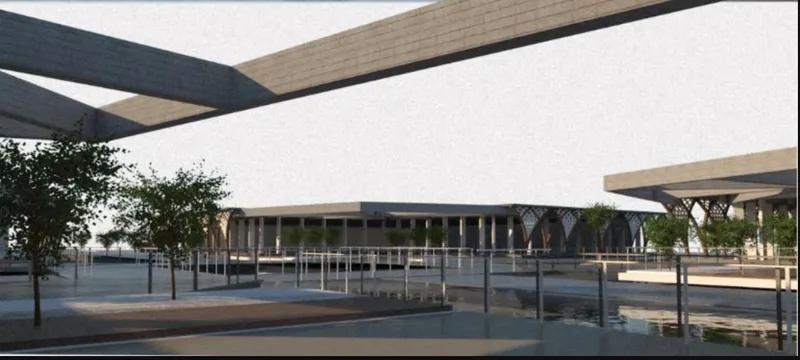
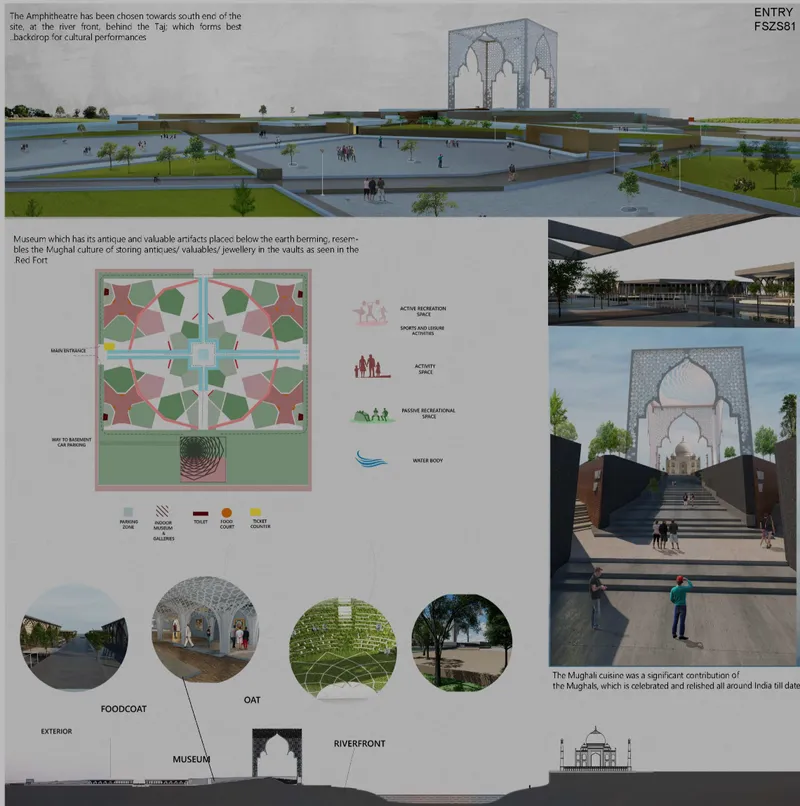
The project's most striking architectural gesture is a grand arch frame, a perforated steel structure inspired by Islamic geometry that functions as both visual anchor and symbolic counterpart to the Taj Mahal across the river. Pierced with thousands of patterned voids, the arch transforms daylight into a dynamic spatial experience where shadow rhythms echo the cadences of Mughal ornamentation. The plaza beneath it features reflecting pools and colonnaded pavilions framed by crossing timber canopies overhead, establishing a forecourt that mediates between the monumental and the intimate.
The overall site plan derives from the octagonal footprint of the Taj Mahal itself, modified into a chamfered square grid that organizes the entire complex. The presentation boards reveal how sectional drawings, rendered views, and site plans work together to articulate a layered program: galleries and activity zones at lower levels, public squares at grade, and the arch rising as a framing device that positions the Taj as a perpetual visual terminus.
Landscape as Infrastructure Along the Yamuna
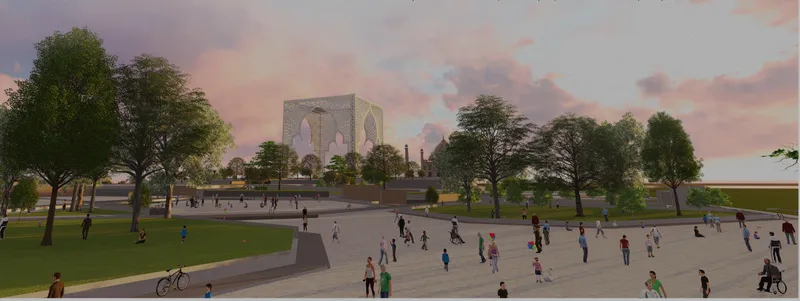

The approach sequence matters as much as the destination. Walking paths wind through scattered trees and open plazas toward the monumental arched gateway, visible at dusk as a silhouette that deliberately inverts the Taj's luminous white presence. The designers retained existing green belts and integrated water channels to cool microclimates naturally, treating landscape not as decoration but as functional environmental infrastructure. The result is an eco-sensitive riverfront where the built form merges with the terrain rather than dominating it.
Overhead views capture the interplay of light and shadow across the paving, where alternating stripes created by sunlight filtering through canopy structures produce a ground-level version of the jali effect found throughout the complex. Bicycle tracks, shaded walkways, and food courts surround the southern amphitheatre zone, activating public engagement while maintaining strict visual alignment with the Taj axis. It is a careful calibration: every sight line is orchestrated so that heritage remains the horizon.
Subterranean Museum with Vaulted Jali Ceilings
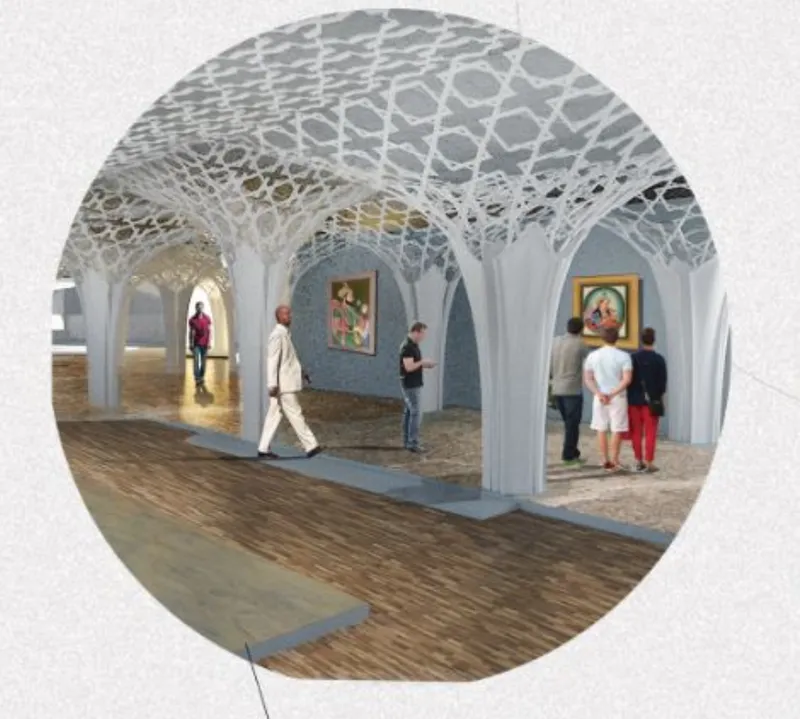
Below grade, the underground museum serves as the project's cultural repository, exhibiting artifacts and historical narratives linked to Mughal heritage. The subterranean typology deliberately recalls the vaults of the Red Fort, where precious antiquities were once preserved. White branching columns rise to support a geometric vaulted ceiling that filters light through lattice structures, producing diffused patterns reminiscent of traditional jalis. Visitors move through gallery spaces where the architecture itself becomes a pedagogical instrument, bridging architectural memory and modern fabrication techniques in a single immersive interior.
Threshold and Ascent: Framing the Portal
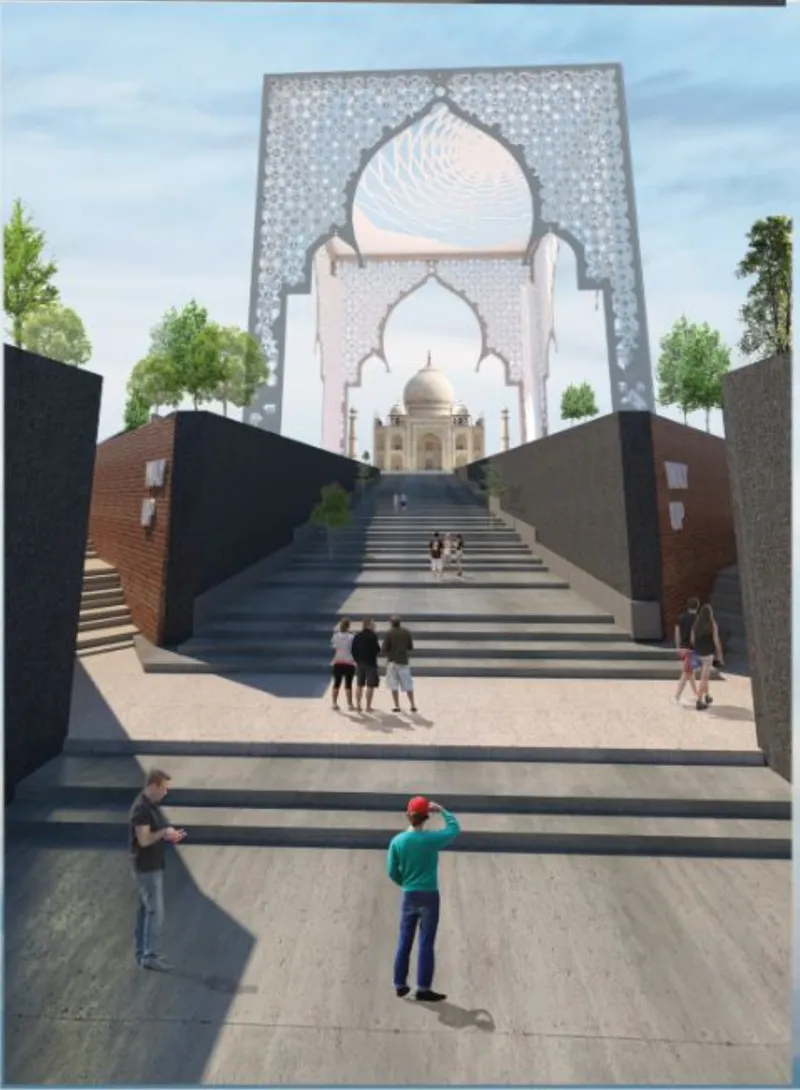
One of the project's most compelling spatial moments occurs in the ascending stair passage between flanking walls that channel visitors upward toward a perforated arch portal. The sequence compresses sightlines before releasing them into an open view, a technique deeply rooted in Mughal processional architecture but executed here with clean contemporary surfaces and sharp geometric perforations. Daylight pours through the arch's patterned screen, casting shifting shadow geometries onto the stair treads as visitors climb. It is a threshold that transforms movement into ritual.
The passage demonstrates UnBox's broader ambition: to use architectural sequence, not ornamental replication, as the vehicle for cultural continuity. The walls are unadorned. The drama comes from proportion, light, and the anticipation built into the compressed corridor opening onto the monumental frame beyond.
Why This Project Matters
Heritage design competitions often produce two predictable outcomes: literal reproductions that mistake nostalgia for respect, or provocative abstractions so detached from context that they could land anywhere. UnBox avoids both traps. By grounding its formal logic in the Taj Mahal's own octagonal geometry, by deploying the jali as a spatial strategy rather than a surface motif, and by burying its museum below grade to preserve the landscape's ecological integrity, the project demonstrates a sophisticated understanding of how tradition can be metabolized rather than copied.
What distinguishes D. Sai, Azil, Priyali, and Adithya's entry is its programmatic ambition. The Black Taj is not treated as a monument to be mourned but as a narrative to be activated through amphitheatres, galleries, promenades, and public squares. The incomplete becomes generative. That conceptual clarity, paired with a rigorous spatial strategy organized around education, interaction, and sustainability, elevates UnBox from a competition entry into a credible proposition for how Indian cities might engage their monumental pasts without being paralyzed by them.
View the Full Project
About the Designers
Designers: D. Sai, Azil, Priyali, Adithya
Enter a Design Competition on uni.xyz
uni.xyz runs architecture and design competitions year-round that reward proposals with spatial conviction and real site intelligence.
Project credits: The Black Taj- UnBox by D. Sai, Azil, Priyali, Adithya The Black Taj (uni.xyz).



Popular Articles
Popular articles from the community


Hill & Cross Opera: Sculptural Opera House Architecture Shaped by Tallinn’s Landscape and Identity
Hill & Cross Opera reimagines opera house architecture in Tallinn through its sculptural hill, civic plaza, glass wave and a luminous cross.

Conexión: Biophilic Design Reimagines High-Rise Living in Hong Kong
Conexión reimagines high-rise living in Hong Kong through biophilic design, green facades, shared spaces, daylight, water and nature within.
AL-JANNAH: Sustainable Architecture and Permaculture for Afghan Widows
AL-JANNAH uses sustainable architecture and permaculture to create resilient oasis of housing, learning, work and renewal for Afghan widows.

The Earth Pod: 3D Printed Homes for Resilient Refugee Communities
The Earth Pod reimagines refugee housing through 3D printed homes made from clay, combining resilience, self-sufficiency, and rapid shelter.


Similar Reads
You might also enjoy these articles

The Musturak Paradise: Senior Living Architecture for a Connected Future in Temara, Morocco
The Musturak Paradise reimagines senior living architecture in Temara via private homes, social spaces, culture, community, and shared care.

The Leaf Center: Cultural Center Architecture for Social Integration in Amsterdam
Cultural center architecture becomes a bridge at The Leaf Center, connecting international students with Amsterdam through art and exchange.
Conexión: Biophilic Design Reimagines High-Rise Living in Hong Kong
Conexión reimagines high-rise living in Hong Kong through biophilic design, green facades, shared spaces, daylight, water and nature within.

Wander to Wonder: Modular Playground Design for Children in Kutupalong Refugee Camp
Wander to Wonder uses modular playground design to create flexible, imaginative play spaces for children in Kutupalong refugee camp.


Explore The Black Taj Competitions
Discover active competitions in this discipline



Challenge to reimagine the Iron Throne


Photograph architecture without architects


Illustrate the lost glory of Angkor Wat - Render Challenge


Bring back Drive In's
Comments (0)
Please login or sign up to add comments
No comments yet. Be the first to comment!