
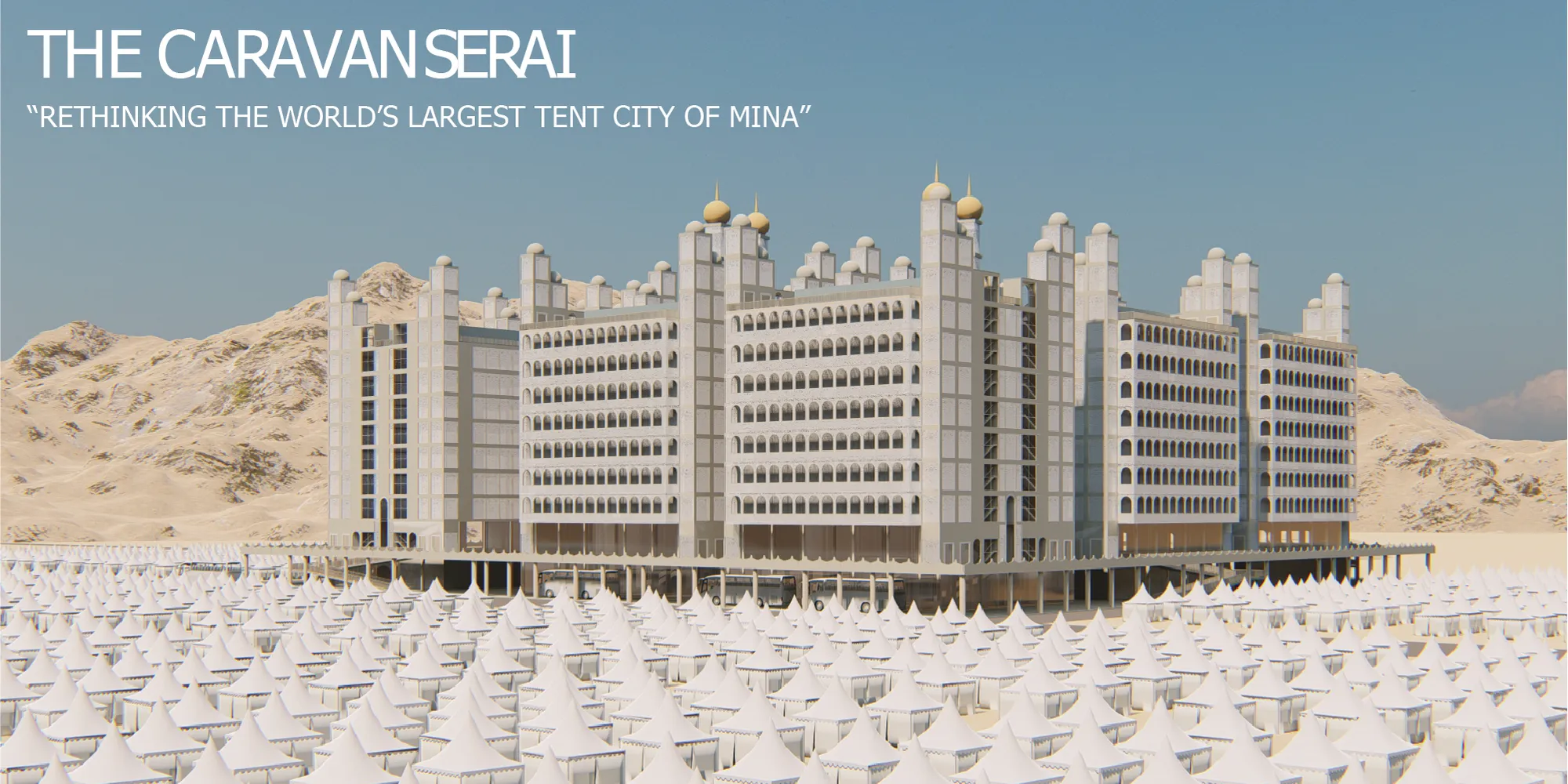
THE CARAVANSERAI
(in Persian: كاروانسرا / kârvânsarâ)

Designed to accommodate 9000 pilgrims during the Hajj, “The Caravanserai” was conceived as a contemporary reinterpretation of the traditional elements of Arabic vernacular architecture, while relying on a modular construction system offering new and imaginative solutions to transform “the world largest city tent”.
The transformation of the supporting structure of the tent (mat or portico: 1 or 2 Dimensions) into a parallelepipedal steel frame (3 Dimensions) allowed us to stack unit elements. The principle of the double envelope: an interior canvas and an outer fabric or "flysheet", has been retained to protect, insulate, and ventilate the living spaces while maintaining the lightness of the building.
Despite the imposing dimensions of this architectural ensemble, we wanted to evoke the “structural lightness” inspired by the “translucent facades” of the most beautiful monuments of Arab and Mughal culture.
Taking elements of Muslim architecture such as Iwan, Baghdir, chatrî, and Hasht Bihisht*, or inspired by the characteristic shapes and decorative patterns, we have “dressed “our buildings with "Mashrabiya" to create an effect of a floating city over the tent of Mina.
*(Persian word meaning eight paradises: type of plan organized in eight spaces around a ninth in the centre.)
The semi transparency of the mashrabiya in the dormitories provides natural light and ventilation while carefully preserving the privacy of the pilgrims.
The concept of the esplanade, terraces and balconies overlooking the city is equally characterized by traditional Arabic elements while emphasizing formal parts and contemporary materials.
Beyond formal references to Arab vernacular traditions, we took the example of 16,000 years of desert architecture to limit the energy consumption of buildings: Natural Ventilation, small windows, grouping buildings, shading roofs and facades, adiabatic air conditioning system.
Like an oasis, "The Caravanserai" can only function by introducing a system of technical and social management for its water and energy. That’s why we design a complete recycling water system and a sustainable energy production.
Construction principles
Although starting from a principle of a modular construction, fitting into a volume of 16M / 16M / 10M,
we have sought to optimize the logistical, technical, economic, and environmental performance of the whole construction process.
In a global and systemic approach, we sought a construction system that allows the industrial prefabrication of complete elements, structurally light, easily transportable, easy to handle, stackable, flexible, and adaptable to different needs, contexts, and constraints and that can be easily supplied worldwide.
Thus, we have finally based our plan on a structural grid with the dimensions of 40’’ shipping containers.
The need for significant and permanent foundations, the complexity of the infrastructures and networks (electricity and water supply, sewer and drainage), the importance of access installations (elevators, mechanical ramps, emergency stairs) as well as the willingness to make this site profitable throughout the year, led us to propose a classic concrete construction with "post-beam-slab system” based on our grid, thus allowing a flexible arrangement of the ground floor and the esplanade according to the various uses. (Free plan)
The container frame system CFS will be used as a skeleton for the entire accommodation structure, (living module, toilet, technical roof-top, access and balconies). A “curtain walls” made of mashrabiya screens will enclose the interior spaces giving natural light and ventilation. Balconies, external corridors, and solar panels will form the second skin, creating shade and ventilation all around the buildings.
In order to keep short construction deadlines, we have devised logistics solutions, based on the industrial system of global production, that can be easily transported to the port of Jeddah before being assembled in larger elements of 16m / 16m / 10m. The last 100 kilometres as well as the final assembly in the heart of Mina will be carry out by airship transportation and lifting, without noise and pollution.


Popular Articles
Popular articles from the community


The Musturak Paradise: Senior Living Architecture for a Connected Future in Temara, Morocco
The Musturak Paradise reimagines senior living architecture in Temara via private homes, social spaces, culture, community, and shared care.

Hill & Cross Opera: Sculptural Opera House Architecture Shaped by Tallinn’s Landscape and Identity
Hill & Cross Opera reimagines opera house architecture in Tallinn through its sculptural hill, civic plaza, glass wave and a luminous cross.

Co-Life: Senior Housing Design That Reconnects Older Adults With the City
Co-Life reimagines senior housing design through healing gardens, shared streets, workshops, and a sustainable community across generations.
AL-JANNAH: Sustainable Architecture and Permaculture for Afghan Widows
AL-JANNAH uses sustainable architecture and permaculture to create resilient oasis of housing, learning, work and renewal for Afghan widows.


Similar Reads
You might also enjoy these articles

Day and Night Park: A Time-Based Urban Newsstand in Beijing
A temporary urban newsstand in Beijing blending travel, light, and reading through poetic colors, compact form, and community-focused design.

Modernist Patio Renovation in El Masnou, Barcelona by Oliver Segura Arquitectura + Cebrià Arquitectura
Modernist patio renovation blending tradition and innovation with a movable pool, leveled floors, and Catalan materials in El Masnou.

Alto Residencial Coop: Cooperative Housing Development in Santiago de Compostela by Carbajo Barrios Arquitectos
A linear cooperative housing complex blending white volumes and perforated metal façades, enhancing community living, natural light, privacy, and urban integration.

Vil Genis School by BPA ARCHITECTURE – Massy, France
Vil Genis School in Massy, France, features sustainable design, south-facing classrooms, community integration, accessible spaces, and modern educational architecture.






Comments (0)
Please login or sign up to add comments
No comments yet. Be the first to comment!