
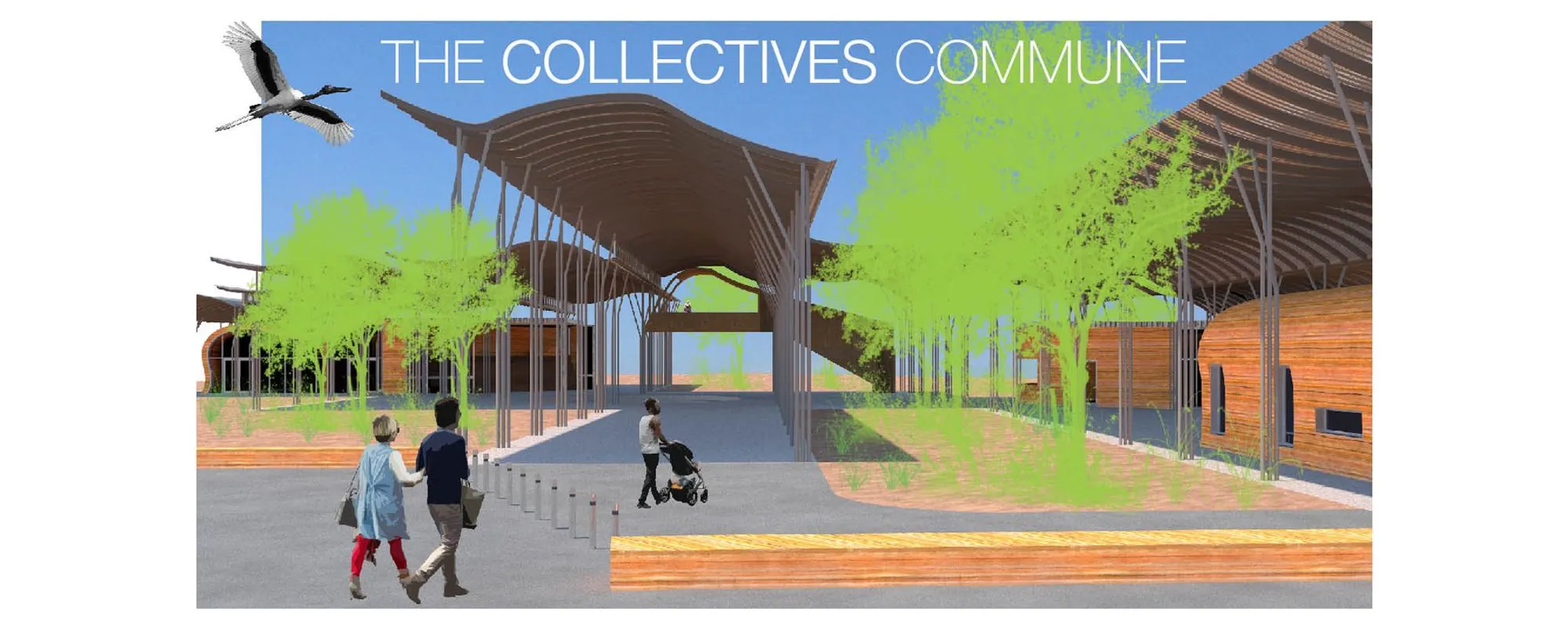
The Collectives Commune: A Multicultural Architecture Rooted in Indigenous Knowledge
Jeff Okello's shortlisted entry for We Australia draws on Kakadu plum symbolism and Aboriginal spatial logic to design belonging.


What does it mean to design a building that acknowledges fifty thousand years of continuous habitation and, simultaneously, the arrival of cultures from every corner of the globe? The Collectives Commune answers that question not with a monument but with a sheltering canopy: a floating roof modeled on the Kakadu plum, a native bush food sacred to the Bininj/Mungguy people, whose organic form becomes the generative geometry for an entire community architecture. Beneath that canopy, gathering halls, clinics, libraries, kitchens, and tiered accommodation cluster together in patterns drawn from indigenous spatial organization, producing a public building that treats cultural exchange as its core programme.
Designed by Jeff Okello as a shortlisted entry for the We Australia competition, the project grows from a deeply personal starting point: the experience of questioning one's place as an immigrant in a globalizing Australia while recognizing the deep-rooted presence and knowledge systems of its First Nations people. Okello channels that tension into an architecture of belonging, one that echoes the Aboriginal concept of Dreaming, where connections to land and community transcend the physical and are embedded in time, place, and memory.
A Canopy That Shelters Like the Kakadu Plum
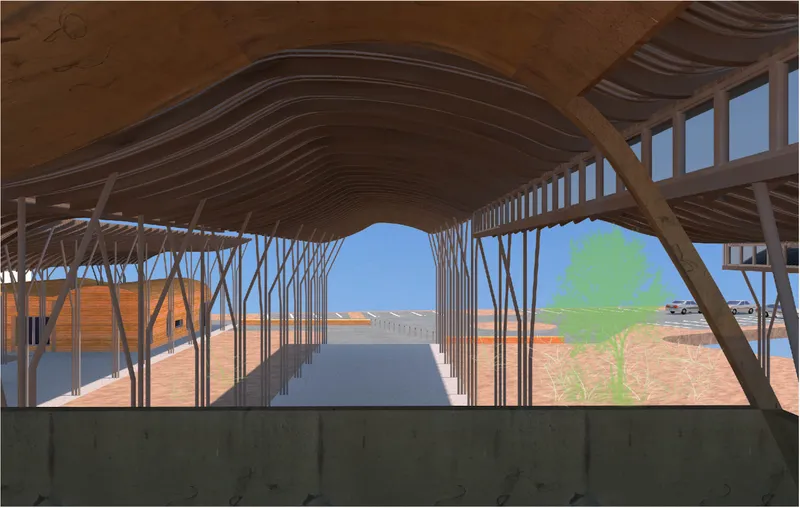
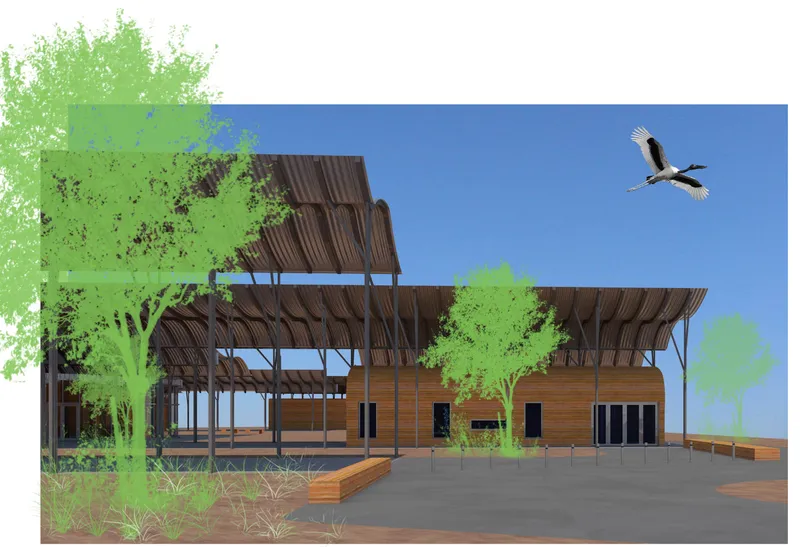
The vaulted timber ceiling in the first rendering immediately establishes the project's tectonic character: slender columns rise from a concrete platform to support an undulating roof that reads as both structure and symbol. The canopy does not simply cover; it floats above the site as a sheltering gesture, representing unity, protection, and nourishment, the same qualities attributed to the Kakadu plum itself. In the second image, layered timber-clad volumes nestle beneath this roof, their materiality warm and grounded against the lightness of the canopy overhead. A bird in mid-flight punctuates the composition, reinforcing the openness between built form and sky. The architecture refuses to enclose; it breathes.
Materials reinforce the conceptual narrative. Rammed earth walls expose natural layers of time and memory, while timber cladding ties the volumes to the surrounding landscape. Passive ventilation strategies and the integration of existing vegetation demonstrate a commitment to environmental sustainability that mirrors the project's cultural ambitions. Nothing here is arbitrary decoration; every surface carries geological and ecological meaning.
Five Eras of Australia Read Through One Exploded Axonometric
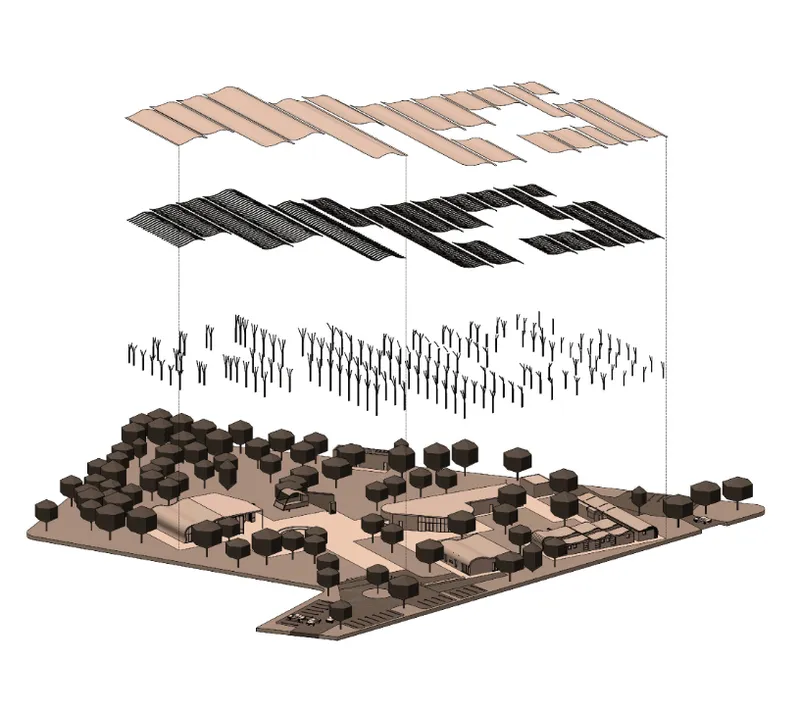
Okello structures the design around a narrative of five defining eras: the Pre-Human Era of Gondwana's geological drift, the Humanization Era of early shelters like Nwarla Gabarnmang, Aboriginal Australia's dome-based collective villages, Colonial Australia's verandah typology reclaimed through indigenous logic, and finally Global Australia, where diverse functions coexist under a single unifying canopy. The exploded axonometric drawing lays this sequence bare. Roof layers peel apart from structural columns, which in turn separate from the scattered volumes at ground level, revealing a cluster-based layout that resonates with indigenous patterns of land occupation. The drawing is not merely technical documentation; it is a spatial argument for how history can be read through form.
Landscape Sections and the Undulating Horizon
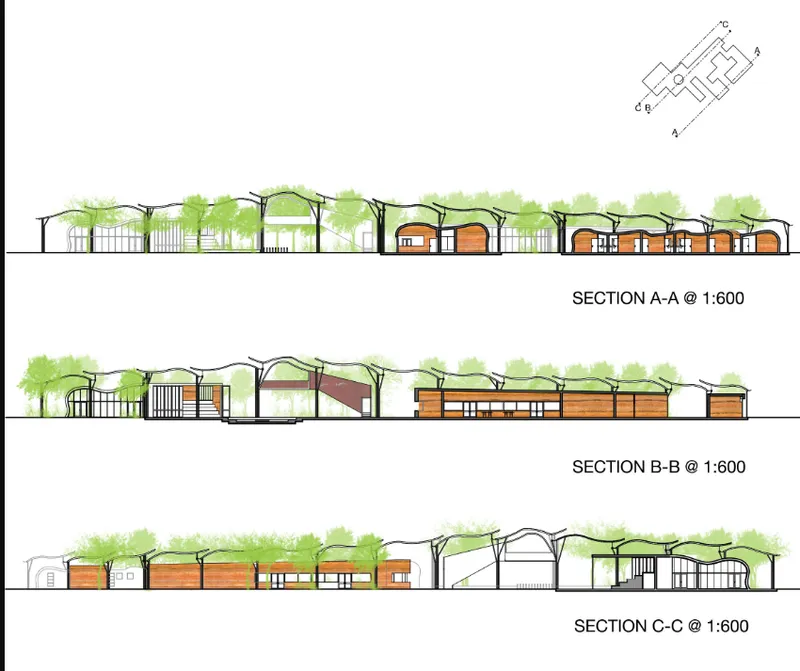
The section drawings confirm what the renderings suggest: the roof canopy is not a single plane but an undulating surface that rises and dips across the site, negotiating with trees and topography rather than overriding them. Timber volumes tuck beneath peaks of the canopy where ceiling height is generous, while lower troughs create intimate thresholds between programmatic zones. Gathering spaces for dialogue and celebration sit alongside healthcare clinics and communal kitchens, each zone identifiable by its relationship to the roof above. The sections also expose the project's strategy of blurring boundaries between indoors and out, private and shared. Walls stop short of the canopy edge, allowing landscape to infiltrate every corridor.
Walking Through Curved Timber and Branching Steel
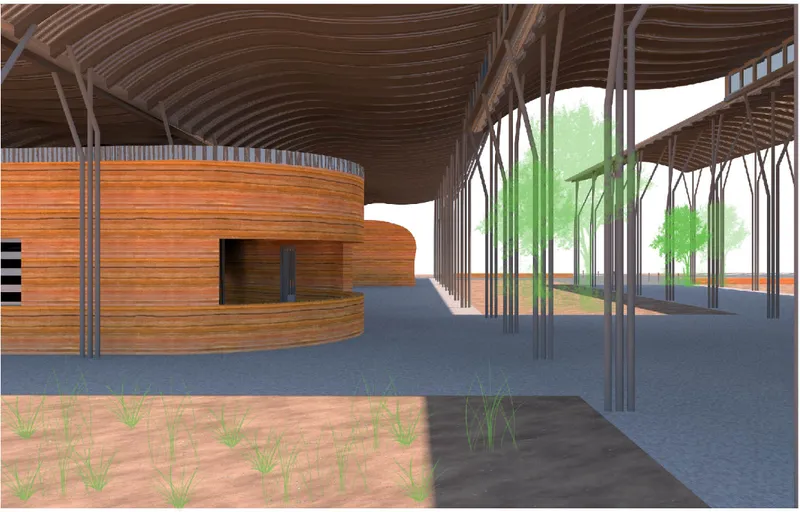
The interior rendering of the covered walkway captures the experiential quality Okello is after. Curved timber walls guide movement along a path that feels organic rather than prescribed, while branching steel columns overhead echo the vegetal logic of the Kakadu plum tree. Light filters through gaps in the canopy structure, dappling the ground in a way that recalls walking beneath a forest canopy. The spatial sequence encourages chance encounters, the kind of informal cross-cultural interactions that no programme diagram can mandate but good architecture can make inevitable. Libraries, workshops for skill-building, and multi-tiered accommodation spaces open off this spine, ensuring that the walkway is not mere circulation but the social backbone of the commune.
Why This Project Matters
The Collectives Commune resists the common trap of multicultural architecture: the tendency to flatten cultural difference into decorative motifs or to treat inclusion as a checklist. Okello instead builds the project from an indigenous knowledge system outward, using the Kakadu plum, Dreaming narratives, and cluster-based spatial organization as structural principles rather than surface references. The result is an architecture that takes cultural sustainability as seriously as environmental sustainability, embedding Aboriginal wisdom into programme, material, and form.
For the We Australia brief, this approach is particularly potent. It refuses to position Australian identity as a resolved question and instead proposes a building type, the commune, that treats identity as an ongoing negotiation. The canopy shelters everyone without demanding uniformity; the walkways invite exchange without forcing encounter. In an era when public architecture too often defaults to neutrality, Okello's project dares to be specific, grounded, and culturally committed.
View the Full Project
About the Designers
Designer: Jeff Okello
Enter a Design Competition on uni.xyz
uni.xyz runs architecture and design competitions year-round that reward proposals with spatial conviction and real site intelligence.
Project credits: uni.xyz by Jeff Okello We Australia (uni.xyz).




Popular Articles
Popular articles from the community


Co-Life: Senior Housing Design That Reconnects Older Adults With the City
Co-Life reimagines senior housing design through healing gardens, shared streets, workshops, and a sustainable community across generations.

Lunar Spiral: Space Architecture Shaped by the Mathematics of the Universe
Lunar Spiral reimagines space architecture through Fibonacci geometry, lunar regolith, levitating habitats, and self-sustaining Moon living.

Hill & Cross Opera: Sculptural Opera House Architecture Shaped by Tallinn’s Landscape and Identity
Hill & Cross Opera reimagines opera house architecture in Tallinn through its sculptural hill, civic plaza, glass wave and a luminous cross.

Co-life: Sustainable Architecture for Age-Friendly Community Living
Co-life reimagines sustainable architecture for seniors through courtyards, rammed earth, shared gardens, and spaces designed for belonging.

Similar Reads
You might also enjoy these articles

Day and Night Park: A Time-Based Urban Newsstand in Beijing
A temporary urban newsstand in Beijing blending travel, light, and reading through poetic colors, compact form, and community-focused design.

Modernist Patio Renovation in El Masnou, Barcelona by Oliver Segura Arquitectura + Cebrià Arquitectura
Modernist patio renovation blending tradition and innovation with a movable pool, leveled floors, and Catalan materials in El Masnou.

Alto Residencial Coop: Cooperative Housing Development in Santiago de Compostela by Carbajo Barrios Arquitectos
A linear cooperative housing complex blending white volumes and perforated metal façades, enhancing community living, natural light, privacy, and urban integration.
Vil Genis School by BPA ARCHITECTURE – Massy, France
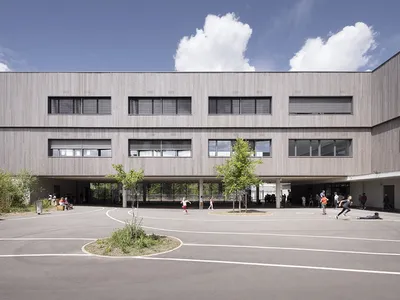
Vil Genis School in Massy, France, features sustainable design, south-facing classrooms, community integration, accessible spaces, and modern educational architecture.

Explore Sustainable Design Competitions
Discover active competitions in this discipline



Challenge to design locus for the upliftment of human rights


Design challenge to reuse E-waste
Comments (0)
Please login or sign up to add comments
No comments yet. Be the first to comment!