

The Cube Zero: A Self-Sufficient Desert City Rooted in African Vernacular
Ania Para's Sahara megastructure fuses traditional courtyard logic with artificial climate systems and closed-loop urban infrastructure.


What if the Sahara Desert, one of the most hostile landscapes on Earth, could host a fully self-sufficient city? The Cube Zero proposes exactly that: a monumental cubic megastructure that encloses an entire urban ecosystem, generating its own weather, recycling its own water, and growing its own food. It is not a utopian fantasy sketched in isolation from climatic reality. Instead, it begins where centuries of African building wisdom left off, translating courtyard houses, minimal façade openings, and shaded rectilinear forms into the scaffolding of a climate-controlled habitat.
Designed by Ania Para, the Cube Zero operates as a holistic climatic machine. Artificial climate systems moderate temperature extremes, solar filters and photovoltaic panels are integrated directly into the cube's surfaces, and a transparent shield wraps the settlement to buffer heat and sandstorms. Inside, vertical farms stabilize microclimates while producing fresh food, and a closed-loop water circulation system eliminates dependency on external supply. The ambition is total: transform extreme heat, dryness, and isolation into conditions suitable for long-term human habitation.
Hexagonal Districts Tessellating Across the Desert
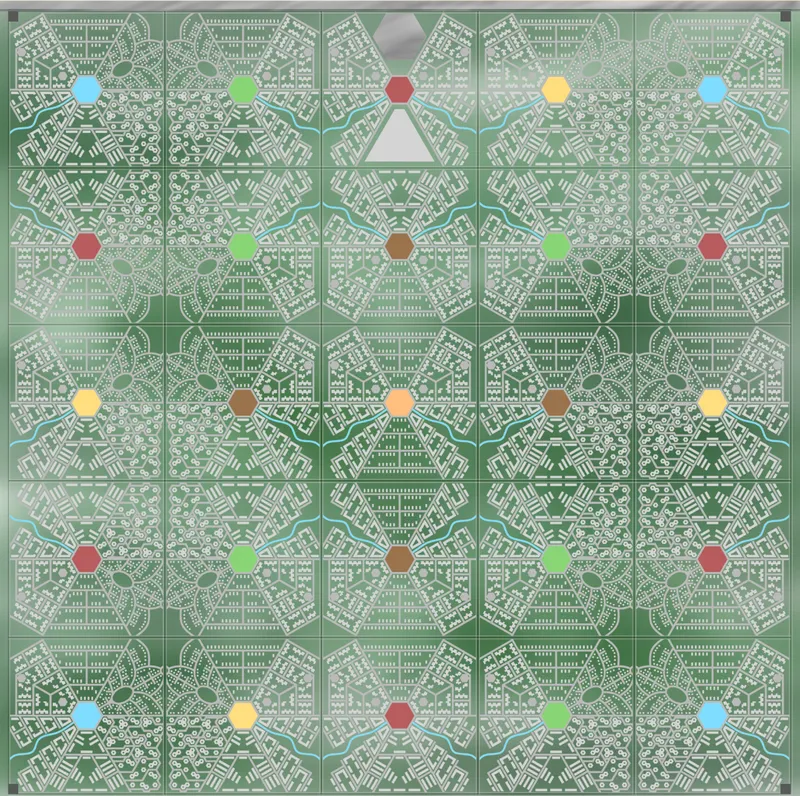
The masterplan follows a modular geometric logic that tessellates outward from a central octagonal core. Colored nodes in the site plan mark the anchors of each hexagonal district, and streets, agricultural zones, and vertical gardens radiate between them. Each module contains residential neighborhoods organized as sheltered clusters, distributed parks that regulate humidity and temperature, and pathways calibrated to walkable distances. The pattern is scalable: add another hex module and the city grows without losing its internal connectivity or climatic balance.
This layered network of housing blocks, vertical farms, greenery and parks, technical towers, fast communication cores, and water circulation systems ensures the habitat can operate with minimal external resources. A Main Tower in each district serves as both a structural anchor and a communications hub, while Hyperloop-enabled mobility connects strategic nodes at high speed. Density and openness are held in careful tension, offering protection from the brutal exterior while maintaining access to shared landscapes within.
Colonnades and Palm-Lined Plazas at the Human Scale
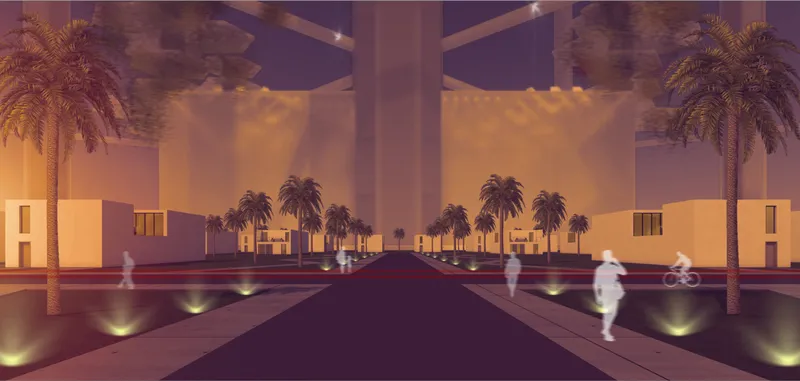

For all its megastructural ambition, the Cube Zero's success depends on what life feels like at ground level. The rendering of a dusk-lit colonnade lined with palm trees shows pedestrians strolling through a plaza that could belong to any well-designed Mediterranean city. The proportions are generous but not overwhelming: columns frame the view, vegetation provides shade and humidity, and warm artificial light supplements the fading sun. This is where the project's debt to vernacular Saharan and Sahelian settlements becomes tangible. Cooling internal gardens, shaded walkways, and modest openings in building facades are not nostalgic gestures; they are thermodynamic strategies refined over centuries.
The axonometric diagram series peels back the cube's skin to reveal its functional anatomy. Central structural cores anchor each district, and surrounding them are layered zones for housing, farming, greenery, and technical services. Reading the diagrams alongside the rendered streetscape clarifies how the macro-scale engineering of artificial climate and solar filtration translates into the micro-scale experience of a shaded plaza with a breeze.
Low-Rise Residential Clusters Behind Glass Walls


Two views into the residential zones show how the Cube Zero domesticates the desert. Through glass walls, palm trees and low-rise white volumes line a pedestrian pathway, giving the streetscape a village-like grain despite its enclosure within a megastructure. The transparent envelope admits filtered daylight without the punishing heat, creating an outdoor quality to spaces that are technically indoors. It is a convincing spatial argument: enclosure need not mean confinement.
The courtyard image sharpens this point. Flowering plants grow beneath a gridded canopy supported by slender columns, and the white residential volumes flanking the space recall both North African medina walls and modernist housing slabs. Two housing typologies, Type A and Type B, serve different household needs. Type A is a compact unit optimized for thermal performance, natural cross-ventilation, and shaded interiors. Type B offers a larger footprint. Both are organized around essential living functions and draw their environmental logic from the courtyard tradition, where internal gardens cool the air before it enters inhabited rooms.
A Transparent Canopy Over Everyday Life

The street-level view beneath the transparent gridded canopy is perhaps the project's most persuasive image. A yellow car rolls past palm trees on a smooth road, pedestrians walk on generous sidewalks, and filtered light falls evenly across the scene. Nothing about this looks like survival architecture. It looks like a comfortable, contemporary city. That is precisely the point. The Cube Zero's transparent shield is not a dome sealing inhabitants away from the world; it is a calibrated filter that admits light and repels heat, sand, and extreme temperature swings. Solar panels embedded in the grid generate the energy that powers the vertical farms, water recycling, and artificial climate systems below.
Why This Project Matters
Desert megastructure proposals often fall into one of two traps: they either fetishize technology at the expense of livability, or they romanticize vernacular traditions without engaging the scale of the problem. The Cube Zero sidesteps both. Its hexagonal masterplan, closed-loop resource systems, and artificial climate envelope are genuinely high-tech, yet the spaces they produce, colonnaded plazas, courtyard gardens, walkable residential clusters, are legible as places shaped by centuries of Saharan spatial intelligence. The project treats African architectural heritage not as a stylistic reference but as a performance library.
Ania Para's work raises a question that will only grow more urgent as climate change renders new territories uninhabitable and makes others newly contested: can architecture create the conditions for human life where nature alone cannot sustain it? The Cube Zero argues yes, but only if designers are willing to think at the scale of infrastructure while designing at the scale of the courtyard. It is a conceptual project, unapologetically speculative, yet grounded enough in real environmental logic to function as a provocation worth taking seriously.
View the Full Project
About the Designers
Designer: Ania Para
Enter a Design Competition on uni.xyz
uni.xyz runs architecture and design competitions year-round that reward proposals with spatial conviction and real site intelligence.
Project credits: The Cube Zero by Ania Para.


Popular Articles
Popular articles from the community


Manzana Morphosis: Stretching Barcelona's Grid into a Living Landscape for 2050
A radical reworking of the Eixample manzana turns density into a tool for generous public space, vertical ecology, and environmental performance.

The Amber Palace Opera: A Geological Fiction Surfaces on Tallinn's Baltic Waterfront
Pierre Brillard reimagines a Baltic legend as a public landscape, opera house, and waterfront promenade rooted in Tallinn's coastal identity.
Opera by the Sea Estonia: Three Shells Dissolving Architecture into Tallinn's Coastline
A winning opera house proposal replaces monumental form with interconnected shells that blur the boundary between building, park and Baltic Sea.

Temporary Home for Dogs: A Reversed Zoo Rethinks Animal Shelter Architecture
In Bucharest, a sinuous corridor and freed landscape flip the logic of containment, designing a shelter that works to make itself unnecessary.

Similar Reads
You might also enjoy these articles

Play: Fragments of Their World: Remembered Architecture Rebuilt as a Modular Playground for Refugee Camps
Tom Gardner abstracts domes, arches and towers from the homelands of displaced families into a kit of child-scaled play parts for camp settlements.
REBIRTH: A Circular Settlement Where Afghan Widows and Their Children Rebuild Life Together
A shortlisted Resile entry turns the circle into a protective ring of timber and brick, gathering homes, classrooms and gardens around a shared landscape.
The Main Dream: A Recycled Plastic Kit That Lets Refugee Children Build Their Own Playground
Thirty-centimetre interlocking cubes that connect on three axes turn play into construction, letting children author the spaces they occupy.

Lunar Spiral: A Fibonacci-Driven Moon Settlement Rising from Shackleton Crater
Golden-spiral geometry organises buried infrastructure and orbiting habitable spheres into a lunar base designed to grow as life on the Moon expands.

Comments (0)
Please login or sign up to add comments
No comments yet. Be the first to comment!