
Dark Side of the Moon: Where Cosmic Gravity Becomes Architecture
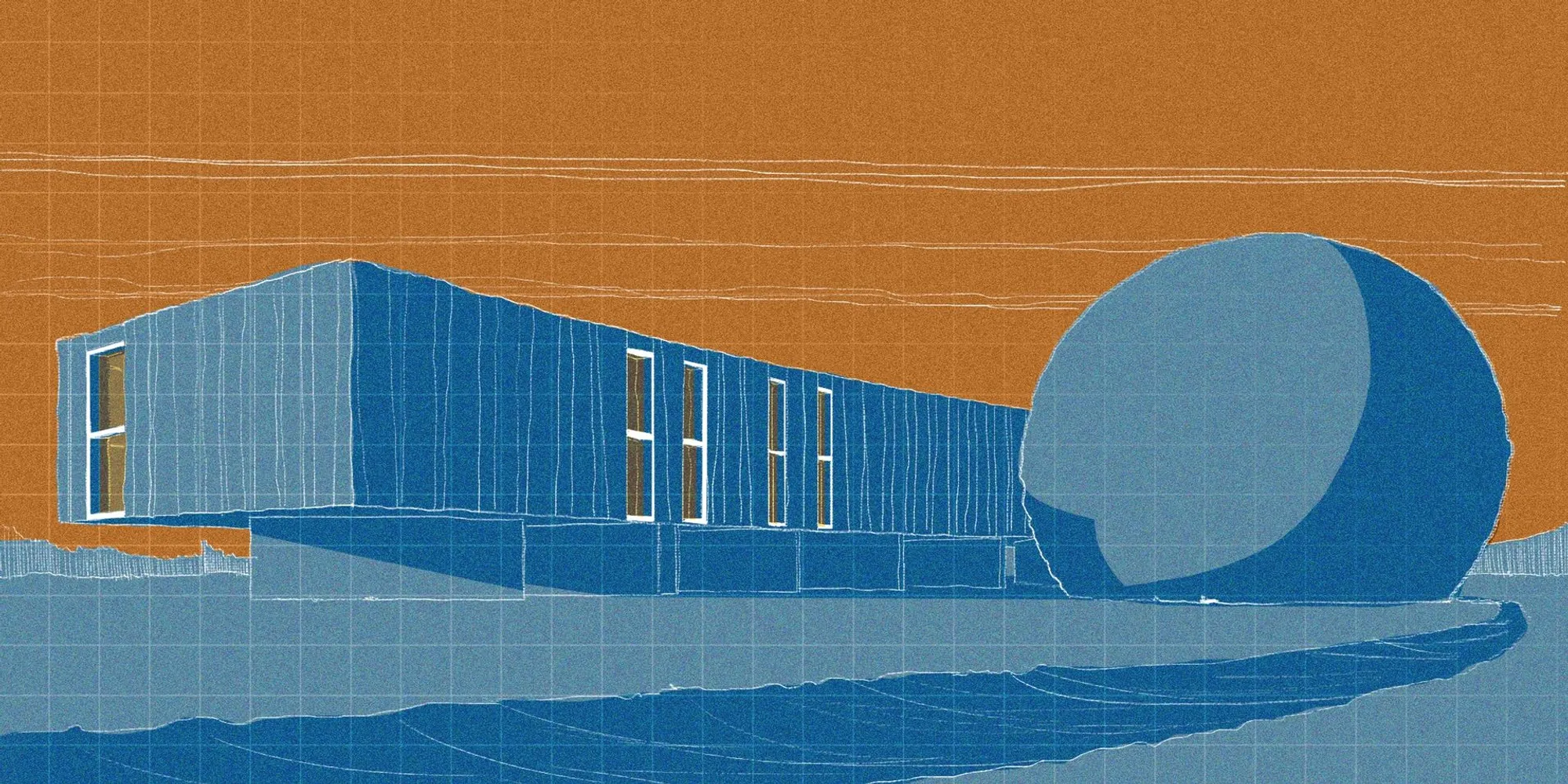
A cuboid and sphere lock into orbit around each other, translating the Earth-Moon gravitational bond into an educational landmark.


What happens when you try to build the gravitational relationship between two celestial bodies? You get a floating cuboid locked in tension with a spherical planetarium, each form pulling at the other across a shared site. Dark Side of the Moon takes the invisible force that binds the Earth and Moon and makes it spatial, structural, and walkable.
Designed by Tamas Balint as an Editor's Choice entry for Moontrip 2019, the project celebrates the 50th anniversary of the Moon landing by fusing science education, immersive entertainment, and speculative architecture into a single complex. The concept leans into the mystery of the Moon's far side, channeling the human urge for discovery into a building that refuses to sit quietly on the ground.
A Cuboid in Orbit Around a Sphere
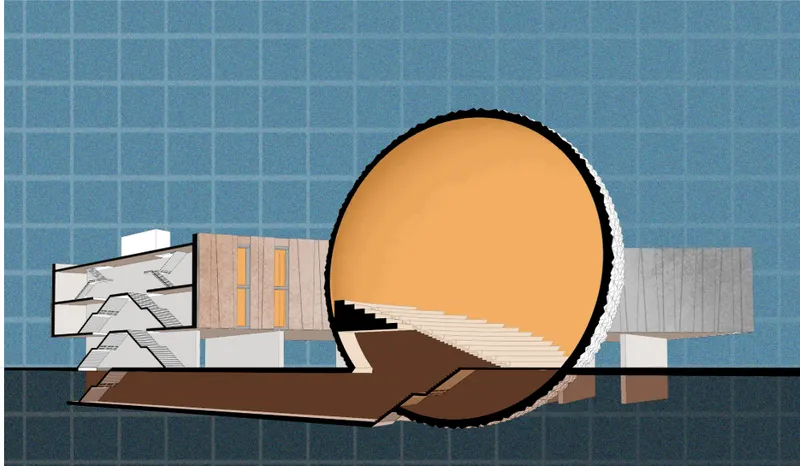
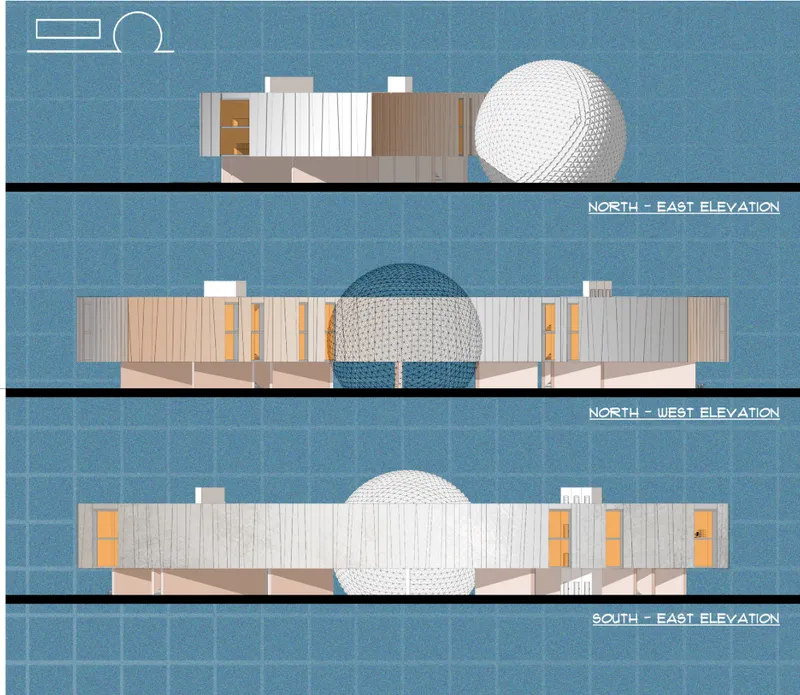
The section and elevation drawings reveal the project's central formal argument: an elongated cuboid volume, elevated on structural blades, appears to hover above the ground plane while a geodesic sphere nestles at its center. The cuboid represents human knowledge and structure; the sphere is the planetarium, the experiential heart of the complex. Seen from multiple compass directions, the dome reads as a gravitational anchor pulling the linear volumes into its orbit. The decision to lift the cuboid off the ground isn't just theatrical. It literalizes the floating sensation of reduced gravity, giving the ground floor an open, colonnade-like quality defined by those blade-thin structural supports.
Atmosphere Rendered in Orange Sky and Blue Terrain
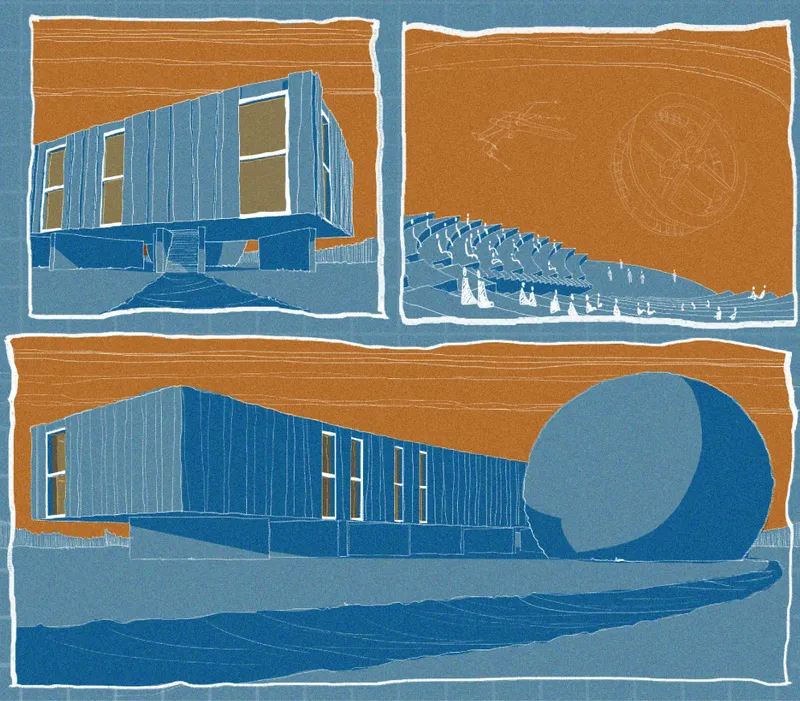

Two renderings capture the project at different emotional registers. In the sketch view, rectangular volumes and the spherical dome sit against a blazing orange sky, suggesting an alien horizon and reinforcing the extraterrestrial ambition of the programme. The second image pulls back to a lakeside vantage point, where ribbed horizontal volumes flank the geodesic dome under overcast skies. Here the building looks surprisingly grounded, even civic, its ribbed facades reflecting in calm water. The contrast between these two views matters: one positions the project as a piece of speculative fiction, the other proves it could hold its own in a real landscape.
An outdoor planetary yard extends the educational programme beyond the building envelope, letting visitors experience simulated planetary atmospheres. The blending of indoor exhibition with outdoor experiential landscape gives the complex an almost theme-park generosity, but one governed by scientific curiosity rather than spectacle alone.
Stacked Floors, From Rovers to Rooftop Constellations
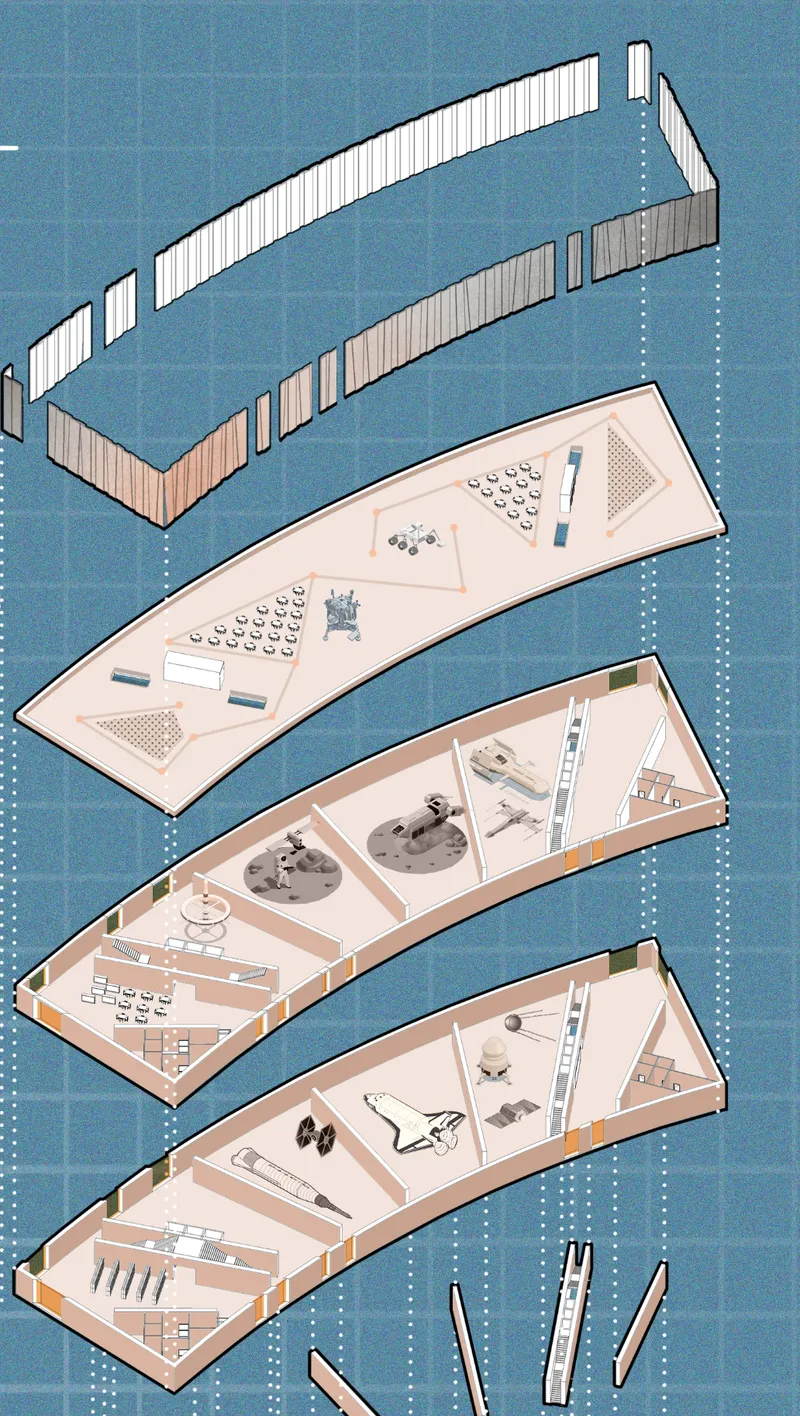
The exploded axonometric is the most revealing drawing in the set. It peels apart the stacked floor levels to show how programme escalates from public to immersive as visitors move upward. The ground floor, held open by those structural blades, creates a floating threshold. The first floor houses exhibition spaces dedicated to Moon exploration, rockets, and rovers. Above that, a second floor shifts to experimental zones focused on light, texture, and biological experiments. At the top, a roof terrace offers a constellation path for interactive learning under the open sky. Each level gains in specificity and intimacy, a gradient from broad spectacle to focused inquiry.
The planetarium itself is accessed through an underground tunnel, a deliberate act of spatial compression before the release into the dome's multidimensional theater. It doubles as a conference hall, making it a flexible anchor for both public events and educational programming.
Reading the Building From Above
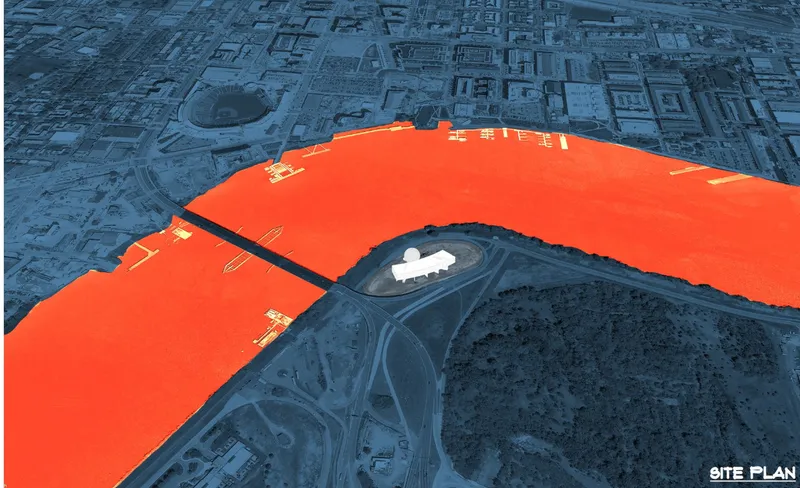
The site plan rendering highlights the curved roofscape in orange against a blue urban grid, revealing how the building asserts itself within its surrounding infrastructure. From above, the flowing roof line reads almost topographic, as if a new landform has settled into the city fabric. The colour coding makes the architectural footprint unmistakable against the orthogonal street pattern, underscoring the tension between the project's cosmic aspirations and its terrestrial context. It is a building that wants to be seen from orbit.
Why This Project Matters
Commemorative architecture often defaults to monuments: static, symbolic, and closed. Dark Side of the Moon takes the opposite approach. By organizing its programme around ascent, from open ground through exhibition to rooftop stargazing, and by threading an underground passage to a spherical planetarium, the project makes the act of exploration its primary spatial experience. Visitors don't just learn about the Moon landing; they move through a sequence that mirrors the journey from Earth to the unknown.
Balint's design demonstrates that speculative architecture can carry genuine programmatic rigor. The cuboid-and-sphere composition is not arbitrary formalism; it encodes a specific physical relationship and then unpacks it into floors of education, experiment, and public engagement. For a competition celebrating humanity's greatest voyage, that commitment to making cosmic forces tangible through architecture is exactly the right ambition.
View the Full Project
About the Designers
Designer: Tamas Balint
Enter a Design Competition on uni.xyz
uni.xyz runs architecture and design competitions year-round that reward proposals with spatial conviction and real site intelligence.
Project credits: Dark Side of the Moon by Tamas Balint Moontrip 2019, (uni.xyz).



Popular Articles
Popular articles from the community


The Earth Pod: 3D Printed Homes for Resilient Refugee Communities
The Earth Pod reimagines refugee housing through 3D printed homes made from clay, combining resilience, self-sufficiency, and rapid shelter.

Riyadh For All: Intergenerational Urban Design for Active Aging in Rabat
Riyadh For All reimagines urban design in Rabat with intergenerational co-living, adaptive courtyards, and Moroccan cultural exchange today.

Co-Life: Senior Housing Design That Reconnects Older Adults With the City
Co-Life reimagines senior housing design through healing gardens, shared streets, workshops, and a sustainable community across generations.

Play: Fragments of Their World
Familiar architecture becomes modular playground design, creating safe spaces where displaced children can learn, connect, imagine and play.


Similar Reads
You might also enjoy these articles

Bao Huynh Watercolor Atelier: A Serene Art Retreat in Hội An
Bao Huynh Watercolor Atelier in Hội An blends multifunctional art spaces, sustainable design, local materials, and family-friendly living in a serene environment.

Atelier Macri Concept Store Interior Design by CASE-REAL
Atelier Macri store features a "ko" counter, walnut wood details, cork displays, blending retail, gallery, and seamless customer experiences.

Manuel Vargas Izquierdo Stadium and High-Performance Sports Center: Architectural Excellence in Jalpa de Méndez
The Manuel Vargas Izquierdo Stadium blends sustainable design, inclusive sports facilities, and cultural-inspired architecture, revitalizing Jalpa de Méndez’s public spaces.

KAKR Buluh Awar Hall: Revitalizing Community and Ecology Through Bamboo Architecture
Community built bamboo hall revitalizes Buluh Awar village, empowering youth, restoring ecology, celebrating vernacular craftsmanship through sustainable architecture and culture.

Explore Moondial Competitions
Discover active competitions in this discipline



Challenge to design public laboratory


Challenge to reimagine the Iron Throne


Photograph architecture without architects


Illustrate the lost glory of Angkor Wat - Render Challenge
Comments (0)
Please login or sign up to add comments
No comments yet. Be the first to comment!