
The Echoes of the Railway
Reimagining Chile through a railway-inspired eco-tourism complex that grows from the landscape, blends heritage with innovation, and explores the structural poetry of wood, stone, and steel

Rio Blanco, a small village in the Chilean Andes, once pulsed with the rhythm of the railway. The iron tracks carried workers, goods, and stories, weaving the town into a larger network of movement and exchange. Today, however, only traces remain. The railway lies dormant, its echoes fading into the mountains. This project is an architectural eco-tourism complex rooted in the railway’s legacy and aims to restore life to Rio Blanco, not by replicating the past, but by transforming its logic of branching circulations into architecture.
The design grows like a living organism: from a simple nucleus it expands into a branching network that integrates seamlessly with the riverbanks and the steep mountain slopes. It is not only a place for visitors to stay, but a spatial narrative. A way to experience Rio Blanco’s layered history, its natural beauty, and its potential future.
Conceptual Framework: Circulations as Architecture
The core idea is drawn from the railway logic of branching. Just as railways once extended from a central line into multiple routes, the project develops from a central plaza into diverging paths, each leading to a distinct programmatic cluster: lodging, dining, wellness, and cultural exchange.
This networked structure encourages exploration and movement. Visitors are not confined to a single axis but are invited to wander, discovering the architecture as they might discover the landscape itself through paths, pauses, and intersections. The design becomes circulation, and circulation becomes the narrative.
Materiality and Construction
The material strategy bridges tradition and innovation:
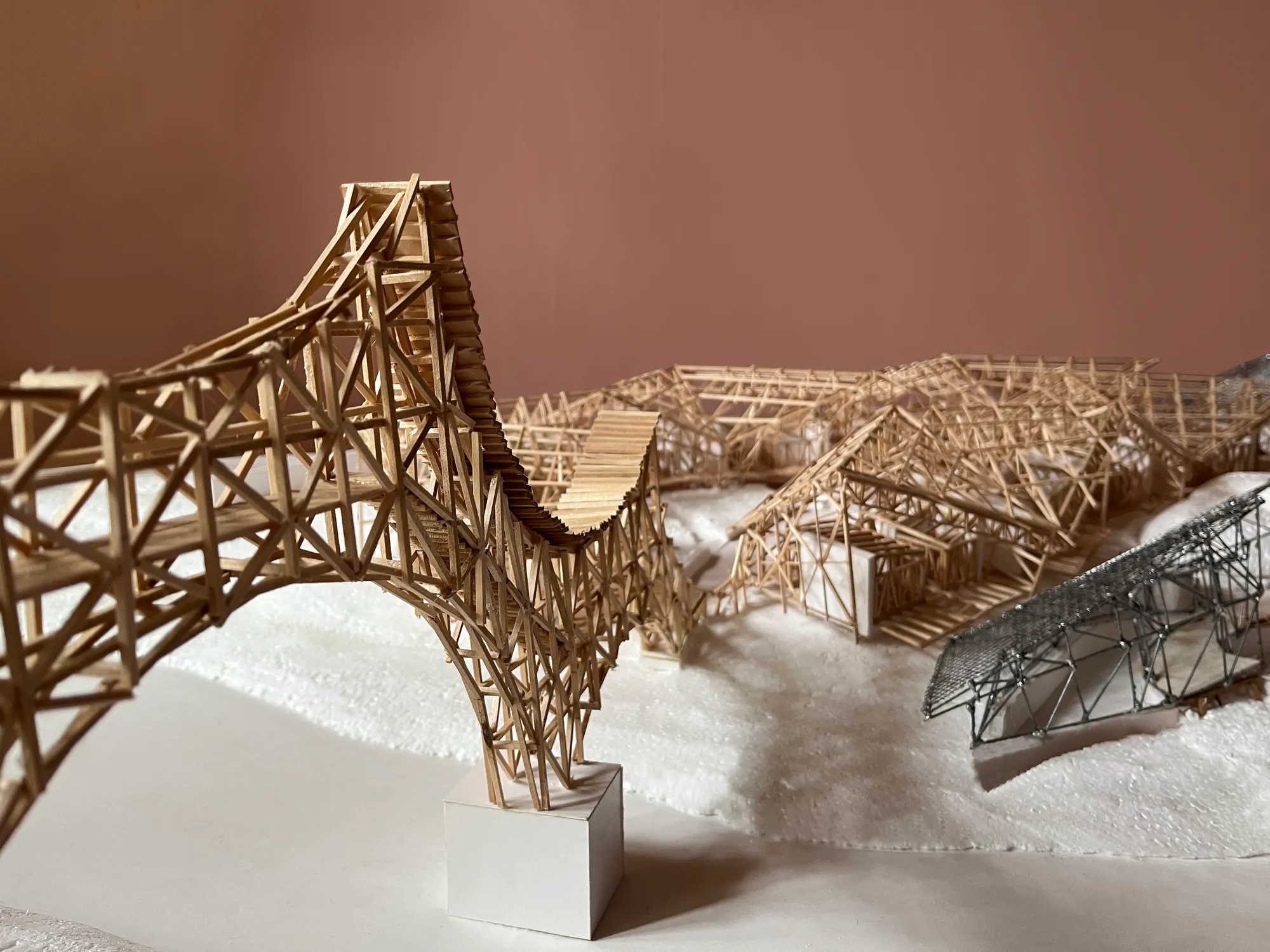
• Wood is the protagonist. Local timber is employed not only for its availability and warmth but also for its structural versatility. By experimenting with a scaled physical model, I explored different joinery techniques, spanning systems, and the balance between slenderness and stability. These analog studies revealed how wooden beams and panels could achieve lightness without compromising seismic resistance which is a crucial factor in Chile.
• Stone acts as the anchor. Retaining walls and foundations are built with stone sourced from the site, grounding the project and echoing the rugged Andes. The massive quality of stone contrasts with the lightness of wood and glass, creating a dialogue of permanence and adaptability.
• Steel and glass complete the palette. Steel joints allow precision where wood alone would falter, while glass opens the interiors to the landscape, framing the river and the snow-capped peaks.
Together, these materials embody resilience against climate extremes which range from heavy snowfalls to seismic events, while maintaining a tactile, human presence.
Programs of Eco-Tourism
Rio Blanco sits at a dramatic intersection: the river carves through the valley floor, while steep mountains rise abruptly on either side. The project embraces this duality, conceived as more than accommodation. It is a microcosm of sustainable tourism, offering diverse experiences while minimizing ecological impact.
1. Lodging: Wooden cabins scattered along branching paths, each with views to the river or mountains, offering both intimacy and immersion in nature.
2. Dining Rooms: Long timber structures with exposed beams and glass façades, where the guests can prepare food with local ingredients, celebrating regional traditions.
3. Wellness Spaces: Different variations of indoor and outdoor pools integrated into wooden decks, shaded by delicate lattice structures inspired by railway bridges.
4. Cultural Pavilion: A huge, railway-station-like hall for exhibitions, workshops, and storytelling, connecting visitors with the memory of the railway and the culture of the Andes.
Through these programs, the project becomes a living cultural exchange, rather than a passive resort.
Design Process: Analog and Experimental
The project was shaped through hands-on model making rather than purely digital simulations. By working with wooden sticks, wire, and cardboard I tested how materials could interact structurally and atmospherically.
• Models in wood and wire allowed me to explore span and joinery, teaching me how to balance elegance and strength.
• Cardboard as a representative of stone, helped visualize massing and the dialogue between solid and void.
This analog process was crucial in understanding not just the form of the project but its constructive logic and how it might truly be built in a seismic region, how forces flow through joints, and how material honesty translates into architectural expression.
Sustainability and Resilience
Sustainability is embedded at every scale:
• Energy: Passive solar orientation, natural ventilation, and thermal mass reduce the need for artificial heating and cooling.
• Water: Rainwater is harvested and filtered, while greywater is reused for irrigation.
• Biodiversity: The project preserves riparian habitats along the river, minimizing ecological disruption.
• Seismic Design: Structural redundancies and material combinations ensure resilience in one of the world’s most earthquake-prone regions.
Here, eco-tourism is not just an experience but a responsibility. It is a way of inhabiting the Andes without erasing its fragility.
A Narrative of Heritage and Future
At its heart, the project is a story of Rio Blanco. The railway once carried the lifeblood of the town, but when the trains stopped, silence settled. By transforming railway logic into architecture, this project revives motion. Not a mechanical one but a human, ecological, and cultural motion.
It is a dialogue between past and future, nature and architecture, memory and possibility. Visitors become participants in this dialogue, moving through spaces that echo with history while opening to new horizons.
Conclusion: Architecture as Movement
“Echoes of the Railway, Chile” is not a static object but a living system of movement, branching, and adaptation. It embodies how architecture can grow from a site, respect its heritage, and push forward into new ecological and structural possibilities.
By weaving together material experimentation, analog design processes, and the cultural memory of the railway, the project demonstrates how architecture can be both rooted and transformative, how it can be an echo that carries forward into the future.



Popular Articles
Popular articles from the community


Co-life: Sustainable Architecture for Age-Friendly Community Living
Co-life reimagines sustainable architecture for seniors through courtyards, rammed earth, shared gardens, and spaces designed for belonging.

The Musturak Paradise: Senior Living Architecture for a Connected Future in Temara, Morocco
The Musturak Paradise reimagines senior living architecture in Temara via private homes, social spaces, culture, community, and shared care.

The Earth Pod: 3D Printed Homes for Resilient Refugee Communities
The Earth Pod reimagines refugee housing through 3D printed homes made from clay, combining resilience, self-sufficiency, and rapid shelter.

Conexión: Biophilic Design Reimagines High-Rise Living in Hong Kong
Conexión reimagines high-rise living in Hong Kong through biophilic design, green facades, shared spaces, daylight, water and nature within.


Similar Reads
You might also enjoy these articles

Day and Night Park: A Time-Based Urban Newsstand in Beijing
A temporary urban newsstand in Beijing blending travel, light, and reading through poetic colors, compact form, and community-focused design.

Modernist Patio Renovation in El Masnou, Barcelona by Oliver Segura Arquitectura + Cebrià Arquitectura
Modernist patio renovation blending tradition and innovation with a movable pool, leveled floors, and Catalan materials in El Masnou.
Alto Residencial Coop: Cooperative Housing Development in Santiago de Compostela by Carbajo Barrios Arquitectos
A linear cooperative housing complex blending white volumes and perforated metal façades, enhancing community living, natural light, privacy, and urban integration.
Vil Genis School by BPA ARCHITECTURE – Massy, France
Vil Genis School in Massy, France, features sustainable design, south-facing classrooms, community integration, accessible spaces, and modern educational architecture.




Comments (0)
Please login or sign up to add comments
No comments yet. Be the first to comment!