
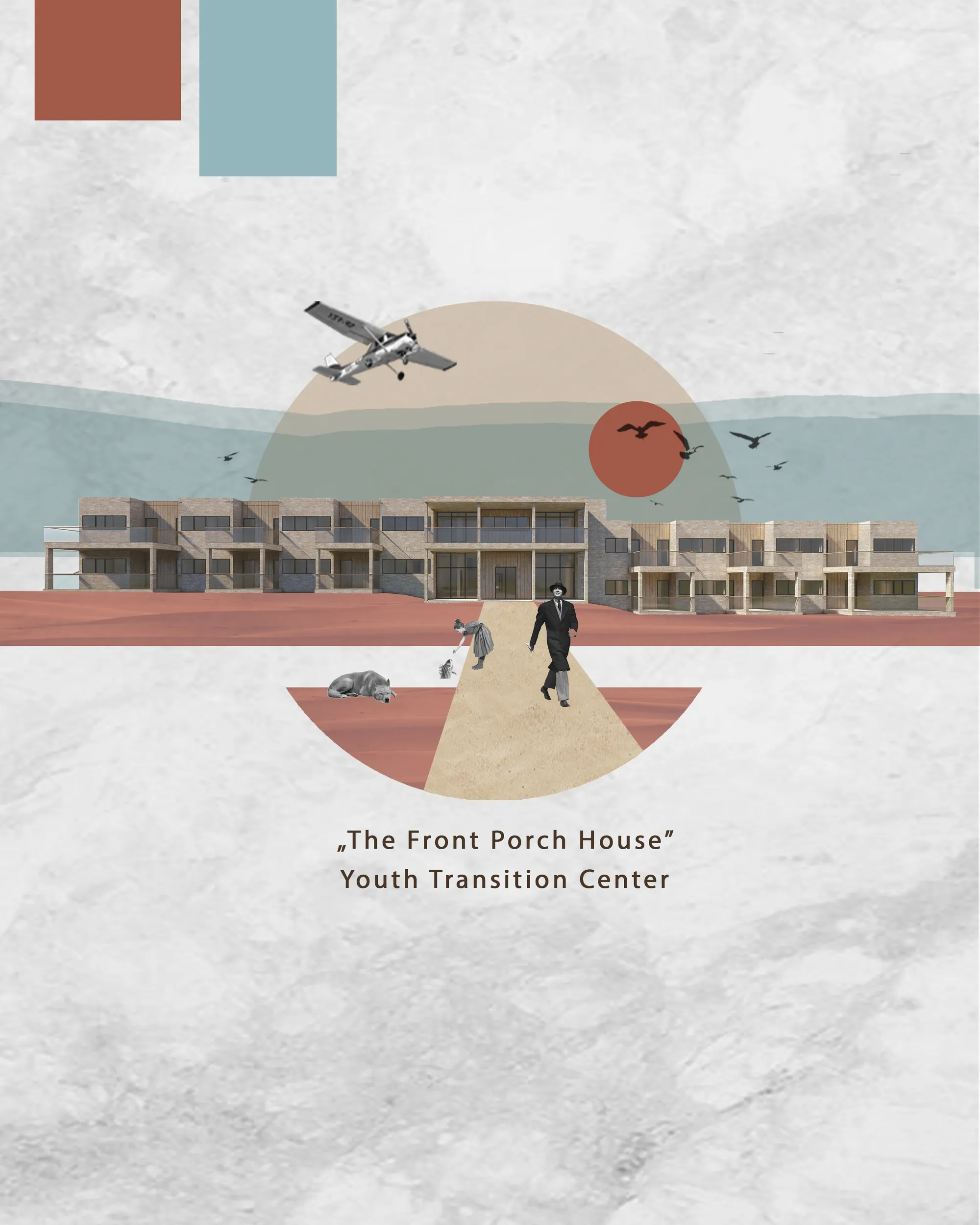
The Front Porch House
About the way how location can impact the designed building.

Every design has hours of analysis and sketches behind it. Each architect creates his/her concept and way of combining the functions of the building with its appearance. So you may be wondering what was the main idea behind my design of the transition center for homeless youth. Well...First of all, I wanted to create a place that can replace home - functionally and in feel. It is not difficult to design an attractive or impressive building. The main challenge is to design not only a model that can be placed anywhere in the world but a building that both: suits the location and represents an image/dream of a home.
“The front porch house” refers to the neighborhood. Thanks to embedding their place in the locality the youth will not feel like misfits but like members of the local community.
I started my project by researching the area. The neighboring buildings are single-family houses with brick or stone façades and typical front porches. This has become one of my main inspirations. I have designed four types of residential modules with a total of sixty, each with direct access to a porch (two modules for one common porch). Most of the residential units are private rooms. Many of these people may have problems with accepting their identities, such as transgender youth or those suffering from physical or mental abuse. In my opinion, they deserve a sense of privacy and time for themselves - without strangers disrupting their comfort zone. As I am a supporter of the statement "form follows function"- housing unit became the main factor of planning the whole building. My main goal was to create a place where young homeless individuals can acquire skills that they did not learn at home. This will be a facility where they will be given a chance of proper education, medical assistance, or psychological counseling.
The transition center consists of the main core with workshop, studio, offices, training kitchen, classroom, etc., and two dormitory wings with residential modules- west-wing for females and east-wing for males. Both parts of the building are connected from the south by the library and the amphitheater entrance, and from the north by a common greenhouse. The second-floor plan is similar to the ground floor. It consists of administration at the middle and housing units on both sides of the building. The underground part of the building consists of technical rooms
The greenhouse is an important point in the center because there you can carry out Horticultural therapy- therapy during which people can talk to a therapist about their problems and issues, during routine gardening work. Plant therapy teaches people to be responsible and committed. It also provides a sense of ownership and smart management. This method encourages them to talk and open up to the other person. Direct contact with plants is also believed to distract youth from stress, improving the overall quality of life. The center also has a garden with openwork benches, which is quiet and cut off from outside noise thanks to the surrounding buildings. I also designed a place for a streetball field where young people can spend their free time actively.
The shape of the center fits into the sloping terrain. The main part of the building is on level 0, the left side is raised by 75 cm and the right side is lowered by the same amount. The ceiling of the main section is also raised by 75cm making it in line with the left section, which makes the main hall higher and more representative. The designed seating placement for the audience of the amphitheater is opposite to the slope of the ground (it climbs upwards). Thanks to this, a place for a library was obtained, and a meeting room underneath it. The youth can spend their free time watching TV and playing ping-pong or board games.
When planning the building, I also paid attention to the fact that it should be easily accessible to people with disabilities. Thanks to many well-thought-out design solutions, they can easily move around the center. To pass height changes between the three different sections of the building, disabled individuals may use elevators and specifically personalized lifts to satisfy their needs. Four housing units - two in the female wing and two in the male wing, have also been adapted for the use of people with disabilities.
In the end, let's look at the more technical aspect of the design that complements the idea of the porch house. The building was designed in cross-laminated timber (CLT) technique. This material is 99% made of wood, which comes from friendly and responsible forest cultivation. CLT is also considered a sustainable building material due to the fact that wood in the very process of its "formation" uses more CO2 as a plant than it produces. Other building materials consume large amounts of fossil fuels in the production process and consequently produce large amounts of CO2. On the ground floor, glazed, sliding modular walls have been introduced, thanks to which you can easily access the inner garden from almost every part of the center. The roof of the greenhouse is partly covered in photovoltaic glass which provides the building with energy. The façade was clad with stones intertwined with wood, which warms the raw appearance of the building. That style, as I mentioned at the beginning of the article, directly refers to the neighborhood, creating a coherent part of city planning.


Popular Articles
Popular articles from the community


Riyadh For All: Intergenerational Urban Design for Active Aging in Rabat
Riyadh For All reimagines urban design in Rabat with intergenerational co-living, adaptive courtyards, and Moroccan cultural exchange today.

The Ocean Hive: Sustainable Architecture for a Self-Sufficient Civilization at Sea
The Ocean Hive imagines sustainable architecture at sea, where modular habitats, algae, wave power and ocean waste sustain a growing colony.
EW PARK: Sustainable Architecture Reimagines the Future of Urban Parking
EW PARK reimagines city parking as a modular wooden tower combining automation, solar energy, electric mobility, and adaptable urban design.

Hill & Cross Opera: Sculptural Opera House Architecture Shaped by Tallinn’s Landscape and Identity
Hill & Cross Opera reimagines opera house architecture in Tallinn through its sculptural hill, civic plaza, glass wave and a luminous cross.


Similar Reads
You might also enjoy these articles

Day and Night Park: A Time-Based Urban Newsstand in Beijing
A temporary urban newsstand in Beijing blending travel, light, and reading through poetic colors, compact form, and community-focused design.

Modernist Patio Renovation in El Masnou, Barcelona by Oliver Segura Arquitectura + Cebrià Arquitectura
Modernist patio renovation blending tradition and innovation with a movable pool, leveled floors, and Catalan materials in El Masnou.

Alto Residencial Coop: Cooperative Housing Development in Santiago de Compostela by Carbajo Barrios Arquitectos
A linear cooperative housing complex blending white volumes and perforated metal façades, enhancing community living, natural light, privacy, and urban integration.

Vil Genis School by BPA ARCHITECTURE – Massy, France
Vil Genis School in Massy, France, features sustainable design, south-facing classrooms, community integration, accessible spaces, and modern educational architecture.
Explore Youth Architecture Competitions
Discover active competitions in this discipline



Challenge to design locus for the upliftment of human rights


Challenge to reimagine the Iron Throne


Photograph architecture without architects


Illustrate the lost glory of Angkor Wat - Render Challenge
Comments (0)
Please login or sign up to add comments
No comments yet. Be the first to comment!