Modo Designs Organizes a Concrete Courtyard House Around Light, Air, and Garden Views in AhmedabadModo Designs Organizes a Concrete Courtyard House Around Light, Air, and Garden Views in Ahmedabad

Modo Designs Organizes a Concrete Courtyard House Around Light, Air, and Garden Views in Ahmedabad

UNI logoUNI logo
UNI Editorial
UNI Editorial published Story under Architecture, Housing on

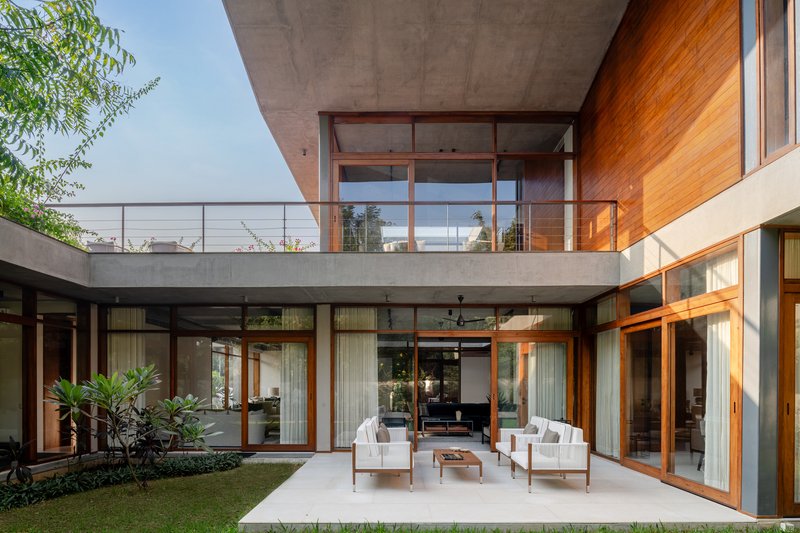
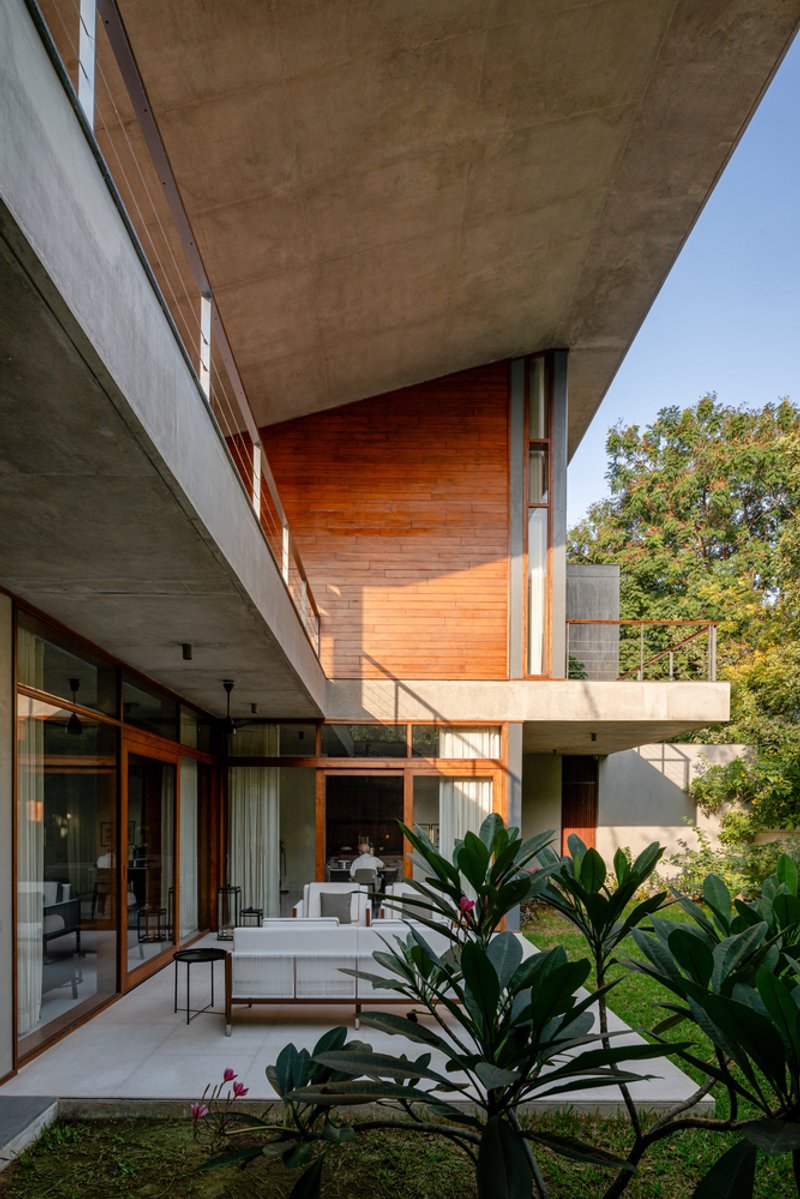
In western Ahmedabad, where tight urban plots meet pockets of mature greenery, Modo Designs has completed a house that plays a deliberate double game. From the south, where the site fronts a public road, The House of Volumes presents a near-fortress: stacked concrete slabs, minimal openings, and a cantilevered canopy that signals entry without giving anything away. Walk through that threshold, though, and the architecture pivots completely. A central courtyard cracks the plan open, pulling daylight down through a double-height void and threading breezes between ground and upper floors. Every room orbits this cut, and the entire northern edge dissolves into floor-to-ceiling glazing that frames a lush private garden.

What makes this project worth studying is the precision of its duality. Modo Designs treats the courtyard not as a nostalgic gesture toward traditional Gujarati housing but as a working environmental device, one that ventilates a deep plan, distributes natural light to interior rooms, and creates visual continuity between two floors of program. The material palette is deliberately restrained: exposed reinforced cement concrete on the outside, white walls and warm timber paneling on the inside. That restraint lets the spatial choreography, the way you move from compression to release, from shadow to sunlight, do all the talking.

A Fortress That Opens Inward

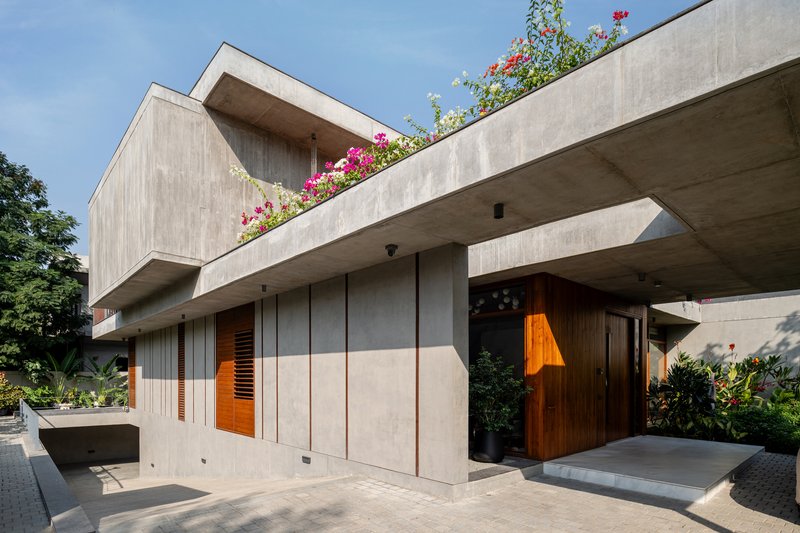
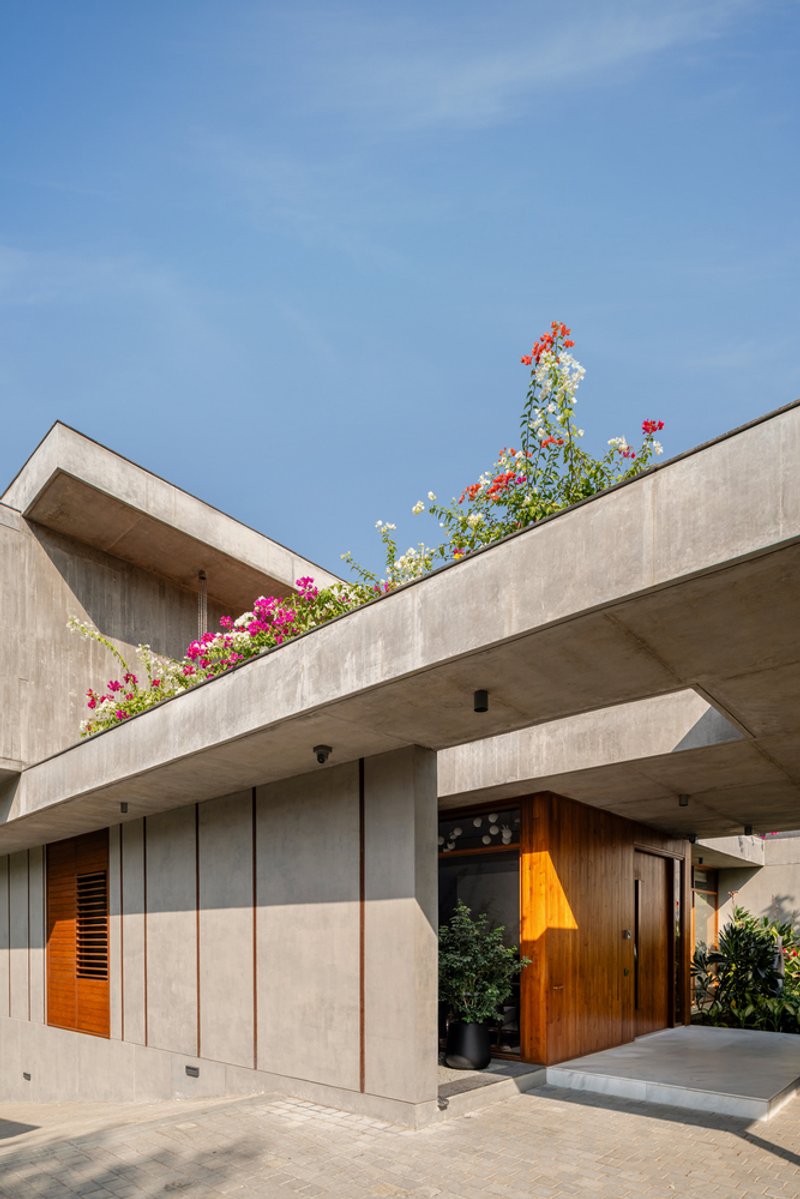
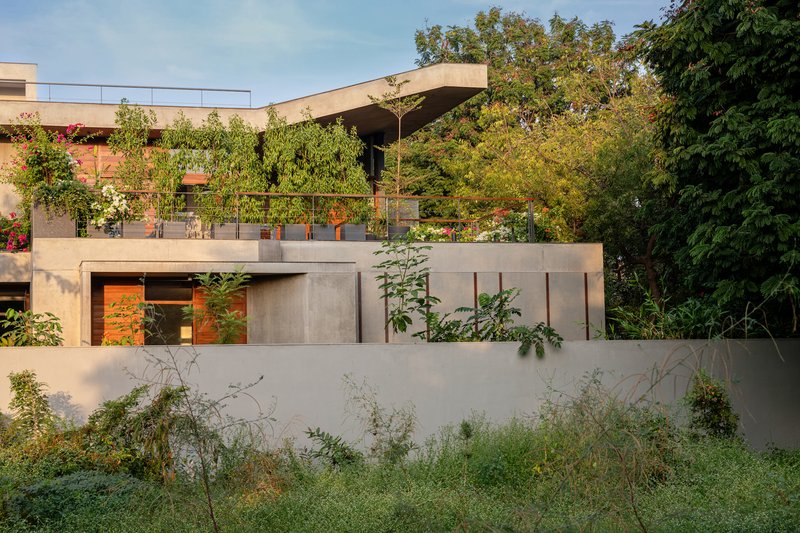
Entrance facade with cantilevered concrete slabs, timber shutters, and flowering plants on the roof terrace
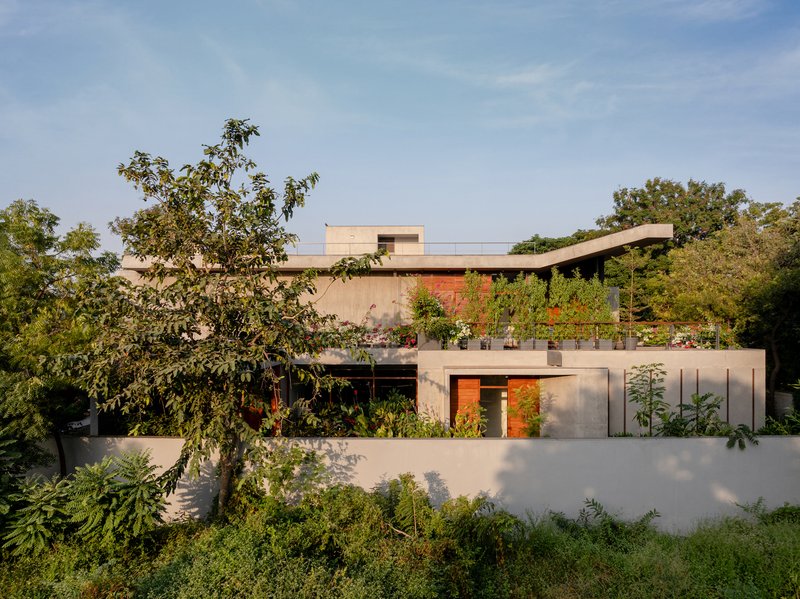
Street view showing stacked concrete volumes with planted terraces surrounded by mature trees at dusk
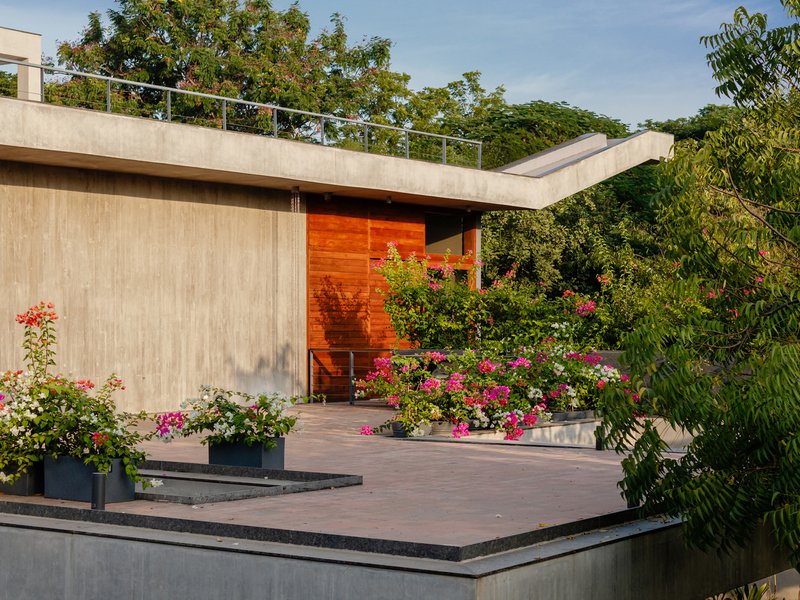
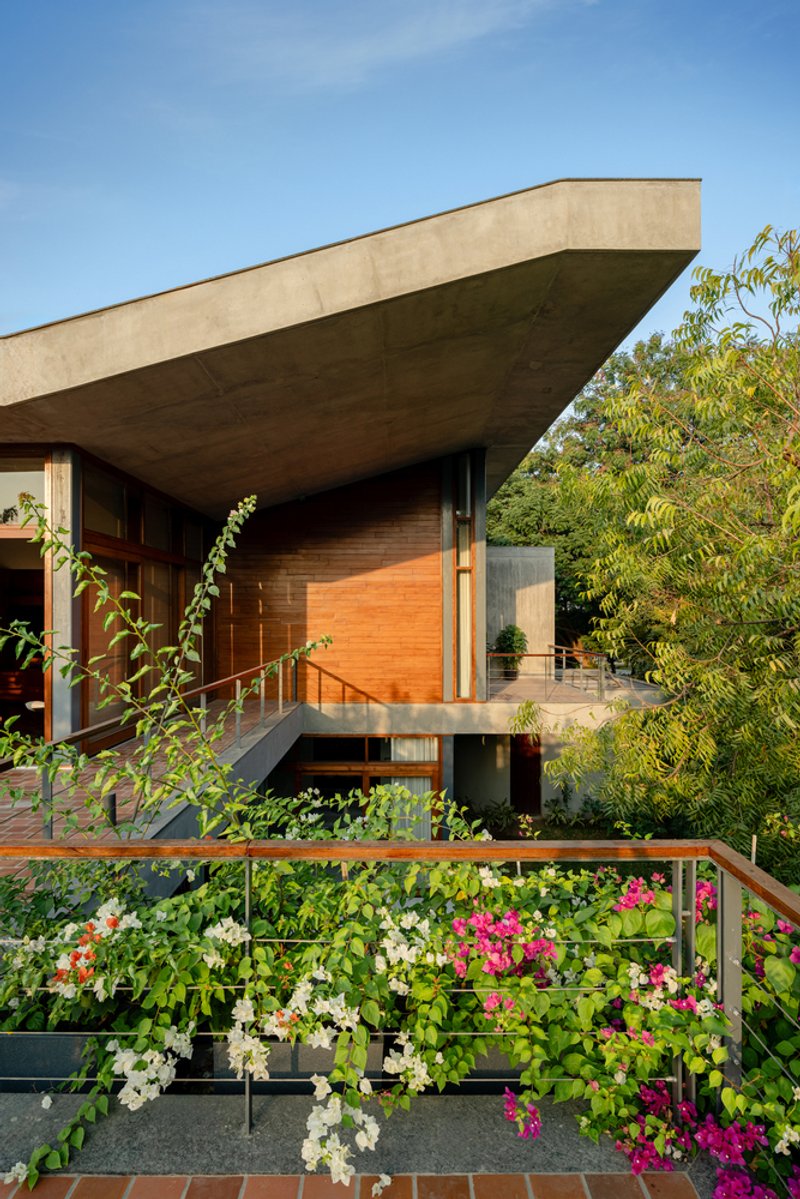
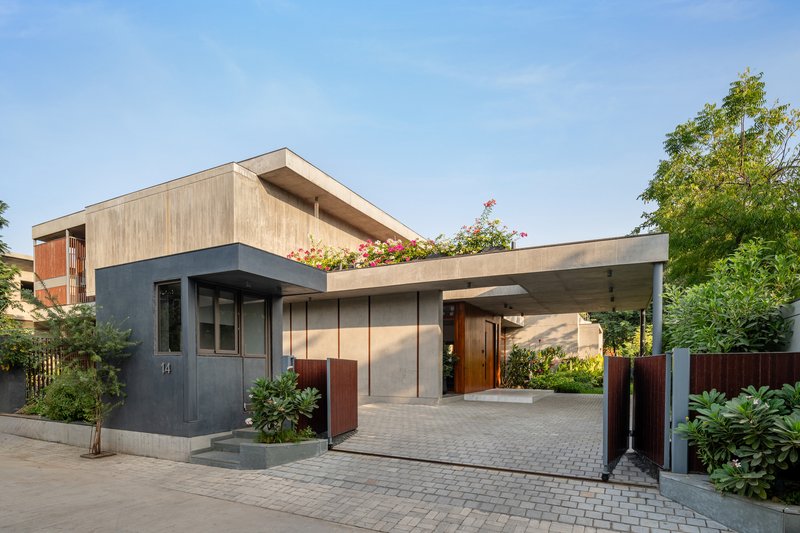
Cantilevered concrete entrance canopy with flowering bougainvillea spilling from the upper terrace against blue sky

The southern facade reads as a composition of stacked concrete volumes, deliberate in its opacity. Cantilevered slabs hover above timber shutters, and bougainvillea cascading from a planted roof terrace softens what would otherwise be an uncompromising wall of grey. At dusk, the layered masses take on a sculptural quality against mature trees lining the street, and the entry canopy, a thick concrete plane jutting out over a brick-paved path, marks the transition from public to private without ceremony.

This is a common enough strategy in hot, dense Indian cities: close down to the street, open up to the sky and the garden. But Modo Designs executes it with real conviction. The south elevation has almost no glass, protecting bedrooms from road noise and western Ahmedabad's intense solar gain. The architecture earns its privacy honestly, through mass and orientation rather than curtains and blinds.

The Courtyard as Climate Machine

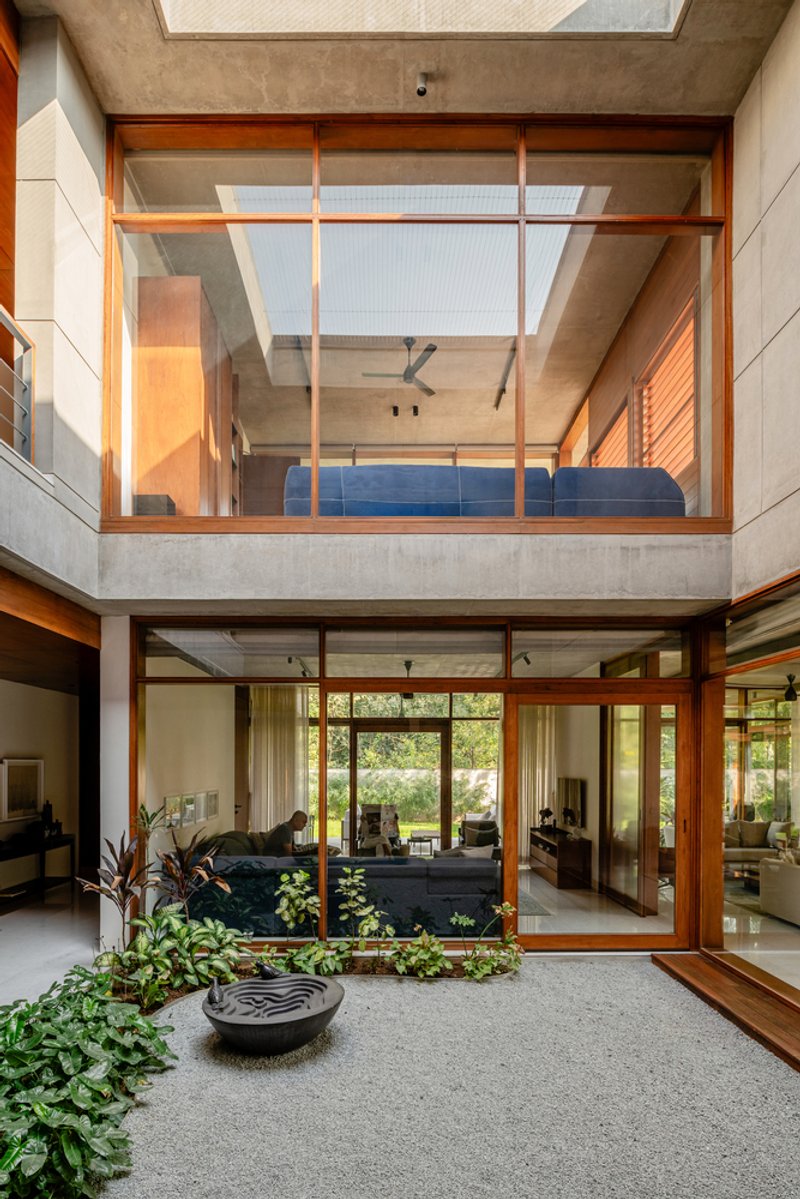
Internal courtyard with timber-framed glazing on two levels and potted plants on terrazzo flooring
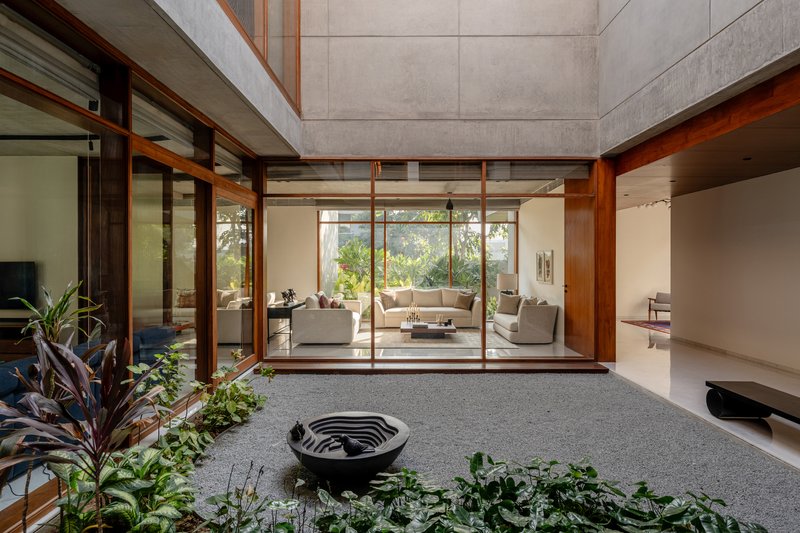
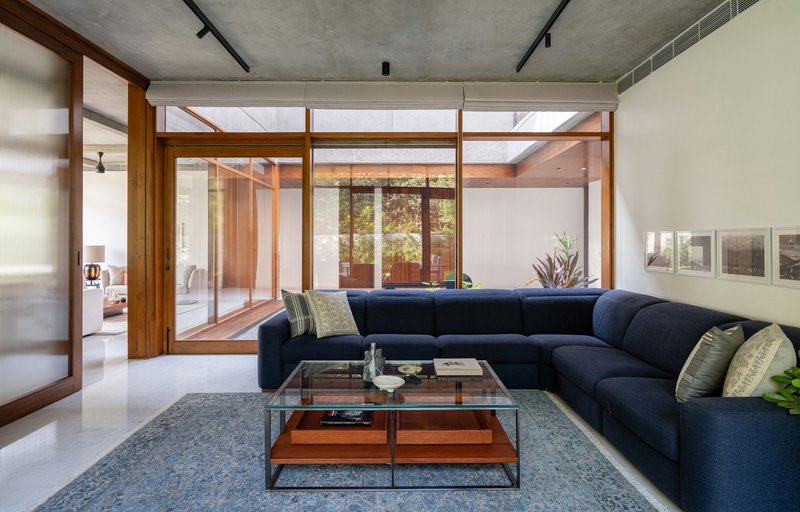
Interior courtyard with gravel floor, planted beds, and timber-framed sliding doors framing living space
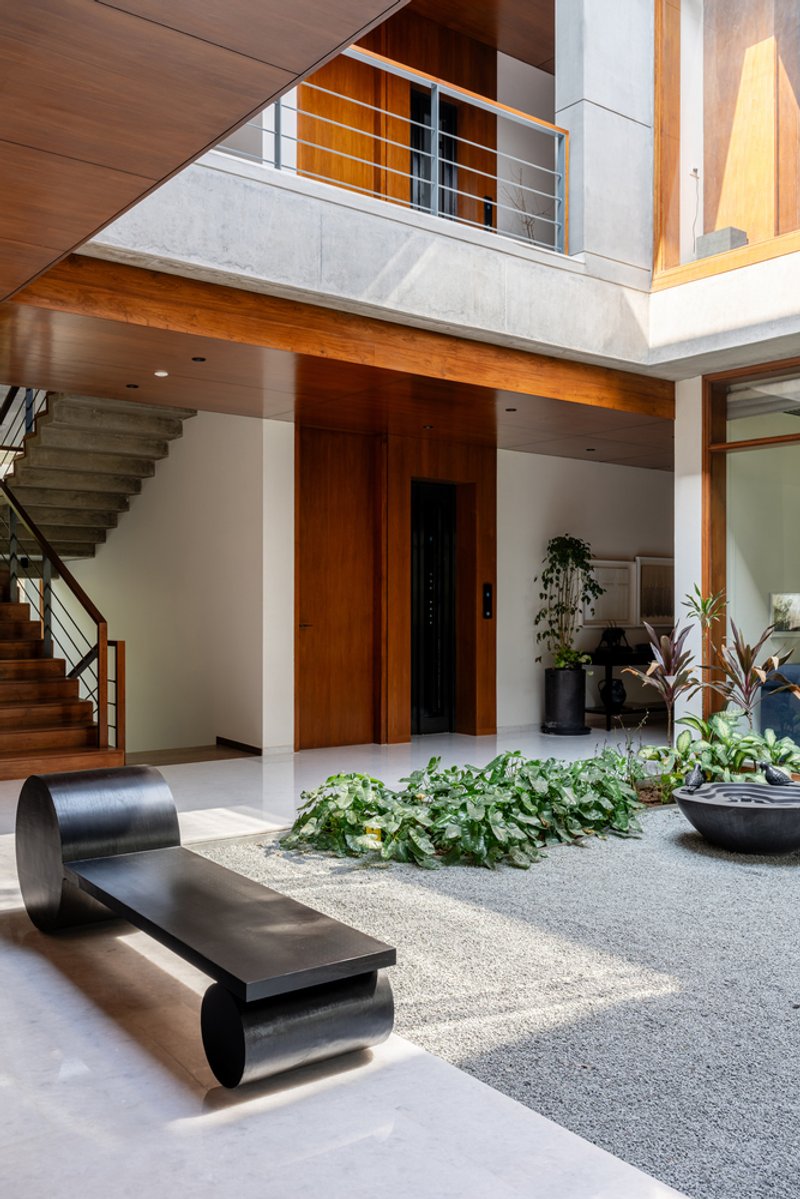
View across courtyard showing timber staircase, upper-level balcony railing, and planted bed below

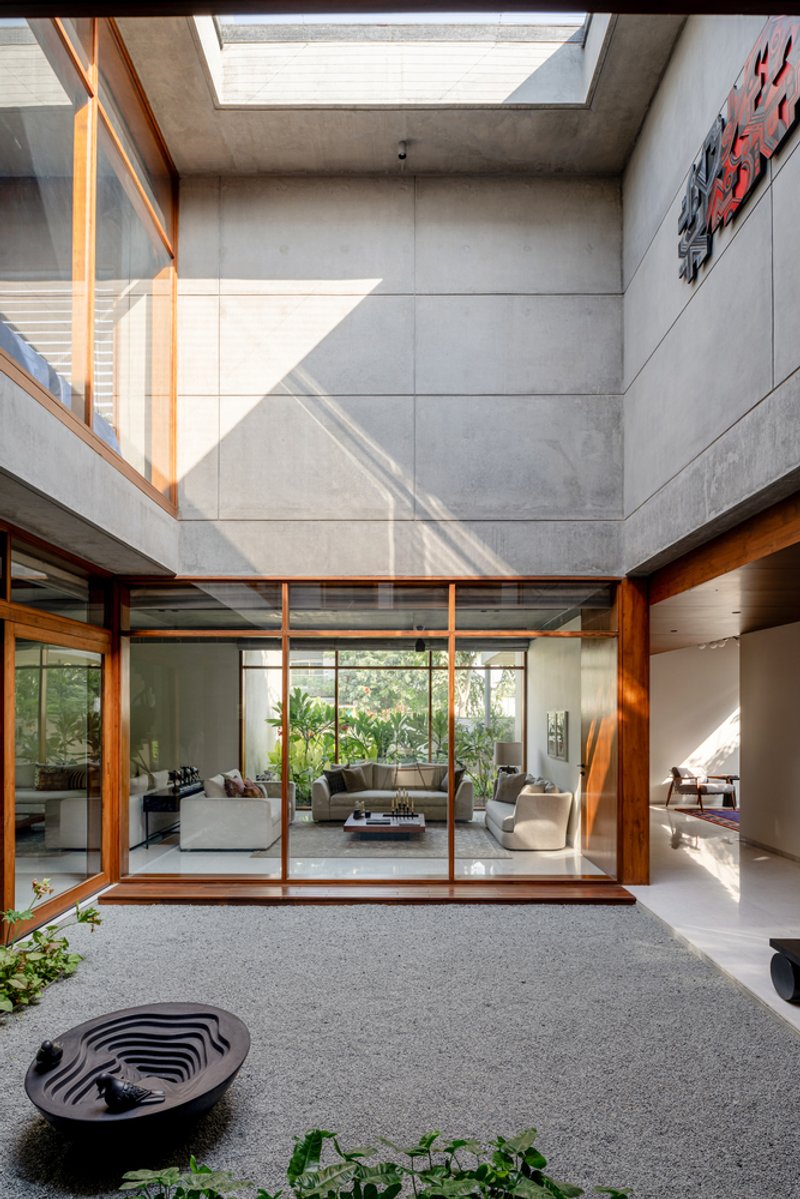
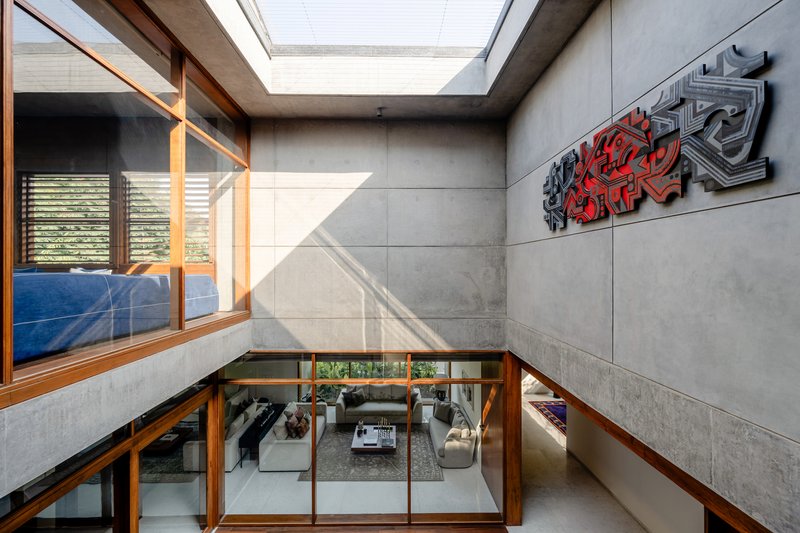
The central courtyard is the engine of the entire plan. Ringed by timber-framed glazing on two levels, it acts as a light well, a ventilation chimney, and a visual anchor all at once. At ground level, a gravel floor with planted beds keeps the courtyard from feeling decorative; it works as a buffer zone between the living spaces on the north and the bedrooms on the south. A timber staircase rises alongside it, and the upper-level balcony railing allows the eye to travel uninterrupted from the first floor down to the greenery below.

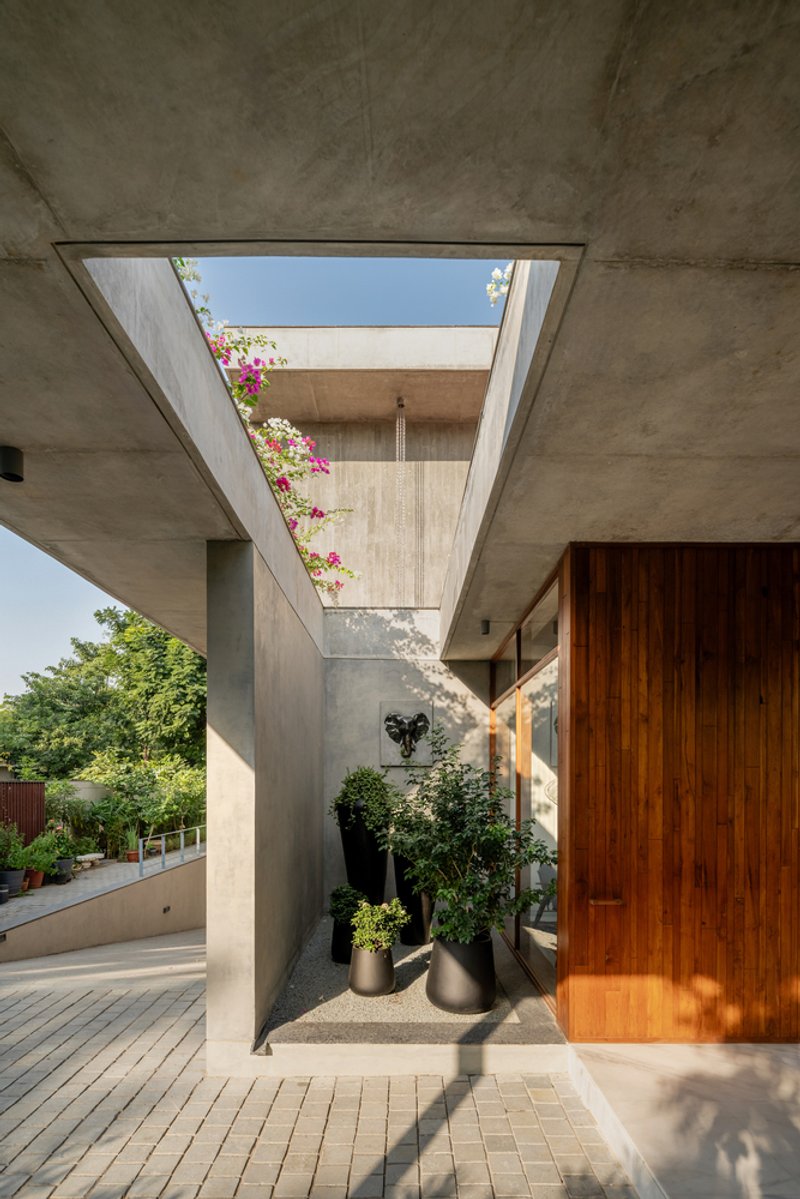
The double-height void above the courtyard, visible most dramatically in the skylight shot, sends a column of light deep into the interior at midday. In Ahmedabad's climate, where summer temperatures routinely exceed 40°C, this stack effect encourages hot air to rise and exit, pulling cooler replacement air through ground-floor openings. It is passive design at its most legible, not hidden in ducts but expressed as architecture.

Living Between Concrete and Timber

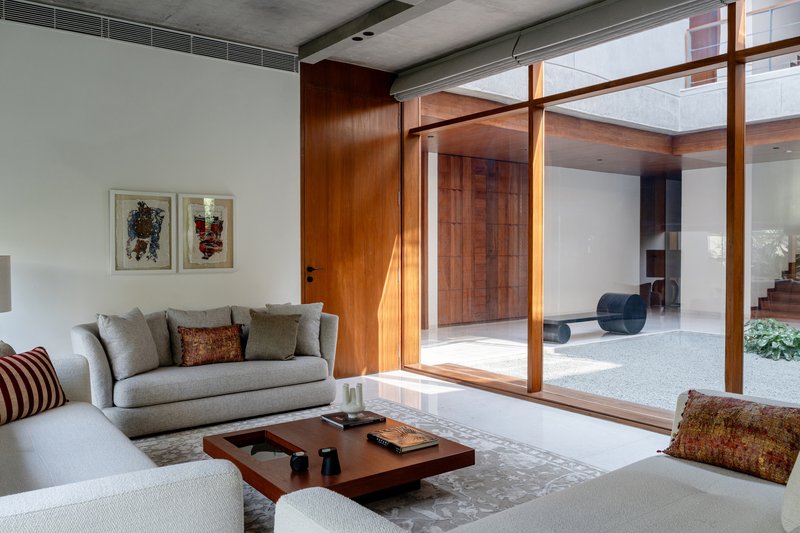
Living room with pivoting timber-framed glass doors opening to interior courtyard and sunlight streaming in
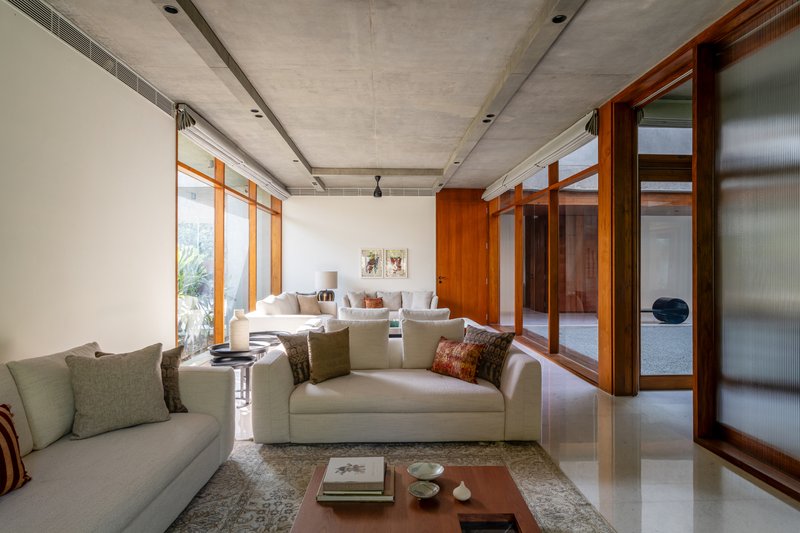
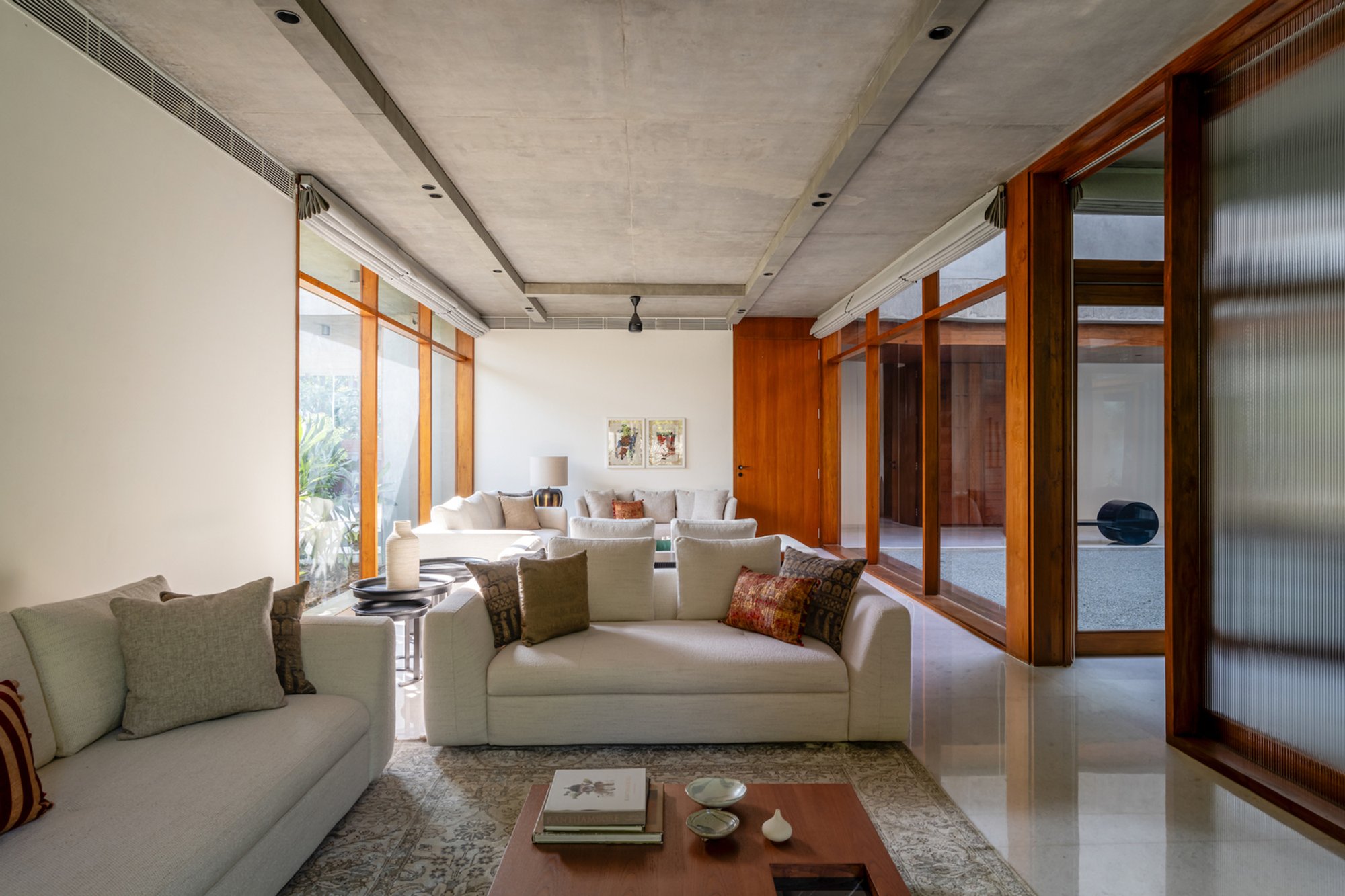
Living room with exposed concrete ceiling and timber-framed glass doors opening to a courtyard
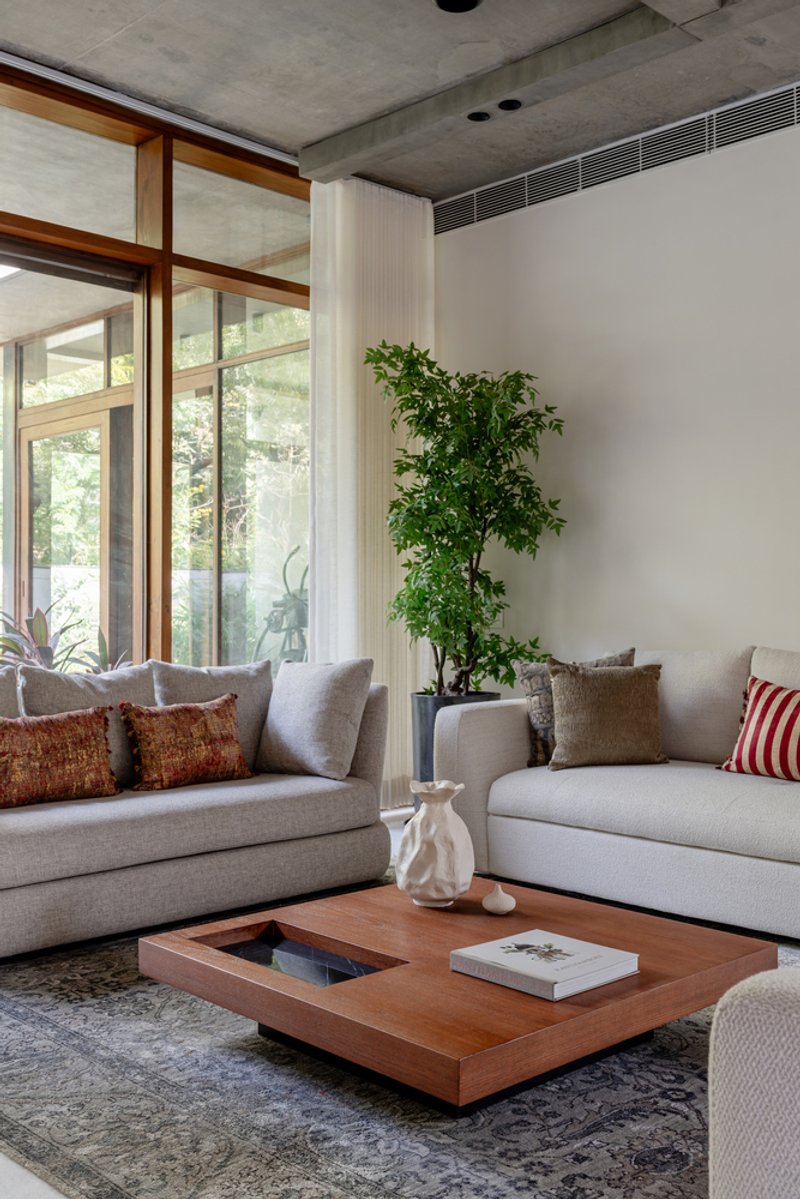
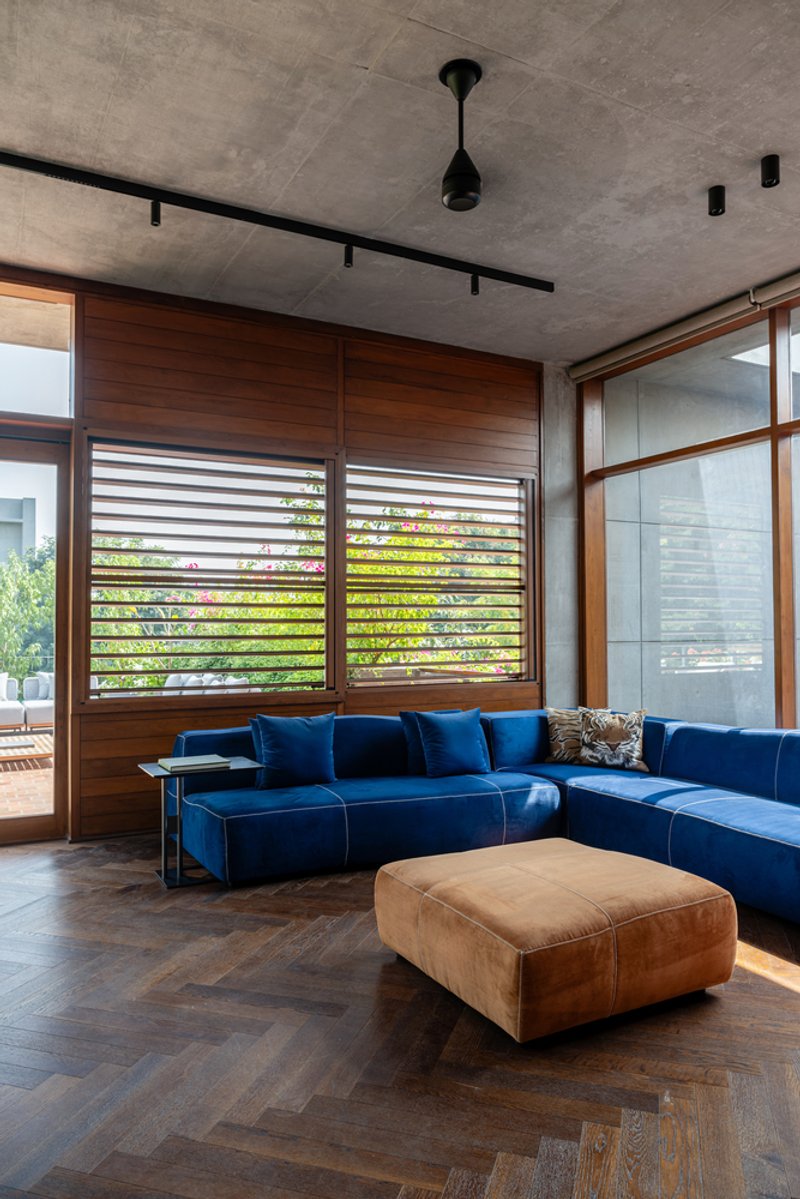
Living room with exposed concrete ceiling and floor-to-ceiling timber-framed windows overlooking greenery

Step into the living room and the material dialogue sharpens. Exposed concrete ceilings, board-marked and left raw, float above rooms defined by timber-framed glass doors that pivot or slide to merge interior with courtyard. The result is a room that can be sealed up tight during monsoon season or thrown wide open during the mild winter months. Timber mullions, warm against the cool grey overhead, set a rhythm that repeats throughout the ground floor.

On the north side, the living space opens through floor-to-ceiling windows and timber louvers to the garden beyond. Modo Designs clearly understood that the northern plot edge, facing green open space, was the project's greatest asset. The architecture treats it almost like a horizon line: long horizontal bands of glass frame the trees, and the double-height section amplifies the sense of depth. You sit in the living room and look through two layers of space, courtyard behind you, garden ahead, with the concrete ceiling connecting them overhead like a continuous datum.

Interior Details and Tactile Warmth

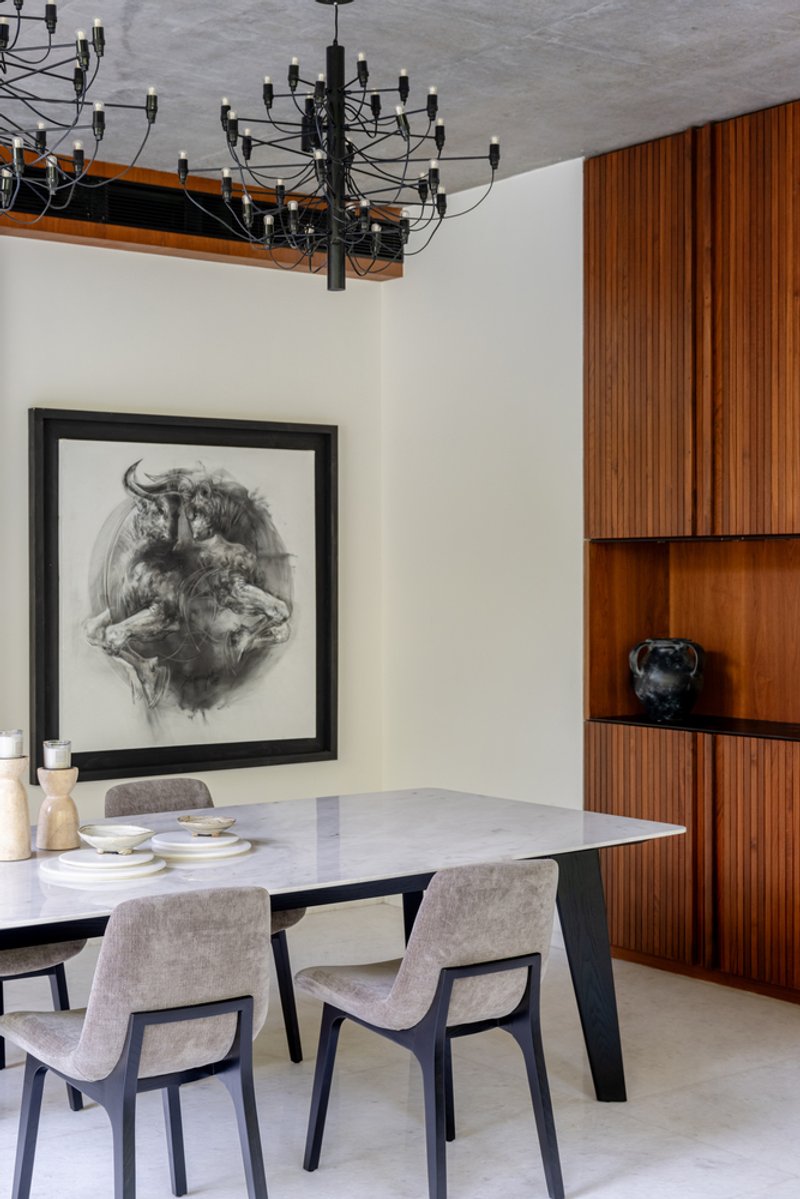
Dining area with marble table beneath exposed concrete ceiling and floor-to-ceiling timber storage wall
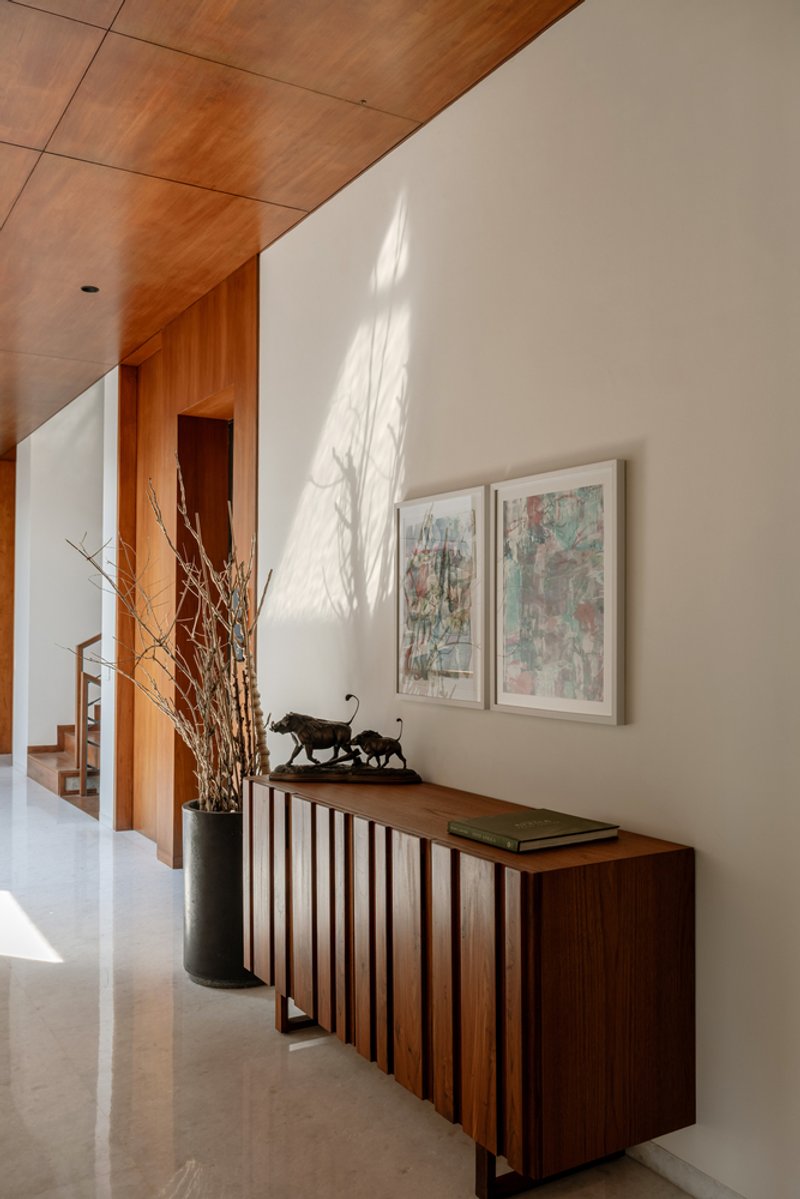
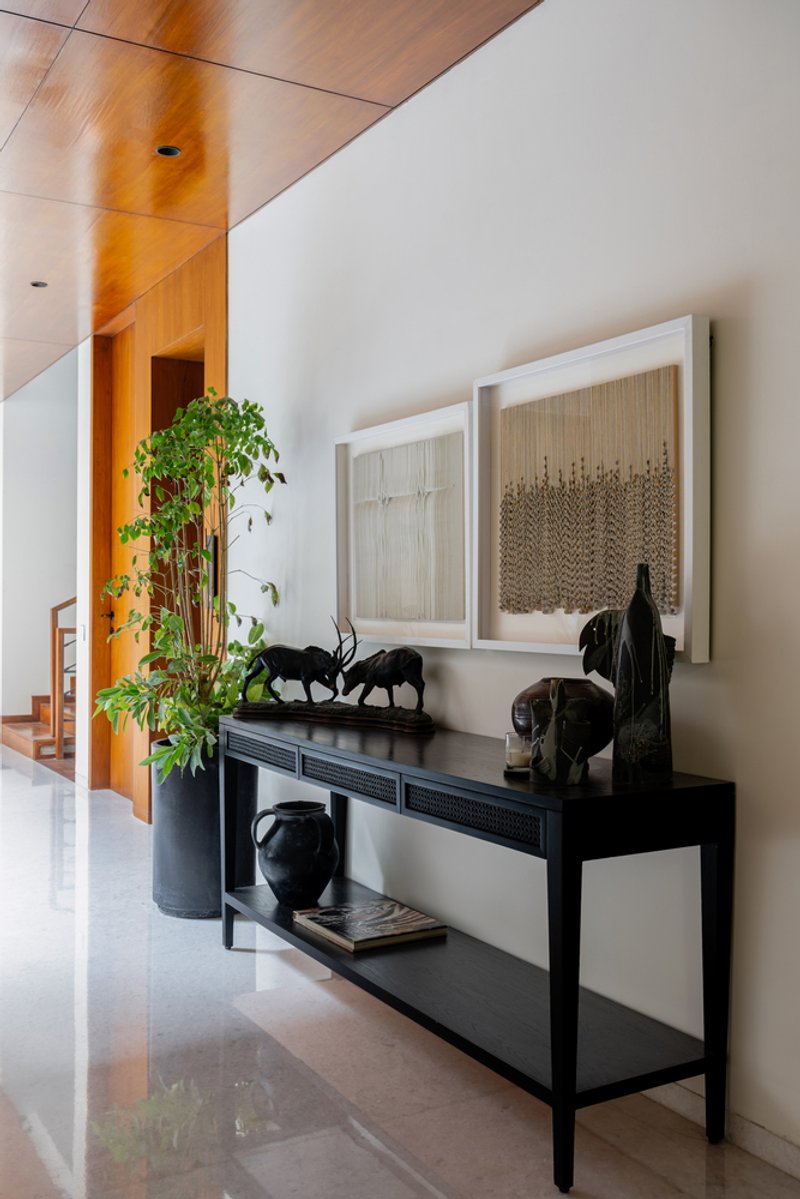
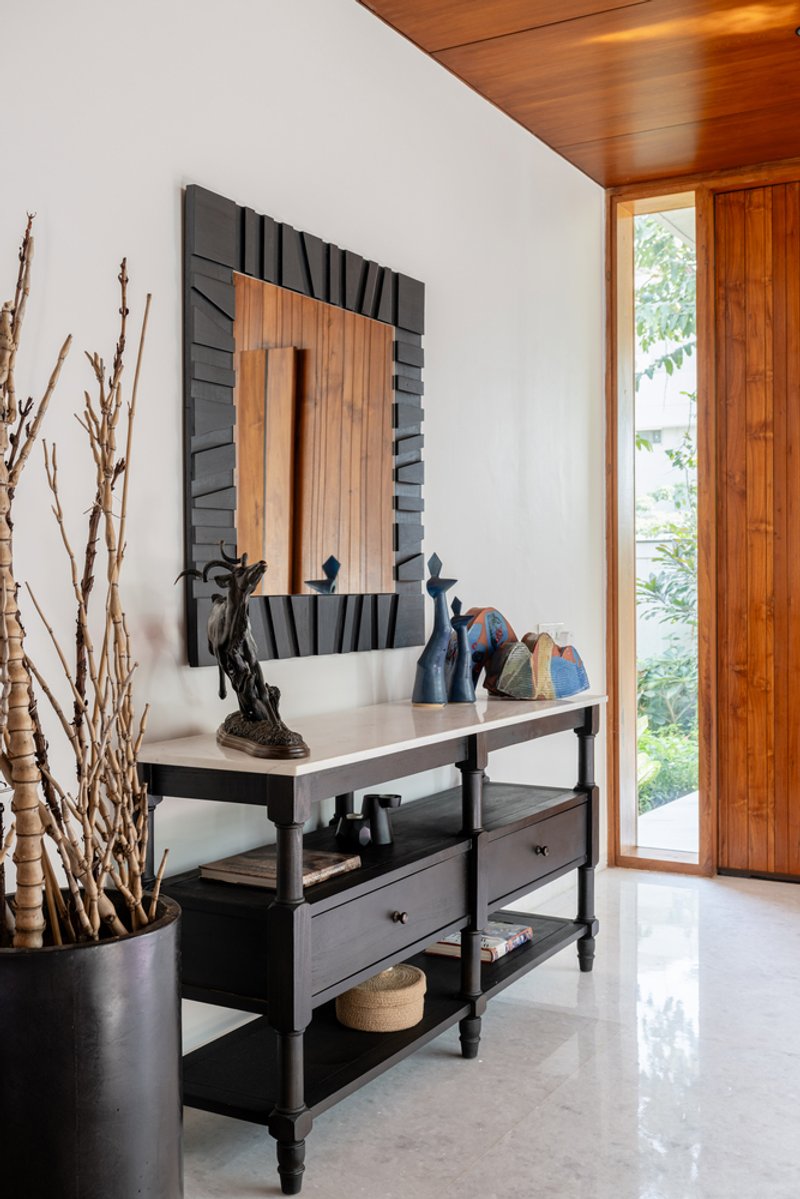
Hallway with timber-slatted credenza and angled wood ceiling panel casting shadow patterns on white walls
Interior view through layered timber-framed glass partitions revealing a planted courtyard beyond

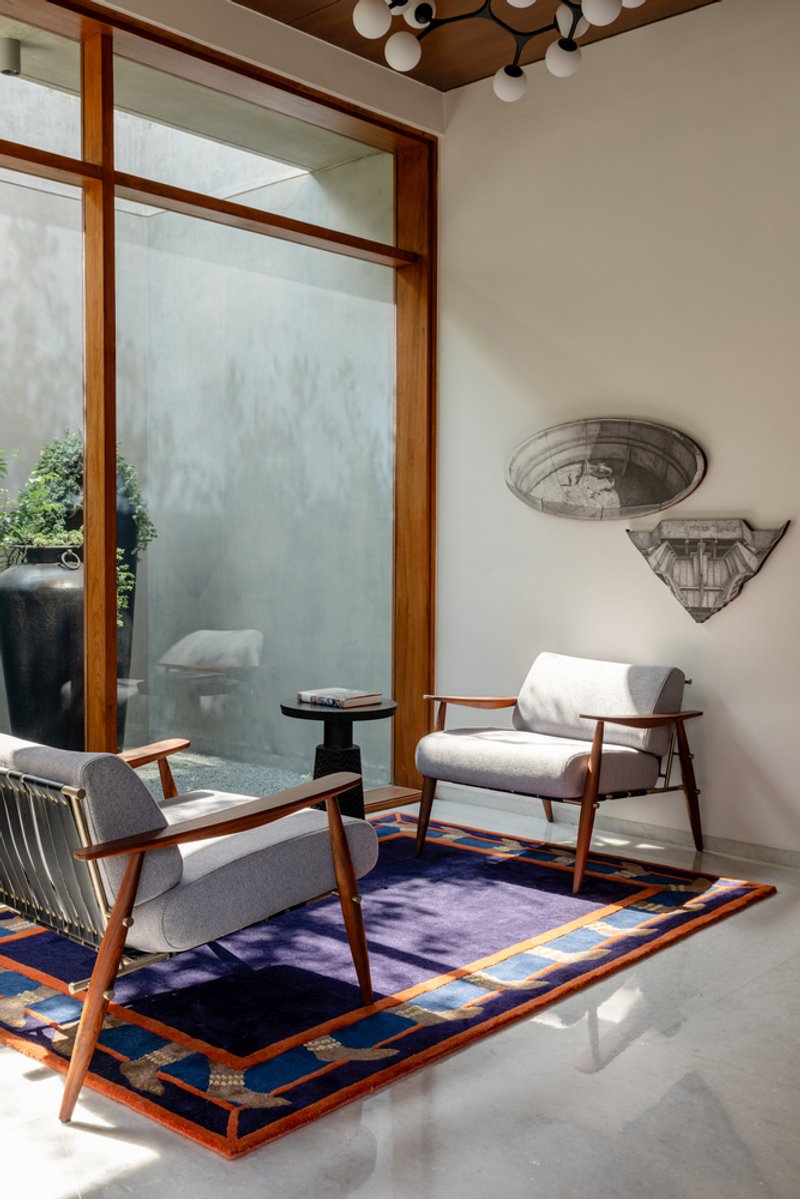
The interiors resist the temptation to over-design. A marble dining table sits beneath an exposed concrete soffit; a timber-slatted credenza runs along a hallway where angled wood ceiling panels throw geometric shadow patterns onto white walls. These moments are quiet, almost incidental, but they reveal a design team thinking carefully about how light and material interact at the scale of a hand or an eye.

Layered views are a recurring theme. Standing in one room, you look through timber-framed glass partitions into a courtyard, then through another layer of glazing into the space beyond. Modo Designs uses this depth of field to make a relatively compact urban plot feel expansive, and it works. The planted courtyard becomes a visual hinge, always present at the periphery of your awareness.

Private Rooms with Considered Character

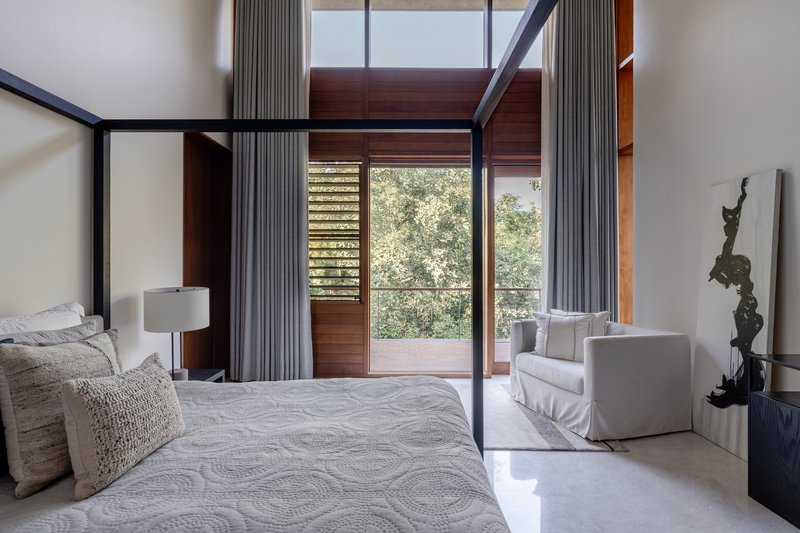
Bedroom with black steel canopy bed frame and glazed doors opening to a balcony with trees
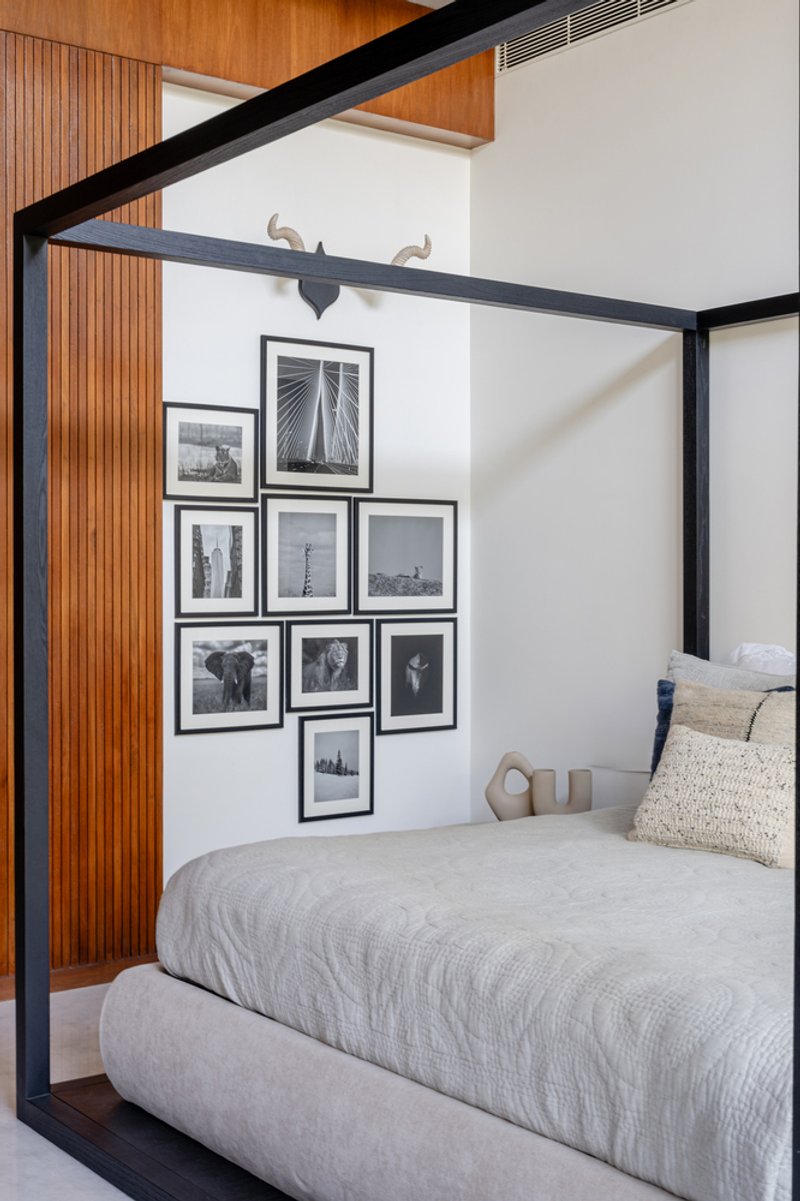
Bedroom corner with black steel bed canopy and vertical timber slat wall paneling
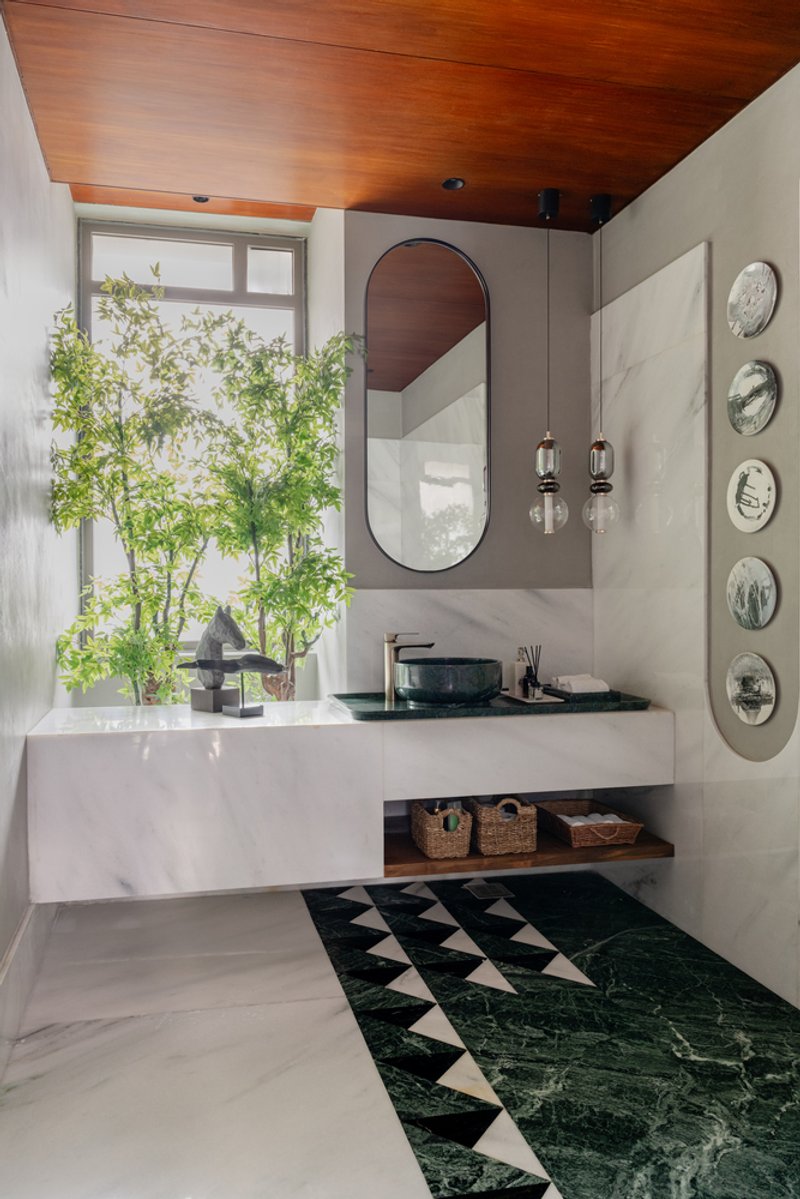
Powder room with floating vanity, timber ceiling and geometric black-and-white floor tiles meeting green marble

The bedrooms occupy the quieter edges of the plan: two on the south side of the ground floor, three on the western side of the upper floor. A black steel canopy bed frame anchors one room against vertical timber slat paneling, giving it an almost industrial clarity that contrasts with the softer timber and marble palette elsewhere. Glazed doors open to balconies canopied by trees, extending the bedroom into the landscape.

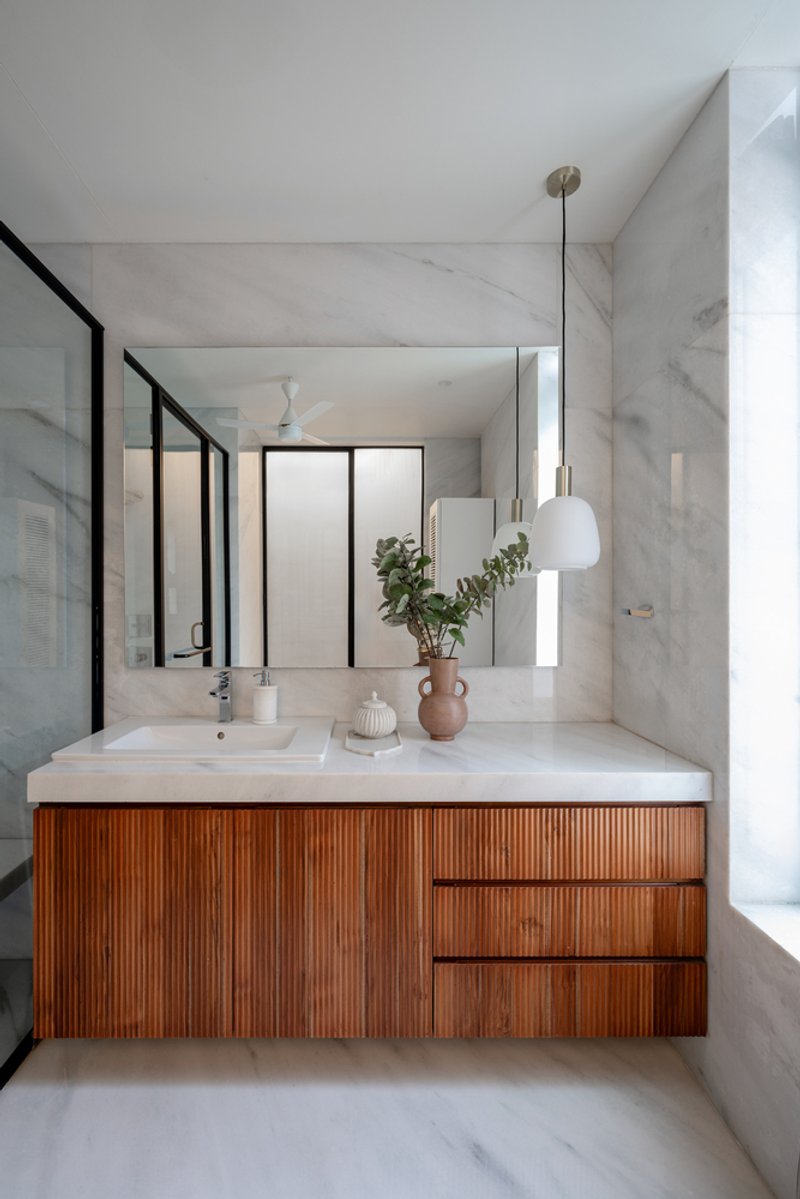
Bathrooms receive equal attention. A powder room pairs a floating vanity with a timber ceiling plane and geometric black-and-white floor tiles that meet a slab of green marble, a sharp, confident material collision. Fluted timber cabinetry in another bathroom sits against white marble wall cladding. These are small rooms, but they carry the same discipline of contrast, concrete against wood, white against texture, that governs the larger spaces.

Terraces and the Roofscape

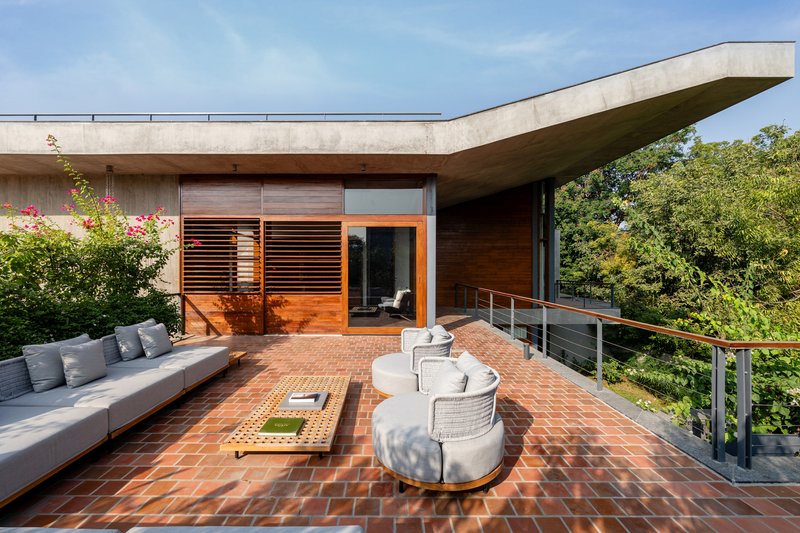
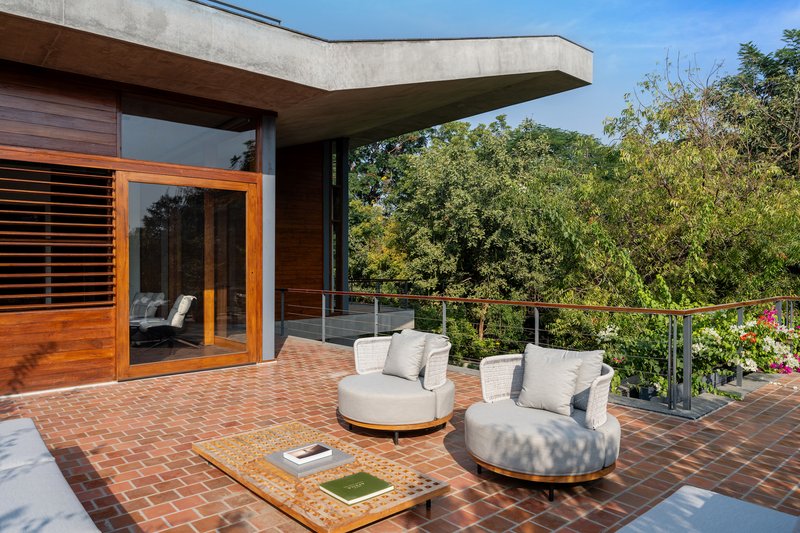
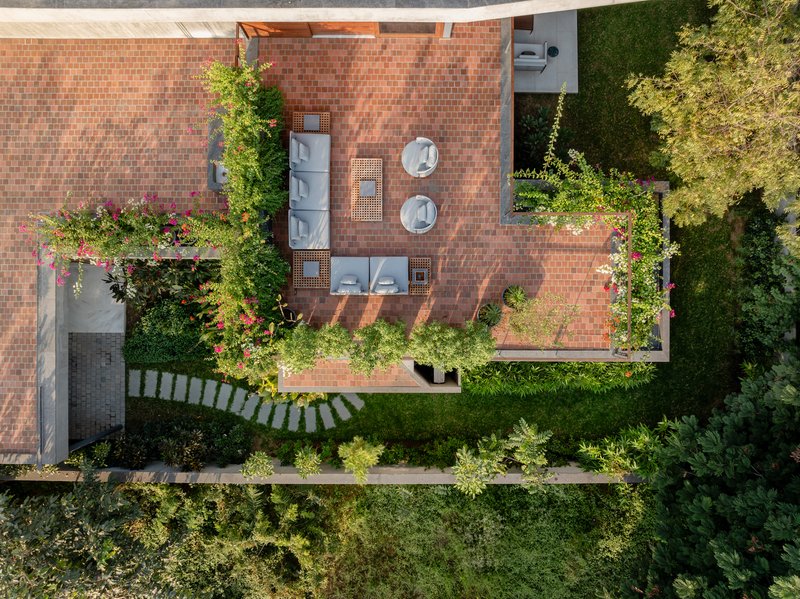
Roof terrace with herringbone clay tile paving, outdoor seating, and cantilevered concrete overhang
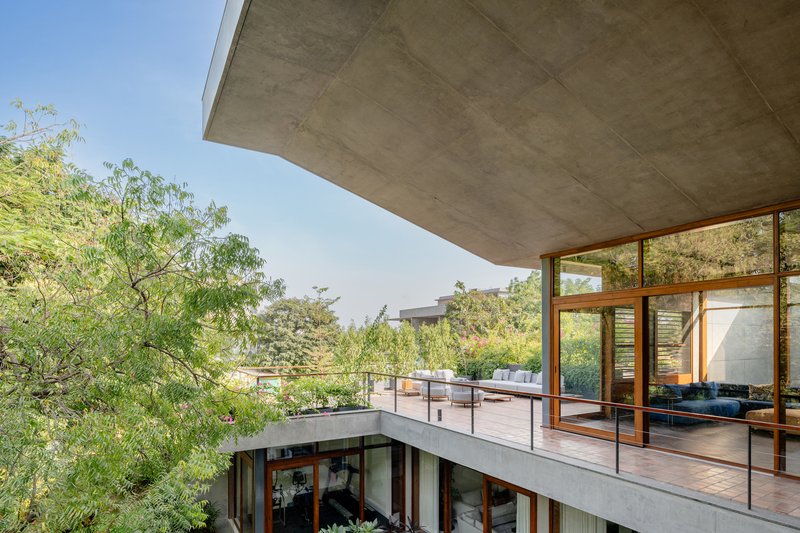
Rooftop terrace deck with potted bougainvillea and cantilevered concrete roof plane at dusk
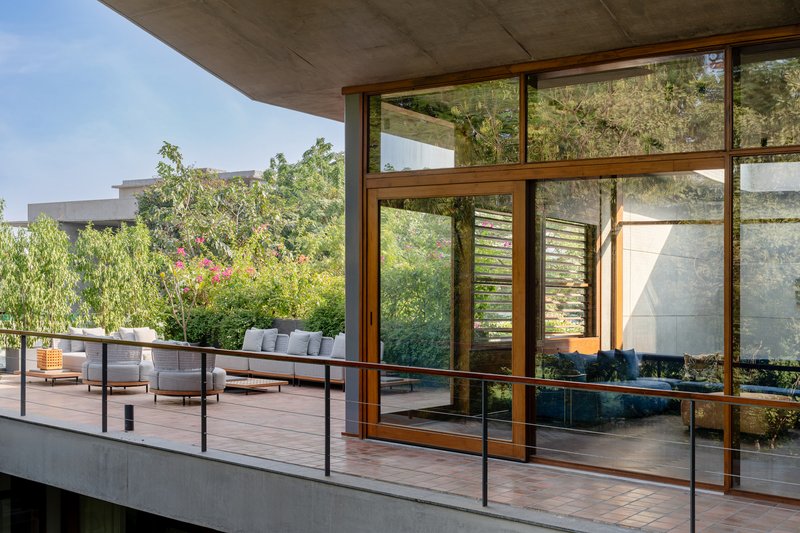
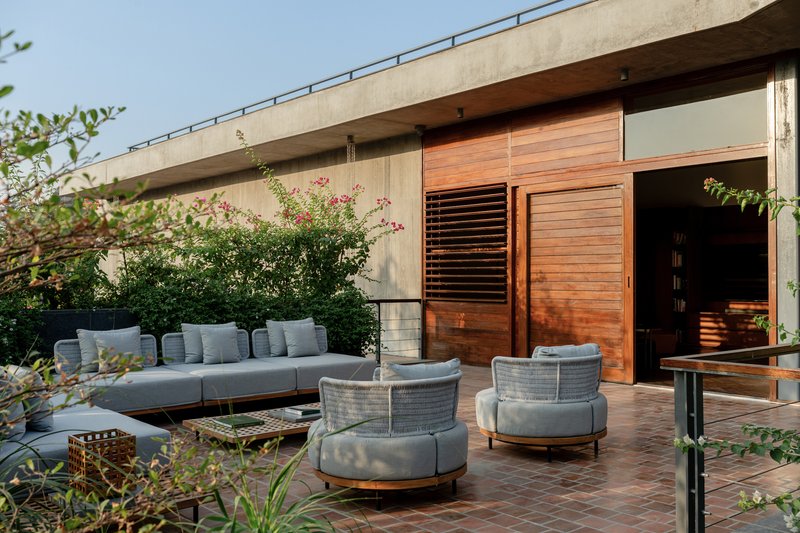
Brick-paved terrace with curved seating beneath a cantilevered concrete overhang and cable railing

The upper floor extends outward into a series of terraces that function as outdoor rooms. On the east, a herringbone clay tile terrace sits beneath a cantilevered concrete overhang, offering shade without enclosure. A brick-paved zone with a curved built-in bench creates an intimate seating area with a cable railing providing an unobstructed view over the surrounding canopy. The rooftop deck, with its potted bougainvillea and timber decking, reads as an extension of the planted roof strategy visible from the street.

These outdoor spaces are not afterthoughts. They are programmed as carefully as any interior room, with the eastern terrace specifically designated for outdoor entertainment and the rooftop offering a quieter retreat. The cantilevered concrete roof planes that shelter them are the same elements that define the building's street presence, which means the terraces and the facade are structurally and visually continuous. It is a clean resolution.

The Garden Edge and the Approach

Private courtyard with lawn, seating area, and floor-to-ceiling timber-framed sliding glass doors
Timber-framed glazed doors opening onto a wooden deck terrace with planted garden beyond
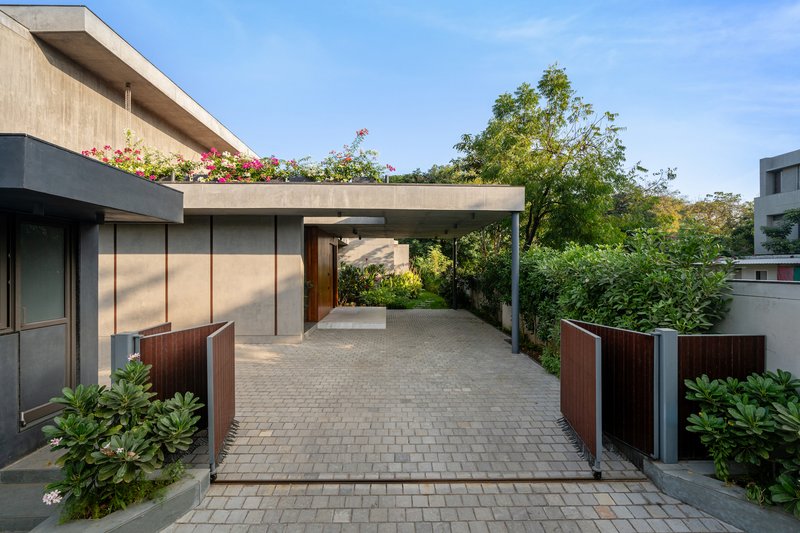
Covered entrance passage with exposed concrete vault, brick paving, planted beds and bougainvillea overhead

The northern garden is where the house finally exhales. Floor-to-ceiling timber-framed sliding glass doors pull back to erase the boundary between living room and lawn. A private courtyard with seating and a small patch of grass offers a more intimate alternative. The contrast with the southern entry sequence, where you walk through a covered passage of exposed concrete vaulting, brick paving, and overhead bougainvillea, is absolute. One side compresses, the other releases.

The carport, tucked beneath a timber ceiling with paver driveway and metal-clad planters, extends the material logic of the house all the way to the street edge. Even the most utilitarian zone participates in the overall composition, reinforcing the impression that nothing here was left unconsidered.

Plans and Drawings

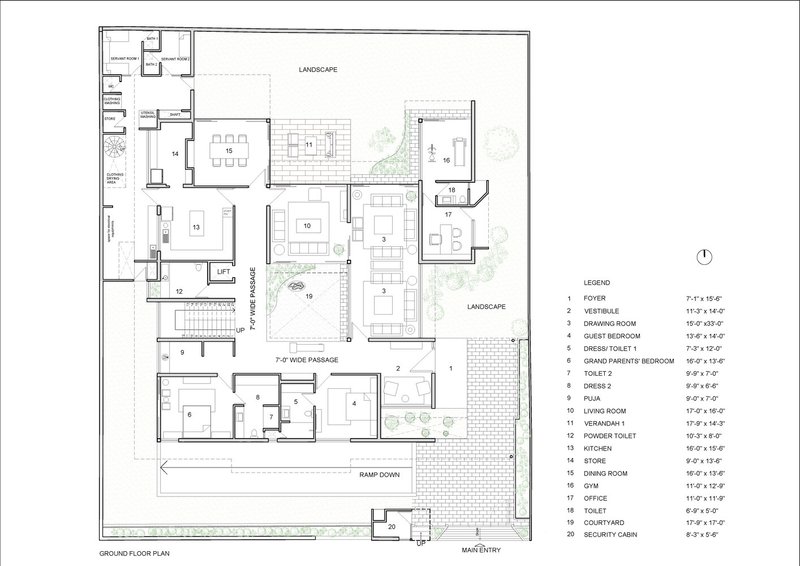
Ground floor plan drawing showing rooms arranged around central courtyards with landscape areas and wide passage
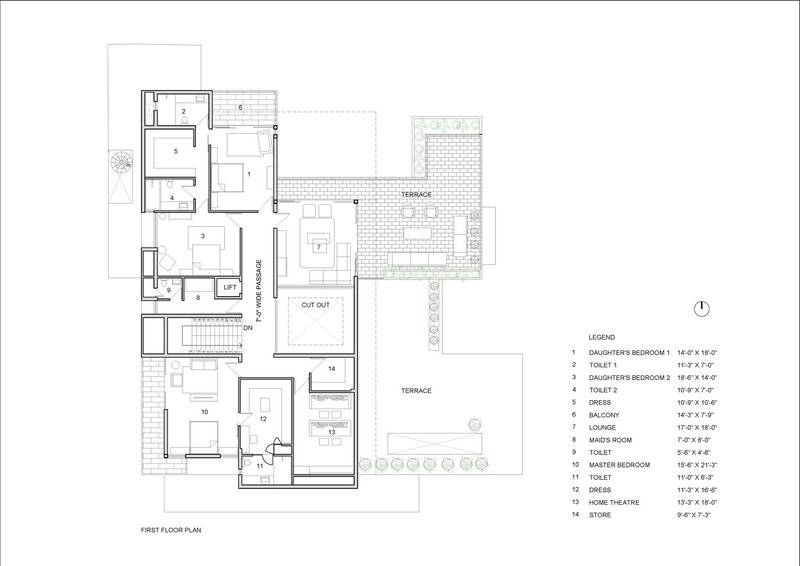
First floor plan drawing showing bedrooms and terraces with cut-out voids and balcony spaces

The ground floor plan confirms the organizational logic: rooms wrap around central courtyards with generous landscape areas and a wide passage connecting front to back. Two bedrooms line the south edge, public program fills the east, and the living and dining zones face north. The first floor plan reveals how the upper bedrooms cluster to the west while voids and terraces occupy the eastern half, keeping the plan porous and ensuring that light from the courtyard reaches both levels. The cut-out voids visible in the upper plan are the key spatial move, they keep the double-height courtyard open and prevent the second floor from capping the light well that drives the whole scheme.

Why This Project Matters

The courtyard house is one of the oldest typologies in Indian residential architecture, and it has been revisited so many times that the risk of cliché is real. What Modo Designs achieves here is a version that feels structurally honest and climatically purposeful rather than merely symbolic. The exposed RCC frame, the controlled palette of timber and white plaster, the careful orientation toward a northern garden: these are not aesthetic choices dressed up as sustainability. They are direct responses to Ahmedabad's heat, density, and light.

The House of Volumes also demonstrates something about restraint. With only two primary materials on the exterior and a handful of finishes inside, the architecture relies on spatial sequence, on the compression and release between courtyard, room, and garden, to generate interest. That is harder to pull off than a flashy facade, and more rewarding when it works. For anyone designing courtyard houses in hot-arid climates, this project offers a disciplined template: close to the street, open to the sky, and always, always oriented toward the light.


The House of Volumes by Modo Designs, Ahmedabad, India, 2024. Photography by Vinay Panjwani.


About the Studio

Share Your Own Work on uni.xyz

If projects like this are the kind of work you want to make, uni.xyz is a place to publish your own, find collaborators, and enter design competitions.

UNI logoUNI logo
UNI Editorial

UNI Editorial

Where architecture meets innovation, through curated news, insights, and reviews from around the globe.

Share your ideas with the world

Share your ideas with the world

Write about your design process, research, or opinions. Your voice matters in the architecture community.

Comments (0)

No comments yet. Be the first to comment!

Similar Reads

You might also enjoy these articles

publishedStory1 month ago
Hodi-Mandai Geram
publishedStory3 months ago
Olio Towers: A Mid-Rise for Performers That Fuses Housing, Rehearsal, and Stage
publishedStory3 months ago
Oasis: Modular Green Housing Carved into Dhaka's Urban Fabric
publishedStory3 months ago
Black Hole: A Floating Megastructure for the Post-Physical Era

Explore Architecture Competitions

Discover active competitions in this discipline

Search in (optional)