
The Infinite Energy Loop: Turning Kuala Lumpur's Skyscrapers into Power Plants
A shortlisted high-rise proposal reimagines towers as closed-loop energy ecosystems that generate, circulate, and redistribute renewable power.


Skyscrapers are among the most energy-hungry building types on the planet, yet they keep multiplying across tropical megacities where cooling loads alone can overwhelm municipal grids. The Infinite Energy Loop asks a pointed question: what if the tower itself became the power station? Sited in Kuala Lumpur, this concept stacks four renewable energy systems, hydroelectric, wind, solar, and bio, into a single vertical structure that aims to flip the skyscraper's energy equation from consumption to production.
Designed by 민경 강, this shortlisted entry in the Alter competition proposes what its author calls the Energy Hub Tower: a carbon-neutral urban system that generates, purifies, and redistributes resources in a continuous loop. Kuala Lumpur's skyline, already dense with high-rises and burdened by waste management pressures, air pollution, and excessive energy demand, serves as both proving ground and provocation. The project positions itself as a prototype for Southeast Asian cities pursuing low-carbon growth and energy independence.
A Tower That Floats Above Its Landscape
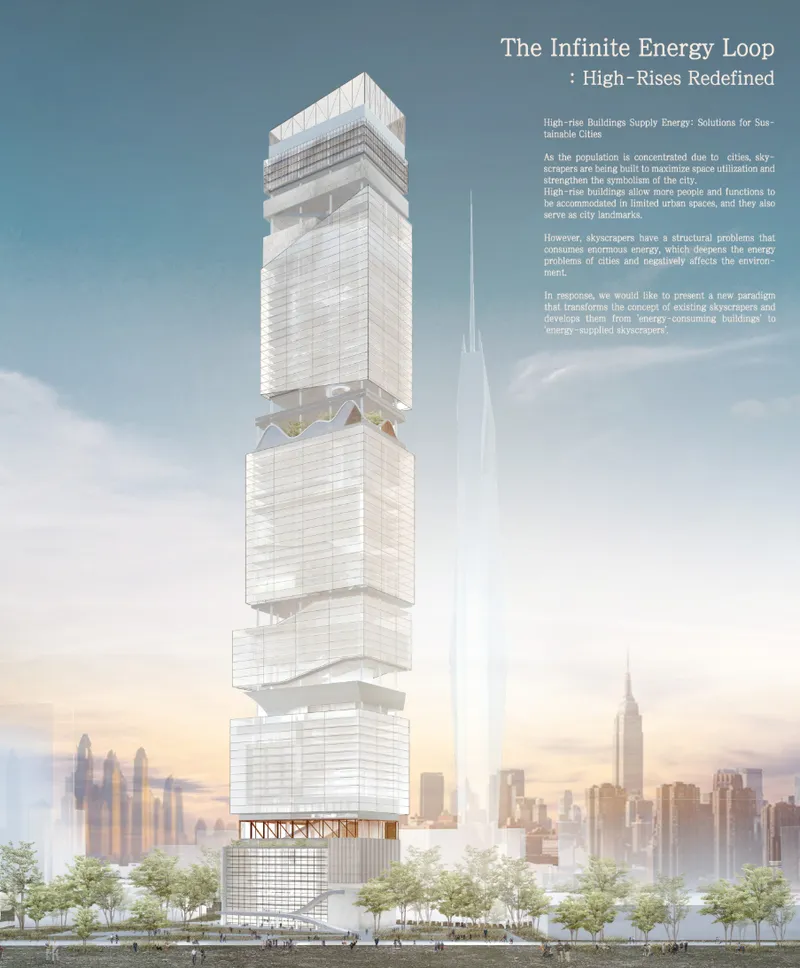
The dusk rendering reveals the tower's defining formal gesture: stacked volumes wrapped in translucent glass facades that appear to hover above a planted ground plane. The lightness is deliberate. By lifting programmatic mass away from the street, the design opens breathing room for landscaped public space beneath, countering the urban heat island effect that plagues Kuala Lumpur's core. The translucent skin is not merely aesthetic; photovoltaic panels line the facade, converting sunlight into electricity and offsetting a significant portion of the building's energy needs while doubling as insulation for the hotel section housed within.
Six Levels of Programme, Each Tuned to a Different Energy System
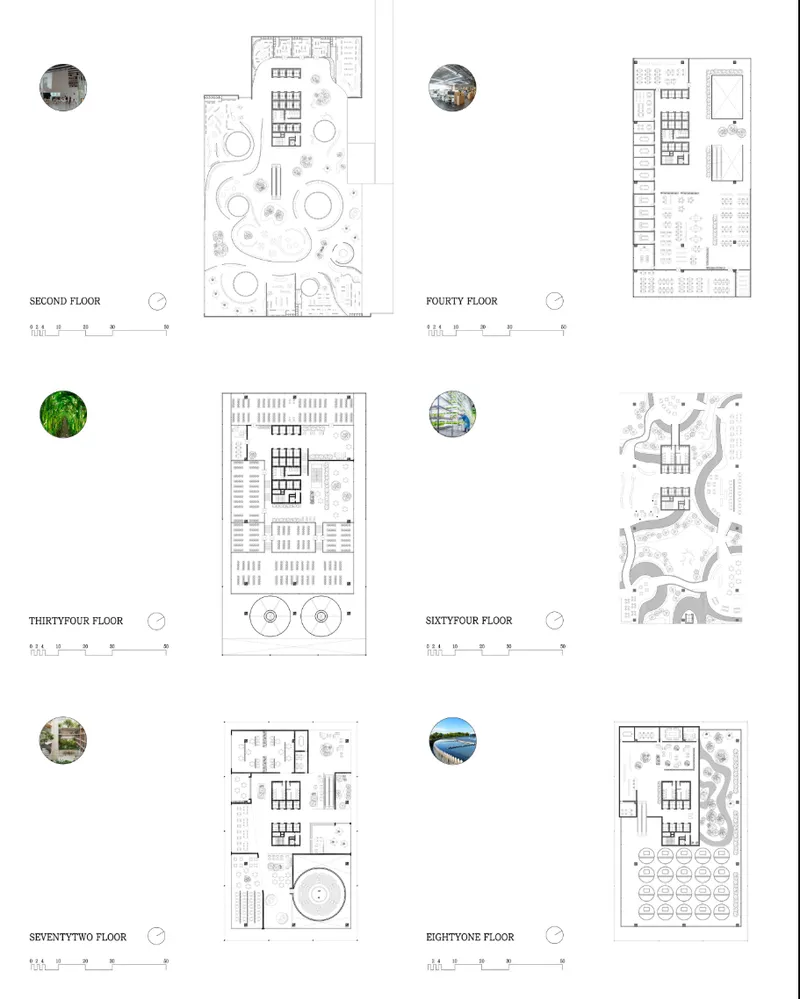
The floor plan drawings expose how the tower's programme is organized around its energy infrastructure rather than the other way around. Six distinct levels accommodate varied amenity spaces and outdoor terraces, each configured to optimize a specific renewable system. Water stored in upper tanks flows downward through turbines to generate hydroelectric power before being purified and recirculated. Wind is captured between the building's split volumes, where aerodynamic shaping creates pressure differentials that enhance turbine efficiency. Smart farms on dedicated floors process organic waste into bio-energy while producing clean air and food.
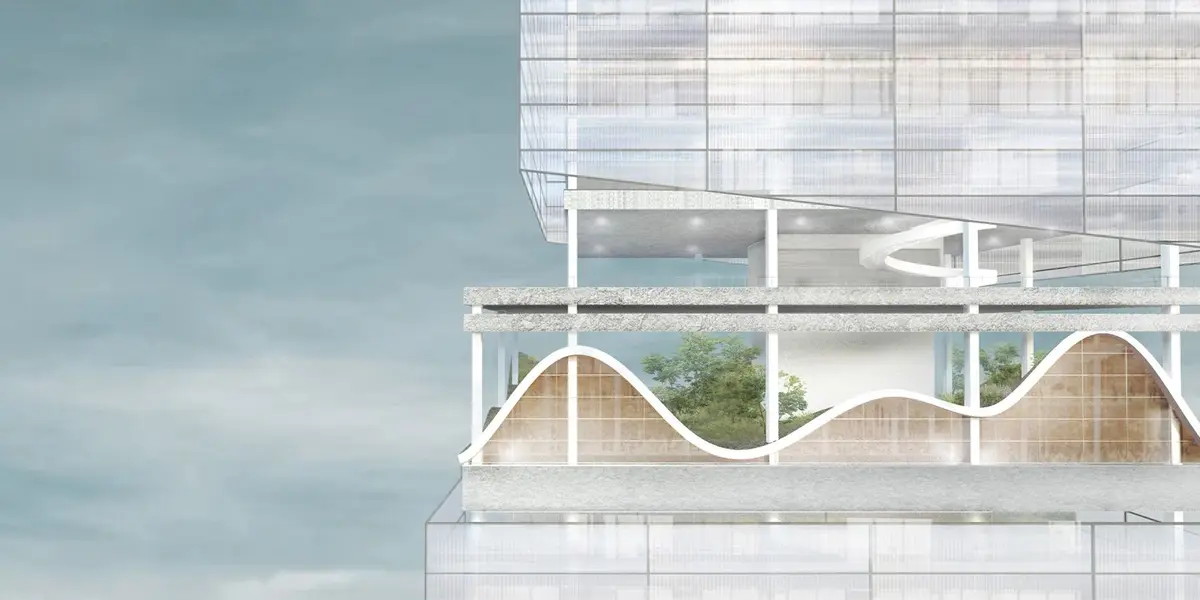
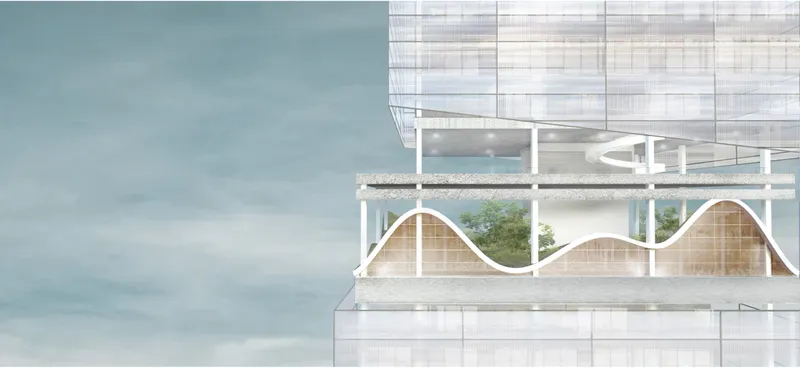
The section detail of a cantilevered terrace reveals the structural logic at a more intimate scale. Undulating timber vault ceilings span between white structural columns, creating generous covered outdoor spaces that blur the line between interior comfort and tropical climate. These terraces are not afterthoughts; they are integral to the building's ventilation and bioclimatic strategy, channeling prevailing winds through habitable zones before those same air currents reach the wind turbines above.
Planted Decks as Living Infrastructure
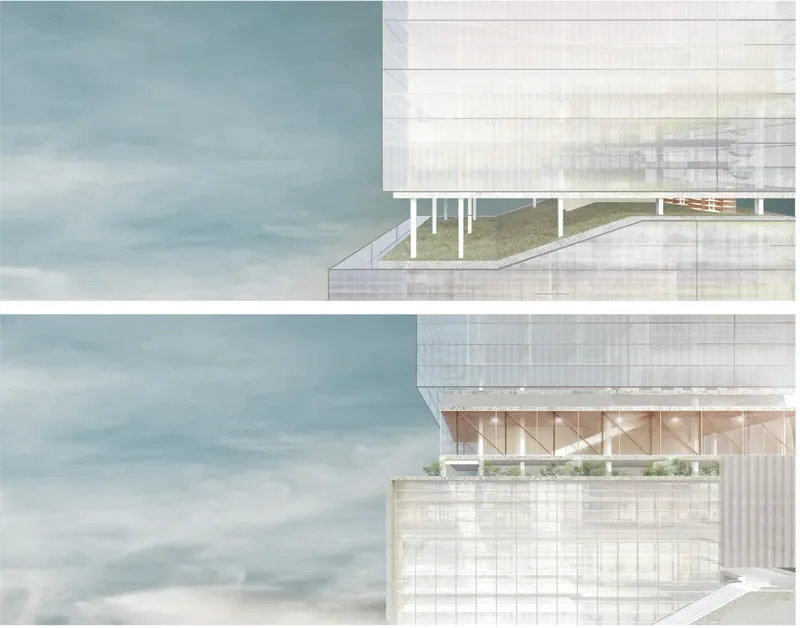
Closer rendered views show the planted terrace decks framed by slender white columns beneath the translucent facade layers. Vegetation here is not decorative. The bio-organic systems embedded within these green zones generate renewable energy from organic waste while producing oxygen, creating a micro-ecology that feeds back into the tower's closed-loop metabolism. The columns maintain a rhythmic structural grid that keeps floor plates column-free at their cores, allowing flexible programming across residential, hospitality, and commercial uses.
Vertical Stacking and Material Logic
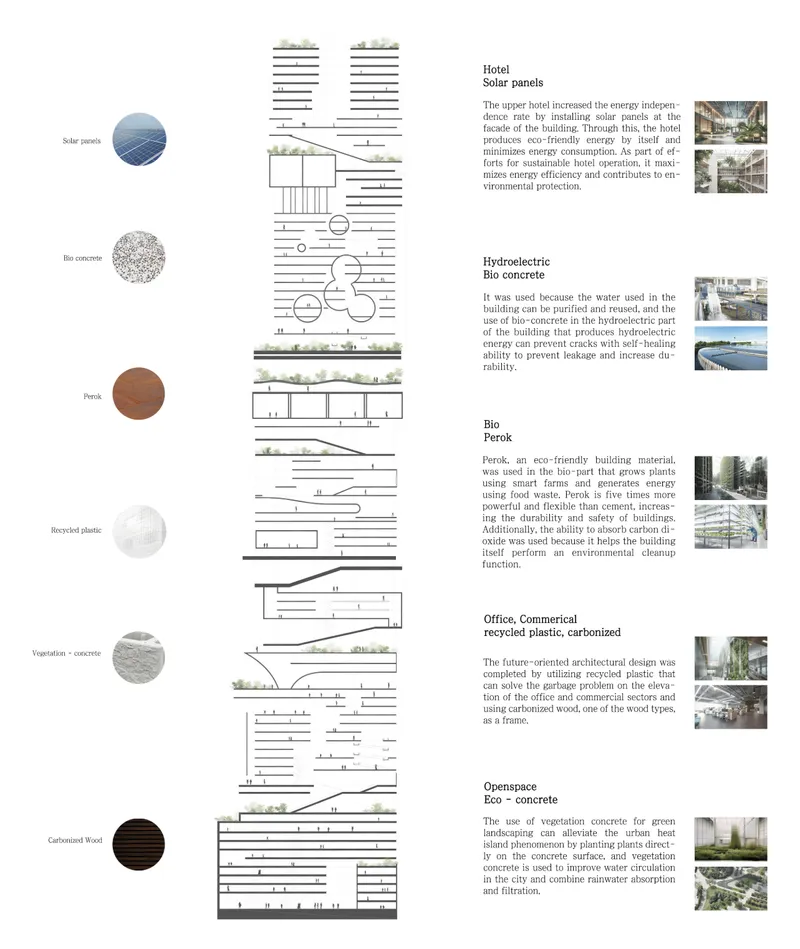
The sectional elevation drawings make the tower's vertical organization legible in a single graphic. Programmatic zones stack upward with clear material differentiation: bio-concrete in the hydroelectric sections provides self-healing durability and prevents water leakage, while solar panels clad the hotel levels to generate power and improve facade insulation. Material samples and reference photographs anchored alongside the section reinforce the project's commitment to what the designer terms eco-smart materials, each selected not for novelty but for measurable performance gains tied to a specific energy system.
The overall composition reads as a vertical catalogue of renewable strategies, layered so that energy generated at one level supports functions at another. Water flows down, wind funnels through, sunlight hits the skin, and organic matter cycles internally. Every material choice serves the closed-loop ambition, turning structural necessity into environmental opportunity.
Why This Project Matters
The Infinite Energy Loop does not propose a single breakthrough technology. Instead, it argues that existing renewable systems, hydroelectric turbines, photovoltaics, wind capture, and bio-energy, can be spatially integrated within a single high-rise to transform the tower from a net consumer into a net contributor to the urban grid. That argument is especially potent in Kuala Lumpur, a city where rapid vertical growth has outpaced infrastructure planning and where the tropical climate offers abundant solar and wind resources year-round.
What elevates the proposal beyond a diagram is its attention to habitable quality. The timber-vaulted terraces, the planted decks, and the careful material zoning suggest that sustainability and spatial generosity are not competing priorities. If the next generation of Southeast Asian skyscrapers is going to justify its energy footprint, projects like this one lay out a credible framework: treat the building envelope as a power plant, the programme as an ecosystem, and the city as a partner rather than a host.
View the Full Project
About the Designers
Designer: 민경 강
Enter a Design Competition on uni.xyz
uni.xyz runs architecture and design competitions year-round that reward proposals with spatial conviction and real site intelligence.
Project credits: The Infinite Energy Loop: High-Rises Redefined by 민경 강 Alter (uni.xyz).


Popular Articles
Popular articles from the community


Singing Woman: Contemporary Architecture Inspired by Estonia’s Voice and the Sea
Singing Woman turns Estonia’s song culture into flowing opera house architecture, blending public life, landscape, sea, and national memory.
Opera by the Sea Estonia: Three Shells Dissolving Architecture into Tallinn's Coastline
A winning opera house proposal replaces monumental form with interconnected shells that blur the boundary between building, park and Baltic Sea.
Cloaked Colonization: A Mobile Underwater Habitat That Moves Like a Fish
Micah Abaya's shortlisted EHC Pacific entry reimagines ocean settlement as a dispersed network of self-sustaining architectural organisms.

Manzana Morphosis: Stretching Barcelona's Grid into a Living Landscape for 2050
A radical reworking of the Eixample manzana turns density into a tool for generous public space, vertical ecology, and environmental performance.

Similar Reads
You might also enjoy these articles

The Amber Palace Opera: A Geological Fiction Surfaces on Tallinn's Baltic Waterfront
Pierre Brillard reimagines a Baltic legend as a public landscape, opera house, and waterfront promenade rooted in Tallinn's coastal identity.
Dynamic Modules Shelter: A Telescopic Ring for Mountain Pilgrimage
A circular modular framework of steel, bamboo, and fabric grows vertically with demand, wrapping communal ground in adaptable shelter.
Singing Woman: Contemporary Architecture Inspired by Estonia’s Voice and the Sea
Singing Woman turns Estonia’s song culture into flowing opera house architecture, blending public life, landscape, sea, and national memory.
HYPERBLOCK: Flexible Urban Design for Barcelona’s Future City
HYPERBLOCK reimagines Barcelona as flexible urban design, layering density, daylight, public space and adaptable housing above Cerdà’s grid.


Comments (0)
Please login or sign up to add comments
No comments yet. Be the first to comment!