

What is the Inspiration behind Plagiarism?
Drawing the line between Appreciation and Imitation


The backstory
As designers, we are expected to come up with subjectively innovative art, resonates with the present era, and helps bring about a change in the community. Being the literal ‘face’ of society, design is an artefact that helps define periods, spanning across various nations and diverse communities coming from a range of cultural bounds. New generations come with a new crop of designers, who are inspired by the previous styles to which they add their flair, bringing in new skills and redefining fields of design like art and architecture. We are even encouraged, during our education, to understand renowned pieces of design and let them inspire us. These are tried and tested techniques, subjected to positive critique already. There is nothing wrong with looking up to our elders for mentorship and inspiration. It is healthy to align ourselves with pre-defined philosophies and to aim for creating a novel design piece through these ideologies.
Yet, a commonly misunderstood concept in the field of design is this ‘inspiration’ that we talk about. With the design field becoming more and more competitive, it is common to see different projects on various media that are similar to each other in some way or the other. In the quest to achieve quick success, many designers turn to exist work and paste them as it is in a different context, responding to a different community.
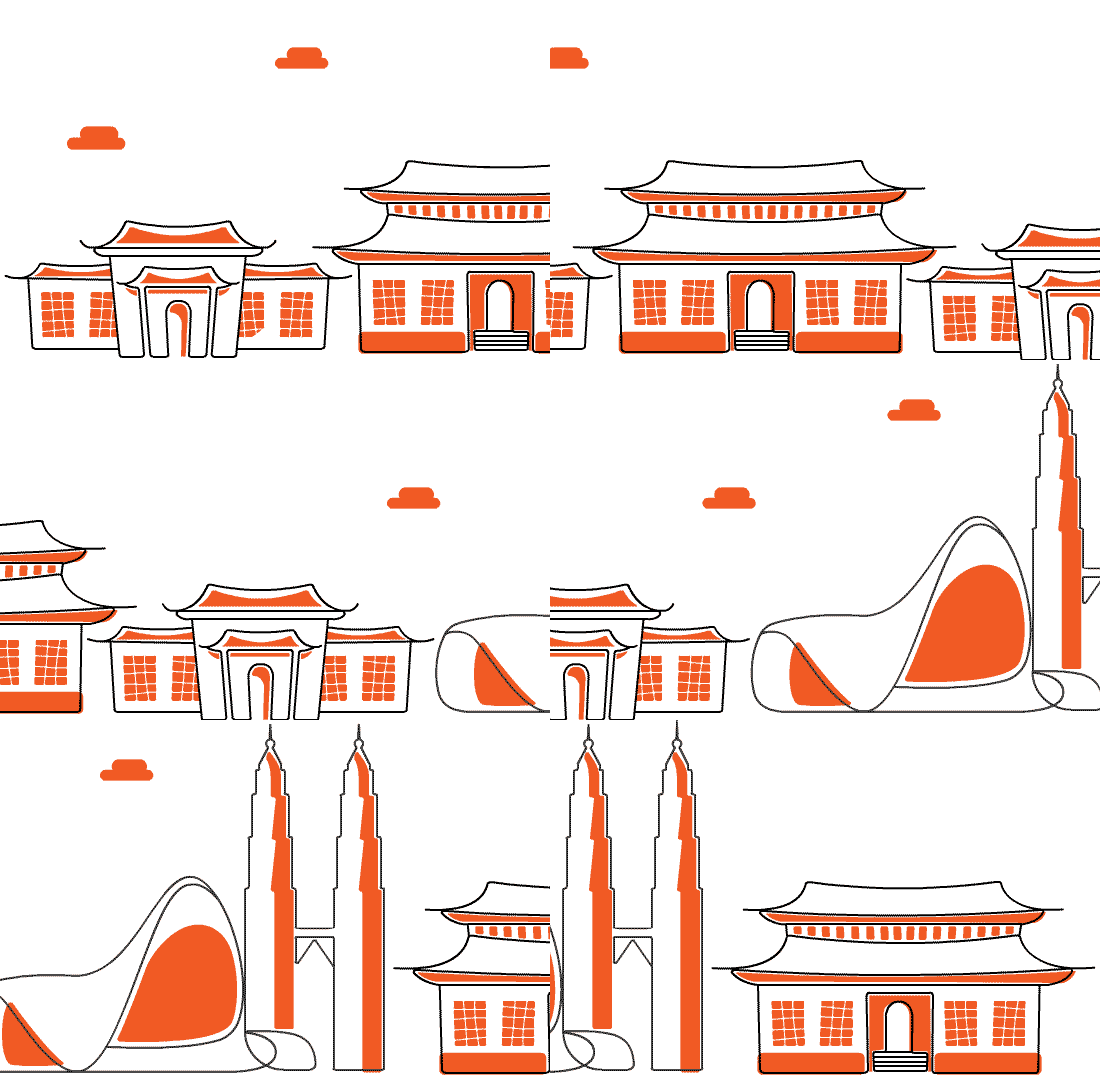
For example, the Tower Bridge in the Jiangsu Province of China is a near-exact replica of the old London Tower Bridge, a famous symbol of the United Kingdom. Plagiarism is a worldwide phenomenon and has been in place for many years. Artists like Andy Warhol have had several plagiarism lawsuits filed on them. Pablo Picasso, the renowned artist, is known for his phrase, “good artists copy; great artists steal.”[1]
The Big-Picture
The sad part is, most of these individuals or agencies get away with it. Design is hardly thought of as intellectual property, and once exposed to society, it is considered to belong to the world at large, to be perused as per their wish. For example, Apple releases its design for a new smartphone and in a month, ten exact replicas belonging to different companies are released as well. Big organizations who become victims of plagiarism have the resources to file lawsuits and pursue justice. But smaller studios and design agencies do not have these resources, nor do they have time to entangle themselves in lawsuits. This is also why these smaller organizations are usually afraid to share their designs and projects over media, giving up a chance for recognition as well. This blatant plagiarism is not only unhealthy, but it also belittles the originality and hard work put in by the actual designer. There is a very thin line between inspiration and plagiarism; but as creators and innovators, it is of utmost importance that we understand the difference.

Inspiration can be thought of as taking an existing design to its version 2.0 or further; re-creating an established concept to accommodate new materials and technologies and adapt better to the evolving society. The Louvre glass pyramid in Paris, designed by famous architect I.M. Pei, draws inspiration from the Great Pyramids of Egypt. The influence can be observed through the form, yet the Glass Pyramid stands as a homage to an architectural icon rather than a reproduction of the same. Art has always been a revival of a predecessor movement — newer styles are constantly inspired from their previous versions, building on them to create a more refined style that is also personal to the particular period. Consider this situation: A new batch of designers replaces the old crop after some time. These new designers bring with them new skills, equipped with the knowledge of emerging technologies. They also understand the needs of their generation better. Hence, they have the power of creating something new by combining novel technologies, old philosophies, and their ideas.
Indian artist and designer Vibhor Sogani put it right when he said “Art is unlike other fields, as it does not provide alternate routes or shortcuts to reaching a career destination in lesser time. One has to go through years of grinding and efforts of finding self-expression.”[2]
The greatest part about design is the journey of an idea that is brought into the physical realm through unrelenting hard work. Designers can change the world and hold the power of defining the face of an entire era with them. We are a global community, working towards the betterment of society through creative outlets. It is time that we work together for the greater good, rather than following deliberate reproduction of the work of our counterparts.
Sources:
[1] Even artists can be plagiarists! Several interesting cases, plagiarismsearch.com, July 12 2016
[2] “Artist and Designer Vibhor Sogani talks about his work, his inspiration and his journey ahead”, India Pages, May 1 2018


Popular Articles
Popular articles from the community


Tsunami Convergenics: Turning Catastrophic Ocean Forces into Underwater Housing Infrastructure
A speculative underwater settlement off the coast of Onagawa, Japan, treats tsunamis and typhoons as energy sources rather than threats.
Faces of the Soviet Avant-Garde: Turning Moscow's Street Names into an Open-Air Museum
A network of sculptural installations across a Moscow residential district transforms forgotten architect names into spatial encounters with cultural memor
Extended Shell: Retrofitting Kolkata's Balconies as Living Urban Thresholds
A modular retrofit system recovers the social and environmental intelligence of Kolkata's historic verandas for contemporary Park Street residents.

Opera by the Sea Estonia: Three Shells Dissolving Architecture into Tallinn's Coastline
A winning opera house proposal replaces monumental form with interconnected shells that blur the boundary between building, park and Baltic Sea.

Similar Reads
You might also enjoy these articles

Shakur's House: Exposed Brick as an Interior Organiser in a 168 m² Mashhad Residence
Brick moves indoors in this Mashhad residence, where masonry walls, glass partitions and teal planes sequence a compact home without closing it off.

Day and Night Park: A Time-Based Urban Newsstand in Beijing
A temporary urban newsstand in Beijing blending travel, light, and reading through poetic colors, compact form, and community-focused design.

Modernist Patio Renovation in El Masnou, Barcelona by Oliver Segura Arquitectura + Cebrià Arquitectura
Modernist patio renovation blending tradition and innovation with a movable pool, leveled floors, and Catalan materials in El Masnou.

Alto Residencial Coop: Cooperative Housing Development in Santiago de Compostela by Carbajo Barrios Arquitectos
A linear cooperative housing complex blending white volumes and perforated metal façades, enhancing community living, natural light, privacy, and urban integration.

Comments (0)
Please login or sign up to add comments
No comments yet. Be the first to comment!