
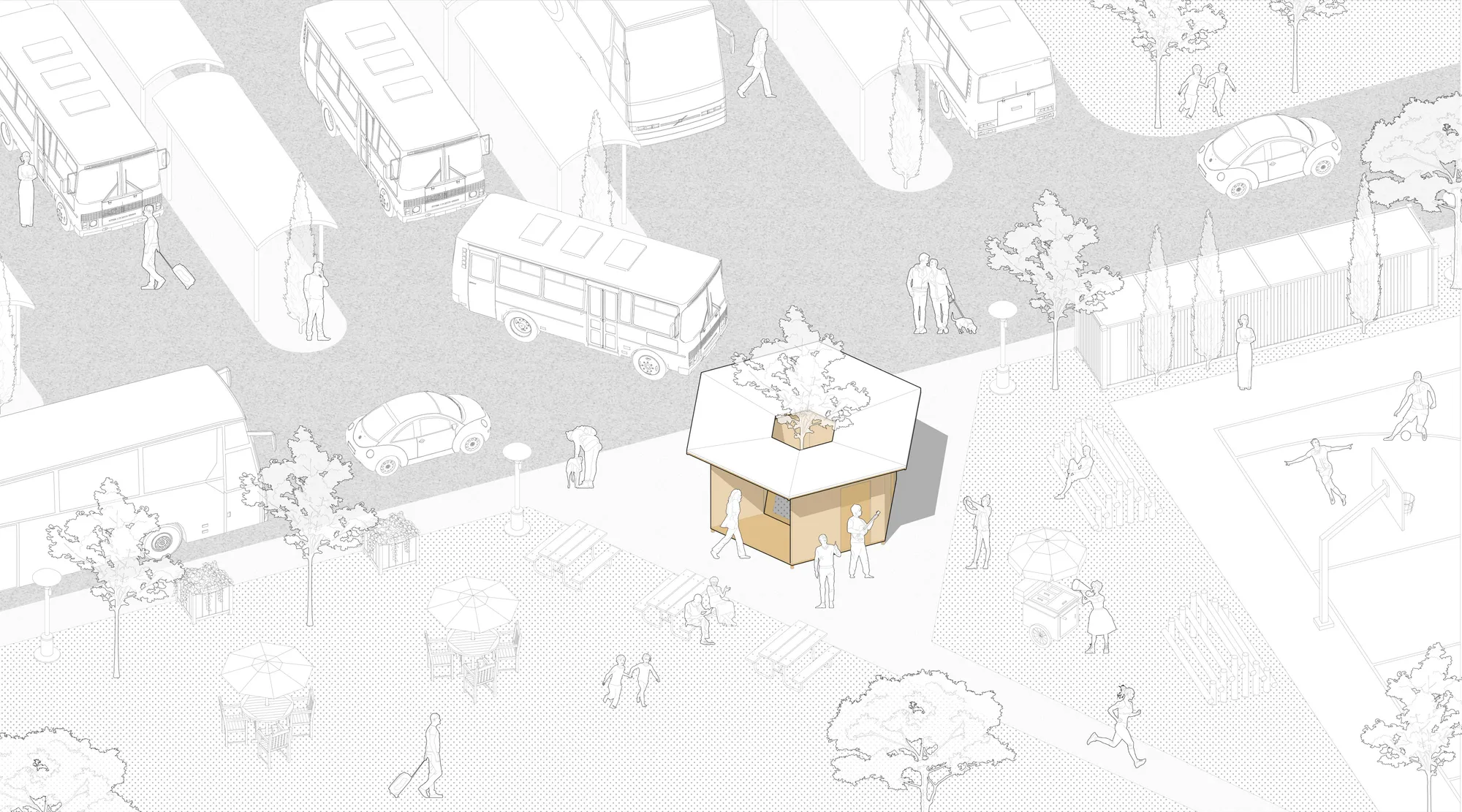
The Library Toilets
Rethinking of public toilets

Basic Concept
We don't tend to talk about toilets much, even though we all use them. According to research, the majority of people spend more than half-hour a day in the toilet, which is 182.5 hours per year. This makes the toilet an important place for people to go after sleeping, living, and working. In my opinion, a good toilet is more than just a little clean space for people’s hygiene needs. When people enter this tiny space and close the door, they actually become isolated from the outside world and enter a small corner that is just for them. It becomes an important place for spirituality and communication, where people can communicate in the same space at different times. People could exchange second-hand books or items here, so they can read during the time in the toilet, and picking up books that interest them and taking the books away.
Traditional outdoor portable toilets are generally narrow and dim, and lack effective hygienic methods, making many people not willing to use these public toilets. At the same time, these toilets are evenly spaced in a single line which is not particularly appealing.
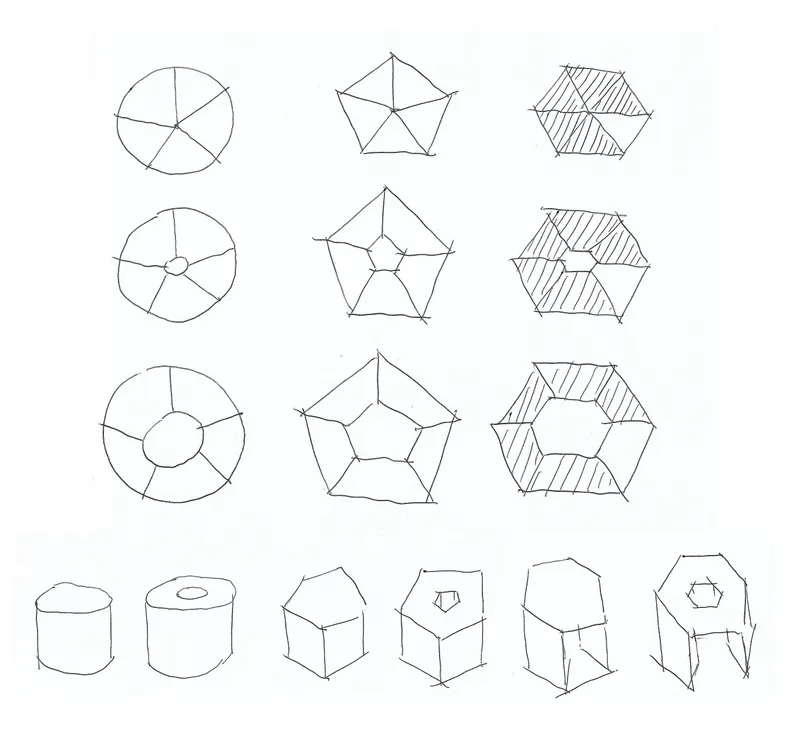
Therefore, my idea was to create a concentric shape, a centralized organization that would make the entire function of construction efficient.
My initial idea was to design a circular construction. But after drawing it, I realized that with this dimension, the space with curvature would give a strong sense of oppression. Then I tried construction in the pentagon, but the totally identic spatial organization made the whole project monotonous and boring.
Finally, I find the idea of using the relation between the solid and empty space to create a hexagonal shape spatial with five solids and one empty space. This means five public toilets with a small terrace for people to take a rest. This combination of different spaces makes the whole project interesting.
The idea of the material and details
The entire toilet structure is wood framed, with walls and floors made up of wooden panels, and the interior cabinets and shelves are all wooden furniture. All these technologies and materials ensure convenience during transport and efficiency during installation.
The idea is that the toilet can be adapted to any different situation site, with self-sufficiency. So the system of rainwater harvesting is important for conserving and storing the water supply. The concept is to capture the free water falling on the sloped roof and direct it to green space in the atrium.
The purpose of the phyto-purification system is to transform water falling down from the roof and the used water into water that can be reused. This system is based on the principle of separating solids from liquids by the plants as well as the bacterial degradation of particles. This plant-based filter consumes no electrical energy and doesn't need complex maintenance.
The filtered water is stored in a water tank under the ground which could supply to the washbasin and flush toilet. This self-sufficient system allows for portable toilets without the need to be connected to the city water pipeline. This feature makes the installation of these public toilets independent of geographical limits.
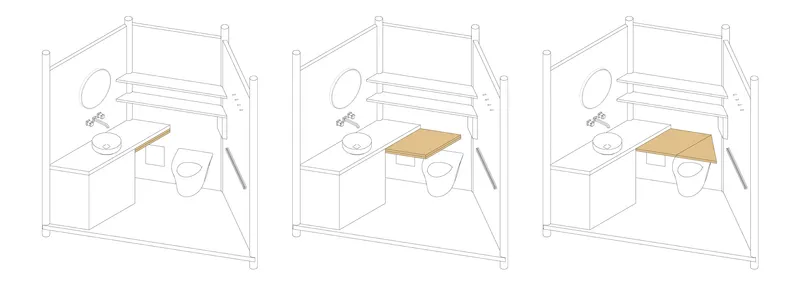
In my idea, there is no need for a special baby care room outside. We can do this in these public toilets. The foldable baby care table is normally folded away under the washbasin table. When a parent needs to change the baby’s diaper, this folding table can be opened in two parts to become a full baby care table.
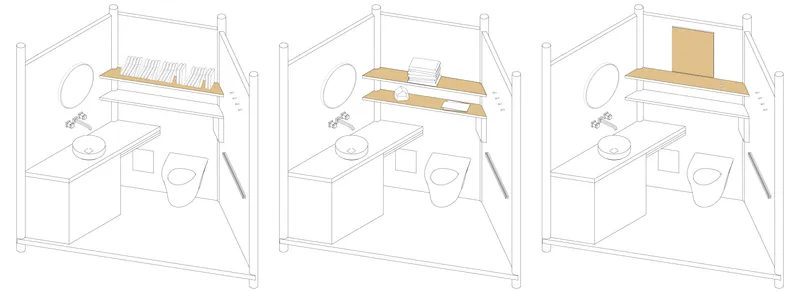
There are double shelves in the toilets for exchanging books or second-hand items such as clothes, children’s toys, etc. These books and items could be freely taken or exchanged by users rather than organizing complex disposal events. Users can pick up a book and read it to pass the time while using the toilet. Also at the top of the bookshelf, a drawing board could be placed for users to share emotions or stories. All of these ideas are aimed at making the public toilets not only a place of hygiene but also a place where different peoples could communication and exchange with each other.
Modularity
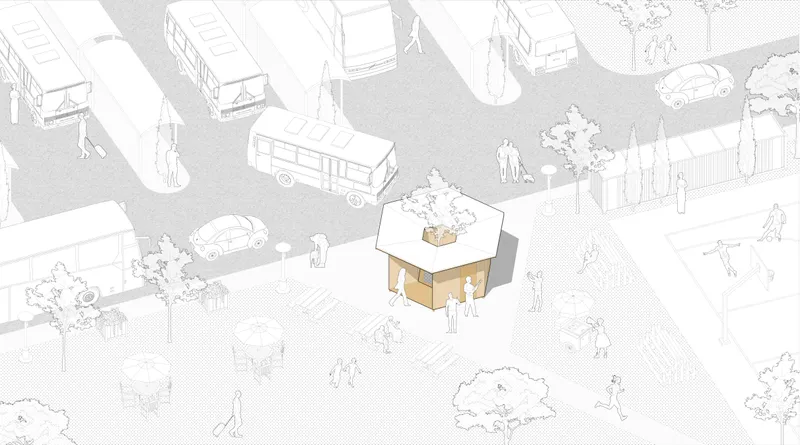
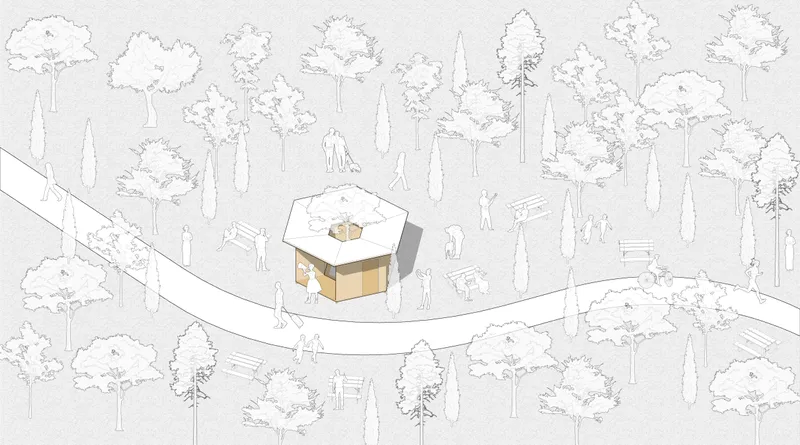
As the main design approach, I aimed to create modular toilets which could be adapted to any conditions and geographical limits, such as a busy bus terminal, or in a peaceful park. These two analysis diagrams try to simulate these two completely different scenarios. The main point of the design is that these toilets don’t need to be connected to an existing city pipeline or a new pipeline system which needs to be built in the suburbs. The entire toilet has a complete self-sufficient water supply system.


Popular Articles
Popular articles from the community


Hill & Cross Opera: Sculptural Opera House Architecture Shaped by Tallinn’s Landscape and Identity
Hill & Cross Opera reimagines opera house architecture in Tallinn through its sculptural hill, civic plaza, glass wave and a luminous cross.

Co-life: Sustainable Architecture for Age-Friendly Community Living
Co-life reimagines sustainable architecture for seniors through courtyards, rammed earth, shared gardens, and spaces designed for belonging.

The Ocean Hive: Sustainable Architecture for a Self-Sufficient Civilization at Sea
The Ocean Hive imagines sustainable architecture at sea, where modular habitats, algae, wave power and ocean waste sustain a growing colony.

Riyadh For All: Intergenerational Urban Design for Active Aging in Rabat
Riyadh For All reimagines urban design in Rabat with intergenerational co-living, adaptive courtyards, and Moroccan cultural exchange today.


Similar Reads
You might also enjoy these articles

Day and Night Park: A Time-Based Urban Newsstand in Beijing
A temporary urban newsstand in Beijing blending travel, light, and reading through poetic colors, compact form, and community-focused design.

Modernist Patio Renovation in El Masnou, Barcelona by Oliver Segura Arquitectura + Cebrià Arquitectura
Modernist patio renovation blending tradition and innovation with a movable pool, leveled floors, and Catalan materials in El Masnou.

Alto Residencial Coop: Cooperative Housing Development in Santiago de Compostela by Carbajo Barrios Arquitectos
A linear cooperative housing complex blending white volumes and perforated metal façades, enhancing community living, natural light, privacy, and urban integration.
Vil Genis School by BPA ARCHITECTURE – Massy, France
Vil Genis School in Massy, France, features sustainable design, south-facing classrooms, community integration, accessible spaces, and modern educational architecture.





Comments (0)
Please login or sign up to add comments
No comments yet. Be the first to comment!