
The Melange Studio Turns a New Delhi Storefront into a Street Culture Temple for Gully Labs
A sneaker store in New Delhi channels Indian street identity through raw concrete, stacked masonry, and a floating shoe sculpture.


Most sneaker stores default to the same visual playbook: white walls, floating shelves, museum lighting. Gully Labs in New Delhi refuses that script entirely. Designed by The Melange Studio, the project treats a retail space as an extension of the street it sits on, borrowing from the textures, improvisation, and layered identity of Indian urban life rather than mimicking the polished retail interiors of global sneaker franchises.
What makes this project genuinely interesting is its commitment to material honesty as brand storytelling. Every surface, from three-dimensional masonry walls that double as display shelves to reclaimed timber ceilings and stainless steel furniture, communicates something about the culture Gully Labs claims to represent. The store is not decorated with street culture references; it is built out of them.
A Facade That Doesn't Whisper

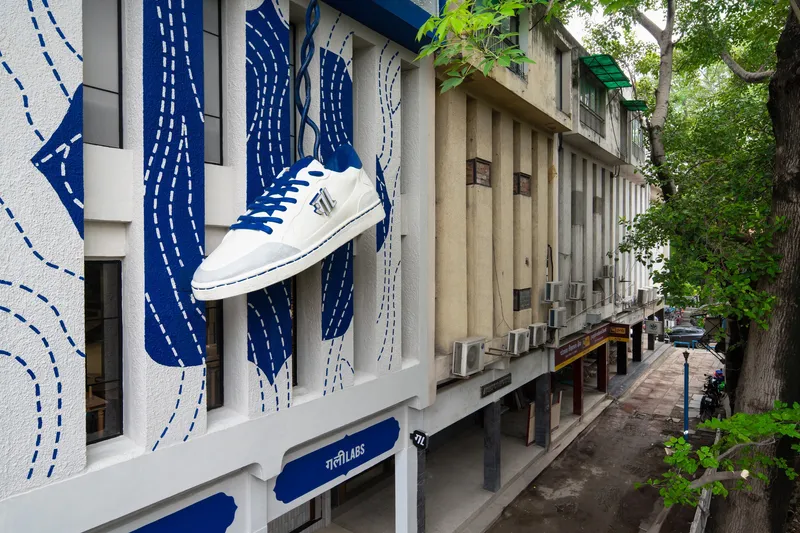
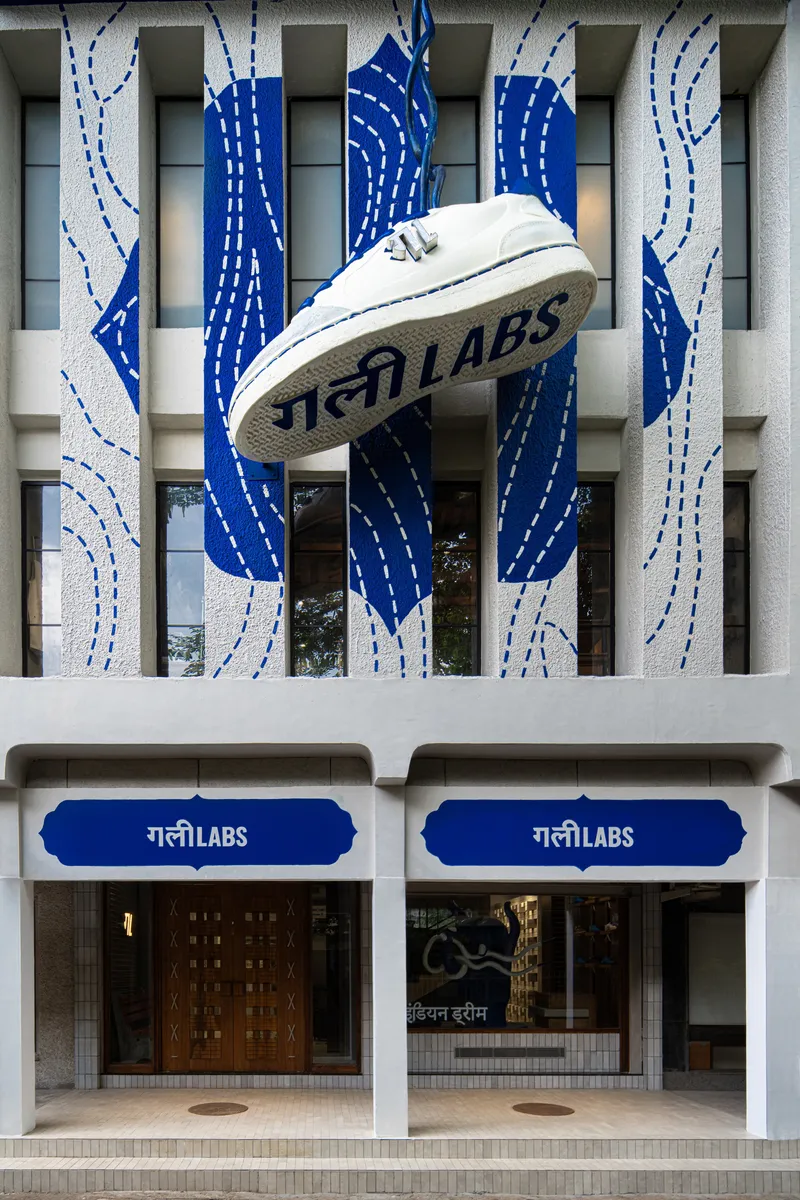
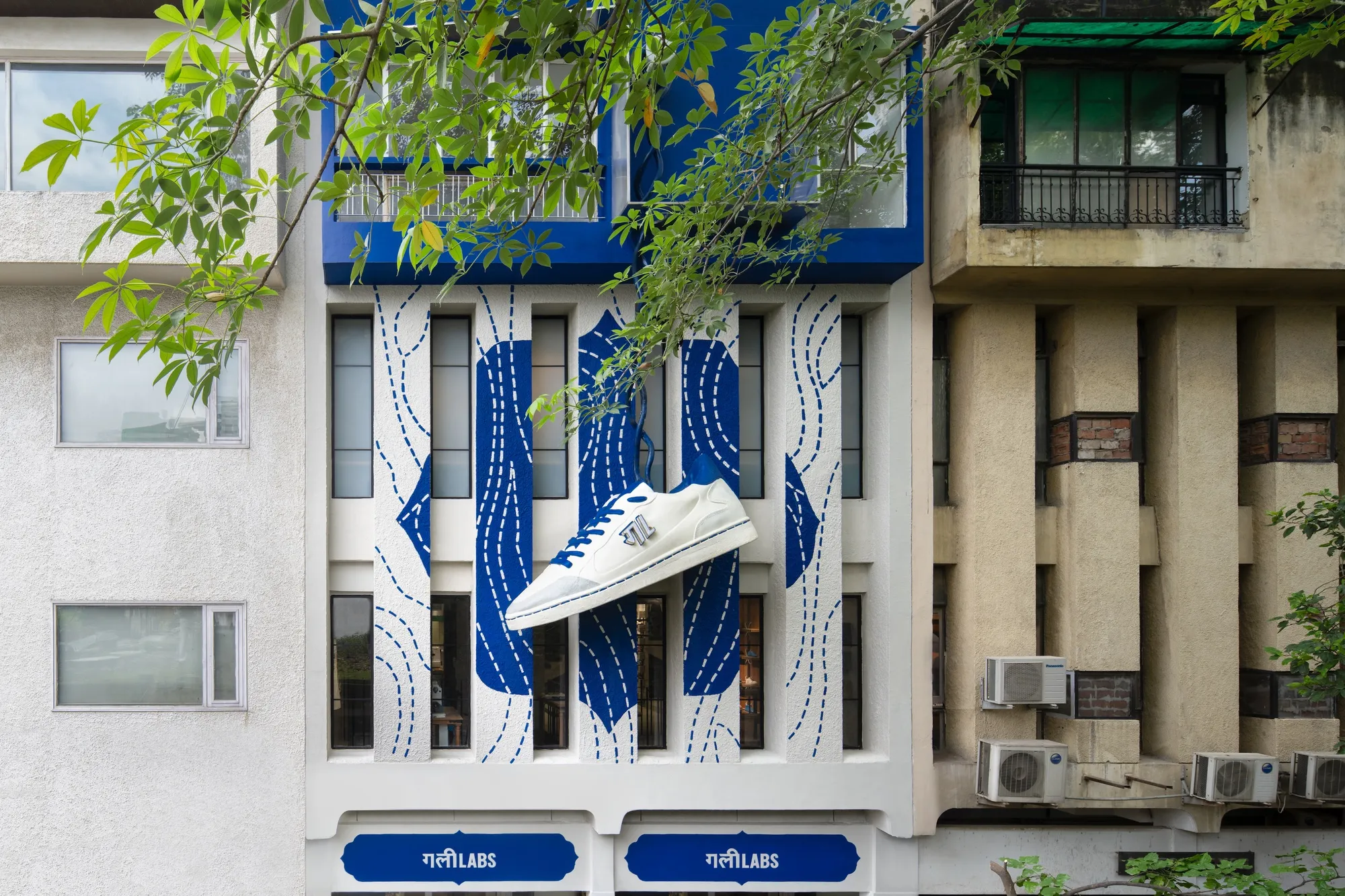
The street presence of Gully Labs is impossible to miss. A large-scale white sneaker sculpture floats above the entrance, suspended against blue and white graphic panels that borrow the visual language of stitching and textile patterns. The mural wraps the facade in an oversized brand declaration that feels more public art installation than shopfront signage.
Dual blue awnings frame the ground-level entry, while the composition reads as a single graphic gesture from across the street. The overhanging trees soften its edges, making the facade feel embedded in the neighborhood rather than dropped in from elsewhere. It is loud, but it earns its volume.
The Street Meets the Threshold


Seen from the pavement at a distance, the storefront oscillates between a gallery and a workshop. Timber screens and display windows at dusk glow warmly against the concrete sidewalk, while the mural facade provides a painted backdrop that draws pedestrians into a conversation with the building before they even step inside. The seated figure on the walkway in front of the mural captures the casual relationship between the store and its public context. The architecture invites loitering, which is exactly what a street culture brand should do.
Masonry Walls as Merchandise Infrastructure

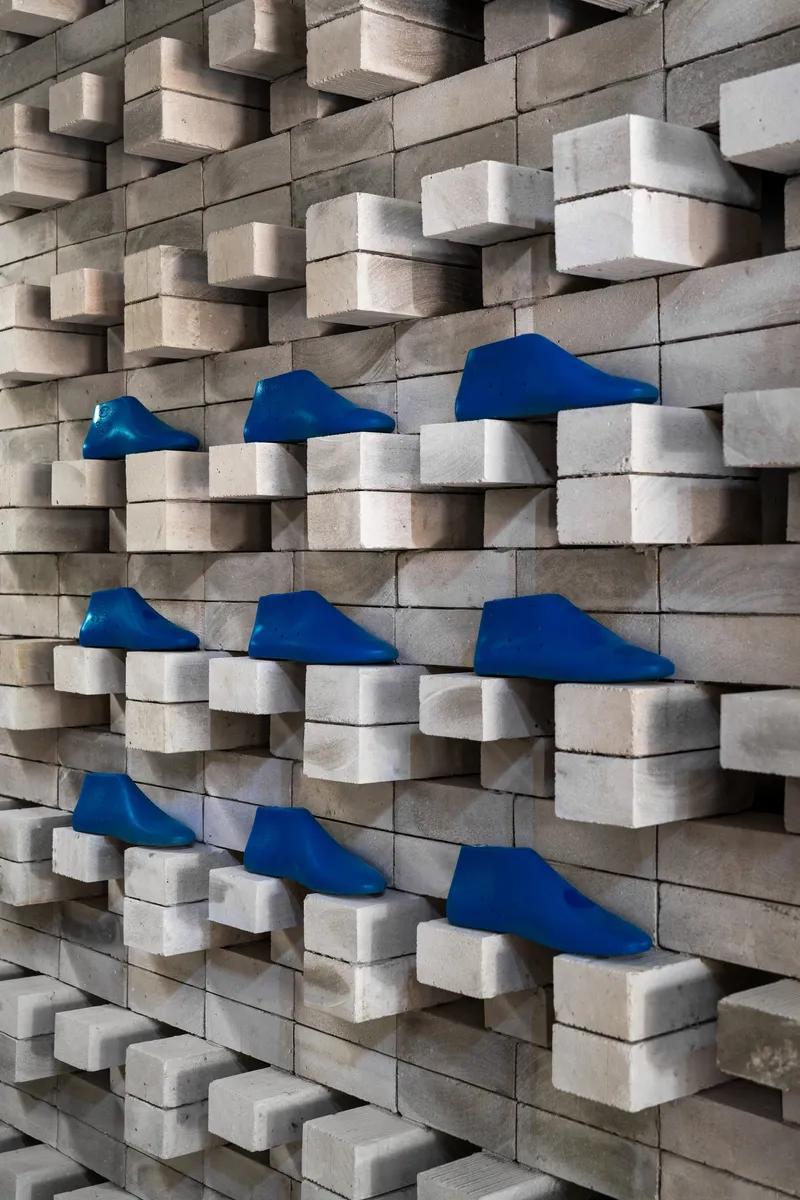

The most distinctive interior move is the three-dimensional block wall: masonry units project at staggered depths to create a textured surface that simultaneously serves as display shelving. Sneakers and fabric footwear sit in recessed ledges formed by the offset blocks, eliminating the need for conventional retail fixtures. The wall is structure, surface, and furniture all at once.
Paired with timber-lined niches and stainless steel display tables, the material palette oscillates between industrial grit and craft. A linear fluorescent fixture runs the length of the block wall, washing light across the projecting surfaces and casting deep shadows that give the shoes their own micro-architecture.
Arches, Portals, and Layered Depth

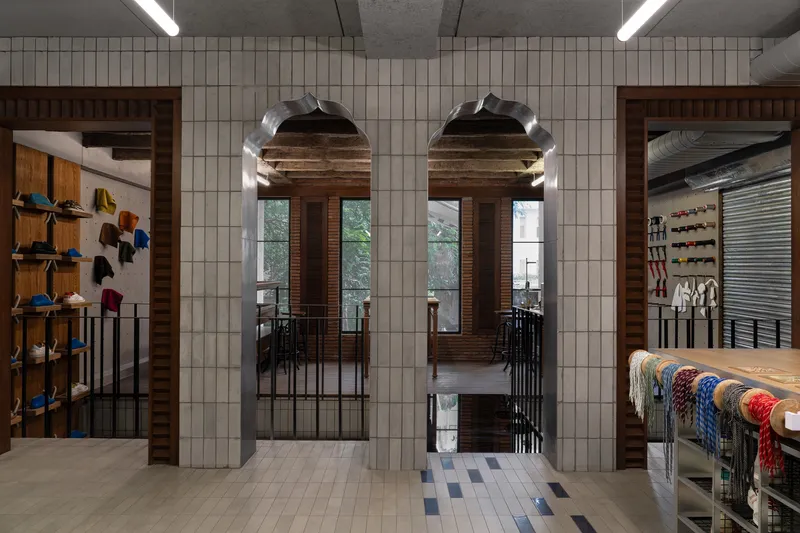
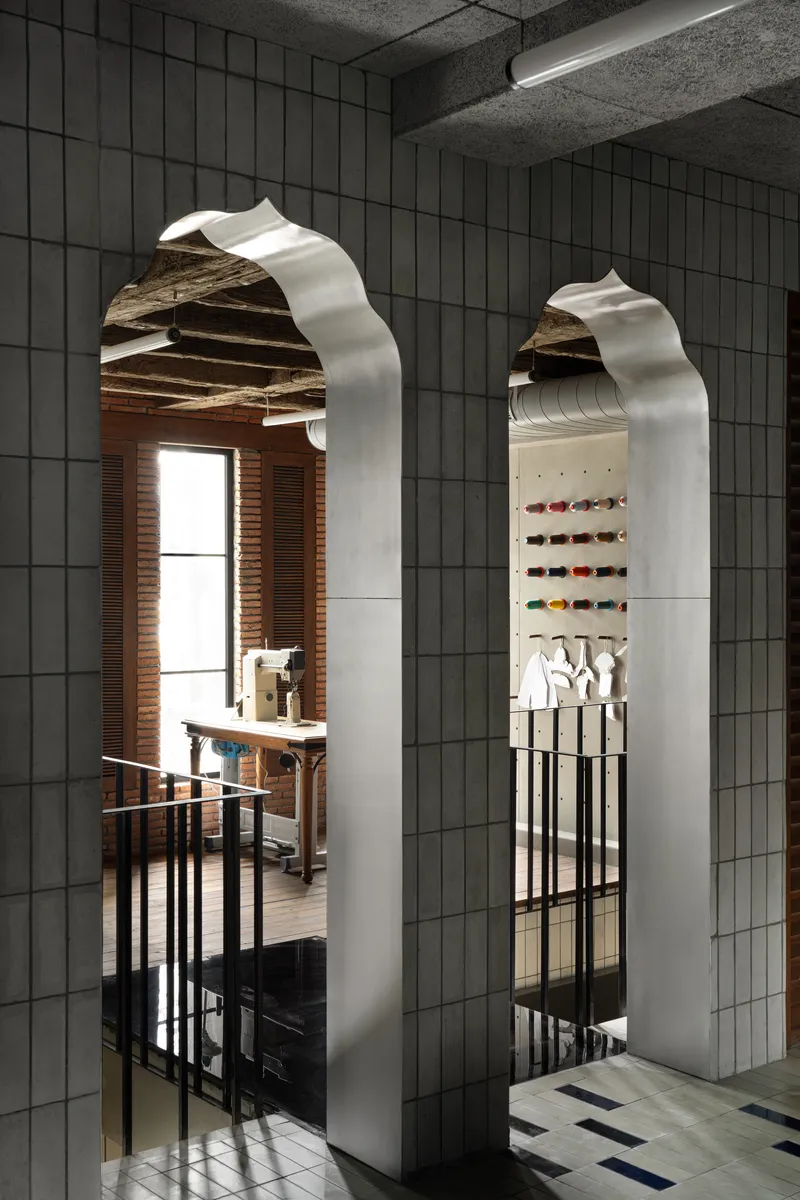
The Melange Studio uses arched openings and ribbed portal columns to organize the interior into a sequence of framed views. White metal arches punch through grey tile walls, revealing the timber-beamed workshop beyond, while reclaimed wood ceilings overhead tie the spaces together materially even as the portals separate them spatially.
The twin arched doorways create a visual rhythm that slows customers down, turning a walk through the store into a series of reveals. You see the next room through a carefully composed frame before you arrive in it, which gives the relatively modest floor area a sense of procession and discovery.
Stainless Steel and Striped Tiles

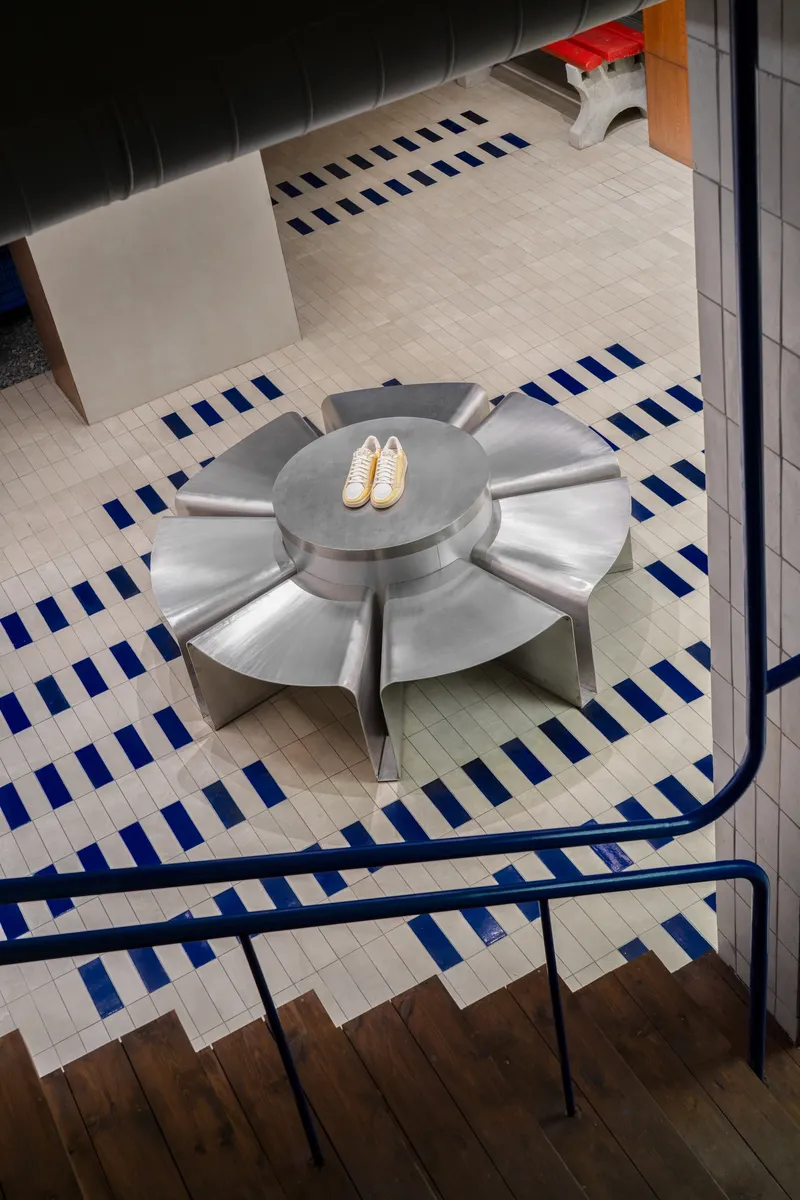
The ground floor retail space plays exposed concrete ceilings and visible mechanical ducts against striped floor tiles and polished stainless steel furniture. A flower-shaped seating element near the staircase reads almost as sculpture, its reflective surface picking up the linear floor pattern and the overhead utilities. The juxtaposition is intentional: nothing in the space pretends to be precious, yet everything is carefully placed.
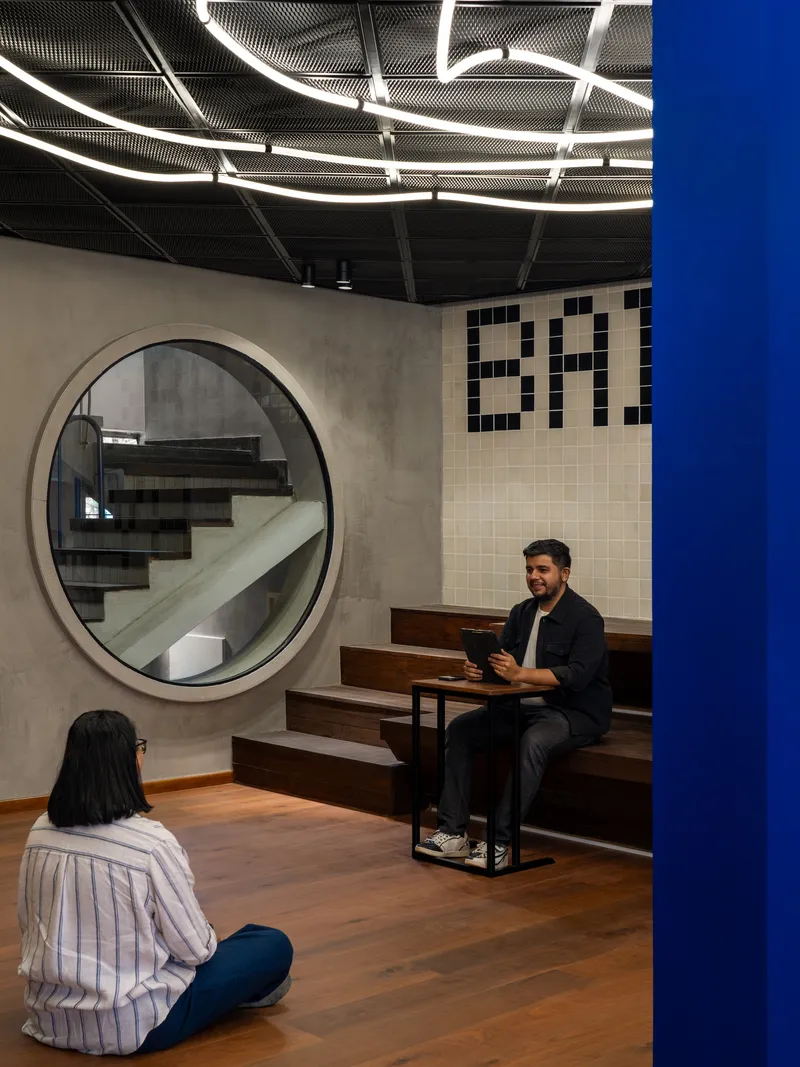
A double-height seating area near a circular concrete staircase portal introduces curved linear lighting and tiled wall graphics, adding another layer of visual texture. Two visitors sit casually beneath the fixture, reinforcing the idea that this is a space designed for hanging out, not just transacting.
Vertical Circulation as Spectacle
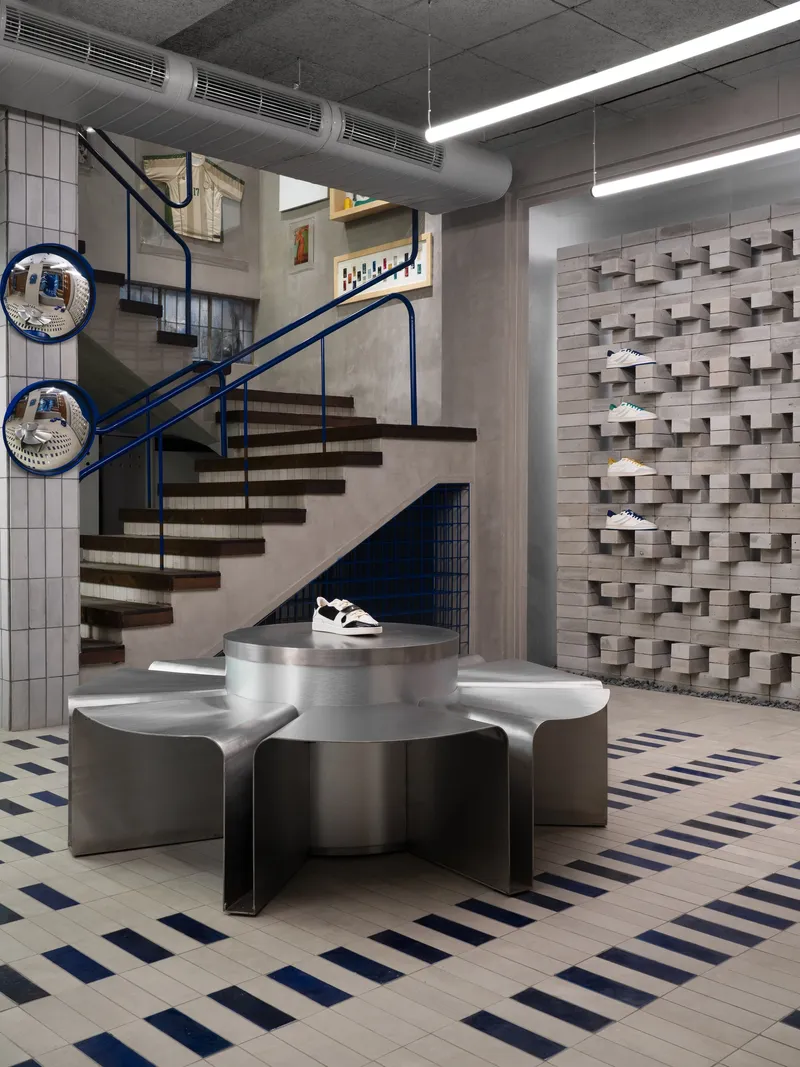

A floating timber stair with a blue steel railing connects the ground floor retail to the upper workspace. Viewed from above, the spiral staircase and protruding block wall form a striking composition against the linear floor pattern, turning the vertical circulation into a spatial event rather than a functional afterthought. A metal display pedestal at the base of the stair anchors the transition and catches the eye of anyone walking past.
The Upper Workshop: Where the Brand is Made


Upstairs, exposed timber beams and louvered windows create a workshop atmosphere that feels genuinely productive. Pegboard walls display caps and product samples while someone works at a cutting table below. Morning light enters through the louvers and rakes across the ceiling joists, giving the space a warmth that the concrete ground floor deliberately withholds.
Making the production space visible and accessible to customers is a smart brand decision. It tells the customer that Gully Labs is not just a label applied to imported goods; it is a place where things are cut, stitched, and assembled. The architecture reinforces that narrative without overstating it.
Rope Crosses, Blue Totems, and Cultural Artifacts
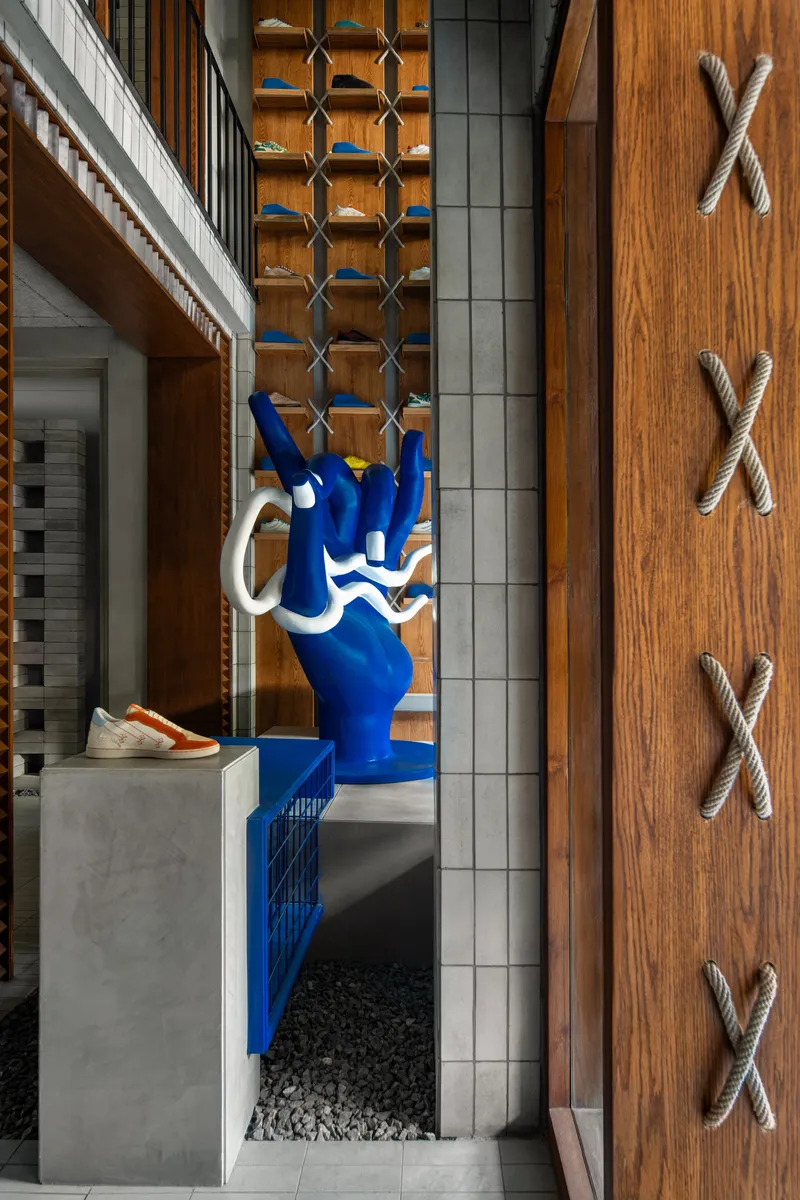


Scattered through the interior are objects that function as cultural signifiers: a blue sculpture on a concrete plinth, rope cross motifs on timber walls, hexagonal shelving units that recall the ad hoc storage solutions of Indian market stalls. These elements are not decorative afterthoughts; they set the tone of each zone and orient customers within a narrative about craft, street life, and material ingenuity.
The double-height view of the blue sculpture against the timber wall and hexagonal shelving under exposed ceiling beams is the interior's most arresting moment. It compresses the entire material vocabulary of the project into a single frame: wood, concrete, steel, pigment, and rope.
Service Counter and Corridor Details
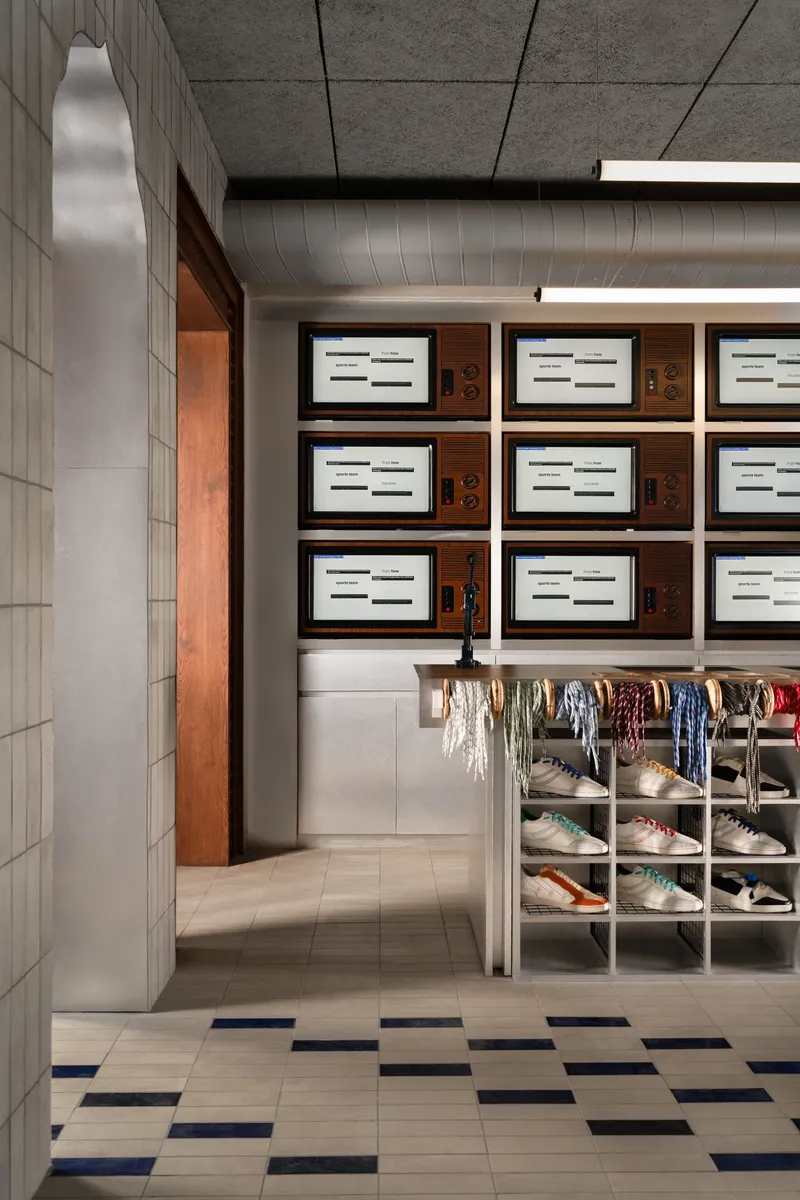
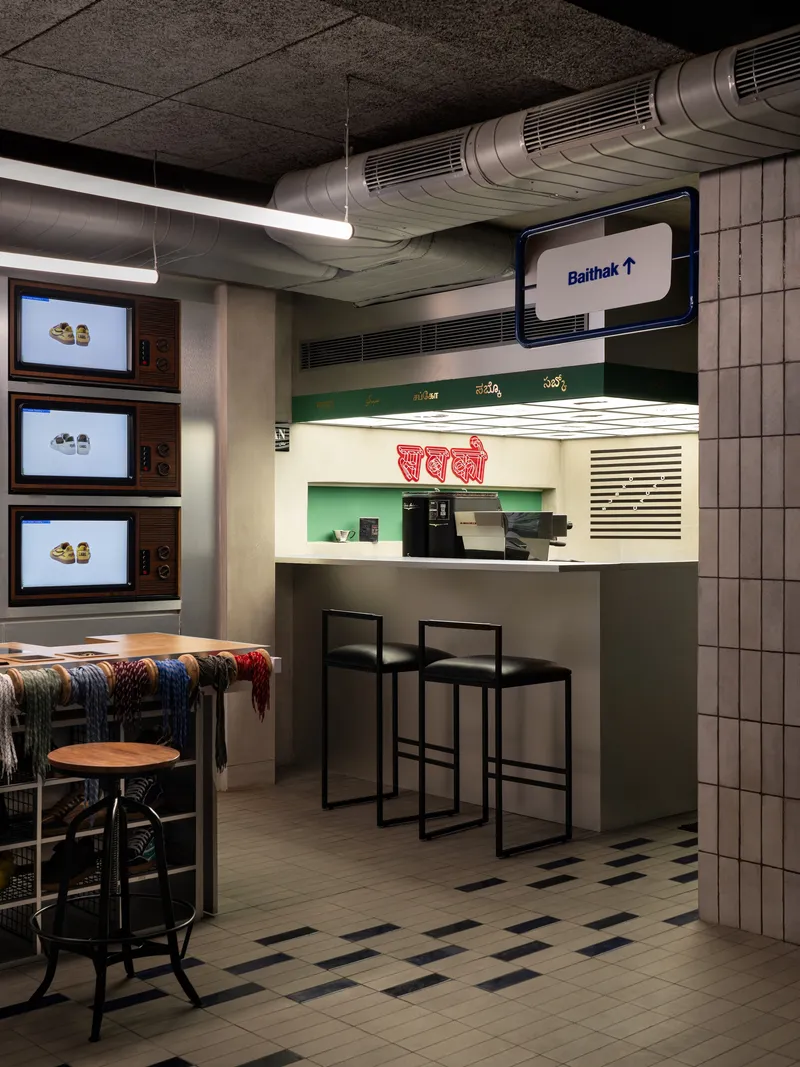

Even the utilitarian zones receive careful treatment. A grey-tiled corridor leads to a storage area where sneakers and backlit product boxes are displayed with gallery-like precision. The service counter features illuminated menu panels and a canopy with backlit grid panels showing food illustrations, suggesting the store doubles as a community gathering point rather than operating as a pure retail machine.
Exposed ductwork runs beneath textured ceiling tiles above the counter, maintaining the raw overhead language that defines the entire project. The consistency is key: no surface is treated as a throwaway, and no zone is allowed to fall outside the material logic established at the front door.
Why This Project Matters
Gully Labs succeeds because it refuses to separate the act of selling sneakers from the culture that produces them. The Melange Studio has designed a space that is simultaneously a store, a workshop, a social hub, and a piece of street art. That ambiguity is not a failure to commit; it is a recognition that street culture brands cannot survive in hermetic retail boxes. They need porous boundaries, visible making, and spaces that reward loitering as much as purchasing.
The project also makes a quiet argument about material economy. Stacked masonry, reclaimed timber, exposed concrete, and stainless steel are not luxury finishes, but they are deployed here with enough care and spatial intelligence to create an interior that feels richer than spaces finished at ten times the cost. For retail architecture in India and beyond, that is a model worth studying.
Gully Labs Sneaker Store by The Melange Studio, New Delhi, India. Photography by Avesh Gaur.
About the Studio
Share Your Own Work on uni.xyz
If projects like this are the kind of work you want to make, uni.xyz is a place to publish your own, find collaborators, and enter design competitions.



Popular Articles
Popular articles from the community


Riyadh For All: Intergenerational Urban Design for Active Aging in Rabat
Riyadh For All reimagines urban design in Rabat with intergenerational co-living, adaptive courtyards, and Moroccan cultural exchange today.

The Earth Pod: 3D Printed Homes for Resilient Refugee Communities
The Earth Pod reimagines refugee housing through 3D printed homes made from clay, combining resilience, self-sufficiency, and rapid shelter.

Conexión: Biophilic Design Reimagines High-Rise Living in Hong Kong
Conexión reimagines high-rise living in Hong Kong through biophilic design, green facades, shared spaces, daylight, water and nature within.

The Ocean Hive: Sustainable Architecture for a Self-Sufficient Civilization at Sea
The Ocean Hive imagines sustainable architecture at sea, where modular habitats, algae, wave power and ocean waste sustain a growing colony.


Similar Reads
You might also enjoy these articles

Bao Huynh Watercolor Atelier: A Serene Art Retreat in Hội An
Bao Huynh Watercolor Atelier in Hội An blends multifunctional art spaces, sustainable design, local materials, and family-friendly living in a serene environment.

Atelier Macri Concept Store Interior Design by CASE-REAL
Atelier Macri store features a "ko" counter, walnut wood details, cork displays, blending retail, gallery, and seamless customer experiences.

Manuel Vargas Izquierdo Stadium and High-Performance Sports Center: Architectural Excellence in Jalpa de Méndez
The Manuel Vargas Izquierdo Stadium blends sustainable design, inclusive sports facilities, and cultural-inspired architecture, revitalizing Jalpa de Méndez’s public spaces.

KAKR Buluh Awar Hall: Revitalizing Community and Ecology Through Bamboo Architecture
Community built bamboo hall revitalizes Buluh Awar village, empowering youth, restoring ecology, celebrating vernacular craftsmanship through sustainable architecture and culture.



Comments (0)
Please login or sign up to add comments
No comments yet. Be the first to comment!