
SHED Architecture Rewires a Pacific Northwest Forest Retreat Around Light, Timber, and Mist
A mid-century house in the wooded hills outside Seattle is stripped back and rebuilt as a series of carefully framed encounters with its landscape.


Most mid-century renovations lean on nostalgia: restore the originals, polish the brass, call it done. The Mori House, reworked by Seattle's SHED Architecture & Design, does something more demanding. It treats the existing bones of a wooded hillside home not as a relic to preserve but as a chassis to re-engineer, swapping dated enclosures for a new spatial logic governed by views, material warmth, and the particular damp light of the Pacific Northwest.
The result is a house that feels simultaneously grounded and permeable. Black-clad volumes anchor it to the steep site, while floor-to-ceiling glazing and continuous timber ceilings dissolve the boundary between interior and forest. What makes the project genuinely interesting is the discipline behind these gestures: every opening is calibrated to a specific view or quality of light, every material palette decision reinforces a gradient from the dark, protective shell to the warm, grain-rich core. The house doesn't shout mid-century revival. It operates on the same principles, then pushes past them.
A Dark Shell in a Green World
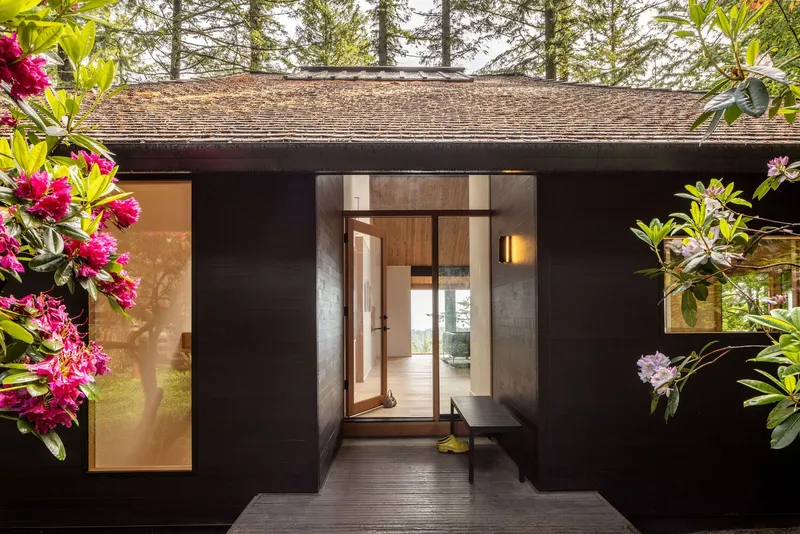
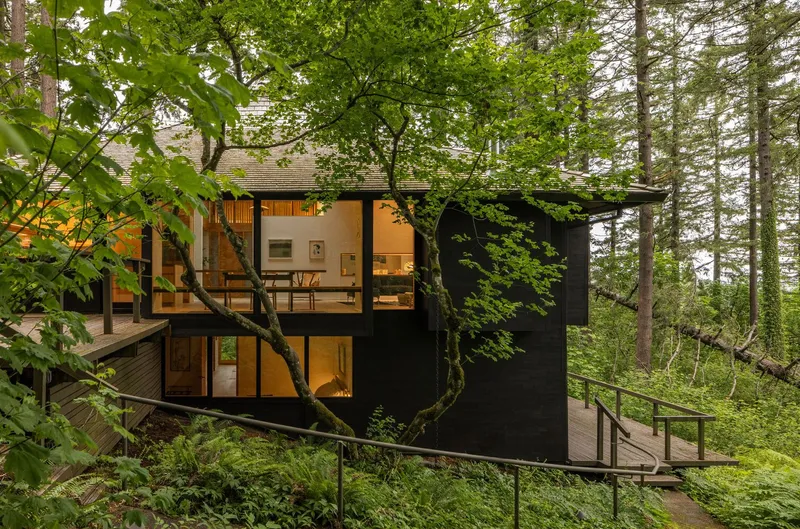
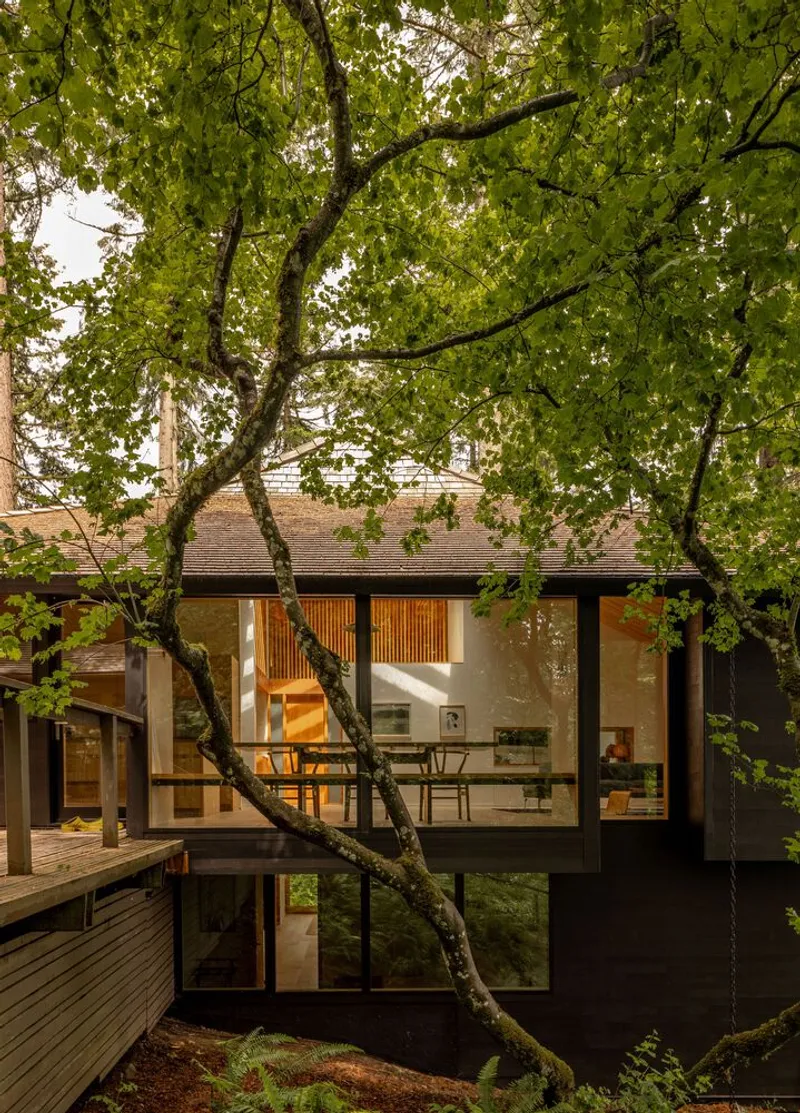
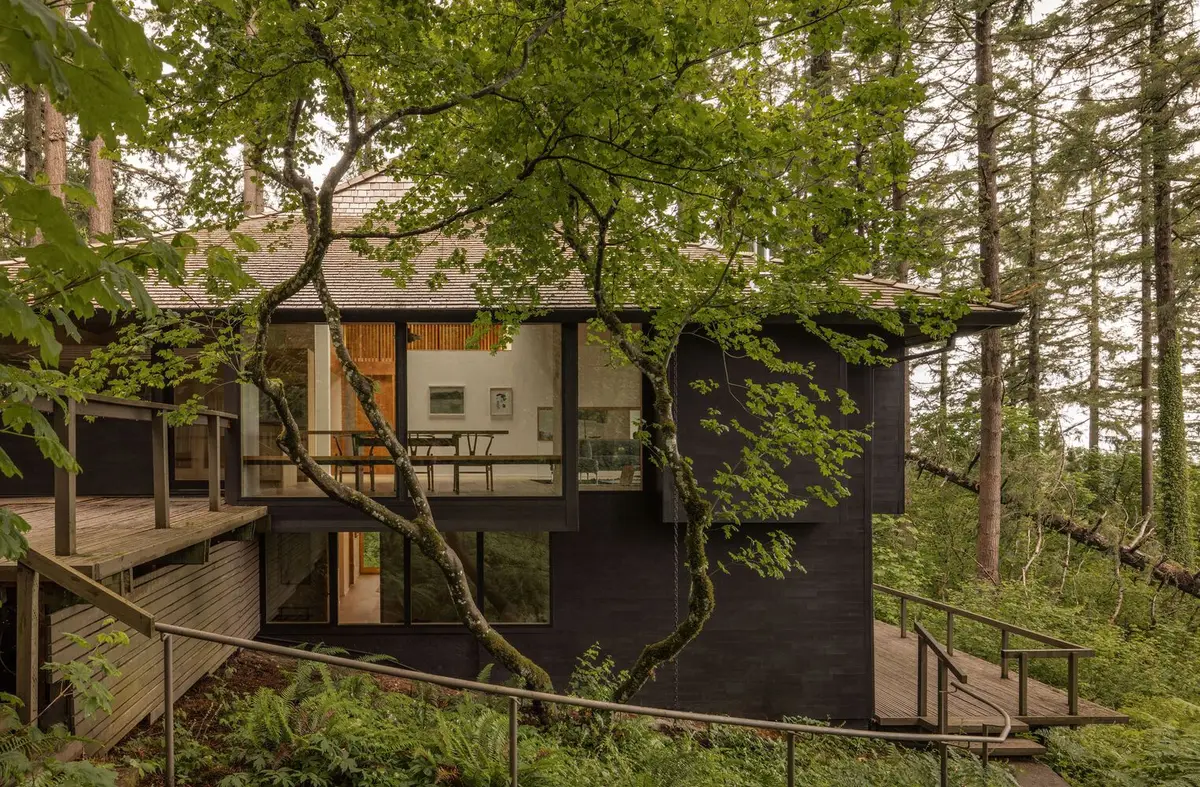
The exterior cladding is a matte black that reads as deliberate understatement. Against the saturated greens of moss, fern, and evergreen canopy, the dark volumes recede rather than compete. SHED lets the landscape do the visual heavy lifting: blooming rhododendrons crowd the entry, and moss-laden branches drape directly over timber decks.
At dusk the strategy pays dividends. The black shell becomes nearly invisible while interior warmth glows through expansive glazing, turning the house into a lantern suspended among the trees. The effect is less about drama than about establishing a relationship of deference. The architecture concedes the foreground to the site.
Approach and Threshold
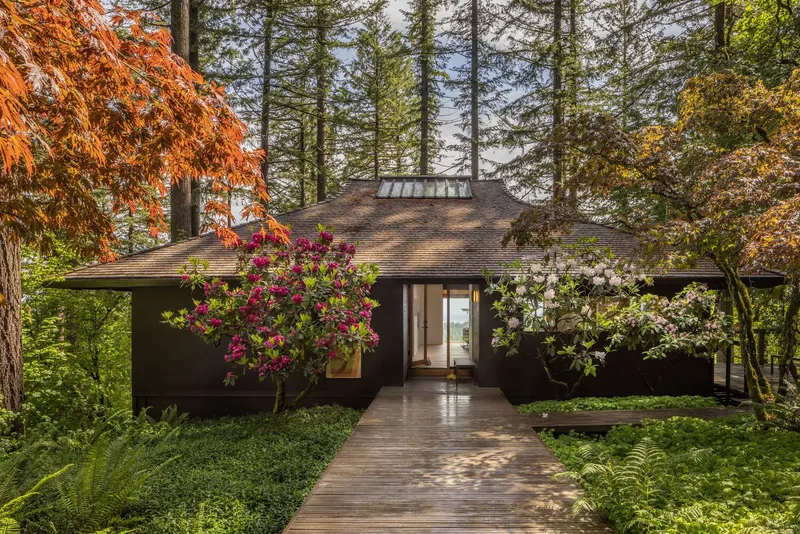
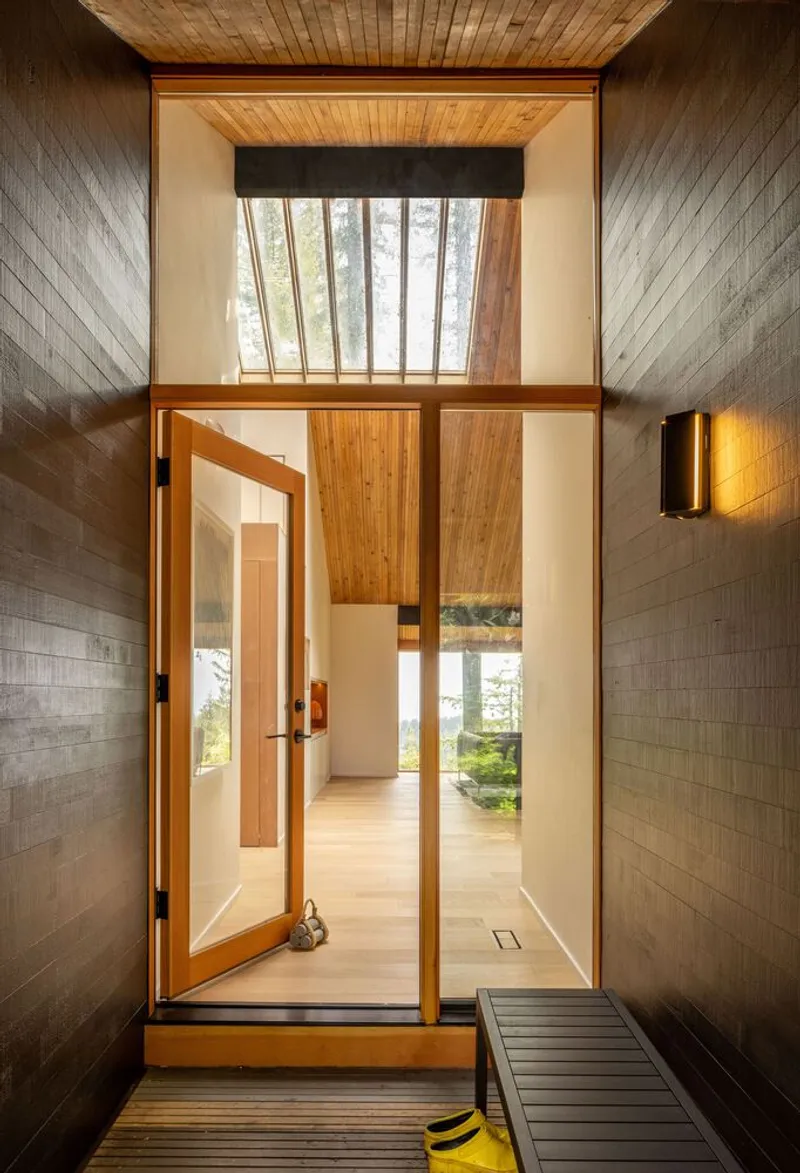
Arrival is orchestrated through a timber boardwalk that threads beneath flowering canopy, compressing the visitor's field of vision before releasing it into a double-height entry vestibule. The transition from the muted, damp exterior path to a tall space washed with skylight through slatted timber is precise and intentional. A glazed pivot door marks the formal threshold, but the experiential one starts much earlier, somewhere between the gravel and the first plank.
Inside the vestibule, the slatted ceiling and exposed structure telegraph the material logic of the entire house. You understand within seconds that timber is the connective tissue, and that the architects have calibrated its exposure, finish, and rhythm differently in each zone.
Living Under the Vault
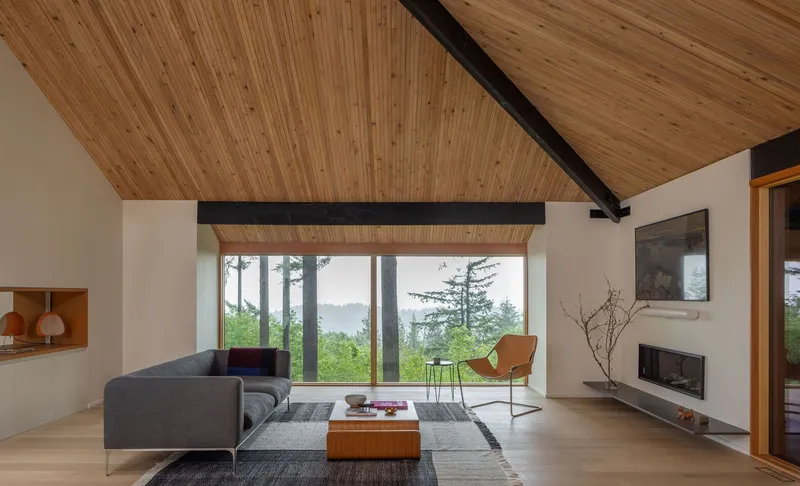
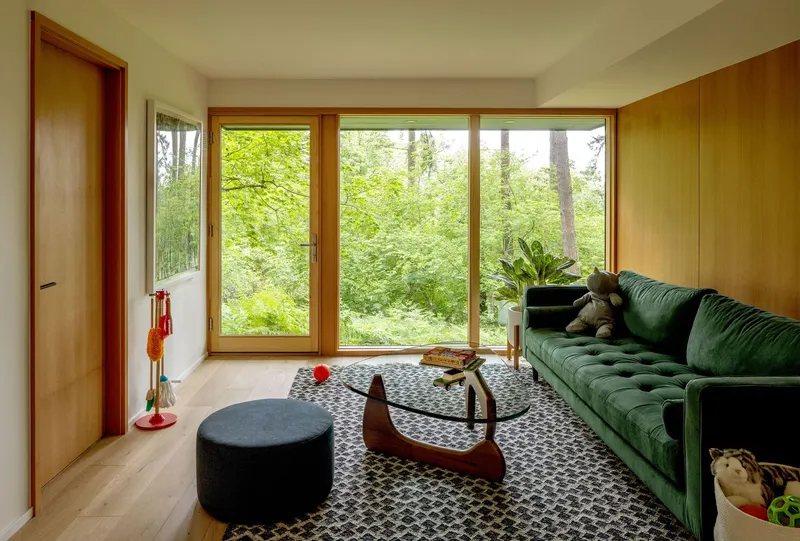
The primary living spaces occupy a vaulted volume where exposed black steel beams counterpoint the warm timber deck of the ceiling. The proportions are generous without being cavernous, and the vaulted form channels the eye outward and downward toward the forest floor visible through full-height glass. It is the kind of section that feels inevitable once you see it, but required real effort to carve out of the existing structure.
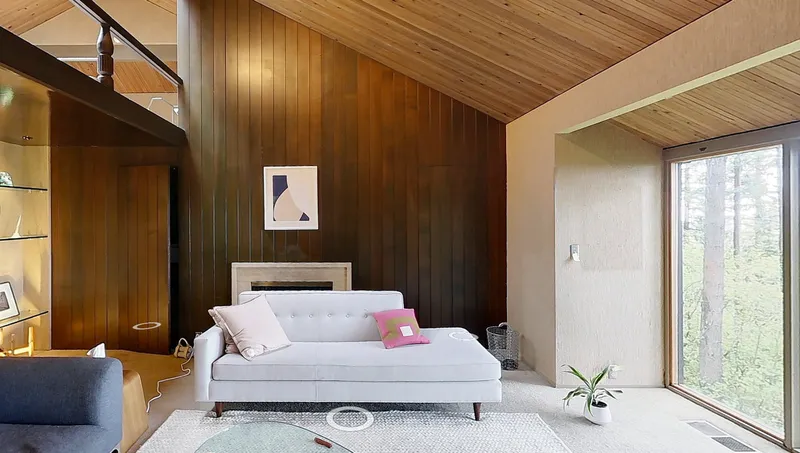
A dark timber accent wall and restrained furnishings keep the room from tipping into cabin cliché. The palette is cool enough to feel modern, warm enough to feel human. Glass doors open directly to the undergrowth, and in certain light conditions the room reads as a covered clearing rather than an enclosed box.
The Mezzanine as Spatial Hinge
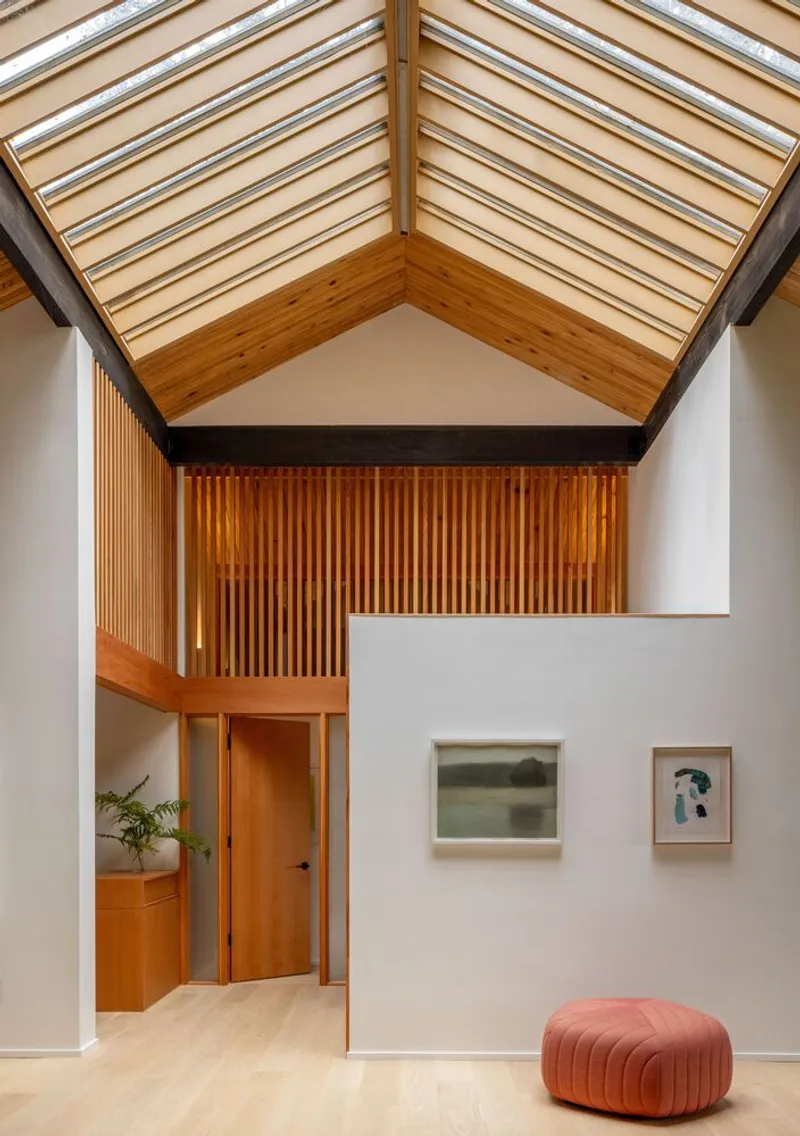
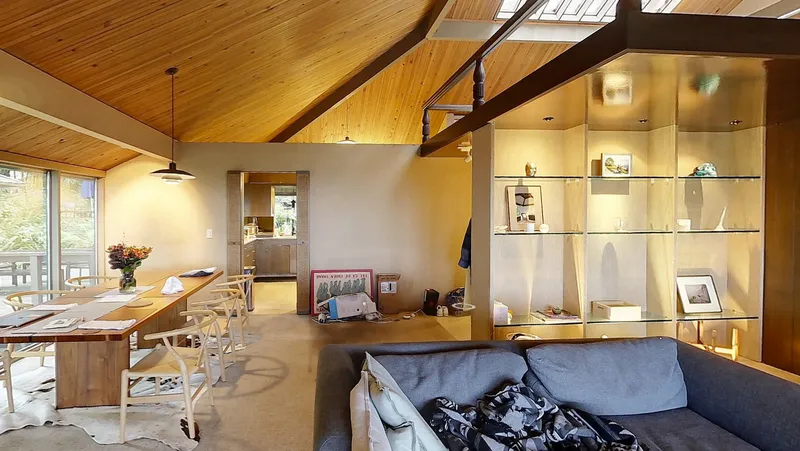
A timber-slatted mezzanine hovers above the main living volume, filtering light from a striped skylight overhead and lending the double-height space a layered section. This is not a loft tacked on for extra square footage. It works as a spatial hinge that connects the upper sleeping level to the communal heart of the house while maintaining acoustic and visual separation through the slatted screen.
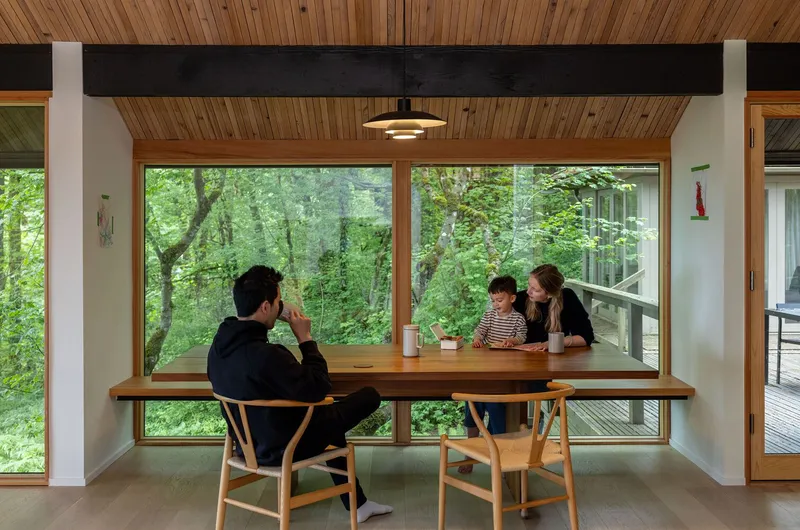
Below, the open-plan living and dining zone benefits from the borrowed height. A backlit shelving unit and pendant light over the dining table create intimate zones without partitions. The slatted ceiling overhead modulates daylight, casting rhythmic shadow patterns that shift with the sun's angle and the weather, a constant, low-key performance that keeps the space from ever feeling static.
Kitchen as Quiet Workshop
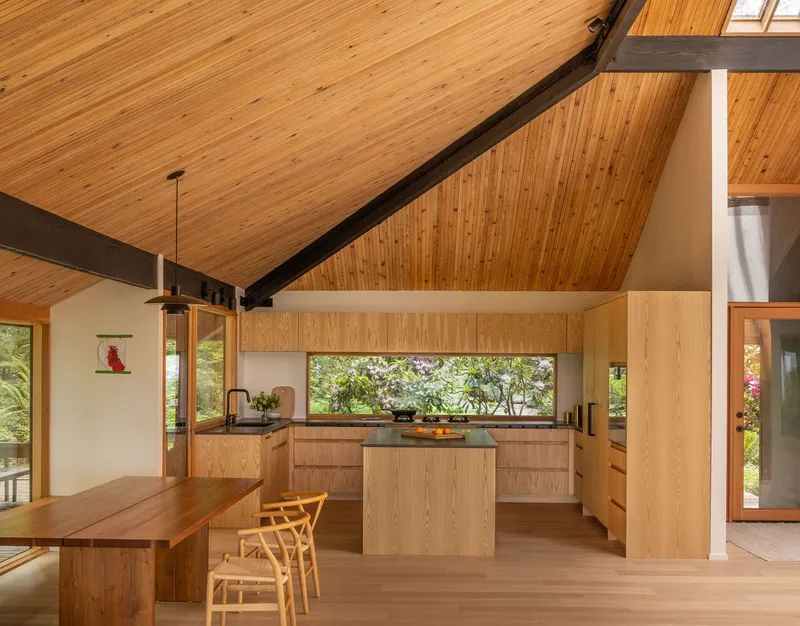
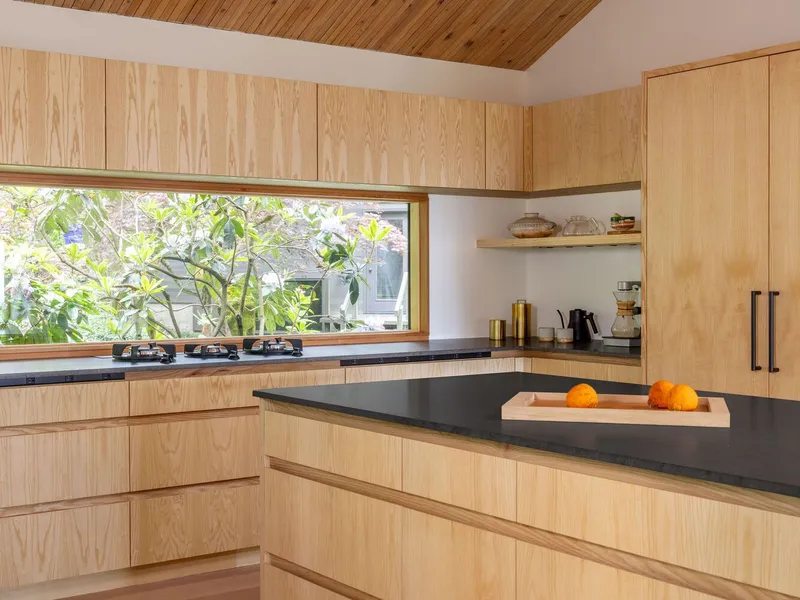
The kitchen plays a supporting role rather than a starring one, which is the correct move in a house this attuned to its landscape. Oak and plywood cabinetry sit beneath a sloped timber ceiling, with a continuous horizontal window strip framing the garden at counter height. The view is deliberately domestic in scale: leafy vegetation and filtered daylight, not the panoramic vistas reserved for the living room and bedrooms.
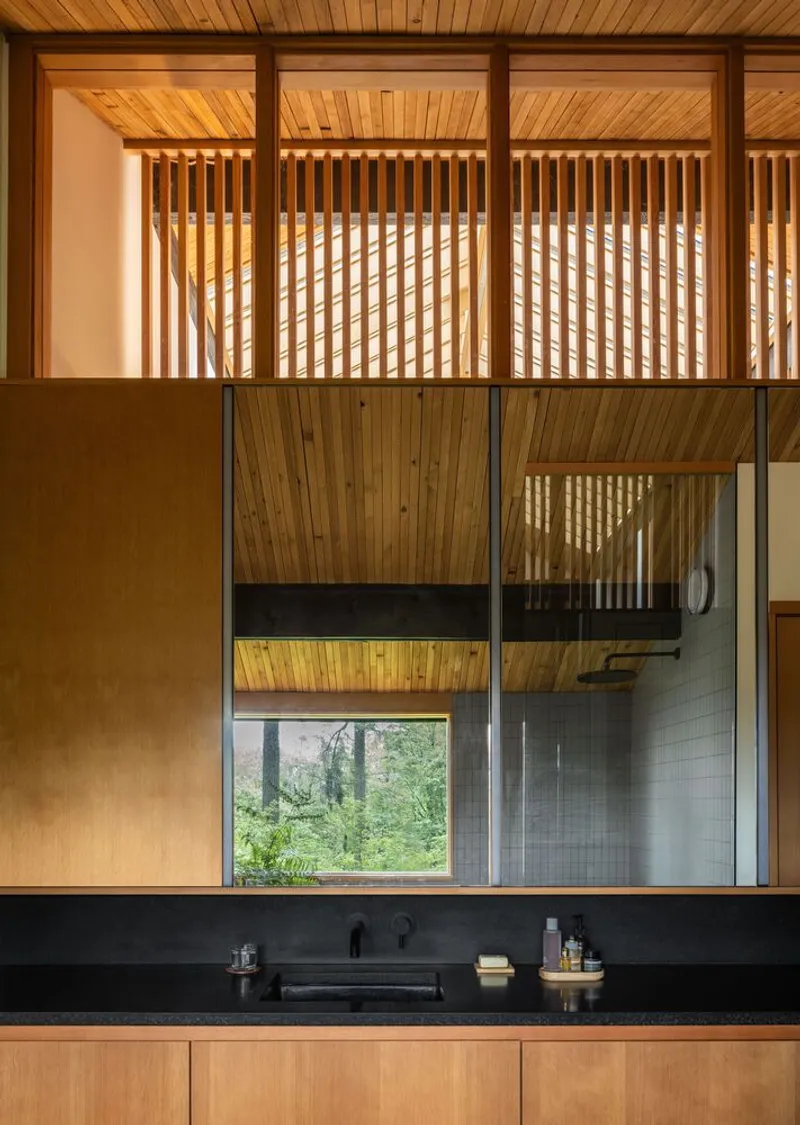
Black stone countertops and a dark backsplash give the workspace visual weight without competing with the timber above. A vertical wood screen on one wall filters afternoon light into the space, introducing a second rhythm that plays against the horizontal window. The effect is calm, focused, and functional, a room that rewards daily use more than first impressions.
Bathing with the Forest
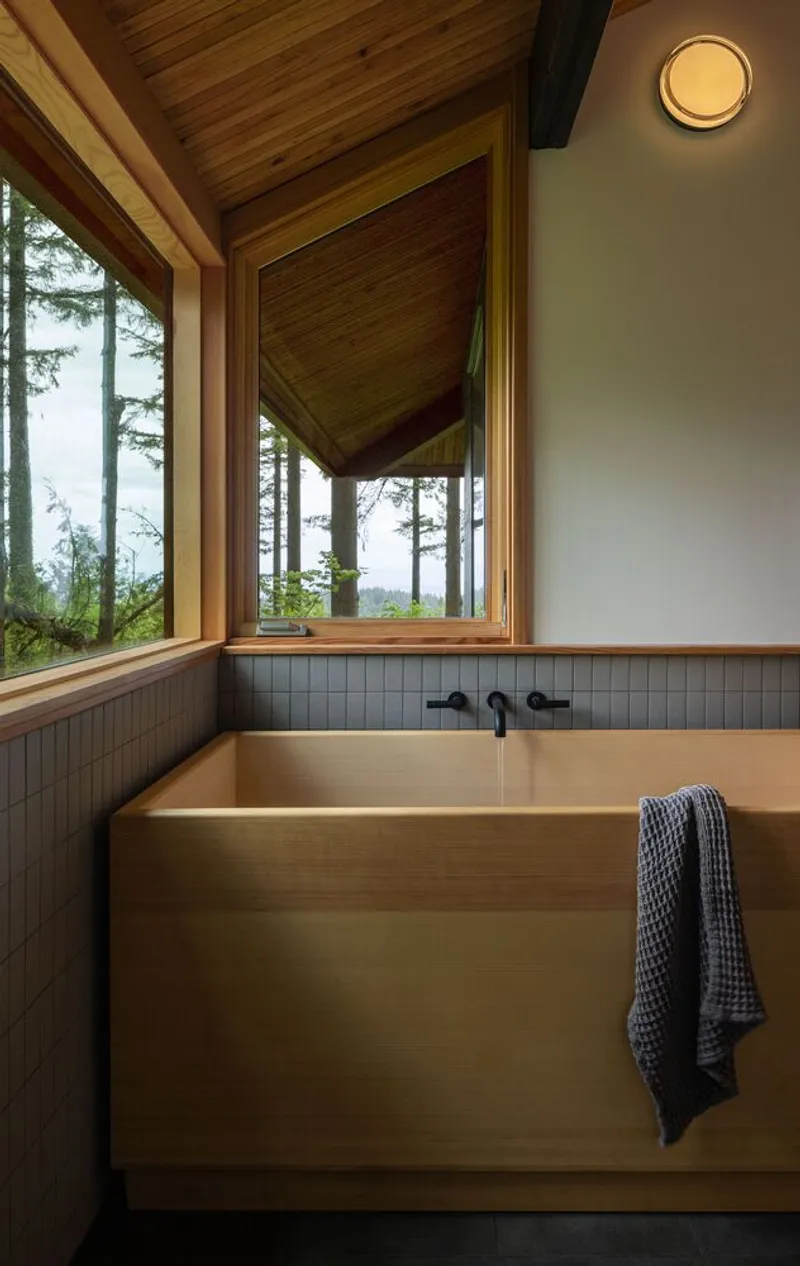
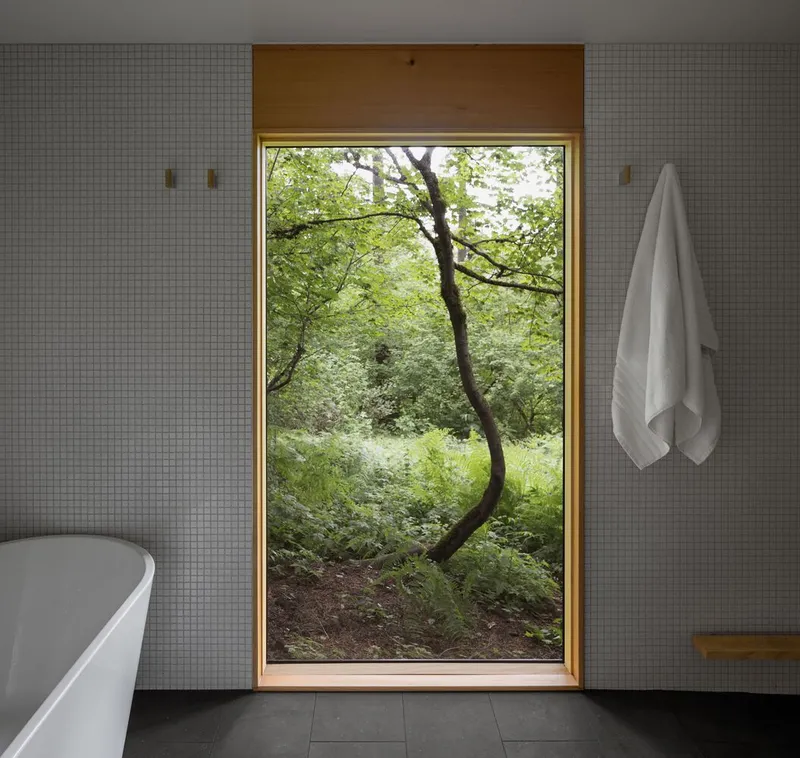
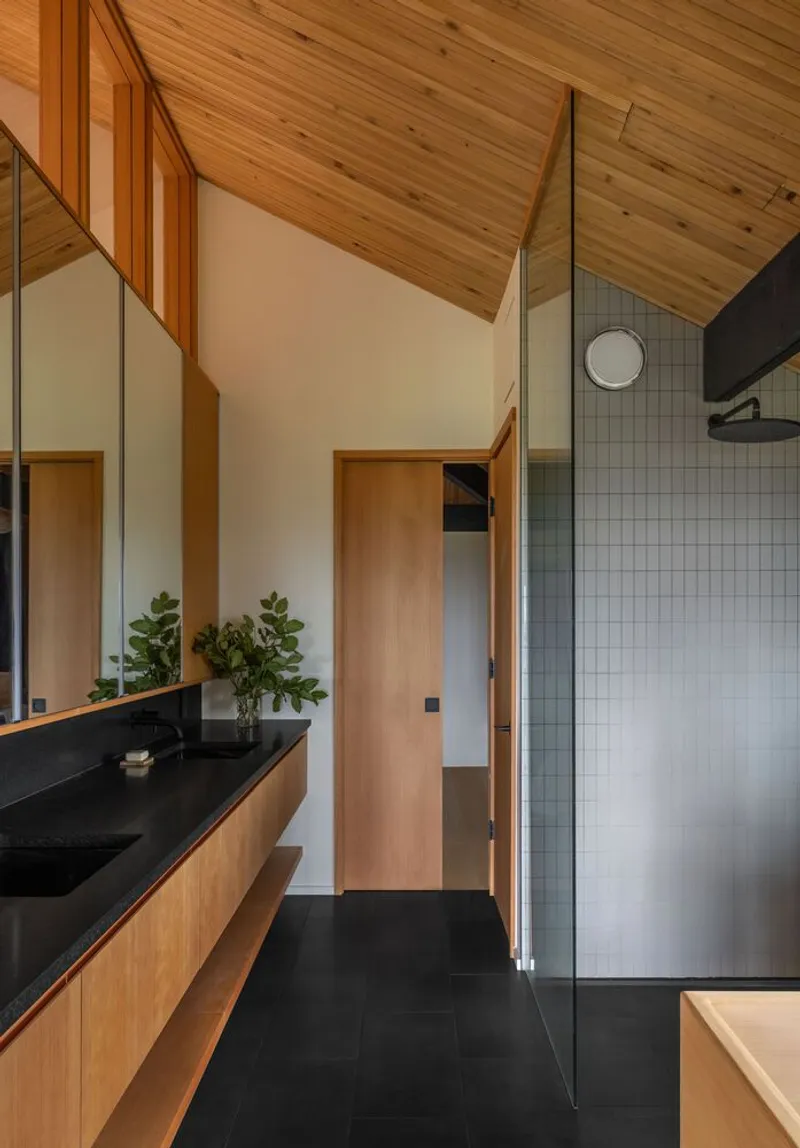
The hinoki wood soaking tub is the most assertive single gesture in the house. Placed beneath corner windows that overlook the forested hillside, it collapses the distance between the rituals of bathing and the textures of the landscape outside. Grey tile wainscoting grounds the room while the angled timber ceiling continues the material thread from the rest of the house.
Elsewhere, a shower room frames a fixed window onto a curved tree trunk and ferns, turning a utilitarian space into something approaching contemplation. The secondary bathroom keeps the same material vocabulary: timber vanity, black stone countertop, small-format mosaic tile. SHED understood that these private rooms deserved the same level of compositional attention as the public spaces, and the result is a house where retreat and spectacle coexist without hierarchy.
Bedrooms and Outlook Rooms
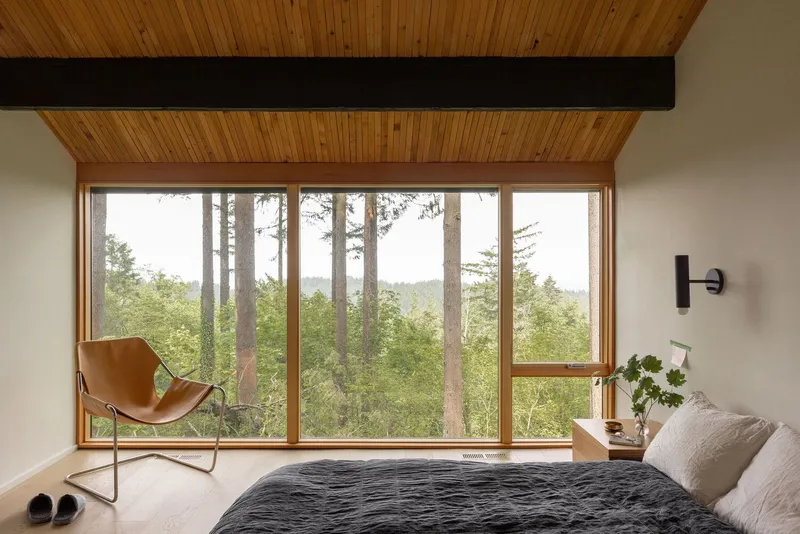
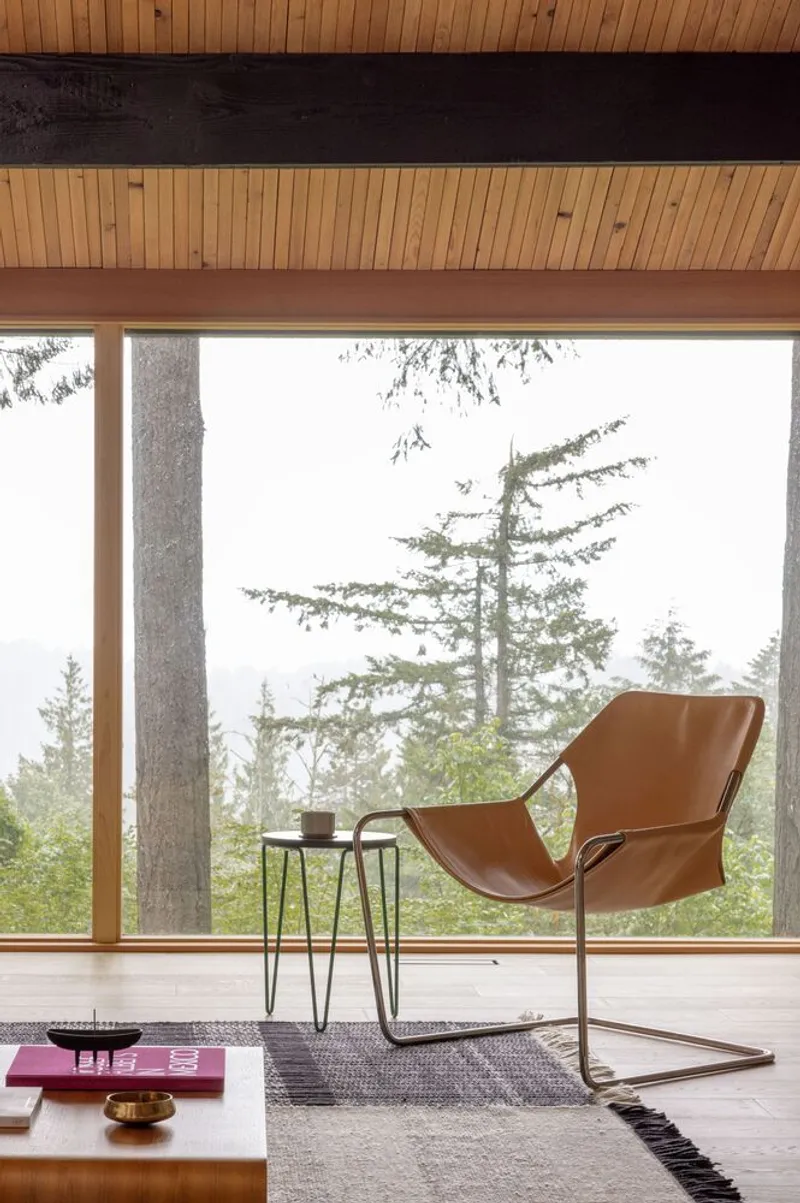
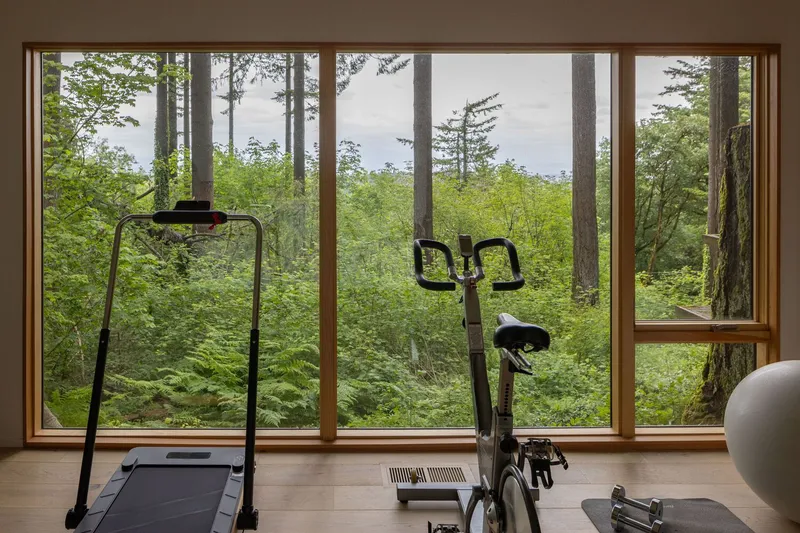
The bedrooms and ancillary rooms share a strategy: floor-to-ceiling glazing that treats the window wall as a projection of the landscape rather than a frame around it. In the primary bedroom, tall evergreen trunks and distant ridges fill the entire visual field. On misty mornings, the room appears to hover in cloud.
Even the exercise room gets the full-glazing treatment, its view of conifers and dense undergrowth making a treadmill feel slightly less punishing. A leather sling chair positioned against one glass wall in a secondary sitting area completes the picture: this is a house designed less for occupation than for observation, where every room is ultimately a viewing platform calibrated to a particular mood of the forest.
Wrapping the Exterior
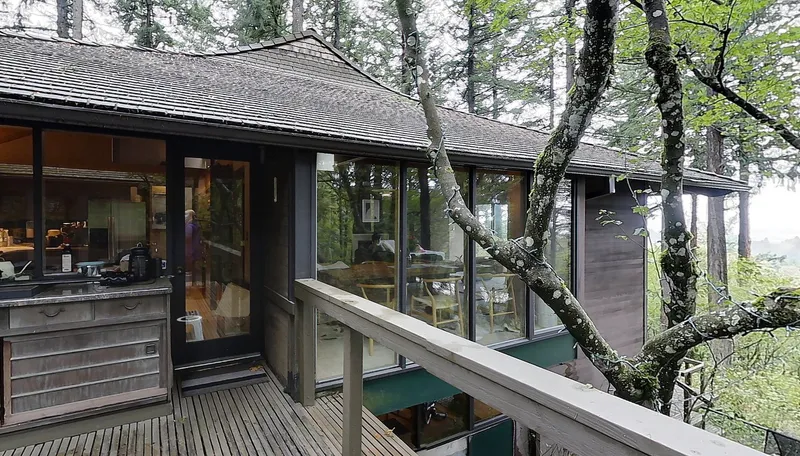
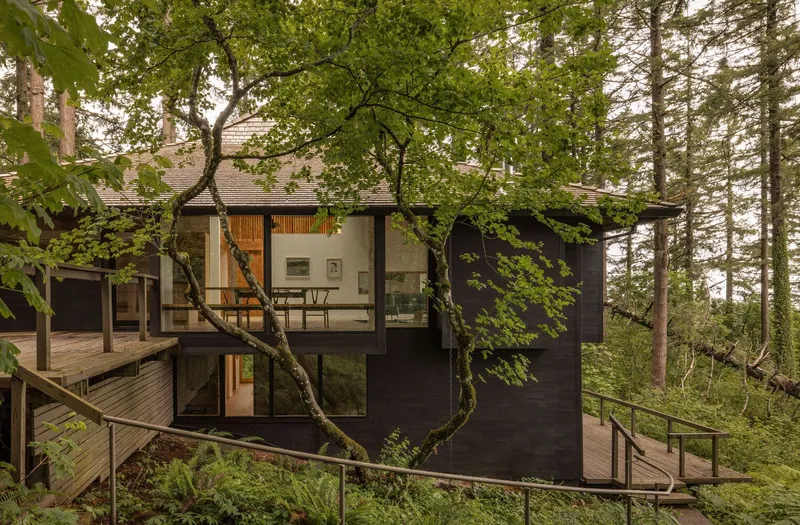
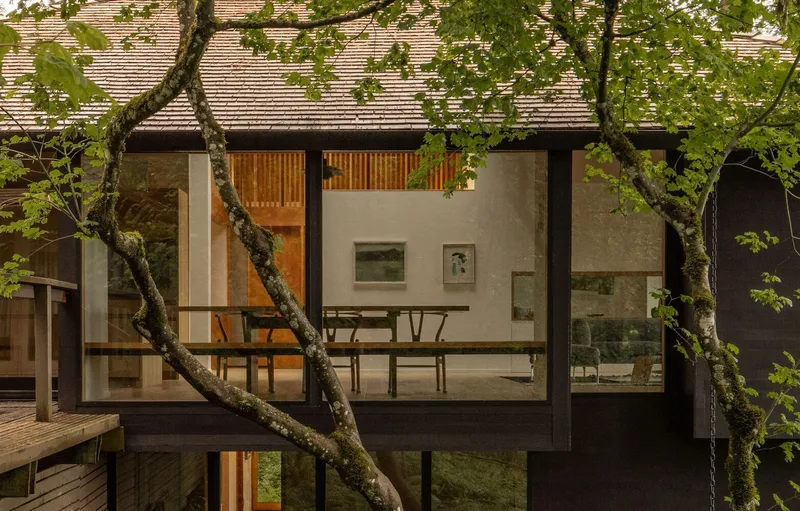
A timber deck wraps the exterior beneath the low-pitched roof, creating a transitional zone that is neither fully inside nor outside. Moss-covered branches reach directly overhead, and the metal railing along the elevated sections is deliberately minimal, maintaining sightlines into the forest canopy. The deck is generous enough to function as an outdoor room but narrow enough to feel like a path, encouraging movement around the perimeter rather than stationary gathering.
Seen through the trees at dusk, the house resolves into a composition of glowing rectangles behind dark frames. The dining area, visible through full-height glazing with moss-laden limbs in the foreground, becomes a tableau vivant for anyone approaching from the hillside. It is a reciprocal architecture: the occupants watch the forest, and the forest watches back.
Plans and Drawings
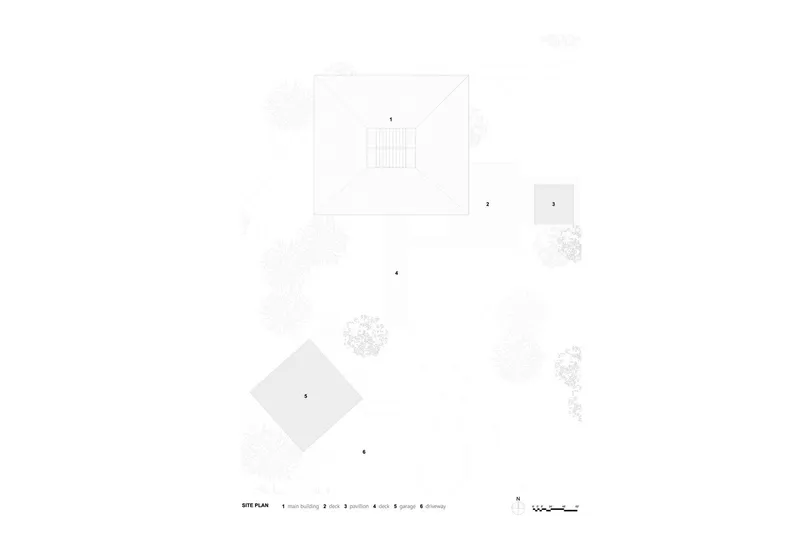
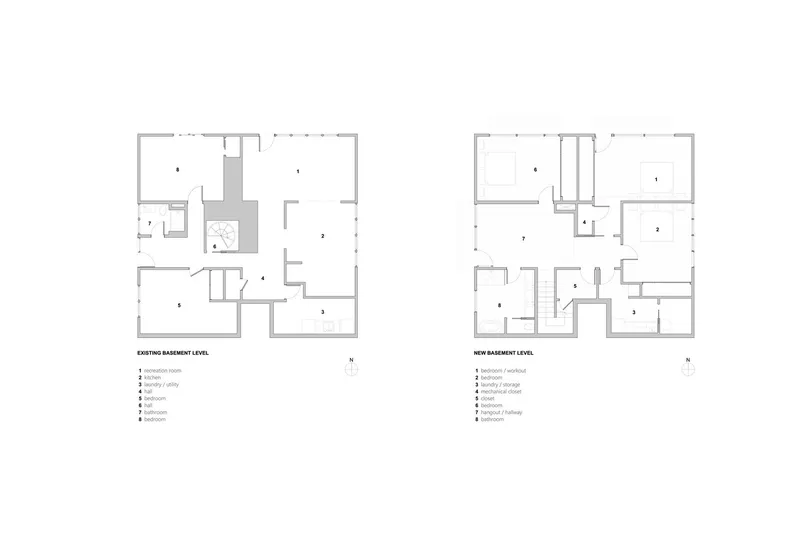
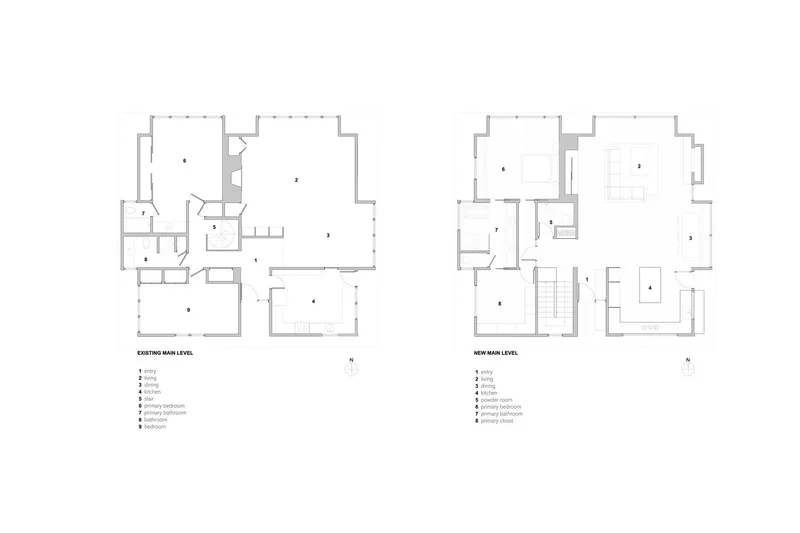
The site plan reveals how the building volumes disperse among the tree canopy, each wing angled to capture a different orientation and a different quality of filtered light. Comparing the existing and proposed floor plans makes the scope of the renovation legible: SHED opened up the main level to establish continuous visual connections across the plan while reorganizing the basement into a more rational sequence of private and service spaces.
The before-and-after comparison is instructive. The original layout compartmentalized the house into conventional rooms that turned their backs on the site. The new plan folds those rooms open, replacing walls with datum lines of cabinetry and timber screens. Circulation becomes part of the spatial experience rather than a corridor to endure.
Why This Project Matters
The Mori House renovation succeeds because it refuses two common traps: the fetishization of the original mid-century plan, and the temptation to replace it entirely with a contemporary open box. SHED found a third path, retaining the structural logic and site strategy of the existing house while rethinking its spatial sequence, material identity, and relationship to light. The result is legible as a renovation but reads as a whole, not a patchwork.
More broadly, the project is a case study in how architecture can be subordinate to landscape without being weak. The black cladding, the calibrated views, the timber warmth, and the hinoki tub are all strong moves, but they derive their strength from service to a specific place. Strip away the Pacific Northwest forest and half the design decisions lose their meaning. That site-specificity, pursued with real rigor, is what separates this renovation from the dozens of dark-clad forest houses published every month.
The Mori House Renovation by SHED Architecture & Design, Seattle, Washington, USA. Photography by Rafael Soldi and SHED Architecture & Design.
About the Studio
Share Your Own Work on uni.xyz
If projects like this are the kind of work you want to make, uni.xyz is a place to publish your own, find collaborators, and enter design competitions.


Popular Articles
Popular articles from the community


Hill & Cross Opera: Sculptural Opera House Architecture Shaped by Tallinn’s Landscape and Identity
Hill & Cross Opera reimagines opera house architecture in Tallinn through its sculptural hill, civic plaza, glass wave and a luminous cross.

ALGAL REALM: A Bio-Integrated Lunar Habitat Design for Life Beyond Earth
ALGAL REALM reimagines lunar habitat design with algae-powered life support, 3D-printed regolith, and vertical living for a lunar future.

Co-life: Sustainable Architecture for Age-Friendly Community Living
Co-life reimagines sustainable architecture for seniors through courtyards, rammed earth, shared gardens, and spaces designed for belonging.

Play: Fragments of Their World
Familiar architecture becomes modular playground design, creating safe spaces where displaced children can learn, connect, imagine and play.

Similar Reads
You might also enjoy these articles


Hodi-Mandai Geram
Project Function: Preservation and revitalization of the Intangible heritage and socio-spatial identity of the Hodi by Housing, Cultural Memory Center, Sacred Grove, landscape, local tourism economy


Olio Towers: A Mid-Rise for Performers That Fuses Housing, Rehearsal, and Stage
Located blocks from Houston's Theater District, this modular tower stacks living units around a central performance atrium.

Oasis: Modular Green Housing Carved into Dhaka's Urban Fabric
A shortlisted Plugin Housing entry reclaims unauthorized settlements in Dhaka with stepped concrete volumes, green roofs, and ventilation-driven design.

Black Hole: A Floating Megastructure for the Post-Physical Era
Emiliano Mazzarotto envisions a spherical, self-scaling arena where e-sports, digital hotels, and holographic stadiums replace traditional public space.

Explore Architecture Competitions
Discover active competitions in this discipline

Challenge to reimagine the Iron Throne

Photograph architecture without architects

Illustrate the lost glory of Angkor Wat - Render Challenge

Design challenge to reuse E-waste
Comments (0)
Please login or sign up to add comments
No comments yet. Be the first to comment!