
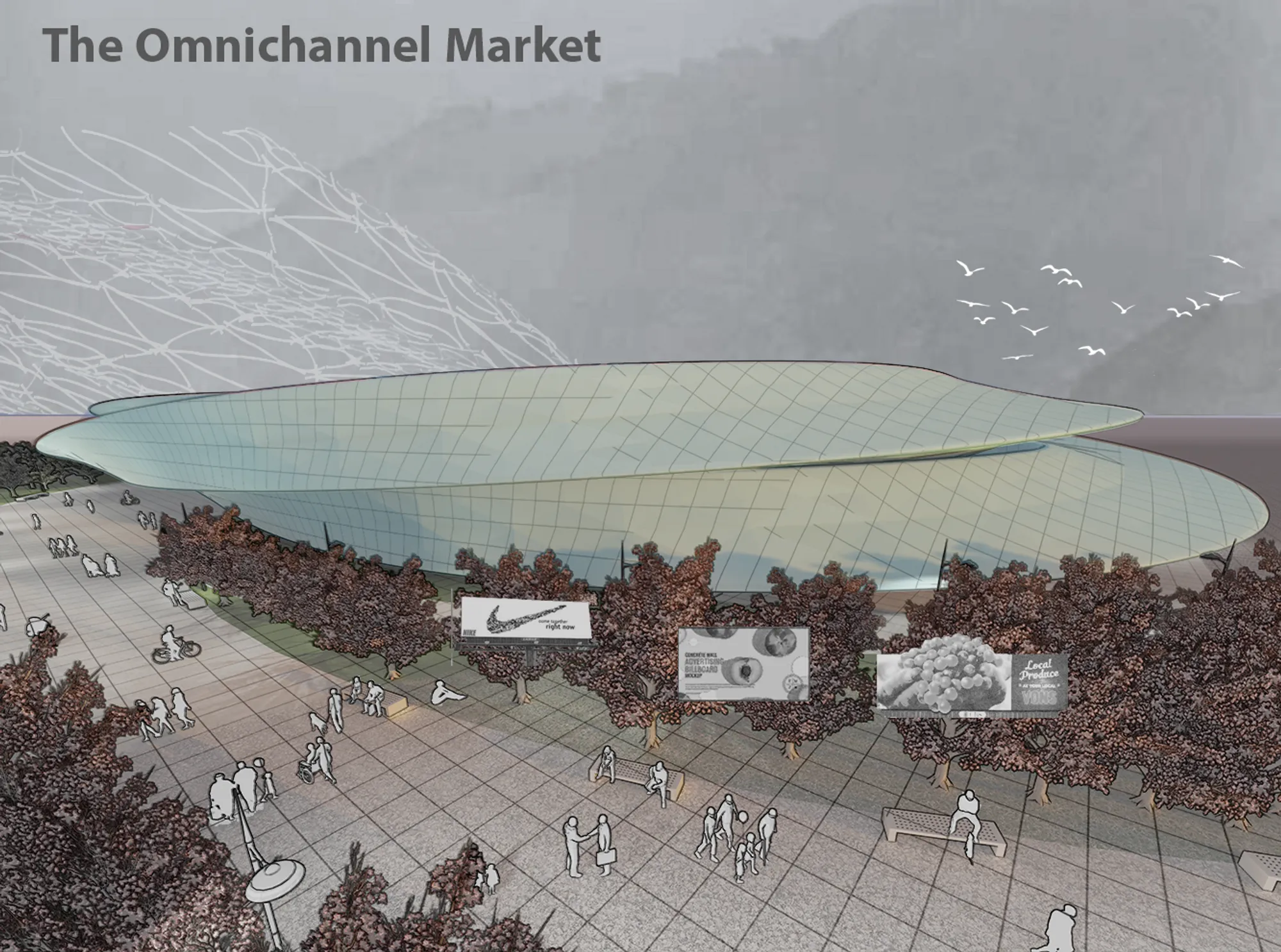
The Omni-channel Market
Best-in-class retailers will reap benefits from adopting technology demands (instore and hybrid) with the Omnichannel Framework.

The future of retail includes embracing ecosystems and the experience economy, reconfiguring stores, and preparing for Web3 and metaverse.
Unified in-store and hybrid customer experience is crucial for retailers to drive value in today’s marketplace.
The retail store of the future capitalizes on IoT, infrastructure technology to enable retailers monetize key customer insights and transform into a “smart store hub “.
Drivers of in-store digital technology transformation, require intelligence competencies, infrastructure technology, tools, and store environments to provide an integrated connected experience.
Digital tools are facilitating retailers to keep the cost of operations low in a cost-competitive and
information-rich environment.
The correct technology stack is critical in order to support world-class e-commerce and brick-and-mortar connections with customers.
Having an isolated database or gamut of disparate systems won’t help, rather these systems need to work together to provide the omnichannel experience.
Using new tech-enabled tools, the smart store hubs will provide a more connected and personalized
experience that meaningfully engages customers.
-Customers can get what they want at OUR store whenever they want it through any way they choose.
We can implement technology in each phase of the shopping journey.
-Customers can place orders online that they can pick up at the nearest location, it complements the in-store experience.
It requires the customer to be connected with the mobile app to sales fulfillment operation, inventory, available promotions, and more information equally offered within the store.
The retail store of the future combines future technology trends including in-store robotic fulfilment, contactless checkout, live dynamic pricing, and other advances to provide an all-in-one experience to transform into a “Smart Store Hub”
Best-in-class retailers will reap benefits from adopting technology demands (instore and hybrid) with the Omnichannel Framework.
Retail store automation
Retail store automation enables speed and efficiency gains.
Retail store automation is primarily a process of harnessing technology to take on specific tasks that have historically required manual work. The main drivers are reducing costs, increasing productivity, and providing a smoother customer experience.
Retail store automation helps reduce reliance on workers so that routine tasks can be completed more efficiently.
The result is that employers are effectively doing more with less.
Retail store automation provides real-time data streams that allow for detailed insight, dynamic decision-making and continuous improvement
Warehouse automation
Warehouse automation helps respond to customer needs, shortening the wait time for a customer to receive the merchandise after checkout.
Automated parking system
Allows shoppers to quickly enter the parking area, view directional and space available signage to quickly find a parking space.
Pick-up centers
A new experience where you can walk in, grab something off the shelf, and walk out. Sure, there are cameras on the ceiling and AI on computers tracking silently from above, but the promise is convenience through automation.
Quick local delivery
AI
Explore AI applications in a “live shopping environment,” using an array of cameras and sensors that can generate real-time data on inventory levels and more.
Target investment areas include frictionless shopping, keep pace for quick shipping or in-store pickups, mixed reality and sustainability.
The IRL
(Intelligent Retail Lab) store has cameras hanging from the ceiling that can track inventory in real time with unprecedented efficiency, making sure every item on every shelf is always in stock.
Lapses in inventory result in lost sales, reduced customer satisfaction, and diminished loyalty.
A ‘things economy’ into an ‘experience economy’
With the help of modern digital technologies like artificial intelligence, sensors, and the Internet of Things, legacy firms too can harness the power of data and digital ecosystems
shift focus from products to data without losing their traditional strengths.
This retail monetizes this service, creating an additional revenue stream.
Collects data on how users interact with products and use them to develop.
It also helps brands build a direct relationship with consumers.
Experiences are meant to bring people to stores and into the company’s ecosystem, and to create a community, Yaffe said.
If you can experience the products, if you can experience the brands, you are more likely to buy things,” Damlapinar said. “
People want to experience things
This will be the experience building platform where we can increase the engagement and the lifetime value of the consumer, and then enhance brand loyalty.
offering free yoga classes in its stores, offering cooking classes,
classes are complimentary and can lead by instructors from local studios in local community.
Displays
About 15% of the future retail store will consist of shopping aisles, like we see today, but dematerialized. There won't be physical products. There will be interactive, well enhanced, high-definition displays where you can walk through and the product catalog will be optimized according to your preferences if you're already in the system as a loyal customer.
Most of the clothing will be kept in the back of the store and only one sample of each item will be displayed floor in its showrooms. To buy it, customers will scan a QR code using a mobile app and then retrieve it at the pickup counter. If they want to try it on first, they can get it sent to a fitting room, which has touchscreens where customers can request different sizes or colors.
Web3
Proponents say Web3 will enable more creativity and ownership, as well as virtual stores and monetized digital assets.
When we think about Web3, we really have to think about platforms. That’s how assets get delivered and exchanged.
It’s not the metaverse over here and a store over there, there are going to be things you can do in the metaverse that will earn you rewards you can redeem in the physical store. Or, you go to the physical store and redeem them in the metaverse. There’s going to be an exchange between these two spaces.”
Interest in AR and VR is accelerating quickly as web3, digital currencies, non-fungible tokens, and the metaverse create new prospects for value creation.
Grocers
A system that could connect local customers with local business and help them manage their product lines better because of local needs. This could potentially get these stores into places that “bigger retailers are finding hard to reach.
Waiting in-line for returns is a pain! WE made returning an item fast and easy.
in-store purchased items can be returned online and then dropped off in person using a QR code.
public electric-vehicle charging
Fuel the business growth, create new operational efficiencies, and unlock amazing experiences for our customers in the short- and long-term.
The shop is an optimal place to wait for our electric car to charge, many will want to pick-up deliveries personally for lower cost.
Experiences
The layout and navigation of a supermarket will be influenced by the way digital experiences are designed. Expect more communal favorites, peer-to-peer recommendations and personalized marketing in the physical marketplace. Stores will also function as entertainment hubs, where people can experience key brands in person. Digital apps will be more connected with the physical space, bridging the customer journey between online and offline. Walk-in-walk-out (WIWO) technologies will become more common, as a touchless economy becomes more widespread. Live streaming from shops and shopping events will cater to different kinds of audiences.
Retail guide
the store includes multiple information stations for customers to visit and understand exactly how AI makes the store tick. As customers shop, they can interact with a number of educational displays, while small educational kiosks are distributed throughout the store. A Welcome Center at the front end allows customers to dive deeper into technical specifications and common questions.
Design
Modular design is “fully customizable” to retailers’ needs and can be applied for a variety of stores.
For shops that sell trainers, electronics and food.
It would be particularly well-suited to the interaction-heavy stores of the future
Aided by technology shops could offer more “Omnichannel based” experiences to customers.
Retailers need to consider a solution that can be augmented for each specific location, whether it be a leading flagship or a smaller store.
The optimal solution is a resolution that is uniform, yet configurable for location needs, and allows non-disruptive growth.
The proposed solution is a cubic system that comprises “bins” to store goods and robots which organize them and take them to workers and customers on the shop floor.
It’s space-saving, more time efficient and can open up possibilities for retailers.
Concepts show how a redefined backroom space could provide greater possibilities for customer interaction on the shop floor, for example: micro-fulfilment can mean warehouses which are located closer to retails (thereby cutting down time and travel distances), but it also covers retail trends such as quick delivery and self-service stations.




Popular Articles
Popular articles from the community


Riyadh For All: Intergenerational Urban Design for Active Aging in Rabat
Riyadh For All reimagines urban design in Rabat with intergenerational co-living, adaptive courtyards, and Moroccan cultural exchange today.

Play: Fragments of Their World
Familiar architecture becomes modular playground design, creating safe spaces where displaced children can learn, connect, imagine and play.

Hill & Cross Opera: Sculptural Opera House Architecture Shaped by Tallinn’s Landscape and Identity
Hill & Cross Opera reimagines opera house architecture in Tallinn through its sculptural hill, civic plaza, glass wave and a luminous cross.

The Musturak Paradise: Senior Living Architecture for a Connected Future in Temara, Morocco
The Musturak Paradise reimagines senior living architecture in Temara via private homes, social spaces, culture, community, and shared care.


Similar Reads
You might also enjoy these articles

Day and Night Park: A Time-Based Urban Newsstand in Beijing
A temporary urban newsstand in Beijing blending travel, light, and reading through poetic colors, compact form, and community-focused design.

Modernist Patio Renovation in El Masnou, Barcelona by Oliver Segura Arquitectura + Cebrià Arquitectura
Modernist patio renovation blending tradition and innovation with a movable pool, leveled floors, and Catalan materials in El Masnou.
Alto Residencial Coop: Cooperative Housing Development in Santiago de Compostela by Carbajo Barrios Arquitectos
A linear cooperative housing complex blending white volumes and perforated metal façades, enhancing community living, natural light, privacy, and urban integration.
Vil Genis School by BPA ARCHITECTURE – Massy, France
Vil Genis School in Massy, France, features sustainable design, south-facing classrooms, community integration, accessible spaces, and modern educational architecture.


Explore Future of Retail Competitions
Discover active competitions in this discipline




Challenge to reimagine the Iron Throne


Photograph architecture without architects


Illustrate the lost glory of Angkor Wat - Render Challenge


Design challenge to reuse E-waste
Comments (0)
Please login or sign up to add comments
No comments yet. Be the first to comment!