
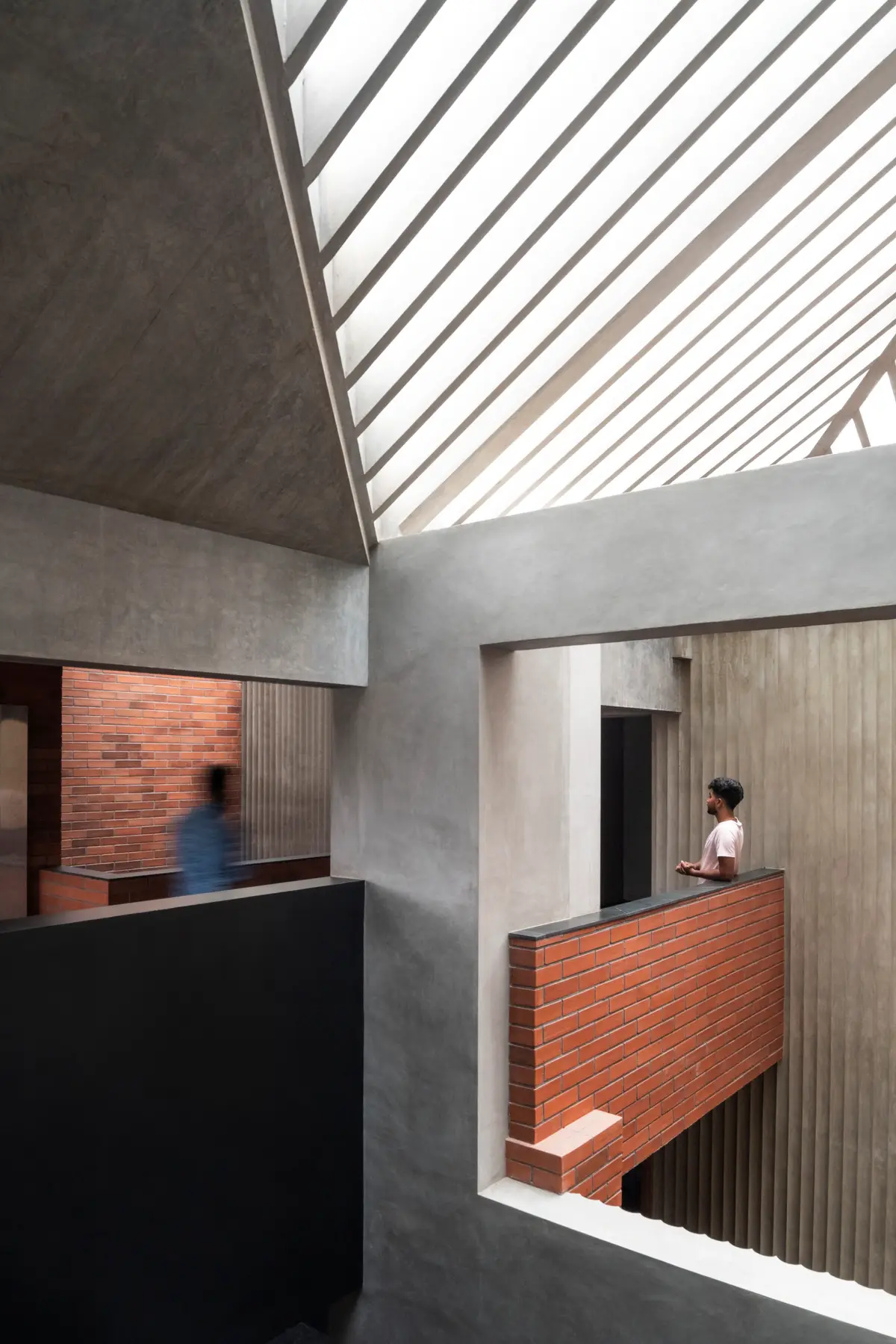
The Purple Ink Studio Wraps a Mangaluru Home in Triple-Layered Brick and Laterite Walls
A courtyard house in coastal Karnataka channels childhood memories of brick factories through jaali screens and passive cooling strategies.


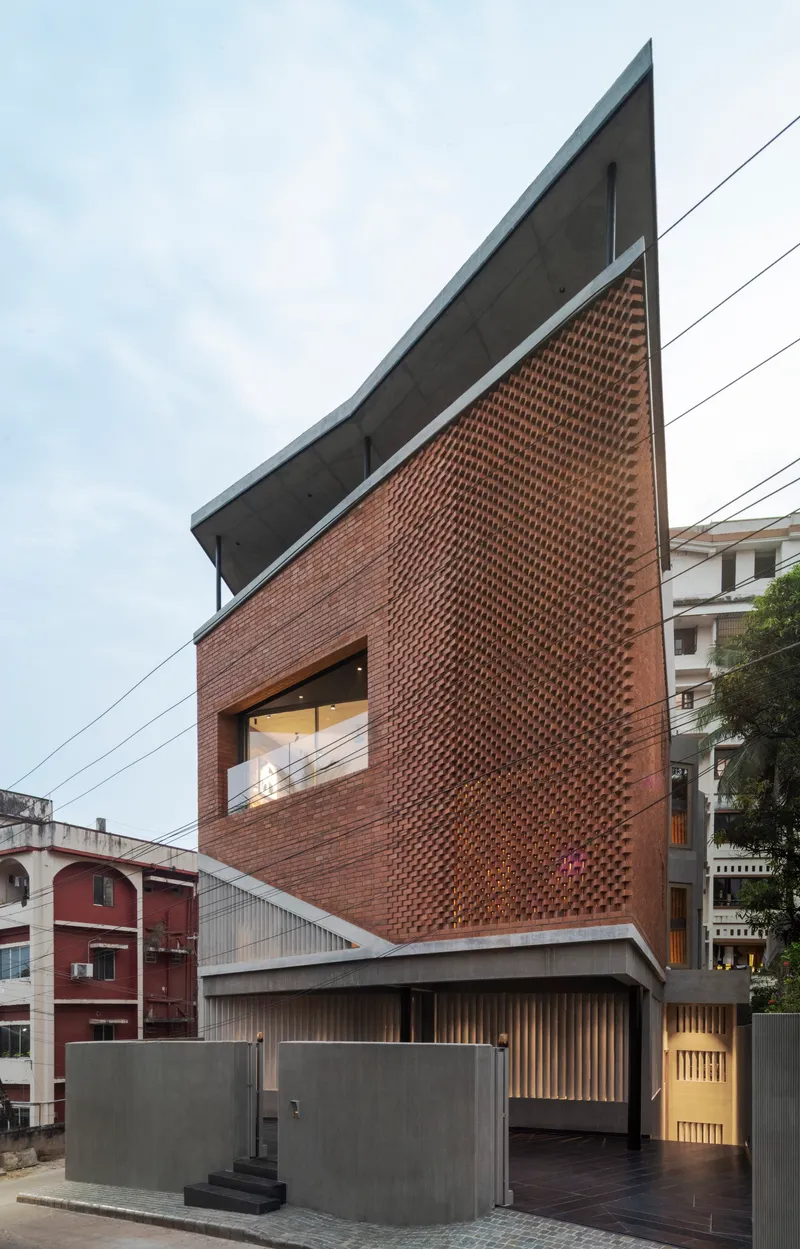
Mangaluru has a problem common to fast-growing Indian cities: its dense urban sprawl has steadily erased the architectural identity that once defined it. The Brick House by The Purple Ink Studio is a direct response to that erasure. Occupying a corner plot hemmed in by neighboring buildings, this 1,254 sqm residence turns inward, borrowing the logic of the traditional Thotti Mane (courtyard house) and stacking it vertically across multiple levels that step down a sloped site. The result is a home that barely acknowledges the street except through its most powerful gesture: a rippling, chequered brick facade that announces itself without apology.
What makes the project worth studying is the rigor of its wall construction. Every exterior surface is a triple-layered sandwich: brick jaali on the outside, laterite masonry in the middle, and thick brick on the inside. This is not decorative brickwork bolted to a concrete frame. It is a climate strategy. Mangaluru's tropical weather delivers heavy rain and punishing summer heat, and the layered skin handles both, insulating against temperature swings and preventing moisture seepage while filtering daylight through intricate perforated screens. The client's childhood memories of old brick factories with their chimneys and kilns gave the studio its material palette. The architects took that nostalgia and disciplined it into something structurally purposeful.
A Facade Built Like Armor
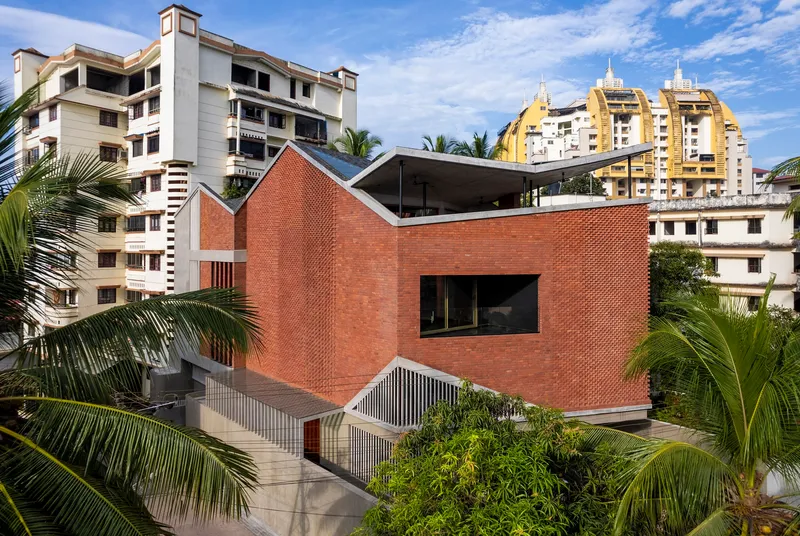
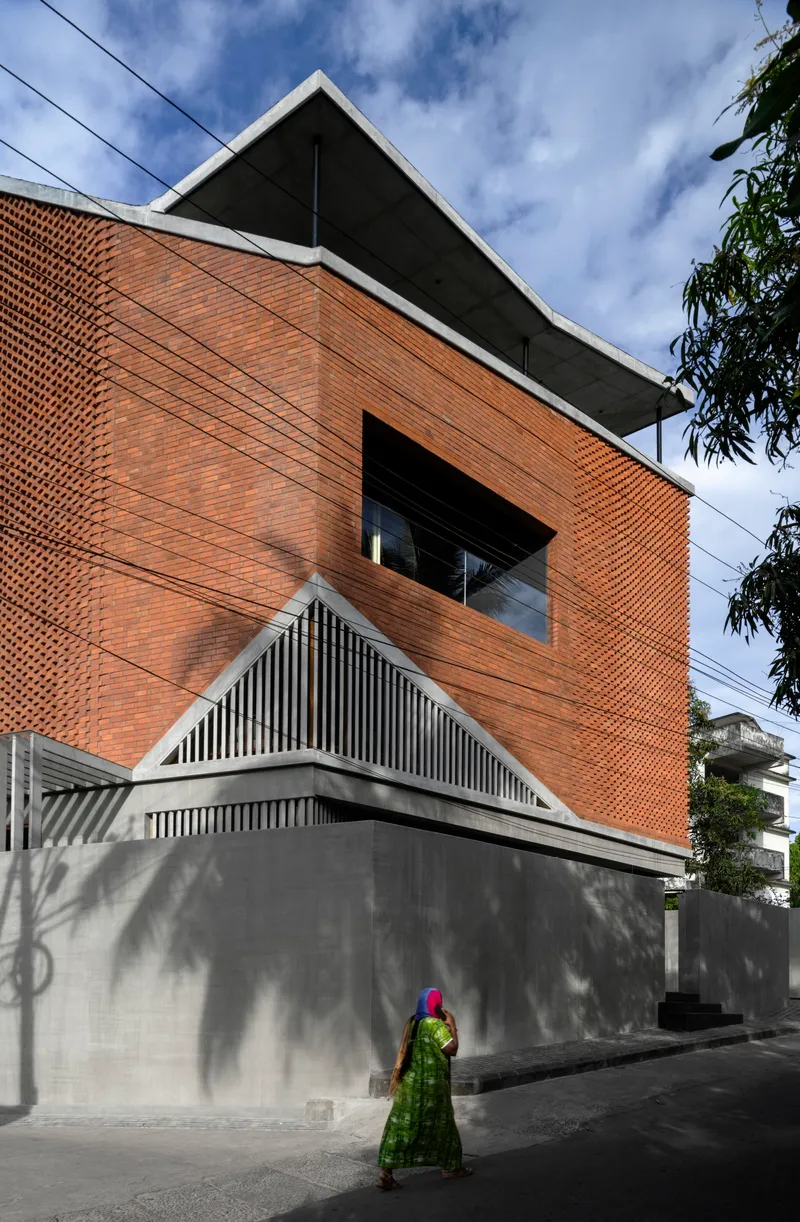
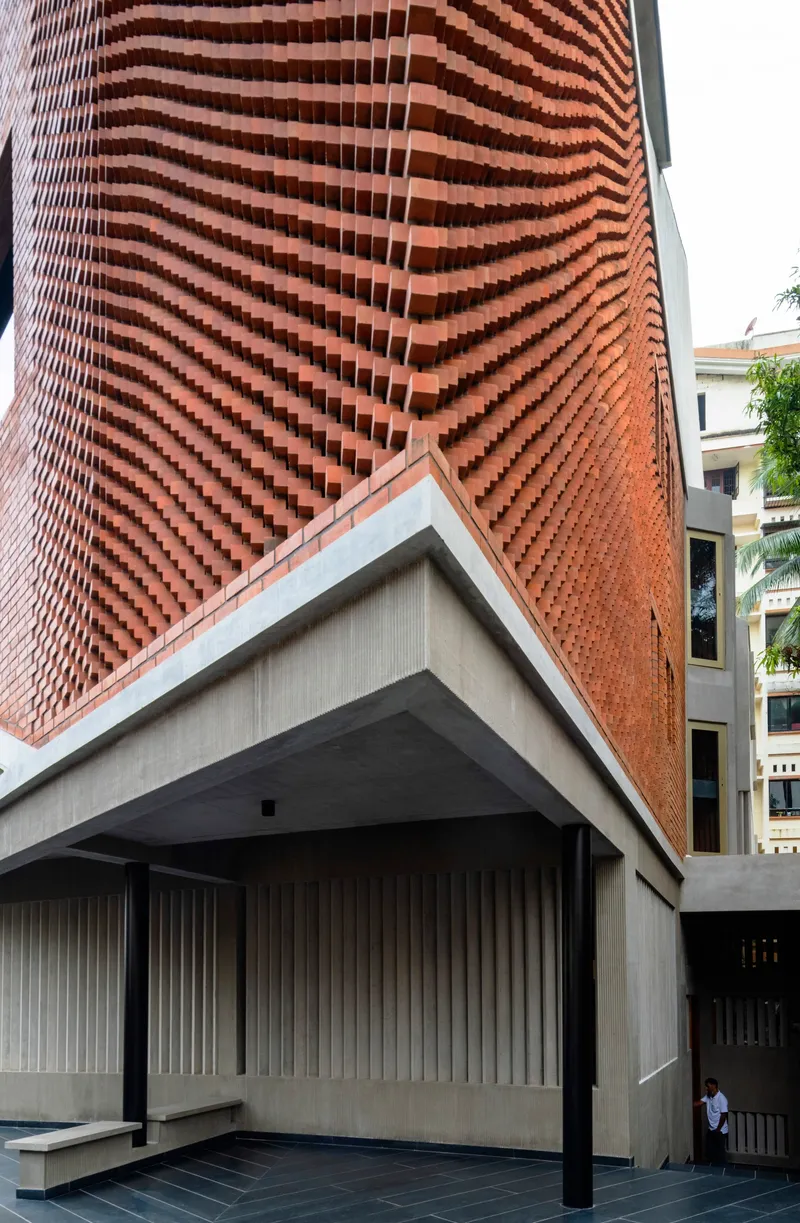
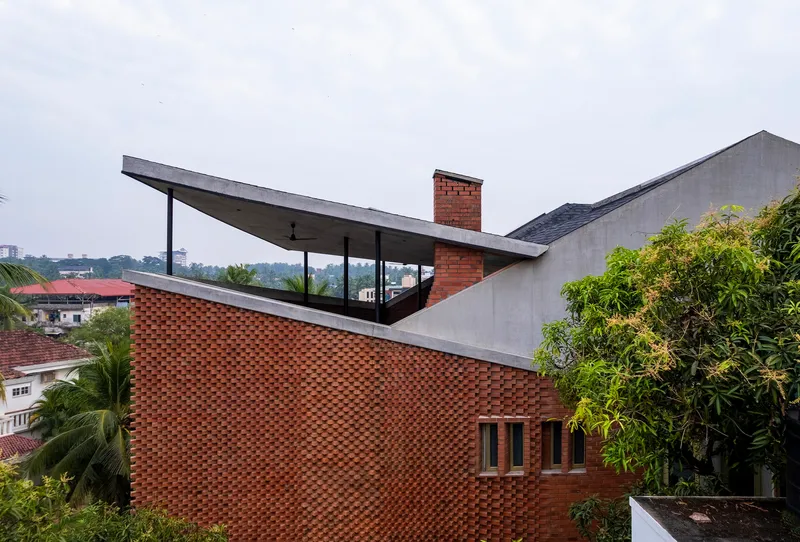
From elevated and street-level views alike, the Brick House reads as a monolithic mass of patterned red brick punctuated by deep concrete overhangs. The chequered and undulating brickwork recalls the geometry of tiled sloping roofs, a motif that creates a sense of motion across what could otherwise be static planes. The jaali screens are not uniform. They shift in density and pattern, responding to the rooms behind them and calibrating the amount of light and air each space receives.
Concrete enters the composition as a counterpoint: sharp, cantilevered roof slabs and heavy base walls that ground the brick above. The interplay between the two materials is legible in every elevation, with the concrete reading as geological strata and the brick as a woven textile draped over it. At dusk, when light escapes through the perforations, the facade transforms from a defensive wall into something closer to a lantern.
The Street Edge
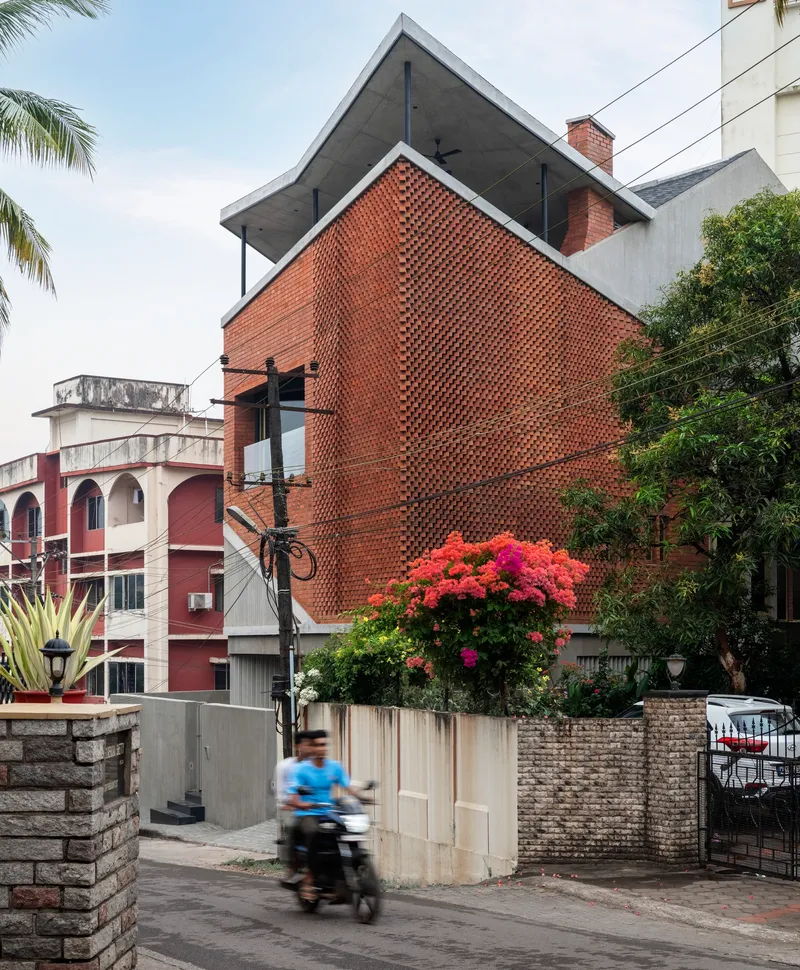
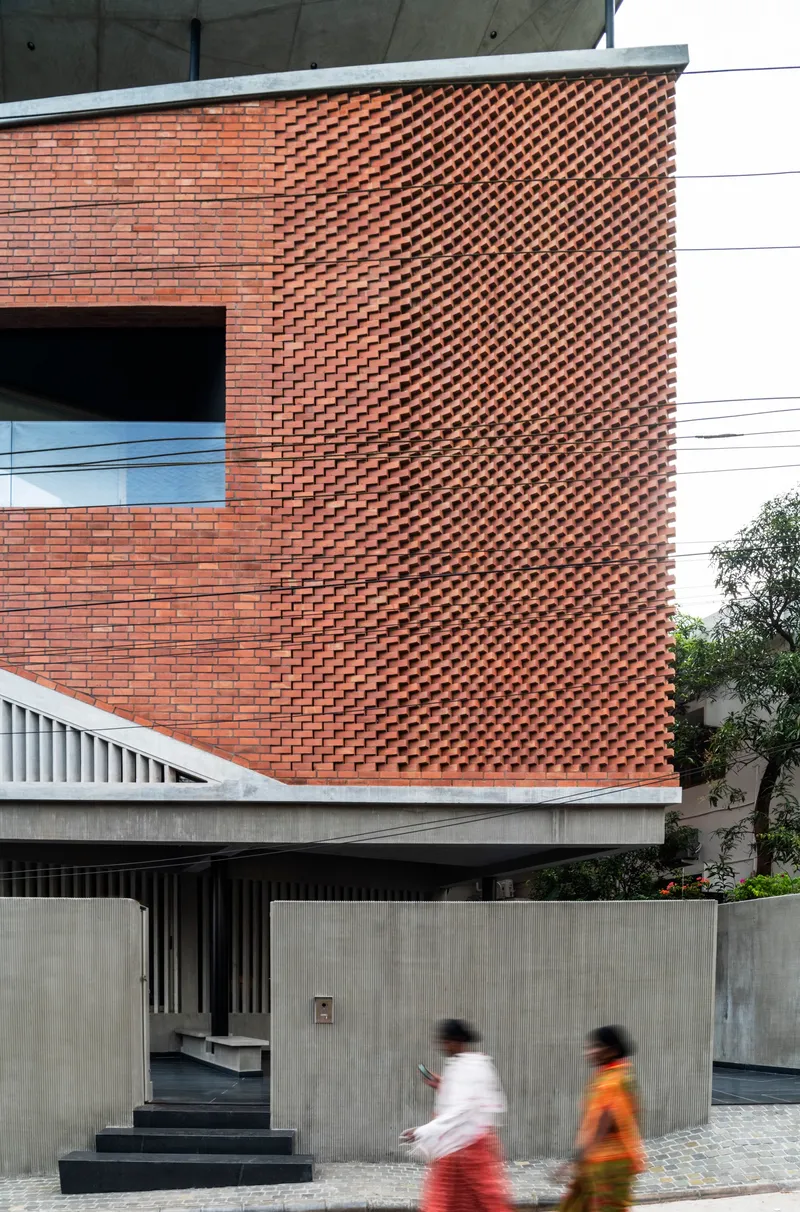
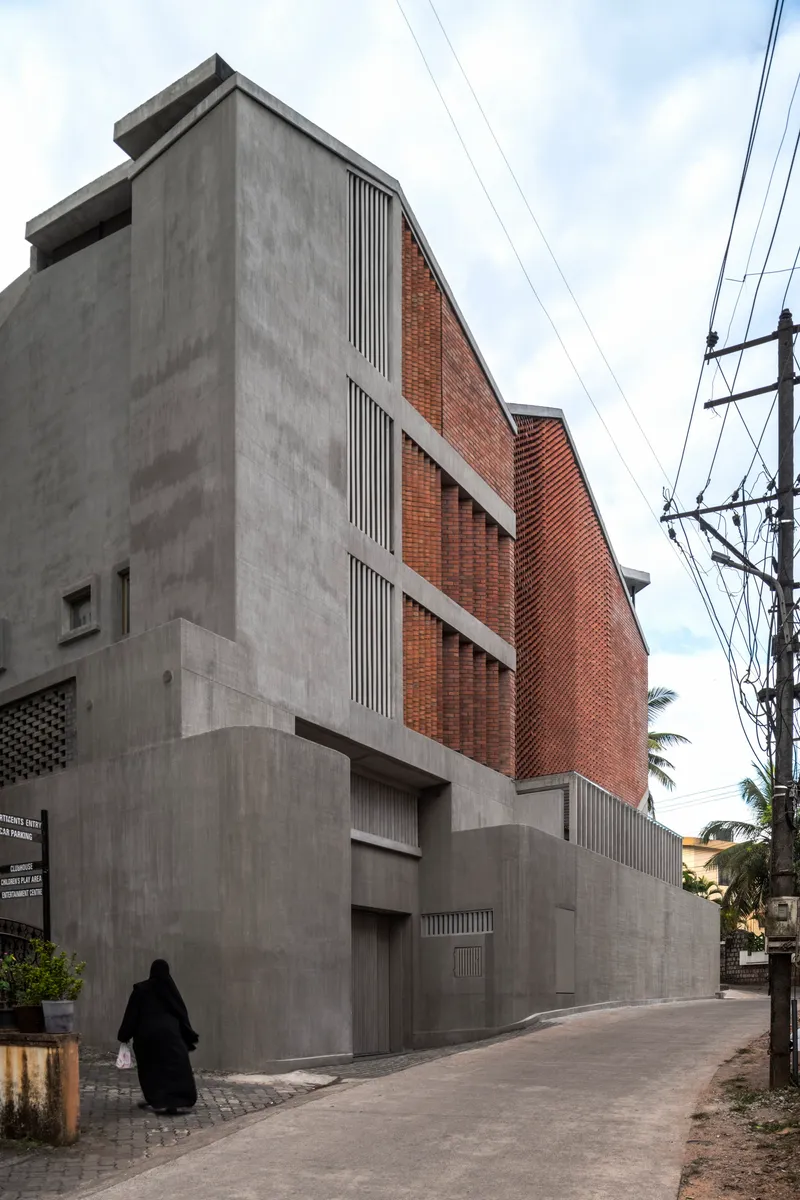
Corner plots offer exposure on two sides, and The Purple Ink Studio uses both to stage a deliberate tension between accessibility and privacy. At street level, the concrete base is solid and opaque, revealing almost nothing of the interior. Above, the brick lattice screens signal domesticity without surrendering it. Figures walking past in the photographs give scale to facades that could easily belong to an institutional building. The boundary wall with its flowering plants is the only concession to the conventional vocabulary of a residential front.
The angular geometry of the facade, with its projecting screens and folded planes, ensures the house never presents a flat face to the street. This is architecture that wants to be read in perspective, from a moving vantage point, not in static elevation.
Vertical Circulation as Spatial Engine
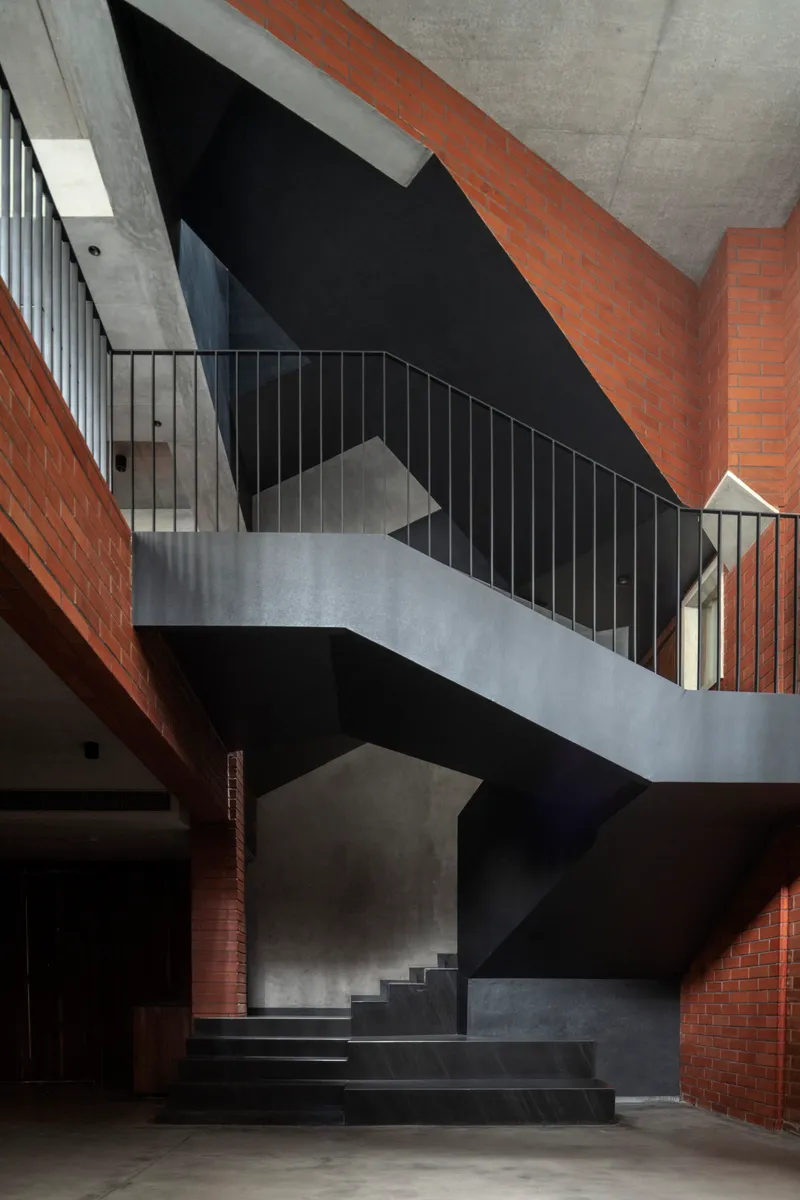
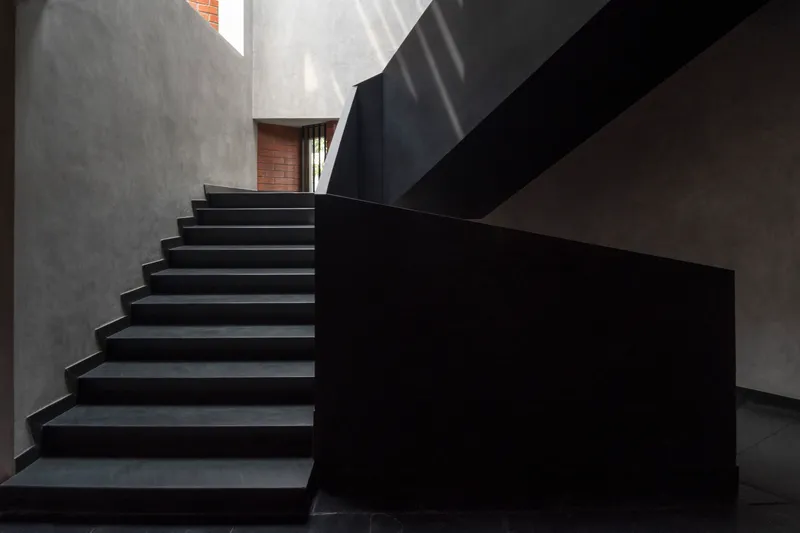
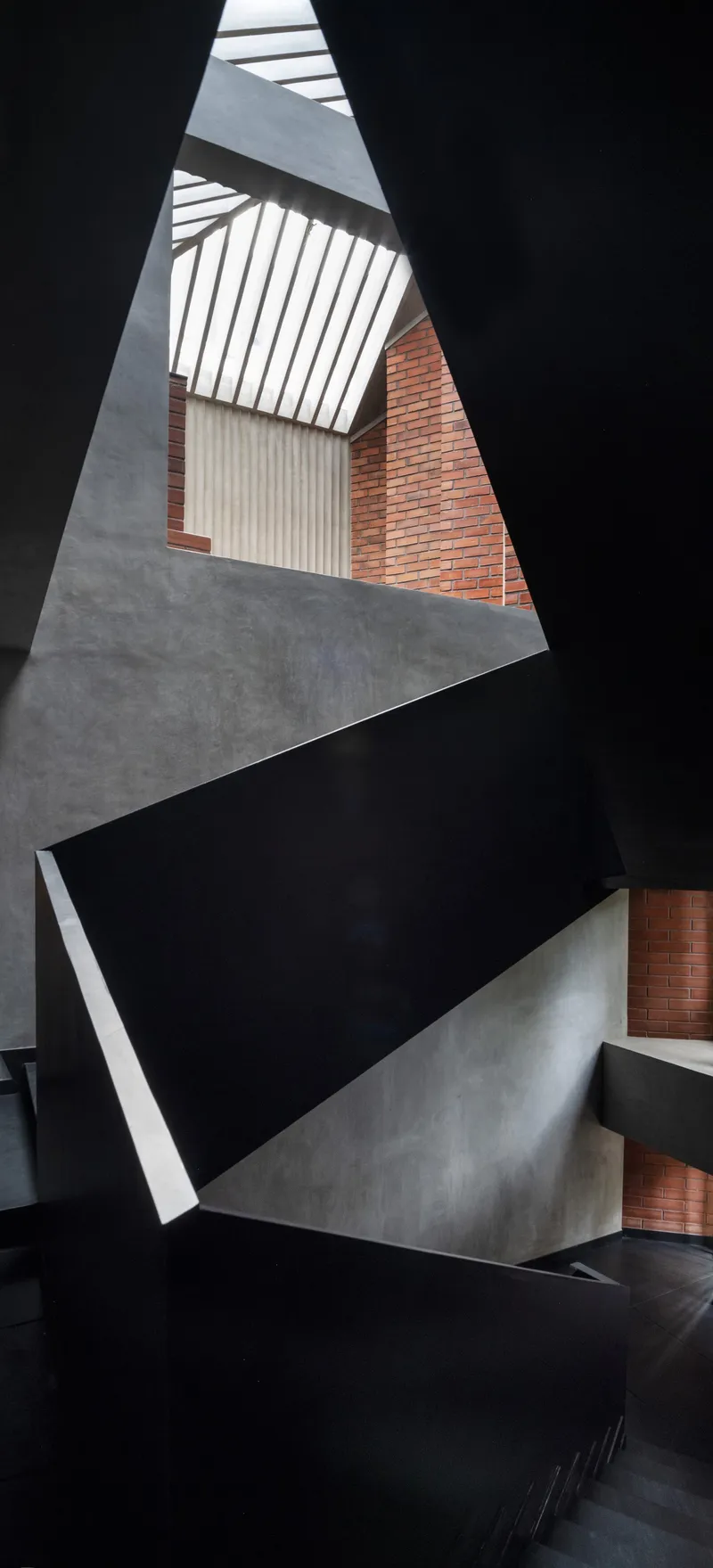
The staircase is not tucked away in this house; it is the house's organizational spine. A folded concrete stair threads through multiple levels, its black steel stringers and railings creating graphic lines against the surrounding brick and concrete. Viewed from above, the stairwell collapses into a triangular shaft of repeating flights, an almost Escher-like composition. From below, slatted skylights pour daylight down through the void, washing the landings in diffused light that changes character throughout the day.
The stair connects the lower ground parking and Majalis (entertainment area) to the formal living spaces above and the private bedrooms beyond. Each landing offers a different spatial condition: a glimpse of a courtyard, a framed view of brick, a shift in ceiling height. Circulation here is not a corridor to pass through but a sequence of events to experience.
Courts, Voids, and Captured Light
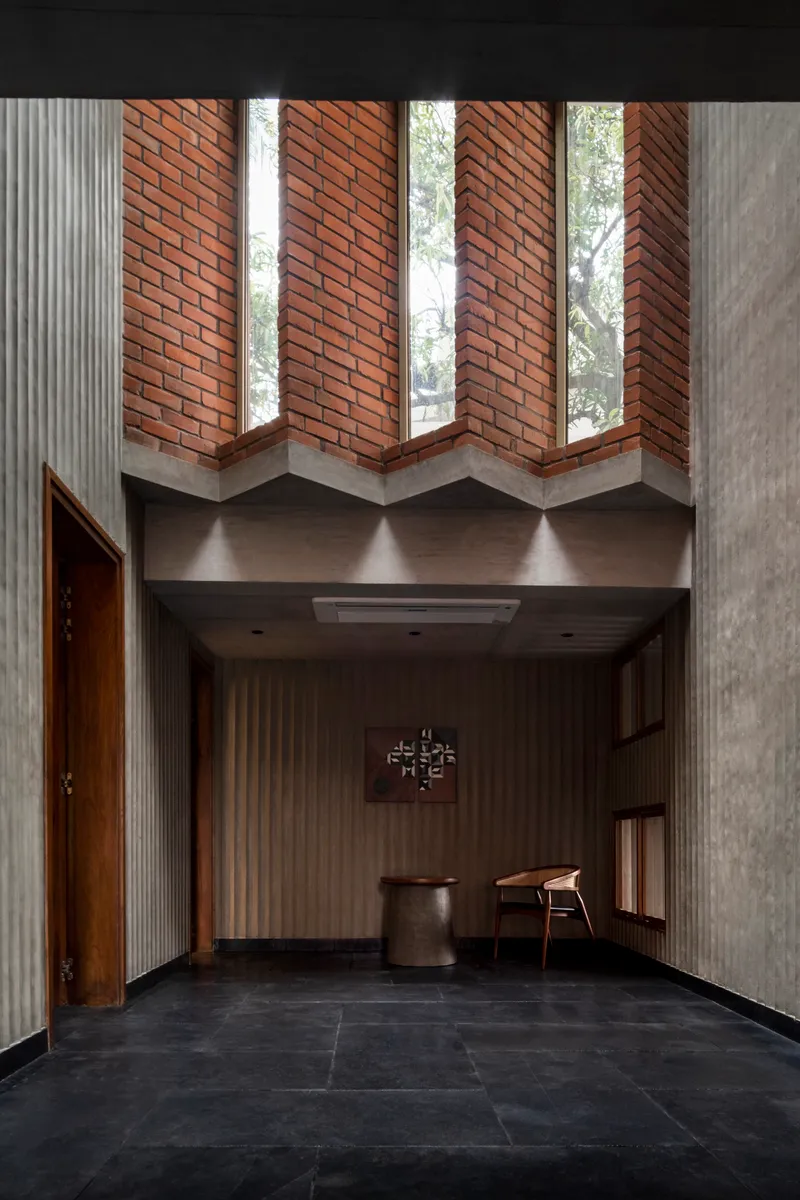
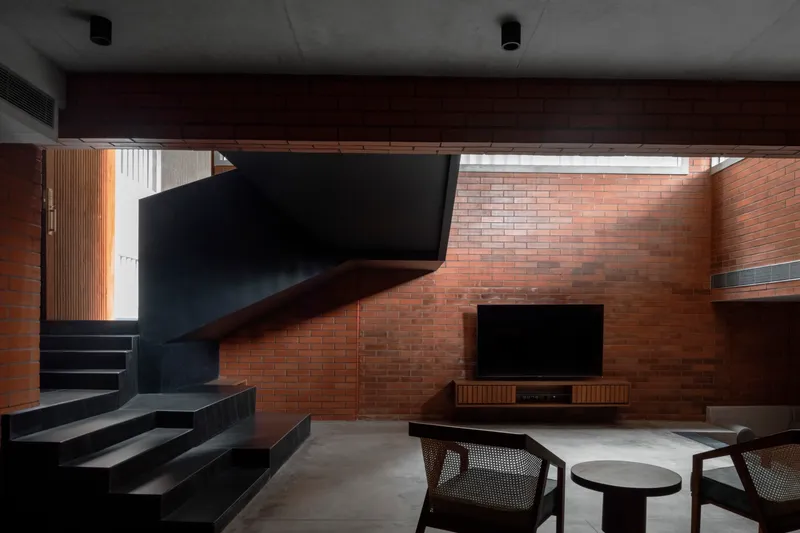
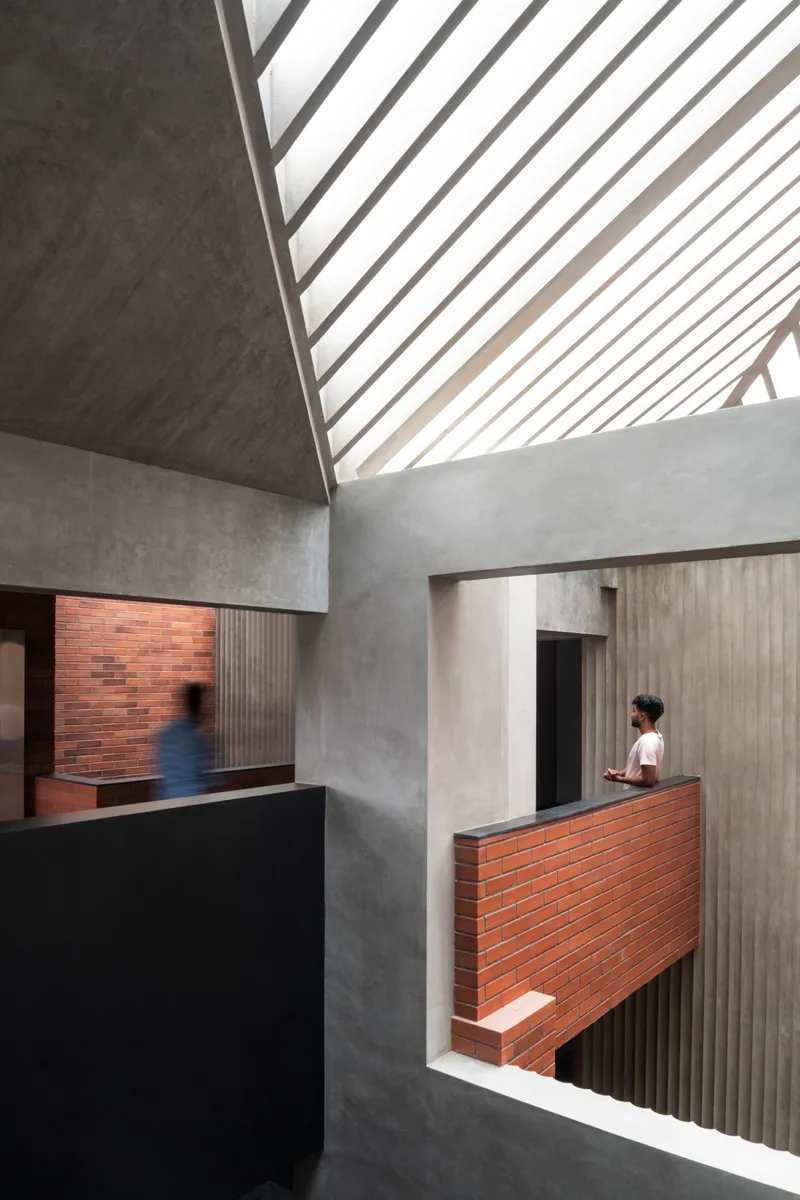
The Thotti Mane typology works by pulling the sky into the plan. Here, that principle is amplified across double and triple-height voids that connect the house's levels visually and thermally. A triple-height skylight marks the main entry, flooding the foyer with light that bounces off zigzag brick clerestory walls. In the living room, a slatted skylight casts diagonal shadows across concrete surfaces, creating a clock-like effect as the sun moves.
These interconnected courts are the house's passive cooling engine. Hot air rises through the voids and exits at the top while cooler air is drawn in at lower levels through the jaali screens. The system is straightforward in principle but demanding in execution, requiring precise coordination between the openings in the facade, the dimensions of the voids, and the position of operable elements. The architects got it right. The house breathes.
Material Honesty in the Interior
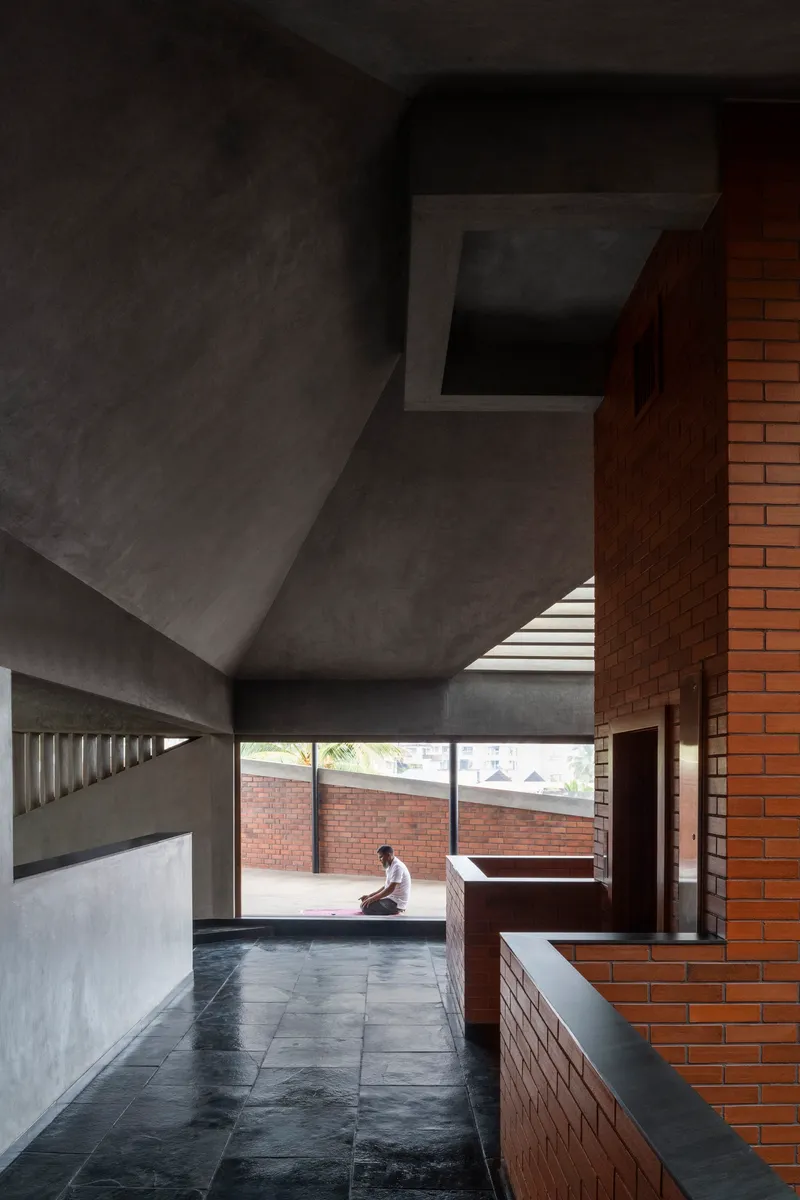
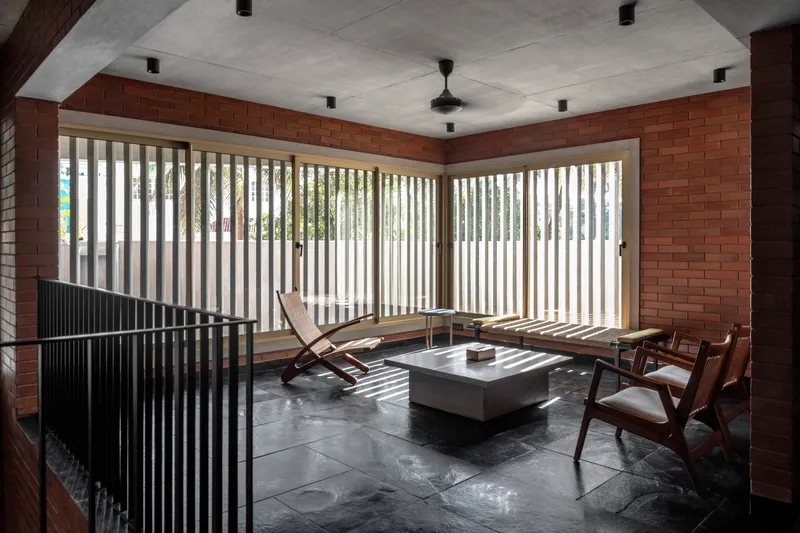
Inside, the material palette is restrained to the point of severity: red brick, exposed concrete, black limestone flooring, and corrugated metal ceilings. There is no plasterboard hiding the structure, no paint concealing the surface. The unifying black stone floor runs throughout, anchoring spaces that shift dramatically in scale from intimate corridors to multi-story volumes. Vertical timber louvres filter daylight across brick walls, producing striped light patterns that soften what could be an austere interior.
The lime-plaster-finished walls and red-oxide flooring referenced by the architects recall the vernacular finishes of the region, materials that were once common in Mangaluru's older buildings. Using them here is not revivalism. It is a pragmatic choice: these finishes perform well in the local climate, age gracefully, and require minimal maintenance. The cotton and jute drapes are the only textiles visible, and they reinforce the palette's earthbound character.
Private Rooms and Wet Spaces
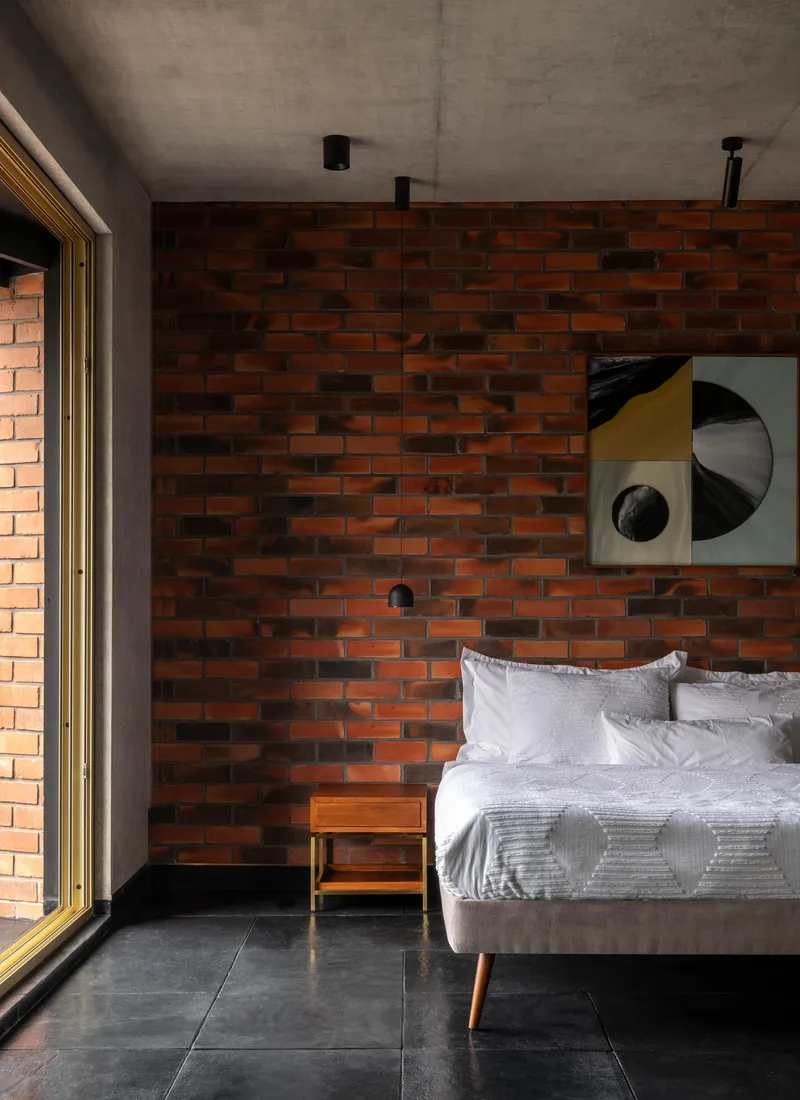
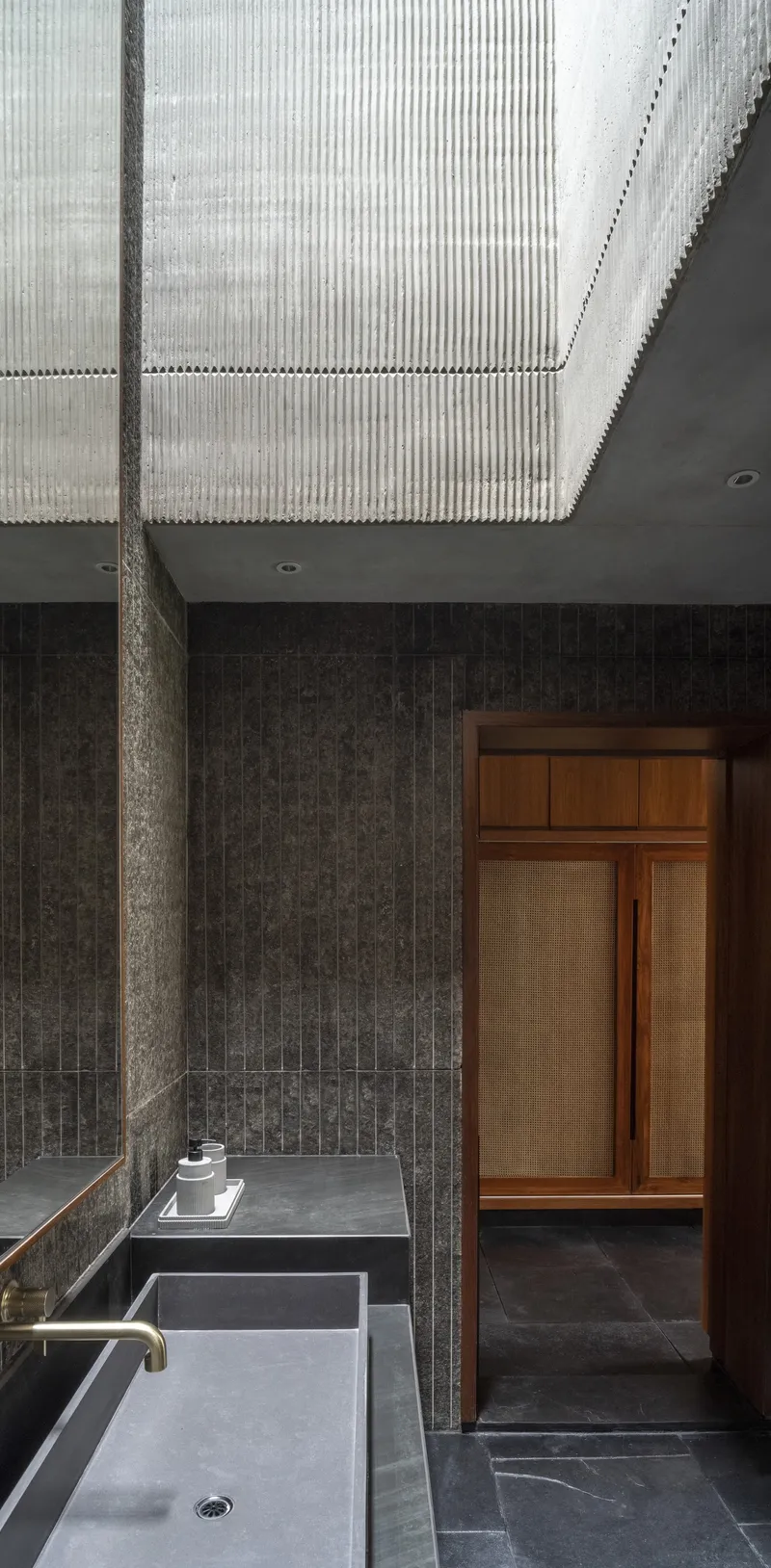
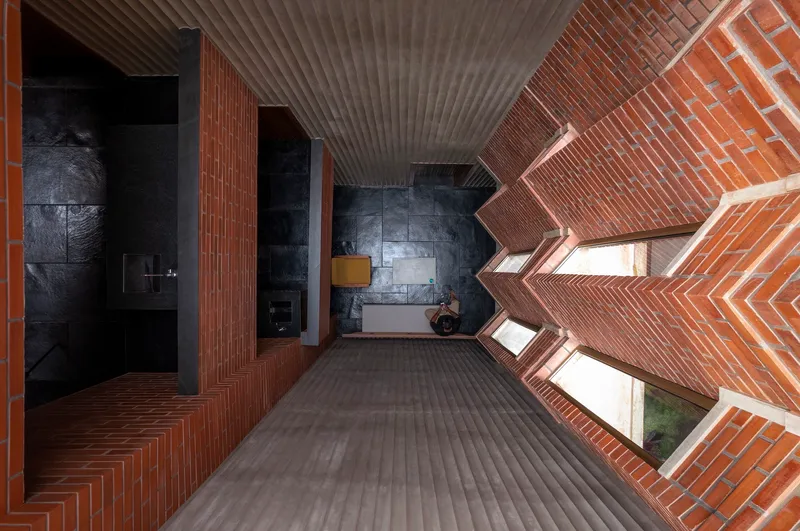
The bedrooms and bathrooms demonstrate that the architects' commitment to raw materiality does not falter behind closed doors. A bedroom wall of variegated red brick sits beneath an exposed concrete ceiling, its tonal range creating visual warmth without any applied finish. The bathroom with its ribbed concrete ceiling and sunken grey stone bathtub is almost monastic, with dark brick walls absorbing light rather than reflecting it.
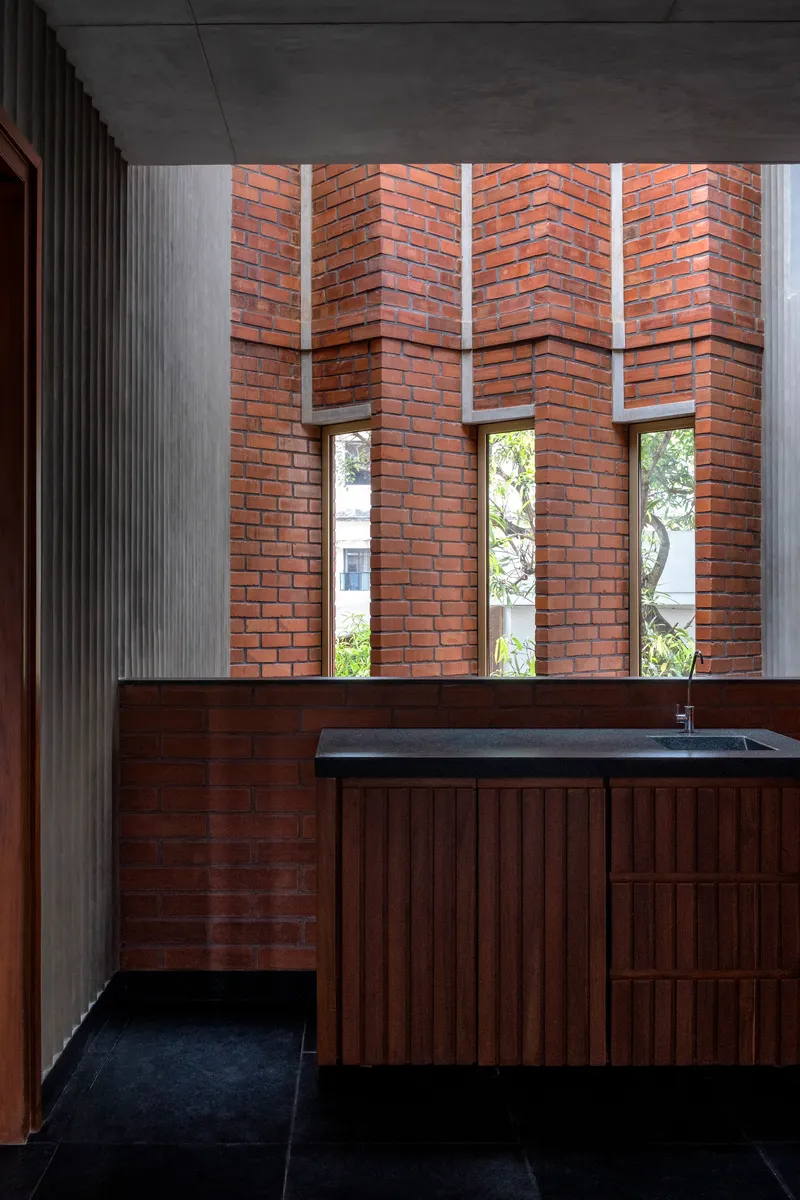
A herringbone-patterned brick wall behind a vanity, slotted with vertical windows that frame greenery outside, is one of the house's quietest details and one of its best. It shows a studio thinking about brickwork not as mass but as pattern, texture, and frame simultaneously.
Terraces and Thresholds
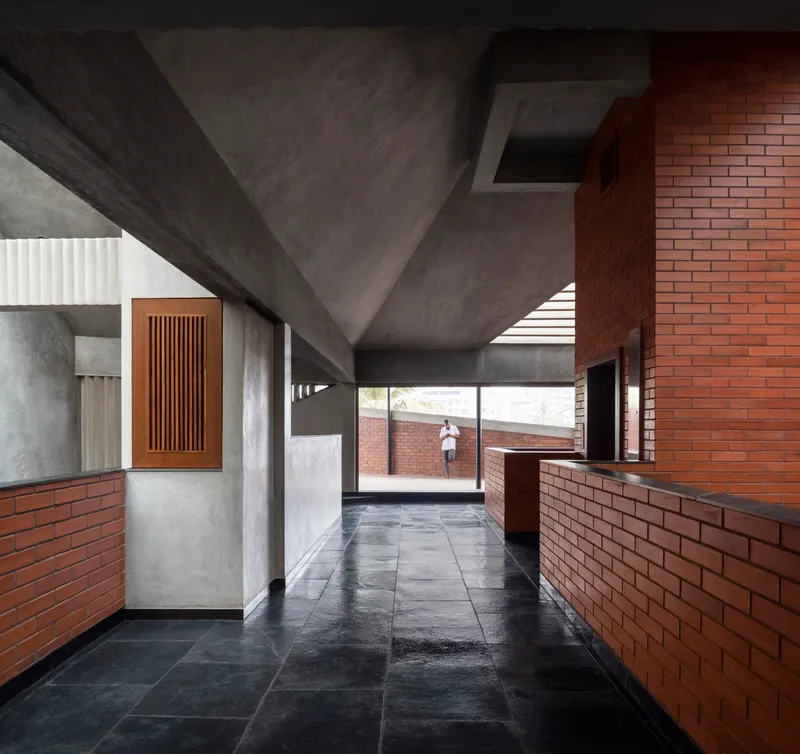
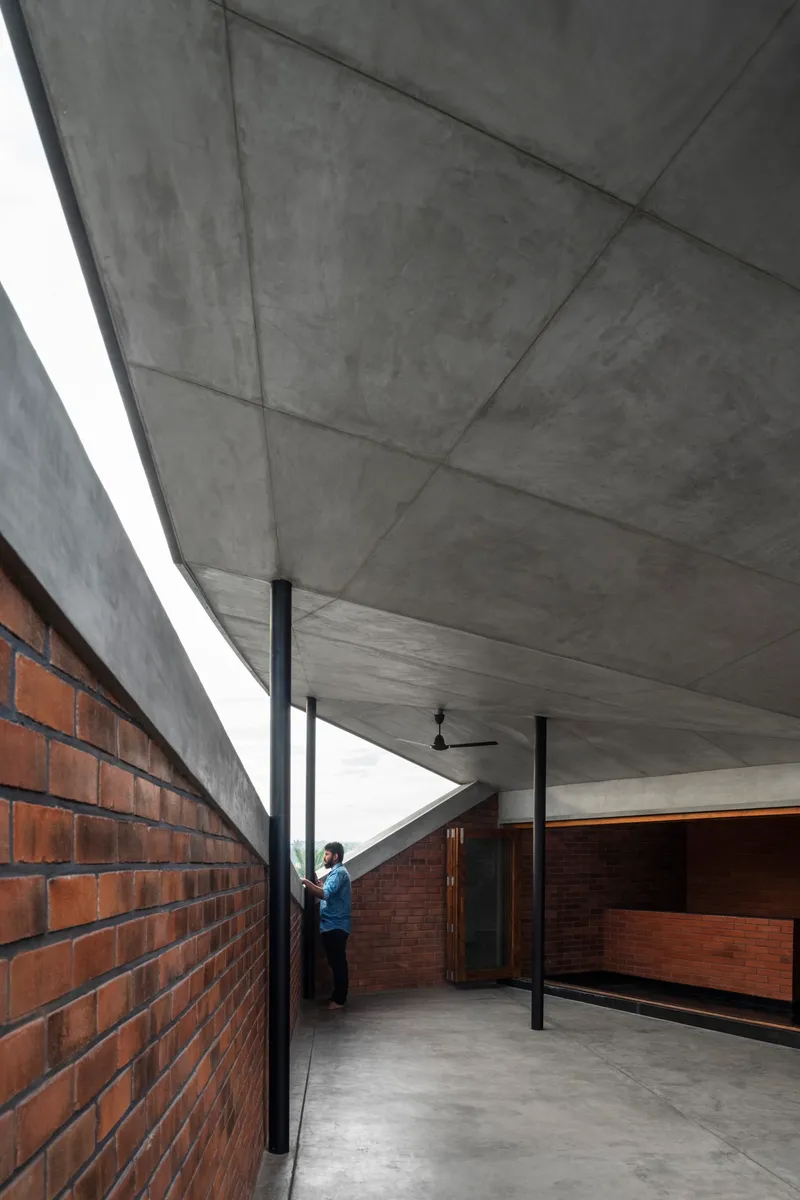
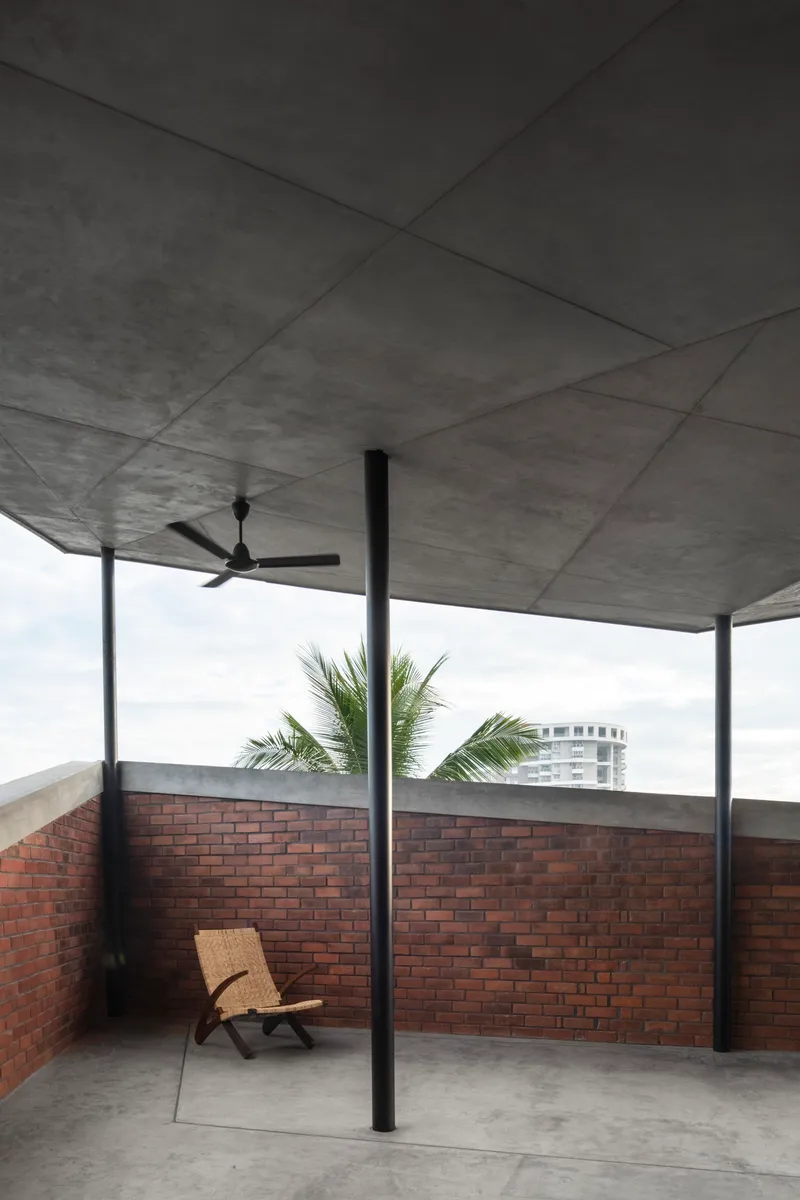
The transition from interior to exterior is managed through a series of covered terraces and corridors that blur the line between inside and out. Exposed concrete ceilings with ceiling fans, black steel columns, and brick parapet walls define outdoor rooms that are fully usable even during Mangaluru's monsoon. Palm fronds and the tops of neighboring trees are the only borrowed views the site allows, and the architects frame them carefully through gaps in the parapet.
These semi-outdoor spaces are essential to the house's climate strategy. They provide shaded areas where cross-ventilation is strongest and serve as buffer zones between the conditioned interior and the tropical heat beyond. The rooftop terrace, with its service and drying areas, is treated with the same material discipline as the formal living spaces below.
Plans and Drawings
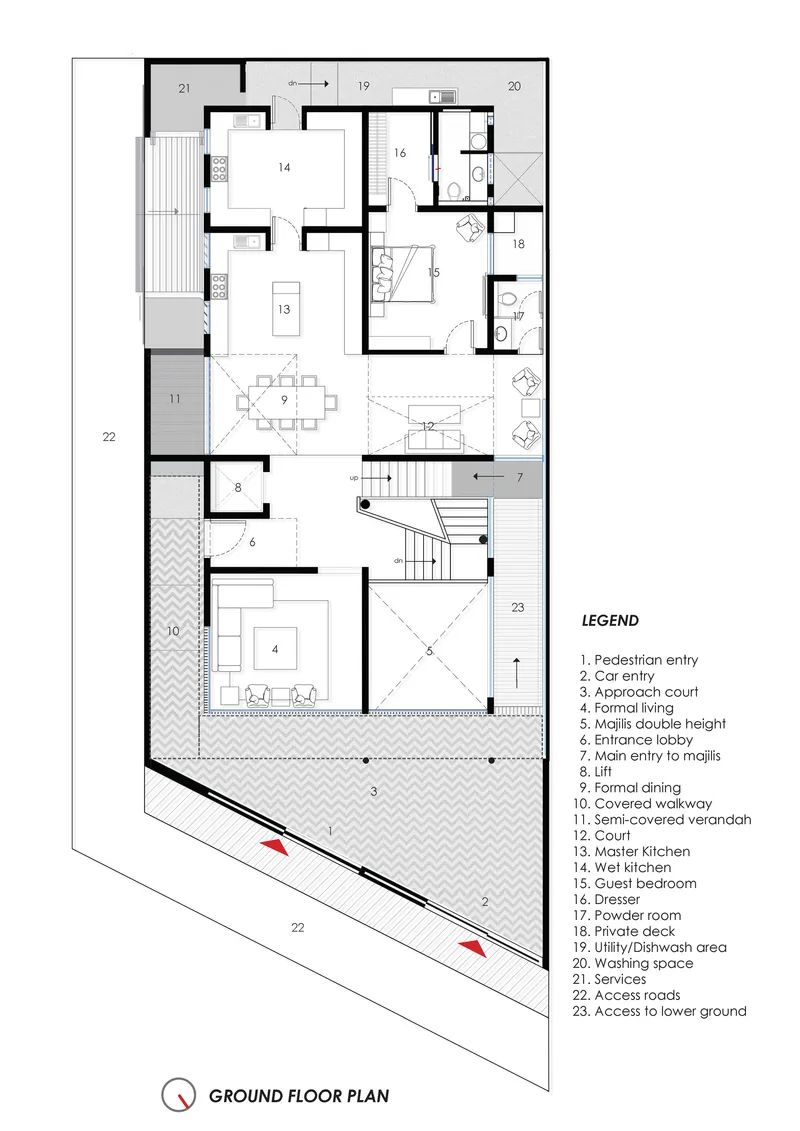
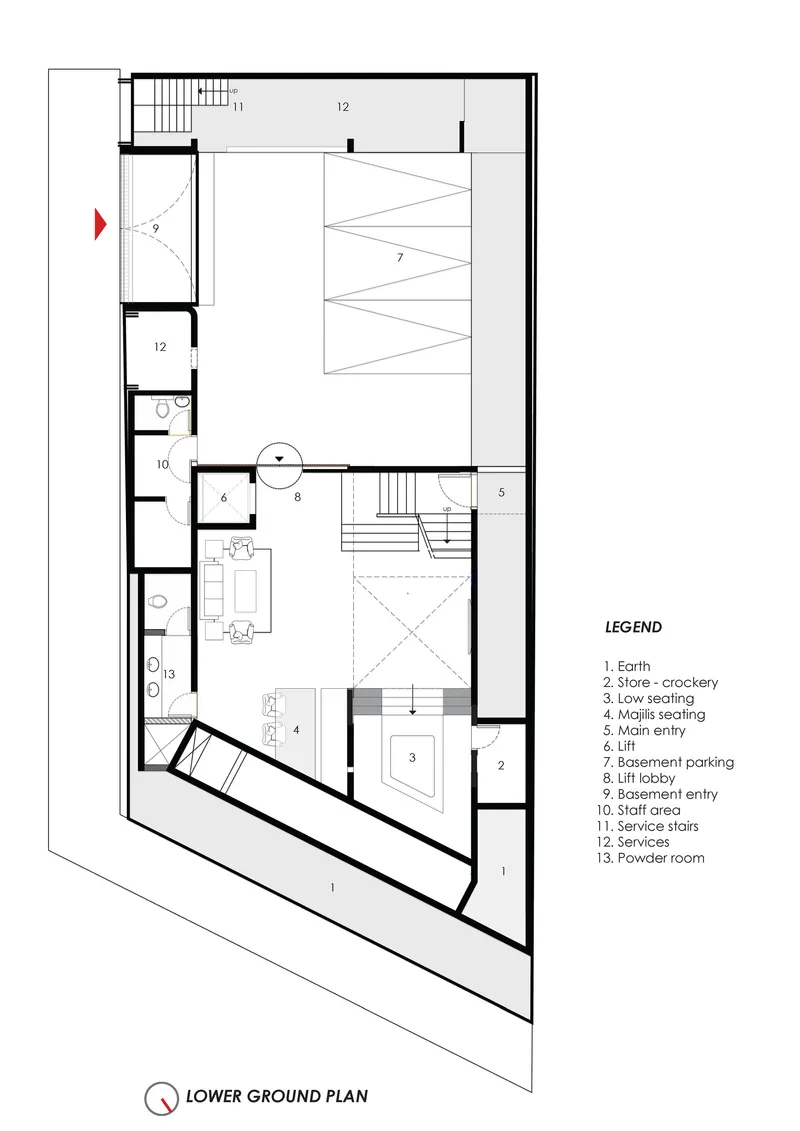
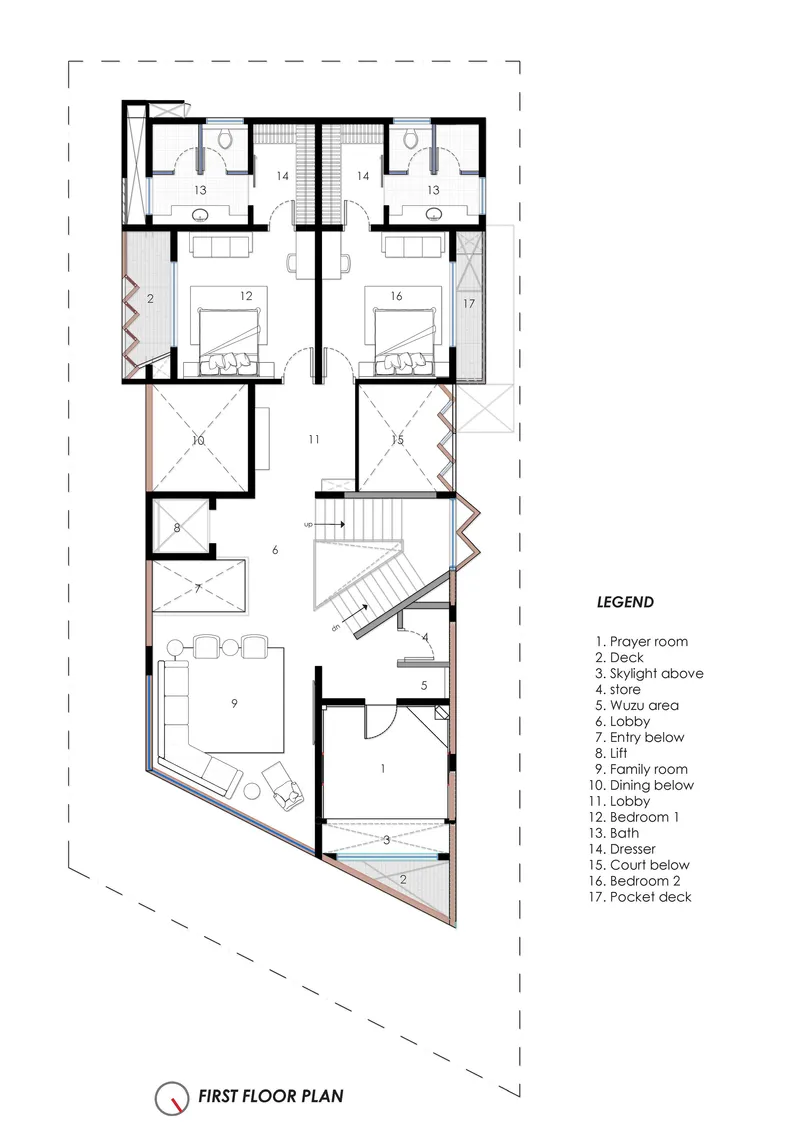
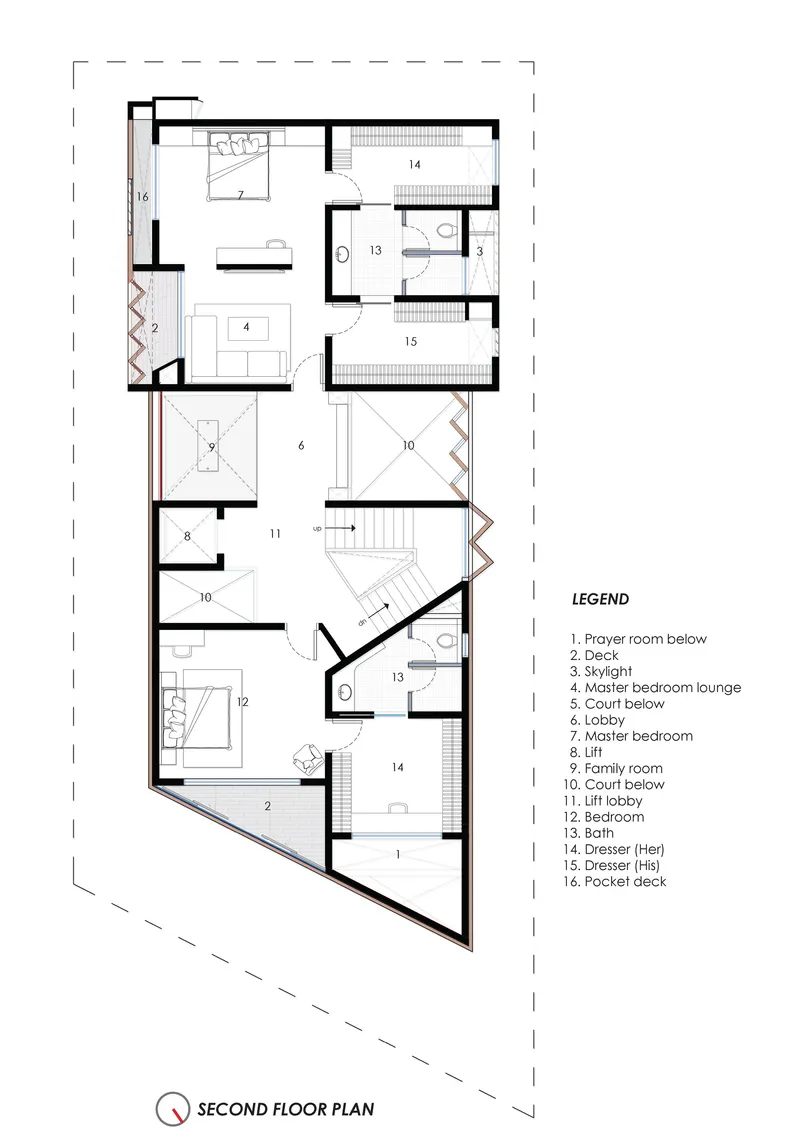
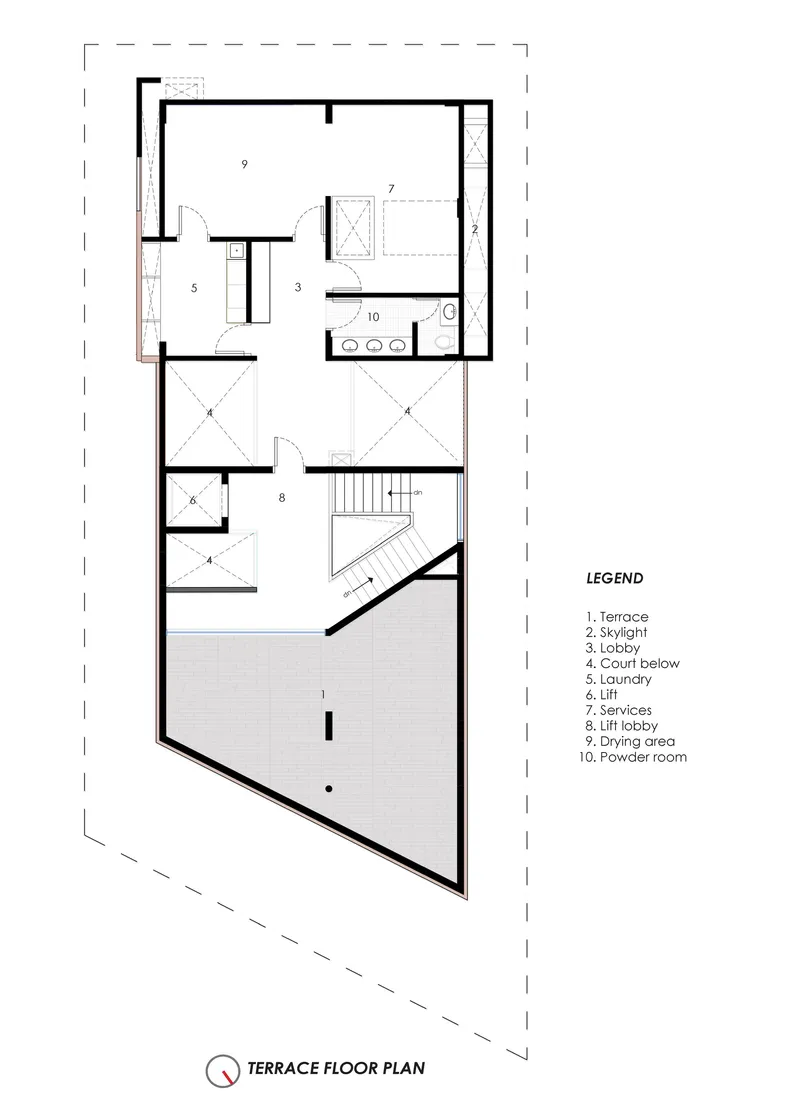
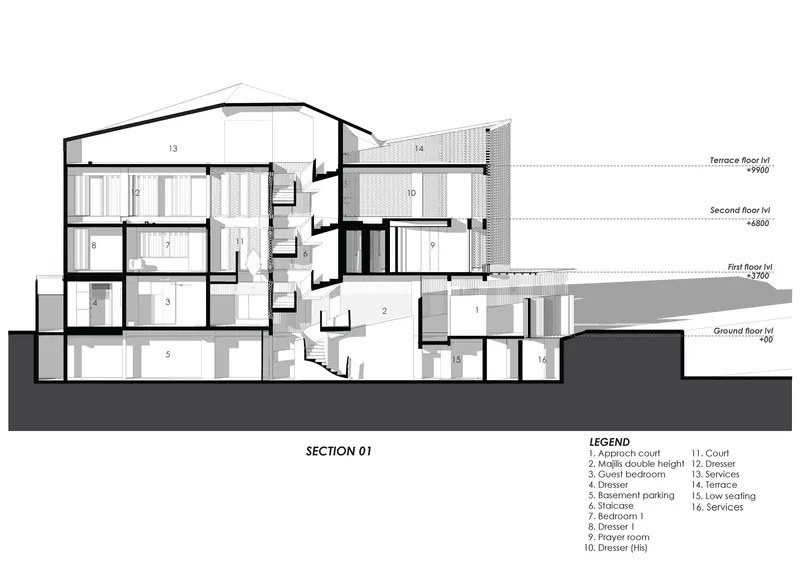
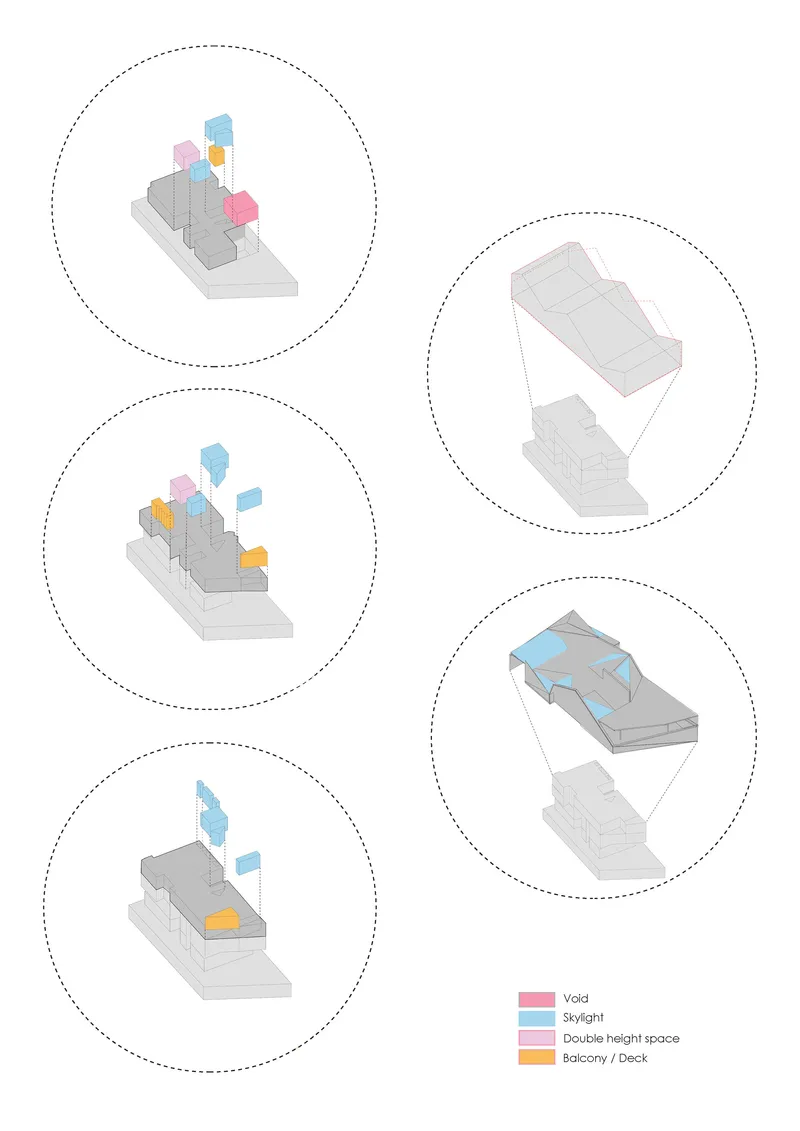
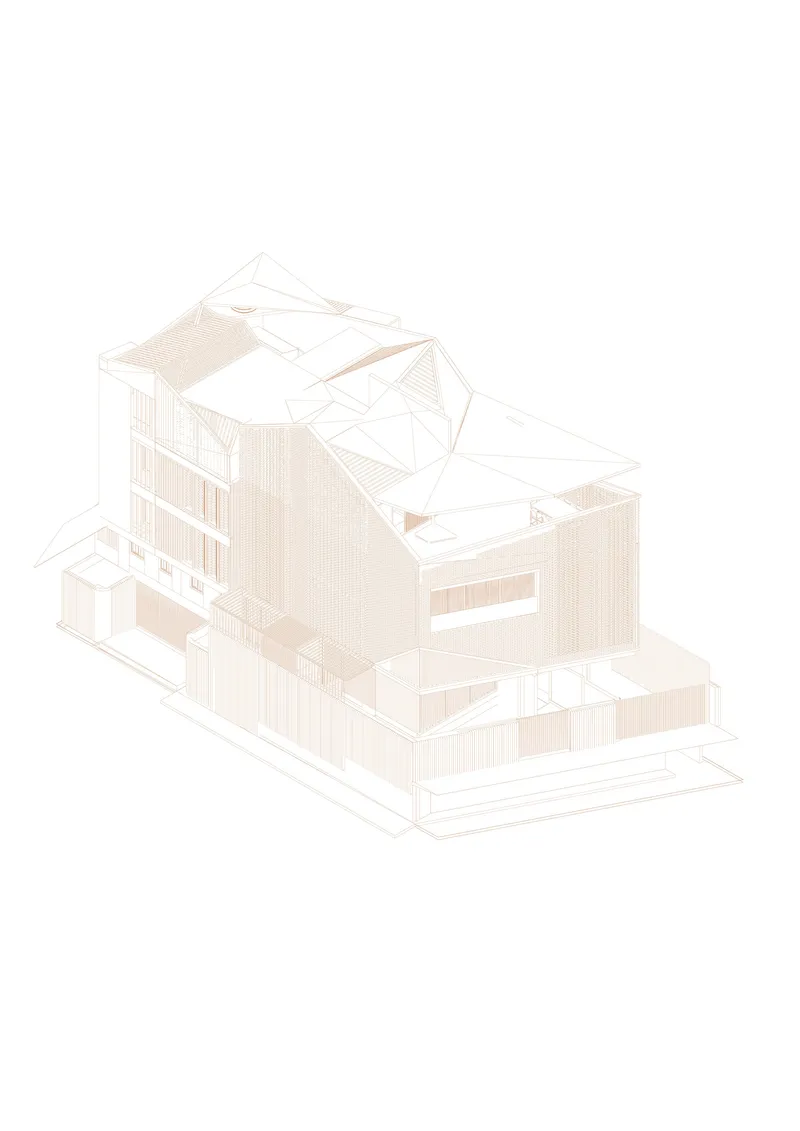
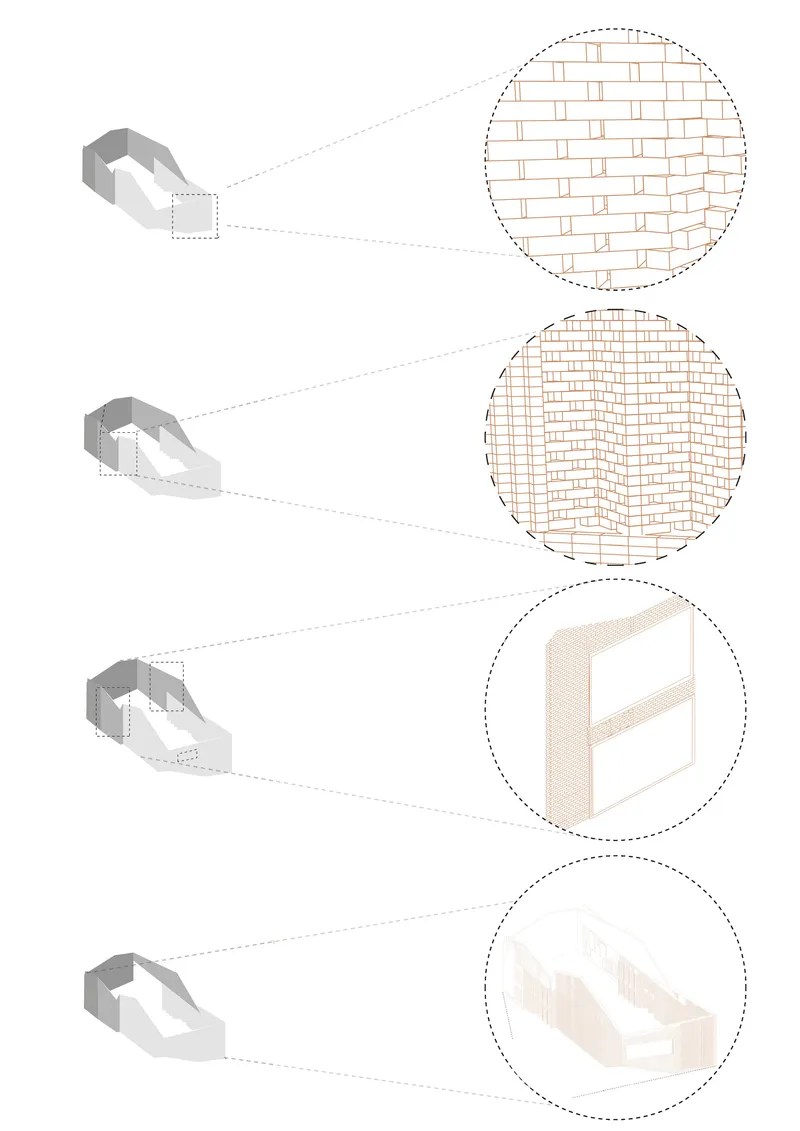
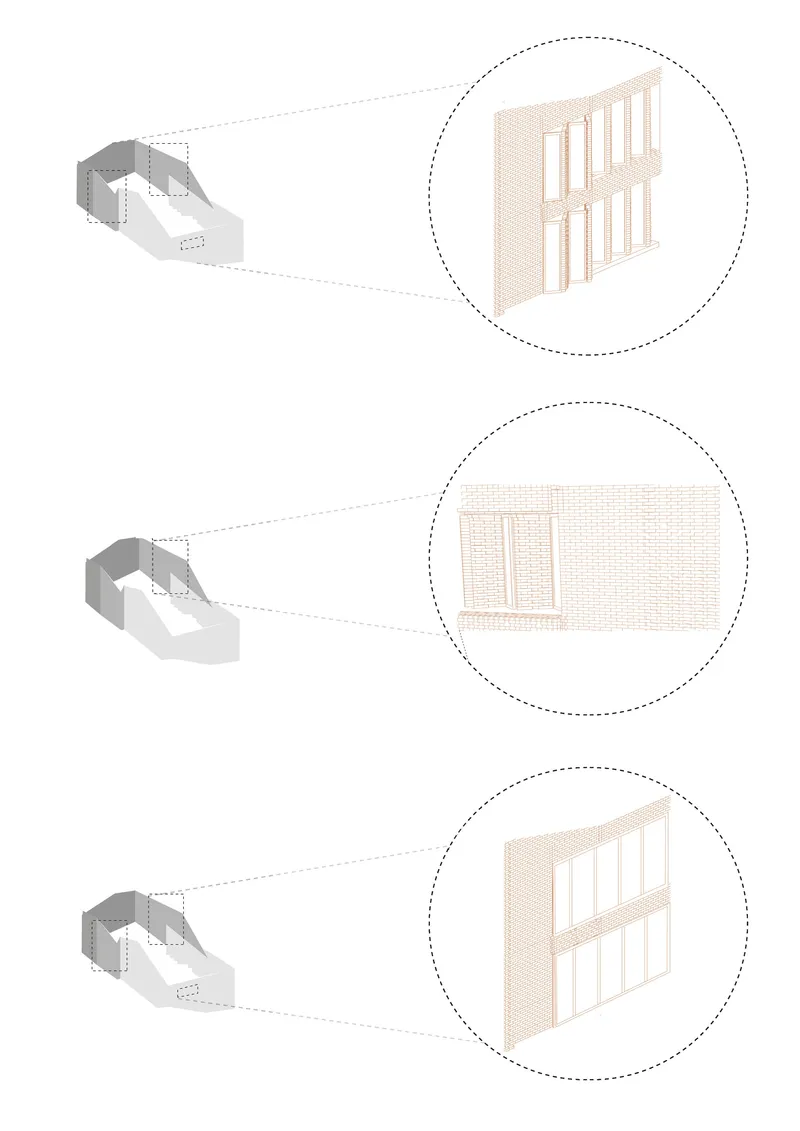
The floor plans reveal the inward-looking logic of the design: living spaces wrap around a central staircase and courtyard on the ground floor, while bedrooms and a prayer room arrange themselves around double-height voids on the upper levels. The section drawing is the most telling document, showing how the house steps down the sloped site, using the grade change to create a dual-level entry with parking below and formal living above. The axonometric diagrams are unusually detailed, illustrating not just the spatial configuration of voids and skylights but the brick bonding patterns and facade assembly at an almost instructional level of precision.
Why This Project Matters
The Brick House matters because it demonstrates that passive design in a tropical climate does not require technological novelty. It requires material intelligence. The triple-layered wall system, the interconnected courtyards, the calibrated jaali screens: none of these strategies are new. What is new is the conviction with which The Purple Ink Studio has assembled them into a contemporary residence that performs thermally, holds together aesthetically, and connects to Mangaluru's architectural memory without becoming a museum piece.
In a city where urban sprawl has systematically dismantled regional identity, this house argues that the answer is not imported materials or air-conditioned hermetic boxes but a return to the logic embedded in the local building tradition. The Thotti Mane courtyard type, the laterite masonry, the red-oxide floors: these are not nostalgic gestures. They are performance-tested solutions, redeployed with spatial ambition and structural precision. That combination of humility and rigor is rare, and it is exactly what makes the project worth watching.
Brick House by The Purple Ink Studio, Mangaluru, India. 1,254 sqm. Completed 2022. Photography by Suryan // Dang.
About the Studio
Share Your Own Work on uni.xyz
If projects like this are the kind of work you want to make, uni.xyz is a place to publish your own, find collaborators, and enter design competitions.


Popular Articles
Popular articles from the community


Tsunami Convergenics: Turning Catastrophic Ocean Forces into Underwater Housing Infrastructure
A speculative underwater settlement off the coast of Onagawa, Japan, treats tsunamis and typhoons as energy sources rather than threats.

Extended Shell: Retrofitting Kolkata's Balconies as Living Urban Thresholds
A modular retrofit system recovers the social and environmental intelligence of Kolkata's historic verandas for contemporary Park Street residents.

Cloaked Colonization: A Mobile Underwater Habitat That Moves Like a Fish
Micah Abaya's shortlisted EHC Pacific entry reimagines ocean settlement as a dispersed network of self-sustaining architectural organisms.

Singing Woman: An Opera House That Performs Before the Curtain Rises
Ovidiu Cristian Pavel's conceptual opera house translates Estonia's choral identity into a sculpted waterfront landmark facing the Baltic Sea.

Similar Reads
You might also enjoy these articles

Pixel Gardens: One Repeated Module Stacked Into a Terraced Social Housing Tower for Famagusta
Salem Bader's shortlisted housing tower builds a vertical neighbourhood from one repeated module, offsetting units to carve terraces, light and air.

Bao Huynh Watercolor Atelier: A Serene Art Retreat in Hội An
Bao Huynh Watercolor Atelier in Hội An blends multifunctional art spaces, sustainable design, local materials, and family-friendly living in a serene environment.

Atelier Macri Concept Store Interior Design by CASE-REAL
Atelier Macri store features a "ko" counter, walnut wood details, cork displays, blending retail, gallery, and seamless customer experiences.

Manuel Vargas Izquierdo Stadium and High-Performance Sports Center: Architectural Excellence in Jalpa de Méndez
The Manuel Vargas Izquierdo Stadium blends sustainable design, inclusive sports facilities, and cultural-inspired architecture, revitalizing Jalpa de Méndez’s public spaces.

Explore Brick Competitions
Discover active competitions in this discipline

Challenge to design mud housing for contemporary communities

Challenge to reimagine the Iron Throne

Photograph architecture without architects

Illustrate the lost glory of Angkor Wat - Render Challenge
Comments (0)
Please login or sign up to add comments
No comments yet. Be the first to comment!