

Live Laugh Love Center: Therapeutic Architecture Rooted in Edinburgh's Urban Fabric
A mental health facility in Edinburgh uses dual programming, timber brise-soleils, and landscape therapy to make architecture an agent of recovery.


What if a building could function as medicine? The Live Laugh Love Center in Edinburgh proposes exactly that: a mental health facility where every spatial decision, from the curved footprint to the retractable terrace, is calibrated to support psychological recovery. Rather than disguising clinical function behind a corporate skin, the design leans into its therapeutic mission, splitting the program between a medical block for outpatient diagnostics and a community block for group therapy, yoga, drawing, music, and light exercise. The result is a building that treats architecture itself as a healing instrument.
Designed by Alexander Chudakov, this shortlisted entry for the Live Laugh Love 2020 competition sits within reach of NHS Lothian and Astley Ainslie Hospital, embedding the facility in Edinburgh's existing healthcare network. The project earned praise from jurors including Eleena Jamil, Principal at Eleena Jamil Architect, who noted "renderings that show the potentials of the proposal," and Juanjo Otero of MOL Arquitectura, who called the use of wooden brise-soleils and the landscaped patio "very successful." Otero also described the geometry as "very blunt," a quality that, in a mental health context, reads less as severity and more as legibility: patients in crisis benefit from spatial clarity.
Timber Volumes Among Existing Trees
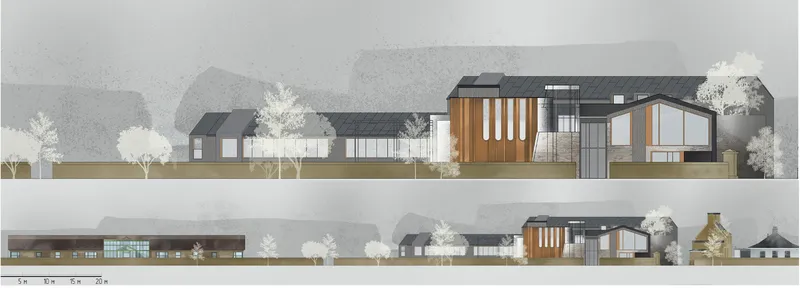
The elevation drawings reveal a multi-building complex wrapped in timber cladding, its varied roof forms stepping down to negotiate the scale of surrounding trees. The material choice is deliberate: timber introduces warmth and tactility that clinical architecture so often lacks. Between the volumes, the existing landscape is preserved rather than cleared, allowing the buildings to appear as insertions within a park rather than objects imposed upon it. The effect softens the institutional reading of the complex. A patient arriving here encounters a collection of sheltering forms, not a monolith.
A Curved Footprint That Organizes Care
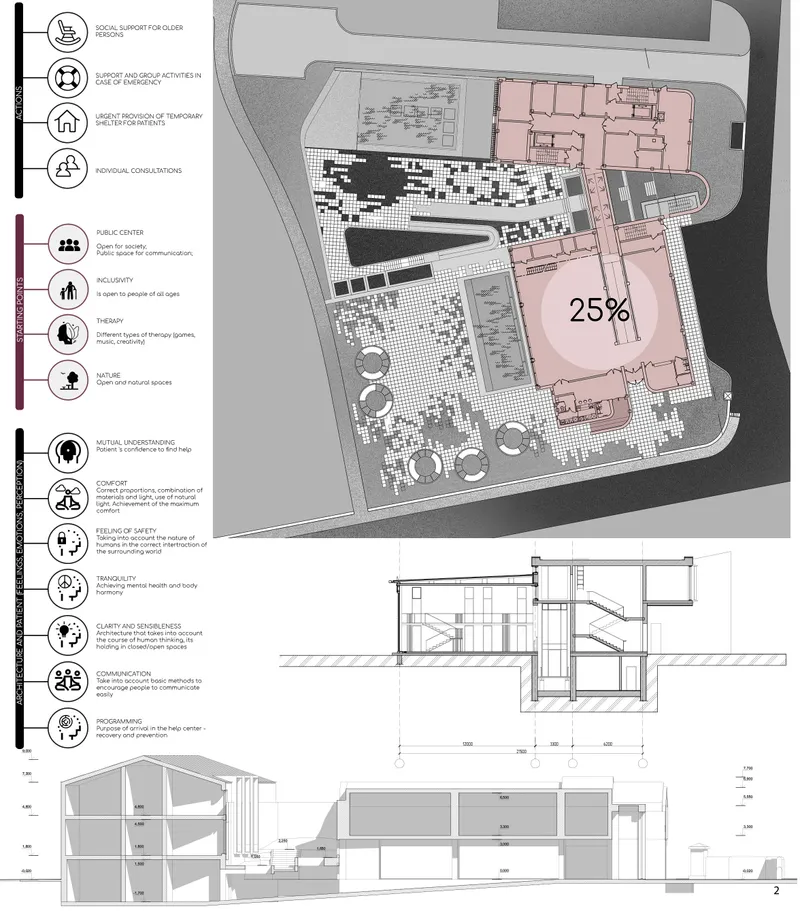
The site plan and section drawings expose the logic beneath the curving building footprint. Program icons map out the dual structure: medical functions on one side, community and administrative spaces on the other. Sectional cuts through the interior show how this separation plays out vertically, with the ground floor housing a cafeteria, patient check-in, therapy rooms, and diagnostic spaces. The curve is not ornamental. It generates a patio at the building's heart, a landscaped courtyard that Otero specifically praised. Meditative walkways and soft planting zones turn this outdoor space into a therapeutic tool, giving patients direct contact with nature without leaving the facility's perimeter.
Contextual Mapping and Ground Floor Logic
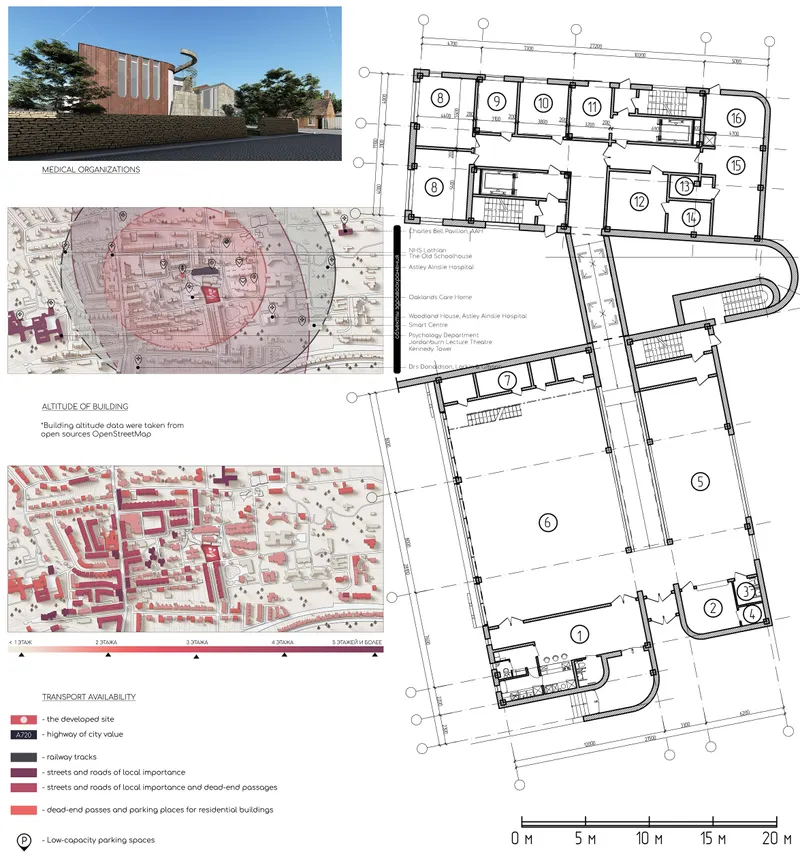
Red-toned context maps place the center within Edinburgh's urban grain, tracing transport routes and pedestrian access that reduce barriers to care. The zoning plan accounts for low-capacity parking, prioritizing foot traffic over vehicular dominance. Alongside these maps, the ground floor plan lays out numbered rooms with precision: laundry services, personnel areas, and diagnostic spaces all receive dedicated positions. Every room is tailored to a therapeutic need, whether solitude, consultation, movement, or recreation. The architectural planning operates as a framework for care delivery, where spatial sequence mirrors treatment sequence.
L-Shaped Upper Floors for Clinical and Administrative Functions

The second and third floor plans reveal an L-shaped layout with curved corners that maintain the building's softened geometry at every level. The second floor concentrates clinical expertise: consultation rooms, doctor's offices, massage and physiotherapy rooms, a laboratory, and administration. The third floor shifts to operational management, housing offices for staff and the chief physician, medicine storage, and special-purpose rooms. Curved corners prevent the sharp angular corridors that characterize so many institutional buildings. For patients navigating these spaces during vulnerable moments, the difference between a right angle and a gentle curve is not aesthetic; it is experiential.
Why This Project Matters
Mental health architecture is too often reduced to interior design gestures: softer colors, better lighting, a plant in the waiting room. Chudakov's proposal pushes further by making the building's form, program split, and landscape strategy all serve the therapeutic agenda simultaneously. The dual-block structure acknowledges that recovery involves both clinical intervention and community participation, and the architecture gives each mode its own spatial identity without isolating them from one another.
Eleena Jamil's observation that the labyrinth concept described in the brief could have been "developed further" is fair, and it points to the tension inherent in competition entries: between showing enough to prove a concept and resolving every detail. What Chudakov has resolved, convincingly, is the argument that grounded geometry, timber warmth, and embedded landscape can transform a healthcare facility from a place people dread visiting into one that actively contributes to their healing. In a world where mental health crises are accelerating, that argument deserves more built evidence.
View the Full Project
About the Designers
Designers: Alexander Chudakov, UNI
Enter a Design Competition on uni.xyz
uni.xyz runs architecture and design competitions year-round that reward proposals with spatial conviction and real site intelligence.
Project credits: Live Lough Love Center by Alexander Chudakov, UNI Live Laugh Love 2020 (uni.xyz).


Popular Articles
Popular articles from the community


Tsunami Convergenics: Turning Catastrophic Ocean Forces into Underwater Housing Infrastructure
A speculative underwater settlement off the coast of Onagawa, Japan, treats tsunamis and typhoons as energy sources rather than threats.

Singing Woman: Contemporary Architecture Inspired by Estonia’s Voice and the Sea
Singing Woman turns Estonia’s song culture into flowing opera house architecture, blending public life, landscape, sea, and national memory.

Opera by the Sea Estonia: Three Shells Dissolving Architecture into Tallinn's Coastline
A winning opera house proposal replaces monumental form with interconnected shells that blur the boundary between building, park and Baltic Sea.

Cloaked Colonization: A Mobile Underwater Habitat That Moves Like a Fish
Micah Abaya's shortlisted EHC Pacific entry reimagines ocean settlement as a dispersed network of self-sustaining architectural organisms.

Similar Reads
You might also enjoy these articles

Bao Huynh Watercolor Atelier: A Serene Art Retreat in Hội An
Bao Huynh Watercolor Atelier in Hội An blends multifunctional art spaces, sustainable design, local materials, and family-friendly living in a serene environment.

Atelier Macri Concept Store Interior Design by CASE-REAL
Atelier Macri store features a "ko" counter, walnut wood details, cork displays, blending retail, gallery, and seamless customer experiences.

Manuel Vargas Izquierdo Stadium and High-Performance Sports Center: Architectural Excellence in Jalpa de Méndez
The Manuel Vargas Izquierdo Stadium blends sustainable design, inclusive sports facilities, and cultural-inspired architecture, revitalizing Jalpa de Méndez’s public spaces.

KAKR Buluh Awar Hall: Revitalizing Community and Ecology Through Bamboo Architecture
Community built bamboo hall revitalizes Buluh Awar village, empowering youth, restoring ecology, celebrating vernacular craftsmanship through sustainable architecture and culture.

Comments (0)
Please login or sign up to add comments
No comments yet. Be the first to comment!