
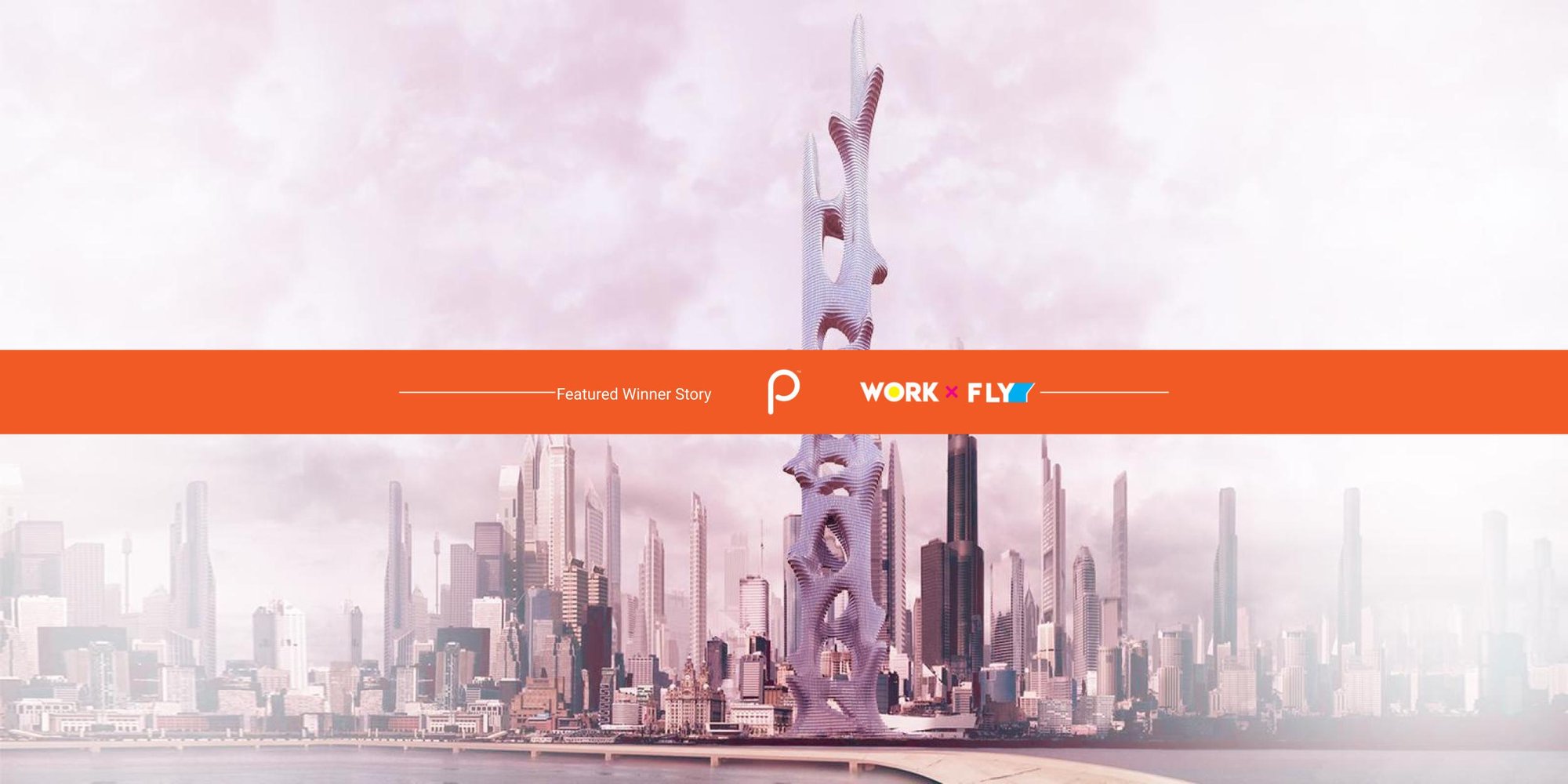
This is how future skyscrapers might look!
Multifunctional Skyscrapers for the future Mega - Cities

Introduction
As our cities grow denser, tall buildings are not a luxury anymore but a necessity today. With the rampant growth of technology and the density, we have to mitigate - the overlaps between the dynamic nature of spaces are now gaining more and more evident form. For instance, restaurants that work as a co-working space in the morning, and a club by the night - our lives are full of such examples where the nature of spaces are bending and blending every day.
Work x Fly ‘19 is an open ideas competition that explores such programmatic ramifications in a much futuristic timeline and high-density scenarios.
The Jury
The jury for the competition consisted of esteemed designers, professionals and academicians from around the world. The Lead Jurors for the competitions were as follows:

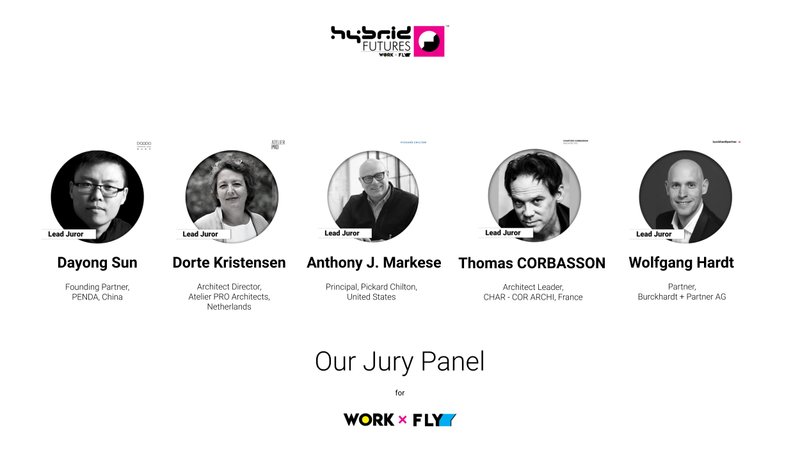
Dayong Sun, Founding Partner, Penda, Beijing China | Anthony J Markese, Principal, Pickard Chilton, United States | Thomas CORBASSON, Architect Leader, Chartier-Corbasson Architects, France | Dorte Kristensen, Architect director, Atelier PRO architects, Netherlands | Wolfgang Hardt, Partner, Burckhardt+Partner AG, Switzerland
Here are the best of competition projects as follows:
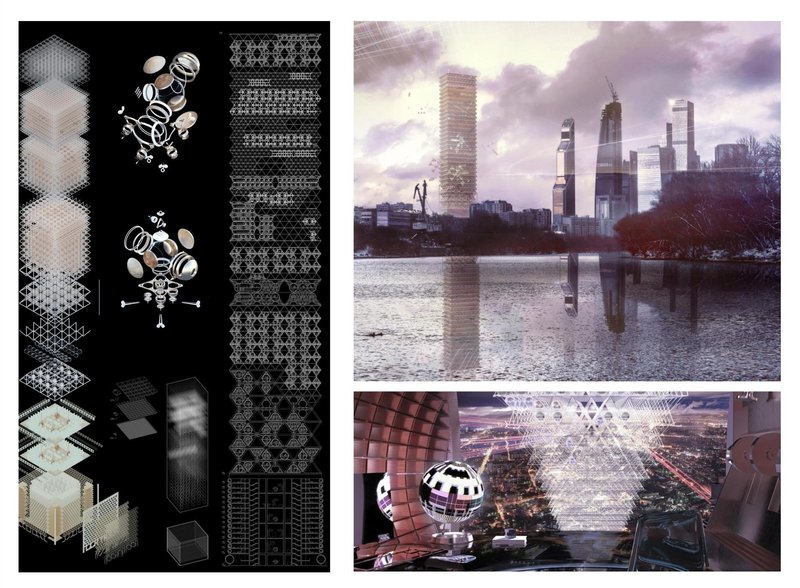
Winning project: HYBRID FUTURE AND BIONIC TONER
By: Bipradip Biswas
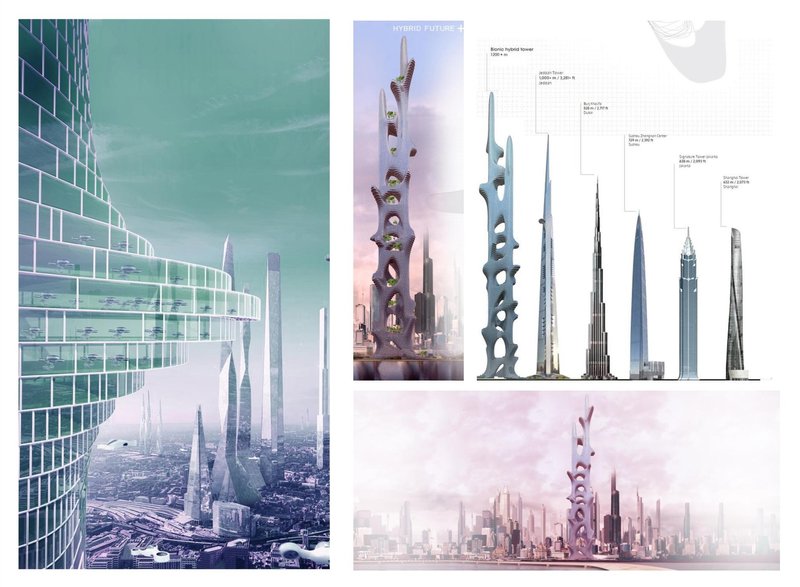
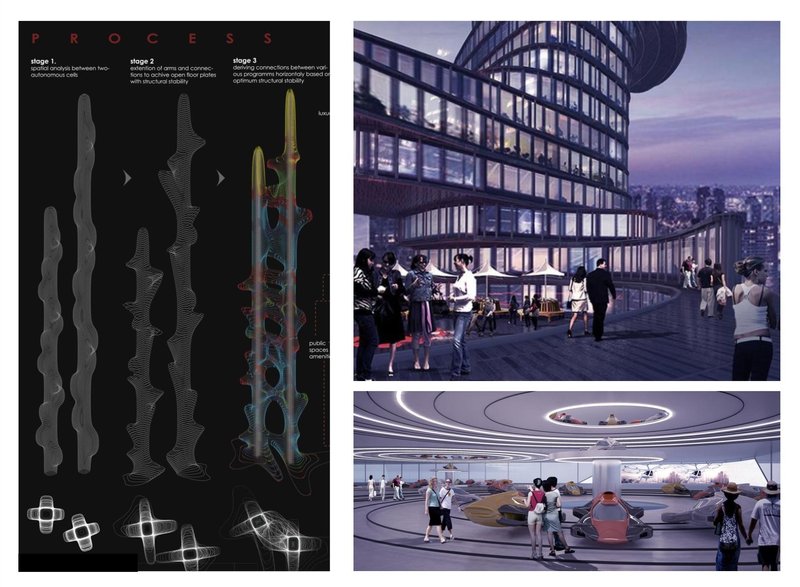
Description: The concept is drawing inspiration from the compact foam-like structure of the bone tissue, and two autonomous cells are considered that grow vertically and can be programmed as per the desired hybrid brief which consists of various interdisciplinary programs and space correlation vertically at the same time maintaining the structural balance and load distribution. The tower can have multiple numbers cells depending on the need for more programs.
-----------------
Honourable Mention: AEROSCRAPER
By: Xiaohan Wu, Jin qiu, Xiyao Wang
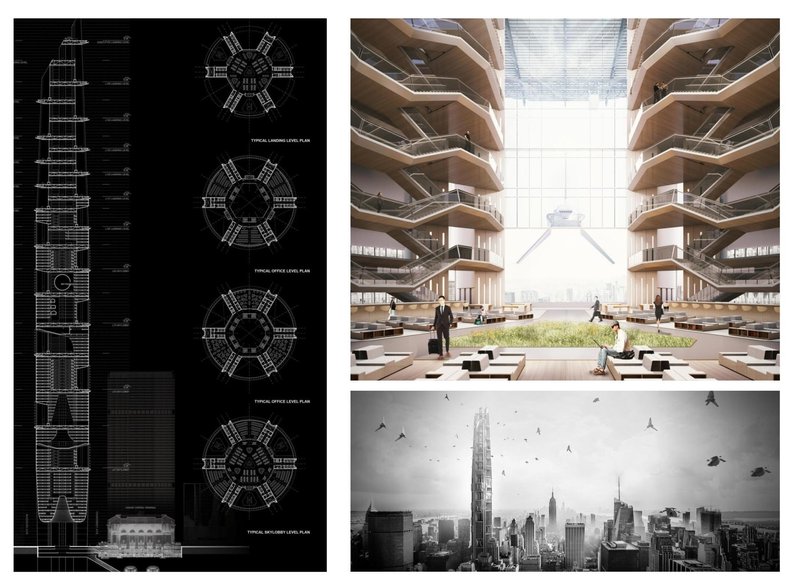
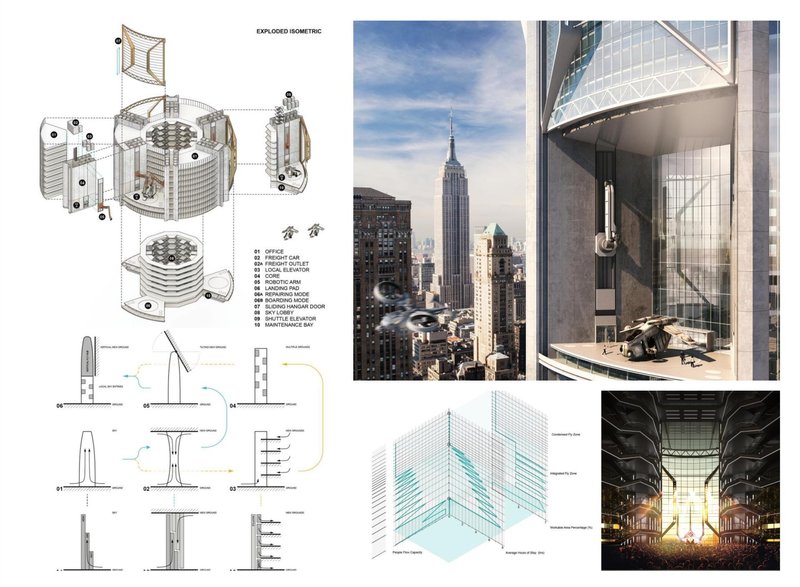
Description: The Aeroscraper is a mixed-use super-tall tower that aims to be a new paradigm for an office building in the age of personal air travel. Technological advance makes the boundary between work and life blurred, people are in constant transitions between the two, moving from place to place. Hence the design aims to make this transitional status more attractive and productive.
Derivation of the form for the project: A skyscraper that accepts aircraft from all directions should have as many faces as possible. After several test-fits of cores and landing/departure platforms, a circular plan with hexagonal-spread cores was framed. This plan is reproducible and versatile at the same time.
The form of our skyscraper is a direct interpretation of the programs. The six cores represent vertical circulation and express verticality. The undulating pattern of solid and void is the result of alternating office and landing platforms. The centralized fly hub consists of only outdoor landing platforms is located at the top to avoid the distraction of all the other tall buildings in Manhattan.
The pattern of landing voids, together with the gently tapered form tries to achieve the effect that the tower dissolves into the sky gradually, marking the tower as an organic connector and a threshold between ground and sky, earth and heaven.
---------------------------
Honourable Mention: MAGNET - THE MAGNETIC CITY
By: Mavis Huang, Hong Chen
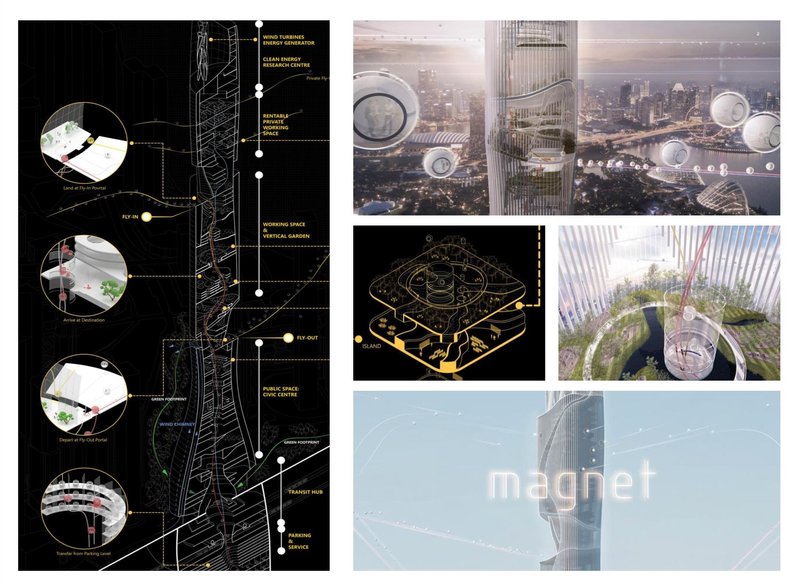
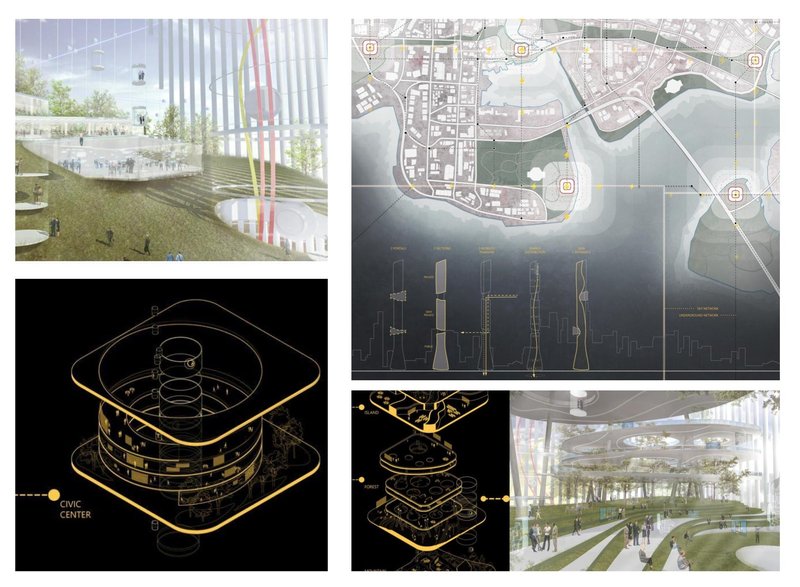
Description: Magnet, a network of hybrid skyscrapers is built up with magnetic levitation. They form systems of clean energy supply and urban green space linking the regions in the city and accommodating the functions of working space, commercial centre, as well as the home for future transportation hence attracting people to gather here daily. The core transportation system is an automatic operation system that connects the entrance, exit and parking levels for the air vehicles. On the other hand, it can also drop passengers to their destinations inside the tower. Air cars are transported by the tracks through electromagnetic suspension. There are tracks for “charge-and-go”, tracks that can transport people to their designated floor plates by the aircars, and tracks that automatically send the cars to the parking level. All controls can be done by application in people’s electronic devices.
-------------------------
Honourable Mention: FLYING PANCAKES
By: Полина Болдырева
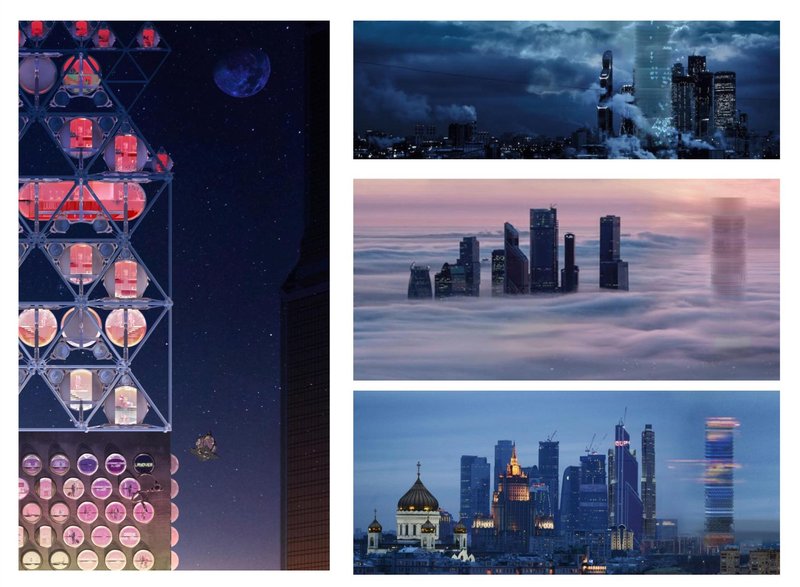
Description: In 2100, with the growth of cities, tall buildings can become a necessity. The quality of spaces also change and evolve into hybrids & units with increased functional potential. A person lives, works and moves in a new way. Capsule drones, private and public, single and multi-cabin, can become places for life, leisure, work and just means of transportation.
This project reflects not only the story of a single tower, but it also presents a new principle of structural formation, the phenomenon of spatial cells and their filling and dividing options, along with the universal formula for further iterations.
------------------------------
People’s Choice Award: THE CITYGATE
By: Darya Zakhvatova, Екатерина Сорокина
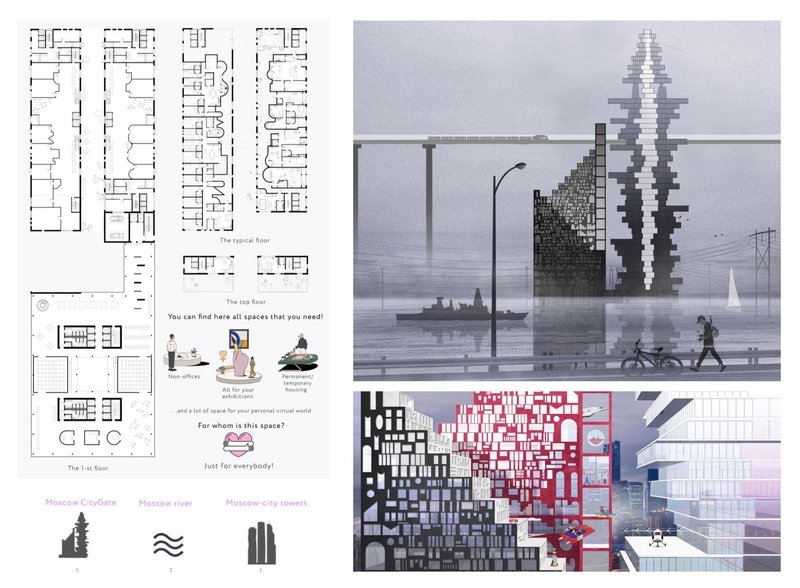
Description: The CityGate is a new high building typology. This is the stop of the ever-wandering nomads who populate the coliving and the permanent residence of groups of people or singles, the stop of ships and boats, drones and hyperloop, private flying cars and aeroplanes. Planes flying to Moscow for the whole world can land on each floor of a skyscraper.
In the future, all of the routine work will be done by machines so the office function will disappear. Its place will be taken by the new ones, which will be free from physical space and which will exist in virtual reality. The person of the future can choose freely the worlds and realities by moving from one to another storey. Yet that the tower has no limit of height, these storeys can be built as necessary.
----------------------------
People’s Choice Award: THE ANCHOR
By: Czaka Zoltan

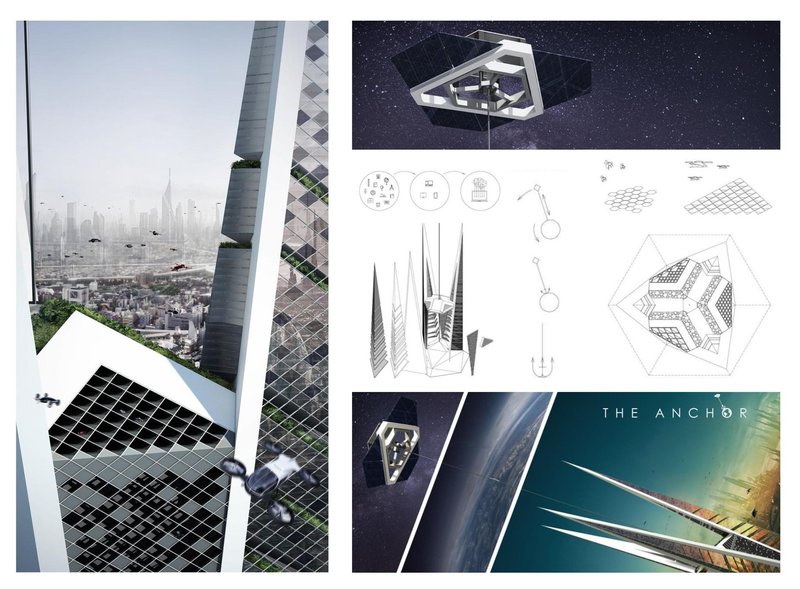
Description: After a period of success in mitigating the damage to mother nature, humanity needs to face new challenges. With the development of technology, it is finally possible to create a space elevator, in which the human history space-age begins. Serving the needs of a multifunctional hybrid building is essential. The energy supply of the building is provided by solar energy, which comes from the space elevator cable and the solar panels integrated into the buildings envelope. With the realization of the space elevator, extracting solar energy from space to the ground can become an economical and sustainable resolution.
Structural concept & its relevance: The bottom anchorage node must keep the centrifugal buoyancy of the cable's weight. The spatial composition of the building follows the basic concept. The masses of towers are standing on the holding weight where the cable is fixed. The underground structures also contribute to the stability of the node. So the whole structure of the building is mainly made of bio-concrete reinforced with graphene fibre functions as an anchor of the space station.
-----------------------
Institutional Excellence Award : HYBRID TOWER - 2050
By: Rabah Saoud (Professor),
Jumana Al, Ghiwa El Housseini
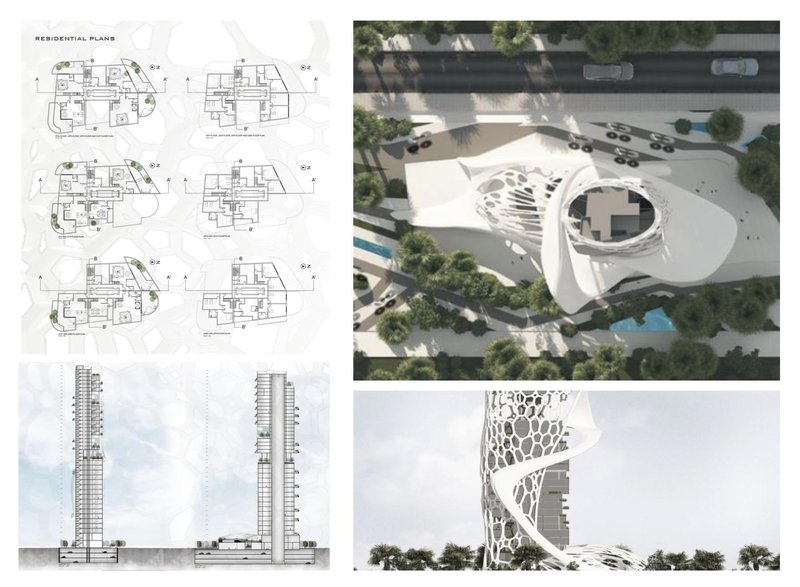
Description: The form of the building was derived from nature as the aim was to connect people to nature. The shell has the pattern of honeycomb and the structure going around the building further going down to the podium and extending to the ground represents the tree trunk and the roots.
----------------------------
Institutional Excellence Award: LIBERTY UTOPIAN NETWORK
By: Alessandro Cece (Professor),
Dina Muneer Nemer Alhasan, Alaa Moustapha El-Khatib
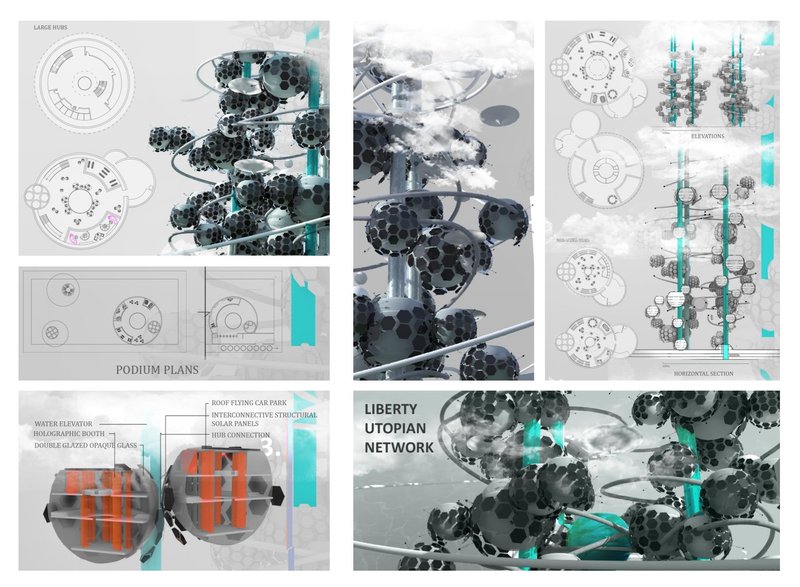
Description: In the future, freedom might be scarce due to the AI movement. Following that, our purpose was to liberate people within their individual space and create a free-flowing community all within itself that isn’t only fluid in form and connection but also functional distribution.
---------------------------
Institutional Excellence Award: THE UNPLUGGED CITY
By: Rabah Saoud (Professor),
Aseel Mohammad Mansour, Nasma Yasir Abdulhaleem
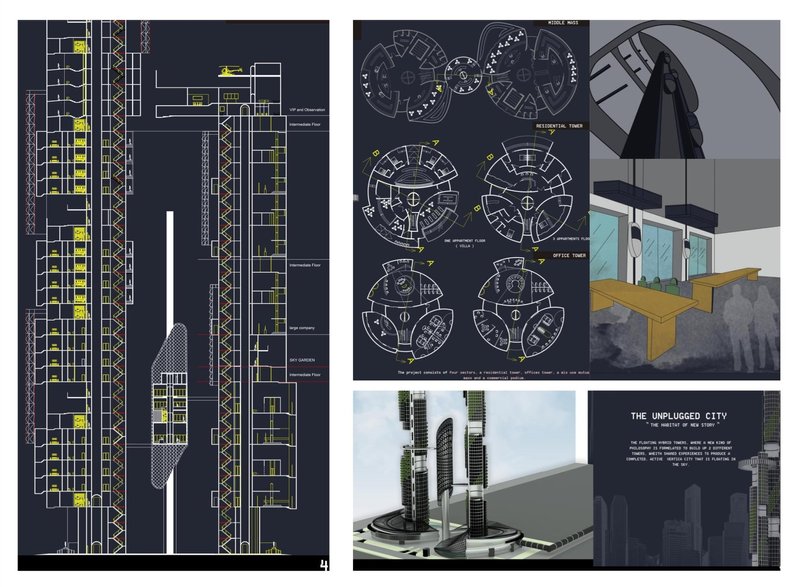
Description: The floating hybrid towers, where a new kind of philosophy is formulated to build up to two different kinds of towers with shared experiences to produce a complete active vertical city that is floating in the sky. The self-generating energy moving middle mass, that connects between the two towers and is used for horizontal transportation makes the design futuristic.
Our new media partners:

Discover the full results here: https://uni.xyz/competitions/hybrid-futures-2019-work-x-fly/entries
Discover the design brief here: https://uni.xyz/competitions/hybrid-futures-2019-work-x-fly/info/about
Follow us on social media: Facebook | Instagram | LinkedIn | Twitter | Youtube
Discover other design competitions to participate here: https://uni.xyz/competitions


Popular Articles
Popular articles from the community

Atelier Macri Concept Store Interior Design by CASE-REAL
Atelier Macri store features a "ko" counter, walnut wood details, cork displays, blending retail, gallery, and seamless customer experiences.

The Ken Roberts Memorial Delineation Competition (Krob)
As the most senior architectural drawing competition currently in operation anywhere in the world, it draws hundreds of entries each year, awarding the very best submissions in a series of medium-based categories.
A Contemporary Take on Iranian Residential Architecture
A modern interior design in Mashhad that reinterprets brick, light, and spatial flow to create a warm, contemporary residential architecture.
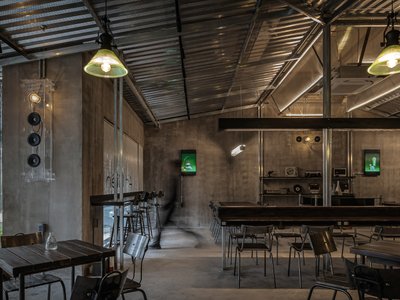
An Miên Lumière Cafe by xưởng xép, Ho Chi Minh City, Vietnam
An industrial-inspired café where layered steel and warm light create a dynamic, immersive environment shaped by reflection, depth, and perception.

Similar Reads
You might also enjoy these articles
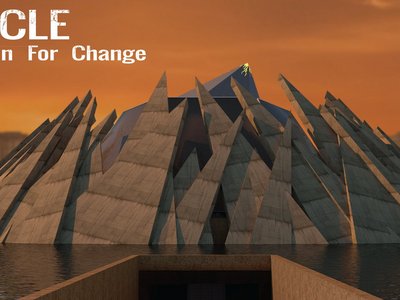
ORACLE: A Sustainable Memorial Architecture Responding to Climate Urgency
A sustainable memorial architecture in Cairo that transforms climate urgency into spatial experience, urging collective reflection and action
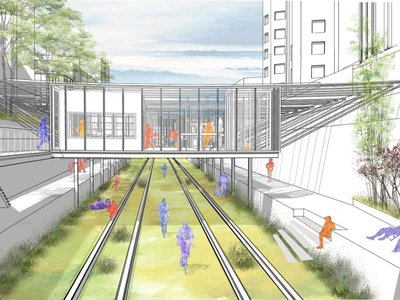
Suspended: Reimagining Paris Through Adaptive Reuse Architecture
A suspended intervention transforms abandoned Paris railways into inclusive, adaptive reuse architecture bridging heritage, mobility, and public life.
Solar Steam: A Climate-Responsive Architecture That Redefines the Monument
A climate-responsive memorial architecture that transforms heat, decay, and time into a living system reflecting humanity’s ecological impact.
Rolly: A Modular Approach to Urban Regeneration Architecture on Paris’ Petite Ceinture
A modular urban regeneration architecture project transforming Paris’ abandoned railway into a dynamic, movable and community-driven public space






Comments (0)
Please login or sign up to add comments
No comments yet. Be the first to comment!